综述

中国边缘海沉积物有机碳分布及其储碳潜力研究进展

  • 徐维海 , 1, 2 ,
  • 钟秋燕 1, 3 ,
  • 颜文 , 1, 3 ,
  • 黎刚 1
展开
  • 1.热带海洋环境与岛礁生态全国重点实验室, 中国科学院南海海洋研究所, 广东 广州 510301
  • 2.三亚海洋生态环境工程研究院, 海南 三亚572000
  • 3.中国科学院大学, 北京 100049
徐维海。 email: ;
颜文。email:

徐维海(1978—), 江苏省连云港市人, 研究员, 主要从事海洋沉积和珊瑚礁碳酸盐岩研究。email:

Copy editor: 殷波

收稿日期: 2024-11-27

  修回日期: 2025-02-17

  网络出版日期: 2025-03-04

基金资助

海南省自然科学基金创新研究团队项目(422CXTD533)

国家自然科学基金项目(42376079)

Research advances on organic carbon distribution and storage potential of sediments in the Chinese marginal seas

  • XU Weihai , 1, 2 ,
  • ZHONG Qiuyan 1, 3 ,
  • YAN Wen , 1, 3 ,
  • LI Gang 1
Expand
  • 1. State Key Laboratory of Tropical Oceanography, South China Sea Institute of Oceanography, Chinese Academy of Sciences, Guangzhou 510301, China
  • 2. Sanya Institute of Marine Ecological and Environmental Engineering, Sanya 572000, China
  • 3. University of Chinese Academy of Sciences, Beijing 100049, China
XU Weihai. email: ;
YAN Wen. email:

Received date: 2024-11-27

  Revised date: 2025-02-17

  Online published: 2025-03-04

Supported by

Hainan Provincial Natural Science Foundation of China(422CXTD533)

National Natural Science Foundation of China(42376079)

摘要

碳元素在海洋中以多种形式参与全球碳循环, 其中海洋沉积物埋藏的有机碳(total organic carbon, TOC)在全球碳循环中起到至关重要的作用。边缘海作为全球海洋物理能量和生产力较高的过渡区, 储存了全球海洋80%以上的有机碳。中国边缘海总面积约470×104km2, 具有显著的储碳能力和前景, 随着我国“双碳”目标的实施, 海洋储碳相关研究成为近年来的研究热点。文章综述了中国边缘海沉积物有机碳分布特征, 整体上呈现出从渤海向南海逐渐增加的趋势, 且沿岸海域和河流入海口周围含量显著高于远海。同时分析了有机碳主要来源和影响因素及其储碳潜力, 并对未来可能的重点研究方向进行了展望, 旨在为国内边缘海储碳和碳循环方面的相关工作提供一定的借鉴。

本文引用格式

徐维海 , 钟秋燕 , 颜文 , 黎刚 . 中国边缘海沉积物有机碳分布及其储碳潜力研究进展[J]. 热带海洋学报, 2025 , 44(5) : 1 -11 . DOI: 10.11978/2024223

Abstract

Carbon participates in the global carbon cycle in various forms in the ocean, with total organic carbon (TOC) buried in marine sediments playing a crucial role. As a transition zone characterized by high physical energy and productivity, marginal seas store more than 80% of the organic carbon in the global ocean. Covering a total area of about 4.7 million square kilometers, China’s marginal seas possess significant carbon storage capacity and potential. With the implementation of China’s “Dual Carbon” initiative, research on marine carbon storage has become a prominent topic in recent years. This review summarizes the distribution characteristics of organic carbon in the sediments of China’s marginal seas, revealing a decreasing tendency from the Bohai Sea to the South China Sea. Notably, organic carbon content in coastal waters and near estuaries is significantly higher than in the deep sea. In addition, the main sources, influencing factors, and storage potential of organic carbon are analyzed. Moreover, the review provides an outlook on potential future research directions, aiming to offer insights for the related work on marine carbon storage and the carbon cycle in China’s marginal seas.

边缘海是位于沿海和公海之间的大型浅水体(Massicotte et al, 2017), 是物理能量和生物生产力较高的过渡区, 可运输、转化和储存大量溶解物和悬浮物, 也是各种动力过程综合影响的区域(张兰生, 2000; 朱纯 等, 2005b)。边缘海沉积物储碳的主要方式是通过河流携带源自陆地的含碳颗粒, 将它们连同泥沙一起, 堆积埋藏在海底, 并阻止其进一步分解成CO2而起到固碳的作用。因此, 具有高生产力、高陆源输入和高沉积速率的特点(Kowalewska et al, 2004)。在波浪和洋流等物理作用下, 部分物质跨陆架输运被输送到外海甚至大洋海域直至沉降(Mei et al, 2019)。除了河流, 人类活动对近海海域的影响也极其显著, 全球约40%的人口居住在距海岸带约100km范围内, 生产活动产生的营养盐和有机质通过直接排放或河流输入沉积于此。因而, 边缘海域在全球碳循环中的作用至关重要(Song, 2011; 宋金明 等, 2019; 张明宇 等, 2021)。尽管大陆架只占全球洋底面积约10%, 但全球80%以上的碳都埋藏在浅海系统中(Gago et al, 2003; Hung et al, 2003; Ogawa et al, 2003; Tesi et al, 2007; Bao et al, 2016)。我国拥有1.8×10⁴km大陆海岸线, 2.0×10⁶km2大陆架, 近海总面积达4.7×10⁶km2, 包括渤海、黄海、东海和南海, 具有发展蓝碳的优越自然条件和巨大的储碳潜力, 是我国实现 “双碳”目标的重要途径。
国内外学者对于海洋碳循环过程等方面已开展多年的深入研究工作(Blair et al, 2012)。自20世纪80年代, 为了应对全球变化如全球变暖等带来的巨大挑战和压力(李晟, 2021), 科学界发起了多个以地球系统碳循环为研究重点的大型科学研究计划, 包括世界气候研究计划和国际地圈生物圈计划等(刘冬梅, 2010), 主要目标是为了解决世界碳源-汇空间分布格局、碳通量与变化趋势等诸多科学问题(高学鲁, 2005; 江春波, 2006)。海洋中的碳以无机碳(inorganic carbon, IC)和有机碳(total organic carbon, TOC)的形式存在, 并以多种形式在海洋环境中不断循环(张咏华 等, 2019)。其中有机碳与人类和海洋生命活动密切相关, 是海洋沉积物中描述碳埋藏和循环的重要指标(Hedges et al, 1995)。因此, 确定沉积物中有机碳含量是定量了解海洋碳循环的关键基础, 是调节现在与未来气候变化的重要指标(Galy et al, 2008), 同时也是目前科学界研究的关键领域(Bauer et al, 2013; Galy et al, 2015)。本文从中国边缘海沉积物中有机碳分布、来源和影响因素等方面入手, 综述海洋沉积储碳的研究现状, 并对未来可能的重点研究方向进行了展望, 以期能够为我国海洋储碳和碳循环方面的相关工作提供一定的借鉴。

1 研究区域与方法

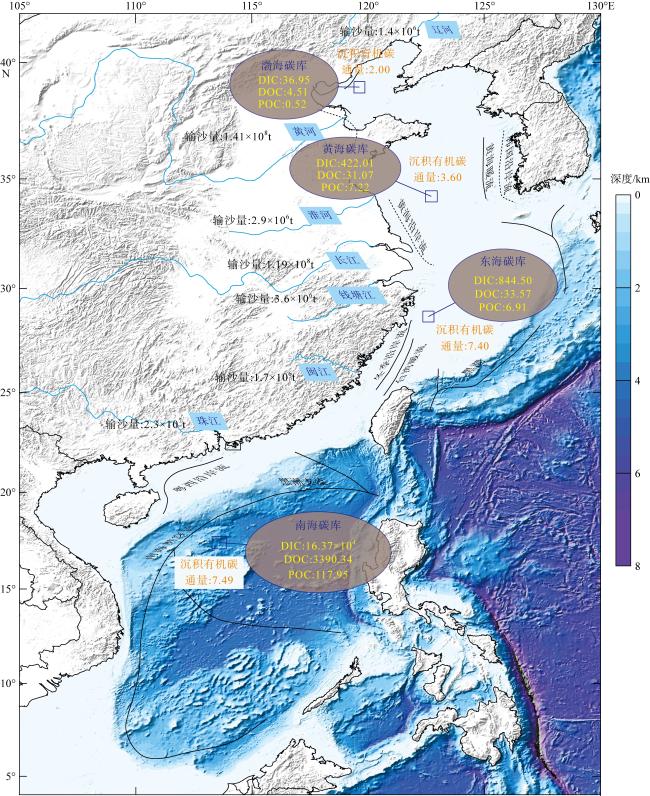
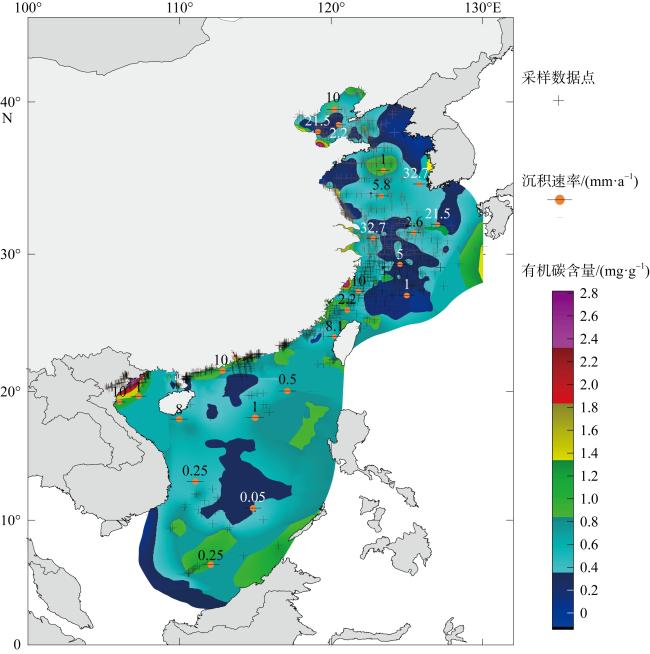
中国边缘海系统是世界上最宽广的陆架边缘海之一(刘雪, 2014), 直接受到长江、黄河、珠江等大河输入的巨量颗粒物质影响(Milliman et al, 1983)(图1)。本文收集了目前已发表的近800个中国边缘海沉积物中有机碳数据, 并利用Surfer和CorelDraw等软件绘制成图表进行展示。文中所收集的有机碳含量数据大多采用元素分析仪(elemental analyzer, EA)分析获得(Gazulla et al, 2012; Wu et al, 2023), 文献中沉积通量数据大多是采用沉积物捕获器取样测定, 或者采用结合元素含量与沉积物埋藏速率计算得出。
图1 中国主要入海河流输沙量和边缘海碳通量[(据焦念志等(2018)、王博士等(2005)、王尧(2023)修订]

该图基于自然资源部标准地图服务网站下载的审图号为GS(2023)2765的标准地图制作, 底图无修改。图中DIC (dissolved inorganic carbon)为溶解无机碳(单位: Tg·a−1)、PIC (particulate inorganic carbon)为颗粒无机碳(单位: Tg·a−1)、POC (particulate organic carbon)为颗粒有机碳(单位: Tg·a−1)、DOC (dissolved organic carbon)为溶解有机碳(单位: Tg·a−1), 图中沉积有机碳通量的单位为Tg·a−1

Fig. 1 Sediment discharge and carbon fluxes in marginal seas from major Chinese rivers

2 边缘海沉积物中有机碳分布

中国边缘海从北向南涵括了渤海、黄海、东海和南海(图1), 总面积约占世界陆架边缘海的12%。区域上涵盖了温带、亚热带和热带, 内有黄河、长江和珠江等大河的输入, 外与“黑潮”交换, 受季风环流的影响物质交换频繁且复杂, 是国际重点关注的边缘海区域之一(戴民汉 等, 2004)。图2为根据已收集的数据点绘制成直观的中国边缘海有机碳分布图。渤海、黄海、东海、南海沉积物中有机碳含量分布区间分别为0.12%~1.13%、0.4%~1.8%、0.5%~3.5%、0.3%~3.3%, 具有明显的地域特征, 整体上呈现出从渤海向南海逐渐增加的趋势, 且沿岸海域和河流入海口周围含量也显著高于远海。
图2 中国边缘海表层沉积物有机碳含量分布和沉积速率图

该图基于自然资源部标准地图服务网站下载的审图号为GS(2023)2765的标准地图制作, 底图无修改。收集站位数据主要来源于参考文献(吴时国 等, 1995; 郭志刚 等, 1999; Duan, 2000; Kao et al, 2003; 王中波 等, 2004; 王博士 等, 2005; Hu et al, 2006; Szarek et al, 2009; 熊林芳, 2010; 陈彬 等, 2011; Xing et al, 2011; 孙书文, 2012; Hu et al, 2013; 文梅, 2013; Bao et al, 2016; 李文宝 等, 2017; Tue et al, 2018; Wan et al, 2019; Dan et al, 2020; Zhu et al, 2020; Chen et al, 2021; Miao et al, 2021; Pang et al, 2022; 陈芬 等, 2023; Dan et al, 2023; Lin et al, 2023; Duraimaran et al, 2024)。沉积速率来源于参考文献(石学法 等, 2024)

Fig. 2 Distribution of total organic carbon content and deposition rates in surface sediments of China’s marginal seas

2.1 渤海

图2显示渤海表层沉积物中有机碳含量在0.12%~1.13%之间, 均值0.40%, 分布特征呈现出近岸高、离岸低的特点(文梅, 2013)。渤海是中国唯一的内海, 也是面积最小的中国边缘海, 接收了来自黄河和辽河等河流的巨量陆源物质输入(侯贵廷 等, 2000; 刘炳辰, 2013; 梅西 等, 2020), 并在海峡沿岸沉积(Tao et al, 2015)。因此, 渤海沉积物有机碳分布受河流输入的影响非常显著。黄河平均每年输入渤海的泥沙量达141×106t, 辽河平均每年输入渤海的泥沙量达1.4×10⁶t (中华人民共和国水利部, 2020)(图1)。由于在细粒沉积物中有机质更易于保存(蔡进功 等, 2007), 故渤海湾泥质区相较于附近砂质海域拥有更高的有机碳。随着离岸距离增加, 有机碳出现的小幅增加趋势可能是由于吸附更多有机质的细粒悬浮颗粒被运移到离岸较远的区域。渤海有机碳含量与南黄海及东海比较接近(赵海萍, 2019)。渤海沉积速率高值区主要分布在渤海湾海河以南至黄河口沿岸、莱州湾、辽东湾顶部及西南部, 其中海河、黄河和辽河河口及其周边区域为沉积速率极高值区。现代黄河入海口有机碳的年均埋藏速率大于500g·m−2, 渤海年均有机碳埋藏速率大约为15.3g·m−2, 年均有机碳埋藏通量为2.00Tg·a-1 (Hu et al, 2016; 赵美训 等, 2017)。

2.2 黄海

黄海表层沉积物中有机碳含量在0.4%~1.8%之间, 均值0.46% (图2), 高值主要分布在黄海中部、北黄海朝鲜半岛西南端; 苏北老黄河口岸外的泥质区出现次高值, 呈现出中部高、四周较低的大致规律。黄海的有机碳分布主要受泥质区分布与洋流的影响。自渤海湾海河以南至黄河口沿岸、莱州湾、辽东湾顶部及西南部, 其中海河、黄河和辽河河口及其周边区域为苏北老黄河口外, 其中南黄海中部是黄海面积最大的泥质区, 有利于细颗粒物的快速沉积和埋藏(石学法, 2014; 韩逸臻, 2022)。因此, 有机碳沿泥质区分布呈现出显著的空间变化。同时, 位于黄海-渤海分界线上的一部分细颗粒物会再悬浮, 在黄海冷水团、黄海暖流和沿岸流的作用下, 通过渤海海峡进一步迁移到黄海中部和西部, 带来有机质供给(熊林芳, 2010)。汇入黄海的大河主要有淮河, 其输沙量约为2.9×10⁶t (中华人民共和国水利部, 2020)(图1), 为苏北老黄河口外泥质区带来持续的有机质补充。黄海海域沉积速率约为3.2mm·a-1, 靠近朝鲜半岛的东南泥质区由于锦江的汇入出现了沉积速率高值, 山东半岛北侧沿岸、黄海中部泥质区西侧、黄海东南部泥质区、长江口以北出现次高值区, 分布大致呈离岸越远沉积越慢。其中黄海有机碳埋藏速率高值区主要分布在北黄海中部、山东半岛北侧等靠近黄河物源供给的地区(石学法 等, 2024)。据估算黄海的固碳通量为70.89~91.45Tg·a−1, 而近100a黄海中部年均总碳埋藏量约1.18Tg, 有机碳年均埋藏通量约为1.02Tg (Wang et al, 2018a)。

2.3 东海

东海表层沉积物中有机碳含量在0.5%~3.5%之间, 均值0.45% (图2), 高值区主要集中在长江入海口、闽江沿岸、台湾岛东北及西南侧、冲绳海槽中北部, 总体呈现中间低, 东西高的趋势。东海储存有机碳能力主要受河流输入、气候、环流与泥质区分布影响(郭志刚 等, 2001; 杨作升 等, 2002; 朱纯 等, 2005a;
周晓静 等, 2010; 李安春 等, 2020)。汇入东海的大河主要有长江、闽江和钱塘江(刘焱光, 2005), 其中长江的径流量和输沙量最大(范德江 等, 2001; 陆孝平 等, 2010), 每年输沙量达1.19×10⁸t; 钱塘江年均输沙量
约为3.6×10⁶t; 闽江年均输沙量约1.7×10⁶t (中华人民共和国水利部, 2020)(图1)。长江入海碳通量与降水量密切相关, 主要受控于西太平洋暖池及其上空的对流活动: 当暖池增强时, 夏季降水减少; 反之降水增多(黄荣辉 等, 1994)。与此同时, 由于东海还受多种环流影响, 如台湾暖流和黑潮共同作用将沉积颗粒向北运输至台湾岛东北侧沉积(图1), 黑潮支流与冬季沿岸流将沉积颗粒带至台湾岛西南侧, 导致台湾岛的东北与西南同时出现了有机碳沉积高值。东海陆架分布着两大泥质区, 分别为远岸济州岛西南泥质区和近岸浅海泥质区(孙晓燕 等, 2012)。由于受到台湾暖流的阻隔, 长江输入的沉积颗粒主要集中沉降在近岸浅海泥质区(郭志刚, 2003)。东海平均沉积速率为(8.1±11.1)mm·a-1, 高值区大致分布在长江入海口、闽浙沿岸(石学法 等, 2024)。陆架浅海水和黑潮汇合的锋面以及台湾暖流和冬季沿岸流间的富营养区都形成了固碳速率的高值区(张玉荣 等, 2016), 其初级生产力达2010mg·m-2·d-1 (焦念志 等, 1998)。台湾暖流和沿岸流共同驱动了近岸沉积颗粒运输, 加之东海拥有较长的陆架边界, 从而造成东海拥有较高沉积通量(焦念志 等, 2018)。碳沉积通量达到7.40Tg·a−1 (刘世东 等, 2018)。闽浙沉积区近百年来总碳埋藏量约1.45Pg, 有机碳埋藏通量年均为6.36Tg (郭志刚 等, 1999; 孙效功 等, 2000; Wang et al, 2018b)。

2.4 南海

南海表层沉积物中有机碳含量在0.3%~3.3%之间, 均值0.52% (图2), 分布特征总体上呈现离岸越远, 有机碳越低, 在越南北部莺歌海盆西侧、珠江沿岸以及马来西亚沿岸出现了有机碳高值区。南海表层沉积物均值高于渤海、黄海、东海沉积物, 究其原因是采样点分布不均匀(图2), 由于南海面积过大, 多数对于南海的研究只能选取较为有特点的区域, 使得大多数采样数据点都具有较高的有机碳含量, 造成了均值高于渤海、黄海、东海沉积物的现象。南海是亚洲大陆沿岸最大的边缘海之一(Ge et al, 2019)。从图2可以看出低有机碳区主要分布在越南东部沿海, 高值出现在马来西亚沿岸, 这可能受到了南海贯穿流的调控(丁奕凡 等, 2022)。流入南海的大河有珠江、红河、湄公河等(谈谈, 2014)。根据南海55条河流碳输入数据, 模拟得到的南海周边河流的物质输入量远超世界上其他河流, 每年约为南海带来5.00×10⁸t沉积颗粒(Sheng et al, 2024)。珠江的年均输沙量约为2.3×10⁷t (中华人民共和国水利部, 2020), 是南海北部沉积物主要来源(He et al, 2024); 红河输沙量为9.2×10⁶t, 为莺歌海盆西侧海域带来大量有机质输入(Roberts et al, 2022)。南海不同区域的沉积速率差距很大: 大陆架泥质区>3mm·a-1, 西部、北部、南部大陆坡>0.25mm·a-1, 东岛斜坡> 0.03~0.08mm·a-1, 深水区域<0.03mm·a-1 (Sheng et al, 2024)。南海北部陆架有机碳年平均埋藏速率达到了14.10g·m−2, 年均埋藏通量超过4.80Tg (焦念志 等, 2018)。在区域对比上, 其沉积速率要远远高于南海中央海盆海域, 其主要原因是直接受到了珠江冲淡水的影响。研究表明, 南海具有较强的深海化能自养固碳能力, 最高可达大西洋的数百倍。南海固碳速率受季节、河流、生物等因素影响, 通常在冬季出现较高的固碳速率, 是因为冬季风致使水体垂向混合作用加强, 深层营养盐向表层补充促进了表层浮游植物的活动。据估算, 固碳速率平均值达到155.73g·m−2·a−1 (Chen, 2005)。

3 边缘海储碳潜力

总体上, 中国的边缘海沉积物呈现出较高的储碳潜力。对比已有研究报道, 中国海域沉积物中的有机碳和无机碳含量均较高(戴民汉 等, 2004; 刘茜 等, 2018; 焦念志 等, 2018)。如图1表1所示, 中国边缘海碳库总量约为167768.2Tg, 总溶解无机碳(dissolved inorganic carbon, DIC)为164176.1Tg, 总溶解有机碳 (dissolved organic carbon, DOC)为3459.5Tg, 总颗粒有机碳 (particulate organic carbon, POC)为132.6Tg, 其中渤海、黄海、东海、南海分别为0.52、7.22、6.91、117.95Tg, 固碳潜力分别达到8.66、78.09、222.99、545.06Tg·a−1 (焦念志 等, 2018)。通过对图2中收集的不同海域沉积钻孔数据进行分析, 可以计算出1~3m沉积物中储存的总碳储量: 东海有机碳约为11.96Tg, 无机碳约为28.06Tg; 南海有机碳约为23.39Tg, 无机碳约为37.46Tg。
表1 中国各边缘海有机碳、碳库与潜力比较

Tab. 1 Comparison of organic carbon stocks and sequestration potential among China’s marginal seas

海域 沉积物有机
碳含量/%
海域DIC
碳库/Tg
海域DOC
碳库/Tg
海域POC
碳库/Tg
整个海域固
碳潜力/(Tg·a−1)
参考文献
渤海 0.12~1.13 36.95 4.51 0.52 8.66 陈彬等(2011); 刘军等(2015); Wang等(2018a)
黄海 0.4~1.8 422.01 31.07 7.22 78.09 高学鲁等(2009); 商荣宁(2011)
东海 0.5~3.5 844.50 33.57 6.91 222.99 李宁等(2011); Chou等(2013)
南海 0.3~3.3 162872.64 3390.34 117.95 545.06 Dai等(2013); Huang等(2017)
中国边缘海 164176.10 3459.49 132.60 854.76 焦念志等(2018)

注: DIC为溶解无机碳, POC为颗粒有机碳, DOC为溶解有机碳

表1可以看出, 由于海域面积、来源和沉积环境等差异, 不同边缘海储碳潜力呈现出较大的差异。由于影响沉积物中有机碳埋藏的因素有很多, 每个海域因所处区域的差异导致有机碳分布各有不同。我国东部海域有大量河流汇入, 故渤海、黄海、东海、南海有机碳沉积都不同程度上受河流输入颗粒的影响; 黄海、东海、南海受黑潮支流、各类沿岸流和季节性变化的洋流影响导致有机碳在某些区域出现明显的聚集, 而渤海是我国的内海, 受洋流影响较小; 泥质、细粒和粗粒等颗粒的大小差异也是影响有机碳分布的重要因素, 其中泥质区更易吸附保存有机碳, 正如南黄海中部泥质区出现有机碳高值。除此之外, 沉积物储碳潜力还与储碳机制密切相关。沉积物储碳涉及了生物、物理和化学等一系列复杂的过程, 以及海陆交换、动植物和微生物的相互作用。因此, 不同海域沉积物储碳机制差异显著。然而, 目前国内外的研究热点主要聚焦于海洋系统的储碳机制, 如提出的海洋碳酸盐泵、溶解泵和生物泵(Gehlen et al, 2006)。近二十年来, 我国海洋学家在海洋系统储碳机制研究方面取得了长足进展, 如在理论上提出了“微型生物碳泵”储碳机制, 揭示了海洋巨大惰性溶解有机碳的成因(Jiao et al, 2010)。而关于沉积物储碳机制, 总体上目前尚缺乏系统的研究。边缘海沉积物储碳机制复杂且不同海域呈现显著的空间变化, 沉积速率、沉积物的粒径或表面积、氧化还原环境等也直接影响碳埋藏过程(Hedges et al, 1995; Gordon et al, 2004; Burdige, 2005)。因此评估中国边缘海沉积物储碳潜力需要从多个角度进行综合分析(高学鲁 等, 2009; 熊林芳, 2010)。

4 研究展望

尽管国内外学者对中国边缘海沉积物有机碳分布、来源和影响因素已进行系统调查和分析, 积累了大量的实测数据, 并利用遥感、钻探等手段对中国边缘海的碳埋藏潜力和通量进行了初步的评估, 且对不同海域碳库进行了初步估算和较为系统的分析汇总。但是由于边缘海碳通量、储碳机制及其调控过程受陆源排放、人类活动和洋流运动影响较大, 使得陆架边缘海的碳源-汇问题研究变得复杂(Tsunogai et al, 1999; 刘茜 等, 2018), 目前所得的研究成果和认识还远远不够, 依旧缺乏全面的钻孔数据支撑; 同时, 对碳的理论计算值和观测值依旧平衡不了全球碳循环(朱纯 等, 2005b); 沉积物储碳机制及其控制因素也亟待更深入的研究。针对以上问题, 在未来的研究中, 综合前人的观点, 建议在以下几个方面加强:借助近年来机器学习和人工智能的高速发展, 进一步加强大科学平台与监测网络的建设, 采取智能化管理和深度机器学习采集的数据, 增强碳循环研究的数据质量和模型精度, 并建立智能化、自动化海洋碳循环监测系统; 加强海洋储碳机制方面的深入研究, 如海洋溶解有机碳在碳循环和储碳机制方面的关键作用, 之前对其关注和相关研究深度明显不足; 进一步加强国际和不同研究方向间(如生物、生态和地质等)的交流与数据共享, 促进多学科交叉研究, 从不同尺度和维度、不同视角厘清边缘海沉积物储碳机制和潜力。总的来说, 中国边缘海储碳潜力巨大, 但需要更多的科学研究和政策支持来加强对碳埋藏的深入研究。
[1]
蔡进功, 包于进, 杨守业, 等, 2007. 泥质沉积物和泥岩中有机质的赋存形式与富集机制[J]. 中国科学(D辑: 地球科学), 37(2): 234-243.

CAI JINGONG, BAO YUJIN, YANG SHOUYE, et al, 2007. Occurrence form and enrichment mechanism of organic matter in argillaceous sediments and mudstone[J]. Science in China (Series D: Earth Sciences), 37(2): 234-243 (in Chinese).

[2]
陈彬, 胡利民, 邓声贵, 等, 2011. 渤海湾表层沉积物中有机碳的分布与物源贡献估算[J]. 海洋地质与第四纪地质, 31(5): 37-42.

CHEN BIN, HU LIMIN, DANG SHENGGUI, et al, 2011. organic carbon in surface sediments of the Bohai Bay, China and its contribution to sedimentation[J]. Marine Geology and Quaternary Geology, 31(5): 37-42 (in Chinese with English abstract).

[3]
陈芬, 黎刚, 朱小畏, 等, 2023. 南海南沙海区沉积有机质分布特征及其指示意义[J]. 海洋地质与第四纪地质, 43(2): 45-54.

CHEN FEN, LI GANG, ZHU XIAOWEI, et al, 2023. Spatial distribution of organic matter in surface sediments from the Nansha sea area of the South China Sea and its implications for marine productivity and monsoon[J]. Marine Geology & Quaternary Geology, 43(2): 45-54 (in Chinese with English abstract).

[4]
戴民汉, 翟惟东, 鲁中明, 等, 2004. 中国区域碳循环研究进展与展望[J]. 地球科学进展, 19(1): 120-130.

DAI MINHAN, ZHAI WEIDONG, LU ZHONGMING, et al, 2004. Regional studies of carbon cycles in China: progress and perspectives[J]. Advance in Earth Sciences, 19(1): 120-130 (in Chinese with English abstract).

[5]
丁奕凡, 田军, 2022. 晚中新世以来印度尼西亚海道及印度尼西亚贯穿流的协同演化及其气候效应研究进展[J]. 地球科学进展, 37(11): 1165-1180.

DOI

DING YIFAN, TIAN JUN, 2022. Research progress on the synergistic evolution of the Indonesian seaway and Indonesian Through Flow and its climate effects since the Late Miocene[J]. Advances in Earth Sciences, 37(11): 1165-1180 (in Chinese with English abstract).

[6]
范德江, 杨作升, 毛登, 等, 2001. 长江与黄河沉积物中粘土矿物及地化成分的组成[J]. 海洋地质与第四纪地质, 21(4): 7-12.

FAN DEJIANG, YANG ZUOSHENG, MAO DENG, et al, 2001. Clay minerals and geochemistry of the sediments from the Yangtze and Yellow Rivers[J]. Marine Geology & Quaternary Geology, 21(4): 7-12 (in Chinese with English abstract).

[7]
高学鲁, 2005. 中国近海典型海域溶解无机碳系统的生物地球化学特征[D]. 青岛: 中国科学院研究生院(海洋研究所).

GAO XUELU, 2005. Biogeochemical characteristics of dissolved inorganic carbon system in the typical coastal waters of China[D]. Qingdao: Institute of Oceanology, Chinese Academy of Sciences (in Chinese with English abstract).

[8]
高学鲁, 宋金明, 李学刚, 等, 2009. 南黄海秋季溶解无机碳的分布特征[J]. 海洋环境科学, 28(1): 17-21.

GAO XUELU, SONG JINMING, LI XUEGANG, et al, 2009. Distribution characteristics of dissolved inorganic carbon in southern Yellow Sea in autumn[J]. Marine Environmental Science, 28(1): 17-21 (in Chinese with English abstract).

[9]
郭志刚, 2003. 长江口泥质区的季节性沉积效应[J]. 中国地理科学文摘, 17(4): 9.

GUO ZHIGANG, 2003. Seasonal sedimentary effect on the Changjiang estuary mud area[J]. Chinese Geographical and Resources Abstracts, 17(4): 9 (in Chinese with English abstract).

[10]
郭志刚, 杨作升, 陈致林, 等, 2001. 东海陆架泥质区沉积有机质的物源分析[J]. 地球化学, 30(5): 416-424.

GUO ZHIGANG, YANG ZUOSHENG, CHEN ZHILIN, et al, 2001. Source of sedimentary organic matter in the mud areas of the East China Sea shelf[J]. Geochimica, 30(5): 416-424 (in Chinese with English abstract).

[11]
郭志刚, 杨作升, 曲艳慧, 等, 1999. 东海中陆架泥质区及其周边表层沉积物碳的分布与固碳能力的研究[J]. 海洋与湖沼, 30(4): 421-426.

GUO ZHIGANG, YANG ZUOSHENG, QU YANHUI, et al, 1999. Distribution pattern of carbon storage in the surficial sediments in the middle continental shelf mud area and its adjoining East China Sea areas[J]. Oceanologia et Limnologia Sinica, 30(4): 421-426 (in Chinese with English abstract).

[12]
韩逸臻, 2022. 中国东部陆架海黑碳沉积记录及其对传统持久性有机污染物的迁移特性表征[D]. 上海: 上海海洋大学.

HAN YIZHEN, 2022. Sedimentary records of black carbon and persistent organic pollutants in three sediment cores from Eastern China marginal seas: terrestrial source versus transport process[D]. Shanghai: Shanghai Ocean University (in Chinese with English abstract).

[13]
侯贵廷, 钱祥麟, 蔡东升, 2000. 渤海中、新生代盆地构造活动与沉积作用的时空关系[J]. 石油与天然气地质, 21(3): 201-206.

HOU GUITING, QIAN XIANGLIN, CAI DONGSHENG, 2000. Space time relationship between tectonics and sedimentation of meso Cenozoic Bohai basin[J]. Oil & Gas Geology, 21(3): 201-206 (in Chinese with English abstract).

[14]
黄荣辉, 孙凤英, 1994. 热带西太平洋暖池的热状态及其上空的对流活动对东亚夏季气候异常的影响[J]. 大气科学, 18(2): 141-151.

HUANG RONGHUI, SUN FENGYING, 1994. Impacts of the thermal state and the convective activities in the tropical western warm pool on the summer climate anomalies in east Asia[J]. Chinese Journal of Atmospheric Sciences, 18(2): 141-151 (in Chinese with English abstract).

[15]
江春波, 2006. 南黄海春季CO2海-气交换通量及其与夏季的比较[D]. 青岛: 中国海洋大学.

JIANG CHUNBO, 2006. The CO2 flux at sea-atmosphere interface in the south Yellow Sea in spring and comparing with it in summer[D]. Qingdao: Ocean University of China (in Chinese with English abstract).

[16]
焦念志, 梁彦韬, 张永雨, 等, 2018. 中国海及邻近区域碳库与通量综合分析[J]. 中国科学: 地球科学, 48(11): 1393-1421.

JIAO NIANZHI, LIANG YANTAO, ZHANG YONGYU, et al, 2018. Carbon pools and fluxes in the China Seas and adjacent oceans[J]. Scientia Sinica (Terrae), 48(11): 1393-1421 (in Chinese with English abstract).

[17]
焦念志, 王荣, 李超伦, 1998. 东海春季初级生产力与新生产力的研究[J]. 海洋与湖沼, 29(2): 135-140.

JIAO NIANZHI, WANG RONG, LI CHAOLUN, 1998. Primary production and new production in spring in the East China Sea[J]. Oceanologia et Limnologia Sinica, 29(2): 135-140 (in Chinese with English abstract).

[18]
李安春, 张凯棣, 2020. 东海内陆架泥质沉积体研究进展[J]. 海洋与湖沼, 51(4): 705-727.

LI ANCHUN, ZHANG KAIDI, 2020. Research progress of mud wedge in the inner continental shelf of the East China Sea[J]. Oceanologia et Limnologia Sinica, 51(4): 705-727 (in Chinese with English abstract).

[19]
李宁, 王江涛, 2011. 春季东海北部近岸水体中的溶解无机碳和有机碳的分布特征及其影响因素[J]. 海洋科学, 35(8): 5-10.

LI NING, WANG JIANGTAO, 2011. Dissolved inorganic and organic carbon in the North of East China Sea (ECS) coastal waters in spring[J]. Marine Sciences, 35(8): 5-10 (in Chinese with English abstract).

[20]
李晟, 2021. 洞庭湖地区绿地生态网络构建及效能评价研究[D]. 长沙: 中南林业科技大学.

LI SHENG, 2021. Study on the construction and efficiency of green space ecological network in Dongting Lake Region[D]. Changsha: Central South University of Forestry & Technology (in Chinese with English abstract).

[21]
李文宝, 王汝建, 万随, 2017. 沉积过程中有机碳及Globigerinoides ruber氧、碳同位素变化特征: 以南海南部为例[J]. 沉积学报, 35(4): 730-739.

LI WENBAO, WANG RUJIAN, WAN SUI, 2017. Changes of TOC and δ18O, δ13C from Globigerinoides ruber during the deposition process in the southern South China Sea[J]. Acta Sedimentologica Sinica, 35(4): 730-739 (in Chinese with English abstract).

[22]
刘炳辰, 2013. 渤海中南部碎屑矿物特征与沉积环境[D]. 烟台: 鲁东大学.

LIU BINGCHEN, 2013. Study on the characteristics of detrital minerals and depositional environment in the south central Bohai Sea[D]. Yantai: Ludong University (in Chinese with English abstract).

[23]
刘冬梅, 2010. 黄河干流有机碳及调水调沙时期碳输运规律[D]. 青岛: 中国海洋大学.

LIU DONGMEI, 2010. Organic carbon in the main stream of the Huanghe (Yellow) river and carbon transport in the sand and water regulation period in Lijin gauge station[D]. Qingdao: Ocean University of China (in Chinese with English abstract).

[24]
刘军, 于志刚, 臧家业, 等, 2015. 黄渤海有机碳的分布特征及收支评估研究[J]. 地球科学进展, 30(5): 564-578.

DOI

LIU JUN, YU ZHIGANG, ZANG JIAYE, et al, 2015. Distribution and budget of organic carbon in the Bohai and Yellow Seas[J]. Advances in Earth Science, 30(5): 564-578 (in Chinese with English abstract).

DOI

[25]
刘茜, 郭香会, 尹志强, 等, 2018. 中国邻近边缘海碳通量研究现状与展望[J]. 中国科学: 地球科学, 48(11): 1422-1443.

LIU QIAN, GUO XIANGHUI, YIN ZHIQIANG, et al, 2018. Carbon fluxes in the China Seas: an overview and perspective[J]. Scientia Sinica (Terrae), 48(11): 1422-1443 (in Chinese).

[26]
刘世东, 乔璐璐, 李广雪, 等, 2018. 东海内陆架悬浮体输运、通量及季节变化[J]. 海洋与湖沼, 49(1): 24-39.

LIU SHIDONG, QIAO LULU, LI GUANGXUE, et al, 2018. Transport and flux of suspended sediment and its seasonal variation over the inner shelf of the East China Sea[J]. Oceanologia et Limnologia Sinica, 49(1): 24-39 (in Chinese with English abstract).

[27]
刘雪, 2014. 基于遥感的中国东部海域悬浮泥沙季节变化研究[D]. 青岛: 中国海洋大学.

LIU XUE, 2014. Seasonal variation research of suspended sediments in the East China Sea based on remote sensing[D]. Qingdao: Ocean University of China (in Chinese with English abstract).

[28]
刘焱光, 2005. 近4万年来冲绳海槽物质来源的定量估计及其对气候变化的响应[D]. 青岛: 中国海洋大学.

LIU YANGUANG, 2005. Estimation of the provenance and flux of the sediments in the Okinawa trough using quantitative analysis since late 40 ka[D]. Qingdao: Ocean University of China (in Chinese with English abstract).

[29]
陆孝平, 富曾慈, 2010. 中国主要江河水系要览[M]. 北京: 中国水利水电出版社.

LU XIAOPING, FU ZENGCI, 2010. An overview of major river systems in China[M]. Beijing: China Water Resources and Hydropower Press (in Chinese).

[30]
梅西, 李学杰, 密蓓蓓, 等, 2020. 中国海域表层沉积物分布规律及沉积分异模式[J]. 中国地质, 47(5): 1447-1462.

MEI XI, LI XUEJIE, MI BEIBEI, et al, 2020. Distribution regularity and sedimentary differentiation patterns of China seas surface sediments[J]. Geology in China, 47(5): 1447-1462 (in Chinese with English abstract).

[31]
商荣宁, 2011. 2010年黄、渤海有机碳的分布特征及影响因素[D]. 青岛: 中国海洋大学.

SHANG RONGNING, 2011. The distribution and influence factors of organic carbon in the Bohai Sea and Yellow Sea of 2010[D]. Qingdao: Ocean University of China (in Chinese with English abstract).

[32]
石学法, 2014. 中国近海海洋—海洋底质[M]. 北京: 海洋出版社.

SHI XUEFA, 2014. China’s offshore oceans——marine substrate[M]. Beijing: China Ocean Press (in Chinese).

[33]
石学法, 吴斌, 乔淑卿, 等, 2024. 中国东部近海沉积有机碳的分布、埋藏及碳汇效应[J]. 中国科学: 地球科学, 54(10): 3113-3133.

SHI XUEFA, WU BIN, QIAO SHUQING, et al, 2024. Distribution, burial fluxes and carbon sink effect of sedimentary organic carbon in the Eastern China seas[J]. Scientia Sinica (Terrae), 54(10): 3113-3133 (in Chinese with English abstract).

[34]
宋金明, 王启栋, 张润, 等, 2019. 70年来中国化学海洋学研究的主要进展[J]. 海洋学报, 41(10): 65-80.

SONG JINMING, WANG QIDONG, ZHANG RUN, et al, 2019. Main progress on chemical oceanography in China over the past 70 years[J]. Haiyang Xuebao, 41(10): 65-80 (in Chinese with English abstract).

[35]
孙书文, 2012. 渤海及邻近海域表层沉积物中木质素的分布特征及其陆源有机质示踪意义[D]. 青岛: 中国海洋大学.

SUN SHUWEN, 2012. The distribution characteristics of lignin in surface sediments from the Bohai Sea and adjacent sea area and its significance in tracing terrestrial organic matter[D]. Qingdao: Ocean University of China (in Chinese with English abstract).

[36]
孙效功, 方明, 黄伟, 2000. 黄、东海陆架区悬浮体输运的时空变化规律[J]. 海洋与湖沼, 31(6): 581-587.

SUN XIAOGONG, FANG MING, HUANG WEI, 2000. Spatial and temporal variations in suspended particulate matter transport on the yellow and East China Sea shelf[J]. Oceanologia et Limnologia Sinica, 31(6): 581-587 (in Chinese with English abstract).

[37]
孙晓燕, 李希彬, 2012. 近3 ka来东海陆架北部泥质沉积物地球化学特征[J]. 海洋地质前沿, 28(4): 10-16.

SUN XIAOYAN, LI XIBIN, 2012. Geochemical characteristics of recent 3 ka mud from the northern part of East China Sea[J]. Marine Geology Frontiers, 28(4): 10-16 (in Chinese with English abstract).

[38]
谈谈, 2014. 熟读南海[J]. 石油知识, (5): 4-5, 11.

TAN TAN, 2014. Familiarize yourself with Nanhai[J]. Petroleum Knowledge, (5): 4-5, 11 (in Chinese).

[39]
王博士, 赵泉鸿, 翦知湣, 2005. 南海南部中上新世以来沉积有机碳与古生产力变化[J]. 海洋地质与第四纪地质, 25(2): 73-79.

WANG BOSHI, ZHAO QUANHONG, JIAN ZHIMIN, 2005. Changes of organic carbon and paleoproductivity in the southern South China Sea since middle Pliocene[J]. Marine Geology & Quaternary Geology, 25(2): 73-79 (in Chinese with English abstract).

[40]
王尧, 2023. 中国主要河流的生源要素输出通量及其在大河河口的来源和迁移转化[D]. 上海: 华东师范大学.

WANG YAO, 2023. The flux of biogenic elements exported from Chinese major rivers and their sources and transformation in large river estuaries[D]. Shanghai: East China Normal University (in Chinese with English abstract).

[41]
王中波, 杨守业, 李从先, 2004. 南黄海中部沉积物岩芯常量元素组成与古环境[J]. 地球化学, 33(5): 483-490.

WANG ZHONGBO, YANG SHOUYE, LI CONGXIAN, 2004. Major elemental compositions and paleoenvironmental changes of the core sediments in the southern Yellow Sea[J]. Geochimica, 33(5): 483-490 (in Chinese with English abstract).

[42]
文梅, 2013. 双台子河口颗粒有机碳的地球化学研究[D]. 青岛: 中国海洋大学.

WEN MEI, 2013. The geochemistry of particle organic carbon in Shuangtaizi Estuary[D]. Qingdao: Ocean University of China (in Chinese with English abstract).

[43]
吴时国, 涂霞, 罗又郎, 等, 1995. 南沙群岛海区有机碳沉积作用与古生产力估算[J]. 热带海洋, 14(4): 58-66.

WU SHIGUO, TU XIA, LUO YOULANG, et al, 1995. Organic carbon sedimentation and the estimation of paleoproductivity in Nansha islands waters[J]. Tropic Oceanology, 14(4): 58-66 (in Chinese with English abstract)

[44]
熊林芳, 2010. 南黄海—东海北部悬浮体与表层沉积物有机碳分布特征[D]. 青岛: 国家海洋局第一海洋研究所.

XIONG LINFANG, 2010. Characteristics of organic carbon distribution in suspended solids and surface sediments in the northern part of the South Yellow Sea and East China Sea[D]. Qingdao: First Institute of Oceanography, State Oceanic Administration (in Chinese with English abstract).

[45]
杨作升, 范德江, 郭志刚, 等, 2002. 东海陆架北部泥质区表层沉积物碳酸盐粒级分布与物源分析[J]. 沉积学报, 20(1): 1-6.

YANG ZUOSHENG, FAN DEJIANG, GUO ZHIGANG, et al, 2002. Distribution of the carbonate clast size and the provenance analyses of the surface sediments in the northern East China Sea[J]. Acta Sedimentologica Sinica, 20(1): 1-6 (in Chinese with English abstract).

[46]
张兰生, 2000. 全球变化[M]. 北京: 高等教育出版社.

ZHANG LANSHENG, 2000. Global Change[M]. Beijing: Higher Education Press (in Chinese with English abstract).

[47]
张明宇, 常鑫, 胡利民, 等, 2021. 东海内陆架有机碳的源-汇过程及其沉积记录[J]. 沉积学报, 39(3): 593-609.

ZHANG MINGYU, CHANG XIN, HU LIMIN, et al, 2021. Source-to-sink process of organic carbon on the inner shelf of the East China Sea and its sedimentary records[J]. Acta Sedimentologica Sinica, 39(3): 593-609 (in Chinese with English abstract).

[48]
张咏华, 吴自军, 2019. 陆架边缘海沉积物有机碳矿化及其对海洋碳循环的影响[J]. 地球科学进展, 34(2): 202-209.

DOI

ZHANG YONGHUA, WU ZIJUN, 2019. Sedimentary organic carbon mineralization and its contribution to the marine carbon cycle in the marginal seas[J]. Advances in Earth Science, 34(2): 202-209 (in Chinese with English abstract).

DOI

[49]
张玉荣, 丁跃平, 李铁军, 等, 2016. 东海区叶绿素a和初级生产力季节变化特征[J]. 海洋与湖沼, 47(1): 261-268.

ZHANG YURONG, DING YUEPING, LI TIEJUN, et al, 2016. Annual variations of chlorophyll a and primary productivity in the East China Sea[J]. Oceanologia et Limnologia Sinica, 47(1): 261-268 (in Chinese with English abstract).

[50]
赵海萍, 2019. 渤海湾有机碳时空特征及其循环过程生态水动力学模拟[D]. 天津: 天津大学.

ZHAO HAIPING, 2019. Spatio-temporal characteristics of organic carbon at Bohai Bay and its ecohydrodynamic simulation for cyclic process[D]. Tianjin:Tianjin University (in Chinese with English abstract).

[51]
赵美训, 丁杨, 于蒙, 2017. 中国边缘海沉积有机质来源及其碳汇意义[J]. 中国海洋大学学报(自然科学版), 47(9): 70-76.

ZHAO MEIXUN, DING YANG, YU MENG, 2017. Sources of sedimentary organic matter in China marginal sea surface sediments and implications of carbon sink[J]. Periodical of Ocean University of China, 47(9): 70-76 (in Chinese with English abstract).

[52]
中华人民共和国水利部, 2020. 中国河流泥沙公报-2019[M]. 北京: 中国水利水电出版社 (in Chinese).

[53]
周晓静, 李安春, 万世明, 等, 2010. 东海陆架表层沉积物粘土矿物组成分布特征及来源[J]. 海洋与湖沼, 41(5): 667-675.

ZHOU XIAOJING, LI ANCHUN, WAN SHIMING, et al, 2010. Clay minerals in surfacial sediments of the East China Sea shelf: distribution and provenance[J]. Oceanologia et Limnologia Sinica, 41(5): 667-675 (in Chinese with English abstract).

[54]
朱纯, 潘建明, 卢冰, 等, 2005a. 长江、老黄河口及东海陆架沉积有机质物源指标及有机碳的沉积环境[J]. 海洋学研究, 23(3): 36-46.

ZHU CHUN, PAN JIANMING, LU BING, et al, 2005a. Source indication and accumulative effect of sedimentary organic matter in the Changjiang Estuary, the old Huanghe River subaqueous delta and the East China Sea shelf[J]. Journal of Marine Sciences, 23(3): 36-46 (in Chinese with English abstract).

[55]
朱纯, 潘建明, 卢冰, 等, 2005b. 长江口及邻近海域现代沉积物中正构烷烃分子组合特征及其对有机碳运移分布的指示[J]. 海洋学报, 27(4): 59-67.

ZHU CHUN, PAN JIANMING, LU BING, et al, 2005b. Compositional feature of n-alkanes in modern sediment from the Changjiang Estuary and adjacent area and its implication to transport and distribution of organic carbon[J]. Acta Oceanologica Sinica, 27(4): 59-67 (in Chinese with English abstract).

[56]
BAO RUI, MCINTYRE C, ZHAO MEIXUN, et al, 2016. Widespread dispersal and aging of organic carbon in shallow marginal seas[J]. Geology, 44(10): 791-794.

[57]
BAUER J E, CAI WEIJUN, RAYMOND P A, et al, 2013. The changing carbon cycle of the coastal ocean[J]. Nature, 504(7478): 61-70.

[58]
BLAIR N E, ALLER R C, 2012. The fate of terrestrial organic carbon in the marine environment[J]. Annual Review of Marine Science, 4: 401-423.

PMID

[59]
BURDIGE D J, 2005. Burial of terrestrial organic matter in marine sediments: a re-assessment[J]. Global Biogeochemical Cycles, 19(4): GB4011.

[60]
CHEN Y L, 2005. Spatial and seasonal variations of nitrate-based new production and primary production in the South China Sea[J]. Deep Sea Research Part I: Oceanographic Research Papers, 52(2): 319-340.

[61]
CHEN YAN, HU CHUN, YANG GUIPENG, et al, 2021. Source, distribution and degradation of sedimentary organic matter in the South Yellow Sea and East China Sea[J]. Estuarine, Coastal and Shelf Science, 255: 107372.

[62]
CHOU W C, GONG G C, HUNG C C, et al, 2013. Carbonate mineral saturation states in the East China Sea: present conditions and future scenarios[J]. Biogeosciences, 10(10): 6453-6467.

[63]
DAI MINHAN, CAO ZHIMIAN, GUO XIANGHUI, et al, 2013. Why are some marginal seas sources of atmospheric CO2?[J]. Geophysical Research Letters, 40(10): 2154-2158.

[64]
DAN S F, LAN WENLU, YANG BIN, et al, 2020. Bulk sedimentary phosphorus in relation to organic carbon, sediment textural properties and hydrodynamics in the northern Beibu Gulf, South China Sea[J]. Marine Pollution Bulletin, 155: 111176.

[65]
DAN XIAOPENG, LIU SHUANG, FENG XIULI, et al, 2023. Geochemical record of methane seepage in carbon cycling and possible correlation with climate events in the Qiongdongnan basin, South China Sea[J]. Marine and Petroleum Geology, 149: 106061.

[66]
DUAN YI, 2000. Organic geochemistry of recent marine sediments from the Nansha Sea, China[J]. Organic Geochemistry, 31(2/3): 159-167.

[67]
DURAIMARAN P, MANI D, YADAV R, et al, 2024. Biogeochemical evidence of the Oligocene and late Miocene-Pleistocene climatic variability from two deep sediment cores of the South China Sea[J]. Journal of Earth System Science, 133(3): 166.

[68]
GAGO J, ÁLVAREZ-SALGADO X A, GILCOTO M, et al, 2003. Assessing the contrasting fate of dissolved and suspended organic carbon in a coastal upwelling system (‘Rı́a de Vigo’, NW Iberian Peninsula)[J]. Estuarine, Coastal and Shelf Science, 56(2): 271-279.

[69]
GALY V, BEYSSAC O, FRANCE-LANORD C, et al, 2008. Recycling of graphite during Himalayan erosion: a geological stabilization of carbon in the crust[J]. Science, 322(5903): 943-945.

DOI PMID

[70]
GALY V, PEUCKER-EHRENBRINK B, EGLINTON T, 2015. Global carbon export from the terrestrial biosphere controlled by erosion[J]. Nature, 521(7551): 204-207.

[71]
GAZULLA M F, RODRIGO M, ORDUÑA M, et al, 2012. Determination of carbon, hydrogen, nitrogen and sulfur in geological materials using elemental analysers[J]. Geostandards and Geoanalytical Research, 36(2): 201-217.

[72]
GE QIAN, XU DONG, YE LIMING, et al, 2019. Linking monsoon activity with river-derived sediments deposition in the northern South China Sea[J]. Journal of Ocean University of China, 18(5): 1098-1104.

[73]
GEHLEN M, BOPP L, EMPRIN N, et al, 2006. Reconciling surface ocean productivity, export fluxes and sediment composition in a global biogeochemical ocean model[J]. Biogeosciences, 3(4): 521-537.

[74]
GORDON E S, GOÑI M A, 2004. Controls on the distribution and accumulation of terrigenous organic matter in sediments from the Mississippi and Atchafalaya river margin[J]. Marine Chemistry, 92(1/2/3/4): 331-352.

[75]
HE CHENJIAN, OUYANG TINGPING, LI MINGKUN, et al, 2024. Nonnegligible contribution of terrigenous sediment inputs from local small watersheds to west regions of the Pearl River Estuary, northern South China Sea shelf[J]. Marine Geology, 475: 107369.

[76]
HEDGES J I, KEIL R G, 1995. Sedimentary organic matter preservation: an assessment and speculative synthesis[J]. Marine Chemistry, 49(2/3): 81-115.

[77]
HU JIANFANG, PENG PING’AN, JIA GUODONG, et al, 2006. Distribution and sources of organic carbon, nitrogen and their isotopes in sediments of the subtropical Pearl River estuary and adjacent shelf, Southern China[J]. Marine Chemistry, 98(2/3/4): 274-285.

[78]
HU LIMIN, SHI XUEFA, BAI YAZHI, et al, 2016. Recent organic carbon sequestration in the shelf sediments of the Bohai Sea and Yellow Sea, China[J]. Journal of Marine Systems, 155: 50-58.

[79]
HU LIMIN, SHI XUEFA, GUO ZHIGANG, et al, 2013. Sources, dispersal and preservation of sedimentary organic matter in the Yellow Sea: The importance of depositional hydrodynamic forcing[J]. Marine Geology, 335: 52-63.

[80]
HUANG T H, CHEN C T A, TSENG H C, et al, 2017. Riverine carbon fluxes to the South China Sea[J]. Journal of Geophysical Research: Biogeosciences, 122(5): 1239-1259.

[81]
HUNG J J, CHEN C H, GONG G C, et al, 2003. Distributions, stoichiometric patterns and cross-shelf exports of dissolved organic matter in the East China Sea[J]. Deep Sea Research Part II: Topical Studies in Oceanography, 50(6/7): 1127-1145.

[82]
JIAO NIANZHI, HERNDL G J, HANSELL D A, et al, 2010. Microbial production of recalcitrant dissolved organic matter: long-term carbon storage in the global ocean[J]. Nature Reviews Microbiology, 8: 593-599.

DOI PMID

[83]
KAO S J, LIN F J, LIU K K, 2003. Organic carbon and nitrogen contents and their isotopic compositions in surficial sediments from the East China Sea shelf and the southern Okinawa Trough[J]. Deep Sea Research Part II: Topical Studies in Oceanography, 50(6/7): 1203-1217.

[84]
KOWALEWSKA G, WAWRZYNIAK-WYDROWSKA B, SZYMCZAK-ŻYŁA M, 2004. Chlorophyll a and its derivatives in sediments of the Odra estuary as a measure of its eutrophication[J]. Marine Pollution Bulletin, 49(3): 148-153.

[85]
LIN BAOZHI, LIU ZHIFEI, ZHAO MEIXUN, et al, 2023. Compositions and sources of sedimentary organic carbon on the tropical epicontinental sea[J]. Geochimica et Cosmochimica Acta, 351: 32-44.

[86]
MASSICOTTE P, ASMALA E, STEDMON C, et al, 2017. Global distribution of dissolved organic matter along the aquatic continuum: Across rivers, lakes and oceans[J]. Science of The Total Environment, 609: 180-191.

[87]
MEI XI, LI XINXIN, WANG ZHONGBO, et al, 2019. Cross shelf transport of terrigenous organic matter in surface sediments from outer shelf to Okinawa Trough in East China Sea[J]. Journal of Marine Systems, 199: 103224.

[88]
MIAO XIAOMING, FENG XIULI, LI JINGRUI, et al, 2021. Tracing the paleo-methane seepage activity over the past 20,000 years in the sediments of Qiongdongnan Basin, northwestern South China Sea[J]. Chemical Geology, 559: 119956.

[89]
MILLIMAN J D, MEADE R H, 1983. World-wide delivery of river sediment to the oceans[J]. The Journal of Geology, 91(1): 1-21.

[90]
OGAWA H, USUI T, KOIKE I, 2003. Distribution of dissolved organic carbon in the East China Sea[J]. Deep Sea Research Part II: Topical Studies in Oceanography, 50(2): 353-366.

[91]
PANG LEI, LI YUANYUAN, GUAN PING, et al, 2022. Organic geochemical characteristics of sediments in the natural gas hydrate geo-system in Shenhu area, South China Sea[J]. Journal of Natural Gas Geoscience, 7(2): 95-110.

[92]
ROBERTS L R, PANIZZO V N, et al, 2022. In flux: Annual transport and deposition of suspended heavy metals and trace elements in the urbanised, tropical Red River Delta, Vietnam[J]. Water Research, 224: 119053.

[93]
SHENG JIE, QIAO SHUQING, SHI XUEFA, et al, 2024. Modern sedimentation and sediment budget in the South China Sea and their comparisons with the Eastern China seas[J]. Marine Geology, 475: 107348.

[94]
SONG JINMING, 2011. Carbon cycling processes and carbon fixed by organisms in China marginal seas[J]. Journal of Fishery Sciences of China, 18(3): 703-711.

[95]
SZAREK R, KUHNT W, KAWAMURA H, et al, 2009. Distribution of recent benthic foraminifera along continental slope of the Sunda Shelf (South China Sea)[J]. Marine Micropaleontology, 71(1/2): 41-59.

[96]
TAO SHUQIN, EGLINTON T I, MONTLUÇON D B, et al, 2015. Pre-aged soil organic carbon as a major component of the Yellow River suspended load: Regional significance and global relevance[J]. Earth and Planetary Science Letters, 414: 77-86.

[97]
TESI T, MISEROCCHI S, GOÑI M A, et al, 2007. Organic matter origin and distribution in suspended particulate materials and surficial sediments from the western Adriatic Sea (Italy)[J]. Estuarine, Coastal and Shelf Science, 73(3/4): 431-446.

[98]
TSUNOGAI S, WATANABE S, SATO T, 1999. Is there a “continental shelf pump” for the absorption of atmospheric CO2?[J]. Tellus B: Chemical and Physical Meteorology, 51(3): 701-712.

[99]
TUE N T, NGUYEN P T, QUAN D M, et al, 2018. Sedimentary composition and organic carbon sources in mangrove forests along the coast of northeast Vietnam[J]. Regional Studies in Marine Science, 17: 87-94.

[100]
WAN ZHIFENG, WANG XIANQING, LI YONGFANG, et al, 2019. The composition and geochemical significance of organic matters in surface sediments from the Southwest Sub-basin of the South China Sea[J]. Journal of Asian Earth Sciences, 171: 103-117.

[101]
WANG JIANGHAI, XIAO XI, ZHOU QIANZHI, et al, 2018a. Rates and fluxes of centennial-scale carbon storage in the fine-grained sediments from the central South Yellow Sea and Min-Zhe belt, East China Sea[J]. Journal of Oceanology and Limnology, 36(1): 139-152.

[102]
WANG KAI, ZOU LI, LU XINXIN, et al, 2018b. Organic carbon source and salinity shape sediment bacterial composition in two China marginal seas and their major tributaries[J]. Science of The Total Environment, 633: 1510-1517.

[103]
WU WEIFENG, LI HAOSHUAI, WANG NAN, et al, 2023. An approach for carbon content measurement in marine sediment: Application of organic and elemental carbon analyzer[J]. Marine Environmental Research, 188: 106000.

[104]
XING LEI, ZHANG HAILONG, YUAN ZINENG, et al, 2011. Terrestrial and marine biomarker estimates of organic matter sources and distributions in surface sediments from the East China Sea shelf[J]. Continental Shelf Research, 31(10): 1106-1115.

[105]
ZHU XIAOWEI, JIA GUODONG, XU WEIHAI, et al, 2020. Sedimentary records of nitrogen isotope in the western tropical Pacific linked to the eastern tropical Pacific denitrification during the last deglacial time[J]. Geo-Marine Letters, 40(1): 89-99.

文章导航

/