|
吴兰军(1996—), 女, 河南省沈丘县人, 博士, 主要从事海洋古环境研究。email: wulanjun@scsio.ac.cn |
Editor: 孙翠慈
收稿日期: 2025-03-05
修回日期: 2025-03-31
网络出版日期: 2025-05-30
基金资助
国家自然科学基金(42176079)
国家自然科学基金(41976062)
中国科学院南海海洋研究所自主部署项目(SCSIO2023QY05)
A review of the Holocene hydroclimate in the arid West Asia
Editor: SUN Cuici
Received date: 2025-03-05
Revised date: 2025-03-31
Online published: 2025-05-30
Supported by
National Natural Science Foundation of China(42176079)
National Natural Science Foundation of China(41976062)
Independent Deployment Project of South China Sea Institute of Oceanology, Chinese Academy of Sciences(SCSIO2023QY05)
西亚地区是亚欧大陆中纬度干旱区的重要组成部分, 常年降水稀少、蒸发强烈, 生态系统脆弱, 对降水-温度耦合变化响应极为敏感。厘清西亚地区的气候变化规律, 不仅可为未来气候变化提供预测依据, 也对区域经济发展与社会稳定具有重要意义。然而, 长期以来西亚地区古气候研究相对薄弱, 气候记录稀少且存在诸多矛盾, 严重制约了对区域气候长期变化趋势的预测。本文系统梳理了过去30年西亚全新世水文气候记录, 探讨其变化模式和驱动机制。已有的孢粉记录显示, 该区域有效湿度在全新世呈持续增强趋势, 而石笋和湖泊沉积物δ18O的记录却显示全新世气候逐渐变干。整合对比西亚地区现有的气候记录, 推断石笋和湖泊次生碳酸钙的δ18O变化主要受控于水汽源区——地中海表层海水δ18O组成变化, 不能用雨量效应来解释。基于对西亚地区多源水文气候记录和指标可靠性的剖析, 本文推断, 西亚干旱地区全新世千年尺度气候条件模式与夏季太阳辐射主导的西风带强度和位置密切相关。早全新世夏季太阳辐射增强对应较高表面温度, 驱动西风环流向北移动, 导致西亚地区西风水汽输送减少, 气候干旱加剧; 然而东非季风区降雨增加导致尼罗河等河流入海水量增大, 从而引起地中海海水δ18O组成负偏, 受水汽源区δ18O变化影响, 西亚地区降水δ18O记录趋于负偏。晚全新世则呈现相反的特征。
吴兰军 , 黎刚 , 杨梦林 . 西亚干旱区全新世水文气候研究进展[J]. 热带海洋学报, 2026 , 45(1) : 3 -16 . DOI: 10.11978/2025035
As a key component of the mid-latitude arid belt in Eurasia, arid West Asia is characterized by perennial aridity, low precipitation, intense evaporation, and fragile ecosystems, making it highly sensitive to coupled precipitation-temperature variations. Clarifying the climatic evolution patterns in West Asia is therefore crucial for predicting future climate trends and ensuring regional economic development and social stability. However, long-term trend analyses of precipitation in West Asia remain challenging due to the sparsity of paleoclimate records, which are often contradictory. This study synthesizes hydroclimatic records from the past three decades to summarize Holocene moisture patterns in West Asia and discuss their potential drivers. Existing pollen records suggest a long-term increase in effective moisture during the Holocene. In contrast, speleothem and lacustrine carbonate δ18O records demonstrate a progressive aridification trend during the Holocene. After reviewing existing hydroclimatic records in West Asia, we infer that the δ18O variations in secondary carbonates in West Asia are dominated by seawater δ18O dynamics in eastern Mediterranean, rather than directly recording local precipitation amount. Based on multi-proxy hydroclimatic records and reliability assessments of paleoclimate indicators in West Asia, this study infers that the millennial-scale climatic patterns in the arid regions of West Asia during the Holocene were closely linked to the intensity and latitudinal shifts of the westerlies, which were primarily modulated by summer insolation. During the early Holocene, increased summer insolation led to higher surface temperatures, driving a northward shift of the westerly circulation. It reduced moisture transport by the westerlies to West Asia, resulting in drier conditions. However, increased precipitation in the East African monsoon region enhanced freshwater discharge from the Nile and other rivers into the Mediterranean Sea, resulting in a negative δ18O excursion in Mediterranean seawater. Consequently, this modified moisture source signature led to depleted δ18O values in precipitation records across West Asia. The late Holocene exhibited opposite characteristics.
Key words: arid West Asia; hydroclimate; pollen; stalagmite; westerlies
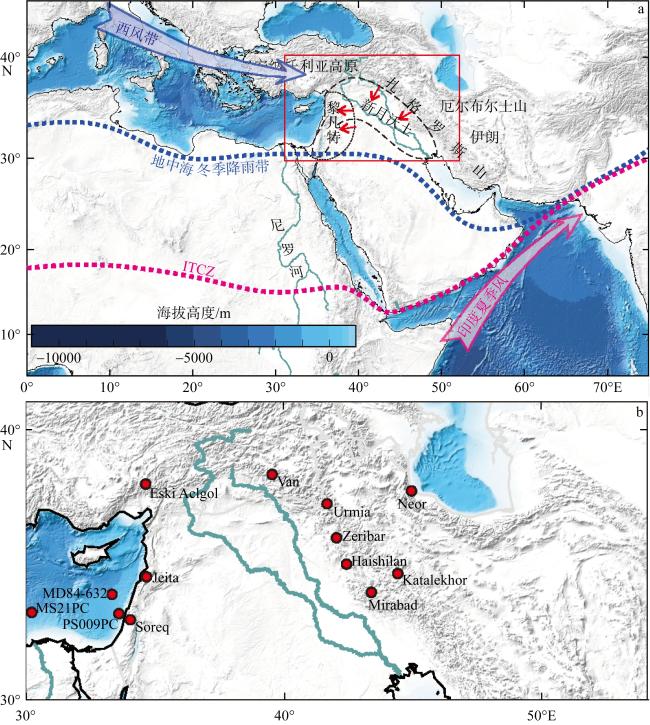
图1 (a)西亚地区主要大气环流系统与区域示意图; 粉色虚线代表现代热带辐合带(intertropical convergence zone, ITCZ)边界, 蓝色虚线代表现代地中海冬季降雨带边界; 蓝色箭头表示冬季西风带, 粉色箭头表示印度夏季风; (b)重要的气候记录分布图(图1a红色方框内区域), 海洋沉积记录: MS21PC、MD84-632、PS009PC; 石笋记录: Soreq洞、Jeita洞、Katalekhor洞; 湖泊沉积记录: Eski Acigöl、Van、Urmia、Zeribar、Mirabad、Haishilan、Neor该图基于自然资源部标准地图服务网站下载的审图号为GS(2016)2937的标准地图制作 Fig. 1 (a) Schematic map of West Asia illustrating dominant atmospheric circulation patterns; the modern positions of the intertropical convergence zone (ITCZ) and Mediterranean winter precipitation belt are delineated by pink and blue dashed lines, respectively; mid-latitude westerlies and Indian summer monsoon are indicated by blue and pink arrows, respectively; (b) the study area (red rectangle, see detailed view in Fig. 1b) with locations of key paleoclimate archives discussed in this study (red circles): marine sediment records—MS21PC, MD84-632, PS009PC; stalagmite records—Soreq Cave, Jeita Cave, Katalekhor Cave; lake sediment records—Eski Acigöl, Van, Urmia, Zeribar, Mirabad, Haishilan, Neor |
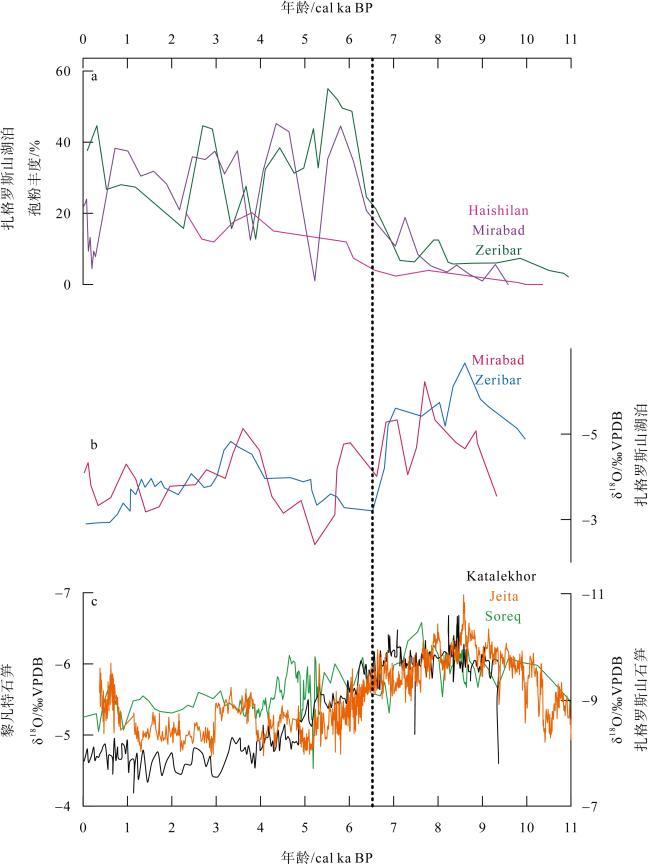
图2 全新世期间西亚主要的古水文记录对比a. 来自Zeibar湖泊、Mirabad 湖泊(van Zeist et al, 1977)和Hashilan湿地橡树孢粉丰度记录(Safaierad et al, 2023); b. 来自Zeibar湖泊和Mirabad湖泊次生碳酸钙δ18O记录(Stevens et al, 2001, 2006); c. 黎凡特地区石笋δ18O [Soreq洞(Bar-Matthews et al, 2003)、Jeita洞(Cheng et al, 2015)]和扎格罗斯山地区Katalekhor洞δ18O记录(Andrews et al, 2020) Fig. 2 Comparison of major paleohydrological records in West Asia during the Holocene. (a) Oak pollen abundance records from Lake Zeibar, Lake Mirabad (van Zeist et al, 1977) and Haishilan Wetland (Safaierad et al, 2023); (b) secondary carbonate δ18O records from Lake Zeibar and Lake Mirabad (Stevens et al, 2001; 2006); (c) stalagmite δ18O records from the Levant region [Soreq Cave (Bar-Matthews et al, 2003), Jeita Cave (Cheng et al, 2015)] and Katalekhor Cave in the Zagros Mountains (Andrews et al, 2020) |
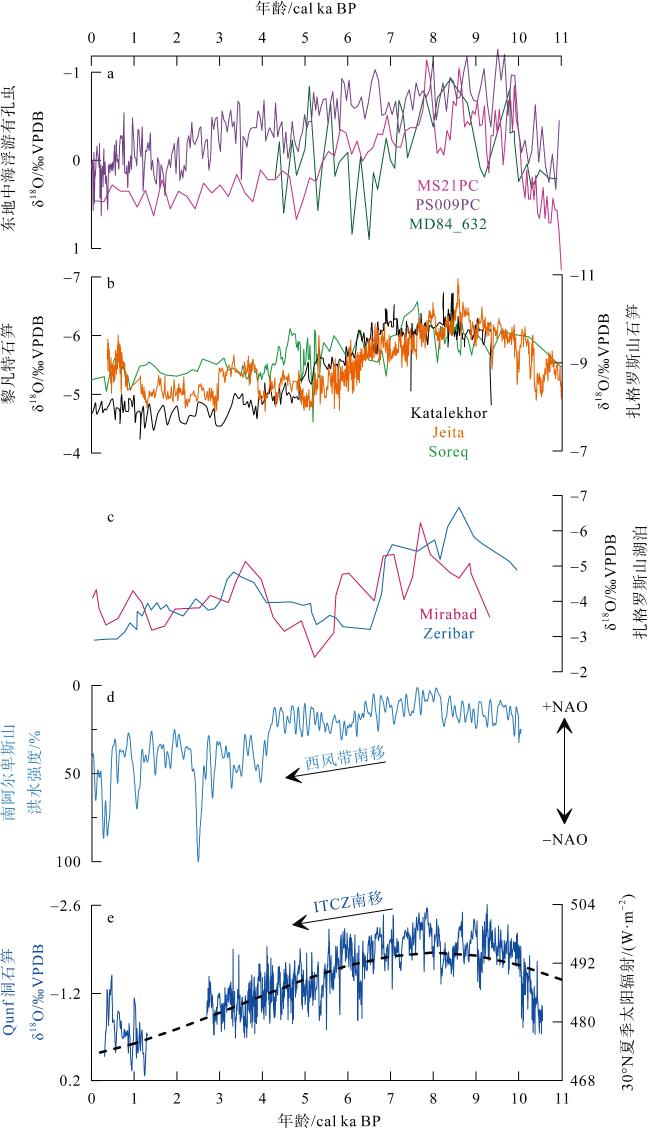
图3 西亚地区不同δ18O记录与夏季风记录的对比a. 东地中海浮游有孔虫海洋沉积记录: MS21PC (Hennekam et al, 2015)、MD84_632 (Essallami et al, 2007)、PS009PC (Hennekam et al, 2014, 2015); b. 石笋记录: 黎凡特地区[Soreq洞(Bar-Matthews et al, 2003)、Jeita洞(Cheng et al, 2015)]、扎格罗斯山Katalekhor洞(Andrews et al, 2020); c. 湖泊沉积记录: Zeribar (Stevens et al, 2001)、Mirabad (Stevens et al, 2006); d. 北大西洋涛动(North Atlantic Oscillation, NAO)相关的南阿尔卑斯山洪水活动变化(Wirth et al, 2013); e. 北纬30°夏季太阳辐射变化(6—8月) (Berger et al, 1991)和来自阿曼南部的Qunf洞石笋δ18O记录(Fleitmann et al, 2003), 后者常用来指示印度夏季风强度 Fig. 3 Comparison of δ18O records from different research archives in West Asia with Indian summer monsoon records. (a) Marine sediment records: MS21PC (Hennekam et al, 2015), MD84-632 (Essallami et al, 2007), PS009PC (Hennekam et al, 2014, 2015); (b) stalagmite δ18O records from the Levant region [Soreq Cave (Bar-Matthews et al, 2003), Jeita Cave (Cheng et al, 2015)] and Katalekhor Cave in the Zagros Mountains (Andrews et al, 2020); (c) lake sediment records: Lake Zeribar (Stevens et al, 2001), Lake Mirabad (Stevens et al, 2006); (d) flood variabilities in southern Alps associated with the North Atlantic Oscillation (NAO) (Wirth et al, 2013); (e) summer insolation curves (June-August) for 30°N (Berger et al, 1991) and Qunf Cave stalagmite δ18O records from southern Oman (Fleitmann et al, 2003) |
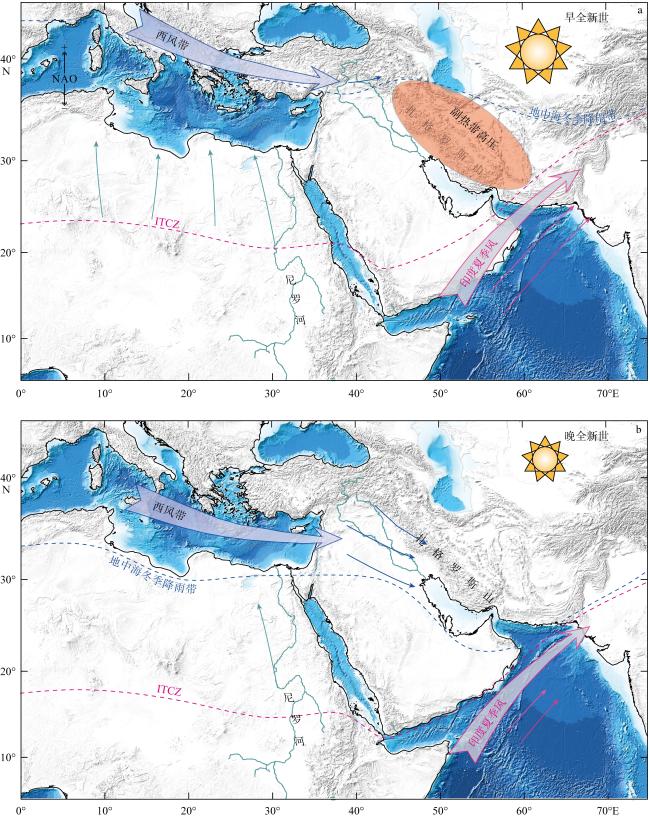
图4 早全新世(a)、晚全新世(b)西亚大气环流和水文气候系统演变模型红色阴影区表示副热带高压; 粉色虚线代表ITCZ边界位置, 蓝色虚线代表地中海冬季降雨带边界位置; 灰蓝色箭头表示夏季淡水输入量(与东地中海δ18O组成相关); 蓝色箭头表示冬季西风带强度和位置, 粉色箭头表示印度夏季风强度和位置 Fig. 4 Schematic models of atmospheric circulation evolution and hydroclimatic system in West Asia during the early Holocene (a) and late Holocene (b). The red shaded area indicates the subtropical high; the pink and blue dashed lines represent the boundary positions of the ITCZ and Mediterranean winter precipitation belt, respectively; the grey-blueish arrows indicate the summer freshwater runoff amount (associated with the δ18O value in the eastern Mediterranean); blue and pink arrows denote the intensity and location of westerlies and Indian summer monsoon, respectively |
| [1] |
|
| [2] |
|
| [3] |
|
| [4] |
|
| [5] |
|
| [6] |
|
| [7] |
|
| [8] |
|
| [9] |
|
| [10] |
|
| [11] |
|
| [12] |
|
| [13] |
|
| [14] |
|
| [15] |
|
| [16] |
|
| [17] |
|
| [18] |
|
| [19] |
|
| [20] |
|
| [21] |
|
| [22] |
|
| [23] |
|
| [24] |
|
| [25] |
|
| [26] |
|
| [27] |
|
| [28] |
|
| [29] |
|
| [30] |
|
| [31] |
|
| [32] |
|
| [33] |
|
| [34] |
|
| [35] |
|
| [36] |
|
| [37] |
|
| [38] |
|
| [39] |
|
| [40] |
|
| [41] |
|
| [42] |
|
| [43] |
|
| [44] |
|
| [45] |
|
| [46] |
|
| [47] |
|
| [48] |
|
| [49] |
|
| [50] |
|
| [51] |
|
| [52] |
|
| [53] |
|
| [54] |
|
| [55] |
|
| [56] |
|
| [57] |
|
| [58] |
|
| [59] |
|
| [60] |
|
| [61] |
|
| [62] |
|
| [63] |
|
| [64] |
|
| [65] |
|
| [66] |
|
| [67] |
|
| [68] |
|
| [69] |
|
| [70] |
|
| [71] |
|
| [72] |
|
| [73] |
|
| [74] |
|
| [75] |
|
| [76] |
|
| [77] |
|
| [78] |
|
| [79] |
|
| [80] |
|
| [81] |
|
| [82] |
|
| [83] |
|
| [84] |
|
| [85] |
|
| [86] |
|
| [87] |
|
| [88] |
|
/
| 〈 |
|
〉 |