孟加拉湾下扇沉积炭屑证据发现HS1早期气候干旱
|
罗传秀(1970—), 女, 汉族, 四川省成都市人, 博士, 研究员, 博士研究生导师, 研究方向为海洋地质。email: xiu104@scsio.ac.cn |
Editor: 孙翠慈
收稿日期: 2025-06-27
修回日期: 2025-07-16
网络出版日期: 2025-09-30
基金资助
青海省盐湖地质与环境重点实验室奖励经费2024
国家自然科学基金项目(41906057)
国家自然科学基金项目(42376074)
国家自然科学基金共享航次计划项目(资助的NORC2011-03开放航次)(41049903)
中国科学院南海海洋研究所发展基金(SCSIO202201)
Evidence of micro-charcoal deposited in the lower fan of the Bay of Bengal reveals an arid climate during the early Heirich Stadial 1
Editor: SUN Cuici
Received date: 2025-06-27
Revised date: 2025-07-16
Online published: 2025-09-30
Supported by
Science and Technology Plan Project of Qinghai Province Incentive Fund 2024
National Natural Science Foundation of China(41906057)
National Natural Science Foundation of China(42376074)
Shiptime Sharing Project (NORC2011-03) of National Natural Science Foundation of China(41049903)
Development Fund of South China Sea Institute of Oceanology of Chinese Academy of Sciences(SCSIO202201)
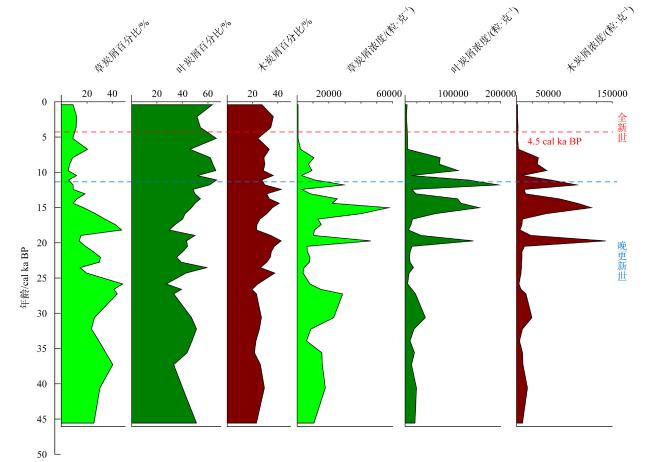
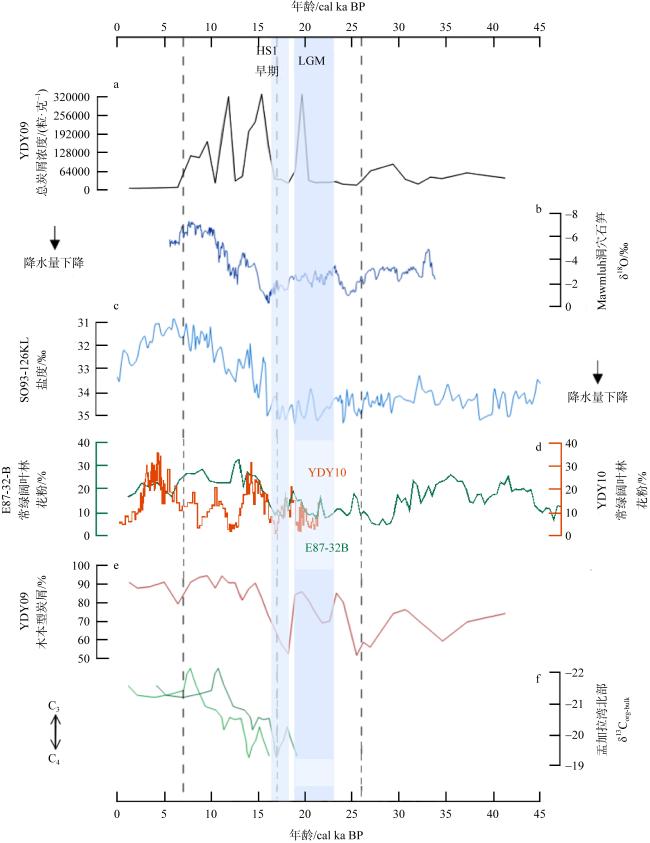
前人研究认为, 受海因里希1(Heinrich Stadial 1, HS1)早期(约18.3—16.3cal ka BP)北半球降温的影响, 热带辐合带(intertropical convergence zone, ITCZ)雨带的平均位置会向南移动。但是, 最新结果发现, HS1早期北半球低纬度地区(3ºN—9ºN)呈现湿润水文条件, 而其南北部却同步出现干旱。可见HS1早期ITCZ对北大西洋降温事件的响应方向及位移幅度仍存争议。孟加拉湾的海洋炭屑记录保存了周边陆地大量气候成因古火事件的信息。研究发现, 在HS1早期(18.3—16.3 cal ka BP), 位于9°54′N的YDY09孔的炭屑总浓度与木本型炭屑百分比均降至最低, 而草本型炭屑百分比则有所上升, 这表明火灾发生强度急剧降低。这一变化, 结合有孔虫和石笋δ18O记录所揭示的降水减少信号, 可能源于当时气候干旱与温度降低共同导致的植被退化。该结论说明炭屑、孢粉与有孔虫等其他指标重建的印度夏季风降水结果一致, 也与来自10°N的YDY10岩芯和15°N的E87-32B岩芯中常绿阔叶林花粉低值所反映的干旱情形相符。同期, 苏门答腊岛2个孔(分别位于6°N和6°S)的炭屑和孢粉含量也分别显示湿润和干旱, 反映其炭屑和孢粉源区当时处于ITCZ雨带范围内部与外部区域。炭屑与孢粉记录共同揭示, HS1早期在10°N至6°S范围之外存在干旱证据; 结合苏门答腊岛6°N孔的湿润证据, 间接支持了该时期ITCZ位置在6°N两侧。
罗传秀 , 林刚 , THILAKANAYAKA Vidusanka A. M. , 魏海成 , 向荣 , 杨艺萍 , 万随 , 梁诗晴 , 苏翔 , 杜恕环 , 张兰兰 , 刘建国 , 黄云 , SOE Moe Lwin . 孟加拉湾下扇沉积炭屑证据发现HS1早期气候干旱[J]. 热带海洋学报, 2026 , 45(1) : 117 -130 . DOI: 10.11978/YG2025002
Previous studies have suggested that the mean position of the intertropical convergence zone (ITCZ) rain belt shifted southward due to the cooling of the Northern Hemisphere during the Heinrich Stadial 1 (HS1) early period (approximately 18.3-16.3 cal ka BP). However, recent studies indicate that wet conditions prevailed in the low-latitude region (3°N-9°N) of the Northern Hemisphere during the early HS1 period, while adjacent regions to the north and south were arid. It can be seen that the response and displacement amplitude of the ITCZ to the cooling event in the North Atlantic during early HS1 remain controversial. Marine charcoal records from the Bay of Bengal may preserve critical information about climate-driven palaeo-fire events from the surrounding land. In this study, we observe that the total concentration of charcoal and the percentage of woody charcoal in core YDY09 (located at 9°54′N) decreased to their lowest levels in early HS1, while the percentage of herbaceous charcoal increased. This suggests a sharp reduction in the strength of fire events, consistent with decreased rainfall inferred from the δ18O records of foraminifera and stalagmites and other proxies. The decline in fire strength may be related to reduced vegetation cover under drier climate and cooler climatic conditions, which aligns with evidence of aridity from low pollen values of evergreen broad-leaved forests in core YDY10 (located at 10°N) and core E87-32B (located at 15ºN) from the Bay of Bengal. During the same period, the charcoal and pollen contents in two cores on Sumatra Island (located at 6°N and 6°S, respectively) also showed humid and arid conditions, indicating that the charcoal and pollen source areas were inside and outside the ITCZ rain belt at that time. Reconstructed results of Indian Summer Monsoon precipitation based on micro-charcoal, pollen, foraminifera, and other indicators are consistent. For the first time, combined charcoal and pollen records reveal the evidence of drought outside the range of 10°N to 6°S in the early stage of HS1, while moist evidence from the 6°N core on Sumatra Island indirectly supports the inference that the ITCZ centered around 6° N during this period.
Key words: Heinrich; micro-charcoal; pollen; early HS1; Bay of Bengal
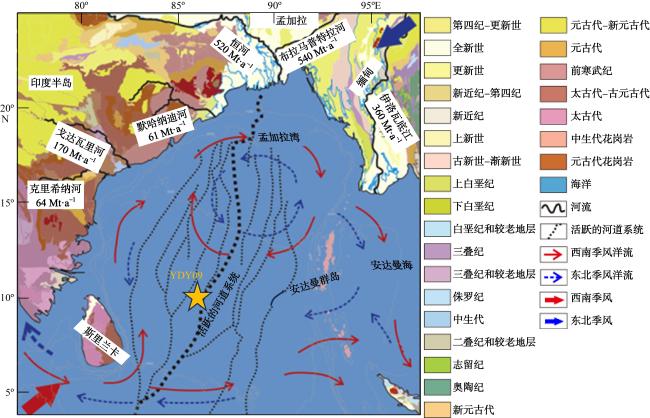
图1 孟加拉湾的地质、季风和水文背景(修改自Liu 等, 2019a)图中的橙色星形表示本文研究站位; 黑色虚线是峡谷通道; 该图基于自然资源部标准地图服务网站下载的审图号为GS (2016)2956号的标准地图制作 Fig.1 Geological, monsoonal, and hydraulic setting of the Bay of Bengal (modified from Liu et al, 2019a). The orange star in the figure indicates the study site of this paper; the black dashed line represents the canyon channel |
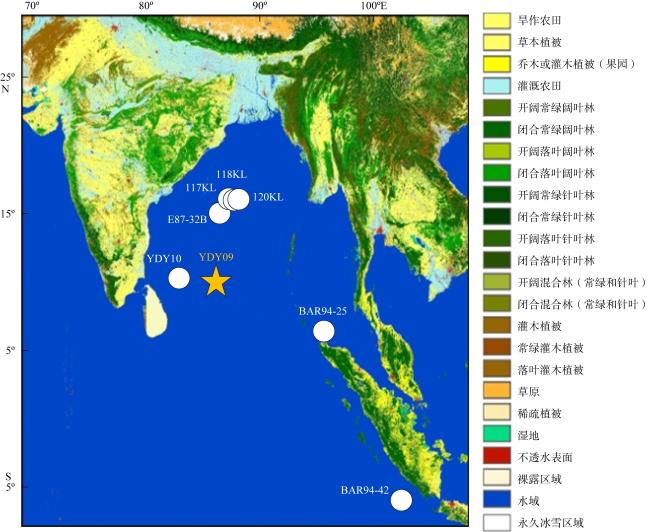
图2 东北印度洋周边植被图(修改自刘良云 等, 2021)图中橙色星形表示本文研究站位; 白色圆点是本文讨论中提到的站位, 其中YDY10和E87-32B钻孔引自Rahman 等(2025), BAR94-25引自van Der Kaars 等(2012), BAR94-42引自van Der Kaars 等(2010), 117KL钻孔、118KL钻孔、120KL钻孔引自Galy 等(2008)。该图基于自然资源部标准地图服务网站下载的审图号为GS(2016)2956号的标准地图制作 Fig. 2 Vegetation map of the surrounding area of the northeastern Indian Ocean (modified from Liu et al, 2021). The orange star in the figure represents the study site in this study; the white dots are the positions mentioned in the discussion, among which core YDY10 and core E87-32B are cited from Rahman et al (2025), BAR94-25 is cited from van Der Kaars et al (2012), BAR94-42 is cited from van Der Kaars et al (2010), cores 117KL, 118KL, and 120KL are cited from Galy et al (2008) |
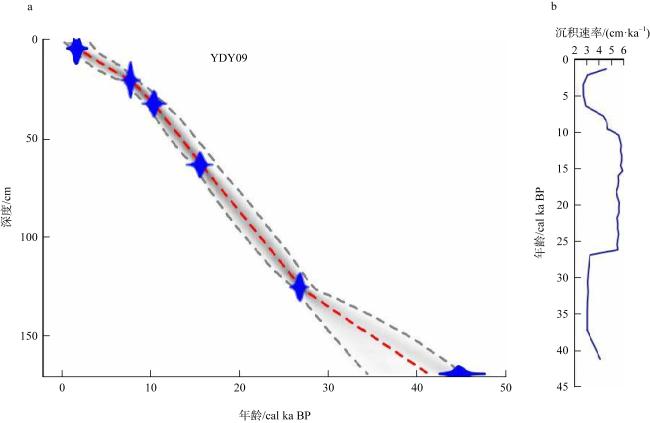
表1 YDY09孔AMS14C年龄数据和校正结果及其沉积速率(Liu et al, 2019b)Tab. 1 AMS14C age data, calibration results, and sedimentation rates for core YDY09 (Liu et al, 2019b) |
| 深度/cm | 实验室编号 | 测年材料 | AMS 14C年龄/ a | 日历年龄/ a | δ13C/‰ | 沉积速率/ (cm·ka−1) |
|---|---|---|---|---|---|---|
| 3~4 | 391114 | 混合浮游有孔虫 | 2100±30 | 1669±52 | 1.4 | 2.00 (0~3cm深度) |
| 19~20 | 391115 | 混合浮游有孔虫 | 7260±30 | 7716±42 | 0.8 | 2.64 (3~19cm深度) |
| 30~32 | 391116 | 混合浮游有孔虫 | 9490±30 | 10323±59 | 0.6 | 4.61 (19~31cm深度) |
| 62~63 | 391117 | 混合浮游有孔虫 | 13480±40 | 15688±98 | 0.7 | 6.18 (31~63cm深度) |
| 124~125 | 408431 | 混合浮游有孔虫 | 23290±80 | 27255±105 | 1.3 | 5.21 (63~125cm深度) |
| 168~169 | 408432 | 混合浮游有孔虫 | 42790±600 | 45651±534 | 0.9 | 2.39 (125~169cm深度) |
图5 YDY09钻孔炭屑记录与古环境记录对比a. YDY09钻孔的总炭屑沉积浓度; b. 印度东北部Mawmluh洞穴石笋δ18O记录(Dutt et al, 2015); c. 孟加拉湾北部SO93-126KL钻孔的盐度记录, 指示印度夏季风降水量的变化(Kudrass et al, 2001); d. 孟加拉湾YDY10和E87-32B钻孔的常绿阔叶林百分比(Rahman et al, 2025); e. YDY09钻孔木本型炭屑的百分含量, 指示木本植物燃烧量的变化; f. 孟加拉湾北部117KL、118KL和120KL钻孔的沉积物有机碳(Corg-bulk)的δ13C移动平均值(浅绿)以及其向过去平移3ka(深绿, 3ka为沉积年龄和有机碳表观年龄之间的迟滞时间)的记录, 指示喜马拉雅盆地C3和C4植物的比例(Galy et al, 2008); 黑色虚线标示了26cal ka BP、17cal ka BP以及7cal ka BP所在; 蓝色阴影标示LGM、HS1早期时期 Fig. 5 Comparison of charcoal records from core YDY09 with paleoenvironmental records. (a) Total charcoal concentration from core YDY09; (b) δ18O record of stalagmites from Mawmluh Cave, northeastern India (Dutt et al, 2015); (c) salinity record from core SO93-126KL in the northern Bay of Bengal, indicating variations in Indian Summer Monsoon precipitation (Kudrass et al, 2001); (d) percentage of evergreen broad-leaved forests from cores YDY10 and E87-32B in the Bay of Bengal (Rahman et al, 2025); (e) percentage of woody charcoal from core YDY09, indicating changes in the amount of woody plant combustion; (f) moving average of δ13C record (light green) of sedimentary organic carbon (Corg-bulk) from cores 117KL, 118KL, and 120KL in the northern Bay of Bengal and its 3 ka shifted data towards the past (dark green), indicating the proportion of C3 and C4 plants in the Himalayan basin (Galy et al, 2008). Black dashed lines indicate the locations of 26 cal ka BP, 17 cal ka BP, and 7 cal ka BP; blue shading indicates the LGM and Early HS1 periods |
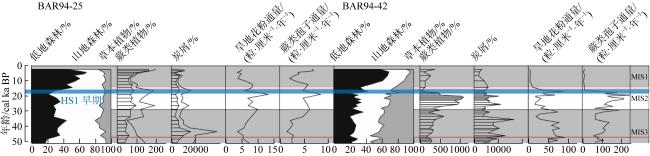
图6 海洋岩芯BAR94-25(van Der Kaars et al, 2012)和BAR94-42(van Der Kaars et al, 2010)记录中选定花粉曲线之间相关性的图带有水平黑条填充图案的百分比曲线显示了使用全部孢粉总和计算的值。无填充的百分比曲线显示了使用孢粉总和(不包括松花粉)计算的值 Fig. 6 Diagram showing the correlation between selected pollen curves from the marine core BAR94-25 (van Der Kaars, et al, 2012) and BAR94-42 (van Der Kaars et al, 2010) records. The percentage curves with horizontal black bar fill patterns show values calculated using pollen sum defined in the text. The unfilled percentage curves show values calculated using pollen sum excluding pine pollen |
| [1] |
江鸿, 饶志国, 2018. 火的历史重建及其与气候变化和人类活动关系研究进展[J]. 海洋地质与第四纪地质, 38(2): 185-197.
|
| [2] |
李小强, 赵宏丽, 闫敏华, 等, 2005. 东北三江平原全新世火演化及其与植被和气候的关系[J]. 地理科学, 25(2): 177-182.
|
| [3] |
李宜垠, 侯树芳, 赵鹏飞, 2010. 微炭屑的几种统计方法比较及其对人类活动的指示意义[J]. 第四纪研究, 30(2): 356-363.
|
| [4] |
刘良云, 张肖, 2021. 2020年全球30米地表覆盖精细分类产品V1. 0[Z]. 北京: 中国科学院空天信息创新研究院.
|
| [5] |
罗运利, 陈怀成, 吴国瑄, 等, 2001. 南海最近3个冰期旋回中的天然火与气候: ODP1144孔深海沉积中的炭屑记录[J]. 中国科学(D辑: 地球科学), 31(10): 854-860 (in Chinese).
|
| [6] |
王梓莎, 苗运法, 赵永涛, 等, 2020. 柴达木盆地北缘湖泊表层沉积物炭屑特征及其环境意义[J]. 中国沙漠, 40(4): 10-17.
|
| [7] |
魏海成, 鄂崇毅, 段荣蕾, 等, 2021. 真菌孢子记录的全新世中期以来青藏高原东北部地区畜牧活动历史[J]. 中国科学: 地球科学, 51(11):1907-1922 (in Chinese).
|
| [8] |
严崇潮, 1984. 东南亚的植被类型和分布规律[J]. 生态学杂志, 3(5): 28-32.
|
| [9] |
张健平, 吕厚远, 2006. 现代植物炭屑形态的初步分析及其古环境意义[J]. 第四纪研究, 26(5): 857-863.
|
| [10] |
张瑞, 迟云平, 谢远云, 等, 2022. 哈尔滨黄土炭屑记录的中晚更新世以来古火活动及其驱动机制[J]. 生态学报, 42(24): 10317-10328.
|
| [11] |
张亚敬, 姜云鹏, 徐亚男, 等, 2021. 孟加拉湾东海岸波浪特征分析[J]. 中国水运, (5): 157-160 (in Chinese).
|
| [12] |
|
| [13] |
|
| [14] |
|
| [15] |
|
| [16] |
|
| [17] |
|
| [18] |
|
| [19] |
|
| [20] |
|
| [21] |
|
| [22] |
|
| [23] |
|
| [24] |
|
| [25] |
|
| [26] |
|
| [27] |
|
| [28] |
|
| [29] |
|
| [30] |
|
| [31] |
|
| [32] |
|
| [33] |
|
| [34] |
|
| [35] |
|
| [36] |
|
| [37] |
|
| [38] |
|
| [39] |
|
| [40] |
|
| [41] |
|
| [42] |
|
| [43] |
|
| [44] |
|
| [45] |
|
| [46] |
|
| [47] |
|
| [48] |
|
| [49] |
|
| [50] |
|
| [51] |
|
| [52] |
|
| [53] |
|
| [54] |
|
| [55] |
|
| [56] |
|
| [57] |
|
| [58] |
|
| [59] |
|
| [60] |
|
| [61] |
|
| [62] |
|
| [63] |
|
| [64] |
|
| [65] |
|
| [66] |
|
| [67] |
|
| [68] |
|
| [69] |
|
| [70] |
|
| [71] |
|
| [72] |
|
| [73] |
|
| [74] |
|
| [75] |
|
| [76] |
|
| [77] |
|
| [78] |
|
| [79] |
|
| [80] |
|
/
| 〈 |
|
〉 |