红树植物秋茄根系固氮微生物群落的稳定性和复杂性及其关键影响因子研究
|
齐峰(2001—), 男, 山西省大同市人, 硕士研究生, 从事海洋微生态研究。email: 18835201665@163.com |
Editor: 林强
收稿日期: 2025-08-06
修回日期: 2025-09-24
网络出版日期: 2025-10-02
基金资助
广东海洋大学创新团队(海洋灾害预警)项目(2023KCXTD015)
广西科技计划项目(2024GXNSFBA010342)
国家自然科学基金项目(42267018)
Study on the stability and complexity of diazotrophic communities and key driving factors in the root-associated zones of the mangrove plant Kandelia obovata
Editor: LIN Qiang
Received date: 2025-08-06
Revised date: 2025-09-24
Online published: 2025-10-02
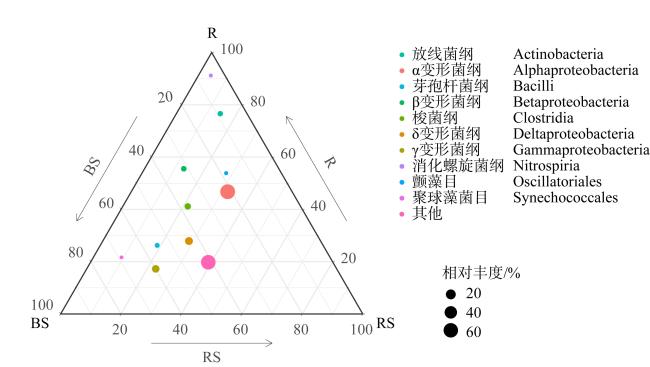
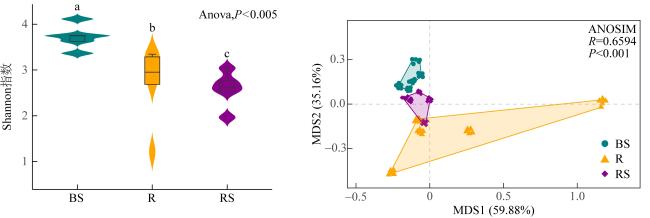
红树植物秋茄根系固氮微生物物种组成丰富, 对红树林生态系统氮循环至关重要, 然而, 关于固氮微生物在红树林生态系统中的生态适应机制, 仍不十分清楚。本研究在中国南方的雷州红树林自然保护区分别采集了根内、根际和非根际各75份样品, 基于高通量测序技术和分子生态学方法, 研究了秋茄根内、根际、非根际的固氮微生物组成、多样性、复杂性和稳定性及其主要影响因子。研究发现, α变形菌纲(Alphaproteobacteria)、δ变形菌纲(Deltaproteobacteria)和γ变形菌纲(Gammaproteobacteria)是红树林根系中的优势物种, 其中 α变形菌在根内丰度最高(54.9%), 显著高于根际(37.5%)与非根际(29.1%)。α 多样性显示非根际 Shannon 指数最高, 根际最低(P<0.05); NMDS(non-metric multidimensional scaling) 与 ANOSIM (analysis of similarities) 分析(r=0.659, P<0.001)证实三个区域群落结构差异显著。共现网络分析显示, 根际固氮微生物网络的鲁棒性最高, 非根际连接最密, 根内最复杂但最脆弱。Spearman相关性分析表明, 环境因子对复杂性和稳定性的影响具有区域特异性: 盐度与$ \mathrm{NH}_{4}^{+}-\mathrm{N} $共同驱动非根际与根际的复杂性, $ \mathrm{NO}_{3}^{-}-\mathrm{N} $主要驱动非根际稳定性; 根内复杂性受总硫(total sulfur, TS)与$ \mathrm{NO}_{2}^{-}-\mathrm{N} $显著负影响, 而根际稳定性仅与盐度呈显著正相关。本研究加强了对红树林生态系统中固氮微生物复杂性和群落稳定性的维持机制的理解, 对恢复和维持红树植被生态系统具有重要意义。
齐峰 , 邓晓杰 , 关永鹏 , 周盛垚 , 何庆 , RAJAPAKSHALAGE Thashikala Nethmini , 李楠 , 姜宫凌侠 , 陈清香 , 雷欣悦 , 侯庆华 , 黄来珍 , 李小蕾 , 韦巧艳 . 红树植物秋茄根系固氮微生物群落的稳定性和复杂性及其关键影响因子研究[J]. 热带海洋学报, 2026 , 45(3) : 153 -163 . DOI: 10.11978/2025123
The root-associated diazotrophs of the mangrove species Kandelia obovata exhibit remarkable species richness, which are integral to nitrogen cycling within mangrove ecosystems. However, their ecological adaptation mechanisms remain inadequately understood. In this study, we collected 75 samples each of root endosphere, rhizosphere, and bulk soil from a mangrove nature reserve in Leizhou, South China. Based on high-throughput sequencing and molecular ecological approaches, we investigated the composition, diversity, complexity, and stability of diazotrophs across these three compartments of K. obovata, as well as their main influencing factors. The results showed that Alphaproteobacteria, Deltaproteobacteria, and Gammaproteobacteria were the dominant species in the mangrove root-associated diazotrophs, with Alphaproteobacteria having the highest abundance in the root endosphere (54.9%), significantly higher than that in the rhizosphere (37.5%) and bulk soil (29.1%). α-diversity analysis revealed that the Shannon index was the highest in the bulk soil and the lowest in the rhizosphere (P<0.05). NMDS (Non-metric Multidimensional Scaling) and ANOSIM (Analysis of Similarities) analyses (r=0.659, P<0.001) confirmed significant differences in community structure among the three compartments. Notably, the diazotrophs in the rhizosphere of K. obovata exhibit the lowest α-diversity but highest community stability. Co-occurrence network analysis indicated that diazotrophs network in the rhizosphere was the most robust, the bulk soil network had the highest connectivity, while the endorhizosphere was the most complex yet the most fragile. Spearman correlation analysis demonstrated region-specific effects of environmental factors on complexity and stability: salinity and $ \mathrm{NH}_{4}^{+}-\mathrm{N} $ jointly drove complexity in the bulk soil and rhizosphere, while $ \mathrm{NO}_{3}^{-}-\mathrm{N} $ mainly influenced stability in bulk soil. In the rhizosphere, complexity was significantly negatively correlated with TS and $ \mathrm{NO}_{2}^{-}-\mathrm{N} $, while stability showed significant positive correlation with salinity. This study enhances the understanding of the mechanisms governing the maintenance of complexity and stability of diazotrophs within mangrove ecosystems, holding significant implications for the restoration and conservation of mangrove ecosystems in similar coastal wetlands.
表1 红树林根系不同区域固氮微生物的α多样性与理化因子的相关性Tab. 1 Correlation between α-diversity of diazotrophic communities and physicochemical factors in distinct root compartments of mangrove forests |
| 环境因子 | Shannon指数 | ||
|---|---|---|---|
| 非根际(BS) | 根(R) | 根际(RS) | |
| 氧化还原电位ORP/mV | 0.68*** | 0.1 | -0.35 |
| pH | 0.08 | 0.29 | -0.49* |
| 温度/℃ | -0.63*** | -0.88*** | 0.78*** |
| 盐度/‰ | 0.35 | -0.49* | 0.29 |
| 总硫TS/% | -0.14 | 0.29 | 0.1 |
| 硫酸盐 $\mathrm{SO}_{4}^{2-}$/(mg·g-1) | -0.02 | 0.1 | 0.2 |
| 总磷TP/(mg·g-1) | -0.04 | -0.69*** | 0.59** |
| 磷酸盐 $\mathrm{PO}_{4}^{3-}$/(mg·g-1) | 0.04 | 0.69*** | -0.59** |
| 总氮TN/% | 0.8*** | 0.15 | -0.4* |
| 总碳 TC/% | 0.35 | 0.1 | 0.05 |
| 总有机碳 TOC/% | -0.08 | -0.29 | 0.49* |
| 亚硝态氮 $\mathrm{NO}_{2}^{-}-\mathrm{N}$/(μmol·L-1) | -0.67*** | -0.39 | 0.69*** |
| 硝态氮 $\mathrm{NO}_{3}^{-}-\mathrm{N}$/(μmol·L-1) | -0.45* | -0.69*** | 0.59** |
| 氨氮 $ \mathrm{NH}_{4}^{+}-\mathrm{N}$/(μmol·L-1) | 0.18 | -0.69*** | 0.49* |
注: *表示P< 0.05, **表示P< 0.01, ***表示P< 0.001。 |
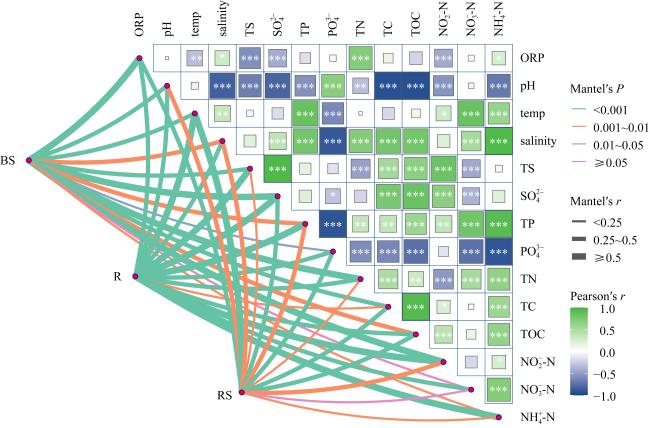
图3 红树林根系不同区域固氮微生物群落的Bray-Curtis距离与环境因子之间的相关性*表示环境因子之间Pearson相关性的显著性水平, *表示P< 0.05, **表示P< 0.01, ***表示P< 0.001; BS: 非根际; R: 根内; RS: 根际, rhizosphere; ORP: 氧化还原电位(oxidation-reduction potential); pH: 酸碱度; temp: 温度; salinity: 盐度; TS: 总硫(total sulfur); TP: 总磷(total phosphorus); TN: 总氮(total nitrogen); TC: 总碳(total carbon); TOC: 总有机碳(total organic carbon)。对于Mantel检验结果, 线的颜色表示P值, 线的粗细表示Mantel's r的绝对值 Fig. 3 Correlation between Bray-Curtis distance of diazotrophic communities and physicochemical factors in distinct root compartments of mangrove forests |
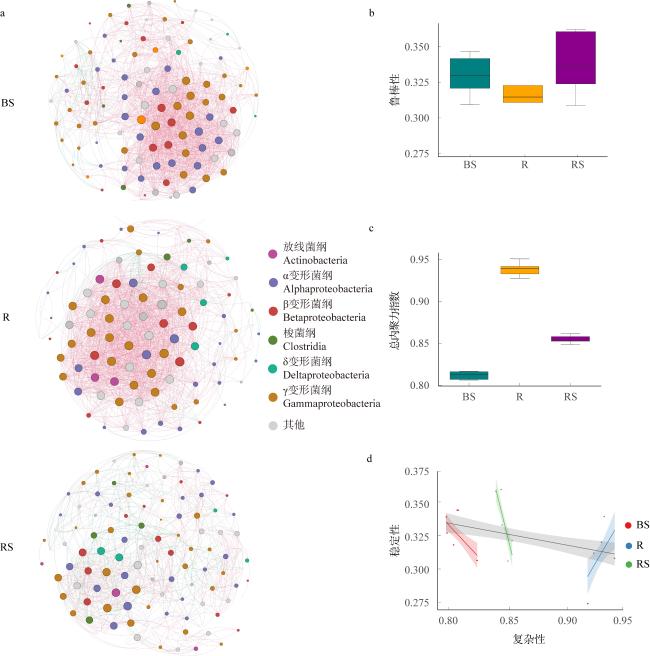
图4 红树林根系不同区域固氮微生物群落的共发生网络以及稳定性和复杂性分析(a) 红树林根系不同区域固氮微生物群落在属分类水平上的共发生网络, (b) 红树林根系不同区域固氮微生物群落的稳定性, (c) 红树林根系不同区域固氮微生物群落的复杂性, (d) 红树林根系不同区域固氮微生物群落的复杂性与稳定性的相关性 Fig. 4 Co-occurrence network, stability and complexity analyses of diazotrophic communities in distinct root compartments of mangrove. (a) Co-occurrence network of diazotrophic communities in distinct root compartments of mangrove at the level of taxonomic genus. (b) Stability of diazotrophic communities in distinct root compartments of mangrove. (c) Complexity of diazotrophic communities in distinct root compartments of mangrove. (d) Correlation between the complexity and stability of diazotrophic communities in distinct root compartments of mangrove. |
表2 红树林根系不同区域固氮微生物群落共发生网络的网络参数Tab. 2 Network parameters of the co-occurrence network of diazotrophic communities in distinct root compartments of mangrove forests |
| 参数 | 非根际(BS) | 根内(R) | 根际(RS) |
|---|---|---|---|
| 节点数(nodes number) | 104 | 90 | 98 |
| 边数(edges number) | 1444 | 1471 | 764 |
| 平均度(average degree) | 27.769 | 32.689 | 15.592 |
| 平均路径长度(average path length) | 2.187 | 1.974 | 2.368 |
| 网络直径(graph diameter) | 5 | 6 | 5 |
| 网络密度(graph density) | 0.27 | 0.367 | 0.161 |
| 平均聚类系数(average clustering coefficient) | 0.702 | 0.721 | 0.59 |
| 模块化(modularity) | 0.281 | 0.16 | 0.478 |
| 正相关比例(positive correlation) | 0.962 | 0.967 | 0.67 |
表3 红树林根系不同区域固氮微生物的复杂性和稳定性与理化因子的相关性Tab. 3 Correlation between complexity and stability of diazotrophic communities and physicochemical factors in distinct root compartments of mangrove forests |
| 环境因子 | BS | R | RS | |||
|---|---|---|---|---|---|---|
| 复杂性 | 稳定性 | 复杂性 | 稳定性 | 复杂性 | 稳定性 | |
| ORP/mV | 0.3 | 0.56 | 0.35 | 0.36 | -0.6** | 0.31 |
| pH | -0.59** | 0.2 | 0.29 | 0.5 | 0.59** | -0.6 |
| 温度/℃ | 0.29 | -0.9* | 0.1 | -0.8 | 0 | 0.3 |
| 盐度/‰ | 0.98*** | -0.4 | 0.49* | -0.3 | -0.78*** | 1*** |
| TS/% | -0.1 | 0.3 | -0.69*** | -0.1 | -0.1 | -0.1 |
| $ \mathrm{SO}_{4}^{2-}$/(mg·g-1) | 0.29 | 0 | -0.39 | -0.2 | -0.29 | 0.3 |
| TP/(mg·g-1) | 0.88*** | -0.7 | 0.29 | -0.6 | -0.59** | 0.9* |
| PO43-/(mg·g-1) | -0.88*** | 0.7 | -0.29 | 0.6 | 0.59** | -0.9* |
| TN/% | 0.7*** | 0.21 | 0.65*** | 0.41 | -0.65*** | 0.72 |
| TC/% | 0.55** | 0.21 | -0.15 | -0.05 | -0.65*** | 0.56 |
| TOC/% | 0.59** | -0.2 | -0.29 | -0.5 | -0.59** | 0.6 |
| $ \mathrm{NO}_{2}^{-}-\mathrm{N}$/(μmol·L-1) | -0.2 | 0.1 | -0.88*** | -0.7 | -0.2 | -0.2 |
| $ \mathrm{NO}_{3}^{-}-\mathrm{N}$/(μmol·L-1) | 0.39 | -1*** | 0.29 | -0.6 | 0.1 | 0.4 |
| $ \mathrm{NH}_{4}^{+}-\mathrm{N}$/(μmol·L-1) | 0.88*** | -0.3 | 0.29 | -0.5 | -0.88*** | 0.9* |
注: *表示P<0.05, **表示P<0.01, ***表示P<0.001。 |
| [1] |
董俊德, 黄小芳, 龙爱民, 等, 2023. 红树林固氮微生物及其生态功能研究进展[J]. 热带海洋学报, 42(4): 1-11.
|
| [2] |
|
| [3] |
|
| [4] |
|
| [5] |
|
| [6] |
|
| [7] |
|
| [8] |
|
| [9] |
|
| [10] |
|
| [11] |
|
| [12] |
|
| [13] |
|
| [14] |
|
| [15] |
|
| [16] |
|
| [17] |
|
| [18] |
|
| [19] |
|
| [20] |
|
| [21] |
|
| [22] |
|
| [23] |
|
| [24] |
|
| [25] |
|
| [26] |
|
| [27] |
|
| [28] |
|
| [29] |
|
| [30] |
|
| [31] |
|
| [32] |
|
| [33] |
|
| [34] |
|
| [35] |
|
| [36] |
|
| [37] |
|
| [38] |
|
| [39] |
|
| [40] |
|
| [41] |
|
| [42] |
|
| [43] |
|
| [44] |
|
| [45] |
|
| [46] |
|
/
| 〈 |
|
〉 |