

热带海洋学报 ›› 2026, Vol. 45 ›› Issue (5): 35-52.doi: 10.11978/2026024CSTR: 32234.14.2026024
海扩张机制的制约*
苗秀全1,2( ), 张运迎1,2(), 颜文1,2,3
- 1
热带海洋环境与岛礁生态全国重点实验室(中国科学院南海海洋研究所)
2边缘海与大洋地质实验室(中国科学院南海海洋研究所)
3中国科学院大学
-
收稿日期:2026-01-30修回日期:2026-03-14出版日期:2026-09-10发布日期:2026-10-13 -
通讯作者:张运迎 -
作者简介:苗秀全(1992—), 男, 山东省枣庄市人, 副研究员, 从事海洋地质研究。email: xqmiao@scsio.ac.cn
*感谢编辑与匿名审稿专家提出的宝贵修改意见和建议; 感谢所有为南科1井钻探项目作出贡献的科学和工程专家。
-
基金资助:国家重点研发计划项目(2021YFC3100600); 国家重点研发计划项目(2024YFF0808200); 国家自然科学基金项目(42541603); 国家自然科学基金项目(42506052); 国家自然科学基金项目(42372080)
Mesozoic magmatism in the Nansha Block: implications for the tectonic affinity of southern continental margin of the South China Sea and the opening mechanism of the Proto-South China Sea*
MIAO Xiuquan1,2(), ZHANG Yunying1,2(), YAN Wen1,2,3
- 1
State Key Laboratory of Tropical Oceanography ,South China Sea Institute of Oceanology, Chinese Academy of Sciences
2Laboratory of Marginal Sea and Ocean Geology ,South China Sea Institute of Oceanography, Chinese Academy of Sciences
3University of Chinese Academy of Sciences
-
Received:2026-01-30Revised:2026-03-14Online:2026-09-10Published:2026-10-13 -
Contact:ZHANG Yunying -
Supported by:National Key Research and Development Program of China(2021YFC3100600); National Key Research and Development Program of China(2024YFF0808200); National Natural Science Foundation of China(42541603); National Natural Science Foundation of China(42506052); National Natural Science Foundation of China(42372080)

摘要:
厘清南海南部陆缘在中生代是否位于华南板块东南陆缘, 对于重建东南亚中—新生代构造演化历史与区域古地理格局具有关键作用。此外, 古南海存在于南海形成之前, 是中生代东南亚构造体系的重要组成部分, 然而其初始扩张时代与动力学机制长期缺乏直接地质约束。文章选取南海南部陆缘南沙地块“南科1井”钻孔获得的岩浆岩为研究对象, 综合运用年代学与岩石地球化学研究方法, 约束岩浆活动的形成时代、成因及构造背景, 以期深化对南海南部陆缘的构造属性与古南海形成机制的认识。研究结果表明, 南沙地块发育3期中生代岩浆作用, 分别为晚三叠世(约217Ma)英安岩、早侏罗世(约177Ma)辉长闪长岩以及早白垩世(约124Ma)辉绿岩。这3期岩浆活动在时代与地球化学特征上与华南板块内部相应时期的岩浆事件可对比, 共同指示南沙地块在三叠纪是华南板块东南缘的一部分。而且, 这3期岩浆活动系统记录了华南板块东南陆缘在中生代的连续构造演化过程: 晚三叠世的英安岩表现出典型的A2型花岗岩特征, 指示其形成于古太平洋板片平俯冲引起的陆内伸展构造背景; 早侏罗世辉长闪长岩显示明显的陆缘弧玄武岩亲缘性, 反映古太平洋板块俯冲控制下的大陆边缘弧岩浆作用; 早白垩世辉绿岩具有弧后盆地玄武岩地球化学特征, 指示其形成于古太平洋板片俯冲后撤形成的弧后盆地构造环境。此外, 南沙地块早白垩世辉绿岩代表古南海初始扩张阶段的陆缘伸展岩浆活动, 其地球化学特征与同期古南海残留洋壳共同显示弧后盆地玄武岩属性, 表明古南海构造属性为弧后盆地, 于早白垩世开始扩张。本研究为重建中生代南海南部陆缘构造格局及东南亚区域构造演化提供了新的关键约束。
中图分类号:
- P736.121
引用本文
苗秀全, 张运迎, 颜文. 海扩张机制的制约*[J]. 热带海洋学报, 2026, 45(5): 35-52.
MIAO Xiuquan, ZHANG Yunying, YAN Wen. Mesozoic magmatism in the Nansha Block: implications for the tectonic affinity of southern continental margin of the South China Sea and the opening mechanism of the Proto-South China Sea*[J]. Journal of Tropical Oceanography, 2026, 45(5): 35-52.
图1
华南板块中生代岩浆岩分布图以及南海构造纲要图[改自苗秀全(2021)] QHB: 钦—杭带(185—169Ma); ZDB: 政和—大埔带(254—215Ma); CB: 沿海带(141—116Ma); DYB: 东沙—塔伦—雁荡带(200—177Ma), 各带虚线圈中的数字表示该区域内岩浆岩位置。ALF: 安化—罗城断裂; CBF: 慈利—保靖断裂。蛇绿混杂岩包括中巴拉望蛇绿岩(CPO)(Gibaga et al, 2020)、南巴拉望蛇绿岩(SPO)、安蒂克蛇绿岩(ANO)、达沃湾蛇绿岩(DBO)、安奈蛇绿岩(AMO)、伊罗戈蛇绿岩(ILO)、曼延蛇绿岩(MAO)、阿科赫蛇绿岩(ACO)、塞加马蛇绿岩(SEO)、默拉图斯蛇绿岩(MEO)和沙巴蛇绿岩(SAO)。各岩浆作用带内岩浆岩(圆圈)及蛇绿岩(绿色区域)数据引自苗秀全(2021)及其内参考文献"
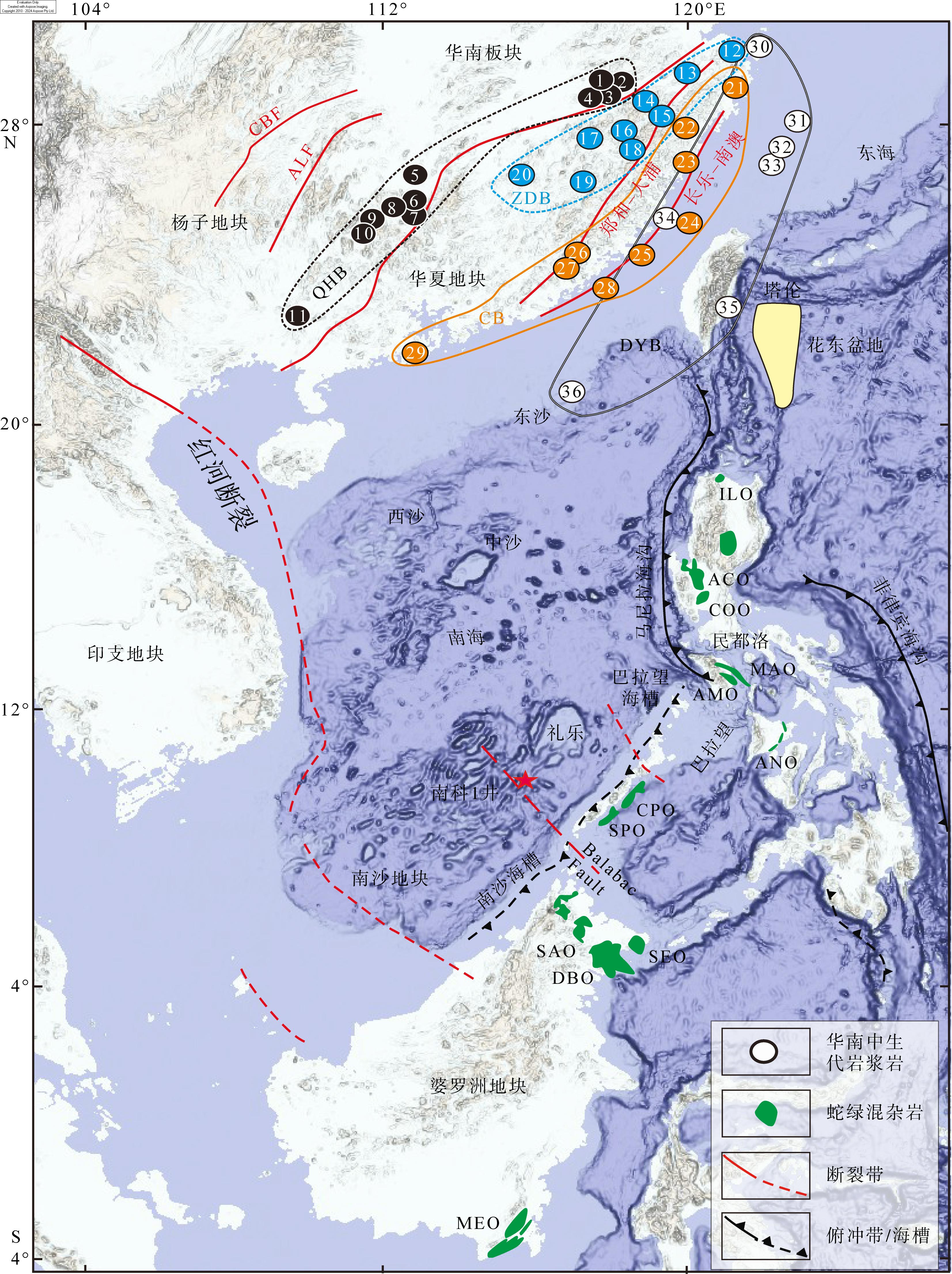
图1
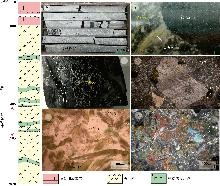
图2
南科1井钻孔岩性柱状剖面及代表性样品照片 a. 南科 1 井钻孔揭露的岩性序列; b. 钻获岩芯的代表性照片; c. 英安岩体被石英脉切割, 其后期又受到镁铁质岩脉的再次贯入; d. 英安岩被后期的镁铁质岩脉侵入的特征; e. 英安岩镜下照片; f. 辉长闪长岩镜下照片; g. 辉绿岩镜下照片。图d中白色实线表示镁铁质岩细脉"

图2
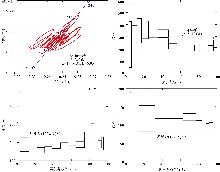
图3
南科1井岩浆岩定年结果 a. 英安岩中锆石U-Pb年龄谐和图; b. 英安岩40Ar/39Ar坪年龄谱图; c. 辉长闪长岩40Ar/39Ar坪年龄谱图; d. 辉绿岩40Ar/39Ar坪年龄谱图。图a中n表示锆石测试点数量, MSWD表示加权均方偏差, 红色曲线表示单个锆石的年龄测定结果"
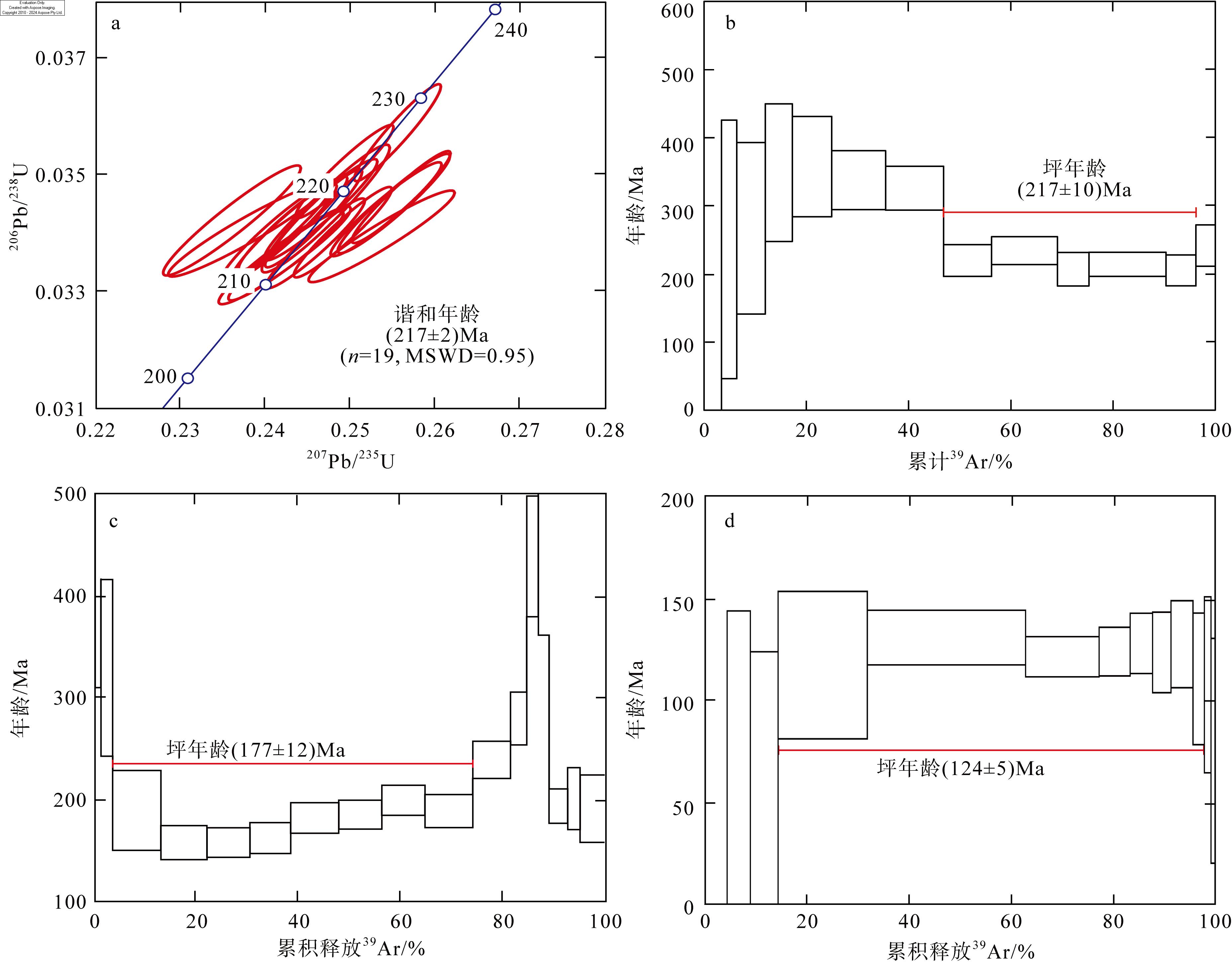
图3
图4
南科1井岩浆岩主量元素与微量元素地球化学特征 a. 全碱-硅(TAS)岩石类型判别图[改自Le Maitre (1989)]; b. SiO2 vs. K2O岩浆系列划分图; c~f分别是英安岩、辉长闪长岩、辉绿岩球粒陨石标准化稀土配分图和原始地幔(正常洋中脊玄武岩)标准化微量元素蛛网图。图a中代表古南海残余洋壳的蛇绿岩与镁铁质侵入岩数据引用自Omang等(1996); Tamayo等(2001); Hickey-Vargas等(2008); Gibaga等(2020)。图b中黑线用于区分拉斑、钙碱性及高钾钙碱性岩浆系列。图c~f中标准化值引自Sun等(1989)。图c和d中上陆壳(UCC)和下陆壳(LCC)数据引自Rudnick等(2003), 陆缘弧玄武岩数据来源于墨西哥和喀斯喀特陆缘弧玄武岩(Schmidt et al, 2017), 弧后盆地玄武岩(BABB)数据来源于冲绳海槽和日本弧后盆地玄武岩(Hoang et al, 2006; Hirahara et al, 2015; Miao et al, 2021b)"
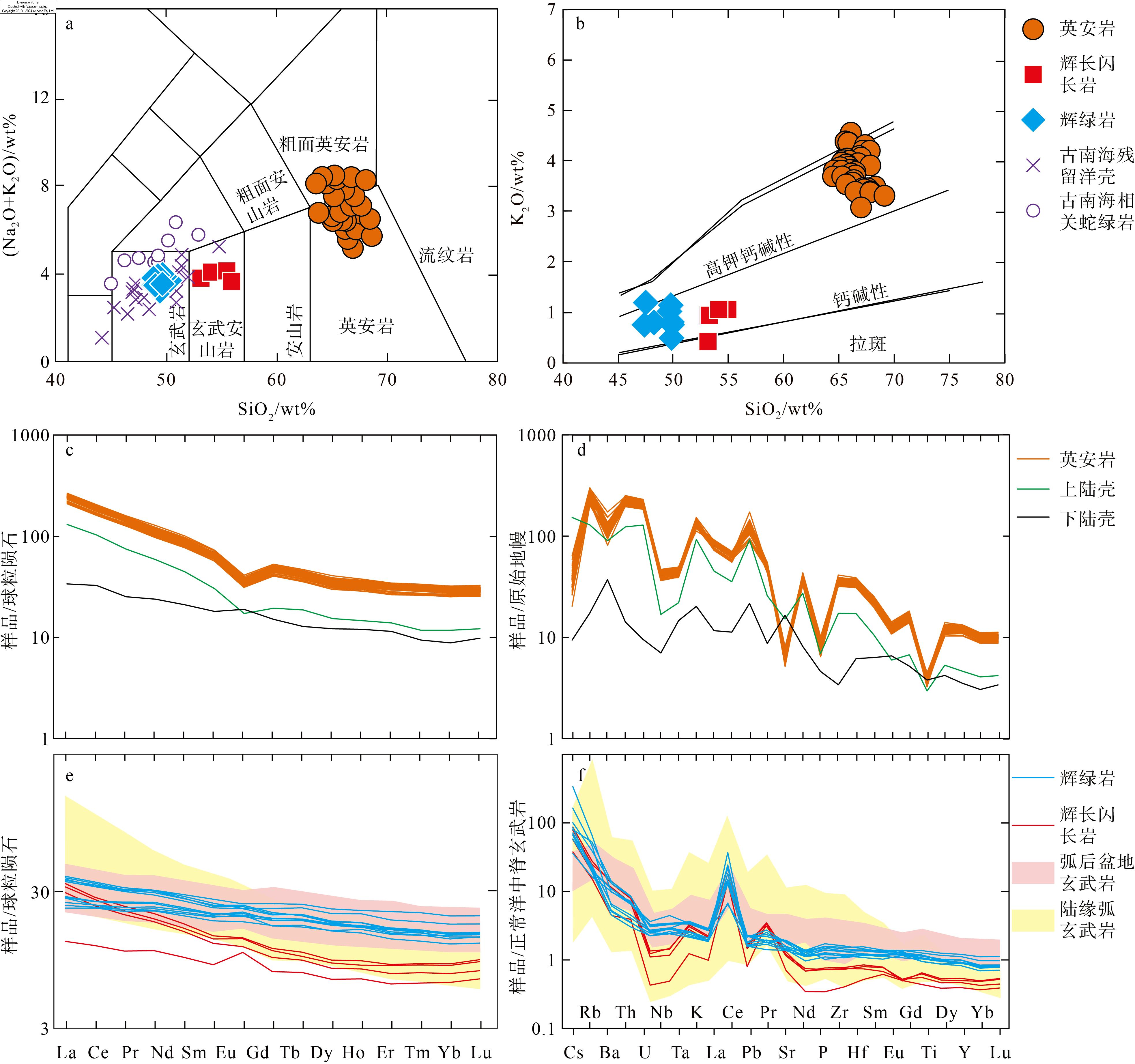
图4
图5
南科1井岩浆岩Sr-Nd-Hf同位素图解 a. 英安岩Sr-Nd同位素图解; b. 英安岩Nd-Hf同位素图解; c. 辉长闪长岩与辉绿岩Sr-Nd同位素图解; d. 辉长闪长岩与辉绿岩Nd-Hf同位素图解。华南板块三叠纪A型花岗岩数据来源Wang等(2005)、Sun等(2011)和Zhao等(2013)。图a, c, d中亏损地幔(DM)、蚀变洋壳(AOC)、全球俯冲沉积物(GLOSS)、远洋沉积物和陆缘沉积物的Sr-Nd-Hf同位素引自Miao等(2021a, 2021b)。图c中灰色圆点、橘色圆点和绿色圆点分别指示亏损地幔(DM), 蚀变洋壳(AOC)和全球俯冲沉积物(GLOSS); 该图中BABB指示弧后盆地玄武岩, QHB代表钦—杭带(185—169Ma; 黑色虚线), ZDB代表政和—大埔带(254—215Ma; 灰色虚线), DYB代表东沙—塔伦—雁荡带(200—177Ma; 紫色虚线)。图c和图d中绿色实线、绿色叉号、黑色实线、黑点、橘色曲线以及橘色短线及其内数字代表AOC、GLOSS、DM各端元之间混合的Sr-Nd 与 Nd-Hf 同位素模拟结果"

图5
图6
“南科1井”英安岩地球化学判别图解 a. 花岗岩(FeOT/MgO) vs (Zr+Nb+Ce+Y)判别图[改自Whalen等(1987)]; b. 花岗岩Nb vs 10000×Ga/Al判别图[改自Whalen 等(1987)]; c. 南科1井英安岩与华南板块内部三叠纪—侏罗纪A型和Ⅰ型花岗岩锆石饱和温度(TZr)对比图[改自苗秀全(2021)]; d. A型花岗岩的Ce/Nb vs Y/Nb图解[改自Eby (1992)]"
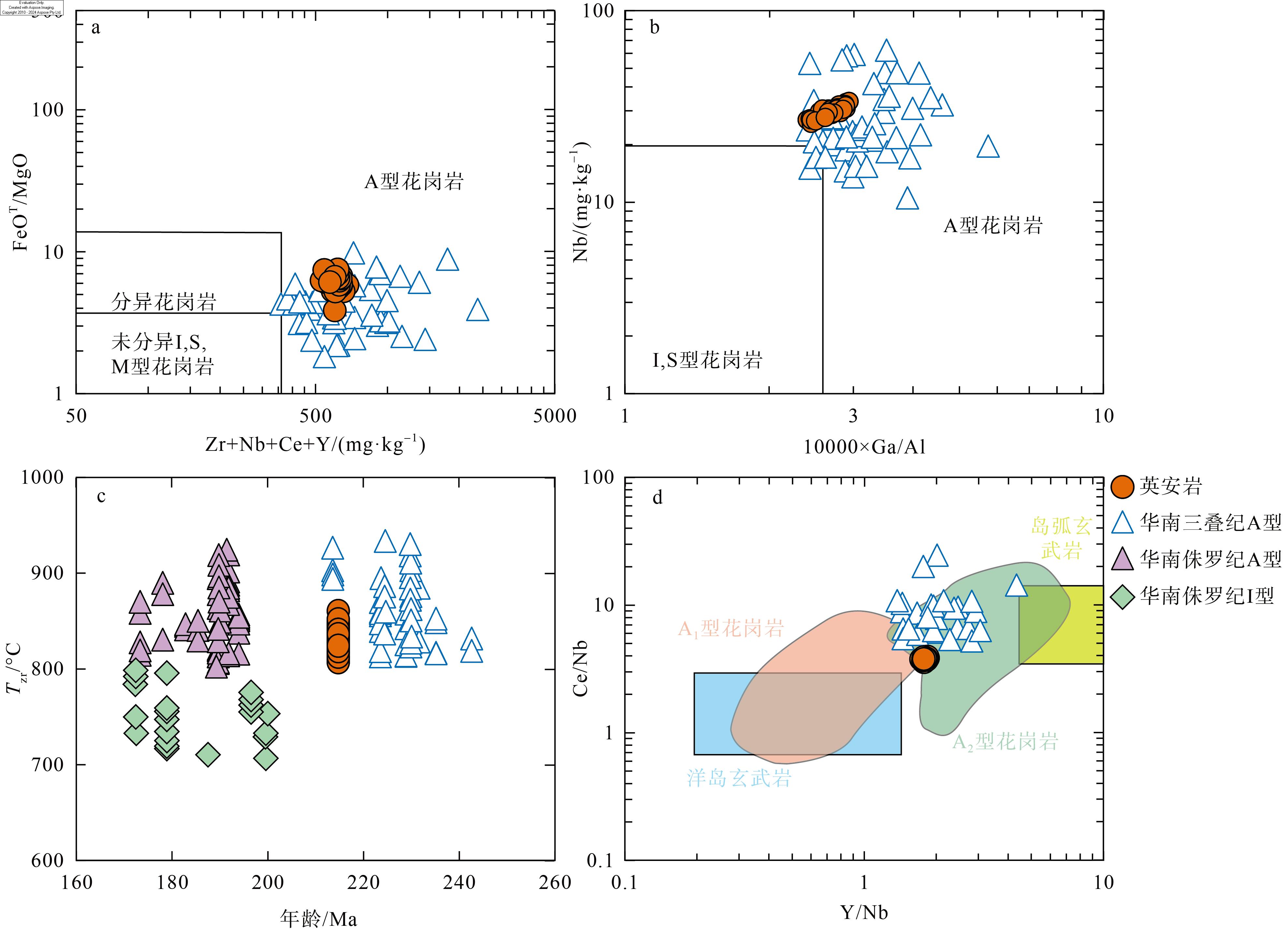
图6
图7
“南科1井”辉长闪长岩和辉绿岩主微量元素图解 a. εNd(t) vs Th/Nb图解; b. εNd(t) vs Nd/Hf图解; c. εNd(t) vs Sr/Nd图解; d. La/Nb vs Y图解; e. TiO2 vs FeOT/MgO图解[改自Shuto等(2006) ]; f. Th/Yb vs Ta/Yb图解[改自Pearce等(2005)]。图b和c中的虚线箭头分别指示俯冲沉积物熔体与流体交代趋势。图f展示了俯冲物质对地幔源区的不同混染比例, 分别为30%、75%和90% (Pearce et al, 2005)。陆缘弧玄武岩选用墨西哥及喀斯喀特大陆弧数据(Schmidt et al, 2017), 弧后裂谷与扩张阶段的玄武岩则选用加勒比海与马里亚纳弧后盆地数据(Pearce et al, 2005; Escuder Viruete et al, 2008)。与图c中箭头所指向区域的冲绳与马里亚纳玄武岩的数据引自 Gribble等(1996, 1998)、Shinjo等(1999)和Schmidt等(2017)"

图7
图8
三叠纪—白垩纪东南亚古地理重建以及南海南部陆缘微陆块构造模型图 a. 三叠纪阶段, 南沙地块位于华南板块陆缘, 受古太平洋板片平俯冲作用的影响; b. 图 a 中 A—A' 剖面所示的构造演化示意图; c. 侏罗纪阶段, 南沙地块仍受古太平洋板片俯冲作用的影响; d. 图 c 中 B—B' 剖面对应的构造示意图; e. 白垩纪阶段, 古南海作为弧后盆地形成, 其发育受控于古太平洋板片俯冲后撤过程; f. 图 e 中 C—C' 剖面所示的构造格局。图a, c, e中五角星指示南科1井钻孔中3期中生代岩浆岩。图b, d, f中虚线黄色部分代表未知板块。图a, c, e中缩写: MB (民都洛地块); NS (南沙地块); PB (巴拉望地块); R (礼乐地块); ZDF (政和—大埔断裂); CLF (郴州—临武断裂)"
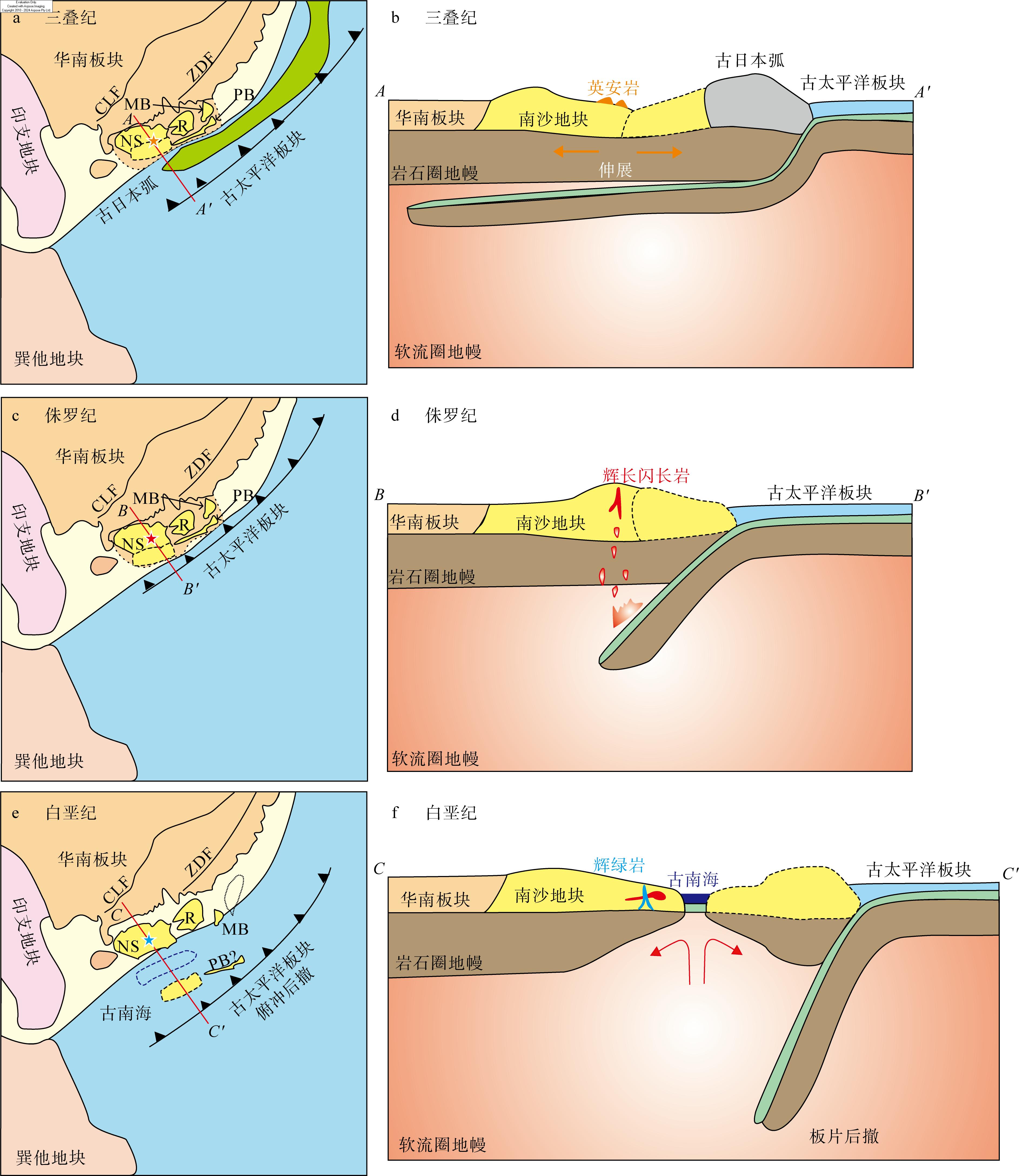
图8
| [1] |
刘海龄, 2002. 南沙地块断裂构造系统与岩石圈动力学研究[M]. 北京: 科学出版社.
|
|
|
|
| [2] |
苗秀全, 2021. 南沙“南科1井”岩浆岩成因机制与南海南部陆缘中生代构造演化[D]. 广州: 中国科学院大学(中国科学院广州地球化学研究所).
|
|
|
|
| [3] |
孙卫东, 林秋婷, 张丽鹏, 等, 2018. 跳出南海看南海: 新特提斯洋闭合与南海的形成演化[J]. 岩石学报, 34(12): 3467-3478.
|
|
|
|
| [4] |
孙珍, 赵中贤, 李家彪, 等, 2011. 南沙地块内破裂不整合与碰撞不整合的构造分析[J]. 地球物理学报, 54(12): 3196-3209.
|
|
|
|
| [5] |
鄢全树, 石学法, 王昆山, 等, 2008. 南沙微地块花岗质岩石LA-ICP-MS锆石U-Pb定年及其地质意义[J]. 地质学报, 82(8): 1057-1067.
|
|
|
|
| [6] |
姚伯初, 曾维军, 陈艺中, 等, 1994. 南海北部陆缘东部的地壳结构[J]. 地球物理学报, 37(1): 27-35.
|
|
|
|
| [7] |
周蒂, 陈汉宗, 孙珍, 等, 2005. 南海中生代三期海盆及其与特提斯和古太平洋的关系[J]. 热带海洋学报, 24(2): 16-25.
|
|
|
|
| [8] |
朱奕先, 2019. 基于南海重磁震剖面的地质-地球物理研究[D]. 长春: 吉林大学.
|
|
|
|
| [9] |
|
| [10] |
|
| [11] |
|
| [12] |
|
| [13] |
|
| [14] |
|
| [15] |
|
| [16] |
|
| [17] |
|
| [18] |
|
| [19] |
|
| [20] |
|
| [21] |
|
| [22] |
|
| [23] |
|
| [24] |
|
| [25] |
|
| [26] |
|
| [27] |
|
| [28] |
|
| [29] |
|
| [30] |
|
| [31] |
|
| [32] |
|
| [33] |
|
| [34] |
|
| [35] |
|
| [36] |
|
| [37] |
|
| [38] |
|
| [39] |
|
| [40] |
|
| [41] |
|
| [42] |
|
| [43] |
|
| [44] |
|
| [45] |
|
| [46] |
|
| [47] |
|
| [48] |
|
| [49] |
|
| [50] |
|
| [51] |
|
| [52] |
|
| [53] |
|
| [54] |
|
| [55] |
|
| [56] |
|
| [57] |
|
| [58] |
|
| [59] |
|
| [60] |
|
| [61] |
|
| [62] |
|
| [63] |
|
| [64] |
|
| [65] |
|
| [66] |
|
| [67] |
|
| [68] |
|
| [69] |
|
| [70] |
|
| [71] |
|
| [72] |
|
| [73] |
|
| [74] |
|
| [75] |
|
| [76] |
|
| [77] |
|
| [78] |
|
| [79] |
|
| [80] |
|
| [81] |
|
| [82] |
|
| [83] |
|
| [84] |
|
| [85] |
|
| [86] |
|
| [87] |
|
| [1] | 黎刚, 徐维海, 罗云, 刘建国, 赵建新, 俸月星, 程俊, 孙珍, 向荣, 徐敏, 颜文. 基于南沙美济礁深钻的南海南部新生代构造演化研究[J]. 热带海洋学报, 2026, 45(5): 16-34. |
| [2] | 黄康俊, 张攀, 冯东, 颜文. 海相碳酸盐岩体系镁同位素组成控制因素及其指示意义*[J]. 热带海洋学报, 2026, 45(5): 146-161. |
| [3] | 王婵, 刘皓, 徐维海. 三叠纪古太平洋俯冲: 南海南部陆缘的岩浆记录*[J]. 热带海洋学报, 2026, 45(5): 53-79. |
| [4] | 罗云, 黎刚, 张喜洋, 徐维海, 朱小畏, 周婉秋, 黄慧文, 钟福昌, 颜文. 基于美济礁深钻的南海岛礁差异白云石化过程研究[J]. 热带海洋学报, 2026, 45(5): 108-127. |
| [5] | 韩雪, 徐维海, 罗云, 黎刚, 刘建国, 朱小畏, 程俊, 苗莉, 向荣, 颜文. 南沙群岛南科1井白云岩发育特征及铁白云石成因机制的初步研究*[J]. 热带海洋学报, 2022, 41(5): 74-88. |
| [6] | 罗云, 黎刚, 徐维海, 程俊, 刘建国, 颜文. 南科1井第四系暴露面特征及其与海平面变化的关系*[J]. 热带海洋学报, 2022, 41(1): 143-157. |
| [7] | 张云帆, 胡登科, 王万银, 邱之云, 李付成. 南海南北陆坡地壳拉张特征对比[J]. 热带海洋学报, 2012, 31(3): 137-143. |
|
||