

热带海洋学报 ›› 2026, Vol. 45 ›› Issue (5): 108-127.doi: 10.11978/2025236CSTR: 32234.14.2025236
基于美济礁深钻的南海岛礁差异白云石化过程研究
罗云1( ), 黎刚1(), 张喜洋1, 徐维海1, 朱小畏1, 周婉秋1,2, 黄慧文1, 钟福昌1, 颜文1,2()
- 1
中国科学院南海海洋研究所 ,热带海洋环境与岛礁生态全国重点实验室, 边缘海与大洋地质实验室
2中国科学院大学
-
收稿日期:2025-12-10修回日期:2026-01-23出版日期:2026-09-10发布日期:2026-10-13 -
通讯作者:黎刚, 颜文 -
作者简介:罗云(1992—), 河南省信阳市人, 助理研究员, 从事珊瑚礁沉积成岩过程与同位素地球化学研究。email: luoyun@scsio.ac.cn
-
基金资助:国家重点研发计划项目(2021YFC3100600); 广东省基础与应用基础研究基金项目(2025A1515012022); 广东省基础与应用基础研究基金项目(2025A1515010958); 海南省海洋地质资源与环境重点实验室开放基金项目(24-HNHYDZZYHJKF047)
Differential dolomitization process of coral reefs in the South China Sea: a case study based on a deep borehole in Meiji Atoll
LUO Yun1(), LI Gang1(), ZHANG Xiyang1, XU Weihai1, ZHU Xiaowei1, ZHOU Wanqiu1,2, HUANG Huiwen1, ZHONG Fuchang1, YAN Wen1,2()
- 1
South China Sea Institute of Oceanology ,Chinese Academy of Sciences, State Key Laboratory of Tropical Oceanography, Laboratory of Ocean and Marginal Sea Geology
2University of Chinese Academy of Sciences
-
Received:2025-12-10Revised:2026-01-23Online:2026-09-10Published:2026-10-13 -
Contact:LI Gang, YAN Wen -
Supported by:National Key Research and Development Program of China(2021YFC3100600); Guangdong Basic and Applied Basic Research Foundation(2025A1515012022); Guangdong Basic and Applied Basic Research Foundation(2025A1515010958); Hainan Marine Geological Resources and Environment Key Laboratory Open Fund(24-HNHYDZZYHJKF047)

摘要:
在全球大洋中许多孤立碳酸盐岩台地、岛屿或环礁上普遍发育着新生代岛礁白云岩。然而, 缺乏多期次白云石化的准确年龄和流体组成信息, 导致对这些岛礁白云岩的成因模式仍存在争议。文章以南海南部美济礁南科1井南湾组中的白云岩为研究对象, 系统分析了不同白云石化程度的岛礁碳酸盐岩中方解石、交代白云石和白云石胶结物的原位U-Pb年龄、Sr同位素年龄和元素组成, 阐明了南海岛礁多期次白云石化流体组成与差异白云石化过程。结果表明, 准同生的交代白云石化作用发生在11.0—8.5Ma, 与前体灰岩的沉积时间相近, 而白云石胶结物的沉淀时间为8.5—6.0Ma。南湾组交代白云石和白云石胶结物的成岩流体可能是不同演化程度的海水, 其中白云石胶结物中较高的Mg/Ca值和较低的Mn、Sr含量指示其流体来自轻微蒸发的海水。此外, 南湾组灰岩中白云石含量与孔隙度呈正相关, 指示原生孔隙在后续白云石化作用中起到重要作用, 而珊瑚藻和含藻屑的灰泥更有利于白云石的快速成核。该研究进一步表明激光原位分析在确定岛礁白云石化期次和流体来源方面具有很好的潜力, 有助于完善现有孤立环礁的白云石化模型。
中图分类号:
- P736.213
引用本文
罗云, 黎刚, 张喜洋, 徐维海, 朱小畏, 周婉秋, 黄慧文, 钟福昌, 颜文. 基于美济礁深钻的南海岛礁差异白云石化过程研究[J]. 热带海洋学报, 2026, 45(5): 108-127.
LUO Yun, LI Gang, ZHANG Xiyang, XU Weihai, ZHU Xiaowei, ZHOU Wanqiu, HUANG Huiwen, ZHONG Fuchang, YAN Wen. Differential dolomitization process of coral reefs in the South China Sea: a case study based on a deep borehole in Meiji Atoll[J]. Journal of Tropical Oceanography, 2026, 45(5): 108-127.
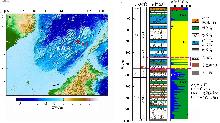
图1
南海南部地形与南科1 (NK-1)井位置及地层概况 a. 南海南部地形与南科1井位置; b. 南科1井的地层发育情况与矿物组成。图a基于国家测绘地理信息局标准地图服务网站下载的审图号为琼S(2024)044号的标准地图绘制, 底图无修改。图b中红色框线部分为本文研究层位"

图1
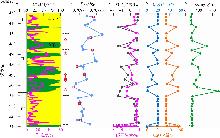
图2
南科1井南湾组下部的岩性地层及主要矿物、地球化学特征 a. 地层、矿物组成及孔隙度; b. Sr同位素组成; c. δ18O和δ13C同位素组成; d. MgO和CaO含量; e. Sr含量。图a中的红色空心五角星代表原位激光测试的采样层位, 黑色曲线代表暴露面所在层位。图b中蓝色实心圆代表Sr同位素数据来自团队已发表文章(Li et al, 2023), 红色空心方框代表本文增加的Sr同位素数据"
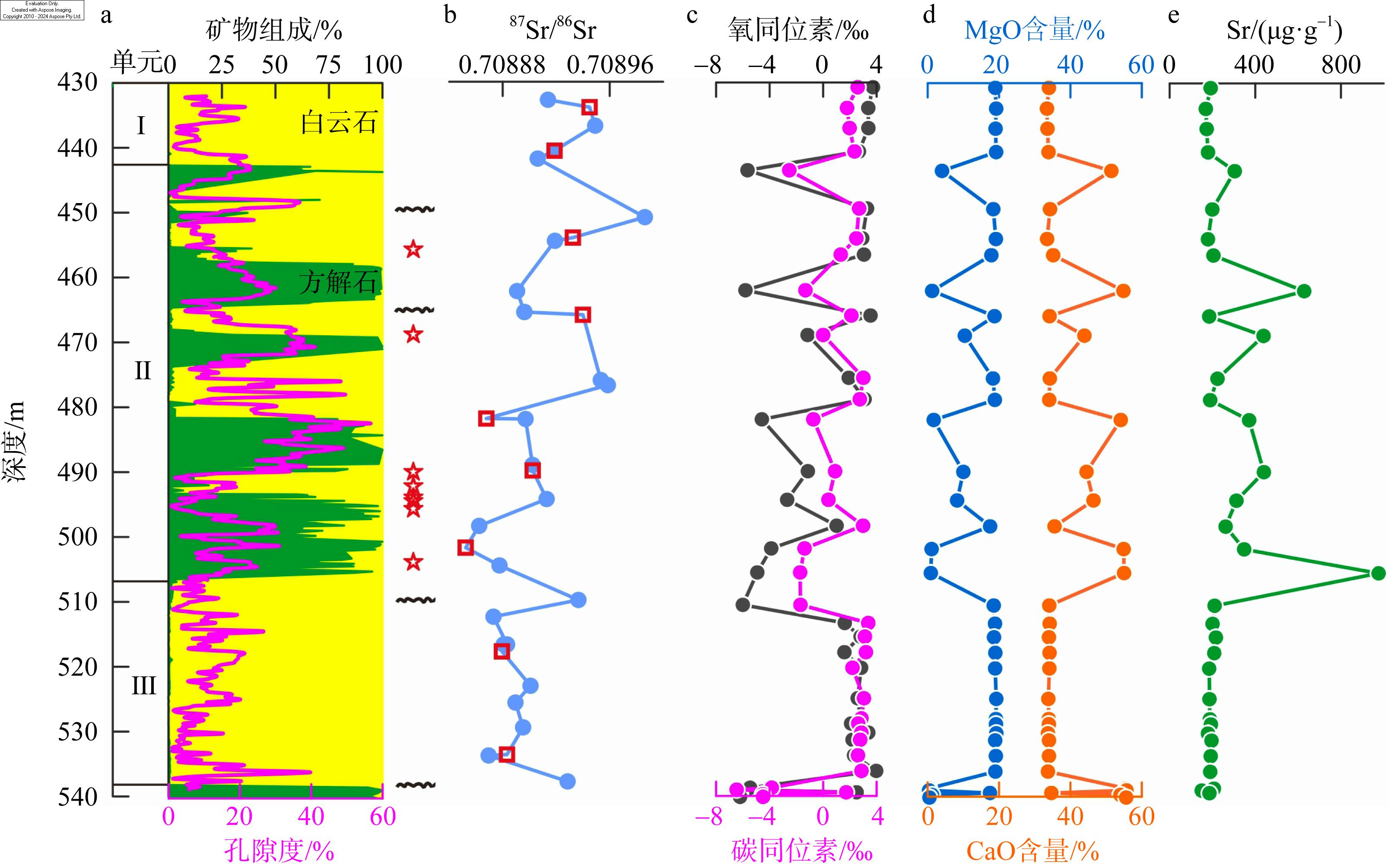
图2
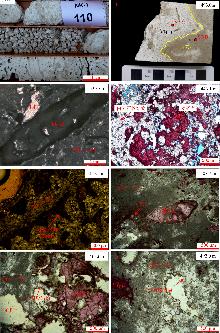
图3
NK-1井南湾组岩芯手标本与镜下照片 a. 手标本照片, 显示暴露面附近有许多铸模孔隙; b. 颗粒灰石, 其中白色为方解石, 棕色为白云石。红色实心圆代表用于Sr同位素分析的微钻取样位置, S7-C和S7-D分别表示S7样品中的方解石和白云石部分; c. 交代白云石, 带有藻碎片。前体生物碎屑结构保存完好, 孔隙边缘不发育白云石胶结物; d. 白云质灰岩, 显示白云石胶结物“漂浮”在方解石中; e. 灰质白云岩, 未云化的珊瑚骨骼和交代白云石, 白云石具有雾心亮边结构; f. 白云质灰岩, 含有未云化的有孔虫; g, h. 灰质白云岩, 发育交代白云石、白云石胶结物(孔隙边缘)和未白云化的方解石。图b~h右上角数字为样品层位深度"

图3
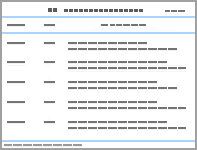
表1
NK-1井南湾组下段不同白云石化程度碳酸盐岩的矿物组成及白云石化学计量学参数"
| 样品编号 | 深度/m | 方解石含量/% | 白云石含量/% | 白云石阳离子有序度 | d(104) | CaCO3/(mol%) | 白云石类型 | 白云石胶结物含量/% |
|---|---|---|---|---|---|---|---|---|
| S1 | 489.8 | 77.8 | 22.2 | 0.43 | 2.90806 | 58.2 | HCD | 40 |
| S2 | 495.5 | 71.9 | 28.1 | 0.43 | 2.90419 | 56.9 | HCD | 20 |
| S3 | 503.7 | 70.3 | 29.7 | 0.36 | 2.90529 | 57.3 | HCD | 10 |
| S4 | 494.3 | 48.5 | 51.5 | 0.36 | 2.90538 | 57.3 | HCD | 30 |
| S5 | 455.5 | 38.9 | 61.1 | 0.34 | 2.90197 | 56.2 | HCD | 10 |
| S6 | 468.6 | 20.4 | 79.6 | 0.33 | 2.90288 | 56.5 | HCD | 20 |
| S7 | 493.0 | 20.3 | 79.7 | 0.34 | 2.91119 | 59.3 | HCD | 20 |
| S8 | 492.0 | 18.9 | 81.1 | 0.38 | 2.91019 | 58.9 | HCD | 30 |
| S9 | 476.3 | 0.8 | 99.2 | 0.45 | 2.90079 | 55.8 | HCD | 30 |
表1
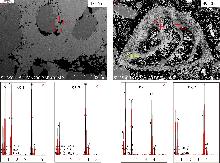
图4
南湾组下部白云岩的背散射图像和能谱分析 a和b为样品S5和S8的背散射图像, 浅灰白色为方解石, 深灰色为白云石, 黑色为孔隙, 图中右上角数字为样品所在钻孔层位; c和d为图a中S5-1和S5-2点位的能谱数据图; e和f为图b中S8-1和S8-2点位的能谱数据图"

图4
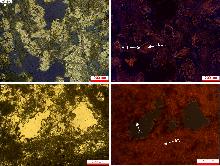
图5
白云石微观特征及其对应的阴极发光特征 a, b. 结构破坏性白云岩。细粉晶白云石胶结物的核心(呈橙红色发光)为DC-Ⅰ型, 白云石胶结物的边缘(呈带状交替发光)为DC-Ⅱ型。图b中白云石胶结物的云雾状晶体核心往往具有与交代白云石相同的橙红色发光。c, d. 藻类碎片呈橘红色发光, 内部含有大量泥微晶的交代白云石(RD), 孔隙边缘的白云石胶结物(DC)不发光"
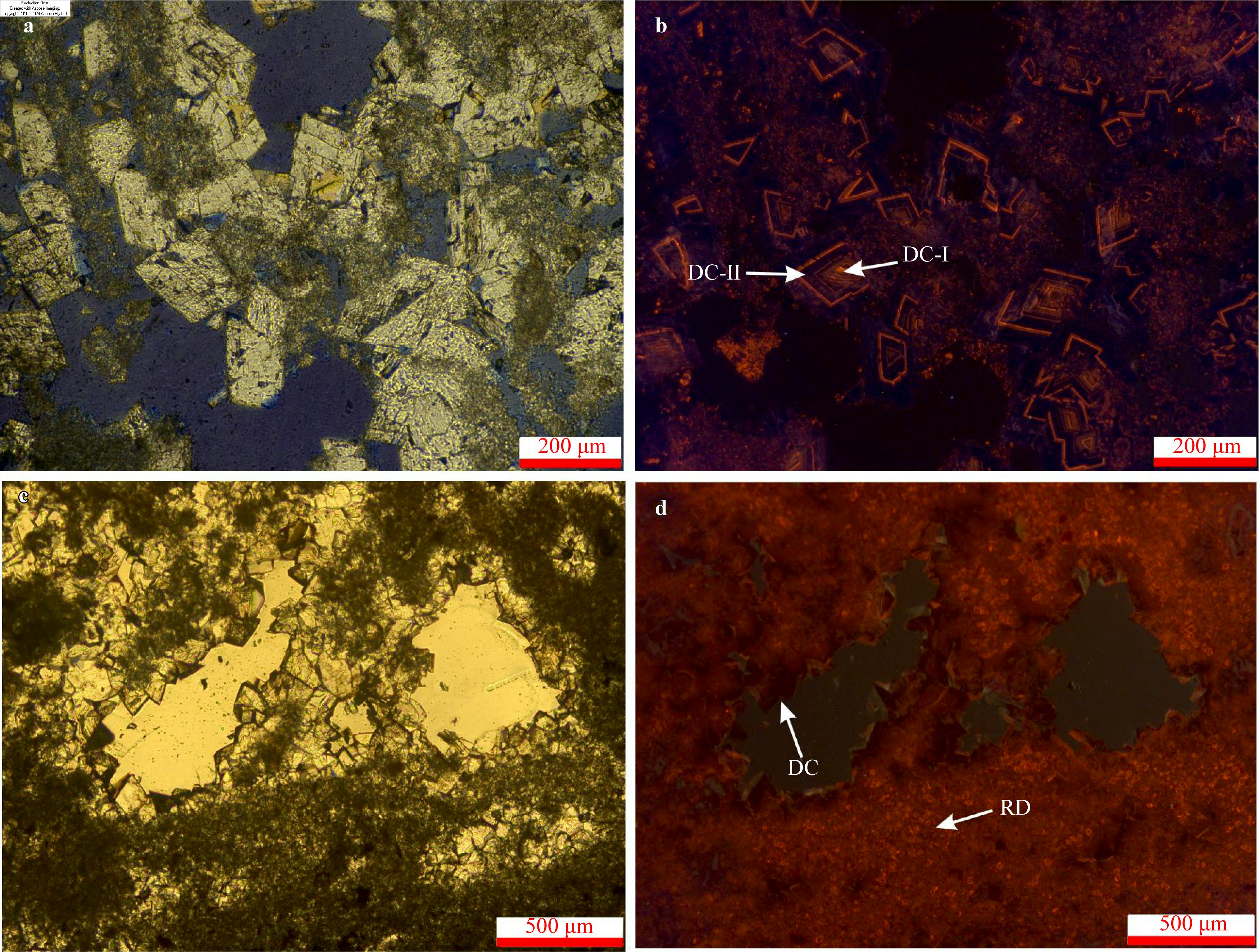
图5
表2
方解石(珊瑚骨架)与交代白云石的原位激光U-Pb定年和Sr同位素定年结果"
| 样品号 | 深度/m | 矿物组成 | 87Sr/86Sr | Sr同位素年龄/Ma | 原位U-Pb年龄/Ma |
|---|---|---|---|---|---|
| S7-C | 493.0 | 方解石(100%) | 0.708862±5 | 10.9 | - |
| S7-D | 交代白云石(99.2%) | 0.708865±5 | 10.8 | 10.7±0.8 | |
| S4-C | 494.3 | 方解石(100%) | 0.708860±5 | 11.0 | - |
| S4-D | 交代白云石(98.3%) | 0.708861±4 | 11.0 | 11.0±0.3 |
表2
图6
南湾组下部岩石中前体方解石和交代白云石的Sr同位素年龄图(a)和交代白云石原位U-Pb年龄协和图(b、c) MSWD为平均平方加权偏差, n为样品点数"
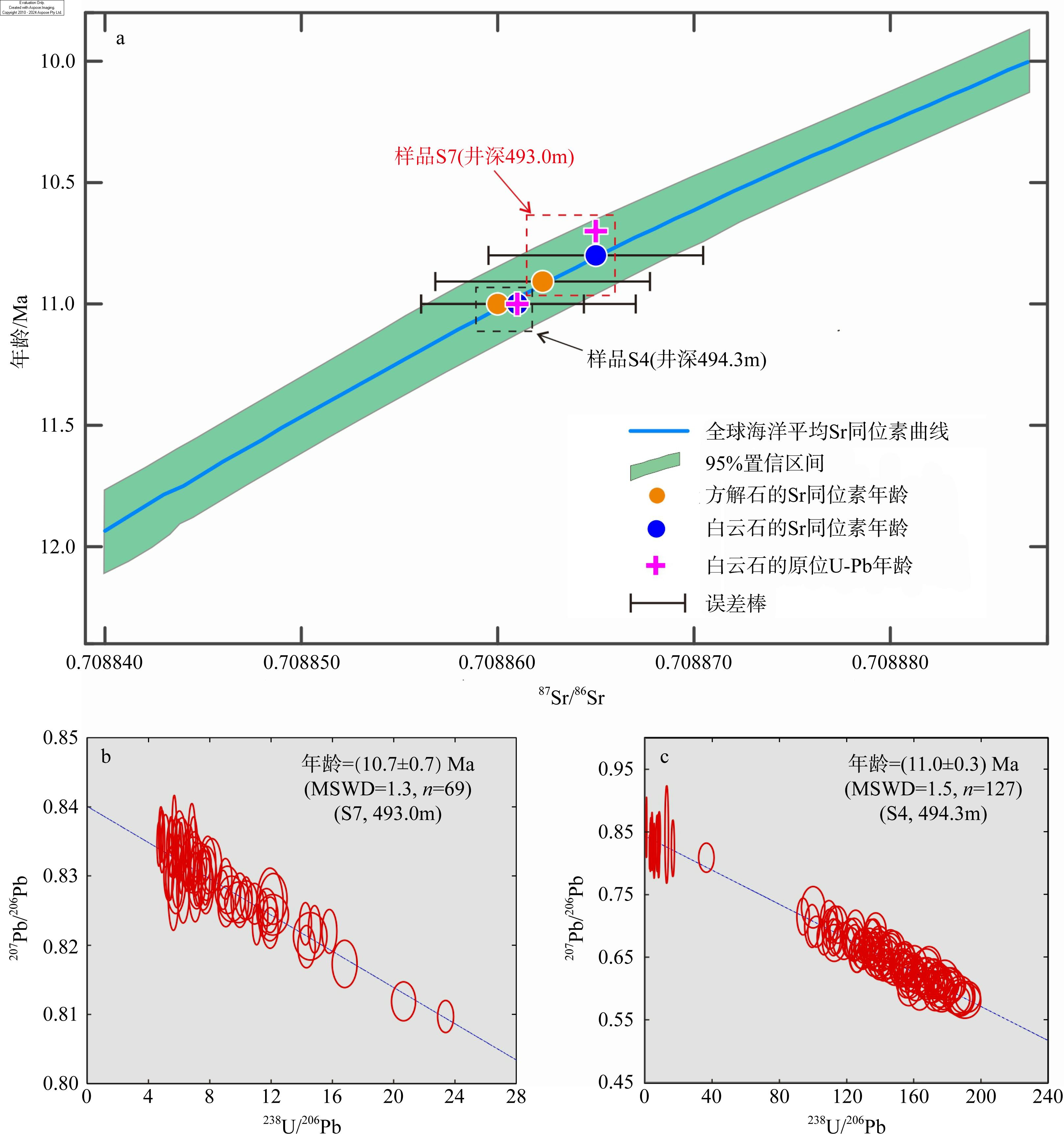
图6
图7
方解石、交代白云石和白云石胶结物的原位稀土元素组成(a)和灰岩和白云岩的碳氧同位素组成(b) 图a中现代珊瑚和南海表层海水的稀土元素数据分别来自Luo等(2021)和Alibo等(2000)"
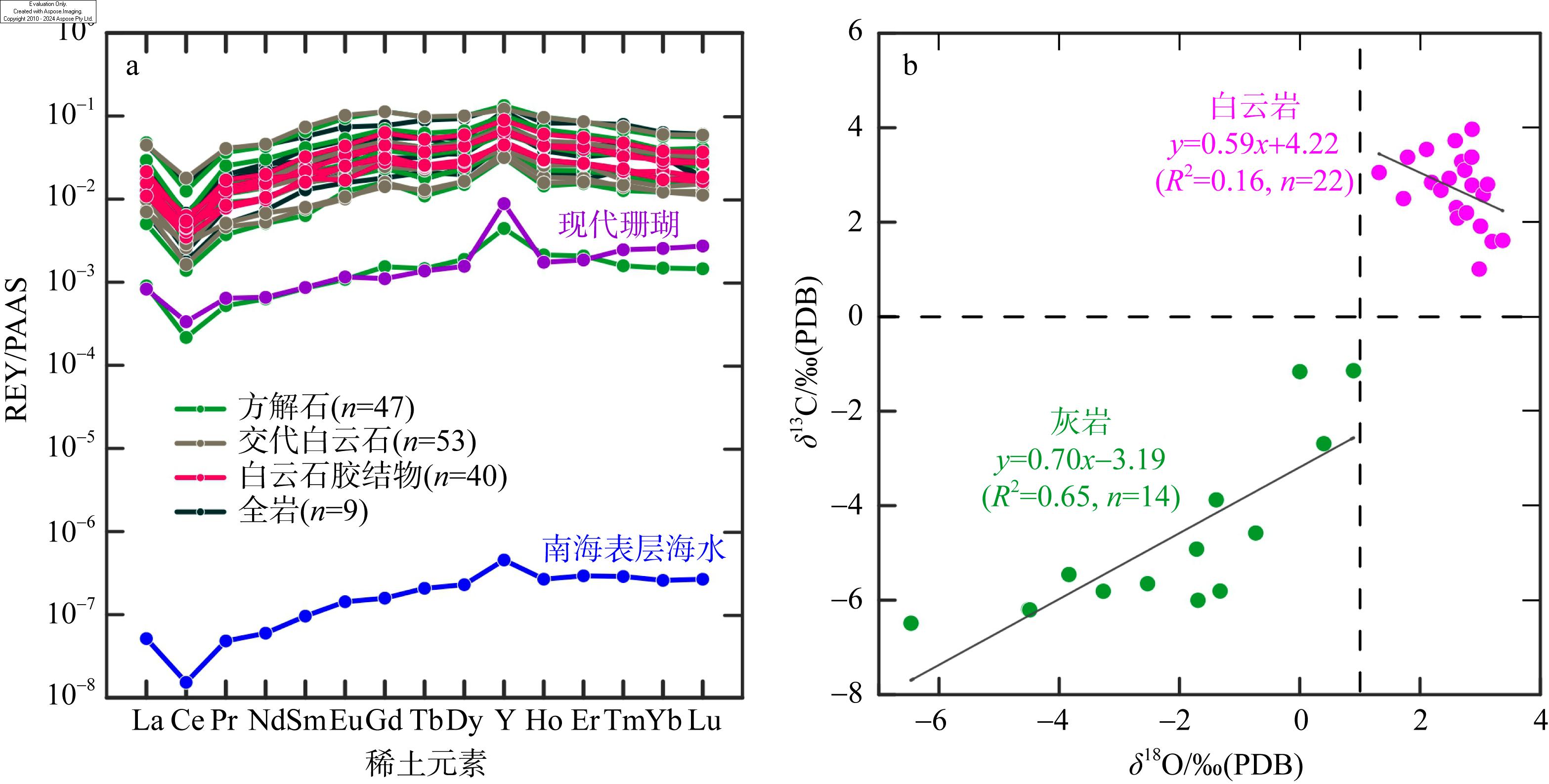
图7
表3
南湾组下部碳酸盐岩中不同组分的原位元素组成"
| 样品编号 | 深度/m | 矿物类型 | 原位分析点数 | Mg/Ca (mol/mol) | Mn/(μg·g-1) | Fe/(μg·g-1) | Sr/(μg·g-1) | Mn/Sr |
|---|---|---|---|---|---|---|---|---|
| S1 | 489.8 | 方解石 | 2 | 0.03 | 15.7 | 255 | 640 | 0.02 |
| 交代白云石 | N/A | N/A | N/A | N/A | N/A | N/A | ||
| 白云石胶结物 | 9 | 0.53 | 6.7 | 118 | 173 | 0.04 | ||
| S2 | 495.5 | 方解石 | 8 | 0.04 | 13.3 | 142 | 888 | 0.03 |
| 交代白云石 | 9 | 0.48 | 10.3 | 130 | 251 | 0.04 | ||
| 白云石胶结物 | 4 | 0.62 | 5.2 | 102 | 204 | 0.02 | ||
| S3 | 503.7 | 方解石 | 13 | 0.05 | 17.6 | 122 | 519 | 0.04 |
| 交代白云石 | 15 | 0.53 | 19.1 | 110 | 222 | 0.09 | ||
| 白云石胶结物 | N/A | N/A | N/A | N/A | N/A | N/A | ||
| S5 | 455.5 | 方解石 | 7 | 0.01 | 0.3 | 127 | 1523 | 0.00 |
| 交代白云石 | 13 | 0.61 | 4.5 | 93 | 197 | 0.02 | ||
| 白云石胶结物 | 3 | 0.64 | 4.6 | 96 | 174 | 0.03 | ||
| S6 | 468.6 | 方解石 | 3 | 0.01 | 0.9 | 118 | 494 | 0.00 |
| 交代白云石 | 2 | 0.63 | 5.6 | 90 | 223 | 0.03 | ||
| 白云石胶结物 | 5 | 0.66 | 4.6 | 78 | 192 | 0.02 | ||
| S7 | 493.0 | 方解石 | 12 | 0.03 | 22.6 | 134 | 239 | 0.11 |
| 交代白云石 | 7 | 0.53 | 7.0 | 109 | 241 | 0.03 | ||
| 白云石胶结物 | 13 | 0.62 | 7.0 | 99 | 190 | 0.04 | ||
| S8 | 492.0 | 方解石 | 2 | 0.02 | 4.6 | 127 | 1300 | 0.00 |
| 交代白云石 | 7 | 0.58 | 10.1 | 99 | 259 | 0.04 | ||
| 白云石胶结物 | 6 | 0.67 | 3.9 | 89 | 212 | 0.02 |
表3
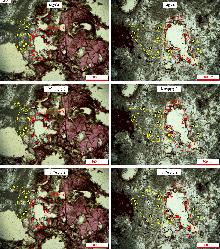
图8
交代白云石与白云石胶结物的Mg/Ca (a, b)、Mn (c, d)和Sr (e, f)含量对比图中数字表示元素比值或含量"

图8
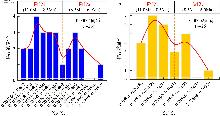
图9
南湾组下部地层白云岩Sr同位素年龄的统计分布 图中红色曲线表示不同间隔间的趋势变化, 均为双峰型; 图中红色虚线为两个阶段的分隔线"
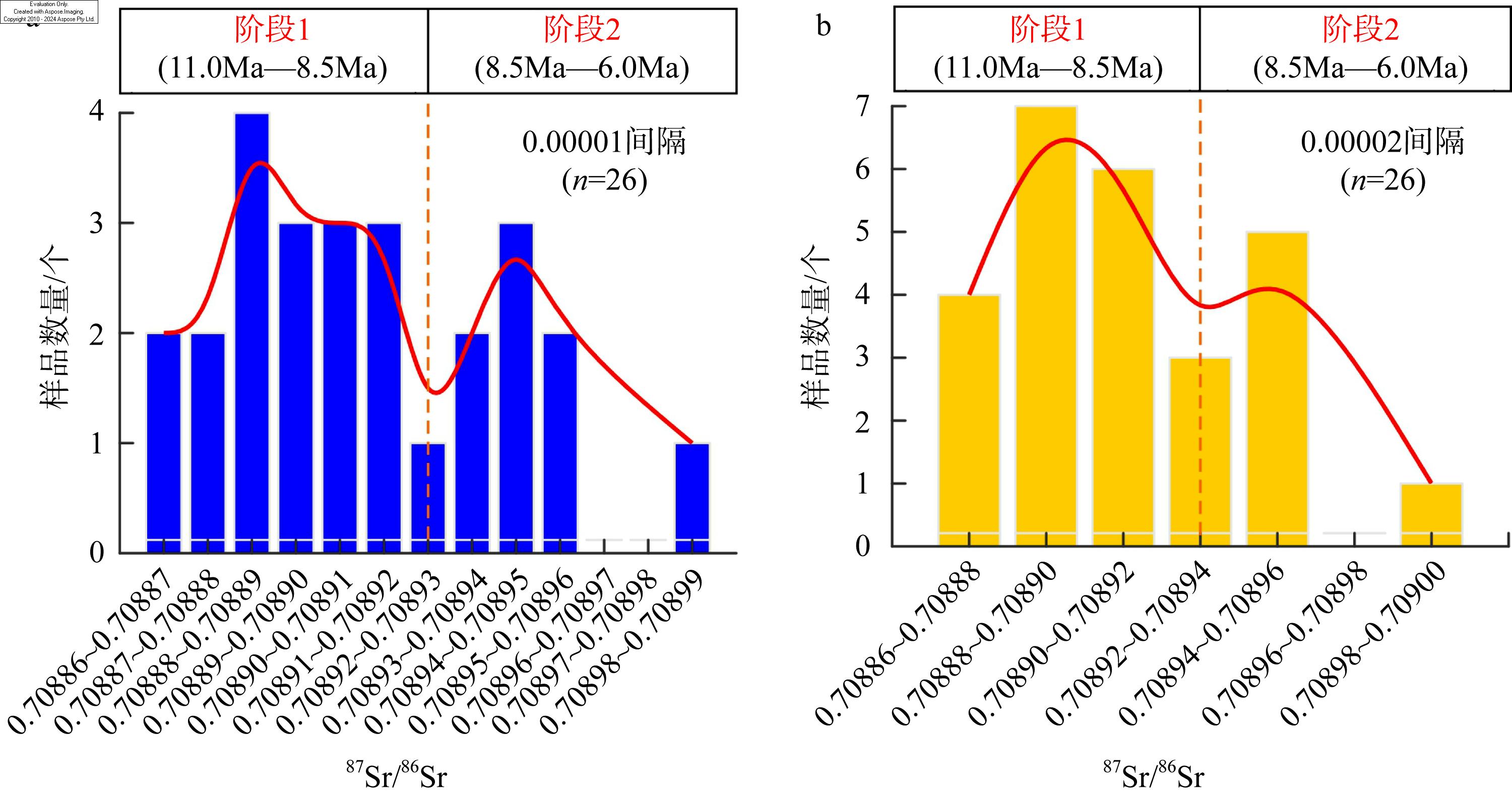
图9
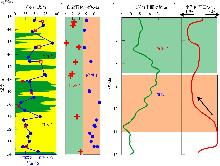
图10
南湾组下部地层的白云石化阶段与海平面变化历史 a. 矿物组成与Sr同位素组成分布; b. Sr同位素年代地层; c. 晚中新世期间全球海平面变化历史, 数据来自文献Miller等(2020); d. 晚中新世期间南海海平面变化历史, 数据来自文献Shao等(2017)。图a中黄色部分表示白云石, 绿色部分表示方解石, 蓝色实心圆代表Sr同位素数据来自团队已发表文章(Li et al, 2023), 红色空心方框为本文新增的11个Sr同位素数据。图b中红色十字为阶段2的白云石化年龄, 蓝色圆点为阶段1的白云石化年龄。图d中黑色箭头表示海平面上升"
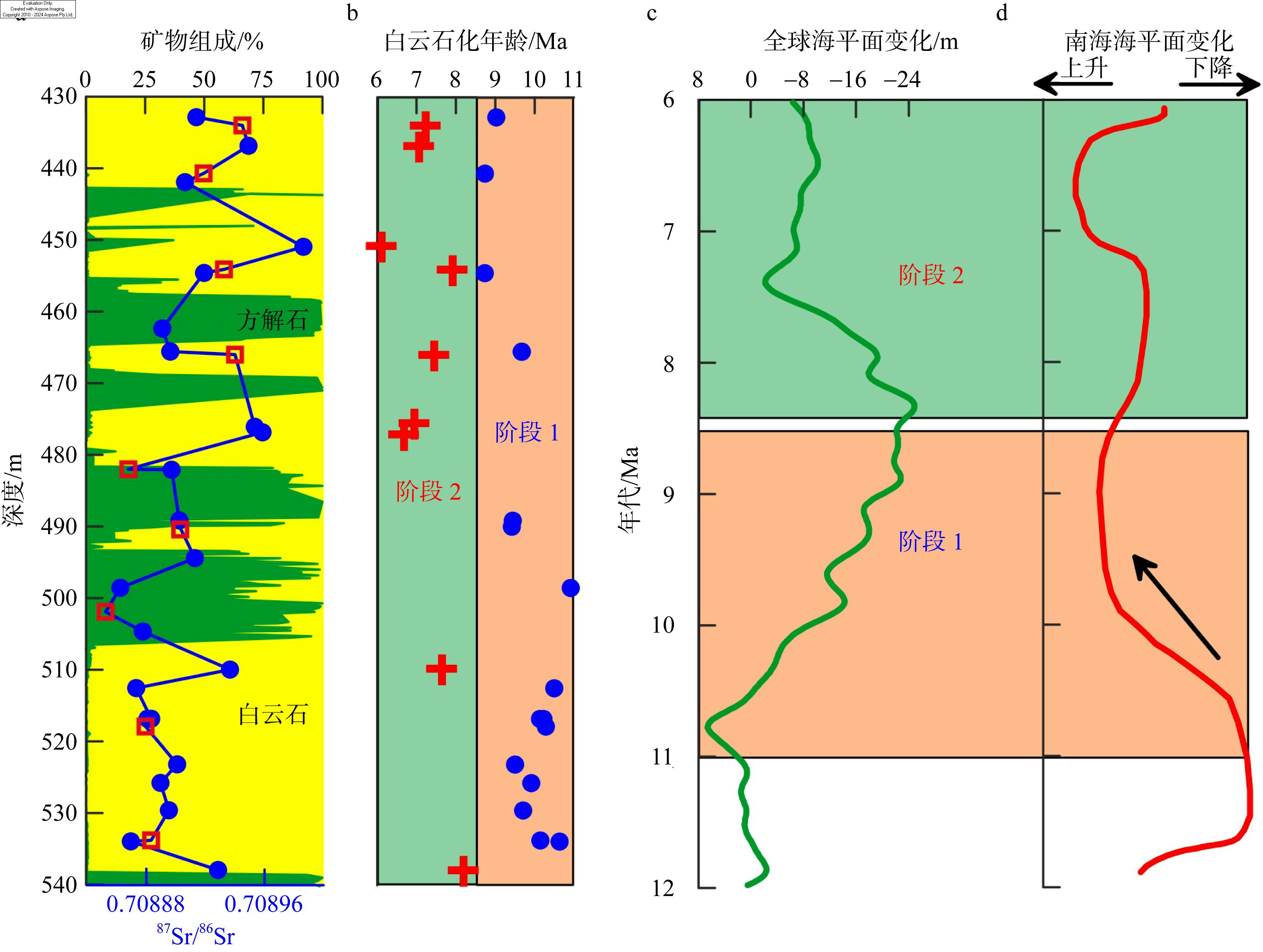
图10
图11
美济礁南科1井南湾组下部差异白云石化模型示意图 a, b, c表示宏观尺度; d, e, f表示微观尺度。d, e, f中绿色表示未发生白云石化(前体方解石), 黄色表示白云石化"
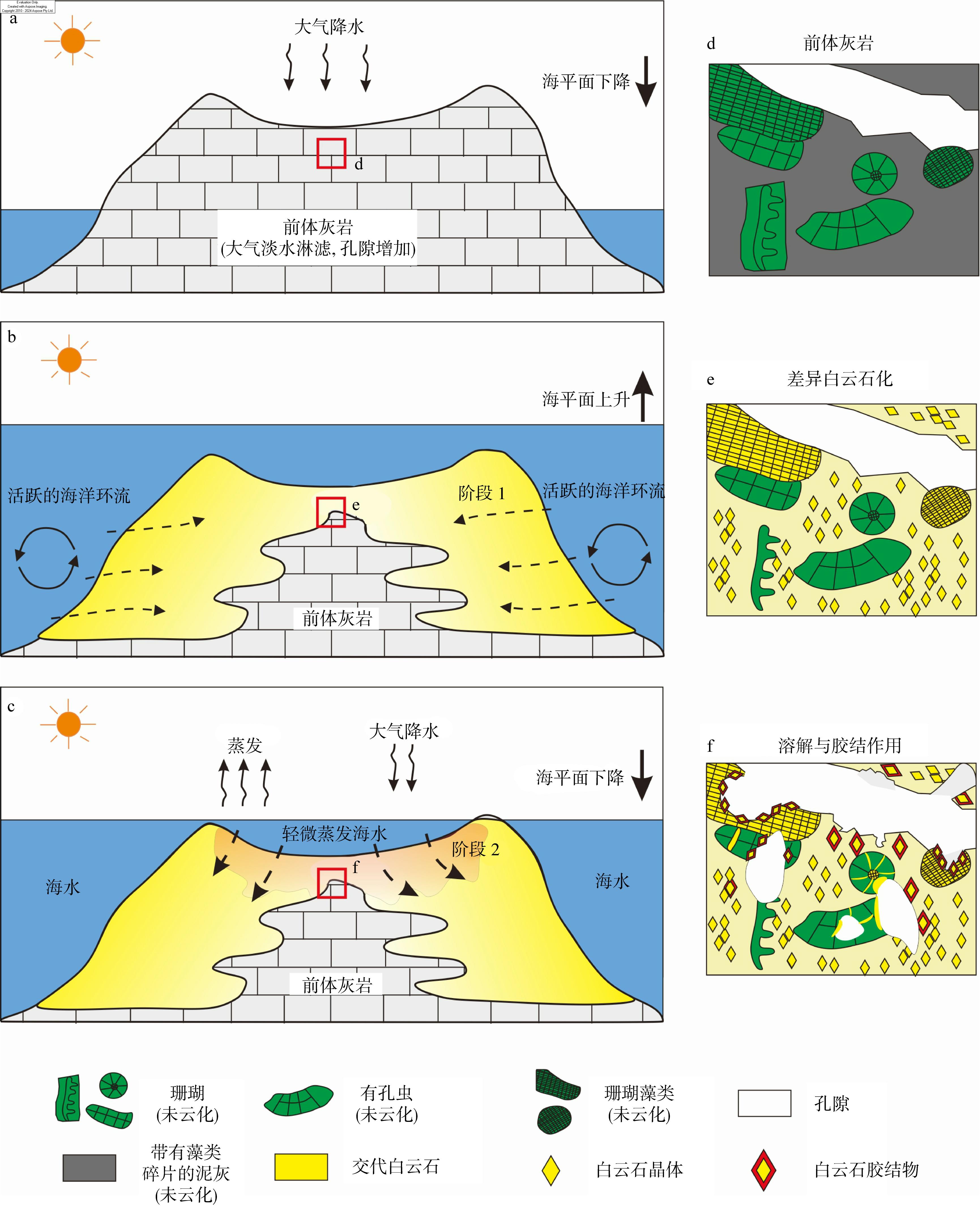
图11
| [1] |
黄康俊, 滕方振, 沈冰, 等, 2022. 镁同位素示踪表生地质过程的原理及应用[J]. 矿物岩石地球化学通报, 41(2): 213-234.
|
|
|
|
| [2] |
李波, 颜佳新, 刘喜停, 等, 2010. 白云岩有机成因模式: 机制、进展与意义[J]. 古地理学报, 12(6): 699-710.
|
|
|
|
| [3] |
李建忠, 陶小晚, 白斌, 等, 2021. 中国海相超深层油气地质条件、成藏演化及有利勘探方向[J]. 石油勘探与开发, 48(1): 52-67.
|
|
|
|
| [4] |
罗云, 黎刚, 徐维海, 等, 2022. 南科1井第四系暴露面特征及其与海平面变化的关系[J]. 热带海洋学报, 41(1): 143-157.
|
|
|
|
| [5] |
马永生, 郭彤楼, 赵雪凤, 等, 2007. 普光气田深部优质白云岩储层形成机制[J]. 中国科学
|
|
( D辑( A2): 43-52.
|
|
| [6] |
梅冥相, 2012. 从3个科学理念简论沉积学中的“白云岩问题”[J]. 古地理学报, 14(1): 1-12.
|
|
|
|
| [7] |
史德锋, 李潇雨, 王亚辉, 等, 2020. 中国南海西沙地区西科1井中新统白云岩中微生物特征及其对白云石化的启示[J]. 矿物岩石, 40(2): 104-113.
|
|
|
|
| [8] |
魏喜, 祝永军, 许红, 等, 2006. 西沙群岛新近纪白云岩形成条件的探讨: C、O同位素和流体包裹体证据[J]. 岩石学报, 22(9): 2394-2404.
|
|
|
|
| [9] |
许红, 张金川, 蔡峰, 1994. 西沙群岛中新世生物礁矿物相研究及其意义[J]. 海洋地质与第四纪地质, 14(4): 15-23.
|
|
|
|
| [10] |
詹文欢, 钟建强, 刘以宣, 等, 1995. 南沙西南地区新构造运动及其动力学机制[J]. 海洋通报(6): 53-60.
|
|
|
|
| [11] |
|
| [12] |
|
| [13] |
|
| [14] |
|
| [15] |
|
| [16] |
|
| [17] |
|
| [18] |
|
| [19] |
|
| [20] |
|
| [21] |
|
| [22] |
|
| [23] |
|
| [24] |
|
| [25] |
|
| [26] |
|
| [27] |
|
| [28] |
|
| [29] |
|
| [30] |
|
| [31] |
|
| [32] |
|
| [33] |
|
| [34] |
|
| [35] |
|
| [36] |
|
| [37] |
|
| [38] |
|
| [39] |
|
| [40] |
|
| [41] |
|
| [42] |
|
| [43] |
|
| [44] |
|
| [45] |
|
| [46] |
|
| [47] |
|
| [48] |
|
| [49] |
|
| [50] |
|
| [51] |
|
| [52] |
|
| [53] |
|
| [54] |
|
| [55] |
|
| [56] |
|
| [57] |
|
| [58] |
|
| [59] |
|
| [60] |
|
| [61] |
|
| [62] |
|
| [63] |
|
| [64] |
|
| [65] |
|
| [66] |
|
| [67] |
|
| [68] |
|
| [69] |
|
| [70] |
|
| [71] |
|
| [72] |
|
| [73] |
|
| [74] |
|
| [75] |
|
| [76] |
|
| [77] |
|
| [78] |
|
| [79] |
|
| [80] |
|
| [81] |
|
| [82] |
|
| [83] |
|
| [84] |
|
| [85] |
|
| [86] |
|
| [87] |
|
| [88] |
|
| [89] |
|
| [90] |
|
| [91] |
|
| [92] |
|
| [1] | 苗秀全, 张运迎, 颜文. 海扩张机制的制约*[J]. 热带海洋学报, 2026, 45(5): 35-52. |
| [2] | 黎刚, 徐维海, 罗云, 刘建国, 赵建新, 俸月星, 程俊, 孙珍, 向荣, 徐敏, 颜文. 基于南沙美济礁深钻的南海南部新生代构造演化研究[J]. 热带海洋学报, 2026, 45(5): 16-34. |
| [3] | 朱小畏, 莫梓谊, 茅晟懿, 田雨杭, 罗云, 苗莉, 徐维海, 黎刚, 颜文. 南沙美济礁南科1井生物标志物组成分布特征及其环境指示*[J]. 热带海洋学报, 2026, 45(5): 162-177. |
| [4] | 黄康俊, 张攀, 冯东, 颜文. 海相碳酸盐岩体系镁同位素组成控制因素及其指示意义*[J]. 热带海洋学报, 2026, 45(5): 146-161. |
| [5] | 李若安, 李旭清, 陈天然. 南海南部珊瑚骨骼δ18O和Sr/Ca对ENSO的分级响应[J]. 热带海洋学报, 2025, 44(4): 45-55. |
| [6] | 韩雪, 徐维海, 罗云, 黎刚, 刘建国, 朱小畏, 程俊, 苗莉, 向荣, 颜文. 南沙群岛南科1井白云岩发育特征及铁白云石成因机制的初步研究*[J]. 热带海洋学报, 2022, 41(5): 74-88. |
| [7] | 罗云, 黎刚, 徐维海, 程俊, 刘建国, 颜文. 南科1井第四系暴露面特征及其与海平面变化的关系*[J]. 热带海洋学报, 2022, 41(1): 143-157. |
| [8] | 廖秀丽, 戴明, 巩秀玉, 刘华雪, 黄洪辉. 南海南部次表层叶绿素a质量浓度最大值及其影响因子*[J]. 热带海洋学报, 2018, 37(1): 45-56. |
| [9] | 张燕, 何蕾, 殷克东, 姜玥璐, 姚景龙, 王东晓. 南海南部陆坡区生态要素垂向分布和日变化特征及其与物理环境的关系[J]. 热带海洋学报, 2014, 33(6): 68-72. |
| [10] | 周鹏,李冬梅,刘广山,门武,纪利红. 南海东北部和南部海域表层沉积物生物硅研究[J]. 热带海洋学报, 2010, 29(4): 40-47. |
| [11] | 向荣,陈木宏,成鑫荣,张兰兰,陆钧,刘建国,陈忠 . 南海南部水体和沉积物中的浮游有孔虫氧碳同位素分析[J]. 热带海洋学报, 2009, 28(3): 59-66. |
|
||