

热带海洋学报 ›› 2025, Vol. 44 ›› Issue (6): 39-50.doi: 10.11978/2025004CSTR: 32234.14.2025004
珠江三角洲河口湾现代生物遗迹的组成和分布特征
刘泽宇1( ), 张国成1,2, 王媛媛1,2()
- 1
河南理工大学资源环境学院
2河南省生物遗迹与成矿过程重点实验室
-
收稿日期:2025-01-04修回日期:2025-04-17出版日期:2025-11-10发布日期:2025-12-03 -
通讯作者:王媛媛。email: yyw@hpu.edu.cn -
作者简介:刘泽宇(2001—), 男, 河南省安阳市人, 硕士研究生, 从事沉积学、遗迹学研究。email: l061888@163.com
-
基金资助:国家自然科学基金项目(42172130); 河南省本科高校青年骨干教师培养计划(2023GGJS055)
Composition and distribution characteristics of modern biological relics in the estuary of Pearl River Delta
LIU Zeyu1(), ZHANG Guocheng1,2, WANG Yuanyuan1,2()
- 1
Institute of Resource and Environment ,Henan Polytechnic University
2Henan Key Laboratory of Biogenie Traces & Sedimentary Minerals of Henan Province
-
Received:2025-01-04Revised:2025-04-17Online:2025-11-10Published:2025-12-03 -
Contact:WANG Yuanyuan. email: yyw@hpu.edu.cn -
Supported by:National Natural Science Foundation of China(42172130); Yong Backbone Teachers Training Program of Henan Province(2023GGJS055)

摘要:
珠江三角洲河口湾受到波浪、潮汐和河流共同作用, 沉积环境独特, 现代生物遗迹丰富, 而生物遗迹可以提供沉积过程中环境变化的高灵敏信息, 高精度识别珠江三角洲河口湾生物遗迹的组成, 建立生物遗迹分布与沉积环境的关系模式, 可丰富现代河口湾的遗迹学知识。本文运用沉积学和遗迹学方法深入研究珠江三角洲河口湾生物遗迹, 通过盐度、粒度、浑浊度分析及 X 射线计算机断层扫描和重构方法对采集的岩心进行测试, 精细研究了不同微环境中的生物遗迹特征, 结果表明: (1)造迹生物主要包括螃蟹、双齿围沙蚕、弹涂鱼、寄居蟹和沙蚬等, 层面遗迹以爬行迹和足辙迹为主, 亦有拖迹、觅食迹、挖掘迹、鸟足迹和沙蚕粪粒, 层内居住迹最为丰富, 潜穴形态表现为I形、Y形和U形; (2)珠江三角洲河口湾生物遗迹在空间分布上存在不均衡性, 潮坪的生物遗迹类型多样性和密度较其他微环境高; (3)底栖造迹生物栖息于沉积底层中的不同空间位置, 小螃蟹、弹涂鱼和沙蚬栖息在沉积层浅层, 大螃蟹和双齿围沙蚕在中层, 深层主要由双齿围沙蚕占据, 反映出其对生态空间的适应性和扰动强度。该研究为珠江三角洲河口湾现代沉积学和遗迹学提供实证资料, 并为古遗迹学和古环境重构提供了基础资料, 增强对古河口湾环境的精准理解。
中图分类号:
- P512.2
引用本文
刘泽宇, 张国成, 王媛媛. 珠江三角洲河口湾现代生物遗迹的组成和分布特征[J]. 热带海洋学报, 2025, 44(6): 39-50.
LIU Zeyu, ZHANG Guocheng, WANG Yuanyuan. Composition and distribution characteristics of modern biological relics in the estuary of Pearl River Delta[J]. Journal of Tropical Oceanography, 2025, 44(6): 39-50.
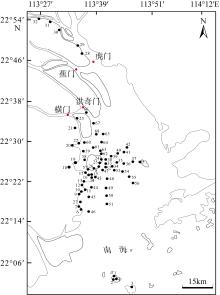
图1
研究区位置图 该图基于广东省公共地图服务系统下载的审图号GS粤(2024)1858号地图制作,图2、4同; 数字为本文取样点, 红点为潮汐型河口"

图1
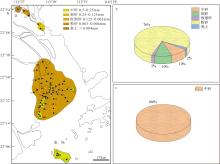
图2
珠江三角洲河口湾沉积物粒度特征图 a. 珠江三角洲河口湾采样点位沉积物粒度分布; b. 河口湾和湾外浅海沉积粒度点位占比; c. 湾外岛屿水域砂沉积粒度点位占比"

图2
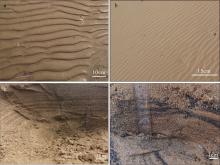
图3
河口湾砂质沉积物物理沉积构造特征 a. 弯脊波痕; b. 分叉波痕; c. 砂质韵律层理; d. 交错层理。a、b引自王媛媛 等(2024)"

图3
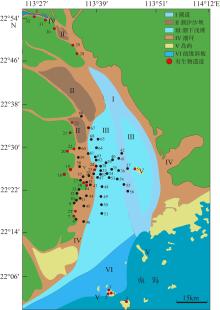
图4
珠江三角洲河口湾微环境划分及其生物遗迹分布"

图4
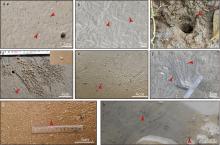
图5
珠江三角洲河口湾潮坪生物遗迹 a. 螃蟹潜穴附近的足辙迹; b. 螃蟹的层面凹痕状爬行迹; c. 螃蟹的潜穴居住迹; d. 螃蟹的挖掘迹(右上角为造迹生物); e. 弹涂鱼的U形带状爬行迹; f. 弹涂鱼的居住迹以及潜穴附近的觅食迹, 引自王媛媛 等(2024); g. 双齿围沙蚕的长直型爬行迹; h. 双齿围沙蚕的线条状粪泥排泄物以及居住迹; 红头箭头指示图中描绘遗迹"

图5
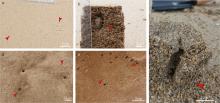
图6
珠江三角洲河口湾岛屿生物遗迹 a. 砂质层面的鸟足迹; b. 沙蚬生存的居住迹潜穴; c. 沙蚬居住迹的潜穴剖面; d. 螃蟹居住潜穴和足辙迹; e. 寄居蟹的层面弯曲形拖迹。红头箭头指示图中描绘遗迹"

图6
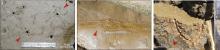
图7
珠江三角洲河口湾潮汐沙坝生物遗迹 a. 螃蟹的放射线形排列的挖掘球粒; b. 弹涂鱼的拖迹; c. 沙蚕的潜穴剖面居住迹。红头箭头指示图中描绘遗迹"

图7
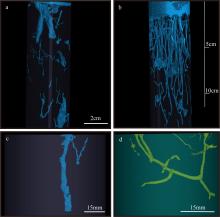
图8
造迹生物潜穴的三维形态 a. 螃蟹Y、U、I形潜穴形态; b. 双齿围沙蚕Y、U、I形潜穴以及与螃蟹共生潜穴形态; c. Y 形沙蚕潜穴和I 形螃蟹潜穴形态; d. 沙蚕Y形和L形潜穴形态"

图8
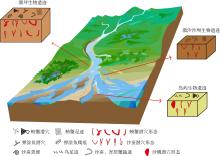
图9
珠江三角洲河口湾生物遗迹分布"

图9
| [1] |
陈伟, 1993. 河口湾动力响应特征[J]. 水动力学研究与进展(A辑), 8(S1): 552-559.
|
|
|
|
| [2] |
陈耀泰, 1995. 珠江口沉积分区[J]. 中山大学学报(自然科学版), 34(3): 109-114.
|
|
|
|
| [3] |
方神光, 喻丰华, 2023. 洪季伶仃洋水域径潮动力作用机制及演变探讨[J]. 海岸工程, 42(4): 301-316.
|
|
|
|
| [4] |
宫清华, 周晴, 李平日, 等, 2019. 珠江口伶仃洋地貌特征演变与纳潮能力变化研究[J]. 海洋学报, 41(1): 98-107.
|
|
|
|
| [5] |
何用, 吴尧, 卢陈, 2022. 珠江河口演变与治理保护探讨[J]. 泥沙研究, 47(6): 1-8.
|
|
|
|
| [6] |
胡斌, 王冠忠, 齐永安, 1997. 痕迹学理论与应用[M]. 徐州: 中国矿业大学出版社: 30-50 (in Chinese).
|
| [7] |
黄畅, 王永红, 杨清书, 等, 2022. 珠江三角洲河网流量的时空变化及影响因素[J]. 中国海洋大学学报(自然科学版), 52(5): 97-106.
|
|
|
|
| [8] |
金长茂, 眭良仁, 1989. 试论河口湾[J]. 海洋学报, 11(3): 378-384 (in Chinese).
|
| [9] |
马道修, 徐明广, 周青伟, 等, 1988. 珠江三角洲沉积相序[J]. 海洋地质与第四纪地质, 8(1): 43-53.
|
|
|
|
| [10] |
|
|
|
|
| [11] |
齐永安, 1999. 河口湾相模式研究[J]. 地质科技情报, 18(1): 45-49.
|
|
|
|
| [12] |
宋慧波, 于会新, 王海邻, 等, 2014. 杭州湾庵东浅滩现代沉积物中的生物遗迹[J]. 古地理学报, 16(5): 703-714.
doi: 10.7605/gdlxb.2014.05.56 |
|
doi: 10.7605/gdlxb.2014.05.56 |
|
| [13] |
王翠, 王媛媛, 胡斌, 2023. 黄河三角洲潮坪环境现代生物遗迹与物化条件的响应关系[J]. 沉积学报, 41(3): 748-762.
|
|
|
|
| [14] |
王海邻, 王长征, 宋慧波, 等, 2017. 杭州湾庵东滨岸潮间带现代沉积物中的生物遗迹特征[J]. 沉积学报, 35(4): 714-729.
|
|
|
|
| [15] |
王润怀, 齐永安, 潘结南, 2000. 河口湾沉积学及层序地层学研究[J]. 焦作工学院学报(自然科学版), 19(3): 188-191.
|
|
|
|
| [16] |
王文介, 1985. 珠江口的沉积作用和沉积相[J]. 沉积学报, 3(2): 129-140.
|
|
|
|
| [17] |
王英国, 王珍如, 1999. 河口湾区生物扰动强度及扰动作用特征研究: 以山海关大石河河口湾为例[J]. 青岛海洋大学学报(自然科学版), 29(4): 709-714.
|
|
|
|
| [18] |
王英国, 2000. 渤海湾西岸大石河河口湾遗迹生态学研究[J]. 古地理学报, 2(1): 54-63.
|
|
|
|
| [19] |
王媛媛, 勾松林, 张国成, 2024. 现代珠江三角洲前缘生物遗迹组成与分布特征[J]. 沉积学报, 42(5): 1512-1529.
|
|
|
|
| [20] |
吴贤涛, 张国成, 吴渤, 等, 2014. 东濮凹陷古近系沙河街组三段河口湾沉积亚相之沉积学与痕迹学识别与油气储层[J]. 沉积学报, 32(4): 744-753.
|
|
|
|
| [21] |
肖志建, 李团结, 廖世智, 2011. 伶仃洋表层沉积物特征及其泥沙运移趋势[J]. 热带海洋学报, 30(4): 58-65.
|
|
doi: 10.11978/j.issn.1009-5470.2011.04.058 |
|
| [22] |
赵焕庭, 1982. 珠江三角洲的形成和发展[J]. 海洋学报, 4(5): 595-607 (in Chinese).
|
| [23] |
赵焕庭, 1984. 珠江河口演变的基本过程[J]. 热带海洋, 3(4): 1-9+92.
|
|
|
|
| [24] |
赵焕庭, 1989. 珠江河口的水文和泥沙特征[J]. 热带地理, 9(3): 201-212.
|
|
|
|
| [25] |
张光威, 1988. 珠江口现代沉积环境的沉积物特征[J]. 海洋地质动态, 4(2): 4-6 (in Chinese).
|
| [26] |
张光威, 马道修, 徐明广, 等, 1988. 珠江口现代沉积物构造特征及其沉积环境[J]. 海洋地质与第四纪地质, 8(3): 71-83.
|
|
|
|
| [27] |
郑建禄, 何锦文, 朱克勤, 1984. 珠江口海域重金属的河口化学研究: Ⅴ. 表层沉积物中粘土矿物的分布[J]. 海洋学报, 6(2): 197-205 (in Chinese).
|
| [28] |
doi: 10.1144/GSL.SP.2004.228.01.10 |
| [29] |
|
| [30] |
|
| [31] |
doi: 10.2110/palo.2004.p04-32 |
| [32] |
doi: 10.1016/j.earscirev.2017.10.006 |
| [33] |
|
| [34] |
|
| [35] |
|
| [36] |
doi: 10.3354/ab00055 |
| [37] |
doi: 10.2307/3515462 |
| [38] |
doi: 10.1175/1520-0485(1989)019<1060:TIVOTD>2.0.CO;2 |
| [39] |
doi: 10.1111/sed.2016.63.issue-3 |
| [40] |
doi: 10.1016/j.sedgeo.2012.03.024 |
| [41] |
doi: 10.2110/jsr.2015.47 |
| [42] |
|
| [43] |
doi: 10.1016/j.sedgeo.2006.05.008 |
| [44] |
doi: 10.1016/j.sedgeo.2016.07.005 |
| [45] |
doi: 10.1016/j.pocean.2013.05.018 |
| [46] |
doi: 10.1111/sed.1981.28.issue-2 |
| [47] |
doi: 10.1306/D4267F50-2B26-11D7-8648000102C1865D |
| [48] |
doi: 10.1016/j.ecss.2012.09.005 |
| [1] | 何思璇,何斌源. 防城河口湾鱼类群落结构及其与环境因子关系研究[J]. 热带海洋学报, 2019, 38(5): 86-97. |
| [2] | 莫文渊,韦惺,吴超羽. 全新世以来珠江三角洲海鸥沙形成过程的地貌动力学分析[J]. 热带海洋学报, 2019, 38(3): 68-78. |
| [3] | 赖廷和, 何斌源, 黄中坚, 汤乔, 覃漉雁, 朱婷, 莫珍妮, 刘俐, 钟云旭. 防城河口湾潮间带大型底栖动物群落结构研究[J]. 热带海洋学报, 2019, 38(2): 67-77. |
| [4] | 秦莉真, 张蔚, 官明开, 赵晟, 程梁秋. 不同周期分潮簇对复杂河网潮位分布的影响*[J]. 热带海洋学报, 2019, 38(1): 27-34. |
| [5] | 董好刚, 陈宇达. 西江断裂三水至磨刀门段第四纪活动性再研究[J]. 热带海洋学报, 2017, 36(2): 26-32. |
| [6] | 钟广见,吴世敏,冯常茂. 南海北部中生代沉积模式[J]. 热带海洋学报, 2011, 30(1): 43-48. |
|
||