

热带海洋学报 ›› 2026, Vol. 45 ›› Issue (1): 140-153.doi: 10.11978/2025024CSTR: 32234.14.2025024
印度洋赤道深层流的季节内变化特征及其驱动机制*
钟卿文1,2( ), 陈更新1(), 陈举1, 何云开1
- 1热带海洋环境与岛礁生态全国重点实验室(中国科学院南海海洋研究所), 广东 广州 511458
2中国科学院大学, 北京 100049
-
收稿日期:2025-02-18修回日期:2025-03-25出版日期:2026-01-10发布日期:2026-01-30 -
通讯作者:陈更新, 研究员, 博士生导师。email:chengengxin@scsio.ac.cn -
作者简介:钟卿文(1997—), 广东省韶关市人, 博士研究生, 研究方向为海洋环流与波动动力学。email: zhongqingwen@scsio.ac.cn
*本研究所使用的数据来自国家自然科学基金共享航次计划项目, 相关航次编号(及项目批准号)为: NORC2015-10(41549910)、NORC2016-10(41649910)、1ORC2017-10(41749910)、NORC2018-10(41849910)、NORC2019-10(41949910)、NORC2020-10(42049910)、NORC2022-10+NORC2022-303(42149910), 航次由“实验1号”“实验3号”和“实验6号”组织实施, 在此一并致谢
-
基金资助:国家自然科学基金共享航次计划项目(42149910); 国家自然科学基金(42476199); 国家自然科学基金(42476022); 国家自然科学基金共享航次计划项目(41549910); 国家自然科学基金共享航次计划项目(41649910); 国家自然科学基金共享航次计划项目(41749910); 国家自然科学基金共享航次计划项目(41849910); 国家自然科学基金共享航次计划项目(41949910); 国家自然科学基金共享航次计划项目(42049910)
Intraseasonal variability and dynamical mechanisms of equatorial deep currents in the Indian Ocean*
ZHONG Qingwen1,2(), CHEN Gengxin1(), CHEN Ju1, HE Yunkai1
- 1State Key Laboratory of Tropical Oceanography, South China Sea Institute of Oceanology, Chinese Academy of Sciences, Guangzhou 511458, China
2University of Chinese Academy of Sciences, Beijing 100049, China
-
Received:2025-02-18Revised:2025-03-25Online:2026-01-10Published:2026-01-30 -
Contact:CHEN Gengxin. email:chengengxin@scsio.ac.cn -
Supported by:Shiptime Sharing Project of National Natural Science Foundation of China (NSFC)(42149910); National Natural Science Foundation of China(42476199); National Natural Science Foundation of China(42476022); Shiptime Sharing Project of National Natural Science Foundation of China (NSFC)(41549910); Shiptime Sharing Project of National Natural Science Foundation of China (NSFC)(41649910); Shiptime Sharing Project of National Natural Science Foundation of China (NSFC)(41749910); Shiptime Sharing Project of National Natural Science Foundation of China (NSFC)(41849910); Shiptime Sharing Project of National Natural Science Foundation of China (NSFC)(41949910); Shiptime Sharing Project of National Natural Science Foundation of China (NSFC)(42049910)

摘要:
本文利用2015年3月—2021年5月热带印度洋观测网(tropical Indian Ocean observation net, TIOON)在赤道80°E、85°E和93°E布设的观测潜标所获取的环流时间序列, 结合BRAN2020 (Bluelink ReANalysis)环流流速数据以及JRA-55(Japanese 55-year Reanalysis)气象数据, 研究了印度洋赤道深层环流(1200m以下)的季节内变化特征及其驱动机制。观测结果显示, 深层环流流速平均值接近0, 纬向流速标准偏差范围为2.5~3.1cm·s−1, 经向流速标准偏差范围为2.6~3.1cm·s−1。纬向流和经向流的季节内周期信号强度分别占各自总流动强度的88%~91%和74%~84%, 揭示了深层环流中的显著季节内周期变率特征。小波分析表明, 深层纬向流季节内信号主要周期为10~100d, 其中80°E处的周期较长(50~90d), 而93°E处的主要为50d及更高频信号, 表现为蓝移现象, 即环流变化的主导频率随位置靠东而变高的现象。经向流季节内信号以60d周期最显著。赤道风应力异常是深层环流季节内变率的重要驱动因素。中海盆(80°E和85°E)深层环流季节内变率主要受纬向风应力异常驱动, 通过反射波动过程调制; 基于低阶斜压模态, 能量通过Kelvin波在东边界反射后形成的Rossby波向深层传递。东海盆(93°E)深层环流季节内变率主要受纬向和经向风应力异常驱动, 通过直接波动过程调制; 基于多阶斜压模态, 能量通过在环流西侧由风直接驱动产生的Yanai波向深层传递。根据线性波动理论, 本研究刻画了上述赤道波的能量传播射线, 结果显示地形对赤道波调制深海环流的动力过程有重要影响: 中海盆的平坦地形有利于向下向西传播能量的反射波动过程, 而90°E海脊可能会阻碍向下向东传播能量的直接波动过程。在平坦地形区域, 正压不稳定过程在经向上无显著差异且强度弱, 区域平均结果显示能量主要由平均流向环流季节内变率释放; 90°E海脊附近, 环流季节内变率与平均流之间存在更强的非线性动力作用, 表现为环流季节内变率向平均流转移能量。本研究加深了对深层环流动力学的理解, 为改进深海环流模拟提供了观测依据。
中图分类号:
- P731.27
引用本文
钟卿文, 陈更新, 陈举, 何云开. 印度洋赤道深层流的季节内变化特征及其驱动机制*[J]. 热带海洋学报, 2026, 45(1): 140-153.
ZHONG Qingwen, CHEN Gengxin, CHEN Ju, HE Yunkai. Intraseasonal variability and dynamical mechanisms of equatorial deep currents in the Indian Ocean*[J]. Journal of Tropical Oceanography, 2026, 45(1): 140-153.
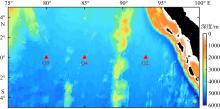
图1
TIOON潜标观测点(Q5、Q4、Q2; 红色三角形)及热带东印度洋海底地形图 该图基于自然资源部标准地图服务网站下载的审图号为GS(2016)1665号的标准地图制作"
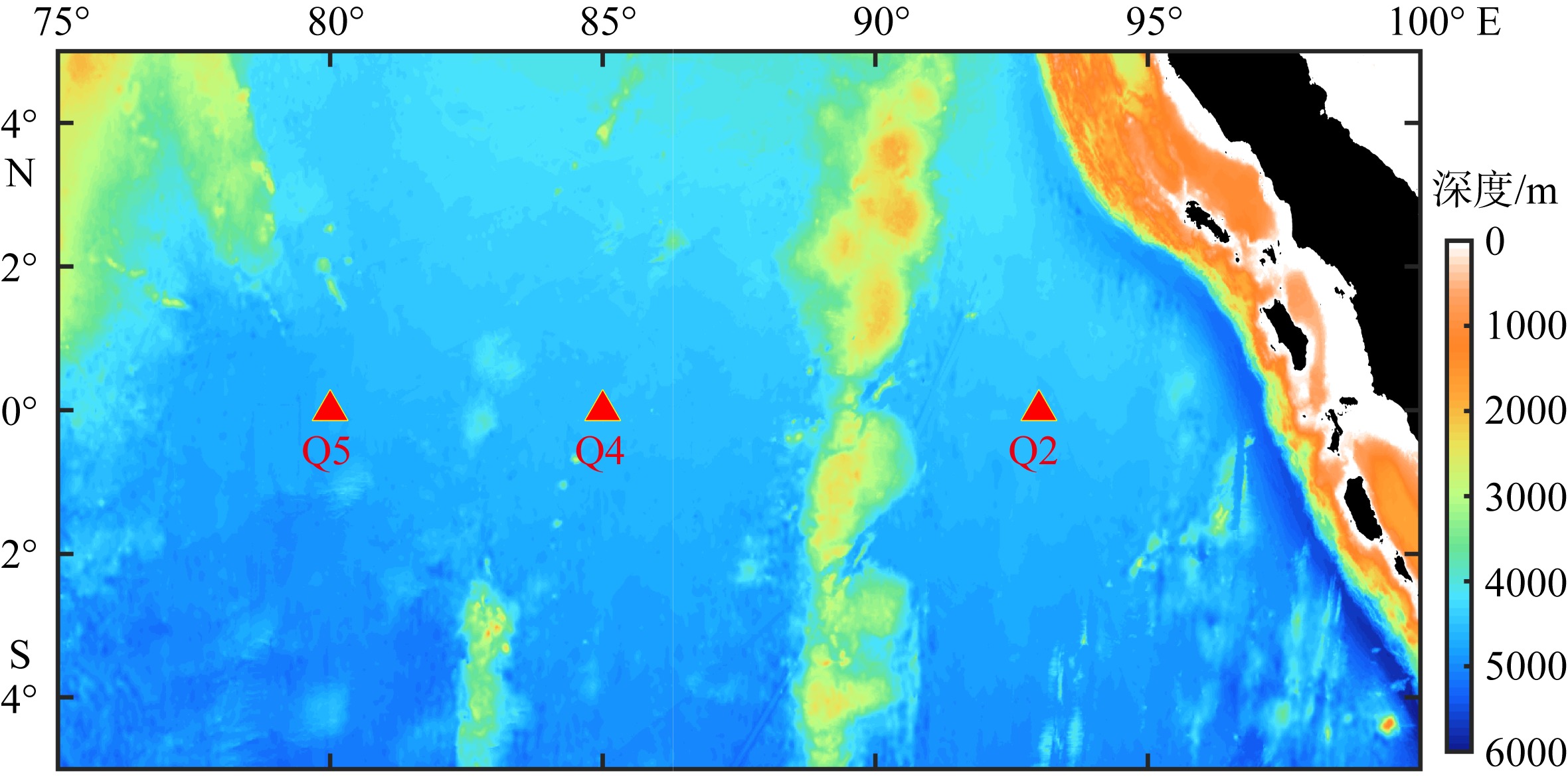
图1
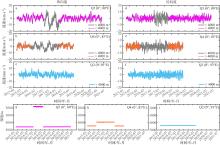
图2
2015年3月—2021年5月期间TIOON潜标(Q5、Q4、Q2)的纬向流速(a、b、c)和经向流速(d、e、f)的时间序列及其所在观测深度(g、h、i)"

图2
表1
TIOON潜标观测点信息及洋流特征统计, 包括地理位置与深度(单位: m)、观测时间范围以及洋流速度, 其中速度包含纬向流速(u; 单位: cm·s−1)以及经向流速(v; 单位: cm·s−1), 数据为平均值±标准差"
| 潜标 | 位置 | 观测深度/m | 地形深度/m | 时间 | 纬向流速u / (cm·s−1) | 经向流速v / (cm·s−1) |
|---|---|---|---|---|---|---|
| Q5 | 0°, 80°E | 4590 | 4677 | 2015年4月5日—2021年5月21日 | 0.2±3.1 | 0.0±2.6 |
| Q4 | 0°, 85°E | 4463 | 4546 | 2015年3月30日—2019年5月4日 | 0.6±2.7 | 0.0±3.1 |
| Q2 | 0°, 93°E | 4394 | 4516 | 2015年5月26日—2019年5月8日 | 0.3±2.5 | 0.0±2.8 |
表1
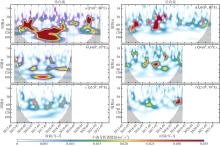
图3
TIOON潜标Q5、Q4、Q2观测的深层纬向流(a、b、c)和经向流(d、e、f)的小波时频分析振幅图 填色表示小波能谱强度(单位: m2·s−2), 用于揭示赤道印度洋深层环流的周期特征及其空间差异。观测数据时间范围为2015年3月至2021年5月, 纵轴为周期(单位: d)的对数坐标, 颜色刻度为线性比例。图中85%(粉色)和90%(品红色)置信水平的等值线用于标示统计上显著的小波信号区域"

图3
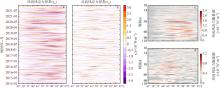
图4
印度洋赤道区域(2°S—2°N)风应力的时间演变和空间分布特征 a、b分别为纬向风应力异常τax与经向风应力异常τay时间经度分布图; c、d分别为τax与τay的快速傅里叶变换得到的周期-经度分布图, 颜色表示能谱强度。风应力数据来自JRA-55数据集, 基于2015年1月至2021年12月的逐日风速数据"

图4
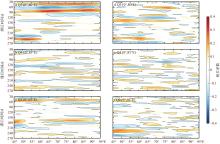
图5
印度洋赤道深层纬向流(基于潜标Q2、Q4、Q5观测)与季节内风应力(源于JRA-55数据集)的滞后相关分析 a、b、c展示纬向流与纬向季节内风应力的相关性; d、e、f展示纬向流与经向季节内风应力的相关性; 反映风应力调控赤道印度洋深层纬向环流的时空滞后特征; 图中99%置信水平(即P< 0.01)的等值线(黑色实线)用于标示统计显著的相关性区域"

图5
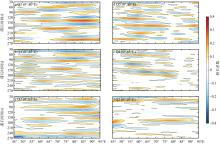
图6
印度洋赤道深层经向流(基于潜标Q2、Q4、Q5观测)与季节内风应力(源于JRA-55数据集)的滞后相关分析 a、b、c展示经向流与纬向季节内风应力的相关性; d、e、f展示经向流与经向季节内风应力的相关性; 反映风应力调控赤道印度洋深层经向环流的时空滞后特征; 图中99%置信水平(即P< 0.01)的等值线 (黑色实线)用于标示统计显著的相关性区域"
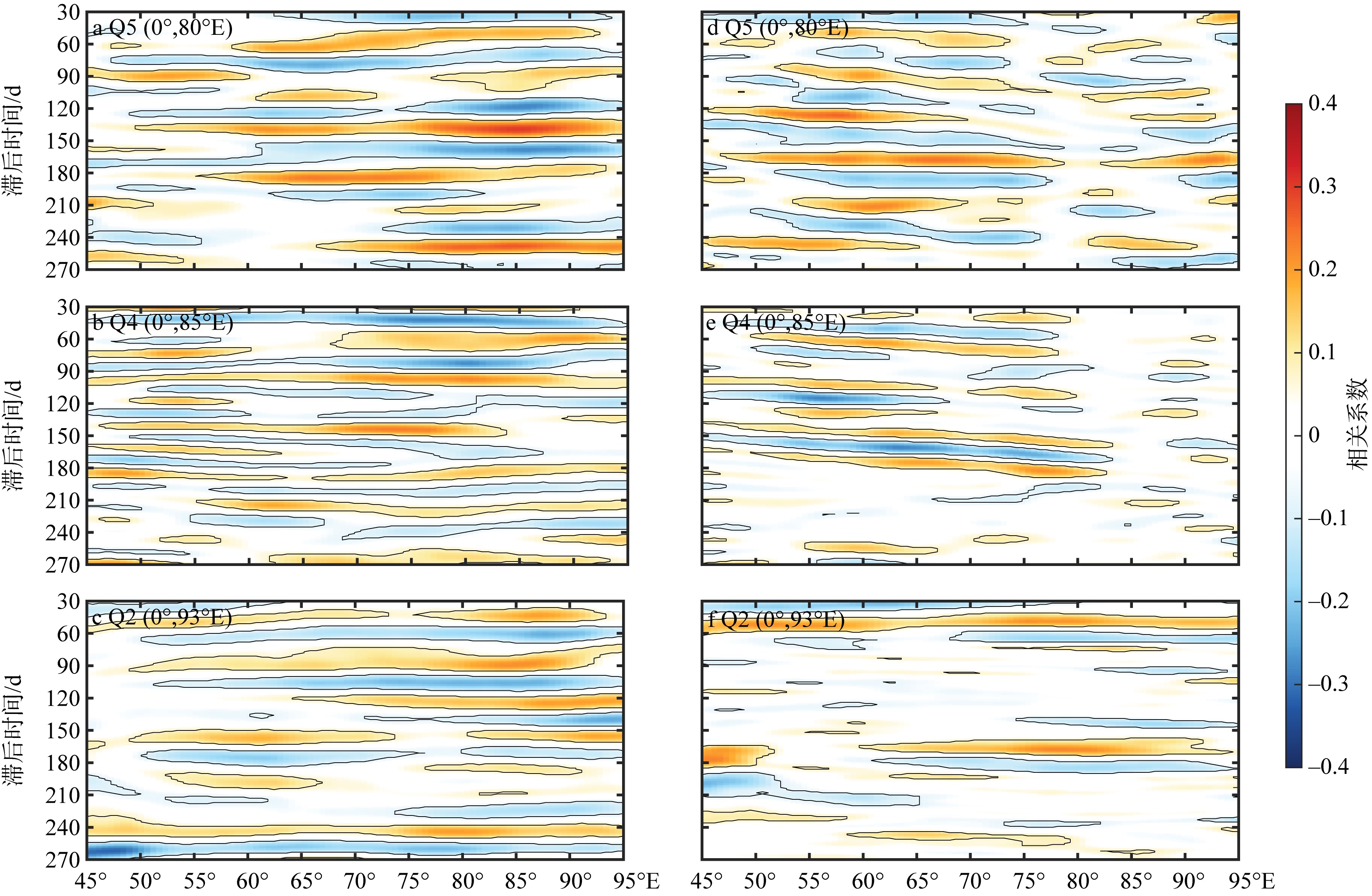
图6
图7
赤道东印度洋季节内纬向流的纬向波数(经度−1)-频率(d−1)功率谱能量(m2·s−2) (a)以及赤道波在印度洋海盆中的理论传播轨迹(b) a. 基于第一和第五斜压模态的赤道波动理论频散关系, 其中包括的Yanai波(虚线)、Kelvin波(点线)以及Rossby波(实线); b. 基于第二斜压模态赤道波理论传播轨迹, 其中x0表示赤道波传播起点经度, WB(western boundary, 西边界), T为典型周期, 灰色阴影区域为海底地形, 黑色条表示观测潜标位置, 从左到右分别为Q2、Q4、Q5"
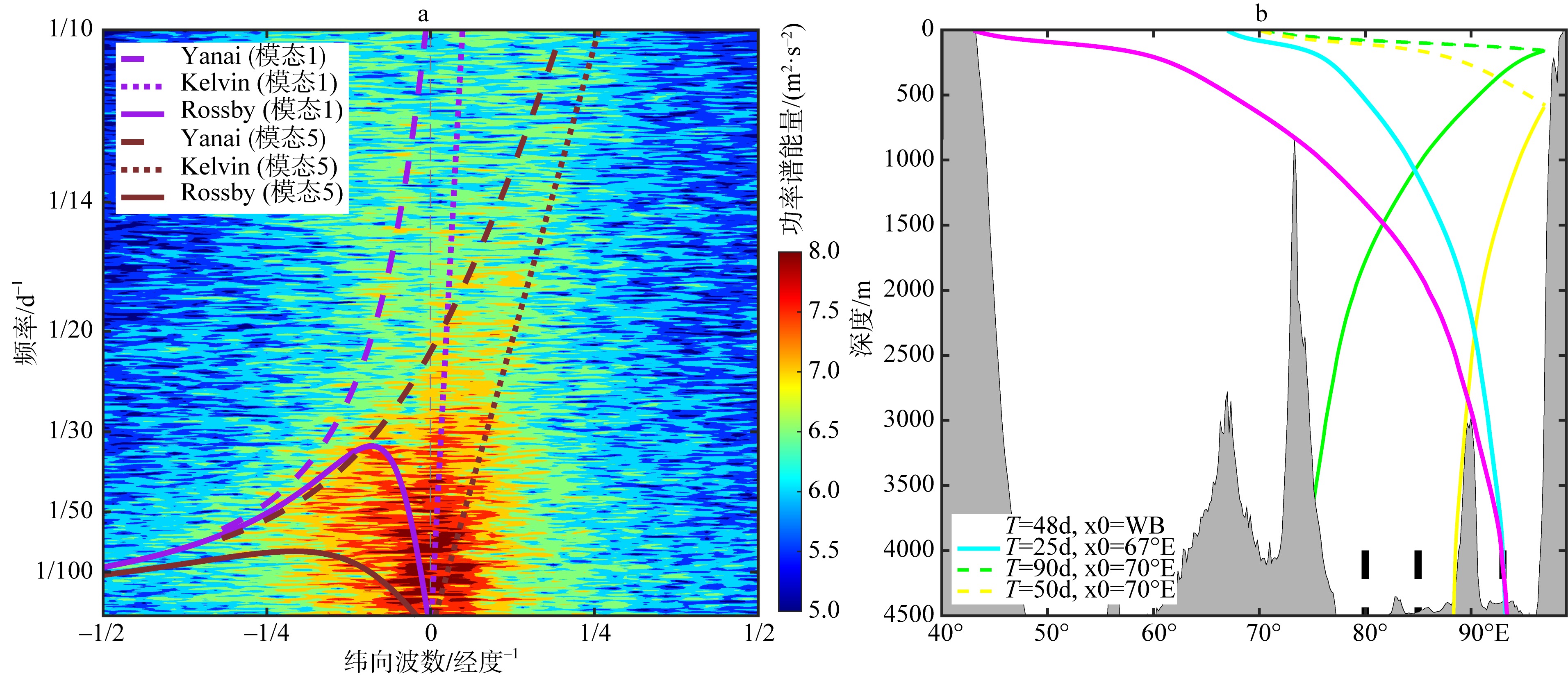
图7
| [1] |
陈更新, 2022. 链接热带东印度洋环流的海洋波动桥梁[J]. 地球科学进展, 37(1): 80-86.
doi: 10.11867/j.issn.1001-8166.2021.113 |
|
doi: 10.11867/j.issn.1001-8166.2021.113 |
|
| [2] |
doi: 10.1007/s00382-021-06125-9 |
| [3] |
doi: 10.1175/2010JPO4356.1 |
| [4] |
|
| [5] |
doi: 10.1038/nature10013 |
| [6] |
doi: 10.5194/essd-13-5663-2021 |
| [7] |
doi: 10.1002/jgrc.v118.3 |
| [8] |
doi: 10.1175/JPO-D-14-0225.1 |
| [9] |
doi: 10.1002/jgrc.v120.11 |
| [10] |
doi: 10.1175/JPO-D-15-0117.1 |
| [11] |
doi: 10.1175/JPO-D-16-0250.1 |
| [12] |
doi: 10.1002/jgrc.v123.3 |
| [13] |
doi: 10.1175/JPO-D-18-0151.1 |
| [14] |
doi: 10.1175/JPO-D-20-0042.1 |
| [15] |
doi: 10.1175/JPO-D-20-0041.1 |
| [16] |
|
| [17] |
doi: 10.1175/1520-0485(2002)032<1165:EDJAAM>2.0.CO;2 |
| [18] |
doi: 10.1357/002224007780388720 |
| [19] |
|
| [20] |
doi: 10.1175/1520-0485(1985)015<0997:HMEPVI>2.0.CO;2 |
| [21] |
|
| [22] |
doi: 10.1002/grl.v45.4 |
| [23] |
doi: 10.1007/s003820000059 |
| [24] |
doi: 10.1175/JPO2725.1 |
| [25] |
pmid: 17753636 |
| [26] |
doi: 10.1017/S0022112008002656 |
| [27] |
doi: 10.1029/2018JC013977 |
| [28] |
doi: 10.1175/JPO-D-17-0238.1 |
| [29] |
doi: 10.1175/JPO-D-19-0089.1 |
| [30] |
|
| [31] |
|
| [32] |
|
| [33] |
doi: 10.1126/science.aad0126 pmid: 26564845 |
| [34] |
|
| [35] |
doi: 10.1016/0011-7471(76)90830-5 |
| [36] |
|
| [37] |
doi: 10.1357/002224084788502792 |
| [38] |
doi: 10.1357/002224009789954766 |
| [39] |
|
| [40] |
doi: 10.1029/RG016i002p00233 |
| [41] |
doi: 10.1175/JPO-D-16-0157.1 |
| [42] |
doi: 10.1175/2007JPO3818.1 |
| [43] |
|
| [44] |
doi: 10.1175/1520-0485(1984)014<1842:EVPPIZ>2.0.CO;2 |
| [45] |
doi: 10.1029/RG016i001p00015 |
| [46] |
doi: 10.1175/JPO-D-15-0035.1 |
| [47] |
doi: 10.1175/1520-0485(1976)006<0243:ANOWIA>2.0.CO;2 |
| [48] |
doi: 10.3389/fmars.2022.910979 |
| [49] |
doi: 10.1175/1520-0469(1968)025<0900:OEOKWI>2.0.CO;2 |
| [50] |
doi: 10.1175/JPO-D-16-0033.1 |
| [51] |
|
| [52] |
doi: 10.1175/JPO-D-14-0181.1 |
| [53] |
|
| [54] |
doi: 10.1016/j.dsr.2022.103938 |
| [1] | 梁湛林, 王卫强. 东印度洋深层环流和水团变异研究进展*[J]. 热带海洋学报, 2026, 45(1): 17-26. |
| [2] | 李林, 王喜冬, 何子康, 陈志强, 曹源, 刘科峰, 陈建. 基于变分法与卫星海表信息重构西北太平洋涡旋三维结构[J]. 热带海洋学报, 2025, 44(5): 39-49. |
| [3] | 刘太龙, 谢涛, 李建, 王超, 张雪红. 基于深度学习的SAR图像海洋涡旋自动检测模型[J]. 热带海洋学报, 2025, 44(5): 65-76. |
| [4] | 刘爽, 经志友, 詹海刚. 基于生成对抗网络模型的热带和亚热带海洋中尺度涡预报研究[J]. 热带海洋学报, 2022, 41(5): 1-16. |
| [5] | 杨潇霄, 曹海锦, 经志友. 南海上层海洋次中尺度过程空间差异和季节变化特征[J]. 热带海洋学报, 2021, 40(5): 10-24. |
| [6] | 罗士浩, 经志友, 闫桐, 郑瑞玺, 曹海锦, 齐义泉. 黑潮延伸体海域次中尺度过程的季节变化研究[J]. 热带海洋学报, 2021, 40(1): 1-11. |
| [7] | 乐洲, 黄科, Venkata Subrahmanyam Mantravadi. 2000—2015年夏秋季孟加拉湾湾口区涡流相互作用能量学特征[J]. 热带海洋学报, 2020, 39(2): 11-14. |
| [8] | 李洁, 经志友, 张偲. 季风环流影响下的南海海洋细菌多样性特征初探[J]. 热带海洋学报, 2018, 37(6): 1-15. |
| [9] | 黄旭媚, 王卫强, 刘海龙. 基于多套数据的印度洋深层经向翻转环流的动力特征[J]. 热带海洋学报, 2016, 35(4): 11-20. |
| [10] | 向荣, 方文东, 鲁远征, 黄孝荣, 周生启. 2014年9月南海西部冷涡及东向急流三维结构观测[J]. 热带海洋学报, 2015, 34(6): 1-10. |
| [11] | 王健, 杜岩, 郑少军, 刘凯. 2004~2011年印度尼西亚贯穿流在望加锡海峡中的年际变化[J]. 热带海洋学报, 2014, 33(6): 9-16. |
| [12] | 宣莉莉, 邱云, 许金电, 曾明章. 热带东印度洋表层环流季节变化特征研究*[J]. 热带海洋学报, 2014, 33(1): 26-35. |
|
||