

热带海洋学报 ›› 2026, Vol. 45 ›› Issue (5): 162-177.doi: 10.11978/2025224CSTR: 32234.14.2025224
南沙美济礁南科1井生物标志物组成分布特征及其环境指示*
朱小畏1,2( ), 莫梓谊1,2,3, 茅晟懿4, 田雨杭1,2,5, 罗云1,2, 苗莉1,2, 徐维海1,2, 黎刚1,2, 颜文1,2,3()
- 1
中国科学院南海海洋研究所 ,热带海洋环境与岛礁生态全国重点实验室
2中国科学院南海海洋研究所 ,边缘海与大洋地质实验室
3中国科学院大学
4中国科学院广州能源研究所 ,天然气水合物实验室
5海南省海洋地质资源与环境重点实验室
-
收稿日期:2025-11-26修回日期:2026-01-14出版日期:2026-09-10发布日期:2026-10-13 -
通讯作者:颜文 -
作者简介:朱小畏(1987—), 男, 研究员, 博士, 主要从事生物有机地球化学研究工作。email: miseraboy@126.com
*感谢参与南科1井钻探、分样和分析的全体工作人员的辛勤付出。
-
基金资助:国家重点研发计划项目(2021-06); 国家自然科学基金项目(42373029); 国家自然科学基金项目(42306076); 国家自然科学基金项目(42176079); 国家自然科学基金项目(42376079); 广东省自然科学基金面上项目(2024A1515012382); 广东省自然科学基金面上项目(2025A1515010958); 海南省海洋地质资源与环境重点实验室开放基金项目(24-HNHYDZZYHJKF047)
Distribution characteristics of biomarker components and their environmental indications at Well NK-1 on Meiji Atoll, Nansha Islands*
ZHU Xiaowei1,2(), MO Ziyi1,2,3, MAO Shengyi4, TIAN Yuhang1,2,5, LUO Yun1,2, MIAO Li1,2, XU Weihai1,2, LI Gang1,2, YAN Wen1,2,3()
- 1
South China Sea Institute of Oceanology ,State Key Laboratory of Tropical Oceanography
2South China Sea Institute of Oceanology ,Laboratory of Ocean and Marginal Sea Geology
3University of Chinese Academy of Sciences
4Guangzhou Institute of Energy Conversion ,Chinese Academy of Sciences, Key Laboratory of Gas Hydrate
5Hainan Key Laboratory of Marine Geological Resources and Environment
-
Received:2025-11-26Revised:2026-01-14Online:2026-09-10Published:2026-10-13 -
Contact:YAN Wen -
Supported by:National Key Research and Development Program of China(2021-06); National Natural Science Foundation of China(42373029); National Natural Science Foundation of China(42306076); National Natural Science Foundation of China(42176079); National Natural Science Foundation of China(42376079); General Program of Natural Science Foundation of Guangdong Province(2024A1515012382); General Program of Natural Science Foundation of Guangdong Province(2025A1515010958); Hainan Marine Geological Resources and Environment Key Laboratory Open Fund(24-HNHYDZZYHJKF047)

摘要:
珊瑚礁广泛发育于我国南海海域, 其生长记录中保存了海洋气候环境变化的各种信息, 是一种重要的环境记录载体。文章以南沙美济礁南科1 (NK-1)井为研究对象, 系统分析了珊瑚礁碳酸盐岩中的脂类生物标志物组成与分布特征, 重点探讨了短链正构C14~18脂肪酸在重建古生产力方面的潜力及其环境指示意义。结果表明, 该类脂肪酸对成岩作用和降解改造具有高抗性, 与陆源营养输入、表层水体生产力、海平面变化密切相关, 可作为重建造礁珊瑚古生产力记录的可靠指标。此外, 在45~65m和95~110m层段识别出具有石油烃类特征的脂肪烃组合, 结合美济礁区域构造背景与年代学数据, 推断其为中—晚更新世自然烃类渗漏事件的产物, 可能由台湾岛斜向弧陆碰撞引发。该研究揭示了南海珊瑚礁区环境记录能力, 既能响应万年尺度的古生产力, 也能为突发性自然烃类渗漏事件提供新的地球化学证据。
中图分类号:
- P734.43
引用本文
朱小畏, 莫梓谊, 茅晟懿, 田雨杭, 罗云, 苗莉, 徐维海, 黎刚, 颜文. 南沙美济礁南科1井生物标志物组成分布特征及其环境指示*[J]. 热带海洋学报, 2026, 45(5): 162-177.
ZHU Xiaowei, MO Ziyi, MAO Shengyi, TIAN Yuhang, LUO Yun, MIAO Li, XU Weihai, LI Gang, YAN Wen. Distribution characteristics of biomarker components and their environmental indications at Well NK-1 on Meiji Atoll, Nansha Islands*[J]. Journal of Tropical Oceanography, 2026, 45(5): 162-177.
图1
南科1 (NK-1)井地理位置图 a. 位于南海南部南沙群岛美济礁上的NK-1井(本研究), 以及位于南海北部西沙群岛上的XC-1井(Liu et al, 1997)、XK-1井(Shao et al, 2017a, 2017b; Liu et al, 2019; Wu et al, 2019)和ZK-1井(Wang et al, 2018)。b. NK-1井钻探点位于南沙群岛中孤立的美济岛礁, 其周边的万安盆地、曾母盆地、文莱-沙巴盆地、巴拉望盆地和礼乐盆地富含烃类资源, 为石油勘探热点区域(Wang et al, 2014; Zhang et al, 2021)。该图基于自然资源部标准地图服务网站下载的审图号为琼S(2024)044号的标准地图制作, 底图无修改"
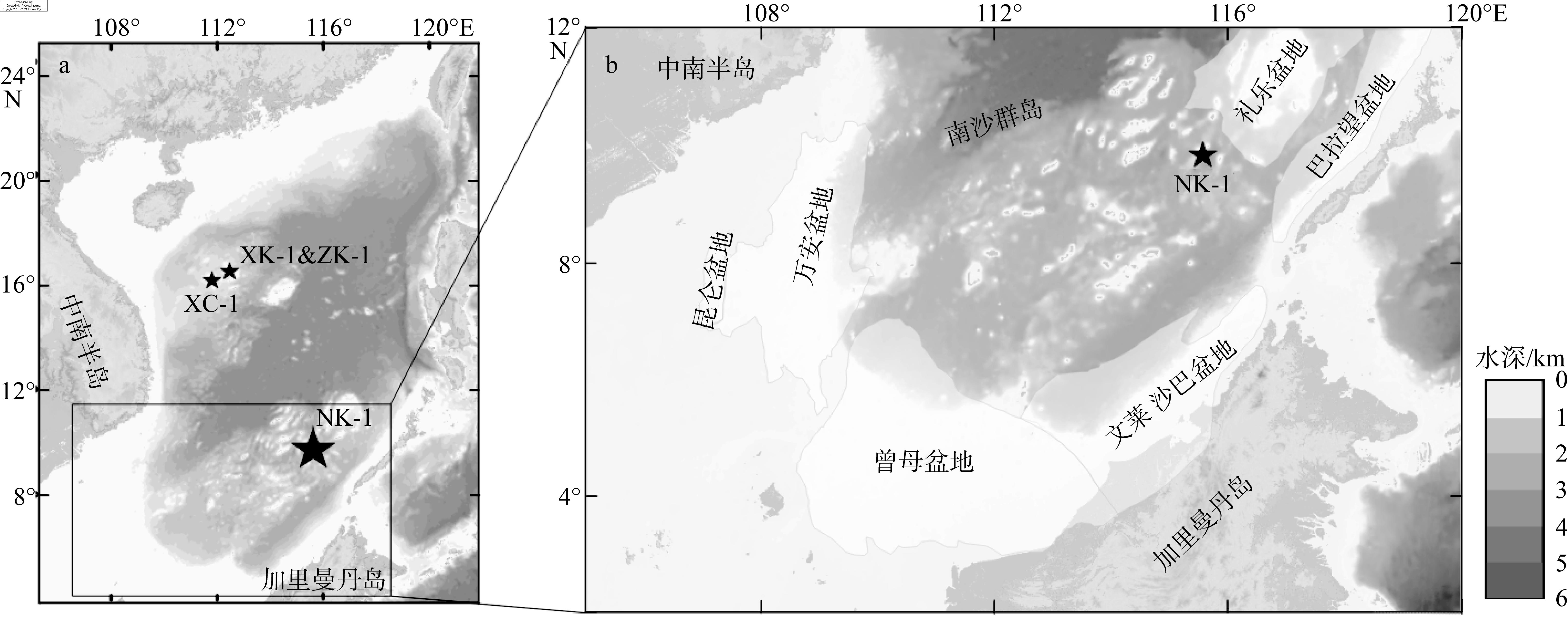
图1
图2
各类化合物的平均丰度(a)以及各类别中单个化合物的相对丰度(b—e) 图中误差棒表示标准偏差, 图b~e横坐标数字表示碳数。在不饱和脂肪酸部分, n-C16:1指n-C16:1ω9和 n-C16:1ω7的总和; n-C18:1指n-C18:1ω9和n-C18:1ω7的总和; n-C20:1指n-C20:1ω9和n-C20:1ω7的总和; n-C22:1指n-C22:1ω9和n-C22:1ω7的总和"
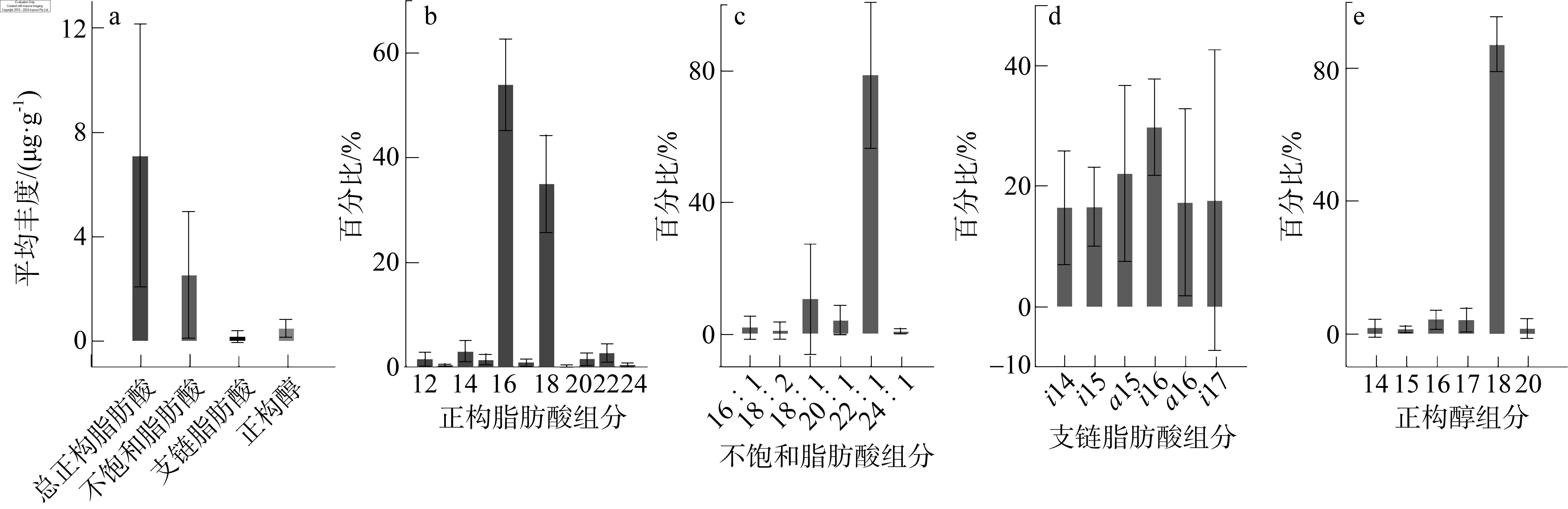
图2
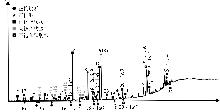
图3
NK-1井中碳酸盐岩样品总脂质标志物提取物色谱图 图中数字表示碳数。Pr表示姥鲛烷, Ph表示植烷, IS表示内标, ?表示未鉴定峰"
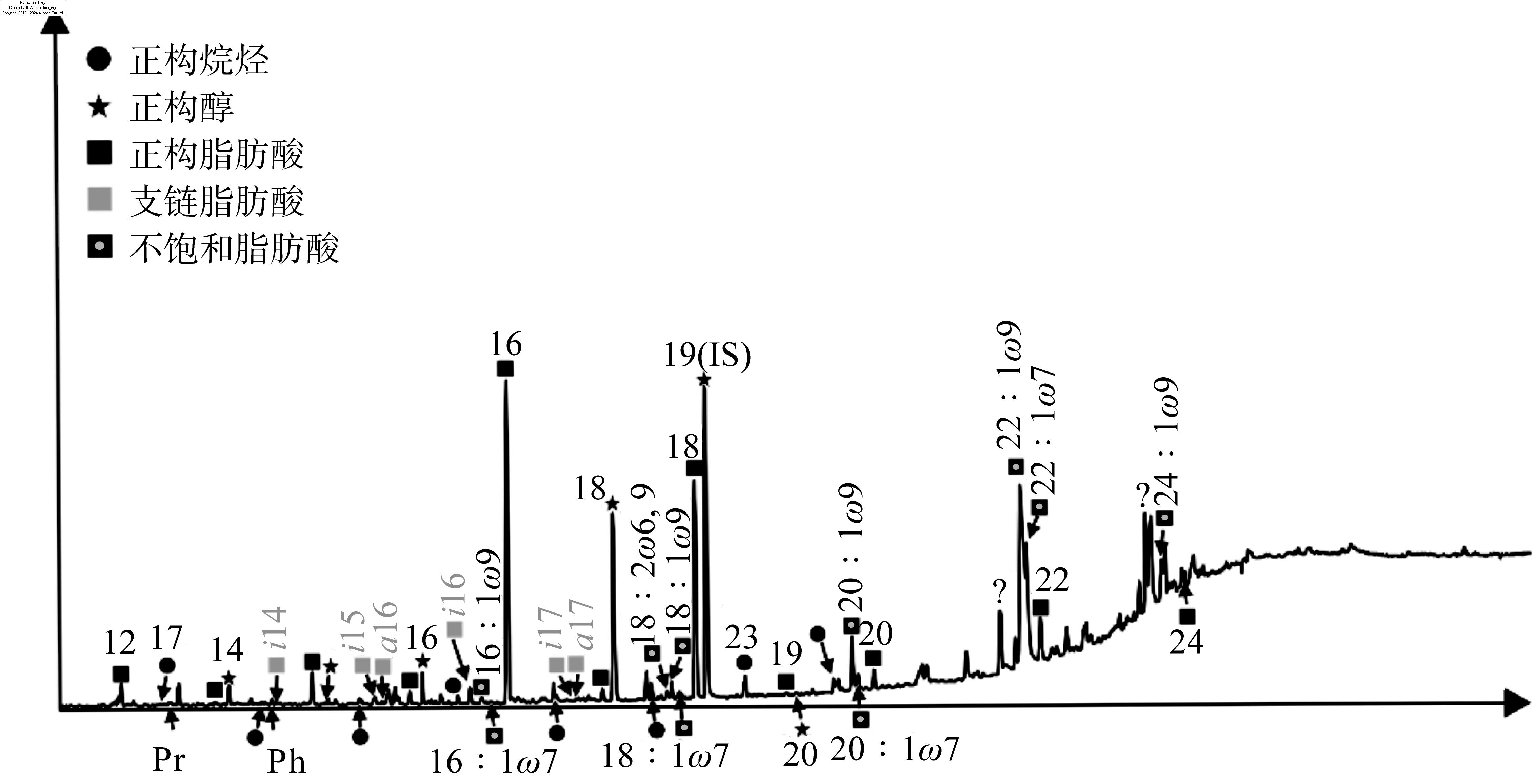
图3
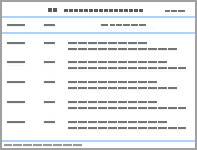
表1
n-C14~18脂肪酸、n-C22:1脂肪酸、支链脂肪酸与n-C14~18脂肪醇之间的皮尔逊相关性(P < 0.01)"
| n-C22:1脂肪酸 | 支链脂肪酸 | n-C14~18脂肪醇 | |
|---|---|---|---|
| n-C14~18脂肪酸 | 0.798 | 0.673 | 0.655 |
| n-C22:1脂肪酸 | 0.443 | 0.612 | |
| 支链脂肪酸 | 0.419 |
表1
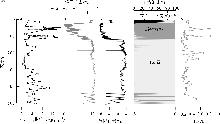
图4
NK-1井中正构C14~18脂肪酸平均丰度(a)、碳同位素(b)、氧同位素(c)、矿物组成(d)和Pr/Ph比值(e)的深度剖面图 图a和e数据来源于本研究, 图b~d数据来自Guo等(2021)和Luo等(2021)。图中20~120m层段和440~500m层段这两个层段曾因海平面低位而经历了陆上氧化条件下的大气淡水成岩作用(Guo et al, 2021; Luo et al, 2021)"
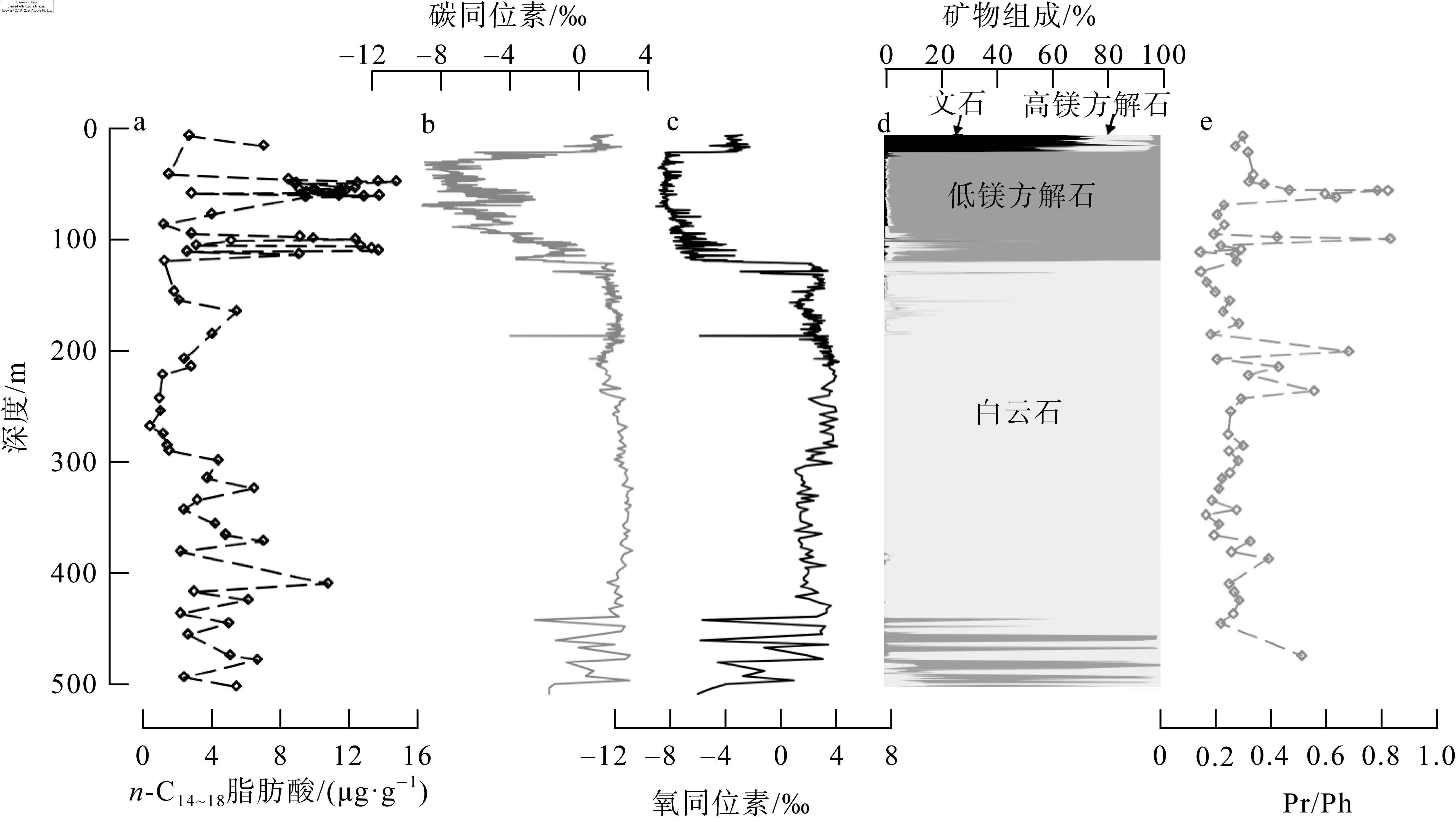
图4
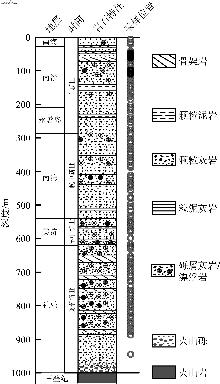
图5
NK-1井的地层柱状图 地层、年代学和岩性数据来自Li等(2022)。脂质生物标志物分析的采样位置中, 浅灰色圆圈(n=111)表示正常组样品, 深黑色圆圈(n=14)表示异常组样品(集中在45~65m和95~110m区间), 这些样品显示出类似石油来源的碳氢化合物"

图5
图6
正常组(n = 111)和异常组(n = 14)样品中单个正构烷烃的平均相对丰度以及总正构烷烃的含量 误差棒表示标准偏差"
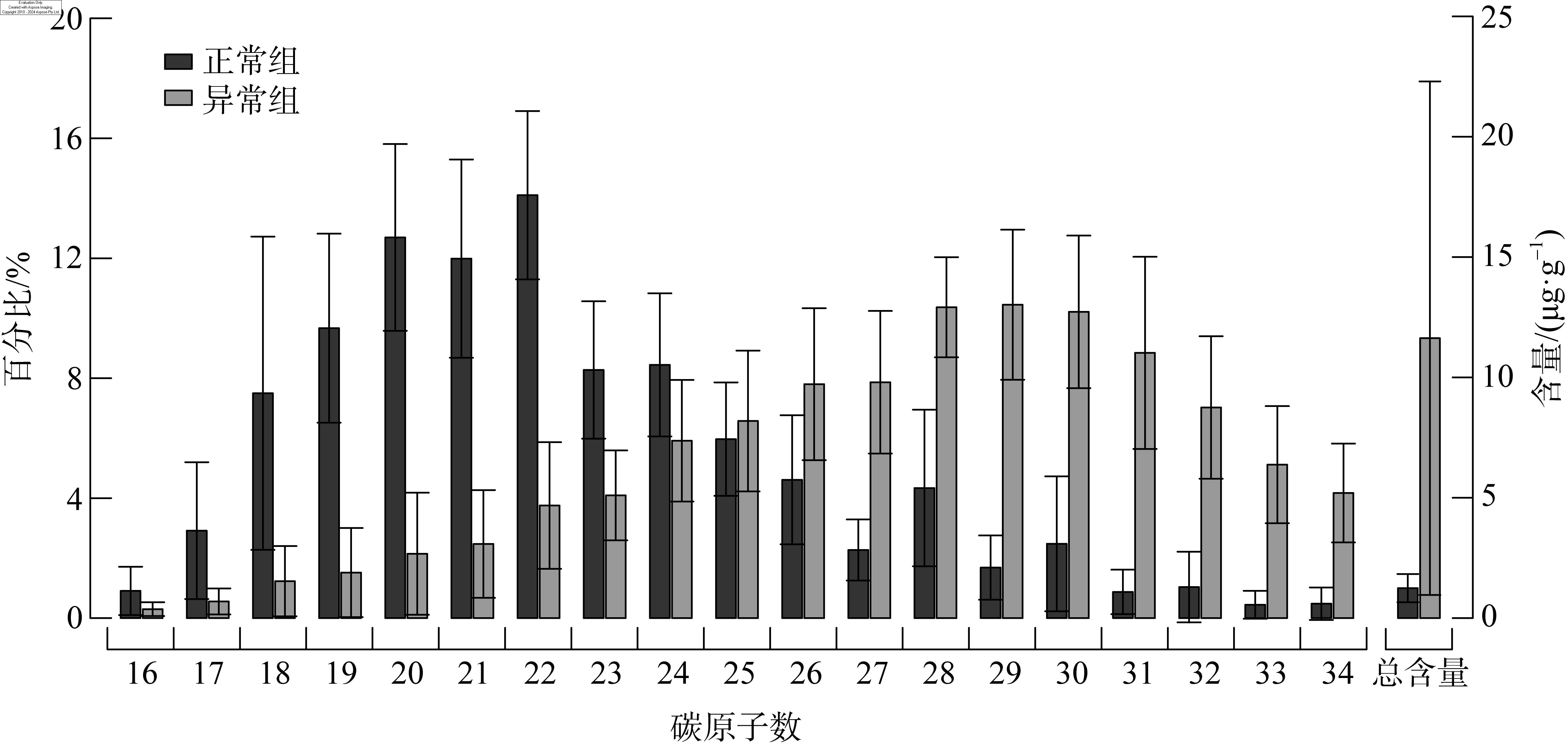
图6
表2
位于45~65m和95~110m层段的异常组样品中的生物标志物参数"
| 深度/m | n-烷烃 CPI | C31 | C32 | C29 | C30 | C31R/C30 | C26/C25 | G/H | |
|---|---|---|---|---|---|---|---|---|---|
| 22S/(22S+22R) | βα/αβ | ||||||||
| 47.19 | 0.82 | - | 0.46 | - | 0.24 | - | 2.27 | 0.28 | |
| 49.39 | 0.97 | 0.62 | 0.60 | 0.13 | 0.12 | 0.17 | 1.36 | 0.24 | |
| 52.51 | 1.02 | - | - | - | - | - | - | - | |
| 53.43 | 1.03 | 0.48 | 0.67 | - | 0.18 | 0.31 | 2.76 | 0.27 | |
| 54.83 | 1.01 | 0.48 | 0.58 | 0.15 | 0.16 | 0.31 | 2.45 | 0.38 | |
| 55.03 | 0.98 | 0.44 | 0.54 | 0.30 | 0.23 | 0.39 | 2.92 | 0.30 | |
| 55.23 | 1.06 | 0.75 | - | - | 0.19 | 0.15 | 2.04 | 0.43 | |
| 57.45 | 0.57 | 0.59 | 0.52 | - | 0.18 | 0.22 | 3.53 | 0.53 | |
| 58.15 | 0.95 | 0.58 | 0.55 | 0.16 | 0.12 | 0.17 | 2.54 | 0.21 | |
| 61.27 | 1.00 | - | 0.66 | 0.22 | 0.20 | - | 2.64 | 0.24 | |
| 97.11 | 1.02 | 0.64 | 0.56 | 0.09 | 0.20 | 0.16 | 2.62 | 0.29 | |
| 98.73 | 1.03 | 0.39 | 0.68 | 0.35 | 0.20 | 0.36 | 2.30 | 0.36 | |
| 105.15 | 0.99 | 0.56 | - | 0.10 | 0.14 | 0.20 | 1.13 | 0.19 | |
| 108.39 | 1.03 | 0.53 | 0.47 | 0.22 | 0.18 | 0.22 | 2.12 | 0.26 | |
表2

图7
NK-1井中n-C14~18脂肪酸含量与δ¹³C值(a)、δ18O值(b)以及Pr/Ph比值(c)的相关关系图[据Zhu等(2022)修改]"
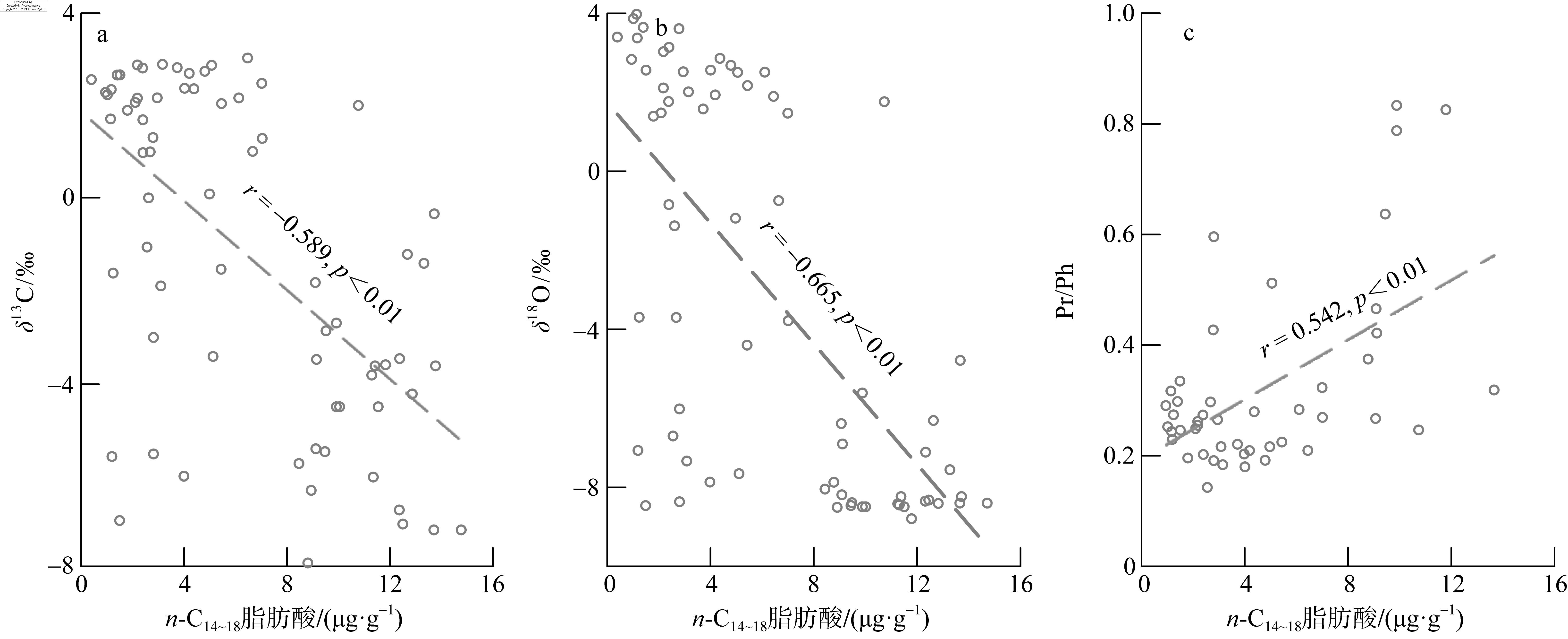
图7
图8
天然油类标志物在珊瑚中形成示意图"
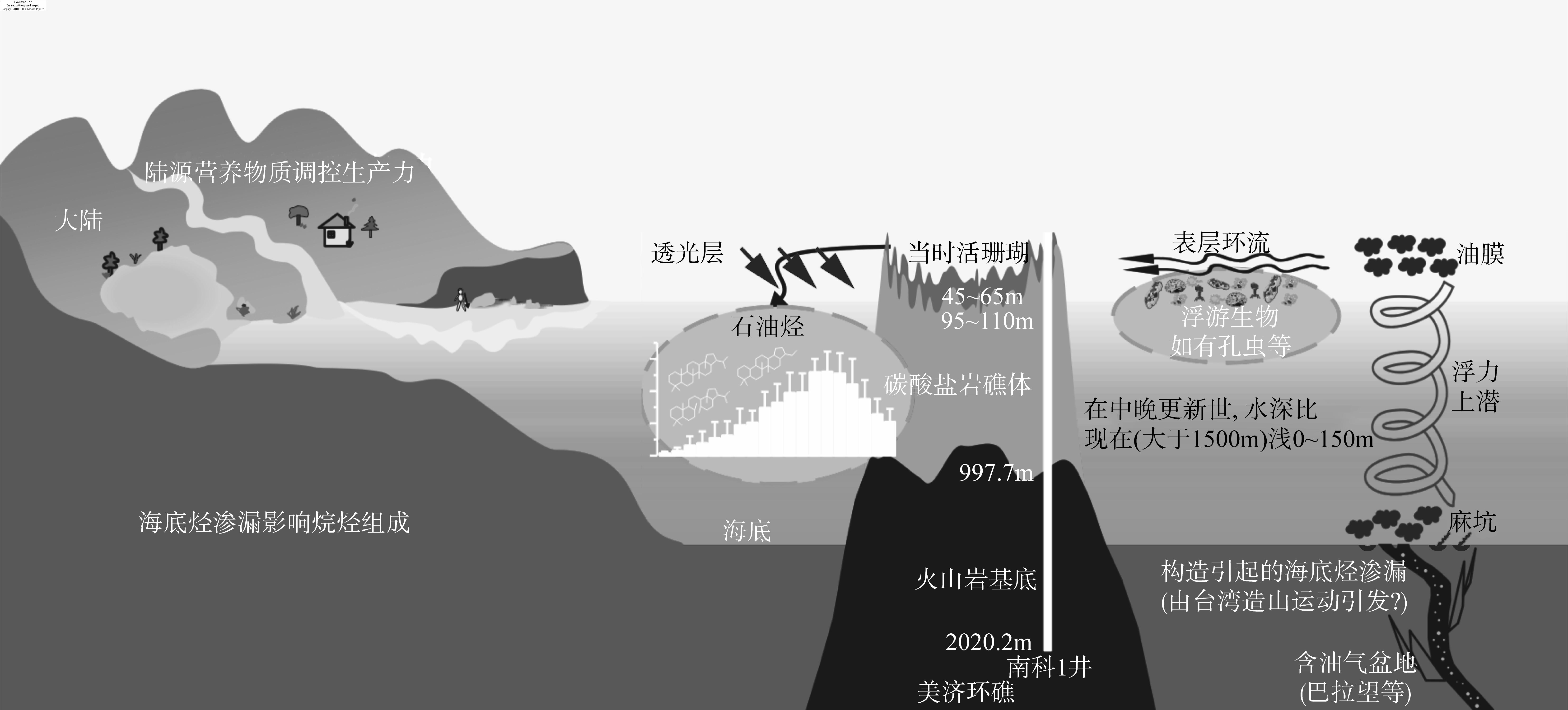
图8
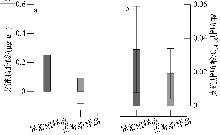
图9
异常组样本和正常组样本中支链脂肪酸的平均含量(a)和支链脂肪酸与正构C14-18脂肪酸的比值(b)"
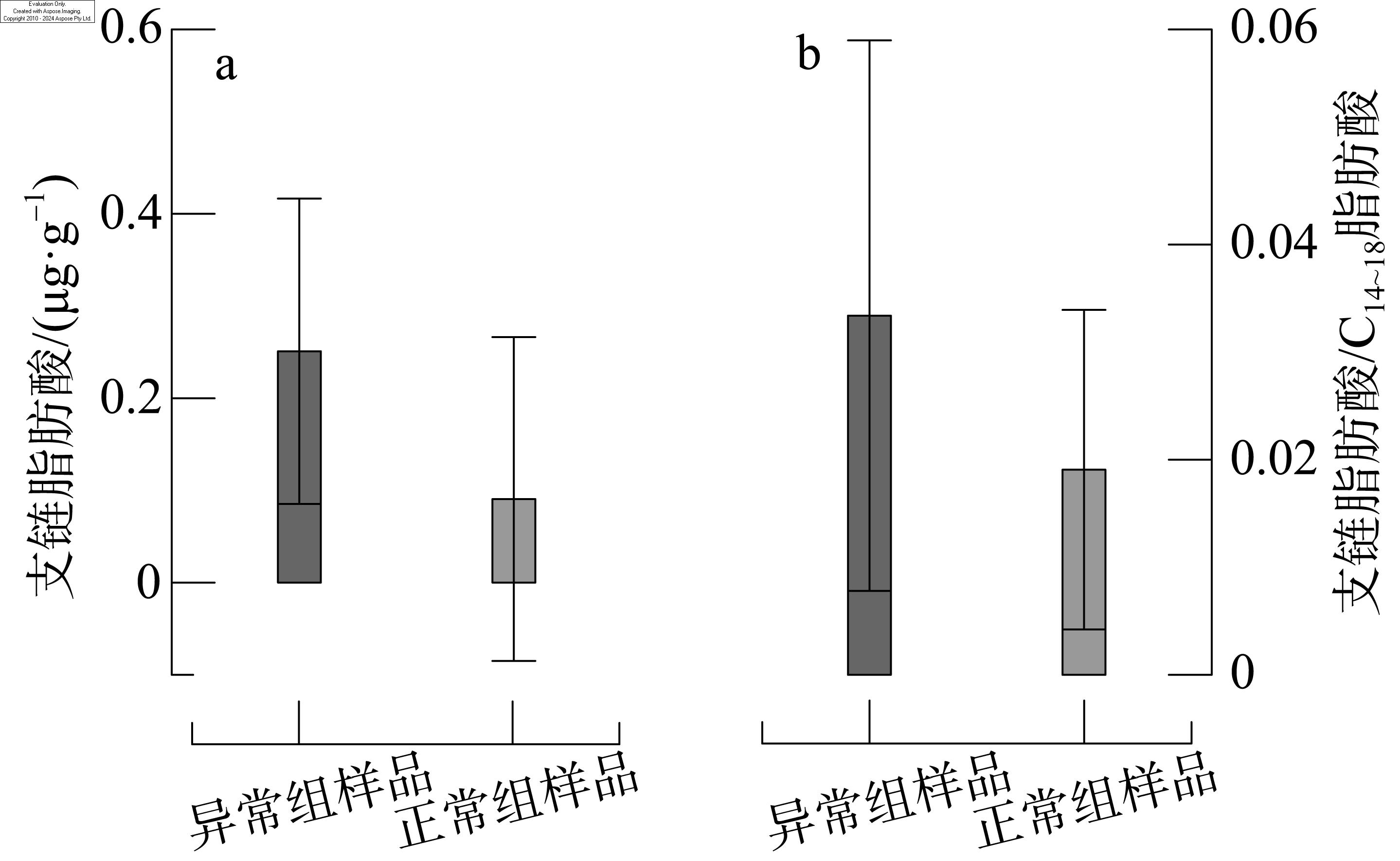
图9
| [1] |
陈史坚, 1982. 南沙群岛珊瑚礁地貌与沉积特征[J]. 海洋通报, 1(2): 41-52.
|
|
|
|
| [2] |
高婧茹, 朱小畏, 颜文, 2025. 脂类生物标志物在珊瑚研究中的应用[J]. 华东地质, 46(3): 339-355.
|
|
|
|
| [3] |
巩恩普, 李骁, 王立芙, 等, 2026. 黔南早二叠世窝托珊瑚礁的微相类型、发展演化及控制因素[J]. 沉积学报, 44(4): 1495-1506.
|
|
|
|
| [4] |
贾云霞, 王钊, 庞红丽, 2025. 南科1井的地球化学特征及其与陆源输入的关系[J]. 海洋地质前沿, 41(8): 13-23.
|
|
|
|
| [5] |
罗云, 黎刚, 徐维海, 等, 2022. 南科1井第四系暴露面特征及其与海平面变化的关系[J]. 热带海洋学报, 41(1): 143-157.
|
|
|
|
| [6] |
吕俏凤, 2012. 生物礁油气藏近源成藏模式及其对勘探的启示[J]. 海相油气地质, 17(1): 41-48.
|
|
|
|
| [7] |
王力, 王鑫, 蔡凯旋, 等, 2021. 生物礁油气分布特征及勘探前景[J]. 内蒙古石油化工, 47(7): 117-121.
|
|
|
|
| [8] |
吴时国, 朱伟林, 马永生, 2018. 南海半封闭边缘海碳酸盐台地兴衰史[J]. 海洋地质与第四纪地质, 38(6): 1-17.
|
|
|
|
| [9] |
臧明思, 王佳宝, 宋宜, 等, 2025. 珊瑚脂类生物标志物组成及对环境的响应: 研究进展与问题[J]. 地球环境学报, 16(4): 416-427.
|
|
|
|
| [10] |
张田升, 吴自银, 赵荻能, 等, 2019. 南海礼乐盆地海底麻坑地貌及成因分析[J]. 海洋学报, 41(3): 106-120.
|
|
|
|
| [11] |
朱照宇, 谢久兵, 郑王琼, 等, 2006. 南海北缘早-中更新世之交新构造活动及其区域对比[J]. 第四纪研究, 26(1): 70-76.
|
|
|
|
| [12] |
|
| [13] |
|
| [14] |
|
| [15] |
|
| [16] |
|
| [17] |
|
| [18] |
|
| [19] |
|
| [20] |
|
| [21] |
|
| [22] |
|
| [23] |
|
| [24] |
|
| [25] |
|
| [26] |
|
| [27] |
|
| [28] |
|
| [29] |
|
| [30] |
|
| [31] |
|
| [32] |
|
| [33] |
|
| [34] |
|
| [35] |
|
| [36] |
|
| [37] |
|
| [38] |
|
| [39] |
|
| [40] |
|
| [41] |
|
| [42] |
|
| [43] |
|
| [44] |
|
| [45] |
|
| [46] |
|
| [47] |
|
| [48] |
|
| [49] |
|
| [50] |
|
| [51] |
|
| [52] |
|
| [53] |
|
| [54] |
|
| [55] |
|
| [56] |
|
| [57] |
|
| [58] |
|
| [59] |
|
| [60] |
National Research Council, 2003. Oil in the sea Ⅲ: inputs, fates, and effects[M]. Washington, DC: The National Academies Press.
|
| [61] |
|
| [62] |
|
| [63] |
|
| [64] |
|
| [65] |
|
| [66] |
|
| [67] |
|
| [68] |
|
| [69] |
|
| [70] |
|
| [71] |
|
| [72] |
|
| [73] |
|
| [74] |
|
| [75] |
|
| [76] |
|
| [77] |
|
| [78] |
|
| [79] |
|
| [80] |
|
| [81] |
|
| [82] |
|
| [83] |
|
| [84] |
|
| [85] |
|
| [86] |
|
| [87] |
|
| [88] |
|
| [89] |
|
| [90] |
|
| [91] |
|
| [92] |
|
| [93] |
|
| [94] |
|
| [95] |
|
| [96] |
|
| [97] |
|
| [98] |
|
| [99] |
|
| [1] | 苗秀全, 张运迎, 颜文. 海扩张机制的制约*[J]. 热带海洋学报, 2026, 45(5): 35-52. |
| [2] | 刘建国, 黄云, 徐维海, 黎刚, 向荣, 苏翔, 罗云, 赵中贤, 颜文. 南海美济珊瑚礁的形成与演化*[J]. 热带海洋学报, 2026, 45(5): 94-107. |
| [3] | 黎刚, 徐维海, 罗云, 刘建国, 赵建新, 俸月星, 程俊, 孙珍, 向荣, 徐敏, 颜文. 基于南沙美济礁深钻的南海南部新生代构造演化研究[J]. 热带海洋学报, 2026, 45(5): 16-34. |
| [4] | 黄康俊, 张攀, 冯东, 颜文. 海相碳酸盐岩体系镁同位素组成控制因素及其指示意义*[J]. 热带海洋学报, 2026, 45(5): 146-161. |
| [5] | 罗云, 黎刚, 张喜洋, 徐维海, 朱小畏, 周婉秋, 黄慧文, 钟福昌, 颜文. 基于美济礁深钻的南海岛礁差异白云石化过程研究[J]. 热带海洋学报, 2026, 45(5): 108-127. |
| [6] | 李东平, 石豪磊, 罗中原, 曹建涛, 贾国东. 南海表层水悬浮颗粒物脂肪酸组成特征及其生态指示意义*[J]. 热带海洋学报, 2026, 45(3): 61-73. |
| [7] | 李若安, 李旭清, 陈天然. 南海南部珊瑚骨骼δ18O和Sr/Ca对ENSO的分级响应[J]. 热带海洋学报, 2025, 44(4): 45-55. |
| [8] | 廖秀丽, 戴明, 巩秀玉, 刘华雪, 黄洪辉. 南海南部次表层叶绿素a质量浓度最大值及其影响因子*[J]. 热带海洋学报, 2018, 37(1): 45-56. |
| [9] | 张燕, 何蕾, 殷克东, 姜玥璐, 姚景龙, 王东晓. 南海南部陆坡区生态要素垂向分布和日变化特征及其与物理环境的关系[J]. 热带海洋学报, 2014, 33(6): 68-72. |
| [10] | 李玉, 赵美训, 张海龙, 邢磊, 杨红梅, 戴民汉, 王磊. 2009年冬季南海北部生物标志物对表层浮游植物生物量/群落结构的指示作用[J]. 热带海洋学报, 2012, 31(4): 96-103. |
| [11] | 孙蕴婕,吴莹,张经. 海南八门湾红树林柱状沉积物中有机生物标志物的分布和降解[J]. 热带海洋学报, 2011, 30(2): 94-101. |
| [12] | 张海生,于培松,倪建宇,姚旭莹,. 太平洋东部W2001-2柱样低成熟烃组成特征、成岩变化及其与某些元素的作用[J]. 热带海洋学报, 2010, 29(5): 49-55. |
| [13] | 周鹏,李冬梅,刘广山,门武,纪利红. 南海东北部和南部海域表层沉积物生物硅研究[J]. 热带海洋学报, 2010, 29(4): 40-47. |
| [14] | ,赵美训,赵晓晨,陈建芳,邢磊,SARNTHEIN M,陆红峰,. 南海表层沉积物生物标志物的分布特征及古生产力重建意义[J]. 热带海洋学报, 2009, 28(3): 45-53. |
| [15] | 向荣,陈木宏,成鑫荣,张兰兰,陆钧,刘建国,陈忠 . 南海南部水体和沉积物中的浮游有孔虫氧碳同位素分析[J]. 热带海洋学报, 2009, 28(3): 59-66. |
|
||