

热带海洋学报 ›› 2026, Vol. 45 ›› Issue (3): 109-121.doi: 10.11978/2025096CSTR: 32234.14.2025096
红海湾电厂温排水对海域珊瑚群落的夏季热白化影响分析
杨冰1,2( ), 袁涛萍1, 董俊德1, 江雷1, 钱江1, 杨清松1, 孙慧明1, 周炎武1()
- 1
中国科学院南海海洋研究所
2中国科学院大学
-
收稿日期:2025-07-04修回日期:2025-10-09出版日期:2026-05-10发布日期:2026-05-28 -
通讯作者:周炎武。email: zhouyanwu@scsio.ac.cn -
作者简介:杨冰(2001—), 女, 山东省滨州市人, 硕士研究生, 从事珊瑚礁生态学研究。email: yangbing23@mails.ucas.ac.cn
-
基金资助:国家自然科学基金项目(42276160)
Effects of thermal discharge of power plants on coral communities in Honghai Bay, Guangdong Province
YANG Bing1,2(), YUAN Taoping1, DONG Junde1, JIANG Lei1, QIAN Jiang1, YANG Qingsong1, SUN Huiming1, ZHOU Yanwu1()
- 1
South China Sea Institute of Oceanology ,Chinese Academy of Sciences
2University of Chinese Academy of Sciences
-
Received:2025-07-04Revised:2025-10-09Online:2026-05-10Published:2026-05-28 -
Contact:ZHOU Yanwu. email: zhouyanwu@scsio.ac.cn -
Supported by:National Natural Science Foundation of China(42276160)

摘要:
珊瑚礁是生物多样性最高的生态系统之一, 具有巨大的社会经济价值。在海表温度(sea surface temperature, SST)上升的背景下, 造礁石珊瑚大规模白化的频度和强度日益加大, 其生存也面临严峻的危机。本文对红海湾海域开展2024年秋季生态调查, 有机整合太平岭核电厂和海丰火电厂温排水影响数值模拟、热周度(degree heating week, DHW)值分析, 讨论电厂温排水对珊瑚群落的影响, 为核电厂选址及生态风险评估提供政策参考。调查结果显示, 在距离温排水排放口较远的6个岛屿周边共分布着5科9属13种石珊瑚以及5科7属7种软珊瑚, 不同站点之间的珊瑚覆盖率存在较大差异(0.30%~36.38%)。白化风险预测结果表明, 温排水引发的海水升温夏季1℃影响范围进入芒屿岛珊瑚分布区, 未进入其他珊瑚分布区; 冬季2℃影响范围未进入海域珊瑚分布区。在常规气候年, 温排水对鸡心石附近珊瑚造成的影响在珊瑚的正常耐受范围之内。而在芒屿岛, 即使在常规水温的年份, 温排水也会使海水的DHW升高到4℃-周以上, 造成珊瑚白化的风险; 但进入秋季以后, SST逐渐降低, 珊瑚白化是有可能恢复的。综上, 在常规气候年, 电厂温排水对周边海岛珊瑚影响有限, 正常情况下不会对珊瑚群落造成明显不利影响。但是, 在夏季厄尔尼诺(El Niño)引发的海洋热浪期间, 温排水则会加剧海洋热浪对鸡心石和芒屿岛珊瑚的不利影响。须进一步加强科学监测与数据收集, 建立预测模型, 持续跟踪温排水对红海湾珊瑚生态的长期影响。
中图分类号:
- Q178
引用本文
杨冰, 袁涛萍, 董俊德, 江雷, 钱江, 杨清松, 孙慧明, 周炎武. 红海湾电厂温排水对海域珊瑚群落的夏季热白化影响分析[J]. 热带海洋学报, 2026, 45(3): 109-121.
YANG Bing, YUAN Taoping, DONG Junde, JIANG Lei, QIAN Jiang, YANG Qingsong, SUN Huiming, ZHOU Yanwu. Effects of thermal discharge of power plants on coral communities in Honghai Bay, Guangdong Province[J]. Journal of Tropical Oceanography, 2026, 45(3): 109-121.
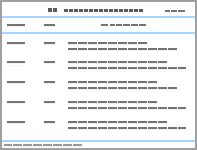
表1
红海湾珊瑚群落调查站位"
| 站点 | 岛屿 | 经度 | 纬度 |
|---|---|---|---|
| 1 | 江牡岛 | 115°11′19″E | 22°44′41″N |
| 2 | 鸡心石 | 115°8′23″E | 22°44′36″N |
| 3 | 三板洲 | 114°55′31″E | 22°37′43″N |
| 4 | 青洲 | 114°54′46″E | 22°35′24″N |
| 5 | 东碇屿 | 115°5′35″E | 22°38′3″N |
| 6 | 西碇屿 | 115°4′33″E | 22°39′7″N |
表1
表2
红海湾珊瑚群落底质、造礁石珊瑚覆盖率和环境因子"
| 站点 | 样带 | 底质类型 | 水深/m | 珊瑚覆盖率/% | |||
|---|---|---|---|---|---|---|---|
| 生物礁石 | 岩石 | 沙 | 泥 | ||||
| 1 | 1—1 | 76.68 | 9.90 | 13.42 | 0.00 | 4.20 | 3.02 |
| 1—2 | 20.68 | 0.00 | 78.12 | 1.20 | 5.50 | 0.30 | |
| 平均值 | 48.68 | 4.95 | 45.77 | 0.60 | 4.85 | 1.66 | |
| 2 | 2—1 | 98.26 | 0.00 | 1.74 | 0.00 | 2.80 | 8.14 |
| 2—2 | 85.04 | 7.74 | 7.22 | 0.00 | 3.50 | 18.22 | |
| 平均值 | 91.65 | 3.87 | 4.48 | 0.00 | 3.15 | 13.18 | |
| 3 | 3—1 | 91.28 | 0.00 | 8.72 | 0.00 | 3.70 | 11.18 |
| 3—2 | 93.64 | 3.84 | 2.52 | 0.00 | 2.90 | 9.08 | |
| 平均值 | 92.46 | 1.92 | 5.62 | 0.00 | 3.3 | 10.13 | |
| 4 | 4—1 | 98.90 | 0.00 | 1.10 | 0.00 | 3.40 | 21.00 |
| 4—2 | 80.06 | 0.00 | 19.94 | 0.00 | 3.20 | 4.42 | |
| 平均值 | 89.48 | 0.00 | 10.52 | 0.00 | 3.30 | 12.71 | |
| 5 | 5—1 | 100.00 | 0.00 | 0.00 | 0.00 | 4.10 | 17.79 |
| 5—2 | 100.00 | 0.00 | 0.00 | 0.00 | 5.30 | 31.55 | |
| 平均值 | 100.00 | 0.00 | 0.00 | 0.00 | 4.70 | 24.67 | |
| 6 | 6—1 | 100.00 | 0.00 | 0.00 | 0.00 | 4.90 | 35.28 |
| 6—2 | 100.00 | 0.00 | 0.00 | 0.00 | 6.20 | 36.38 | |
| 平均值 | 100.00 | 0.00 | 0.00 | 0.00 | 5.55 | 35.83 | |
表2
表3
红海湾海域石珊瑚和软珊瑚种类(2024年)"
| 类群 | 科 | 属 | 物种 | 拉丁名 | 珊瑚群落 | ||||||
|---|---|---|---|---|---|---|---|---|---|---|---|
| 1号 | 2号 | 3号 | 4号 | 5号 | 6号 | ||||||
| 复杂类群 | 鹿角珊瑚科 (Acroporidae) | 蔷薇珊瑚属 | 鬃刺蔷薇珊瑚 | Montipora hispida | + | + | + | + | |||
| 结节蔷薇珊瑚 | Montipora tuberculosa | + | |||||||||
| 截顶蔷薇珊瑚 | Montipora truncata | + | + | + | |||||||
| 膨胀蔷薇珊瑚 | Montipora turgescens | + | + | ||||||||
| 滨珊瑚科 (Poritidae) | 角孔珊瑚属 | 团块角孔珊瑚 | Goniopora lobata | + | + | + | + | + | |||
| 滨珊瑚属 | 团块滨珊瑚 | Porites lobata | + | + | + | + | + | ||||
| 滨珊瑚 sp. | Porites sp. | + | + | + | + | ||||||
| 菌珊瑚科(Agariciidae) | 牡丹珊瑚属 | 球牡丹珊瑚 | Pavona cactus | + | |||||||
| 木珊瑚科 (Dendrophylliidae) | 筒星珊瑚属 | 腥红筒星珊瑚 | Tubastraea coccinea | + | + | ||||||
| 陀螺珊瑚属 | 盾形陀螺珊瑚 | Turbinaria peltata | + | + | |||||||
| 坚实类群 | 裸肋珊瑚科 (Merulinidae) | 刺星珊瑚属 | 锯齿刺星珊瑚 | Cyphastrea serailia | + | + | + | ||||
| 盘星珊瑚属 | 标准盘星珊瑚 | Dipsastraea speciosa | + | + | + | + | |||||
| 角蜂巢珊瑚属 | 秘密角蜂巢珊瑚 | Favites abdita | + | + | |||||||
| 软珊瑚 | 穗珊瑚科 (Nephtheidae) | 棘穗软珊瑚属 | 棘穗软珊瑚 | Dendronephthya cervicornis | + | + | |||||
| 穗软珊瑚属 | 穗软珊瑚 | Nephthea sp. | + | + | |||||||
| 鞭柳珊瑚科(Ellisellidae) | 鞭柳珊瑚属 | 鞭柳珊瑚 | Ellisella sp. | + | |||||||
| 类尖柳珊瑚科 (Paramuriceidae) | 刺柳珊瑚属 | 刺柳珊瑚 | Echinogorgia sp. | + | + | ||||||
| 丛柳珊瑚科 (Plexauridae) | 丛柳珊瑚属 | 弯真丛柳珊瑚 | Euplexaura curvata | + | + | ||||||
| 小月柳珊瑚属 | 小月柳珊瑚 | Menella kanisa | + | ||||||||
| 软珊瑚科(Alcyoniidae) | 多棘软珊瑚属 | 多棘软珊瑚 | Spongodes sp. | + | + | ||||||
表3
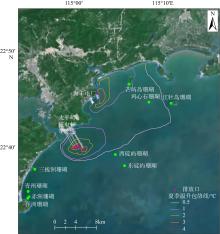
图1
夏季温升影响范围与珊瑚分布叠置示意图 该图基于中科星图服务网站(https://online.geovisearth.com/)的审图号为GS(2023)1924号的在线卫星地图制作"
图1
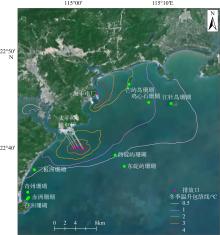
图2
冬季温升影响范围与珊瑚分布叠置示意图 该图基于中科星图服务网站(https://online.geovisearth.com/)的审图号为GS(2023)1924号的在线卫星地图制作"
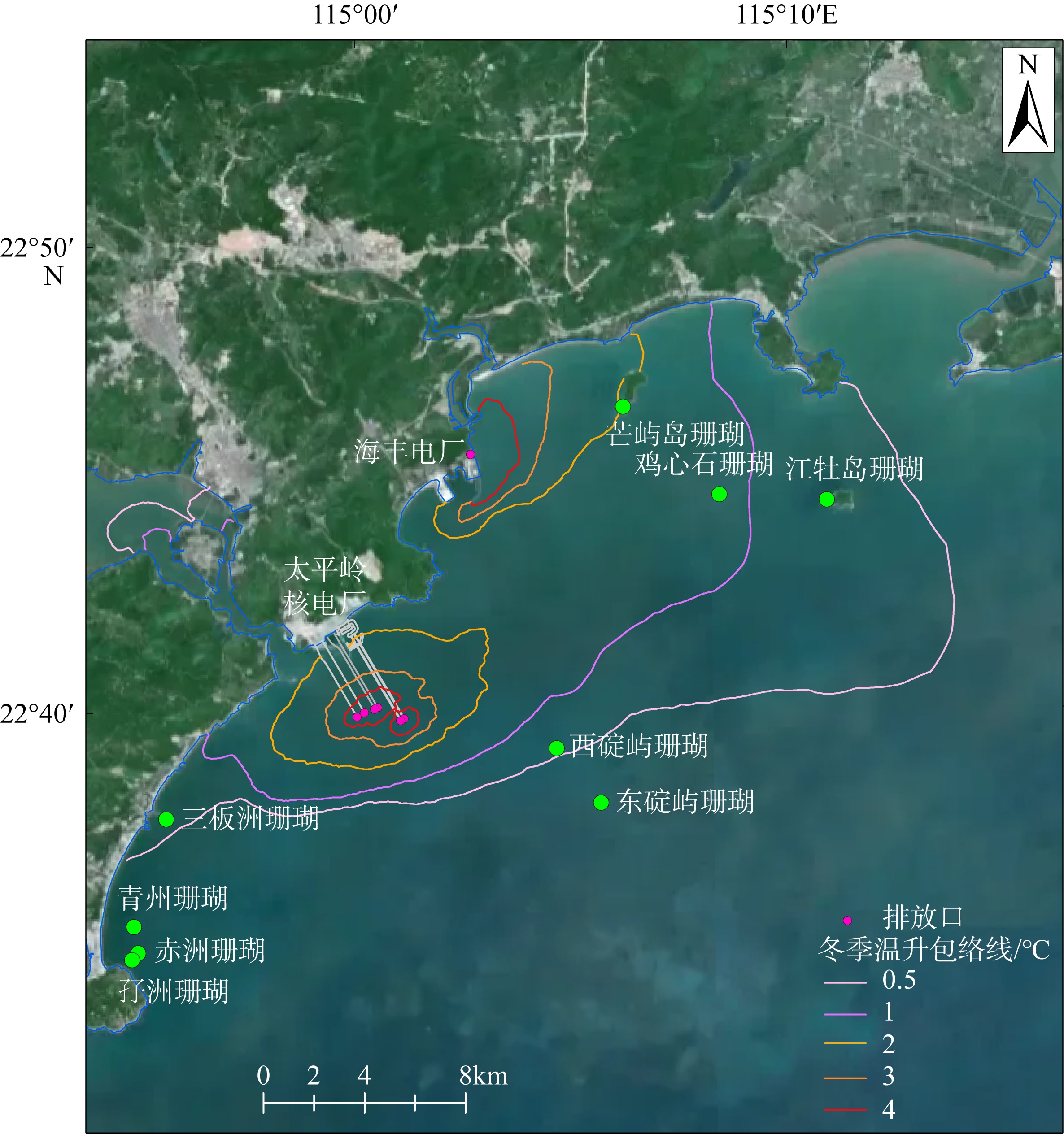
图2
图3
温升影响鸡心石和芒屿岛附近海域的潮汐周期预测"
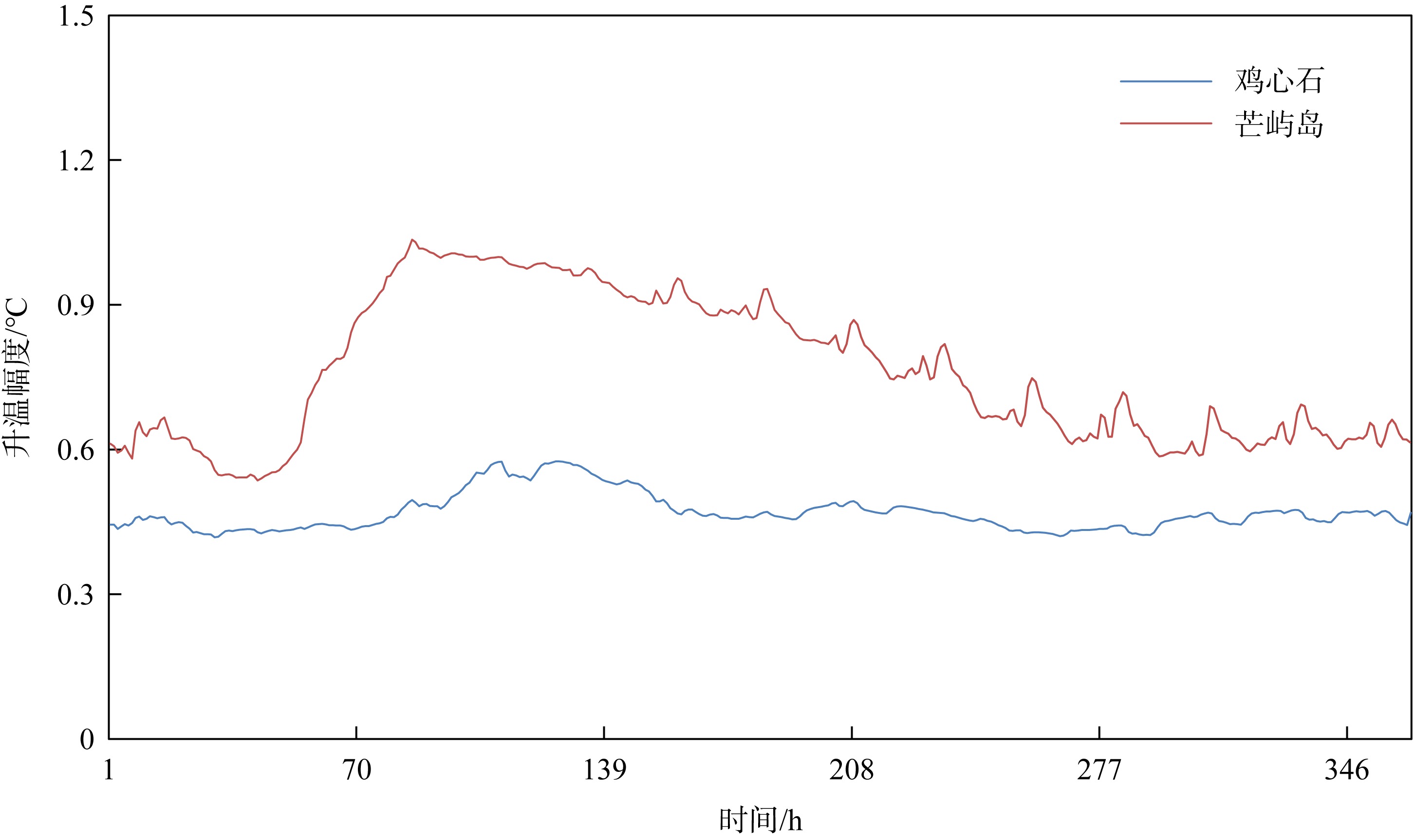
图3
表4
2019—2024年鸡心石和芒屿岛区域夏季海水平均温度"
| 年份 | 鸡心石周边海域/℃ | 芒屿岛周边海域/℃ |
|---|---|---|
| 2019 | 28.352 | 28.625 |
| 2020 | 28.817 | 29.034 |
| 2021 | 28.656 | 28.886 |
| 2022 | 29.204 | 29.294 |
| 2023 | 29.019 | 29.176 |
| 2024 | 29.096 | 29.340 |
表4
表5
2019—2024年鸡心石和芒屿岛区域6—9月的SST均值"
| 月份 | 鸡心石周边海域/℃ | 芒屿岛周边海域/℃ |
|---|---|---|
| 6 | 28.399 | 28.474 |
| 7 | 28.945 | 29.024 |
| 8 | 28.690 | 28.729 |
| 9 | 28.648 | 28.674 |
表5
表6
电厂温排水对夏季海水热周度及珊瑚白化的影响评估"
| 地点 | 基准水温年份 | 珊瑚白化压力标准 | 温排水影响 | DHW/(℃-week) | 珊瑚白化死亡风险 |
|---|---|---|---|---|---|
| 鸡心石 | 2019 | NOAA标准 | 不考虑 | 0.145 | 无 |
| 2019 | NOAA标准 | 考虑 | 2.153 | 无 | |
| 2024 | NOAA标准 | 不考虑 | 7.337 | 白化风险高 | |
| 2024 | NOAA标准 | 考虑 | 10.471 | 白化死亡风险高 | |
| 芒屿岛 | 2019 | NOAA标准 | 不考虑 | 0.483 | 无 |
| 2019 | NOAA标准 | 考虑 | 5.800 | 白化风险高 | |
| 2024 | NOAA标准 | 不考虑 | 9.053 | 白化死亡风险高 | |
| 2024 | NOAA标准 | 考虑 | 17.362 | 白化死亡风险高 |
表6
图4
2019年和2024年鸡心石和芒屿岛附近海区的基准水温、温排水引发的升温和NOAA标准DHW计算 a. 2019年鸡心石附近海区的基准水温、温排水引发的升温和NOAA标准DHW计算; b. 2024年鸡心石附近海区的基准水温、温排水引发的升温和NOAA标准DHW计算; c. 2019年芒屿岛附近海区的基准水温、温排水引发的升温和NOAA标准DHW计算; d. 2024年芒屿岛附近海区的基准水温、温排水引发的升温和NOAA标准DHW计算"
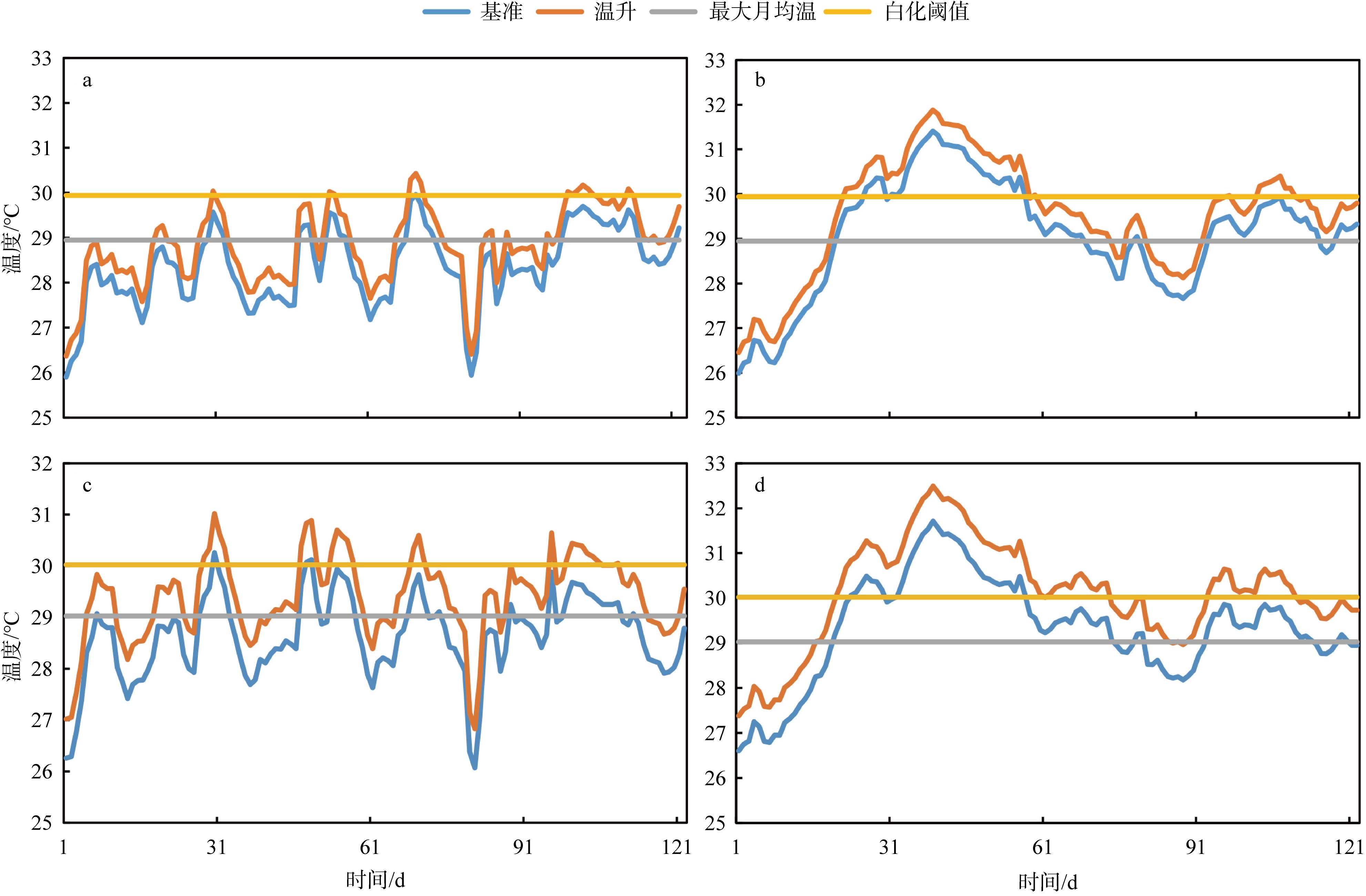
图4
| [1] |
陈天然, 余克服, 施祺, 等, 2011. 全球变暖和核电站温排水对大亚湾滨珊瑚钙化的影响[J]. 热带海洋学报, 30(2): 1-9.
|
|
|
|
| [2] |
陈小莉, 郭有, 纪平, 2015. 电厂温排水模型研究进展[C]// 第七届全国水力学与水利信息学大会论文集. 宜昌: 第七届全国水力学与水利信息学大会, 2015: 166-170 (in Chinese).
|
| [3] |
陈小莉, 张强, 赵懿珺, 等, 2018. 滨海核电厂冷却水明渠浅水排放三维数值模拟[J]. 中国水利水电科学研究院学报, 16(3): 207-212.
|
|
|
|
| [4] |
陈镇东, 汪中和, 宋克义, 等, 2000. 台湾南部核能电厂附近海域珊瑚所记录的水温[J]. 中国科学(D辑), (6): 663-668 (in Chinese).
|
| [5] |
段晓伟, 肖宝华, 廖宝林, 等, 2019. 造礁石珊瑚自然海区断枝培育技术研究[J]. 广东海洋大学学报, 39(3): 115-120.
|
|
|
|
| [6] |
冯名星, 2015. 海丰电厂两台机组全面投产发电[J]. 电器工业, (6): 4 (in Chinese).
|
| [7] |
国家市场监督管理总局, 国家标准化管理委员会, 2024. 珊瑚礁生态修复监测和效果评估技术指南GB/T45025—2024[S]. 北京: 中国标准出版社.
|
|
Standardization Administration of the People’s Republicof China, 2024. Technical guidelines for monitoring and effectiveness evaluation of coral reef ecological restoration: GB/T45025—2024[S]. Beijing: Standards Press of China. (in Chinese)
|
|
| [8] |
何鹏, 谢杰坤, 张鹤峤, 等, 2023. 海南昌江核电站温排水海域浮游植物群落特征[J]. 海南热带海洋学院学报, (5): 30-37.
|
|
|
|
| [9] |
何琦, 魏泽勋, 王永刚, 2012. 南海北部陆架陆坡区海流观测研究[J]. 海洋学报, 34(1): 17-28.
|
|
|
|
| [10] |
黄晖, 2019. 中国珊瑚礁状况报告[R]. 中国太平洋学会珊瑚礁分会. 北京: 海洋出版社 (in Chinese).
|
| [11] |
黄荣永, 余克服, 王英辉, 等, 2019. 珊瑚礁遥感研究进展[J]. 遥感学报, 23(6): 1091-1112.
|
|
|
|
| [12] |
黄诗宁, 2020. 惠州市海洋与渔业生态环境现状、存在问题及防治对策[D]. 广州: 华南农业大学.
|
|
|
|
| [13] |
贾戬, 2023. 粤港澳大湾区造礁石珊瑚脆弱性评估及其保护空缺分析[D]. 厦门: 集美大学.
|
|
|
|
| [14] |
解欣斐, 李慈玲, 周立斌, 2025. 太平岭核电站附近海域海水水质调查分析与评价[J]. 清洗世界, 41(2): 40-42 (in Chinese).
|
| [15] |
李志强, 陈子燊, 2003. 粤东红海湾海区波侯特征分析[J]. 中山大学学报(自然科学版), 42(6): 107-110.
|
|
|
|
| [16] |
刘广平, 何伟宏, 邹晓理, 等, 2018. 红海湾西北海区海流特征分析[J]. 热带海洋学报, 37(5): 40-49.
doi: 10.11978/2017133 |
|
doi: 10.11978/2017133 |
|
| [17] |
刘建峰, 2022. 近40年来大亚湾珊瑚群落退化因素的研究[D]. 南宁: 广西大学.
|
|
|
|
| [18] |
龙丽娟, 杨芳芳, 韦章良, 2019. 珊瑚礁生态系统修复研究进展[J]. 热带海洋学报, 38(6): 1-8.
doi: 10.11978/2019066 |
|
doi: 10.11978/2019066 |
|
| [19] |
陆永强, 陈正华, 余克服, 等, 2022. 1985-2019年南海诸岛珊瑚礁区热压力时空变化研究分析[J]. 海洋学报, 44: 179-190.
|
|
|
|
| [20] |
孙旋, 蔡玉林, 索琳琳, 等, 2018. 基于SST的珊瑚礁白化监测技术综述[J]. 国土资源遥感, 30(2): 21-28.
|
|
|
|
| [21] |
覃宾妮, 2023. 南海珊瑚礁热压力与精细海温时空格局的遥感研究[D]. 南宁: 广西大学.
|
|
|
|
| [22] |
唐森铭, 严岩, 陈彬, 2013. 春夏季大亚湾核电厂温排水对海洋浮游植物群落结构的影响[J]. 应用海洋学学报, 32(3): 373-382.
|
|
|
|
| [23] |
王广华, 卢锟, 刘建峰, 等, 2023. 近40年来大亚湾造礁石珊瑚群落结构的演变分析[J]. 海洋学报, 45(11): 112-130.
|
|
|
|
| [24] |
王以斌, 杜宁, 尹晓斐, 2023. 滨海核电站运行废水排海对海洋生态环境的影响分析[J]. 科技视界, 13(35): 1-3 (in Chinese).
|
| [25] |
王云祥, 2016. 大亚湾海域珊瑚资源恢复技术研究[D]. 天津: 天津农学院.
|
|
|
|
| [26] |
吴莹莹, 雷新明, 黄晖, 等, 2021. 南海典型珊瑚礁生态系统健康评价方法研究[J]. 热带海洋学报, 40(4): 84-97.
|
|
|
|
| [27] |
夏景全, 任瑜潇, 陈煜, 等, 2019. 珊瑚礁生态修复技术进展[J]. 海南热带海洋学院学报, 26(5): 23-33.
|
|
|
|
| [28] |
姚沛林, 薛庆, 卢辉雄, 等, 2025. 核电站温排水监测技术现状与展望[J]. 世界核地质科学, 42(1): 155-165.
|
|
|
|
| [29] |
张爱玲, 朱利, 陈晓秋, 等, 2014. 核电站温排水卫星遥感监测应用研究[J]. 环境监测管理与技术, 26: 12-16.
|
|
|
|
| [30] |
赵升, 刘旭东, 张爱君, 等, 2013. 黄岛电厂温排水对大型底栖生物群落的影响[J]. 环境监测管理与技术, 25(4): 18-23.
|
|
|
|
| [31] |
赵孜苗, 李金雄, 黄慧峰, 等, 2024. 珠江口万山群岛珊瑚生态多样性调查[J]. 环境生态学, (4): 143-150.
|
|
|
|
| [32] |
周浩郎, 王欣, 梁文, 2020. 涠洲岛珊瑚礁特点、演变及保护与修复对策的思考[J]. 广西科学院学报, 36(3): 228-236.
|
|
|
|
| [33] |
邹仁林, 2001. 中国动物志·腔肠动物门·珊瑚虫纲·石珊瑚目·造礁石珊瑚[M]. 北京: 科学出版社 (in Chinese).
|
| [34] |
doi: 10.1007/s003380050249 |
| [35] |
|
| [36] |
|
| [37] |
doi: 10.1016/j.compbiolchem.2008.04.001 pmid: 18565794 |
| [38] |
doi: 10.3389/fmars.2018.00150 |
| [39] |
doi: 10.1007/s00338-019-01844-2 |
| [40] |
|
| [41] |
doi: 10.1046/j.1523-1739.2000.00011.x |
| [42] |
doi: 10.1038/nature21707 |
| [43] |
doi: 10.1126/science.aan8048 pmid: 29302011 |
| [44] |
doi: 10.1038/s41558-020-0822-0 |
| [45] |
doi: 10.1007/BF00265006 |
| [46] |
doi: 10.4319/lo.2014.59.3.0788 |
| [47] |
doi: 10.1016/j.jembe.2005.12.009 |
| [48] |
doi: 10.1029/2003EO150001 |
| [49] |
doi: 10.3390/rs61111579 |
| [50] |
doi: 10.1088/1755-1315/146/1/012058 |
| [51] |
doi: 10.1111/geb.v29.12 |
| [52] |
|
| [53] |
|
| [54] |
doi: 10.1016/j.jembe.2004.08.012 |
| [55] |
doi: 10.1038/s41467-019-09238-2 pmid: 30894534 |
| [56] |
|
| [57] |
doi: 10.1017/RDC.2017.43 |
| [58] |
|
| [59] |
doi: 10.3390/rs12233856 |
| [60] |
|
| [61] |
doi: 10.1016/j.rse.2003.12.005 |
| [1] | 许莉佳, 廖芝衡, 陈辉, 王永智, 黄柏强, 林巧云, 甘健锋, 杨静. 南海北部珊瑚群落结构特征及其对海洋热浪事件的响应[J]. 热带海洋学报, 2024, 43(3): 58-71. |
| [2] | 刘广平, 何伟宏, 邹晓理, 王昭正, 孙天山. 红海湾西北海区海流特征分析[J]. 热带海洋学报, 2018, 37(5): 40-49. |
| [3] | 谢福武, 刘华雪, 黄洪辉, 宋星宇. 大亚湾浮游植物粒级结构对温排水和营养盐输入的响应*[J]. 热带海洋学报, 2018, 37(3): 55-64. |
| [4] | 谢艳辉, 李涛, 简伟军, 胡思敏, 田媛, 刘胜. 海水升温对大亚湾浮游植物群落结构和光合活性的影响[J]. 热带海洋学报, 2015, 34(2): 24-31. |
| [5] | 周国伟,黄晖,喻子牛,尤丰,李秀保. 丛生盔形珊瑚的2种颜色群体共生藻组成比较[J]. 热带海洋学报, 2011, 30(2): 51-56. |
| [6] | 李淑,余克服,陈天然,施祺,陈特固. 珊瑚共生虫黄藻密度的季节变化及其与珊瑚白化的关系——以大亚湾石珊瑚为例[J]. 热带海洋学报, 2011, 30(2): 39-45. |
| [7] | 陈天然,余克服,施祺,陈特固,王嵘. 全球变暖和核电站温排水对大亚湾滨珊瑚钙化的影响[J]. 热带海洋学报, 2011, 30(2): 1-9. |
| [8] | 江志兵,曾江宁,陈全震,廖一波,高爱根,徐晓群,寿鹿,. 不同升温速率对桡足类高起始致死温度的影响[J]. 热带海洋学报, 2010, 29(3): 87-92. |
| [9] | 张晓峰,上官志洪,赵锋. 阳江核电厂附近海域生物辐射影响评价研究[J]. 热带海洋学报, 2009, 28(6): 35-40. |
|
||