

Journal of Tropical Oceanography ›› 2026, Vol. 45 ›› Issue (5): 3-15.doi: 10.11978/YG2026002CSTR: 32234.14.YG2026002
• Review • Previous Articles Next Articles
Advances in the study of physical-mechanical properties and numerical models of coral reef limestone
XU Dongsheng1,2( ), LIU Yang1,2, YAN Wen3,4(), JIN Weiqiang1
- 1
School of Civil Engineering and Architecture ,Wuhan University of Technology
2Sanya Science and Education Innovation Park ,Wuhan University of Technology
3South China Sea Institute of Oceanology ,Chinese Academy of Sciences, State Key Laboratory of Tropical Oceanography, Laboratory of Ocean and Marginal Sea Geology
4University of Chinese Academy of Sciences
-
Received:2026-02-14Revised:2026-03-23Online:2026-09-10Published:2026-10-13 -
Contact:YAN Wen. email:wyan@scsio.ac.cn -
Supported by:National Key Research and Development Program of China(2021-06)

CLC Number:
- P736.32
Cite this article
XU Dongsheng, LIU Yang, YAN Wen, JIN Weiqiang. Advances in the study of physical-mechanical properties and numerical models of coral reef limestone[J].Journal of Tropical Oceanography, 2026, 45(5): 3-15.
share this article
Add to citation manager EndNote|Reference Manager|ProCite|BibTeX|RefWorks
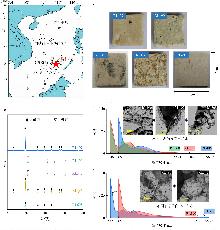
Fig. 1
(a) Geographical location of Well NK-1; (b) reef limestone samples collected from various depths; (c) mineral composition of the samples; (d, e) micro-mechanical properties of reef limestone"

Fig. 1
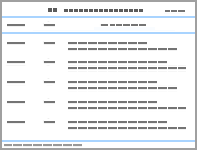
Tab. 1
Comparison of physical indices between coral reef limestone and typical fluvial sandstone"
| 物理指标 | 珊瑚礁灰岩 | 河流相砂岩 | |
|---|---|---|---|
| 物理特性 | 矿物组分 | 文石、高镁方解石、白云石 | 方解石、白云石 |
| 干密度/(g·cm-3) | 1.20 ~ 2.37 | 2.40 ~ 2.80 | |
| 纵波波速/(m·s-1) | 2700 ~ 3700 | 4500 ~ 6000 | |
| 孔隙率/% | 15 ~ 60 | 5 ~ 25 | |
| 结构特点 | 孔隙构成 | 内孔隙(原生)、间隙孔、溶蚀孔 | 间隙孔(原生)、裂隙 |
| 主导孔径 | 中孔(0.0625 ~ 4mm)占比>85% | 细孔为主, 分布均匀 | |
| 孔喉形状 | 偏三角形、极其不规则 | 相对规则、球体化 | |
| 各向异性程度 | 极高(受珊瑚生长方向控制) | 低(受压密层面控制) |
Tab. 1
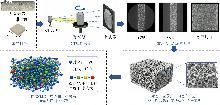
Fig. 2
Workflow for constructing the 3D pore network model of reef limestone"
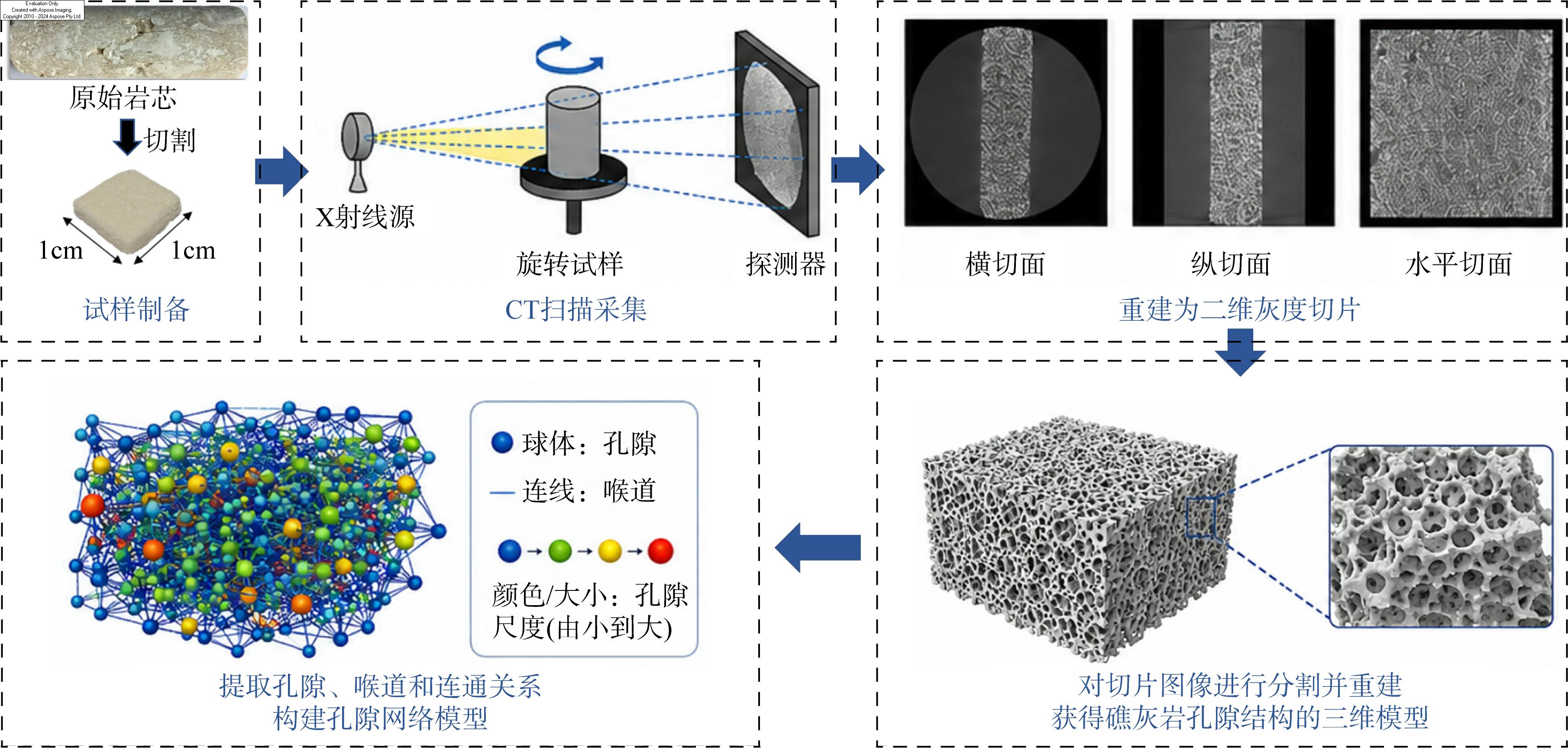
Fig. 2
Tab. 2
Static mechanical properties of reef limestone with different textural types"
| 结构类型 | 单轴破坏强度/MPa | 破坏特征 | 关键影响因素 |
|---|---|---|---|
| 泥晶化格架结构 | 15 ~ 40 | 沿生长线拉伸破坏, 残余强度高 | 孔隙率低、干密度大 |
| 砾屑/砂屑结构 | 1 ~ 15 | 颗粒破碎、脆性剪切 | 胶结强度、孔隙连通性 |
| 鹿角状骨架结构 | 10 ~ 30 | 局部压碎、多面崩解 | 骨架粒径、级配 |
Tab. 2
Fig.3
(a) Relationship between peak stress and porosity of reef limestone under uniaxial compression in both dry and saturated conditions; (b) various failure modes observed in reef limestone specimens"
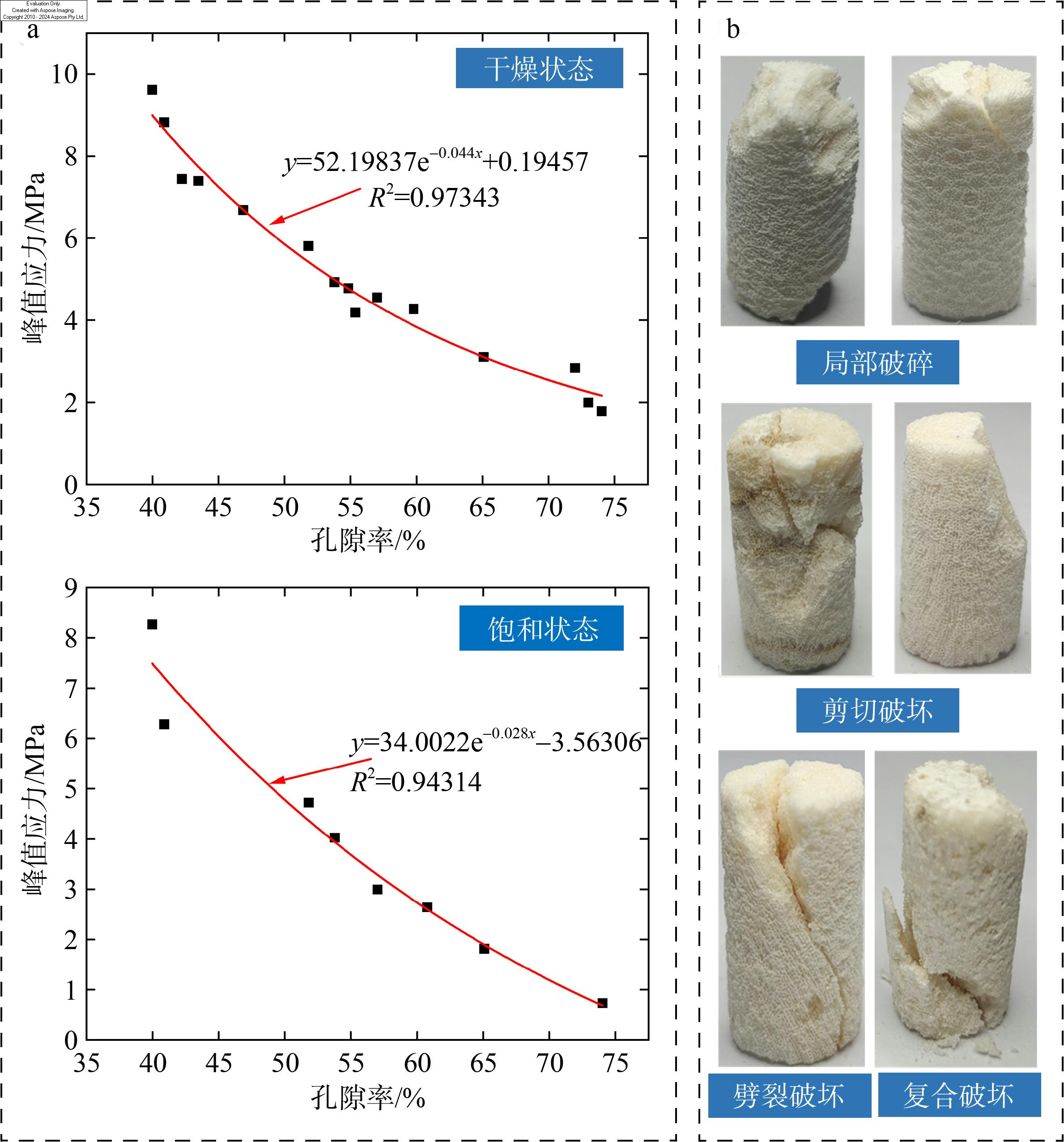
Fig.3
Fig. 4
(a) Micro-scale rock mechanical testing system; (b) load-nanoindentation depth curves of reef limestone with different diagenetic mineral types"
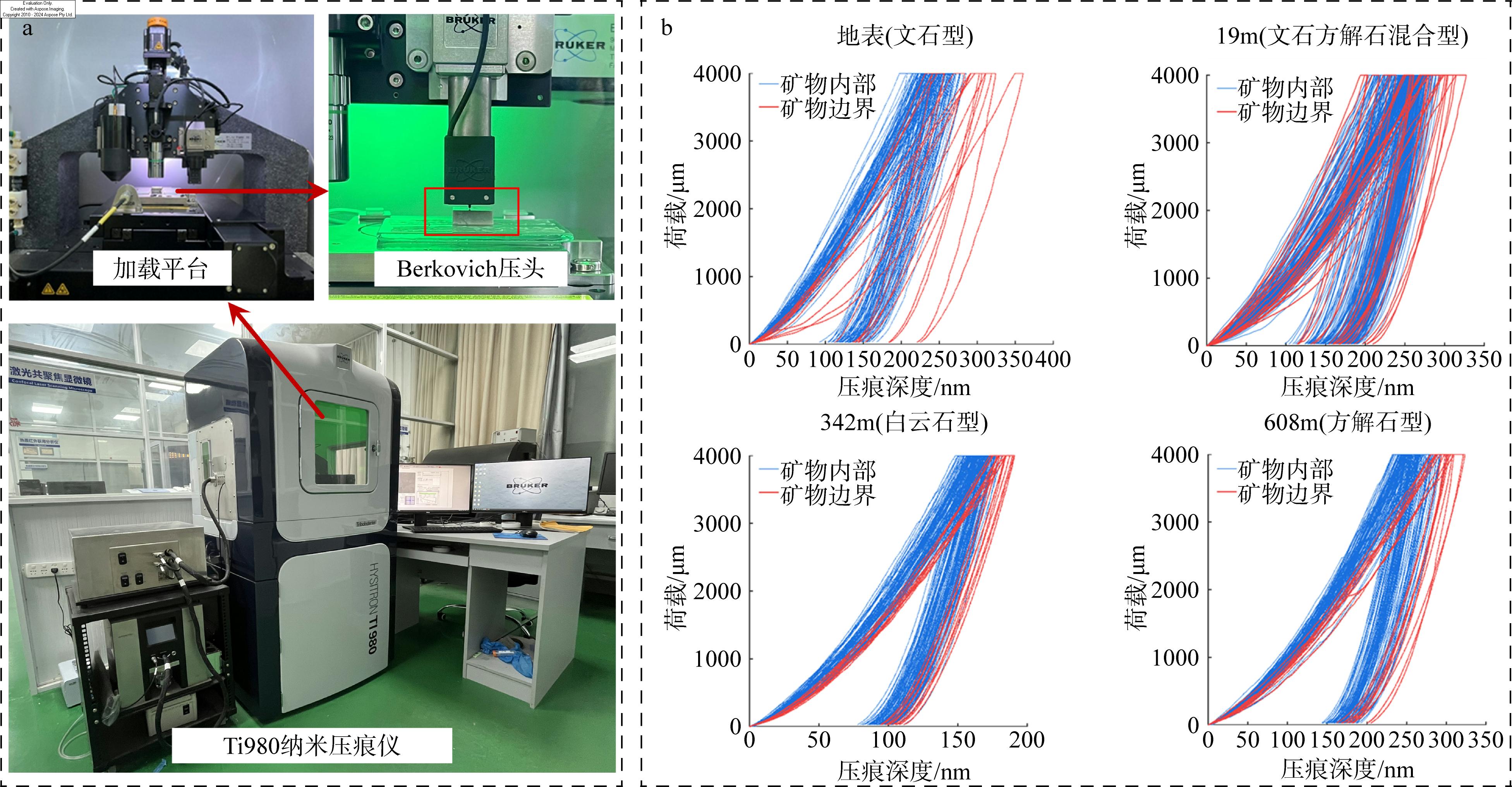
Fig. 4
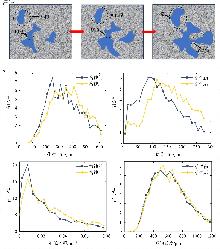
Fig. 5
(a) Schematic diagram of pore and throat development during the dissolution process of coral reef limestone; (b) variations in pore and throat parameters of reef limestone before and after dissolution"

Fig. 5
| [1] |
高宇宁, 朱海威, 余红发, 等, 2025. 基于南海岛礁暴露试验的混凝土服役寿命[J]. 硅酸盐学报, 53(5): 1177-1192.
|
|
|
|
| [2] |
李文杰, 瞿登星, 李新平, 等, 2025. 基于数字岩心的礁灰岩多尺度统计损伤本构模型研究[J]. 岩石力学与工程学报, 44(12): 3386-3402.
|
|
|
|
| [3] |
李新平, 李文灏, 周正荣, 等, 2026. 基于数字岩心的礁灰岩力学尺寸效应机制研究[J]. 岩石力学与工程学报, 45(4): 980-995.
|
|
|
|
| [4] |
刘洋, 2024. 不同埋深礁灰岩的微观岩石力学试验及参数均质化研究[D]. 武汉: 武汉理工大学.
|
|
|
|
| [5] |
唐旭海, 许婧璟, 张怡恒, 等, 2022. 基于微观岩石力学试验和NWA13618陨石的小行星岩石力学参数分析[J]. 岩土力学, 43(5): 1157-1163.
|
|
|
|
| [6] |
汪云龙, 王义德, 陈龙伟, 等, 2026. 南海珊瑚砂剪切波速与抗液化强度关系研究[J]. 岩石力学与工程学报, 45(2): 613-625.
|
|
|
|
| [7] |
王振峰, 时志强, 张道军, 等, 2015. 西沙群岛西科1井中新统-上新统白云岩微观特征及成因[J]. 地球科学, 40(4): 633-644.
|
|
|
|
| [8] |
文兵, 袁内镇, 孔令伟, 等, 2021. 吹填珊瑚砂场地高层建筑复合地基工程实践与沉降估算[J]. 土木工程学报, 54(12): 85-93.
|
|
|
|
| [9] |
徐东升, 刘洋, 杜文博, 等, 2025. 非均质层状珊瑚砂地基承载特性试验研究[J]. 土木工程学报, 58(6): 91-102.
|
|
|
|
| [10] |
徐东升, 刘洋, 侯传坦, 2024. 基于多块体上限法的层状珊瑚砂地基承载力分析[J]. 东南大学学报(自然科学版), 54(4): 921-928.
|
|
|
|
| [11] |
杨阳, 王乐, 马建华, 等, 2024. 考虑颗粒破碎影响的钙质砂中海底管道贯入机制研究[J]. 岩土力学, 45(2): 623-632.
|
|
|
|
| [12] |
钟毓, 汪稔, 李琦, 等, 2020. 珊瑚礁灰岩物性特征及工程性质研究进展[J]. 科技导报, 38(20): 57-70.
doi: 10.3981/j.issn.1000-7857.2020.20.012 |
|
|
|
| [13] |
郑坤, 孟庆山, 汪稔, 等, 2020. 珊瑚礁灰岩工程地质特性研究新进展[J]. 海洋地质与第四纪地质, 40(1): 42-49.
|
|
|
|
| [14] |
周末, 2024. 南海新生代白云岩成因及控制因素[D]. 武汉: 中国地质大学.
|
|
|
|
| [15] |
doi: 10.1016/j.jobe.2023.107940 |
| [16] |
doi: 10.1016/j.conbuildmat.2024.137618 |
| [17] |
|
| [18] |
doi: 10.3390/jmse13050883 |
| [19] |
|
| [20] |
doi: 10.3390/app12052611 |
| [21] |
doi: 10.1007/s00603-021-02570-4 |
| [22] |
doi: 10.1016/j.conbuildmat.2022.129783 |
| [23] |
doi: 10.1007/s11001-023-09539-8 |
| [24] |
doi: 10.3390/jmse13020284 |
| [25] |
doi: 10.1016/j.measurement.2025.118900 |
| [26] |
doi: 10.1016/j.jobe.2024.108853 |
| [27] |
doi: 10.1016/0001-6160(73)90064-3 |
| [28] |
doi: 10.1016/j.ijrmms.2022.105167 |
| [29] |
|
| [30] |
doi: 10.3390/ma16155465 |
| [31] |
|
| [32] |
doi: 10.1016/j.jrmge.2023.10.005 |
| [33] |
|
| [34] |
|
| [35] |
doi: 10.3390/su141912193 |
| [36] |
doi: 10.3389/feart.2024.1515670 |
| [37] |
doi: 10.1007/s11440-021-01277-8 |
| [38] |
doi: 10.3390/app12094105 |
| [1] | TIAN Yuhang, CHEN Zhong, HUANG Weixia, HOU Zhengyu, YAN Wen, WANG Xuesong. P-wave velocity properties and its influencing factors of coral reef limestone in Nansha area [J]. Journal of Tropical Oceanography, 2021, 40(1): 133-141. |
| [2] | Kang ZHANG,Shuangxi GUO,Pengqi HUANG,Ling QU,Yuanzheng LU,Xianrong CEN,Lusha YU,Weidong ZHOU,Shengqi ZHOU. Using artificial intelligence for identifying the depth of upper-ocean mixed layer [J]. Journal of Tropical Oceanography, 2019, 38(5): 32-41. |
|
||