Journal of Tropical Oceanography >
New understanding about Chemical Oceanography in the South China Sea since 1980
Copy editor: LIN Qiang
Received date: 2020-12-14
Request revised date: 2021-01-05
Online published: 2021-01-06
Supported by
Strategic Priority Research Program of the Chinese Academy of Sciences(XDA23050501)
Double-Hundred Talents Project of Yantai City(2019)
Copyright
As the largest marginal sea in the western Pacific, the South China Sea (SCS) plays an important role in the global ocean and the global oceanographic research. In the past 40 years, chemical oceanographic research in the SCS achieved systematic new discoveries and new understandings; researchers put forward many new theoretical viewpoints, making important contributions to the development of oceanography. A subsurface layer was revealed in the SCS, maximum values of ecological environmental parameters represented by nitrite are present; and the depth ranges of water layers for different parameters are different, forming a thermocline ecosystem that has significantly different characteristics from the other ecosystems. The carbon cycle process in the SCS is very complex, and changes of the biological pump controlled by biological activities, and the regional and seasonal changes of carbon sources and sinks, are all great. The characteristics and intensity of carbon sources and sinks in the SCS are unique in different regions at different times. Annually, the SCS is a weak source of atmospheric carbon dioxide. The characteristics of ecological environment and the cycling process of chemical material in the Pearl River Estuary and deep-sea basins were found not only closely related to but also significantly different from that in shelf marginal seas and coral reefs, as the dissolved oxygen concentration is low in the bottom, and the Pearl River Estuary is basically an ecologically fragile area characterized by hypoxia. Based on the systematic understanding of the rapid material circulation and vertical transfer of chemical substances controlled by biological processes in the Nansha coral reef ecosystem, a new mechanism - “resembling drift-net theory” - was proposed to explain how the coral reef ecosystem could maintain high productivity. Systematic studies on the sedimentary chemistry of the SCS show that there is a close coupling between the sediments and chemical cycling of water bodies. The distribution of chemical substances in coral reefs or in sediment cores of the SCS can be used to retrieve historical environment changes. The paleo productivity of surface seawater in the SCS during the glacial period was 1.6 times higher than that of the interglacial period. A "biological explosion event" occurred in the southern SCS in the late Miocene. The productivity in that period was mainly affected by the monsoon and terrigenous nutrients input, while the influences of northeast monsoon and southwest monsoon differed in different regions. These new discoveries and new understandings in chemical oceanography of the SCS in the past 40 years have laid a strong foundation for further systematic and in-depth understanding of the oceanographic processes in the region. In the future, chemical oceanographic research will definitely provide scientific support for the sustainable utilization of resources and environment in the SCS.
SONG Jinming , WANG Qidong . New understanding about Chemical Oceanography in the South China Sea since 1980[J]. Journal of Tropical Oceanography, 2021 , 40(3) : 15 -24 . DOI: 10.11978/YG2020010
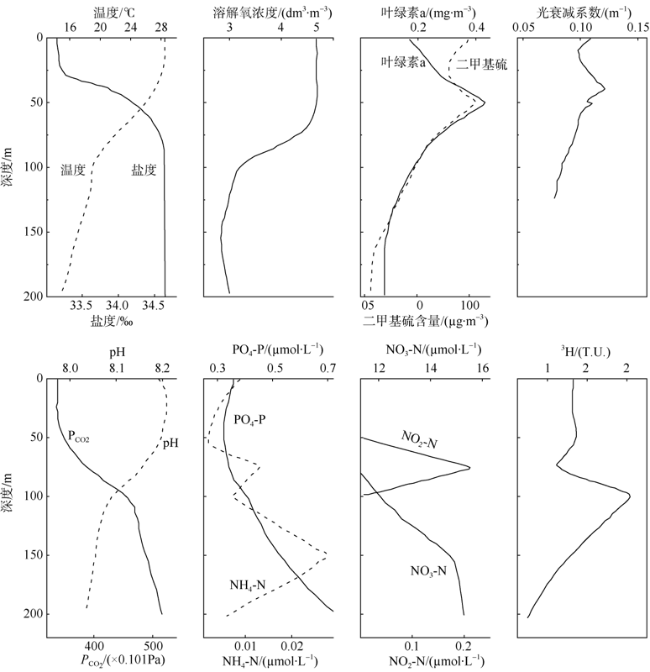
图1 1991年12月南沙群岛海域上层水理化参数的极值现象(林洪瑛 等, 2001)Fig. 1 Vertical profiles of environmental parameter extremums in the upper-layer waters of the Nansha Islands during December 1991. After Lin et al (2001) |
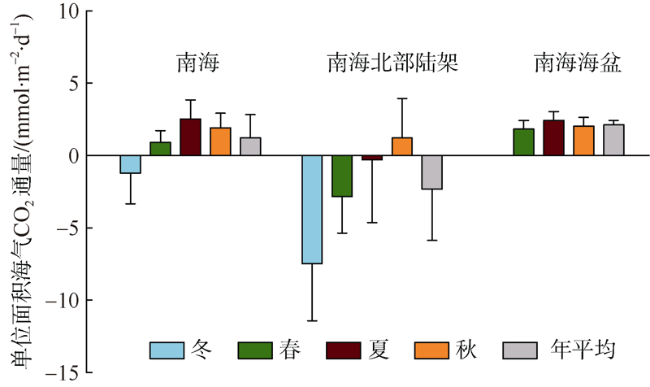
图2 南海海气界面碳通量(戴民汉 等, 2020)Fig. 2 CO2 fluxes across the water-air interface in the South China Sea. After Dai et al (2020) |
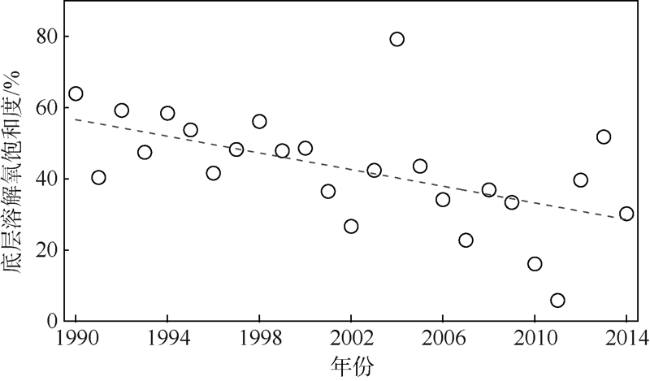
图3 珠江口(22°9'12.7″N, 3°57 '43.6″E, 深度21m)O2饱和度的变化(Qian et al, 2018)Fig. 3 Temporal variation of bottom-water dissolved oxygen saturation (22°9'12.7″N, 3°57 '43.6″E, 21 m depth). After Qian et al (2018) |
| [1] |
戴民汉, 孟菲菲, 2020. 南海碳循环: 通量、调控机理及其全球意义[J]. 科技导报, 38(18):30-34.
|
| [2] |
房殿勇, 翦知湣, 汪品先, 1998. 南沙海区南部近30ka来的古生产力记录[J]. 科学通报, 43(18):2005-2008.
|
| [3] |
韩舞鹰, 王汉奎, 1991. 南海NO2-N薄层的研究[J]. 海洋学报, 13(2):200-206.
|
| [4] |
韩舞鹰, 王明彪, 王汉奎, 1994. 南沙海域上层海水碳垂直通量的初步研究[J]. 海洋与湖沼, 25(3):345-348.
|
| [5] |
韩舞鹰, 1998. 南海海洋化学[M]. 北京: 科学出版社: 1-389.
|
| [6] |
翦知湣, 王律江,
|
| [7] |
焦念志, 梁彦韬, 张永雨, 等, 2018. 中国海及邻近区域碳库与通量综合分析[J]. 中国科学: 地球科学, 48(11):1393-1421.
|
| [8] |
李建如, 王汝建, 李保华, 2002. 南海南部12 Ma以来的蛋白石堆积速率与古生产力变化[J]. 科学通报, 47(3):235-237.
|
| [9] |
李团结, 2017. 伶仃洋地形地貌阶段性演变过程及趋势分析[D]. 武汉: 中国地质大学: 1-112.
|
| [10] |
李秀芹, 卢楚谦, 蔡伟叙, 等, 2014. 珠江口上游海域春季水体缺氧特征及相关因素[J]. 海洋环境科学, 33(6):854-859.
|
| [11] |
林洪瑛, 韩舞鹰, 1989. 我国低纬度海水中O2最大值的初步研究[J]. 海洋学报, 11(2):162-169.
|
| [12] |
林洪瑛, 韩舞鹰, 2001. 南沙群岛海域理化参数垂向分布特征及跃层生态系的提法[J]. 海洋学报, 23(1):43-51.
|
| [13] |
林洪瑛, 程赛伟, 韩舞鹰, 等, 2003. 南沙群岛海域次表层溶解氧垂直分布最大值的强度特征[J]. 热带海洋学报, 22(3):9-15.
|
| [14] |
刘茜, 郭香会, 尹志强, 等, 2018. 中国邻近边缘海碳通量研究现状与展望[J]. 中国科学: 地球科学, 48(11):1422-1443.
|
| [15] |
龙爱民, 陈绍勇, 周伟华, 等, 2006. 南海北部秋季营养盐、溶解氧、pH值和叶绿素a分布特征及相互关系[J]. 海洋通报, 25(5):9-16.
|
| [16] |
宋金明, 1997. 中国近海沉积物-海水界面化学[M]. 北京: 海洋出版社: 1-222.
|
| [17] |
宋金明, 1999a. 维持南沙珊瑚礁生态系统高生产力的新观点──拟流网理论[J]. 海洋科学集刊, (41):79-85.
|
| [18] |
宋金明, 1999b. 南沙珊瑚礁生态系中元素的垂直转移途径[J]. 海洋与湖沼, 30(1):1-5.
|
| [19] |
宋金明, 2004. 中国近海生物地球化学[M]. 济南: 山东科学技术出版社: 1-591.
|
| [20] |
宋金明, 徐永福, 胡维平, 等, 2008. 中国近海与湖泊碳的生物地球化学[M]. 北京: 科学出版社: 1-533.
|
| [21] |
宋金明, 曲宝晓, 李学刚, 等, 2018. 黄东海的碳源汇: 大气交换、水体溶存与沉积物埋藏[J]. 中国科学: 地球科学, 48(11):1444-1455.
|
| [22] |
宋金明, 段丽琴, 王启栋, 2020. 直面健康海洋之问题2—海水低氧及其生态环境效应[M]//李乃胜. 经略海洋(2020). 北京: 海洋出版社: 21-46.
|
| [23] |
叶丰, 黄小平, 刘庆霞, 2012. 2010年夏季珠江口海域溶解氧的分布特征和海气交换通量[J]. 海洋环境科学, 31(3):346-351.
|
| [24] |
叶丰, 贾国东, 韦刚健, 2019. 稳定碳氮同位素对珠江口溶解氧亏损的共同限定[C]// 中国矿物岩石地球化学学会第17届学术年会论文摘要集. 杭州: 中国矿物岩石地球化学学会: 634.
|
| [25] |
赵卫东, 宋金明, 李鹏程, 等, 2001. 珊瑚礁生态系的协同营养模式[J]. 中国科学基金, 15(1):32-35.
|
| [26] |
郑国侠, 宋金明, 孙云明, 等, 2006. 南海深海盆表层沉积物氮的地球化学特征与生态学功能[J]. 海洋学报, 28(6):44-52.
|
| [27] |
|
| [28] |
|
| [29] |
|
| [30] |
|
| [31] |
|
/
| 〈 |
|
〉 |