Journal of Tropical Oceanography >
Identification and analysis of kinematic indicators of early pliocene mass transport complexes: A case study of the northeastern continental slope in the Qiongdongnan Basin*
Received date: 2024-12-13
Revised date: 2025-02-21
Online published: 2025-02-26
Supported by
Major Talent Project in Guangdong Province(2023JC07H110)
National key Research and Development Program of China(2022YFC3103800)
National Natural Science Foundation of China(42206069)
National Natural Science Foundation of China(42272098)
Science and Technology Projects of Guangzhou(2023A04J0191)
Hainan Provincial Natural Science Foundation of China(423QN321)
Through detailed interpretation of high-resolution 3D seismic data from the deepwater area of the Qiongdongnan Basin, this study identifies four stages of Mass Transport Complexes (MTCs) on the northeastern slope of the basin: MTC1, MTC2, MTC3, and MTC4. Among these, MTC1, MTC2, and MTC4 are relatively small in scale with low internal compression, averaging 130-150 m in thickness, while MTC3 is the largest and exhibits the most intense internal deformation, with an average thickness of 200 m. By identifying and analyzing the kinematic indicators within and outside MTC3, its southwestward transport direction was determined, and its developmental process was divided into three stages: initial slope instability, sliding, and fluid transformation. Based on the morphology and internal structural characteristics of the identified MTCs, combined with the tectonic and climatic evolution of the study area, it is concluded that the development of these multi-stage MTCs is influenced by the combined effects of stratigraphic slope, sea-level fluctuations, and high sedimentation rates, with the continuous strike-slip movement of the Red River Fault Zone being the dominant controlling factor. Specifically, the rapid fall and rise of sea levels after the late Miocene (10.5 Ma) altered sediment strength and stratigraphic pressure parameters, promoting MTC development. The rapid subsidence of the Qiongdongnan Basin since 5.5 Ma increased accommodation space, enhanced sediment progradation, and steepened slopes, creating conditions for multi-stage MTC formation. Additionally, fault activity triggered by the continuous strike-slip movement of the Red River Fault Zone is the primary factor triggering the multi-stage MTCs in this region. This study enhances the understanding of the depositional characteristics and triggering factors of multi-phase MTCs on the northeastern slope of the Qiongdongdong Basin and provides insights for exploring MTC development in the South China Sea.
JU Zelong , ZHAN Wenhuan , GUO Jian , WU Xiaochuan , LI Jian , YAO Yantao , FENG Yingci , SUN Jie , WANG Pin , YI Hu , HUANG Jiaxian , XIONG Xin . Identification and analysis of kinematic indicators of early pliocene mass transport complexes: A case study of the northeastern continental slope in the Qiongdongnan Basin*[J]. Journal of Tropical Oceanography, 2025 , 44(5) : 108 -124 . DOI: 10.11978/2024233
图1 研究区示意图(a)和研究区地形地貌特征图(b)图a基于南海地质地球物理图系(杨胜雄 等, 2015)的审图号为JS(2015)02-107的标准地图制作, 底图无修改。图a中黑色虚线代表琼东南盆地的分布范围[据胡守祥(2021)修改], 红色实线代表红河断裂带, 黄色实线代表西沙海槽, 黑色方框为研究区位置。图b中红色方框表示三维地震数据范围, 白色虚线分别为图2b和图6d地震剖面所在的位置, 红点为CC26-1-1井所处位置 Fig. 1 (a) Schematic map of the study area and (b) topographic and geomorphological features of the study area |
图2 琼东南盆地地层柱状示意图(a)和地震层序界面(b)图a中地层修改自Hu等(2024), 岩性剖面来自蔡佳(2017), 沉积速率来源于Zhao等(2016), 海平面变化曲线据李伟等(2013)和Zhao等(2016); 红色实线框所对应的地层(晚中新世—上新世地层)为研究目标地层。图b中白色曲线分别表示研究区区域地震反射界面T20~T60, 黑色实线表示断层, 黄色虚线表示水道的边界, 浅蓝色虚线表示西沙海槽的边界, V.E代表该地震剖面的横纵比 Fig. 2 (a) Integrated stratigraphic column of Qiongdongnan Basin and (b) seismic sequence boundaries |
图3 NE—SW未解释的地震剖面(a)、NE—SW已解释的地震剖面和MTC3内发育的运动标志(b)和MTCs的顶底界面和块体(c)图b显示了研究区块体搬运沉积复合体(MTCs)的整体发育情况, 包含4个关键层位(T40、T30、T20和海底)、MTCs主要发育位置和MTC3 内发育的运动标志。图c展示了MTC3和MTC4中的块体, 图c中H1~H2、H3~H4、H5~H6和H7~H8分别代表MTC1、MTC2、MTC3和MTC4的顶底界面。图中白色实线(T20~T40)代表研究区区域地层界面, 白色虚线代表MTC1、MTC2、MTC4的顶底界面, 绿色和黄色虚线分别代表MTC3的顶界面和基底剪切面, 蓝色虚线代表西沙海槽边界 Fig. 3 (a) Uninterpreted NE-SW seismic profiles, (b) interpreted NE-SW seismic profiles showing kinematic indicators developed within MTC3, and (c) top-bottom interfaces and blocks of MTCs |
表1 各期MTCs发育的运动标志和地震相特征Tab. 1 Kinematic indicators and seismic facies characteristics of MTCs development in each stage |
| MTCs | 类型 | 时代 | 平均厚度/m | 运动标志 | 地震相特征 | |
|---|---|---|---|---|---|---|
| MTC4 | 含块体 | 上新世 | 130 | 挤压脊、块体和滑动轨迹 | 中−强振幅, 杂乱反射, 块体内部表现为杂乱、 透明反射特征 | |
| MTC3 | 含块体 | 上新世 | 200 | 挤压脊、沟槽、块体、 滑动轨迹和逆冲褶皱带 | 中−强振幅, 杂乱反射, 块体内部表现为强振幅平行、 倾斜堆叠反射特征 | |
| MTC2 | 不含块体 | 早中新世 | 150 | 挤压脊 | 弱振幅, 高连续性, 水平状 | |
| MTC1 | 不含块体 | 早中新世 | 140 | 挤压脊 | 弱振幅, 半透明, 杂乱反射 | |
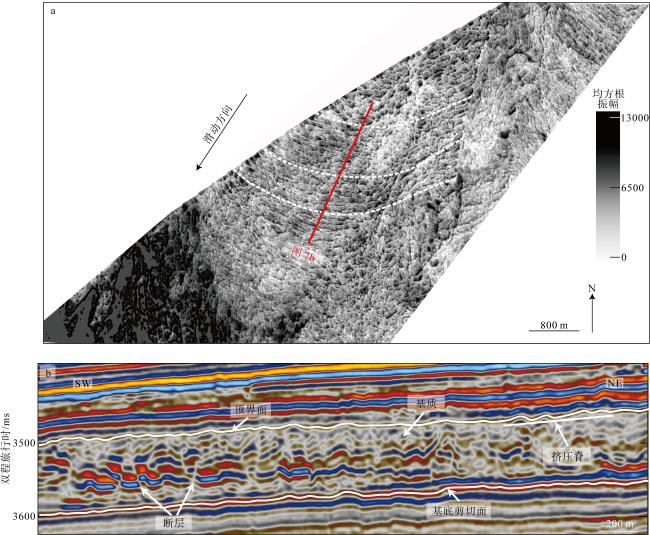
图6 MTC3内发育的逆冲褶皱带a. 逆冲褶皱带振幅切片; b. 振幅切片解释图, 玫瑰花图表示挤压断层的走向, 反映MTC3的运动方向; c. 逆冲褶皱带中的横向地震剖面; d. 逆冲褶皱带中的纵向地震剖面 Fig. 6 Thrust-fold systems developed within MTC3. (a) Amplitude slice of thrust-fold belt; (b) interpreted amplitude slice; (c) cross-sectional seismic profile through thrust-fold belt; (d) longitudinal seismic profile through thrust-fold belt |
图8 MTC3内的运输块体和滑动轨迹a. 振幅切片; b. 相干切片。图中绿色虚线表示滑动轨迹; c. 穿过运输块体的横向地震剖面; d. 穿过运输块体的纵向地震剖面。地震剖面上显示的滑动轨迹为基底剪切面上留下的凹陷; 白色线框代表放大MTC3底界面地震图像, 黄色圆圈代表块体的运动方向由屏幕向外 Fig. 8 Translated blocks and glide track within MTC3. (a) Amplitude slice; (b) coherence slice; (c) cross-sectional seismic profile through translated block; (d) longitudinal seismic profile through translated block |
| [1] |
白博, 秦志亮, 杨鲲, 等, 2016. 珠江口盆地白云深水区海底重力滑脱构造地震地质综合识别[J]. 物探化探计算技术, 38(2): 219-224.
|
| [2] |
蔡佳, 2017. 琼东南盆地长昌凹陷新近系三亚组沉积相[J]. 岩性油气藏, 29(5): 46-54.
|
| [3] |
杜浩, 石万忠, 梁金强, 等, 2021. 琼东南盆地块体搬运沉积体系成因及其对水合物成藏的影响[J]. 石油地球物理勘探, 56(4): 869-881, 676.
|
| [4] |
冯杨伟, 屈红军, 张功成, 等, 2016. 南海北部琼东南盆地深水区梅山组一段地震相分析[J]. 矿物岩石, 36(1): 82-95.
|
| [5] |
付超, 于兴河, 金丽娜, 等, 2017. 琼东南盆地莺歌海组重力流沉积演化过程[J]. 沉积学报, 35(3): 552-560.
|
| [6] |
何云龙, 解习农, 李俊良, 等, 2013. 琼东南盆地东西部块体流沉积内部结构特征的差异性[J]. 吉林大学学报(地球科学版), 43(1): 49-56.
|
| [7] |
胡守祥, 姚衍桃, 李健, 等, 2021. 琼东南盆地陆架区晚中新世以来断层活动性研究[J]. 热带海洋学报, 40(2): 90-102.
|
| [8] |
雷超, 任建业, 裴健翔, 等, 2022. 莺歌海-琼东南盆地结合部记录的红河断裂带向海延伸及其演化过程[J]. 中国科学: 地球科学, 52(1): 81-97.
|
| [9] |
雷亚妮, 王广建, 吴时国, 2018. 白云凹陷深水油气开发区海底滑坡的特征、分布以及成因初探[J]. 海洋地质与第四纪地质, 38(2): 106-114.
|
| [10] |
李杰, 林畅松, 陈平富, 1999. 琼东南盆地莺歌海组-黄流组海平面变化与层序年代地层[J]. 地质论评, 45(5): 514-520.
|
| [11] |
李铁刚, 曹奇原, 李安春, 等, 2003. 从源到汇: 大陆边缘的沉积作用[J]. 地球科学进展, 18(5): 713-721.
|
| [12] |
李伟, 吴时国, 王秀娟, 等, 2013. 琼东南盆地中央峡谷上新统块体搬运沉积体系地震特征及其分布[J]. 海洋地质与第四纪地质, 33(2): 9-15.
|
| [13] |
李艳, 2022. 大陆边缘块体搬运沉积体系的地震响应及运动学过程分析[D]. 广州: 中国科学院南海海洋研究所.
|
| [14] |
李艳, 吴南, 胡守祥, 等, 2021. 南海白云凹陷东南部两种不同类型块体搬运沉积体系的地震响应及成因分析[J]. 热带海洋学报, 40(5): 85-100.
|
| [15] |
罗泉源, 焦祥燕, 何小胡, 等, 2023. 琼东南盆地西区黄流组重力流水道沉积特征及其控制因素[J]. 海洋地质前沿, 39(7): 25-33.
|
| [16] |
马畅, 葛家旺, 赵晓明, 等, 2022. 南海北部琼东南盆地第四系陆架边缘轨迹迁移及深水沉积模式[J]. 地学前缘, 29(4): 55-72.
|
| [17] |
马宏霞, 吕福亮, 范国章, 等, 2011. 缅甸若开海域块体搬运沉积地震响应及典型地质特征[J]. 石油与天然气地质, 32(5): 751-759.
|
| [18] |
马云, 李三忠, 梁金强, 等, 2012. 南海北部琼东南盆地海底滑坡特征及其成因机制[J]. 吉林大学学报(地球科学版), 42(S3): 196-205.
|
| [19] |
孟苗苗, 阎少妮, 梁金强, 等, 2024. 琼东南盆地块体搬运体系沉积特征及其对下伏水合物藏的影响[J]. 地质学报, 98(9): 2592-2606.
|
| [20] |
孙珍, 钟志洪, 周蒂, 等, 2003. 红河断裂带的新生代变形机制及莺歌海盆地的实验证据[J]. 热带海洋学报, 22(2): 1-9.
|
| [21] |
王大伟, 吴时国, 董冬冬, 等, 2009. 琼东南盆地第四纪块体搬运体系的地震特征[J]. 海洋地质与第四纪地质, 29(3): 69-74.
|
| [22] |
王大伟, 吴时国, 吕福亮, 等, 2011. 南海深水块体搬运沉积体系及其油气勘探意义[J]. 中国石油大学学报(自然科学版), 35(5): 14-19.
|
| [23] |
谢金有, 祝幼华, 李绪深, 等, 2012. 南海北部大陆架莺琼盆地新生代海平面变化[J]. 海相油气地质, 17(1): 49-58.
|
| [24] |
闫琢玉, 李建平, 龚胜利, 等, 2023. 琼东南盆地北部梅山组浊积扇砂组构特征与物源体系差异[J]. 天然气地球科学, 34(12): 2087-2100.
|
| [25] |
杨胜雄, 邱燕, 朱本铎, 2015. 南海地质地球物理图系[M]. 天津: 中国航海图书出版社.
|
| [26] |
袁玉松, 杨树春, 胡圣标, 等, 2008. 琼东南盆地构造沉降史及其主控因素[J]. 地球物理学报, 51(2): 376-383.
|
| [27] |
钟佳, 杨希冰, 朱沛苑, 等, 2019. 琼东南盆地宝岛-长昌凹陷陵水组储层差异演化特征[J]. 地球科学, 44(8): 2665-2676.
|
| [28] |
|
| [29] |
|
| [30] |
|
| [31] |
|
| [32] |
|
| [33] |
|
| [34] |
|
| [35] |
|
| [36] |
|
| [37] |
|
| [38] |
|
| [39] |
|
| [40] |
|
| [41] |
|
| [42] |
|
| [43] |
|
| [44] |
|
| [45] |
|
| [46] |
|
| [47] |
|
| [48] |
|
| [49] |
|
| [50] |
|
| [51] |
|
| [52] |
|
| [53] |
|
| [54] |
|
| [55] |
|
| [56] |
|
| [57] |
|
| [58] |
|
| [59] |
|
| [60] |
|
| [61] |
|
| [62] |
|
| [63] |
|
| [64] |
|
| [65] |
|
| [66] |
|
| [67] |
|
| [68] |
|
| [69] |
|
| [70] |
|
| [71] |
|
/
| 〈 |
|
〉 |