Denitrifying microbial activity and community characteristics in coastal lagoons of South China

  • RONG Qing , 1 ,
  • XIAN Hanbiao 2 ,
  • DONG Xuhui 2 ,
  • YE Fei 1 ,
  • WU Jiapeng 1 ,
  • WANG Yu , 1 ,
  • LI Jiahui 3 ,
  • HONG Yiguo 1
Expand
  • 1 Institute of Environmental Research at Greater Bay Area, Guangzhou University, Guangzhou 510007, China
  • 2 School of Geography and Remote Sensing, Guangzhou University, Guangzhou 510006, China
  • 3 PLA Army Academy of Special Operations, Guilin 541000, China
WANG Yu. email:

Received date: 2025-02-25

  Revised date: 2025-04-03

  Online published: 2025-04-08

Supported by

National Natural Science Foundation of China(42476144)

General Program of Guangdong Basic and Applied Basic Research Foundation(2023A1515011747)

General Program of Guangdong Basic and Applied Basic Research Foundation(2025A1515010828)

Abstract

The objective of this study was to investigate the activity of denitrifying microorganisms and the factors influencing their community composition in the coastal lagoons of South China, with the aim of elucidating key mechanisms governing the nitrogen cycle in lagoon ecosystems. Three representative lagoons in South China were selected for this research. By measuring the physicochemical parameters of water and sediment, combined with denitrification rates and metagenomic sequencing data, we analyzed the community composition of three denitrifying functional genes (nirK, nirS, nosZ) and their correlations with environmental factors. The results indicated that the denitrification rate in South China lagoons was significantly lower than marine sediment averages, primarily due to low nutrient concentration, high water transparency, and limited water exchange capacity. Notably, the abundance and diversity of nirK genes within the three denitrification functional gene communities were significantly lower than those of nirS and nosZ, suggesting that nirK was more susceptible to environmental variations. Significant differences were observed in the community composition of nirK, nirS and nosZ among different lagoons. At the order level, the dominant species were Nitrosopumilales, Oceanospirillales and Flavobacteriales, respectively, with the main community composition closely resembling that of denitrifying microorganisms in the marine environment. Water transparency, pH and $\text{NH}_{4}^{+}$ concentration were identified as the key environmental factors regulating the composition of the three denitrification functional gene communities. Specifically, the nirS community was more influenced by sediment physicochemical parameters, while the nirK community was more affected by water physicochemical parameters. Additionally, the nirS and nosZ communities were similarly impacted by the same environmental factors, indicating a stronger synergistic effect in the denitrification process. This study provides valuable data to enhance our understanding of denitrification functions and microbial communities in lagoon ecosystems, thereby laying a foundation for their protection and management.

Cite this article

RONG Qing , XIAN Hanbiao , DONG Xuhui , YE Fei , WU Jiapeng , WANG Yu , LI Jiahui , HONG Yiguo . Denitrifying microbial activity and community characteristics in coastal lagoons of South China[J]. Journal of Tropical Oceanography, 2025 , 44(6) : 108 -119 . DOI: 10.11978/2025031

潟湖是沿海生态系统中一种独特的浅水区域, 通常通过障壁岛或沙坝与外海分离, 由一个或多个入口与外海相连接(Adlam et al, 2014)。潟湖是陆地和海洋一种重要的过渡性生态系统, 占全球海岸线总长约13%, 广泛分布于世界沿海地带(Kennish et al, 2010), 不仅为人类提供了丰富的生态服务, 如食物、水和遗传资源供应等(Honfo et al, 2024), 还为众多海洋生物提供了关键栖息地和繁殖场所, 对调节气候、防范洪涝自然灾害等发挥着重要作用(邢容容 等, 2019)。潟湖同时受到陆地和海洋双重驱动力的影响, 是地球上物质循环和能量流动最为活跃的区域之一(Ward et al, 2020), 其特殊的地理结构使得盐度、温度和营养物质浓度等在时空尺度上呈现高度异质性(张奕璞 等, 2022)。然而, 潟湖相对封闭的水动力环境也使其面临诸多生态风险。由于潟湖与外海的水力交换受限, 污染物质不易扩散, 容易导致富营养化问题(Lloret et al, 2008)。随着人类活动的加剧, 潟湖水域面积不断缩小, 纳潮量减少, 其水体交换能力进一步减弱(王雅君 等, 2025)。此外, 大量含氮污染物流入潟湖, 更易引发水体富营养化、藻类爆发以及溶解氧降低等问题, 威胁潟湖生态环境和生物多样性。
由于潟湖易出现水体富营养化等问题, 深入研究其氮磷物质循环过程显得尤为重要。而以往对于近海生态系统的研究主要集中在河口、红树林湿地等, 潟湖受到的关注相对较少, 尤其是在氮循环过程及微生物群落方面(Wang et al, 2025)。潟湖复杂的环境特征和丰富的生物多样性使得这一领域的研究更具挑战性(韩磊 等, 2023)。氮循环是重要的生物地球化学过程, 无机氮的去除主要通过反硝化和厌氧氨氧化进行, 反硝化在氮循环中发挥关键作用。环境中的硝态氮($\text{NO}_{3}^{-}$)和亚硝态氮($\text{NO}_{2}^{-}$)经反硝化过程转化为氮气(N2), 厌氧氨氧化则是脱氮的补充途径, 可以将氨态氮($\text{NH}_{4}^{+}$)转化为N2, 从而实现水体和沉积物中氮素的去除, 对于缓解氮污染、维持氮平衡至关重要(Wang et al, 2019; Gao et al, 2022)反硝化过程在厌氧环境中通过多个步骤完成($\text{NO}_{3}^{-}$$\text{NO}_{2}^{-}$→NO→N2O→N2)。每个步骤由特定的酶系催化完成, 包括硝酸盐还原酶(nitrate reductase, NAR)、亚硝酸盐还原酶(nitrite reductase, NIR)、一氧化氮还原酶(nitric oxide reductase, NOR)和氧化亚氮还原酶(nitrous oxide reductase, NOS)(Jin et al, 2019)。其中nirKnirSnosZ是反硝化过程的三个关键功能基因。由nirKnirS编码的NIR催化$\text{NO}_{2}^{-}$还原为气态氮氧化物(NO), 是反硝化过程的限速步骤, 由nosZ编码的NOS催化N2O还原为N2, 是反硝化的最后一个步骤(Qi et al, 2025)。
反硝化微生物活性与反应速率是氮素周转速率和生物活性的重要指标(Kang et al, 2024)。但目前对于潟湖反硝化微生物群落结构、功能及其与环境互作关系研究的不足, 限制了对潟湖氮循环和生物地球化学过程的全面理解, 影响了针对潟湖氮污染问题治理措施的制定。本文以华南地区三个典型线性潟湖为研究对象, 通过采集潟湖水体及沉积物样品, 综合运用地球化学、15N同位素示踪、宏基因组测序等技术, 分析潟湖沉积物反硝化脱氮速率, 以及nirKnirSnosZ三个反硝化功能基因的丰度、群落组成和结构特征, 并通过分析潟湖中反硝化微生物群落与环境参数的关系, 揭示潟湖反硝化微生物空间分布的环境特征, 为潟湖环境评价与保护研究提供基础数据支持。

1 材料和方法

1.1 研究地点与样品采集

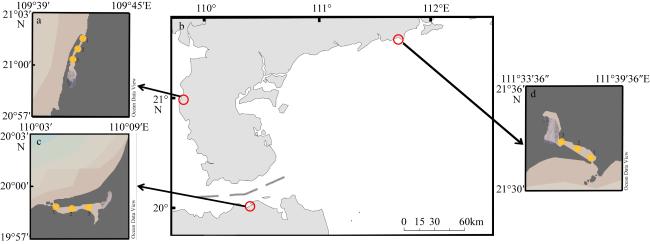
本研究于2022年7月在华南沿海地区选取3个典型线形潟湖开展采样, 分别为位于广东省阳江市的南山海(Nanshanhai, 简称NSH, 范围为111°33′36′′—111°39′36′′E, 21°30′—21°36′N)、广东省湛江市的江洪(Jianghong, 简称JH, 范围为109°39′—109°45′E, 20°57′~21°3′N)以及海南省海口市的东水(Dongshui, 简称DS, 范围为110°03′—110°09′E, 19°57′—20°03′N), 水域面积分别为1.81、0.95和4.25km², 岸线周长分别为11.77、12.67和28.12km。三个潟湖分别位于广东东部、南部及海南北部, 是华南地区重要的港口和水产养殖基地, 能够较好地代表华南地区潟湖的情况。除此之外, 它们在水文特征上有一定的相似性, 均呈现出水面狭长、最长轴沿着入海口方向延伸、潟湖内只有一个与海洋连接通道的特点。因此, 我们在距离潟湖入口处由内至外依次设置三个采样点。每个采样点采集三个上覆水和表层沉积物样品, 共获取27组样品, 采样位点分布见图1
图1 三个潟湖与采样点分布

a.江洪(JH); b. 采样点的相对位置, 基于自然资源部标准地图服务网站下载的审图号为GS(2024)0650号的标准地图制作, 底图无修改; c. 东水(DS); d. 南山海(NSH)

Fig. 1 Distribution of three lagoons and sampling sites. (a) Jianghong (JH); (b) The relative positions of the sampling points; (c) Dongshui (DS); (d) Nanshanhai (NSH)

在每个采样站点, 使用5L玻璃采水器在水体表层0.5m处采集水样。水样立即注入已灭菌的60mL血清瓶中, 使水样从瓶底缓慢充满, 待溢出约三倍瓶身体积的液体后, 迅速加盖密封。随后, 向每瓶水样中注入1mL 50%的ZnCl₂溶液进行灭活处理, 之后将样品常温避光保存, 用于水体溶存N₂O浓度的测定。使用一次性无菌采水袋收集不少于300mL的水样, 水样采集完成后即刻将其转移至预先设定为4℃的低温保存环境, 确保后续运回实验室进行系列理化参数测定的准确性。采用抓斗式采样器获取表层0~10cm的沉积物, 将采集到的沉积物装入密封无菌袋, 并迅速将其置于4℃恒温环境下妥善暂存。后续沉积物样品与水样冷藏状态下运回实验室, 用于进行理化参数测定和微生物活性与群落组成分析。

1.2 理化参数分析

采样过程中, 运用YSI Pro Quatro型多参数水质仪(美国)同步测定水体的pH、电导率(electric conductivity, EC)、温度(temperature, T); 采用MASTER-S盐度计测定水体盐度(salinity, S); 借助塞式圆盘法估算水体透明度(Secchi depth, SD); 利用水深仪测定实时水深(depth)。水样经0.22μm滤膜过滤后, 所得滤液用于测定水体无机氮(water dissloved inorganic nitrogen, W-DIN)、总氮(water total nitrogen, W-TN)和总磷(water total phosphorus, W-TP)浓度。W-DIN中的亚硝酸盐氮(water nitrite nitrogen, W-$\text{NO}_{\text{2}}^{-}$)浓度运用重氮–偶氮法测定, 硝酸盐氮(water nitrate nitrogen, W-$\text{NO}_{3}^{-}$)和氨氮(water ammonia nitrogen, W-$\text{NH}_{4}^{+}$)浓度则分别通过锌镉还原法、次溴酸钠氧化法转化为$\text{NO}_{2}^{-}$后, 依照$\text{NO}_{2}^{-}$浓度的测定方法进行测定与计算(关凤杰 等, 2017)。W-TN、W-TP浓度分别依据碱性过硫酸钾氧化法(HJ636-2012)、过硫酸钾氧化法(GB12763.4-2007)测定。
沉积物保存于4℃环境中, 用于理化参数测定。沉积物样品用2mol·L-1的KCl溶液浸提后, 按照水体DIN的测试方法分析沉积物中DIN的浓度。沉积物总氮(sediment total nitrogen, S-TN)及总磷(sediment total phosphorous, S-TP)浓度采用碱性过硫酸钾氧化方法测定(杨柳燕 等, 2006), 含水率(moisture content, MC)通过鼓风干燥箱采用重量法测定, 有机质(total organic matter, TOM)含量通过马弗炉采用烧失法测定。另一部分沉积物保存于-80℃环境中, 用于后续微生物高通量测序分析。

1.3 反硝化及厌氧氨氧化速率的测定

沉积物的反硝化(Rd)及厌氧氨氧化速率(Ra)通过15N同位素示踪技术的泥浆培养实验测定。泥∶水按照1∶7的比例将沉积物和无菌水均匀混合制成泥浆。用氦气对泥浆进行曝气, 使泥浆处于厌氧状态, 并分装至12.5mL的玻璃小瓶(Labco, UK)中, 暗处预培养以去除本底中的硝酸盐($\text{NO}_{3}^{-}$)。$\text{NO}_{3}^{-}$消耗完时可结束预培养过程。随后加入NH4Cl和15$\text{NO}_{3}^{-}$溶液, 使$\text{NH}_{4}^{+}$15$\text{NO}_{3}^{-}$在体系中浓度为100μmol·L-1, 并于0h和8h时加入0.2mL50%ZnCl2以终止体系内微生物的反应。混匀暗处静置, 待清液和泥浆分层后, 用薄膜进样质谱仪测定其中29N230N2的含量并计算出RdRa(Han et al, 2024)。计算公式如下:
${{R}_{\text{d}}}={{D}_{29}}+2\times {{P}_{30}}$
${{D}_{29}}={{P}_{30}}\times 2\times \left( 1-{{F}_{n-D}} \right)\times {{F}_{n-D}}^{-1}$
${{R}_{\text{a}}}={{P}_{29}}-{{D}_{29}}$
${{R}_{\text{T}}}={{R}_{\text{d}}}+{{R}_{\text{a}}}$
其中, Rd表示反硝化速率(μmol·kg-1·h-1); D29表示反硝化过程产生的总29N2的产生速率(μmol·kg-1·h-1); P30表示总30N2的产生速率(μmol·kg-1·h-1); Fn-D表示体系开始15$\text{NO}_{3}^{-}$占总$\text{NO}_{3}^{-}$的比例; Ra表示厌氧氨氧化速率(μmol·kg-1·h-1); P29表示总的29N2的产生速率(μmol·kg-1·h-1); RT表示脱氮速率(μmol·kg-1·h-1)。

1.4 宏基因组学测序及分析

将沉积物置于干冰环境中送往测序公司进行宏基因组学测序, 主要测试步骤是先通过DNA试剂盒(DNeasy PowerSoil Kit, US)进行沉积物DNA的提取, 然后通过1%的琼脂凝胶电泳方法对提取DNA的完整性和纯度进行评估, 合格后将DNA片段剪切至350bp大小, 通过文库构建及illuminaPE平台进行高通量测序。
基于eggNOG、Uniprot数据库及相关文献, 手动收集与反硝化过程相关的纯菌序列, 确保所收集序列涵盖目前已知的绝大部分反硝化功能物种, 并将纯菌序列进行KEGG(Kyoto Encyclopedia of Genes and Genomes, KEGG)功能注释, 从中提取与反硝化过程相关的功能基因全长蛋白序列, 进而构建包含物种分类信息的功能基因参考数据库(Li et al, 2024a)。使用fastp软件对测序原始数据进行质控, 以剔除低质量的序列。将质控完成之后的reads使用Diamond blastx软件与nirKnirSnosZ全长蛋白参考数据库进行比对, 以确定这些序列是否与目标基因匹配, 并筛选出显著匹配的结果。同时使用Python脚本处理结果文件并生成不同水平的物种分类文件。最后, 使用USEARCH和VSEARCH软件在97%序列相似性阈值下, 将所得目标基因序列进行操作分类单位聚类(operational taxonomic unit, OTU)(Deng et al, 2024), 利用R语言(4.4.1版本)vegan包计算样品的Alpha多样性指数, 基于三种功能基因每百万reads中来自某基因每千碱基长度的reads数(Reads Per Kilobase of transcript per Million mapped reads, rpkm)来表示基因丰度(Lawson et al, 2017), 用于后续反硝化微生物的群落特征分析。

1.5 统计和分析方法

采用非参数检验方法中的Kruskal-Wallis检验, 分析不同潟湖之间以及潟湖内部不同位点间的理化参数、RdRa差异。利用Spearman相关性分析探究环境因子与距潟湖入口距离之间的关系。采用单因素方差分析(one-way ANOVA)方法比较nirKnirSnosZ三种功能基因丰度及Alpha多样性的差异。上述所有分析均在IBM SPSS(Version 27.0)软件中完成。借助R.4.4.1版本中的vegan包, 对不同潟湖微生物群落开展非度量多维尺度分析(non-metric multidimensional scanning, NMDS)以及相似性分析(analysis of similarities, ANOSIM), 进行组间差异性检验。为揭示nirKnirSnosZ类功能基因群落(后续简称nirKnirSnosZ群落)与环境因子之间的内在联系, 运用R语言中的“vegan”、ggcor”和LinkET”等软件包, 进行Mantel交互检验。以上所有分析结果的可视化处理, 均使用Origin 2024或GraphPad 10.1.2软件完成。

2 结果

2.1 水及沉积物环境参数空间分异

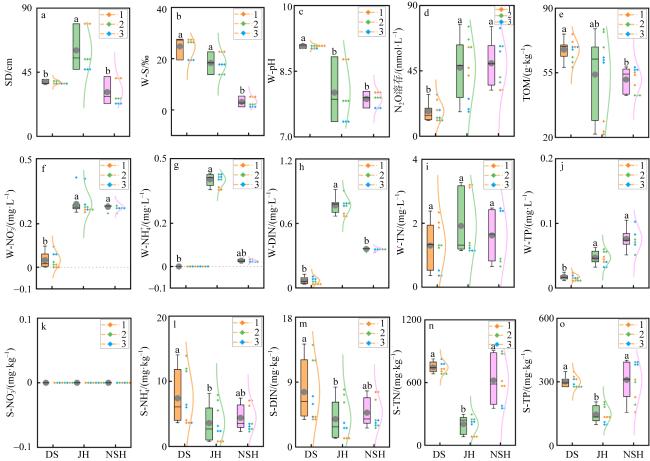
三个潟湖水体及沉积物理化参数之间存在显著差异(图2)。JH潟湖的SD为47~79cm, 显著高于DS(37~40cm)和NSH(23~42cm)(图2a)。DS和JH的S分别为19.5‰~27.6‰、13.8‰~22.7‰, NSH的S(1.2‰~5.7‰)显著低于DS和JH(图2b)。DS的pH(9.02~9.11)显著高于JH(7.35~8.83)和NSH(7.66~8.04) (图2c)。DS的N2O溶存浓度(10.94~28.81nmol·L-1)显著低于JH(16.87~76.93nmol·L-1)和NSH(31.76~75.48nmol·L-1)(图2d)。水体中DIN以$\text{NO}_{3}^{-}$为主, 除JH的W-$\text{NH}_{\text{4}}^{\text{+}}$浓度(0.36~0.43mg·L-1)较高外, DS和NSH的W-$\text{NH}_{4}^{+}$都很低(图2g), DS的$\text{NO}_{\text{3}}^{-}$浓度(0~0.062mg·L-1)显著低于JH(0.25~0.41mg·L-1)和NSH(0.25~0.29mg·L-1)(图2fh)。三个潟湖W-TN介于0.36至3.27mg·L-1之间波动, 几个潟湖之间无显著差异(图2i)。NSH(0.05~0.10mg·L-1)和JH(0.03~0.06mg·L-1)的W-TP显著高于DS(0.01~0.02mg·L-1) (图2j)。DS沉积物中TOM介于57.92至75.97g·kg-1之间, 显著高于NSH(42.77~58.13g·kg-1)(图2e)。沉积物中DIN以$\text{NH}_{4}^{+}$为主, S-$\text{NO}_{3}^{-}$浓度几乎为0, DS沉积物的$\text{NH}_{4}^{+}$浓度介于3.81至14.06mg·kg-1间, 显著高于JH中$\text{NH}_{4}^{+}$浓度(0.78~8.14mg·kg-1)(图2klm)。三个潟湖沉积物的TN和TP浓度处于中低营养水平, DS、NSH中S-TN浓度分别为683.12~826.58mg·kg-1、354.01~906.75mg·kg-1, 显著高于JH的S-TN浓度(82.26~296.49mg·kg-1)(图2n)。DS、NSH中S-TP浓度分别为276.79~348.21mg·kg-1、156.25~401.79mg·kg-1, 显著高于JH的S-TP浓度(98.21~205.36mg·kg-1)(图2o)。
图2 三个潟湖的理化参数

a. 水体透明度; b. 水体盐度; c. 水体pH; d.水体N2O溶存; e.沉积物有机质; f.水体硝酸盐氮浓度; g. 水体氨氮浓度; h.水体无机氮浓度; i.水体总氮浓度; j.水体总磷浓度; k.沉积物硝酸盐氮浓度; l.沉积物氨氮浓度; m.沉积物无机氮浓度; n.沉积物总氮浓度; o. 沉积物总磷浓度。图中灰色实心圆为平均值, 右上角图例部分的1、2、3表示潟湖对应采样点, 误差棒上方不同字母表示显著性检验结果(P<0.05), 有相同字母表示无显著差异。NSH潟湖1号位点水体遗失导致无数据

Fig. 2 Physicochemical parameters of the three lagoons. (a) Secchi depth; (b) water salinity; (c) water pH; (d) dissolution of N2O in water; (e) sediment organic matter; (f) nitrate nitrogen concentration in water; (g) ammonia nitrogen concentration in water; (h) inorganic nitrogen concentration in water; (i) total nitrogen concentration in water; (j) total phosphorus concentration in water; (k) nitrate nitrogen concentration in sediments; (l) ammonia nitrogen concentration in sediments; (m) inorganic nitrogen concentration in sediments; (n) total nitrogen concentration in sediments; (o) total phosphorus concentration in sediments

各个潟湖内部水体及沉积物理化参数存在不同的分布特征, 水体N2O溶存浓度、沉积物TOM、W-TN、S-$\text{NH}_{\text{4}}^{\text{+}}$、S-DIN、S-TN浓度在各个潟湖三个采样点间相差较大, 具有明显空间差异(图2deilmn)。潟湖采样位点理化参数与距潟湖入口距离的Spearman相关性分析发现, 水体理化性质包括SD、S、pH及W-TN浓度与距潟湖入口距离存在显著负相关(P<0.05)(表1)。
表1 各潟湖距入口距离与理化参数的Spearman相关性分析

Tab. 1 Spearman correlation analysis between the distance from each lagoon to the estuary and the physical and chemical parameters

潟湖 理化参数
S SD T pH W-$\text{NO}_{3}^{-}$ W-$\text{NH}_{4}^{+}$ W-DIN W-TN S-$\text{NH}_{4}^{+}$ S-$\text{NO}_{2}^{-}$ S-DIN S-TP
DS -1.000** / 1.000** -1.000** -0.767* / 0.843** -0.949** 0.369 0.847** 0.369 -0.525
JH -0.500 -1.000** 1.000** -1.000** -0.685* 0.738* 0.738* -0.791* 0.474 -0.791* 0.474 -0.482
NSH -1.000** -1.000** -0.429 -1.000** 0.201 -0.891* 0.497 0.891* -0.754* -0.088 -0.715* 0.717*
所有潟湖 -0.369 -0.370 0.158 -0.527** 0.407* 0.069 0.350 -0.476* -0.070 -0.166 -0.035 0.082

注: *表示在0.05级别(双尾)相关性显著, **表示在0.01级别(双尾)相关性显著。

2.2 沉积物反硝化与厌氧氨氧化速率

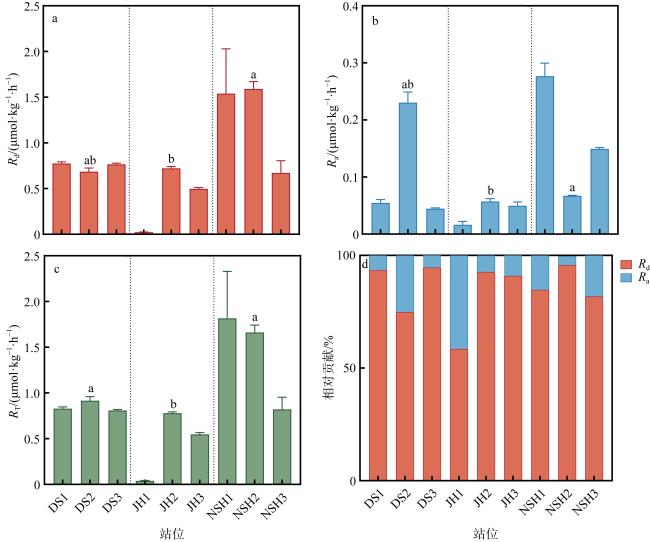
三个潟湖沉积物反硝化、厌氧氨氧化和脱氮速率分别在0.02~1.87、0.01~0.29、0.03~2.23μmol·kg-1·h-1的范围内波动(图3ac)。DS中的沉积物反硝化速率为0.64~0.79μmol·kg-1·h-1, JH为0.02~0.74μmol·kg-1·h-1, NSH为 0.51~1.87μmol·kg-1·h-1, 其中NSH的反硝化速率显著高于JH(图3a)。DS中厌氧氨氧化速率为0.04~0.25μmol·kg-1·h-1, JH中为0.01~0.06μmol·kg-1·h-1, NSH中为0.07~0.29μmol·kg-1·h-1, 其中NSH的厌氧氨氧化速率也显著高于JH的(图3b)。DS中脱氮速率为0.80~0.94μmol·kg-1·h-1, JH中为0.04~0.79μmol·kg-1·h-1, NSH中为0.67~2.16μmol·kg-1·h-1, 其中NSH的脱氮速率显著高于JH(图3c)。三个潟湖沉积物中的脱氮过程均以反硝化为主, 占比超过75%(图3d)。潟湖内部反硝化、厌氧氨氧化速率在各个位点间未表现出一致的空间变化趋势。
图3 三个潟湖反硝化、厌氧氨氧化和脱氮速率的比较

a. 反硝化速率; b. 厌氧氨氧化速率; c. 反硝化速率和厌氧氨氧化速率为主的脱氮速率; d. 反硝化与厌氧氨氧化速率对脱氮速率的相对贡献。不同字母为显著性检验结果(P<0.05); 计算结果基于湿重进行

Fig. 3 Comparison of denitrification and anammox nitrogen removal rates in the three lagoons. (a) Denitrification rate; (b) anammox rate; (c) nitrogen removal rate dominated by denitrification and anammox rates; (d) relative contributions of denitrification and anammox rates to denitrification removal rate

2.3 反硝化功能基因群落多样性及基因丰度

通过宏基因组测序从9个位点沉积物样品中共获得5 889条nirK基因序列, 31 832条nirS基因序列和34 358条nosZ基因序列。所有样品的测序覆盖率均超过99%, 表明测序能够充分捕获nirKnirSnosZ群落的大部分信息。基于97%的序列相似性进行OTU划分, 三个基因分别获得了2248、10282和10282个OTUs。
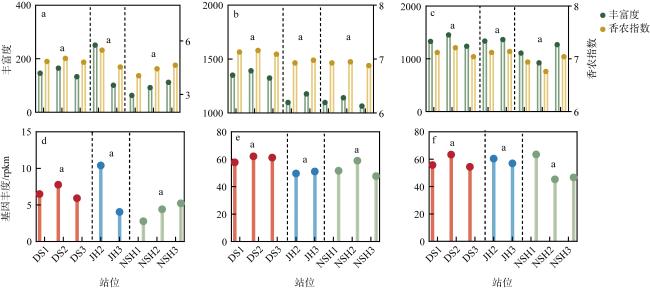
不同潟湖功能一致的反硝化微生物群落中, Alpha多样性指数并无显著差异, 但nirK的显著低于nirSnosZ(P<0.05, 图4ac)。三个潟湖中nirKnirSnosZ的丰富度指数分别在63~251、1098~1392、928~1452间波动, 其中nirK的丰富度波动较大; 三个潟湖中nirKnirSnosZ的香农指数分别在4.05~5.48、6.93~7.16、6.76~7.21间波动, 同样也是nirK的波动较大。此外, Alpha多样性指数与距入口距离并未呈现出一致的变化趋势。DS潟湖中nirK的丰富度随距入口距离增加, 呈现出先上升后下降的变化趋势, 而NSH中nirK的 丰富度则随距入口距离增加而上升; DS和NSH中, nirS的丰富度随着距入口距离的增加, 先上升后下降; DS中nosZ的丰富度随距入口距离增加, 也呈现出先上升后下降的变化趋势, NSH中nosZ的丰富度与之相反, 随距入口距离增加先下降后上升。三种功能基因的香农指数与丰富度, 在随距入口距离变化方面呈现出相似趋势(见图4ac)。
图4 三个潟湖Alpha多样性指数及基因丰度

a. nirK在各位点中丰富度及香农指数; b. nirS在各位点中丰富度及香农指数; c. nosZ在各位点中丰富度及香农指数; d. 各位点nirK基因丰度; e. 各位点nirS基因丰度; f. 各位点nosZ基因丰度。同组比较时不同字母表示具有显著性差异(P<0.05)。JH潟湖1号位点的Alpha多样性指数及rpkm值异常, 图中未体现

Fig. 4 Alpha diversity indices and gene abundance in the three lagoons. (a) nirK richness and Shannon index at each site; (b) nirS richness and Shannon index at each site; (c) nosZ richness and Shannon index at each site; (d) nirK gene abundance at each site; (e) nirS gene abundance at each site; (f) nosZ gene abundance at each site

潟湖沉积物nirKnirSnosZ三种基因rpkm值分别为2~15、45~65、40~70, 其中nirK的rpkm值显著低于nirSnosZ(P<0.05)。三种基因丰度在不同潟湖间未表现出显著差异, 但与Alpha多样性指数表现出相似的变化趋势(图4df)。

2.4 反硝化功能基因群落特征

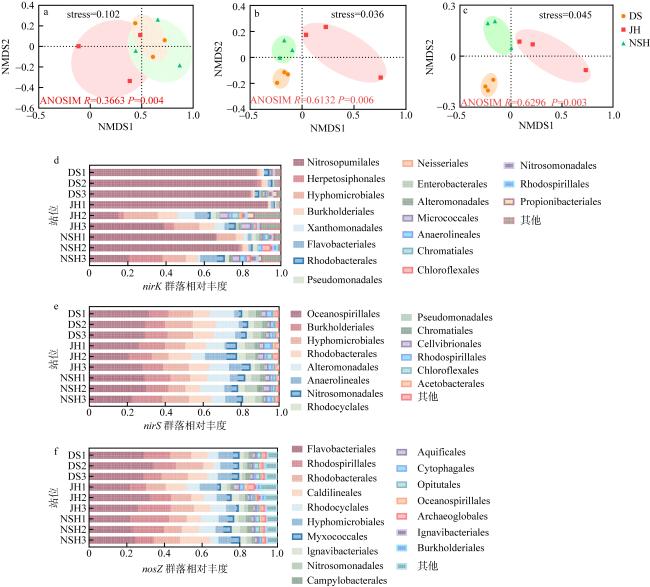
对三个潟湖沉积物中nirKnirSnosZ三种功能基因的群落组成进行了NMDS分析, 结果显示三种功能基因的NMDS模型stress值均小于0.15, 能够有效地反映群落组成的差异。组间ANOSIM分析结果表明, 三个潟湖间nirKnirSnosZ群落均存在显著差异(P值分别为0.004、0.006、0.003)(图5ac)。
图5 三个潟湖基于OTU水平的NMDS分析及目水平群落组成

a—c. nirKnirSnosZ基于OTU分类水平的NMDS分析; d—f. nirKnirSnosZ目水平群落组成

Fig. 5 NMDS analysis based on OTU level and community composition at order level in the three lagoons.(a-c) NMDS analysis of .nirK, nirS and nosZ based on OTU classification level; (d-f) NMDS analysis of.nirK, nirS and nosZ based on order classification level

在目水平上, 三个潟湖中多数位点样品中nirK群落以Nitrosopumilales(亚硝化侏儒菌目)为主, 占比在15%~93%不等。其中, DS中Nitrosopumilales占比超过80%, JH和NSH中除了Nitrosopumilales占比较高外, Herpetosiphonales(赫氏管目)、Hyphomicrobiales (生丝微菌目)、Burkholderiales(伯克氏菌目)的相对丰度也较高, 分别为0.1%~17%、0.3%~17.6%、0.9%~10.3%。此外, DS和NSH中Nitrosopumilales的相对丰度随着与距入口距离增加呈现先升高后降低的趋势, JH中Nitrosopumilales的相对丰度则相反, 先降低后升高(图5d)。nirS群落各物种相对丰度占比更均匀。所有位点样品中相对丰度较高的微生物包括Oceanospirillales(海洋螺菌目)、Burkholderiales (伯克氏菌目)、Hyphomicrobiales(生丝微菌目)、Rhodobacterales(丝杆菌目)、Alteromonadales(交替单胞菌目), 它们占据了近80%的nirS群落。DS和NSH中占比最多的是Oceanospirillales, 其相对丰度随着距入口距离增加呈先降低后升高的趋势, JH中则相反, 先升高后降低(图5e)。nosZ群落所有位点样品中含量较高的微生物包括Flavobacteriales(黄杆菌目)、Rhodospirillales(红螺菌目)、Rhodobacterales(红杆菌目)、Caldilineales(热绳菌目)、Rhodocyclales(红环菌目), 它们占据了几乎70%的nosZ群落。DS和JH中Flavobacteriales的相对丰度随着距入口距离增加呈现先升高后降低的趋势, NSH中则逐渐增加(图5f)。

2.5 反硝化功能基因群落组成与理化参数的相关性

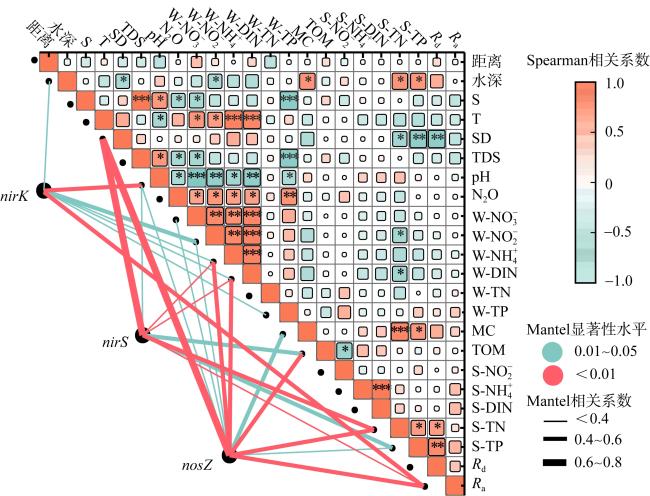
nirKnirSnosZ三种功能基因群落组成与环境因子间的Mantel检验结果如图6所示。与nirK群落相比, nirSnosZ群落组成与环境因子间的关系更显著(P<0.01), r在0.6以上的环境因子更多。其中, nirK的群落组成与水体pH极显著相关(P<0.01), 与SD及水体中氮营养盐及TP浓度显著相关(P<0.05); nirS的群落组成与水体SD、$\text{NH}_{4}^{+}$、DIN浓度及沉积物TN浓度极显著相关(P<0.01), 与水体pH、沉积物TOM、TN、TP浓度显著相关(P<0.05); nosZ的群落组成与水体SD、$\text{NH}_{4}^{+}$、DIN浓度、沉积物TOM、TN浓度极显著相关(P<0.01), 与水体pH、氮营养盐浓度、沉积物MC、TP浓度显著相关(P<0.05)。总体而言, 水体SD、$\text{NH}_{4}^{+}$、DIN浓度和沉积物TN浓度是影响三个功能基因群落组成的重要环境因子。
图6 三个潟湖中三种功能基因群落组成与环境因子的Mantel检验

*、**、***分别表示P<0.05、P<0.01、P<0.001级别的显著相关性

Fig. 6 Mantel test of three functional gene community composition and environmental factors in the three lagoons

3 讨论

3.1 反硝化速率的影响因素

本研究中三个潟湖反硝化速率平均值为0.81μmol·kg-1·h-1(图3a), 显著低于夏季海洋中沉积物反硝化速率的平均值(6μmol·kg-1·h-1) (Lun et al, 2024)。这一差异可能与潟湖独特的环境条件有关, 潟湖的水位及盐度等参数受潮汐影响, 一天内波动较大, 导致生境环境稳定性较差, 这可能是抑制微生物代谢活性和反硝化效率的潜在因素(Li et al, 2024b)。此外, 较低的反硝化速率还可能与营养盐限制有关。有研究表明, 低营养盐浓度会限制微生物的生长和代谢活性, 进而影响脱氮反应速率(赵锋 等, 2021)。在本研究中, 三个潟湖沉积物TN和TP浓度都属于中低水平(TN<750mg·kg-1、TP<400mg·kg-1) (图2no) (周茜 等, 2021), 并且沉积物硝酸盐浓度较低(图2k), 这在一定程度上限制了反硝化速率。例如, JH潟湖沉积物TN、TP浓度显著低于NSH潟湖, 其反硝化速率也显著低于NSH, 表现出与TN、TP浓度较为一致的变化规律。同时, JH较高的SD意味着其水体中悬浮颗粒和浮游植物浓度较低(图2a), 微生物可利用的有机碳源相对匮乏, 也有可能抑制了反硝化过程的进行(He et al, 2025)。
值得注意的是, 三个潟湖中水体的S、T、pH、DIN和TN浓度等营养盐指标表现出与潟湖入口距离的显著相关性(表1)。这一趋势可能归因于潟湖与海洋水体交换能力的空间差异, 潟湖内淡水与海水的混合不均匀, 引起潟湖内部盐度等参数的空间异质性(Wang et al, 2025)。然而, 潟湖内部反硝化速率并未出现随入口距离发生变化的规律。统计分析表明, 潟湖的反硝化速率与水体SD、沉积物中TN、TP浓度显著相关(图6)。说明了潟湖沉积物中的反硝化微生物活性更多受到生境中营养盐浓度影响, 与潟湖内部形成的S、pH等参数的陆海空间梯度关系不大。

3.2 反硝化功能基因群落特点及影响因素

本研究中nirK基因群落的多样性指数显著低于nirSnosZ基因(图4abc), 这与nirK类反硝化微生物通常具有较窄的生态位以及较高的环境敏感度有关(Xiao et al, 2021)。同时, nirS的基因丰度显著高于nirK基因(图4de), 说明nirS基因更适合作为潟湖生态系统的反硝化分子标记(洪义国 等, 2025)。已有研究表明: 在营养盐或者温度等环境参数发生波动时, nirK基因多样性指数和基因丰度的变化显著高于同为还原$\text{NO}_{2}^{-}$步骤的nirS基因(Sun et al, 2025), 同样说明nirS基因更能适应潟湖受潮汐影响不断波动的环境。
三个潟湖中反硝化微生物的nirKnirSnosZ三种功能基因群落在目水平的优势物种相同, 分别是Nitrosopumilales(亚硝化侏儒菌目)、Oceanospirillales (海洋螺菌目)、Flavobacteriales(黄杆菌目)(图5d、e、f)。其中Nitrosopumilales是Thaumarchaeota的一个主要目, 在氨氧化过程中扮演着重要角色(Vipindas et al, 2023), 又是本研究中潟湖nirK群落的优势物种, 说明潟湖氮循环过程的复杂性。Nitrosopumilales通常生存于海洋、湿地甚至淡水湖泊等多种不同盐度环境中, 具有较高的环境适应性(Ngugi et al, 2023), 这与本研究中潟湖处于陆海界面, 存在较高的盐度波动(0~25‰)相一致。对于nirS群落, Oceanospirillales常分布于海洋沉积物环境中(Liao et al, 2020), 在有机物降解、碳氮循环过程中发挥重要作用, 尤其是在分解油污等复杂有机物方面表现出显著功能(Bacosa et al, 2018)。nosZ群落中Flavobacteriales是一种常见的革兰氏阴性菌, 常存在海洋生态系统中(Gavriilidou et al, 2020)。与Oceanospirillales类似的是, Flavobacteriales同样具有强大的有机物分解能力, 能够高效降解潟湖水体和底泥中的有机碎屑, 从而加速物质循环, 对于缓解水体富营养化有重要作用(Tait et al, 2015)。综合来看, 潟湖沉积物中反硝化微生物群落组成与海洋环境中反硝化微生物更为接近, 同时发挥着氮去除和有机质分解的重要作用。
群落组成与环境参数的Mantel检验表明, 水体pH、NH4+、DIN浓度是对三种功能基因群落组成都有显著影响的环境因子(图6)。说明了水体pH以及DIN浓度是对潟湖反硝化微生物群落产生普遍影响的环境因子。除此之外, nirK群落还受到水深的影响。水深可通过改变水体光照、温度、溶解氧等环境条件, 进而影响nirK群落(O’Connor et al, 2008)。而nirS群落还受到水体SD、沉积物中TOM、TN和TP浓度的影响。水体SD的变化会影响光合作用和初级生产力, 进而改变水体中的溶解氧含量和有机物质的产生量, 最终影响nirS群落的结构(杨文焕 等, 2020)。沉积物中TOM、TN和TP浓度指示了其营养状况, 为反硝化微生物提供碳源和营养物质(Abdullah Al et al, 2025), 同样说明nirS群落结构更多受到沉积物中营养状况的影响。对比影响nirKnirS群落组成的因素发现, nirK群落更多地受到潟湖水体环境条件制约, 而nirS则更容易受到沉积物性质的影响, 由于水环境相对于沉积物变化更加频繁, 解释了为何潟湖nirK群落对环境变化更敏感的情况。同时, nirSnosZ群落共同受到水体SD、沉积物$\text{NO}_{2}^{-}$、TN和TP浓度的影响, 这一现象可能源于该生境中的微生物同时携带nirSnosZ基因, 从而导致二者对环境因子的响应模式更为相似, 已有研究表明nosZnirS更有可能共同完成反硝化过程, 因而具有更多共同的影响因素(Hallin et al, 2018)。

4 结论

本研究通过对华南地区三个潟湖反硝化微生物活性和群落组成的深入分析, 得到以下结论: (1)华南地区潟湖夏季反硝化速率显著低于海洋沉积物的平均速率, 主要受沉积物中低营养盐浓度、较高的透明度及有限的水体交换能力的限制; (2)潟湖nirK基因的多样性指数和丰度显著低于nirSnosZ基因, 表明nirK基因具有较高的环境敏感性和较窄的生态位, nirS基因更能适应潟湖复杂的环境; (3)nirKnirSnosZ三种反硝化功能基因群落优势物种不同(目水平), 分别是Nitrosopumilales、Oceanospirillales、Flavobacteriales, 三个优势物种常出现于海洋沉积物中, 凸显了潟湖反硝化微生物受海洋的深度影响; (4)水体透明度、pH、$\text{NH}_{4}^{+}$浓度是影响三种反硝化功能基因群落组成的共同因子, 而nirS群落相较于nirK群落更多地受到沉积物影响, 潟湖沉积物中nirS更能与nosZ协同完成潟湖反硝化过程, 因而具有更多的共同影响因素。
[1]
关凤杰, 洪义国, 吴佳鹏, 等, 2017. 发展一种小体系连续快速测定海洋水体溶解性铵盐的方法[J]. 生态科学, 36(2): 42-48.

GUAN FENGJIE, HONG YIGUO, WU JIAPENG, et al, 2017. A fast sodium hypobromite oxidation method for the sequential determination of ammonia nitrogen in small volume[J]. Ecological Science, 36(2): 42-48 (in Chinese with English abstract).

[2]
韩磊, 胡盎, 任明磊, 等, 2023. 湖泊微生物群落及其介导的碳循环过程[J]. 生命科学, 35(12): 1613-1629.

HAN LEI, HU ANG, REN MINGLEI, et al, 2023. Lake microbial communities and their mediated carbon cycling processes[J]. Chinese Bulletin of Life Sciences, 35(12): 1613-1629 (in Chinese with English abstract).

[3]
洪义国, 张宝善, 吴佳鹏, 等, 2025. 河口近海N2O的分布特征及微生物代谢驱动机制[J]. 热带海洋学报: 1-13.

HONG YIGUO, ZHANG BAOSHAN, WU JIAPENG, et al, 2025. Distribution characteristics and microbial metabolic driving mechanisms of N2O in estuarine and coastal waters[J]. Journal of Tropical Oceanography: 1-13 (in Chinese with English abstract).

[4]
王雅君, 张司一, 欧素英, 等, 2025. 基于短时调和分析的广东惠州双月湾潟湖体系潮汐动力特征分析[J]. 热带海洋学报, 44(1): 93-107.

WANG YAJUN, ZHNAG SIYI, OU SUYING, et al, 2025. Analysis of tidal hydrodynamics characteristics of the Shuangyue Bay Lagoon system in Huizhou, Guangdong based on modified harmonic analysis model using the credo of smoothness[J]. Journal of Tropical Oceanography, 44(1): 93-107 (in Chinese with English abstract).

[5]
邢容容, 刘修锦, 邱若峰, 2019. 七里海潟湖湿地近期演变分析及生态修复研究[J]. 海洋开发与管理, 36(11): 64-68.

XING RONGRONG, LIU XIUJIN, QIU RUOFENG, 2019. Recent evolution analysis and ecological restoration of Qilihai lagoon wetland[J]. Ocean Development and Management, 36(11): 64-68 (in Chinese).

[6]
杨柳燕, 赵兴青, 肖琳, 等, 2006. 沉积物总氮、总磷联合测定分析方法: CN1869656[P]. 2006-11-29 (in Chinese).

[7]
杨文焕, 石大钧, 张元, 等, 2020. 高原湖泊沉积物中反硝化微生物的群落特征: 以包头南海湖为例[J]. 中国环境科学, 40(1): 431-438.

YANG WENHUAN, SHI DAJUN, ZHANG YUAN, et al, 2020. Community characteristics of denitrifying microorganisms in plateau lake sediments— taking Nanhaihu lake as example[J]. China Environmental Science, 40(1): 431-438 (in Chinese with English abstract).

[8]
张奕璞, 于硕, 黄大吉, 等, 2022. 海南新村潟湖潮汐、潮流特征及其对营养盐的影响[J]. 海洋学研究, 40(2): 69-82.

ZHANG YIPU, YU SHUO, HUANG DAJI, et al, 2022. Characteristics of tide, tidal current and their effects on nutrients in Xincun Lagoon, Hainan Island[J]. Journal of Marine Sciences, 40(2): 69-82 (in Chinese with English abstract).

[9]
赵锋, 许海, 詹旭, 等, 2021. 太湖春夏两季反硝化与厌氧氨氧化速率的空间差异及其影响因素[J]. 环境科学, 42(5): 2296-2302.

ZHAO FENG, XU HAI, ZHAN XU, et al, 2021. Spatial differences and influencing factors of denitrification and ANAMMOX rates in spring and summer in Lake Taihu[J]. Environmental Science, 42(5): 2296-2302 (in Chinese with English abstract).

[10]
周茜, 彭秋萧, 张才巧, 等, 2021. 贵州草海沉积物中养分的空间分布与评价[J]. 西南大学学报(自然科学版), 43(11): 33-39.

ZHOU XI, PENG QIUXIAO, ZHANG CAIQIAO, et al, 2021. Spatial distribution and evaluation of nutrients in the sediments of Caohai in Guizhou[J]. Journal of Southwest University (Natural Science Edition), 43(11): 33-39 (in Chinese with English abstract).

[11]
ABDULLAH AL M, ZHANG DANDAN, LIU SIRUI, et al, 2025. Community assembly mechanisms of nirK- and nirS-type denitrifying bacteria in sediments of eutrophic Lake Taihu, China[J]. Current Microbiology, 82(1): 53.

DOI

[12]
ADLAM K, 2014. Coastal lagoons: Geologic evolution in two phases[J]. Marine Geology, 355: 291-296.

DOI

[13]
BACOSA H P, ERDNER D L, ROSENHEIM B E, et al, 2018. Hydrocarbon degradation and response of seafloor sediment bacterial community in the northern Gulf of Mexico to light Louisiana sweet crude oil[J]. The ISME Journal, 12(10): 2532-2543.

DOI

[14]
DENG XUZHE, XU TINGTING, ZHANG FANGQI, et al, 2024. Effects of warming and fertilization on nirK-, nirS- and nosZ-type denitrifier communities in paddy soil[J]. Science of the Total Environment, 955: 177057.

DOI

[15]
GAO DENGZHOU, LIU CHENG, LI XIAOFEI, et al, 2022. High importance of coupled nitrification-denitrification for nitrogen removal in a large periodically low-oxygen estuary[J]. Science of The Total Environment, 846: 157516.

DOI

[16]
GAVRIILIDOU A, GUTLEBEN J, VERSLUIS D, et al, 2020. Comparative genomic analysis of Flavobacteriaceae: insights into carbohydrate metabolism, gliding motility and secondary metabolite biosynthesis[J]. BMC Genomics, 21(1): 569.

DOI PMID

[17]
HALLIN S, PHILIPPOT L, LÖFFLER F E, et al, 2018. Genomics and ecology of novel N2O-reducing microorganisms[J]. Trends in Microbiology, 26(1): 43-55.

DOI

[18]
HAN DONGCHEN, HONG YIGUO, WU JIAPENG, et al, 2024. Salinity and pH related microbial nitrogen removal in the largest coastal lagoon of Chinese mainland (Pinqing Lagoon)[J]. Marine Pollution Bulletin, 201: 116181.

DOI

[19]
HE GANG, DENG DANLI, DELGADO-BAQUERIZO M, et al, 2025. Global relative importance of denitrification and anammox in microbial nitrogen loss across terrestrial and aquatic ecosystems[J]. Advanced Science, 12(8): 2406857.

DOI

[20]
HONFO K J, CHAIGNEAU A, MOREL Y, et al, 2024. Water mass circulation and residence time using Eulerian approach in a large coastal lagoon (Nokoué Lagoon, Benin, West Africa)[J]. Ocean Modelling, 190: 102388.

DOI

[21]
JIN PENG, CHEN YINYAN, YAO RUI, et al, 2019. New insight into the nitrogen metabolism of simultaneous heterotrophic nitrification-aerobic denitrification bacterium in mRNA expression[J]. Journal of Hazardous Materials, 371: 295-303.

DOI PMID

[22]
KANG LIJUAN, ZHU MENGYUAN, ZHU GUANGWEI, et al, 2024. Decreasing denitrification rates poses a challenge to further decline of nitrogen concentration in Lake Taihu, China[J]. Water Research, 256: 121565.

DOI

[23]
KENNISH M, PAERL H, 2010. Coastal lagoons: critical habitats of environmental change[M]. Boca Raton: CRC Press.

[24]
LAWSON C E, WU SHA, BHATTACHARJEE A S, et al, 2017. Metabolic network analysis reveals microbial community interactions in anammox granules[J]. Nature Communications, 8: 15416.

DOI PMID

[25]
LI SHUYAO, SONG XINWEI, SONG YIFAN, et al, 2024a. Tackling global biogeography and drivers of soil microbial dehalogenation traits and taxa: Insights from metagenomic profiling based on a curated dehalogenase database[J]. Soil Biology and Biochemistry, 198: 109553.

DOI

[26]
LI XINYANG, CHENG XUEYU, CHENG KEKE, et al, 2024b. The influence of tide-brought nutrients on microbial carbon metabolic profiles of mangrove sediments[J]. Science of the Total Environment, 906: 167732.

DOI

[27]
LIAO HU, LIN XIAOLAN, LI YUQIAN, et al, 2020. Reclassification of the taxonomic framework of orders Cellvibrionales, Oceanospirillales, Pseudomonadales, and Ateromonadales in class Gammaproteobacteria through phylogenomic tree analysis[J]. mSystems, 5(5): e00543-20.

[28]
LLORET J, MARÍN A, MARÍN-GUIRAO L, 2008. Is coastal lagoon eutrophication likely to be aggravated by global climate change?[J]. Estuarine, Coastal and Shelf Science, 78(2): 403-412.

DOI

[29]
LUN JIAQI, ZHOU WENXI, SUN MENGYUE, et al, 2024. Meta-analysis: Global patterns and drivers of denitrification, anammox and DNRA rates in wetland and marine ecosystems[J]. Science of the Total Environment, 954: 176694.

DOI

[30]
NGUGI D K, SALCHER M M, ANDREI A S, et al, 2023. Postglacial adaptations enabled colonization and quasi-clonal dispersal of ammonia-oxidizing archaea in modern European large lakes[J]. Science Advances, 9(5): eadc9392.

[31]
O’CONNOR B L, HONDZO M, 2008. Enhancement and inhibition of denitrification by fluid-flow and dissolved oxygen flux to stream sediments[J]. Environmental Science & Technology, 42(1): 119-125.

DOI

[32]
QI YUQI, FU RENCHUAN, YAN CHAO, et al, 2025. Enrichment of a heterotrophic nitrifying and aerobic denitrifying bacterial consortium: Microbial community succession and nitrogen removal characteristics and mechanisms[J]. Bioresource Technology, 419: 132013.

DOI

[33]
SUN LIFEI, QIAO YANCI, SONG LIQUAN, et al, 2025. Responses of N2O production and associated functional genes to increasing temperature and moisture in surface and subsurface soils of a temperate forest[J]. Pedobiologia, 108.

[34]
TAIT K, AIRS R L, WIDDICOMBE C E, et al, 2015. Dynamic responses of the benthic bacterial community at the Western English Channel observatory site L4 are driven by deposition of fresh phytodetritus[J]. Progress in Oceanography, 137: 546-558.

DOI

[35]
VIPINDAS P V, JABIR T, VENKATACHALAM S, et al, 2023. Vertical segregation and phylogenetic characterization of archaea and archaeal ammonia monooxygenase gene in the water column of the western Arctic Ocean[J]. Extremophiles, 27(3): 24.

DOI PMID

[36]
WANG JING, KAN JINJUN, QIAN GANG, et al, 2019. Denitrification and anammox: Understanding nitrogen loss from Yangtze Estuary to the East China Sea (ECS)[J]. Environmental Pollution, 252(Part B): 1659-1670.

DOI PMID

[37]
WANG YAJING, DONG XUHUI, XIAN HANBIAO, et al, 2025. Emerging environmental risks to the largest coastal lagoon (Pinqing Lagoon) on the Chinese mainland: Assessment through a water-sediment-ecological perspective[J]. Marine Pollution Bulletin, 212: 117498.

DOI

[38]
WARD N D, MEGONIGAL J P, BOND-LAMBERTY B, et al, 2020. Representing the function and sensitivity of coastal interfaces in Earth system models[J]. Nature Communications, 11: 2458.

DOI PMID

[39]
XIAO XUN, XIE GUIXIAN, YANG ZEHUI, et al, 2021. Variation in abundance, diversity, and composition of nirK and nirS containing denitrifying bacterial communities in a red paddy soil as affected by combined organic-chemical fertilization[J]. Applied Soil Ecology, 166: 104001.

DOI

Outlines

/