Journal of Tropical Oceanography >
Research on seismic P-wave identification method based on convolutional neural network optimized by RLPSO algorithm*
Received date: 2025-03-11
Revised date: 2025-04-11
Online published: 2025-04-18
Supported by
National Key R&D Program of China(2022YFC3003802)
Research Fund of the Key Laboratory of Marine Observation Technology, Ministry of Natural Resources(2024klootA11)
Open Fund of the Key Laboratory of Submarine Geoscience, Ministry of Natural Resources(KLSG2409)
In response to the demand for real-time monitoring of seismic P-waves in marine environments, this study designs a deep learning-based algorithm for seismic P-wave identification. The algorithm constructs a hybrid model by integrating a convolutional neural network (CNN) with a reinforcement learning particle swarm optimization (RLPSO) algorithm. The model is trained using prior seismic data as prior information, with the RLPSO algorithm iteratively optimizing the hyperparameters of the CNN. The optimized hyperparameters are then incorporated into the CNN model to predict the arrival time of seismic P-waves. To validate the effectiveness of the algorithm, simulation tests were conducted on a test dataset using different algorithms. The experimental results demonstrate that the proposed algorithm exhibits lower training loss and higher identification accuracy during the training. Furthermore, the algorithm maintains high identification precision under low signal-to-noise ratio conditions, showcasing strong robustness. The algorithm meets the requirements for real-time seismic P-wave identification in marine seismic monitoring systems.
WANG Luowen , YANG Zerong , WEN Yongpeng , ZHU Xinke , YAN Bo , QIN Huawei . Research on seismic P-wave identification method based on convolutional neural network optimized by RLPSO algorithm*[J]. Journal of Tropical Oceanography, 2025 , 44(6) : 31 -38 . DOI: 10.11978/2025041
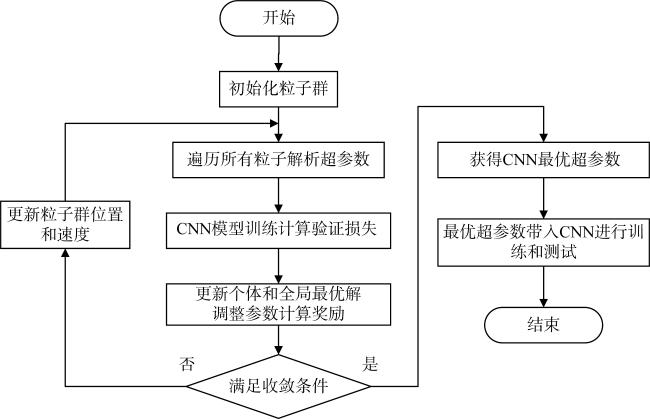
表1 RLPSO-CNN算法伪代码Tab. 1 Pseudocode of the RLPSO-CNN algorithm |
| 输入: 地震P波验证集$D=\left\{ \left( {{X}_{k}},{{Y}_{k}} \right)|k=1,2,...,m \right\}$、地震P波训练集 ${{D}_{\text{train}}}=\left\{ \left( X_{v}^{T},Y_{v}^{T} \right)|v=1,2,...,w \right\}$、地震P波测试集 ${{D}_{\text{test}}}=\left\{ \left( X_{u}^{*},Y_{u}^{*} \right)|u=1,2,...,n \right\}$、最大迭代次数T、粒子群数目N、初始参数w(t) 输出: ${{P}_{\text{out}}}=$ (全局最优参数组合$gbest$, 最小验证集损失$gbest\_score$, 正确率$accuracy$) |
|---|
| 1. 在边界范围内初始化粒子群, 随机初始化粒子位置和速度 |
| 2. for $t=0,...,T$ |
| 3. { |
| 4. for $i=0,...,N$ |
| 5. { |
| 6. $model=EnhancedPWaveCNN\left( HyperParameter \right)$ //解析超参数构建CNN模型 |
| 7. $val\_loss=\frac{1}{m}\sum\limits_{j=1}^{m}{SmoothL1Loss\left( model\left( {{X}_{j}} \right),{{Y}_{j}} \right)}$ //计算验证损失 |
| 8. if $val\_loss<gbest\_score$ |
| 9. $gbest=particles[i],gbest\_score=val\_loss$ |
| 10. else $particles[i]=particles[i-1]$/更新全局最优解和最优损失 |
| 11. $velocities[i]=w\cdot velocities[i]+{{c}_{1}}\cdot rand()\cdot (pbest[i]-particles[i])+{{c}_{2}}\cdot rand()\cdot (gbest-particles[i])$ |
| 12. $particles[i]+=velocities[i]$//更新粒子位置和速度 |
| 13. $w\left( t+1 \right)=w\left( t \right)+\Delta w\left( t \right)$ //调整惯性权重和加速常数, 计算奖励 |
| 14. } |
| 15. } |
| 16. $train\_model\left( model,gbest,{{D}_{\text{train}}} \right)$ |
| 17. ${{P}_{out}}=test\_model(model,{{D}_{\text{test}}})$ //以最优超参数训练和测试输出结果 |
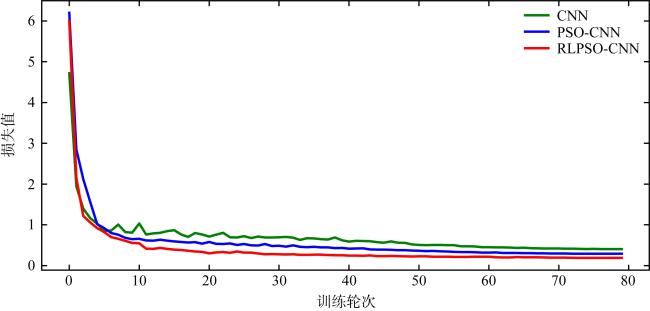
图3 RLPSO-CNN、PSO-CNN和CNN模型训练损失曲线Fig. 3 Training loss curves of RLPSO-CNN, PSO-CNN, and CNN models |
表2 RLPSO-CNN、PSO-CNN与CNN算法结果对比Tab. 2 Comparison of results among RLPSO-CNN, PSO-CNN, and CNN algorithms |
| 方法 | 准确率 | 均方根误差/s | 漏检率 |
|---|---|---|---|
| CNN | 83.88% | 0.3797 | 10.74% |
| PSO-CNN | 91.36% | 0.2974 | 7.06% |
| RLPSO-CNN | 95.90% | 0.1660 | 3.26% |
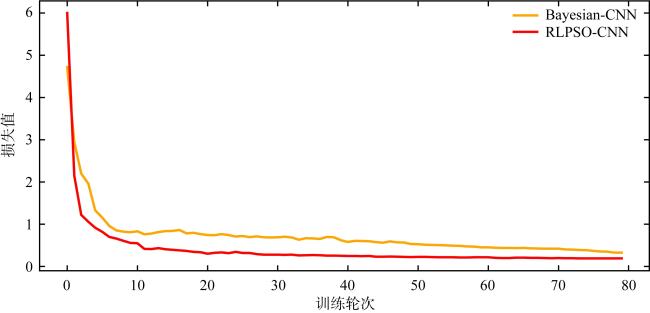
图4 RLPSO-CNN和Bayesian-CNN模型训练损失曲线Fig. 4 Training loss curves of RLPSO-CNN and Bayesian-CNN models |
表3 RLPSO-CNN与Bayesian-CNN、STA/LTA算法结果对比Tab. 3 Comparison of results between RLPSO-CNN and Bayesian-CNN, and STA/LTA algorithms |
| 方法 | 准确率 | 均方根误差/s | 漏检率 | 训练时长/h |
|---|---|---|---|---|
| RLPSO-CNN | 95.90% | 0.1660 | 3.26% | 20.1 |
| Bayesian-CNN | 82.21% | 0.4739 | 12.10% | 22.5 |
| [1] |
丁巍伟, 黄豪彩, 朱心科, 等, 2019. 一种新型潜标式海洋地震仪及在海洋地震探测中的应用[J]. 地球物理学进展, 34(1): 292-296.
|
| [2] |
张军华, 赵勇, 赵爱国, 等, 2002. 用小波变换与能量比方法联合拾取初至波[J]. 物探化探计算技术, 24(4): 309-312+336.
|
| [3] |
|
| [4] |
|
| [5] |
|
| [6] |
|
| [7] |
|
| [8] |
|
| [9] |
|
| [10] |
|
| [11] |
|
/
| 〈 |
|
〉 |