Journal of Tropical Oceanography >
Seasonal distribution characteristics and environmental driving factors of bacterial communities in mangrove sediments of Ximen Island, Zhejiang Province
Editor: YIN Bo
Received date: 2025-06-09
Revised date: 2025-08-13
Online published: 2025-09-15
Supported by
Monitoring Project of the Mangrove Ecosystem at the Estuary of Longgang(21038007721)
The Ministry of Natural Resources' 2024 Ministry-Provincial Cooperation Projects(2024ZRBSHZ103)
Laoshan Laboratory’s Scientific and Technological Innovation Project(LSKJ202202905)
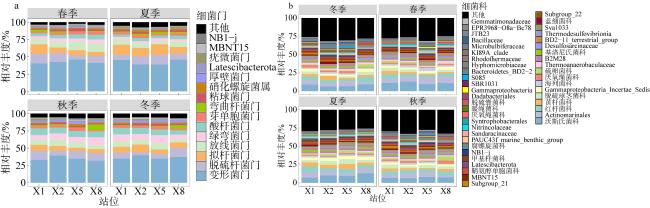
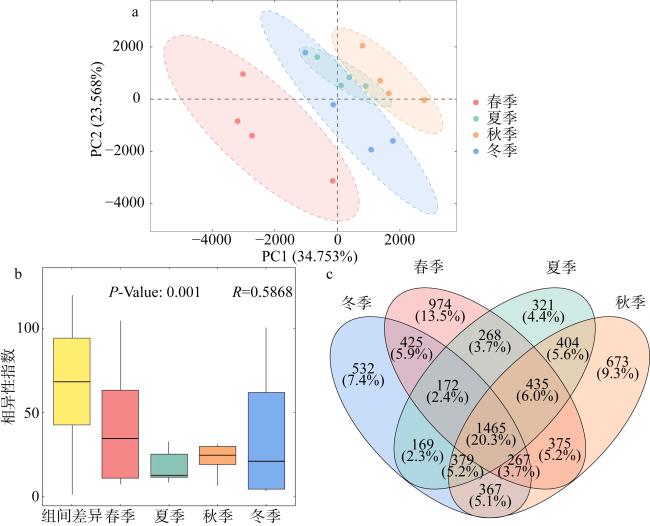
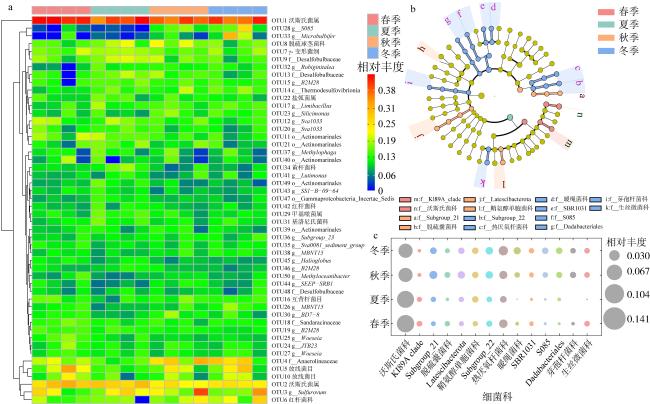
Mangrove forests, located at the interface of marine and terrestrial ecosystems in tropical and subtropical regions, harbor highly productive environments that support diverse microbial communities. These communities play a pivotal role in sustaining mangrove ecological functions and driving biogeochemical cycles. This study investigated the Ximen Island mangrove ecosystem in Zhejiang Province, employing high-throughput sequencing to systematically analyze the bacterial communities in surface sediments. We explored seasonal variations in bacterial diversity and assessed their correlations with environmental parameters. Results revealed that the sediment bacterial community in Ximen Island mangroves was dominated by Proteobacteria (39.11%), Desulfobacterota (10.02%), and Bacteroidota (9.17%). Among these, Proteobacteria and Desulfobacterota exhibited significant enrichment in spring, while Bacteroidota enriched in summer. Bacterial diversity indices exhibited significant seasonal dynamics: The richness index peaked in winter (2136 ± 235), while the Shannon index in spring (6.05 ± 0.15) was significantly lower than in autumn and winter (P < 0.05). Principal component analysis (PCA) and linear discriminant analysis effect size analyses (LEfSe) results demonstrated seasonal specificity in bacterial community composition across spring, autumn, and winter.
Key words: mangrove; sediment; bacterial diversity; Ximen Island
JIANG Shoudian , HU Xin , LAN Peixin , YAO Liqin , SHUI Bonian , JI Jianda , HE Maoqiu . Seasonal distribution characteristics and environmental driving factors of bacterial communities in mangrove sediments of Ximen Island, Zhejiang Province[J]. Journal of Tropical Oceanography, 2026 , 45(2) : 117 -128 . DOI: 10.11978/2025100
表1 西门岛红树林沉积物的环境参数Tab. 1 Environmental parameters of mangrove sediments on Ximen Island |
| 环境参数 | 春季 | 夏季 | 秋季 | 冬季 |
|---|---|---|---|---|
| 温度/℃ | 19.13±0.45b | 31.58±0.71a | 19.30±0.50b | 10.75±1.24c |
| 盐度/‰ | 14.71±1.57c | 27.73±3.35a | 30.00±2.42a | 21.10±3.54b |
| pH | 7.41±0.13a | 7.20±0.30a | 7.29±0.14a | 7.60±0.41a |
| TC/(mg·g-1) | 13.71±0.89a | 13.86±0.55a | 13.68±0.91a | 12.97±1.11a |
| TN/(mg·g-1) | 1.24±0.16a | 1.18±0.12a | 1.23±0.02a | 1.10±0.09a |
| TC/TN | 11.15±0.82a | 11.78±0.79a | 11.11±0.87a | 11.77±0.27a |
| 黏土含量/% | 39.89±1.51a | 39.14±1.16a | 40.52±0.49a | 36.08±1.13b |
| 粉砂含量/% | 59.48±0.87ab | 60.74±1.13a | 59.29±0.18ab | 57.78±2.41b |
| 砂含量/% | 0.54±0.08b | — | 0.76±0.00b | 6.14±3.33a |
注: TC: 总碳; TN: 总氮; TC/TN: 碳氮比值。同一行中的不同字母上角标表示显著差异(P < 0.05); “—”代表低于检测限 |
表2 西门岛红树林沉积物细菌群落多样性指数Tab. 2 Bacterial community diversity indices of mangrove sediments on Ximen Island |
| α多样性指数 | 春季 | 夏季 | 秋季 | 冬季 |
|---|---|---|---|---|
| 丰富度指数 | 1588±103c | 1898±161ab | 1708±89bc | 2136±235a |
| 香农指数 | 6.05±0.15b | 6.22±0.14ab | 6.32±0.12a | 6.41±0.17a |
| 辛普森指数 | 0.99±0.00a | 0.99±0.00a | 0.99±0.00a | 0.99±0.00a |
| 均匀度指数 | 0.57±0.01b | 0.57±0.00ab | 0.59±0.01a | 0.58±0.01ab |
注: 同一行中的不同字母上角标表示显著差异(P < 0.05) |
图4 相对丰度前50个OTUs在不同季节样品中的分布热图(a)、LEfSe分析显示不同季节样品之间具有显著性差异的细菌科(b)和气泡图反映具有显著性差异细菌科的相对丰度(c)Fig. 4 Heatmap showing the distribution of the top 50 OTUs in different seasonal samples (a), LEfSe analysis revealing the significant difference of bacterial families among different seasons (b), and bubble plot reflecting the relative abundance of bacteria families with significant differences (c) |
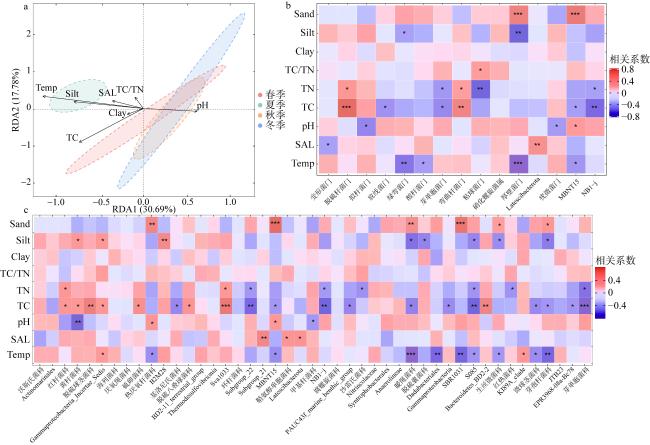
图5 不同季节样品细菌群落的RDA分析(a)以及细菌门(b)和细菌科(c)相对丰度与环境因子之间的相关性Temp: 温度; Silt: 粉砂; Clay: 黏土; SAL: 盐度; TC: 总碳; TN: 总氮; Sand: 砂土 。*: P< 0.05; **: P < 0.01; ***: P < 0.001 Fig. 5 Redundancy analysis (RDA) of bacterial communities from different seasonal samples (a), and correlations between the relative abundances of bacterial phyla (b) and families (c) and environmental factors |
| [1] |
曹启民, 郑康振, 陈耿, 等, 2008. 红树林生态系统微生物学研究进展[J]. 生态环境, (2): 839-845.
|
| [2] |
曹阳, 裘娟萍, 余志良, 2018. 西门岛红树林细菌种群及群体感应细菌的分析[J]. 科技通报, 34(10): 93-100.
|
| [3] |
陈雅慧, 张树刚, 张钊, 2023. 乐清湾盐沼湿地有机碳密度及碳储量估算[J]. 海洋环境科学, 42(1): 38-45.
|
| [4] |
梁文雅, 王冼民, 刘琦, 2024. 廉江高桥红树林沉积物微生物群落结构特征及其与营养因子相关性[J]. 广东海洋大学学报, 44(4): 80-87.
|
| [5] |
刘孟兰, 祁政宇, 朱明栋, 等, 2025. 中国红树林北缘引种区和天然分布区秋茄种群结构与动态特征研究[J/OL]. 生态与农村环境学报, (2025-06-30). https://link.cnki.net/doi/10.19741/j.issn.1673-4831.2025.0298.
LIU MENGLAN, QI ZHENGYU, ZHU MINGDONG, et al, 2025. Study on the population structure and dynamic characteristics of Kandelia obovata in the north marginal introduction and natural distribution region of mangroves in China[J/OL]. Journal of Ecology and Rural Environment, (2025-06-30). https://link.cnki.net/doi/10.19741/j.issn.1673-4831.2025.0298 (in Chinese with English abstract).
|
| [6] |
骆耐香, 陈森洲, 袁桂峰, 等, 2010. 广西沿海地区红树林根系土壤中放线菌的分离与鉴定[J]. 基因组学与应用生物学, 29(2): 310-313.
|
| [7] |
王友绍, 2021. 全球气候变化对红树林生态系统的影响、挑战与机遇[J]. 热带海洋学报, 40(3): 1-14.
|
| [8] |
吴伟志, 赵志霞, 杨升, 等, 2022. 浙江省红树林分布和造林成效分析[J]. 热带海洋学报, 41(6): 67-74.
|
| [9] |
朱慧兰, 郭玉清, 吴成业, 等, 2020. 浙江西门岛红树林湿地小型底栖动物的研究[J]. 集美大学学报(自然科学版), 25(4): 241-247.
|
| [10] |
|
| [11] |
|
| [12] |
|
| [13] |
|
| [14] |
|
| [15] |
|
| [16] |
|
| [17] |
|
| [18] |
|
| [19] |
|
| [20] |
|
| [21] |
|
| [22] |
|
| [23] |
|
| [24] |
|
| [25] |
|
| [26] |
|
| [27] |
|
| [28] |
|
| [29] |
|
| [30] |
|
| [31] |
|
| [32] |
|
| [33] |
|
| [34] |
|
| [35] |
|
| [36] |
|
| [37] |
|
| [38] |
|
| [39] |
|
| [40] |
|
| [41] |
|
| [42] |
|
| [43] |
|
| [44] |
|
| [45] |
|
| [46] |
|
| [47] |
|
| [48] |
|
| [49] |
|
| [50] |
|
| [51] |
|
| [52] |
|
| [53] |
|
| [54] |
|
| [55] |
|
| [56] |
|
| [57] |
|
| [58] |
|
| [59] |
|
/
| 〈 |
|
〉 |