Journal of Tropical Oceanography >
Sexual reproduction and early development of Platygyra carnosus
Received date: 2016-04-28
Request revised date: 2016-09-06
Online published: 2017-01-19
Supported by
Public Welfare Research and Capacity Building of Guangdong Province (K15216)
Marine Fishery Science and Technology Promotion Project in Guangdong Province (A201308E02)
Dapeng New District Development Projects (DPKJ201500080)
Copyright
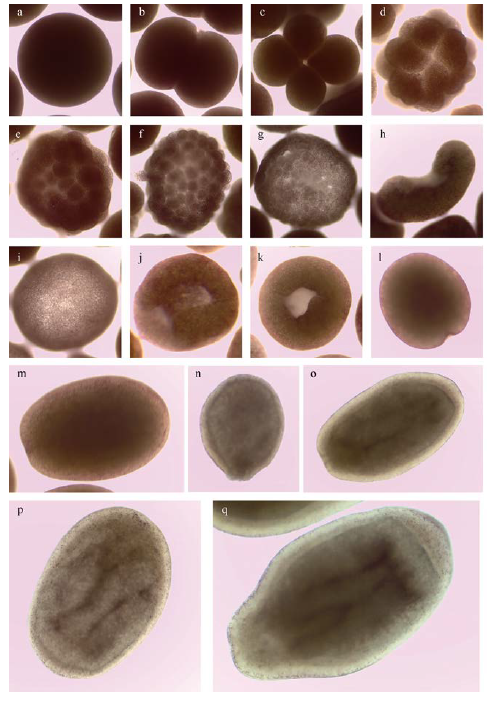
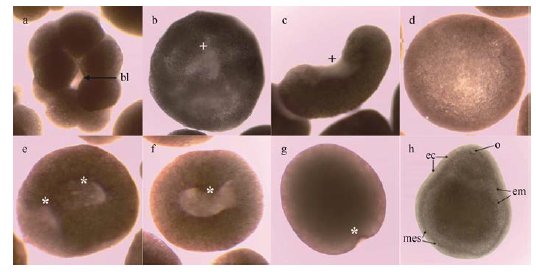
Sexual reproduction of Platygyra carnosus was observed preliminarily under the condition of artificial culture. Eggs and sperms of Platygyra carnosus were collected when they were spawned. The morphological characteristics in early development of Platygyra carnosus during different periods were recorded and described. The results showed that the corals were hermaphrodites, in vitro fertilization, and began spawning on the ninth day after the full moon,, then the spawning quantity of corals increased to the maximum on the 11th day after the full moon. The eggs of Platygyra carnosus were spherical in shape and pink in color. The early development process underwent five phases and 17 stages under the conditions of 27±0.5℃. The fertilized eggs developed into planula in 48 h and the larvae began to settle after 96 h. The sexual reproduction and early development of Platygyra carnosus were reported for the first time in China.
Key words: Platygyra carnosus; sexual reproduction; early development
XIAO Baohua , LIAO Baolin , YANG Xiaodong , XIE Ziqiang . Sexual reproduction and early development of Platygyra carnosus[J]. Journal of Tropical Oceanography, 2017 , 36(1) : 65 -71 . DOI: 10.11978/2016044
Tab. 1 Early development of Platygyra carnosus表1 肉质扁脑珊瑚早期发育过程 |
| 受精后时间 | 胚胎发育时期 | 主要发育特征 | 图示 |
|---|---|---|---|
| 0 | 受精卵 | 受精卵呈粉红色圆球状 | |
| 2h | 2细胞期 | 受精卵分裂成大小相等的2个细胞 | |
| 3h30min | 4细胞期 | 受精卵进一步分裂成4个细胞 | |
| 4h30min | 16细胞期 | 受精卵进一步分裂成16个细胞, 分裂球在胚胎的分布变得不规则 | |
| 5h30min | 32细胞期 | 受精卵进一步分裂成32个细胞 | |
| 6h | 桑葚胚期 | 受精卵进一步分裂成64~128个细胞,细胞团与桑葚球非常相似, 胚胎呈不规则形态 | |
| 7h | 囊胚早期 | 受精卵进一步分裂成128个以上的细胞, 此时胚胎表面变得平滑, 中央出现细胞内陷, 形成假胚孔 | |
| 8h | 囊胚中期 | 囊胚进一步分裂, 胚胎变得扁平, 发育为坐垫状, 凹面继续内陷, 假胚孔加深且表面更加平滑 | |
| 9h | 囊胚晚期 | 坐垫状囊胚逐渐收拢形成一个球状胚体, 假胚伴随此过程逐渐孔消失 | |
| 15h | 原肠胚早期 | 在极短时间内胚胎表面形成两个胚孔 | |
| 17h | 原肠胚中期 | 两个胚孔进一步扩大并最终融合成一个胚孔, 胚孔内陷形成原口, 由于细胞的迁移开始形成两个胚层的分化 | |
| 24h | 原肠胚晚期 | 原肠胚的原口开始逐渐闭合, 胚体逐渐拉长成椭圆形或梨形 | |
| 36h | 原肠胚末期 | 原肠作用临近结束, 原口封闭完成, 胚胎发育结束 | |
| 48h | 浮浪幼虫早期 | 浮浪幼虫维持椭圆形或梨形的形态, 此时外胚层已发育出鞭毛的结构, 已经具备游泳能力 | |
| 58h | 浮浪幼虫中期 | 浮浪幼虫形态明显, 形态拉长为圆柱状, 可在显微镜底下清晰观察到胚体内两个胚层, 幼虫开始四处游动 | |
| 84h | 浮浪幼晚期 | 浮浪幼虫内部分化明显, 内胚层发育出肠系膜 | |
| 96h | 浮浪幼末期 | 游动能力加强, 开始尝试寻找基质附着 |
Fig. 1 Morphology of early development of P. carnosus |
Fig. 2 Morphology of early development of P. carnosus. |
The authors have declared that no competing interests exist.
| [1] |
|
| [2] |
|
| [3] |
|
| [4] |
|
| [5] |
|
| [6] |
|
| [7] |
|
| [8] |
|
| [9] |
|
| [10] |
|
| [11] |
|
| [12] |
|
| [13] |
|
| [14] |
|
| [15] |
|
| [16] |
|
| [17] |
|
| [18] |
|
| [19] |
|
| [20] |
|
| [21] |
|
| [22] |
|
| [23] |
|
| [24] |
|
| [25] |
|
| [26] |
|
| [27] |
|
| [28] |
|
| [29] |
|
/
| 〈 |
|
〉 |