

Journal of Tropical Oceanography ›› 2026, Vol. 45 ›› Issue (3): 74-82.doi: 10.11978/2025121CSTR: 32234.14.2025121
Previous Articles Next Articles
Impacts of wind stress frequency on submesoscale energy variations at mesoscale eddy fronts
WU Boyan1,2( ), ZHENG Ruixi1(), JING Zhiyou1
- 1
State Key Laboratory of Tropical Oceanography ,South China Sea Institute of Oceanology, Chinese Academy of Sciences
2University of Chinese Academy of Sciences
-
Received:2025-08-03Revised:2025-10-09Online:2026-05-10Published:2026-05-28 -
Contact:ZHENG Ruixi. email: zhengruixi@scsio.ac.cn -
Supported by:National Key Research and Development Program of China(2023YFC3008003);National Natural Science Foundation of China(42225602);National Natural Science Foundation of China(42530403);National Natural Science Foundation of China(42306027);National Natural Science Foundation of China(42149907);National Natural Science Foundation of China(42349584);National Natural Science Foundation of China(42349907);National Natural Science Foundation of China(42549907);Development Fund of South China Sea Institute of Oceanology of the Chinese Academy of Sciences(SCSIO2024HC04);Development Fund of South China Sea Institute of Oceanology of the Chinese Academy of Sciences(SCSIO2023QY02);Development Fund of South China Sea Institute of Oceanology of the Chinese Academy of Sciences(SCSIO202201);Development Fund of South China Sea Institute of Oceanology of the Chinese Academy of Sciences(SCSIO202204);Development Fund of South China Sea Institute of Oceanology of the Chinese Academy of Sciences(SCSIO202209)

CLC Number:
- P731.2
Cite this article
WU Boyan, ZHENG Ruixi, JING Zhiyou. Impacts of wind stress frequency on submesoscale energy variations at mesoscale eddy fronts[J].Journal of Tropical Oceanography, 2026, 45(3): 74-82.
share this article
Add to citation manager EndNote|Reference Manager|ProCite|BibTeX|RefWorks
Fig. 1
Model setup and wind forcing schemes. (a) Spatial distributions of initial sea surface density (shading) and surface velocity (black arrows). Arrows denote the direction of wind stress; the white dashed box indicates the nested grid region. (b) Initial vertical temperature profiles at the eddy center (red line) and the background field (blue line). (c) Time series of wind stress magnitude across different experiments. Subgrid nesting is activated after 480 h."
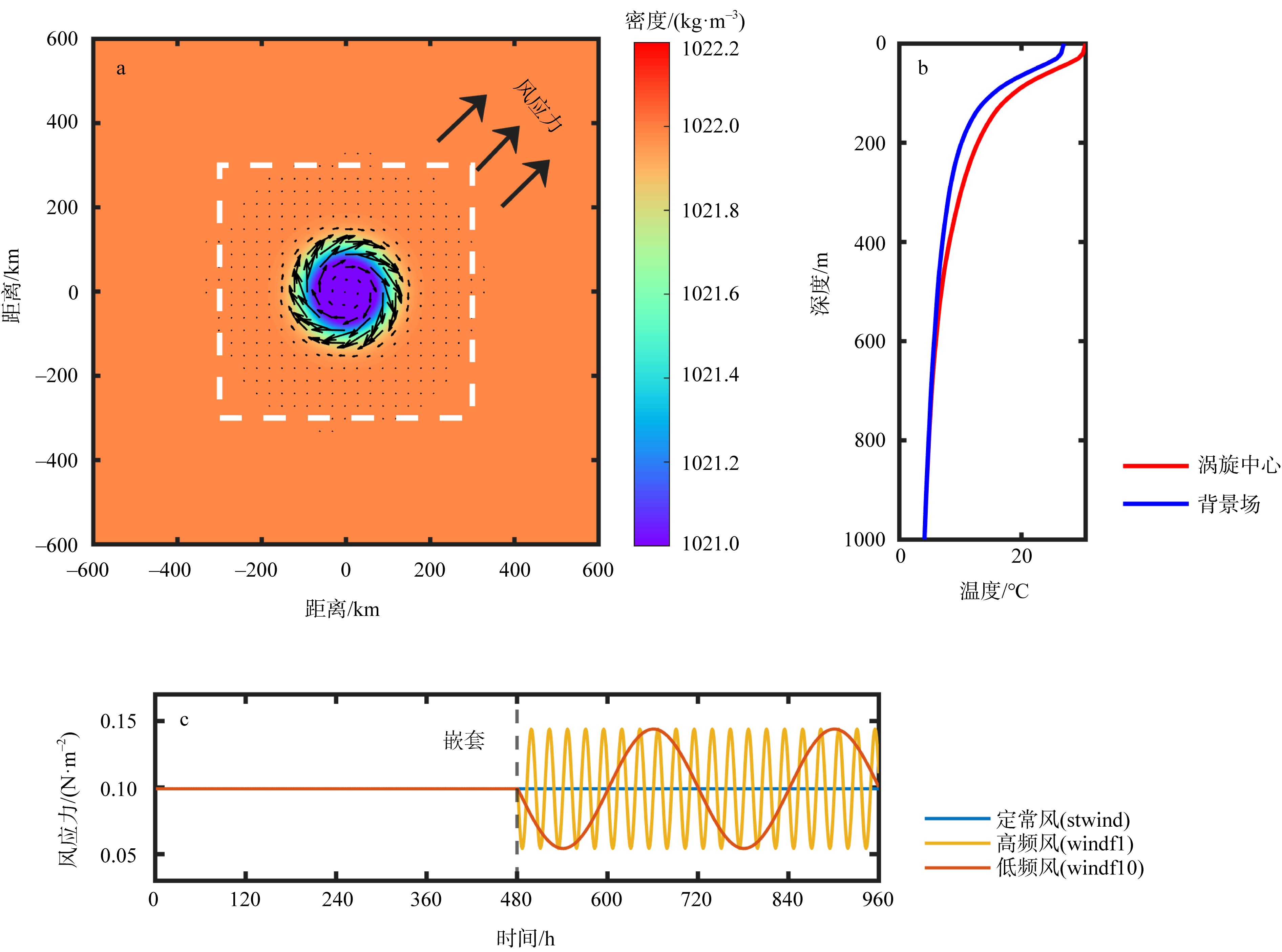
Fig. 1

Tab. 1
Configuration of each sensitivity experiment"
| 案例 | $ \tau_{0} /\left(\mathrm{N} \cdot \mathrm{~m}^{-2}\right) $ | $ \frac{1}{\omega} / \mathrm{d} $ | A/(N·m-2) | $ \phi $ |
|---|---|---|---|---|
| stwind | 0.1 | N/A | 0 | 0 |
| windf1 | 0.1 | 1 | 0.0440 | -π |
| windf10 | 0.1 | 10 | 0.0440 | -π |
Tab. 1
Fig. 2
Time series of submesoscale kinetic energy variation of eddy fronts in different wind forcing experiments. (a) Time series of the prescribed wind stress forcing; (b) frontal-averaged vertical mixing coefficient (Kv) across different wind frequency experiments; (c) frontal-averaged submesoscale eddy kinetic energy (SEKE) evolution."
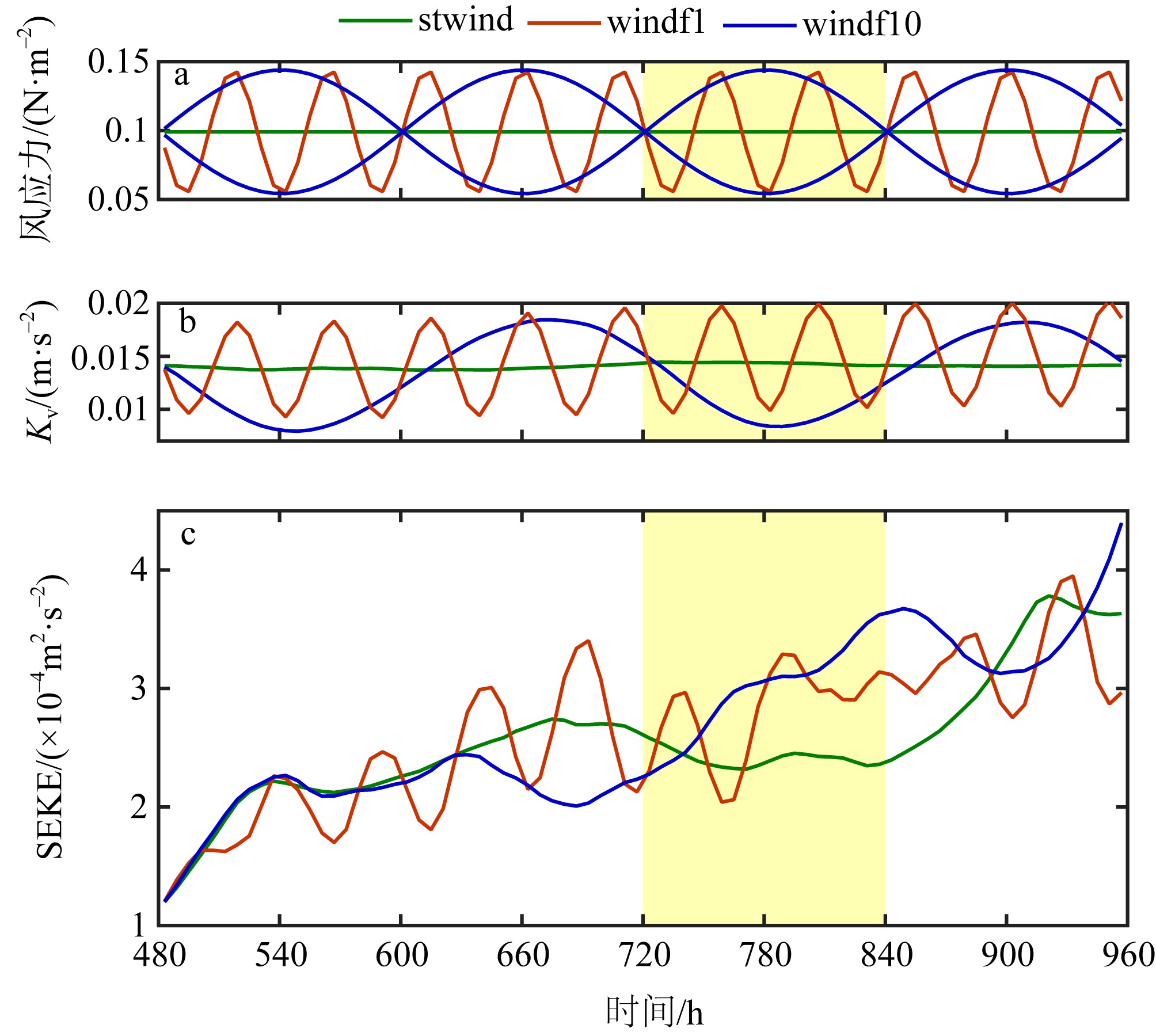
Fig. 2
Fig. 3
Kinetic energy budget diagnostics and time series of selected dynamic parameters in frontal regions in different wind forcing experiments. The figure shows the time series of VBF (a), kinetic energy flux (Π) (b), normalized convergence (c) and normalized frontogenetic rate (d) averaged over the frontal region at 10 m depth from different experiments. The frontal region is selected according to the frontal intensity, with a threshold of 1×10⁻⁷s-2. The yellow shaded area corresponds to the phase of weakened low-frequency wind."
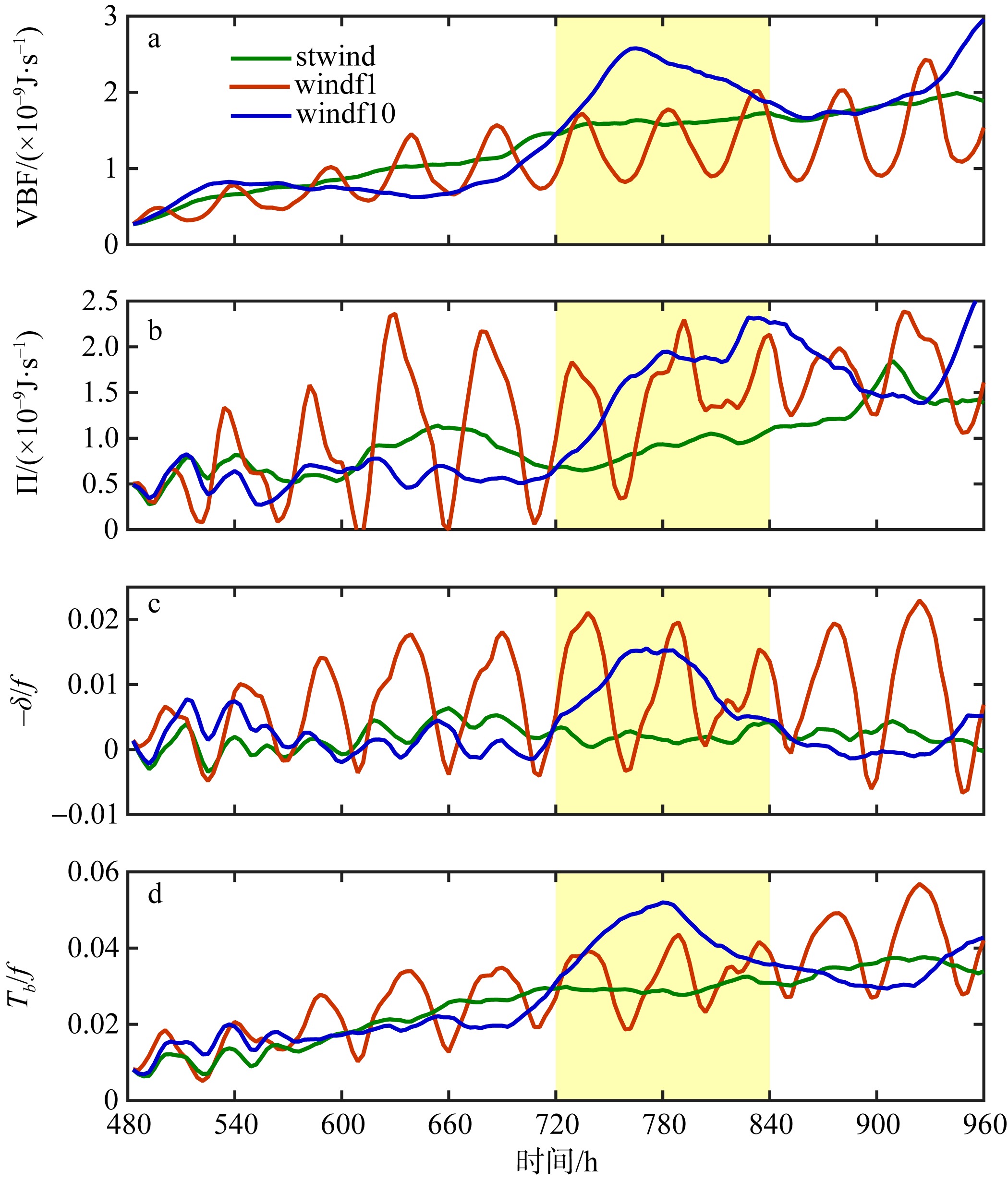
Fig. 3
Fig. 4
Submesoscale frontogenesis in each experiment. (a—f) Spatial distributions of frontogenetic rate (Tb/f) and horizontal convergence (-δ/f) at 10 m depth at the 780th hour of the simulation; (g—i) scatter plots of frontogenetic rate versus horizontal convergence in the frontal region for each experiment, where R denotes the correlation coefficient"
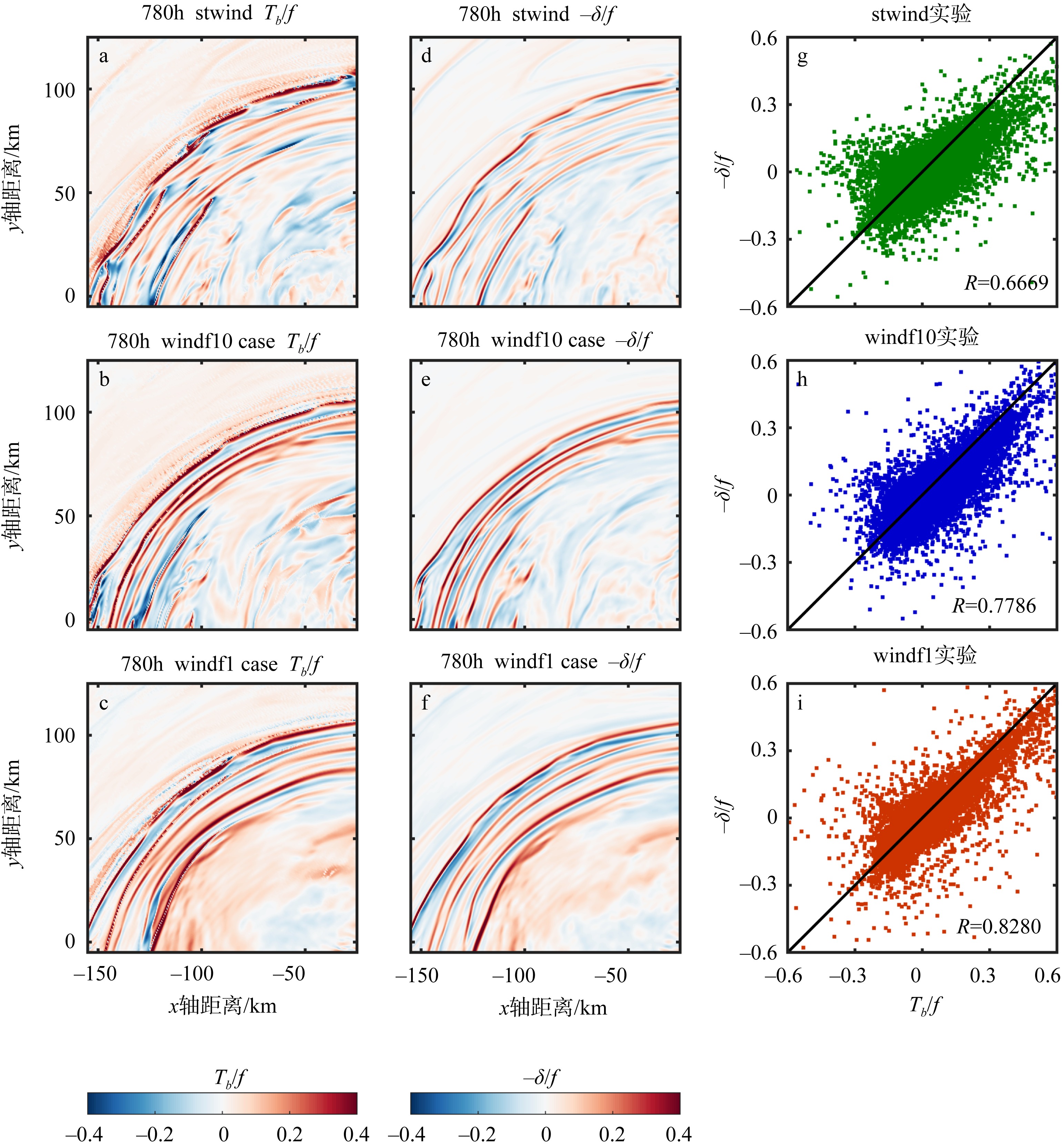
Fig. 4
Fig. 5
Spatial distribution of frontal intensity and kinetic energy budget diagnostics for each experiment a—c. Frontal intensity $ (|\nabla \mathrm{b}|)$ at 10 m depth at the 780th hour of the simulation, with gray contours representing 1×10⁻⁷s-2; d—f. Spatial distributions of vertical buoyancy flux (VBF) for each experiment; g—i. Spatial distributions of kinetic energy flux (Π) for each experiment. Each row corresponds to the stwind (steady wind experiment), windf10 (low-frequency wind experiment) and windf1 (high-frequency wind experiment), respectively."
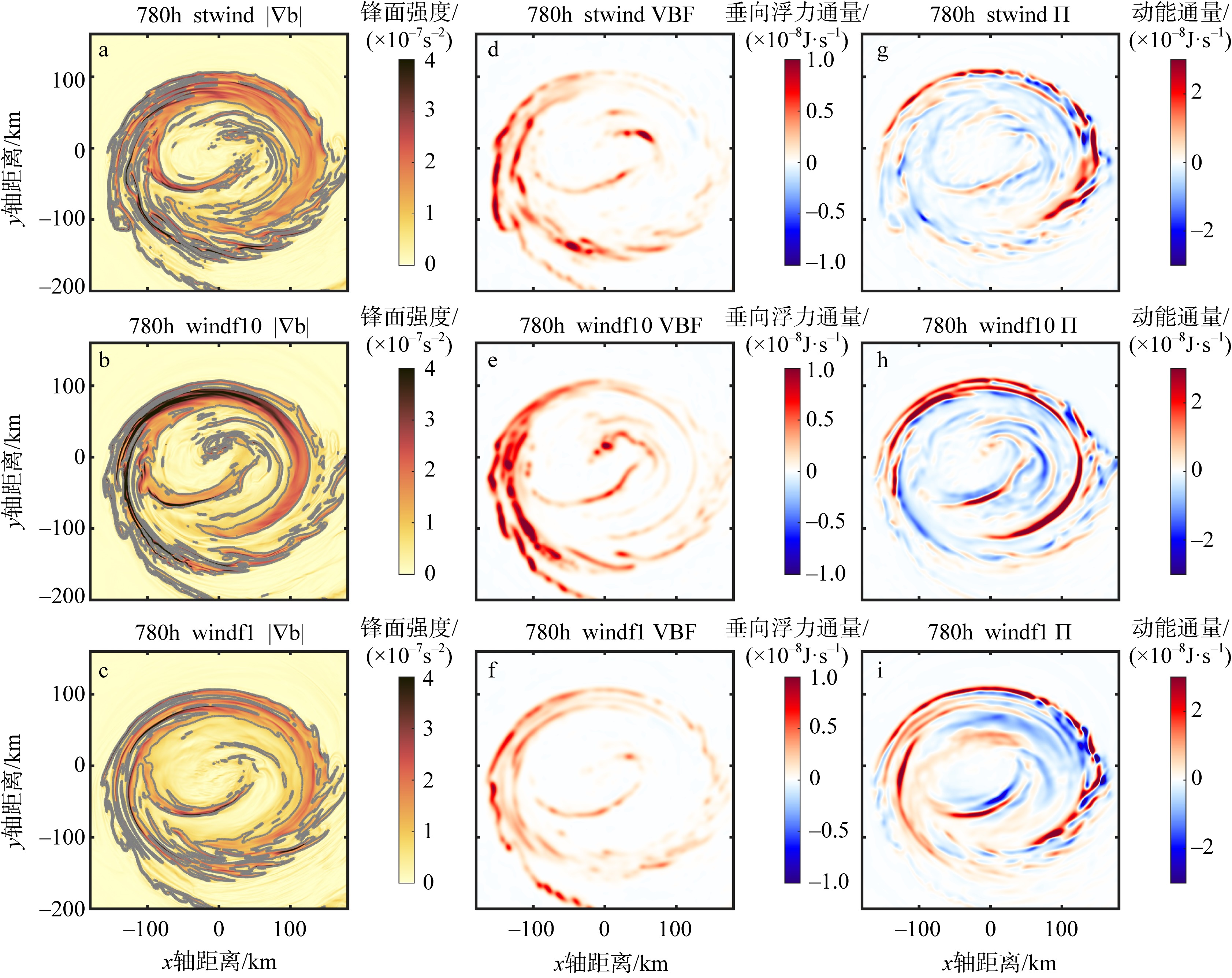
Fig. 5
Fig. 6
Temporal trends of frontal submesoscale kinetic energy and its budget diagnostics for each experiment. The figure shows the time series of 10-day moving averaged SEKE (a), VBF (b) and kinetic energy flux (Π) (c) averaged over the frontal region at 10 m depth from different experiments. The frontal region is selected according to the frontal intensity, with a threshold of 1×10⁻⁷s-2"
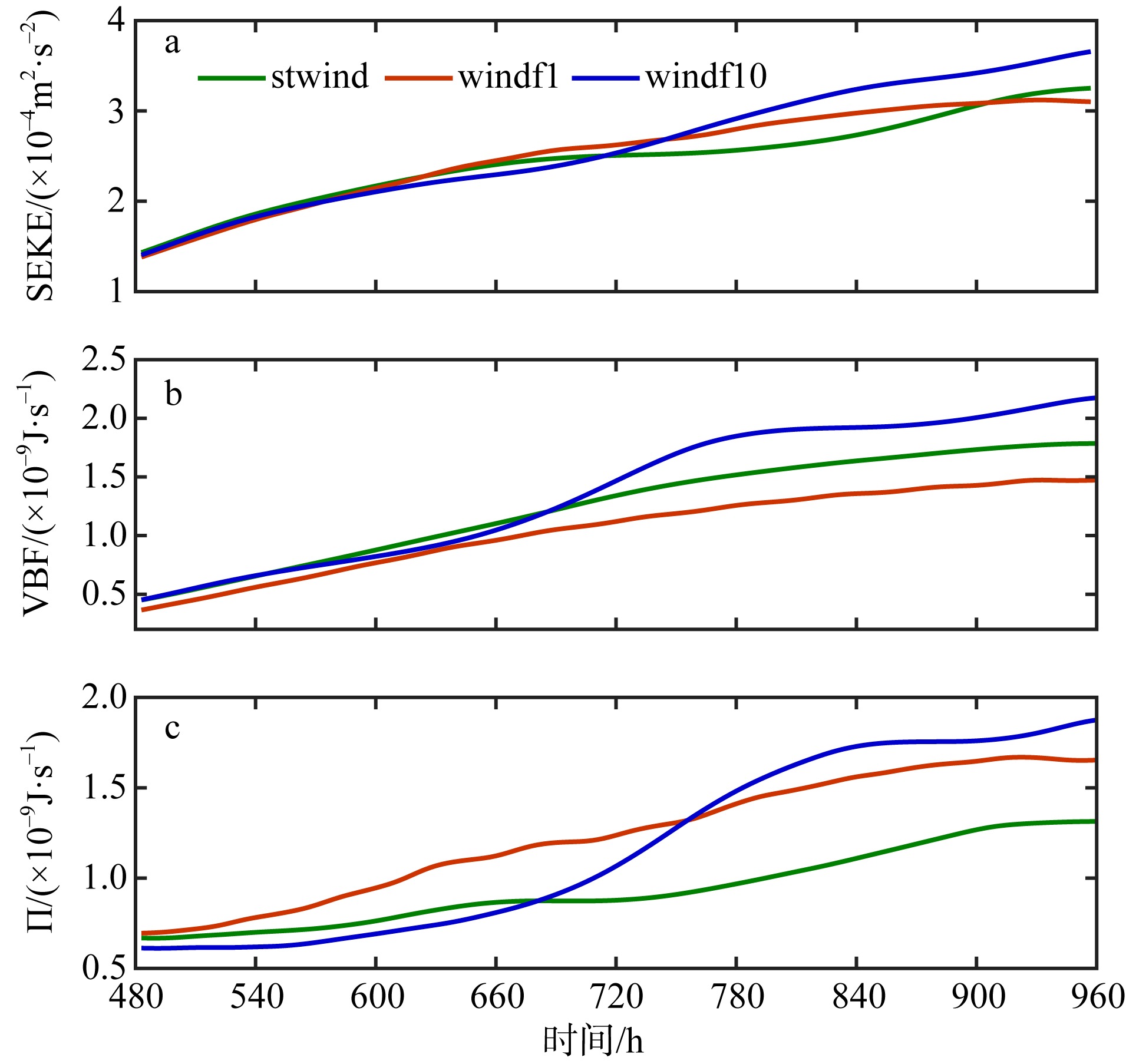
Fig. 6
Fig. 7
Temporal variation trends of the horizontal and vertical terms of kinetic energy flux (Π) for each experiment. The figure shows the temporal variation trends of 10-day moving averaged frontogenetic rate (a), frontal intensity (b), horizontal component of Π (c) and vertical component of Π (d) averaged over the frontal region at 10 m depth from different experiments. The frontal region is selected according to the frontal intensity, with a threshold of 1×10⁻⁷s-2"
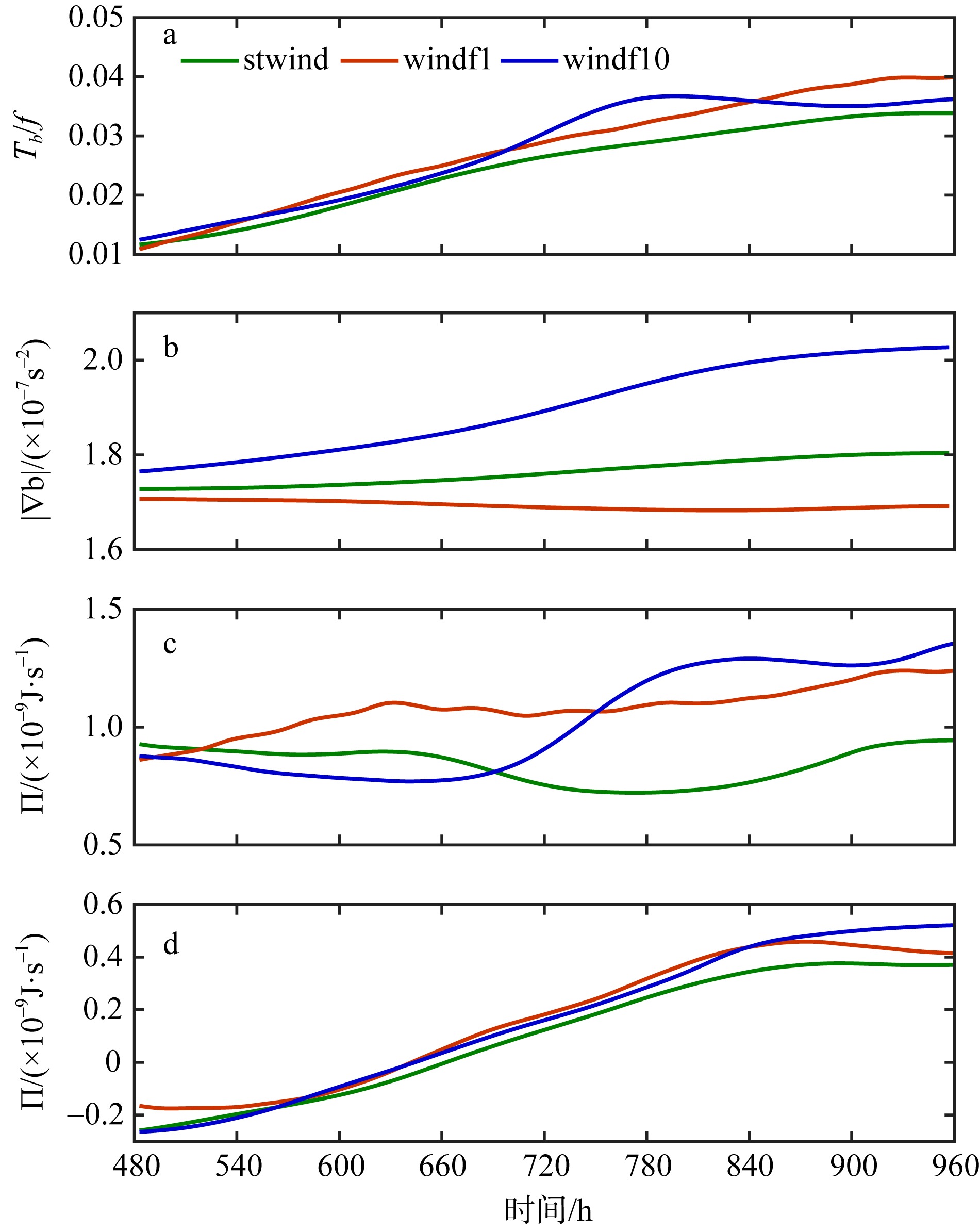
Fig. 7
| [1] |
doi: 10.1175/JPO-D-17-0100.1 |
| [2] |
doi: 10.1175/JPO-D-18-0162.1 |
| [3] |
doi: 10.1016/S1463-5003(01)00012-9 |
| [4] |
doi: 10.1038/ncomms7862 pmid: 25897832 |
| [5] |
doi: 10.1175/2007JPO3672.1 |
| [6] |
doi: 10.1126/science.1201515 pmid: 21393512 |
| [7] |
doi: 10.1175/JPO-D-18-0143.1 |
| [8] |
doi: 10.1016/j.ocemod.2019.101540 |
| [9] |
doi: 10.1175/JPO-D-20-0043.1 |
| [10] |
doi: 10.1175/JPO-D-14-0029.1 |
| [11] |
doi: 10.1146/fluid.1982.14.issue-1 |
| [12] |
doi: 10.1175/2007JPO3773.1 |
| [13] |
doi: 10.1029/94RG01872 |
| [14] |
|
| [15] |
|
| [16] |
doi: 10.1098/rspa.2016.0117 |
| [17] |
doi: 10.1146/annurev-marine-032320-120725 pmid: 33395349 |
| [18] |
doi: 10.1175/JPO-D-14-0071.1 |
| [19] |
doi: 10.1038/s41467-022-33251-7 pmid: 36163322 |
| [20] |
doi: 10.1016/j.ocemod.2004.08.002 |
| [21] |
doi: 10.1175/JPO-D-22-0001.1 |
| [22] |
doi: 10.1017/jfm.2017.833 |
| [23] |
doi: 10.1175/JPO2830.1 |
| [24] |
doi: 10.1175/JPO2737.1 |
| [25] |
doi: 10.1016/j.dsr2.2013.02.025 |
| [26] |
doi: 10.1175/JPO-D-15-0008.1 |
| [27] |
doi: 10.1002/jgrc.v122.6 |
| [28] |
doi: 10.1038/s41467-024-53551-4 pmid: 39455553 |
| [29] |
doi: 10.1002/grl.v42.18 |
| [1] | GUAN Zhuoqiang, YANG Tao, XIE Lingling, LI Junyi. Analysis of hydrodynamic environment evolution characteristics in Zhanjiang Bay based on satellite images [J]. Journal of Tropical Oceanography, 2026, 45(3): 50-60. |
| [2] | ZHANG Ze, QU Ke, LI Wei, WANG Chao. Experimental study on the propagation and evolution characteristics of cnoidal waves over typical coral reefs [J]. Journal of Tropical Oceanography, 2026, 45(2): 30-41. |
| [3] | QIU Cheng, ZHU Yiping, ZHU Jianrong. Changes and causes of saltwater intrusion patterns in the Changjiang Estuary [J]. Journal of Tropical Oceanography, 2026, 45(2): 42-58. |
| [4] | LIANG Zhanlin, WANG Weiqiang. Research progress on the characteristics of deep-sea circulation and water masses in the deep Eastern Indian Ocean* [J]. Journal of Tropical Oceanography, 2026, 45(1): 17-26. |
| [5] | ZHONG Qingwen, CHEN Gengxin, CHEN Ju, HE Yunkai. Intraseasonal variability and dynamical mechanisms of equatorial deep currents in the Indian Ocean* [J]. Journal of Tropical Oceanography, 2026, 45(1): 140-153. |
| [6] | WANG Qiang, ZHENG Yu, LI Jinmei, ZHAO Minghui, ZHANG Jiazheng. A new swell static correction technique based on variational mode decomposition and its application in marine single-channel seismic data processing [J]. Journal of Tropical Oceanography, 2025, 44(5): 166-178. |
| [7] | LI Lin, WANG Xidong, HE Zikang, CHEN Zhiqiang, CAO Yuan, LIU Kefeng, CHEN Jian. Three-dimensional eddy structure reconstruction in the Northwest Pacific using variational method and satellite sea surface data [J]. Journal of Tropical Oceanography, 2025, 44(5): 39-49. |
| [8] | YAO Yu, LIU Xiaona, ZHOU Baobao, ZHOU Ting. Numerical simulation of wave motion over large roughness reef surfaces based on XBeach-NH [J]. Journal of Tropical Oceanography, 2025, 44(5): 31-38. |
| [9] | LIU Tailong, XIE Tao, LI Jian, WANG Chao, ZHANG Xuehong. Deep learning-based automatic detection model for ocean eddies in SAR images [J]. Journal of Tropical Oceanography, 2025, 44(5): 65-76. |
| [10] | ZHU Xiaoyu, YANG Hua, MAO Beibei, ZHENG Yuxuan. Observations of fine-scale structure and study of turbulent mixing in the deep northeastern South China Sea* [J]. Journal of Tropical Oceanography, 2025, 44(5): 22-30. |
| [11] | QIU Liguo, LIANG Xiaoli, CHEN Bin, WANG Shengjian, WANG Fayun. Wave distribution characteristics of Xuande Atoll, Xisha Islands* [J]. Journal of Tropical Oceanography, 2025, 44(5): 50-64. |
| [12] | LI Wei, QU Ke, WANG Chao, YU Renshi, ZHANG Ze. Experimental study on the influence of submerged breakwater on the wave characteristics of infragravity waves on coral reefs [J]. Journal of Tropical Oceanography, 2025, 44(4): 177-186. |
| [13] | XIONG Xin, FENG Yingci, YANG Renhui, SUN Jie, LI Jian, ZHAN Wenhuan, LYU Kaiyun. Study on the characteristics of internal solitary waves in the Dongsha area of the northern South China Sea based on acoustic backscatter data* [J]. Journal of Tropical Oceanography, 2025, 44(3): 14-23. |
| [14] | ZHONG Danni, YAO Yu, ZHOU Ting. Study on wave transformation and run-up around the three-dimensional barrier reef under the action of solitary waves [J]. Journal of Tropical Oceanography, 2025, 44(2): 39-47. |
| [15] | WANG Chao, QU Ke, WANG Xu, GAO Rongze, WANG Aoyu. Influences of artificial fish reef on wave hydrodynamics of solitary wave on an uneven fringing reef [J]. Journal of Tropical Oceanography, 2025, 44(2): 30-38. |
|
||