

Journal of Tropical Oceanography ›› 2026, Vol. 45 ›› Issue (5): 162-177.doi: 10.11978/2025224CSTR: 32234.14.2025224
Previous Articles Next Articles
Distribution characteristics of biomarker components and their environmental indications at Well NK-1 on Meiji Atoll, Nansha Islands*
ZHU Xiaowei1,2( ), MO Ziyi1,2,3, MAO Shengyi4, TIAN Yuhang1,2,5, LUO Yun1,2, MIAO Li1,2, XU Weihai1,2, LI Gang1,2, YAN Wen1,2,3()
- 1
South China Sea Institute of Oceanology ,State Key Laboratory of Tropical Oceanography
2South China Sea Institute of Oceanology ,Laboratory of Ocean and Marginal Sea Geology
3University of Chinese Academy of Sciences
4Guangzhou Institute of Energy Conversion ,Chinese Academy of Sciences, Key Laboratory of Gas Hydrate
5Hainan Key Laboratory of Marine Geological Resources and Environment
-
Received:2025-11-26Revised:2026-01-14Online:2026-09-10Published:2026-10-13 -
Contact:YAN Wen. email:wyan@scsio.ac.cn -
Supported by:National Key Research and Development Program of China(2021-06); National Natural Science Foundation of China(42373029); National Natural Science Foundation of China(42306076); National Natural Science Foundation of China(42176079); National Natural Science Foundation of China(42376079); General Program of Natural Science Foundation of Guangdong Province(2024A1515012382); General Program of Natural Science Foundation of Guangdong Province(2025A1515010958); Hainan Marine Geological Resources and Environment Key Laboratory Open Fund(24-HNHYDZZYHJKF047)

CLC Number:
- P734.43
Cite this article
ZHU Xiaowei, MO Ziyi, MAO Shengyi, TIAN Yuhang, LUO Yun, MIAO Li, XU Weihai, LI Gang, YAN Wen. Distribution characteristics of biomarker components and their environmental indications at Well NK-1 on Meiji Atoll, Nansha Islands*[J].Journal of Tropical Oceanography, 2026, 45(5): 162-177.
share this article
Add to citation manager EndNote|Reference Manager|ProCite|BibTeX|RefWorks
Fig. 1
Geographic location of Well NK-1"
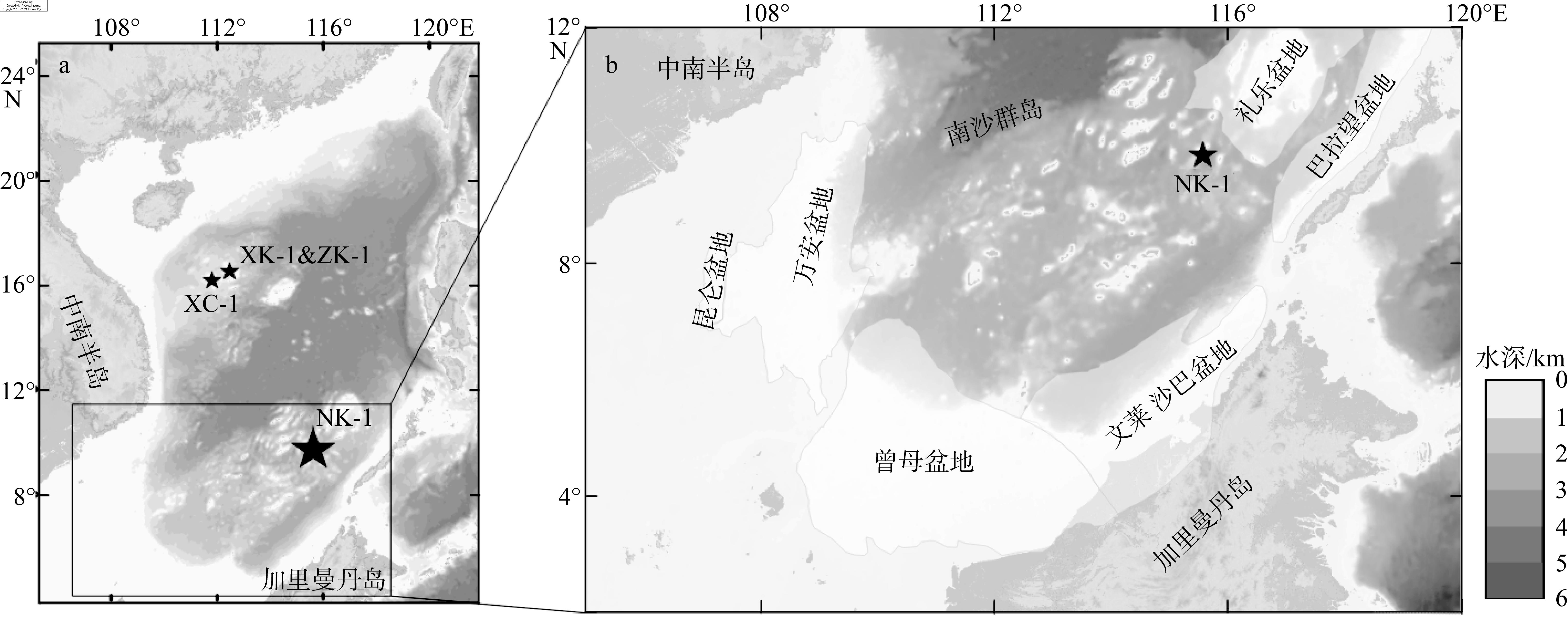
Fig. 1
Fig. 2
The average abundance of various compound classes (a) and the relative abundance of individual compounds within each class (b—e)"
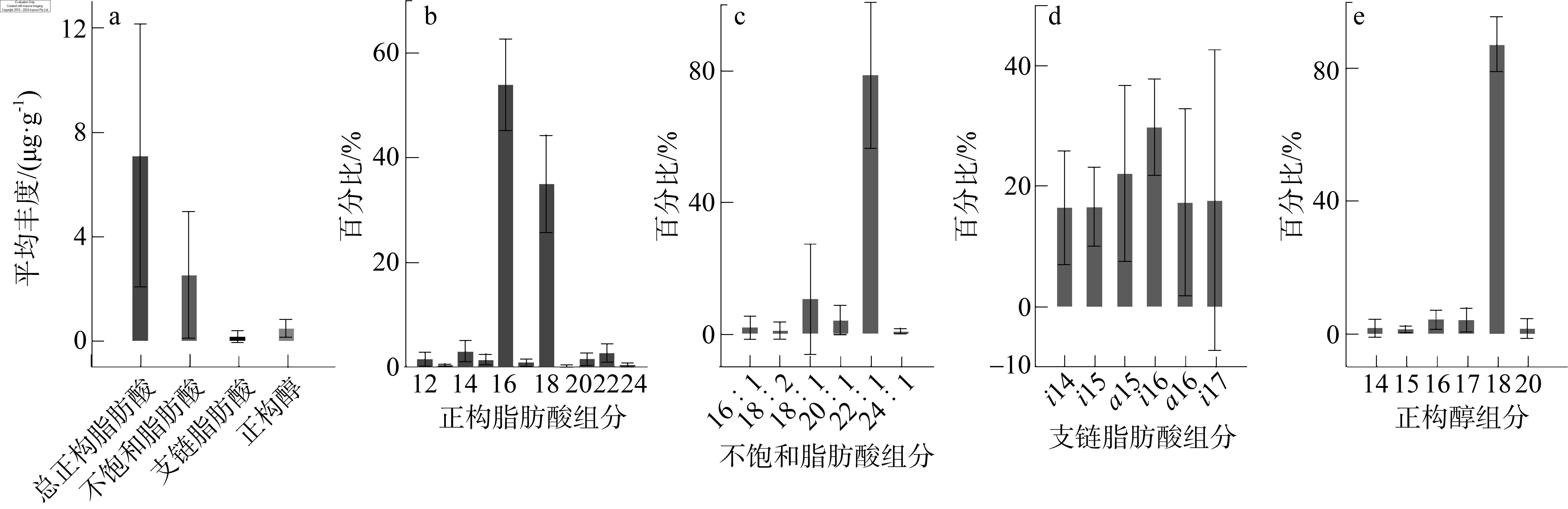
Fig. 2
Fig. 3
Total ion chromatogram of lipid biomarker extracts from carbonate rock samples in Well NK-1"
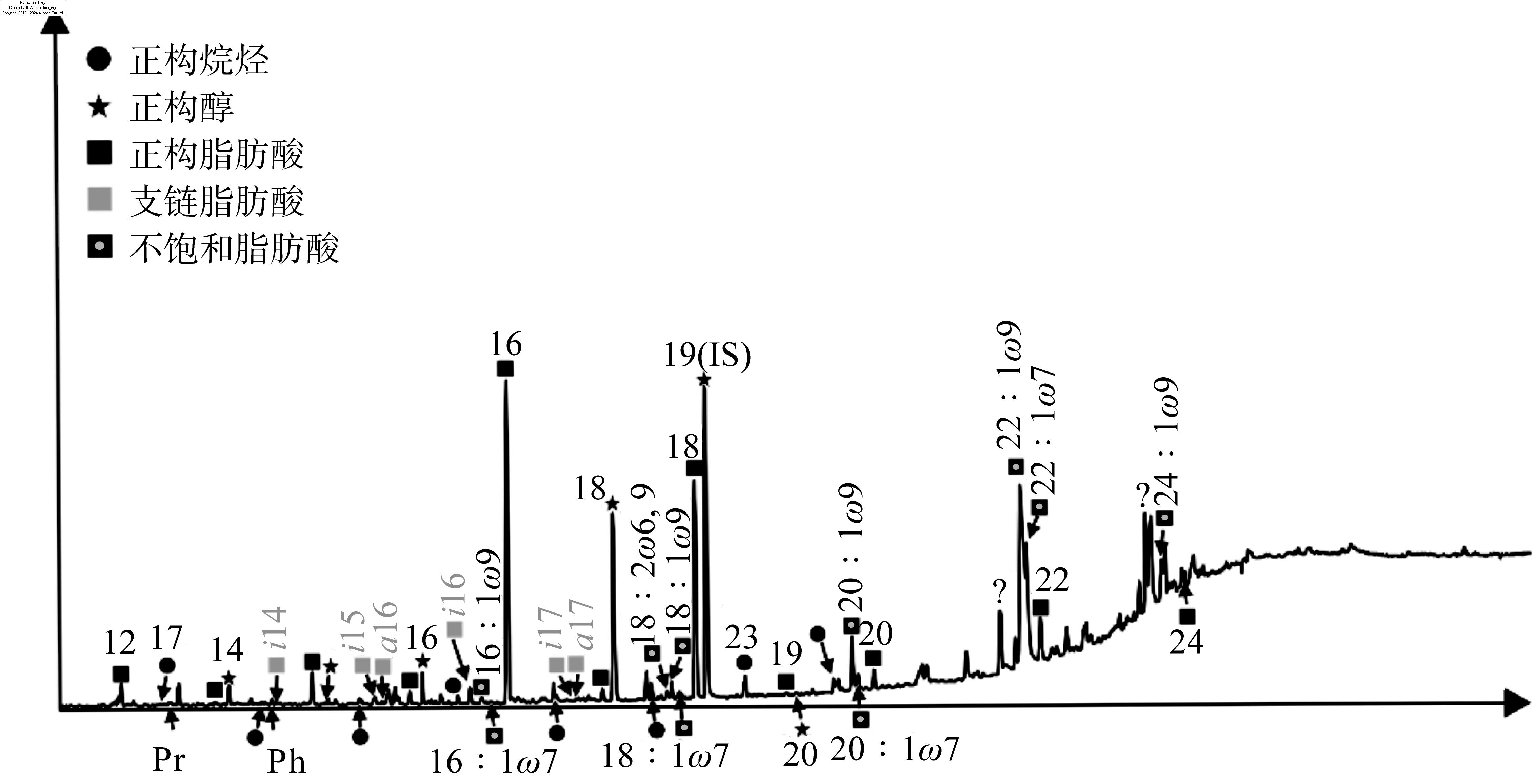
Fig. 3
Tab. 1
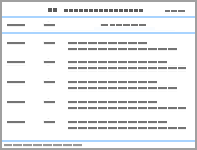
Pearson correlations (P < 0.01) among n-C14-18 FAs, n-C22:1 FAs, br-FAs and n-C14-18 alcohols"
| n-C22:1脂肪酸 | 支链脂肪酸 | n-C14~18脂肪醇 | |
|---|---|---|---|
| n-C14~18脂肪酸 | 0.798 | 0.673 | 0.655 |
| n-C22:1脂肪酸 | 0.443 | 0.612 | |
| 支链脂肪酸 | 0.419 |
Tab. 1
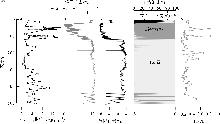
Fig. 4
Depth profiles of (a) average abundance of n-C14-18 FAs; (b) carbon isotopes; (c) oxygen isotopes; (d) mineral composition; (e) Pr/Ph ratio in Well NK-1"
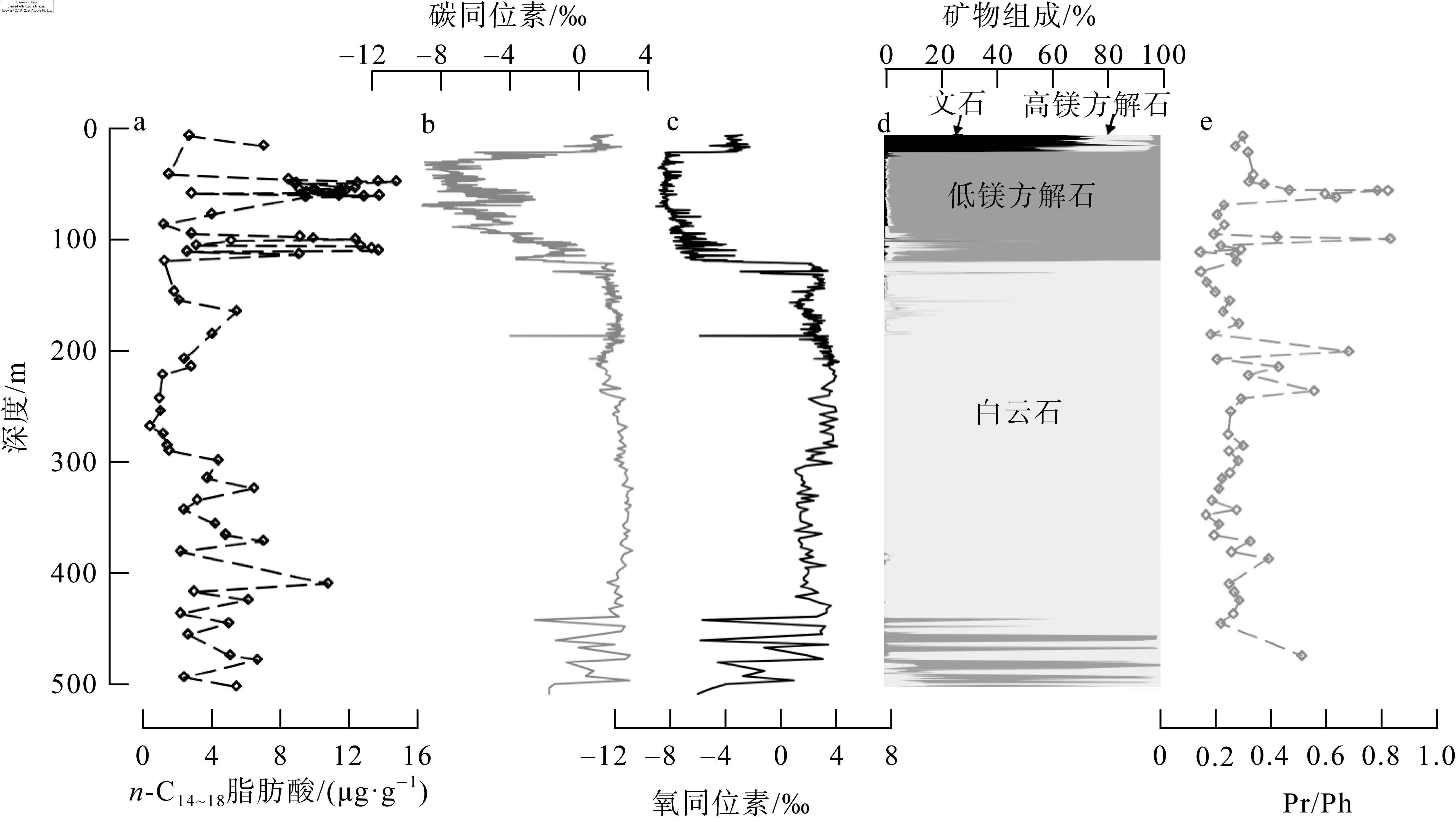
Fig. 4
Fig. 5
Stratigraphic logs of Well NK-1, showing formation, chronology, and lithology (adapted from Li et al, 2022) and sampling locations for lipid biomarker analysis"

Fig. 5
Fig. 6
Average fractional abundances of individual n-alkanes and contents of total n-alkanes in two divergent sample groups (normal group, n=111; abnormal group, n=14). Error bars indicate the standard deviations"
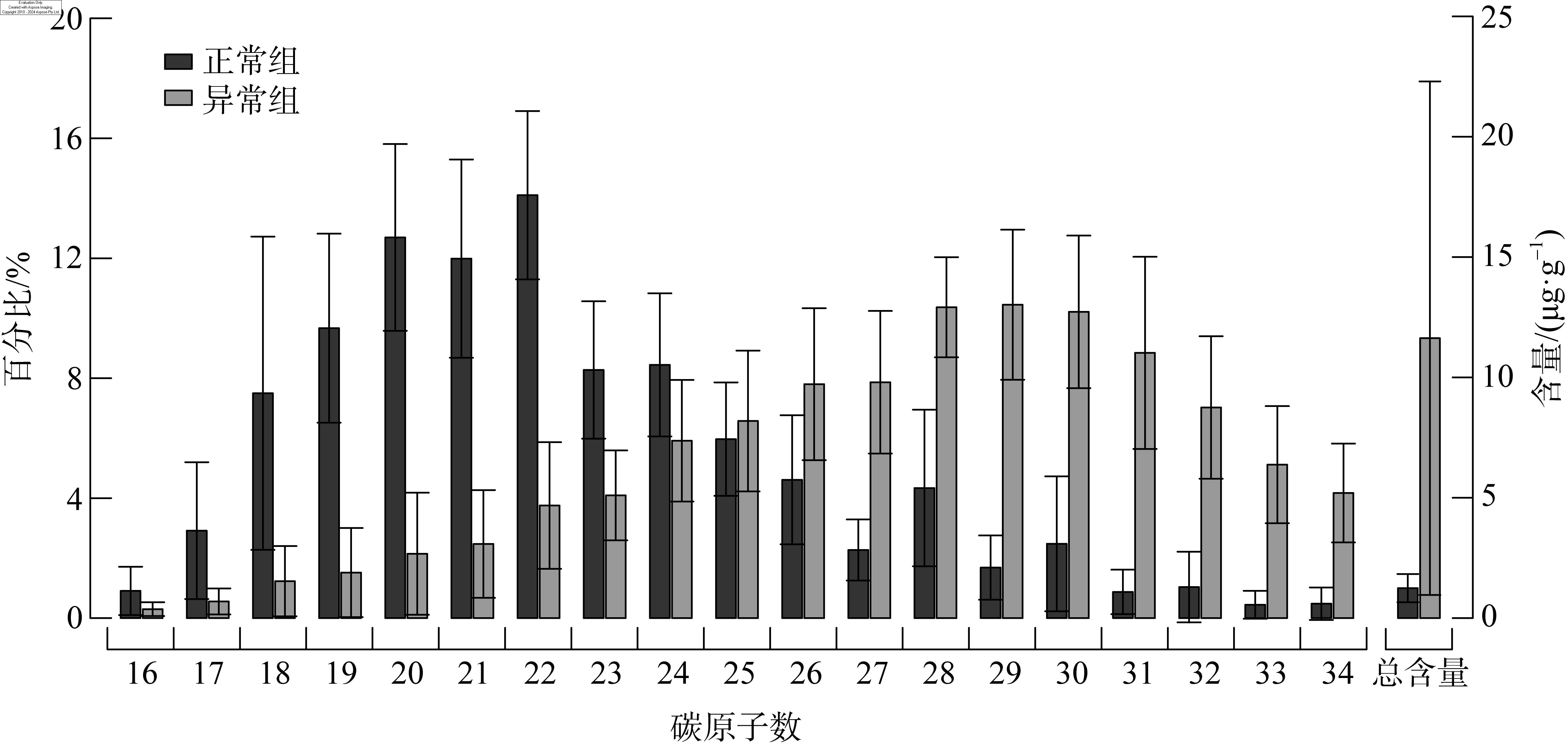
Fig. 6
Tab. 2
Biomarker parameters for the abnormal group samples located in the 45-65 m and 95-110 m intervals"
| 深度/m | n-烷烃 CPI | C31 | C32 | C29 | C30 | C31R/C30 | C26/C25 | G/H | |
|---|---|---|---|---|---|---|---|---|---|
| 22S/(22S+22R) | βα/αβ | ||||||||
| 47.19 | 0.82 | - | 0.46 | - | 0.24 | - | 2.27 | 0.28 | |
| 49.39 | 0.97 | 0.62 | 0.60 | 0.13 | 0.12 | 0.17 | 1.36 | 0.24 | |
| 52.51 | 1.02 | - | - | - | - | - | - | - | |
| 53.43 | 1.03 | 0.48 | 0.67 | - | 0.18 | 0.31 | 2.76 | 0.27 | |
| 54.83 | 1.01 | 0.48 | 0.58 | 0.15 | 0.16 | 0.31 | 2.45 | 0.38 | |
| 55.03 | 0.98 | 0.44 | 0.54 | 0.30 | 0.23 | 0.39 | 2.92 | 0.30 | |
| 55.23 | 1.06 | 0.75 | - | - | 0.19 | 0.15 | 2.04 | 0.43 | |
| 57.45 | 0.57 | 0.59 | 0.52 | - | 0.18 | 0.22 | 3.53 | 0.53 | |
| 58.15 | 0.95 | 0.58 | 0.55 | 0.16 | 0.12 | 0.17 | 2.54 | 0.21 | |
| 61.27 | 1.00 | - | 0.66 | 0.22 | 0.20 | - | 2.64 | 0.24 | |
| 97.11 | 1.02 | 0.64 | 0.56 | 0.09 | 0.20 | 0.16 | 2.62 | 0.29 | |
| 98.73 | 1.03 | 0.39 | 0.68 | 0.35 | 0.20 | 0.36 | 2.30 | 0.36 | |
| 105.15 | 0.99 | 0.56 | - | 0.10 | 0.14 | 0.20 | 1.13 | 0.19 | |
| 108.39 | 1.03 | 0.53 | 0.47 | 0.22 | 0.18 | 0.22 | 2.12 | 0.26 | |
Tab. 2

Fig. 7
Linear correlations of contents of n-C14-18 FAs with values of δ¹³C (a), δ18O (b) and Pr/Ph ratio (c) in Well NK-1 (Zhu et al, 2022)"
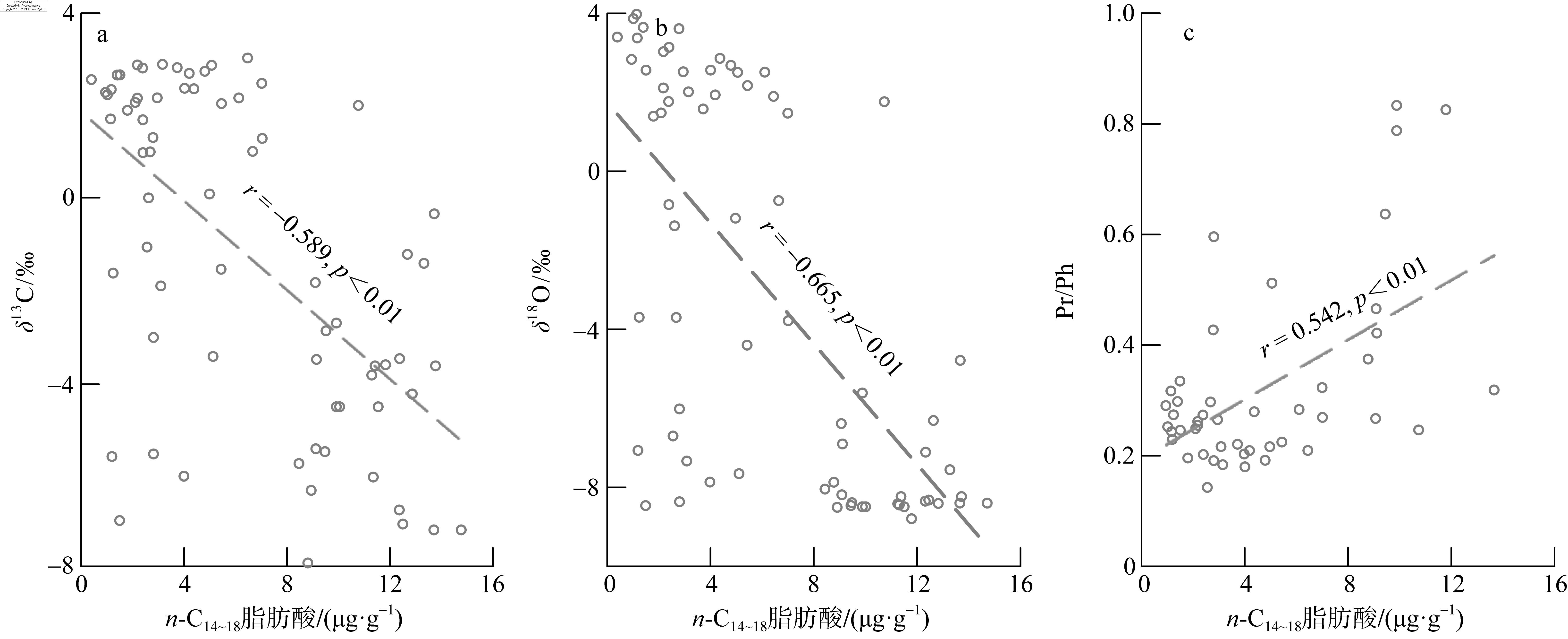
Fig. 7
Fig. 8
Schematic diagram of the formation of natural lipid biomarkers in corals"
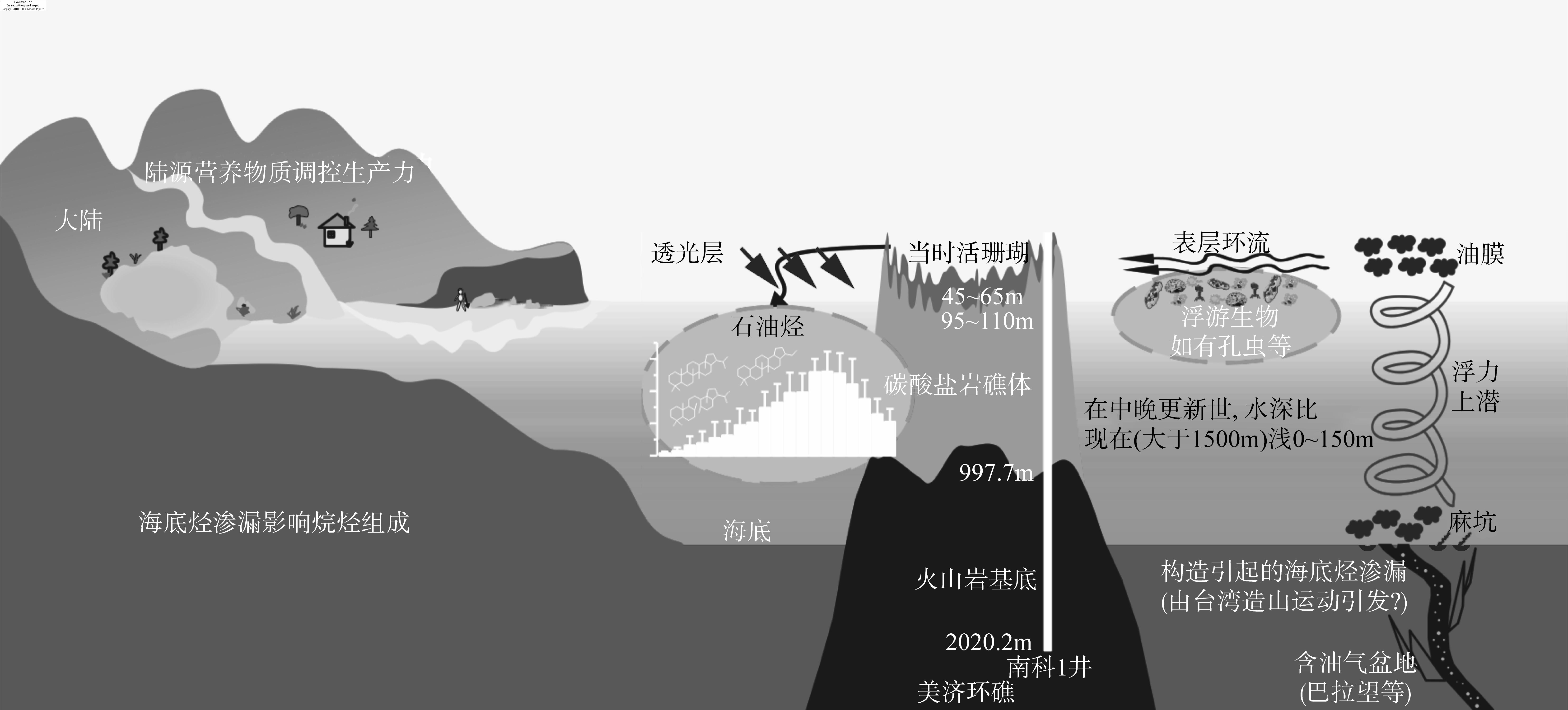
Fig. 8
Fig. 9
Average contents of br-FAs (a), and ratios of br-FAs to n-C14-18 FAs (b) in abnormal group and normal group samples"
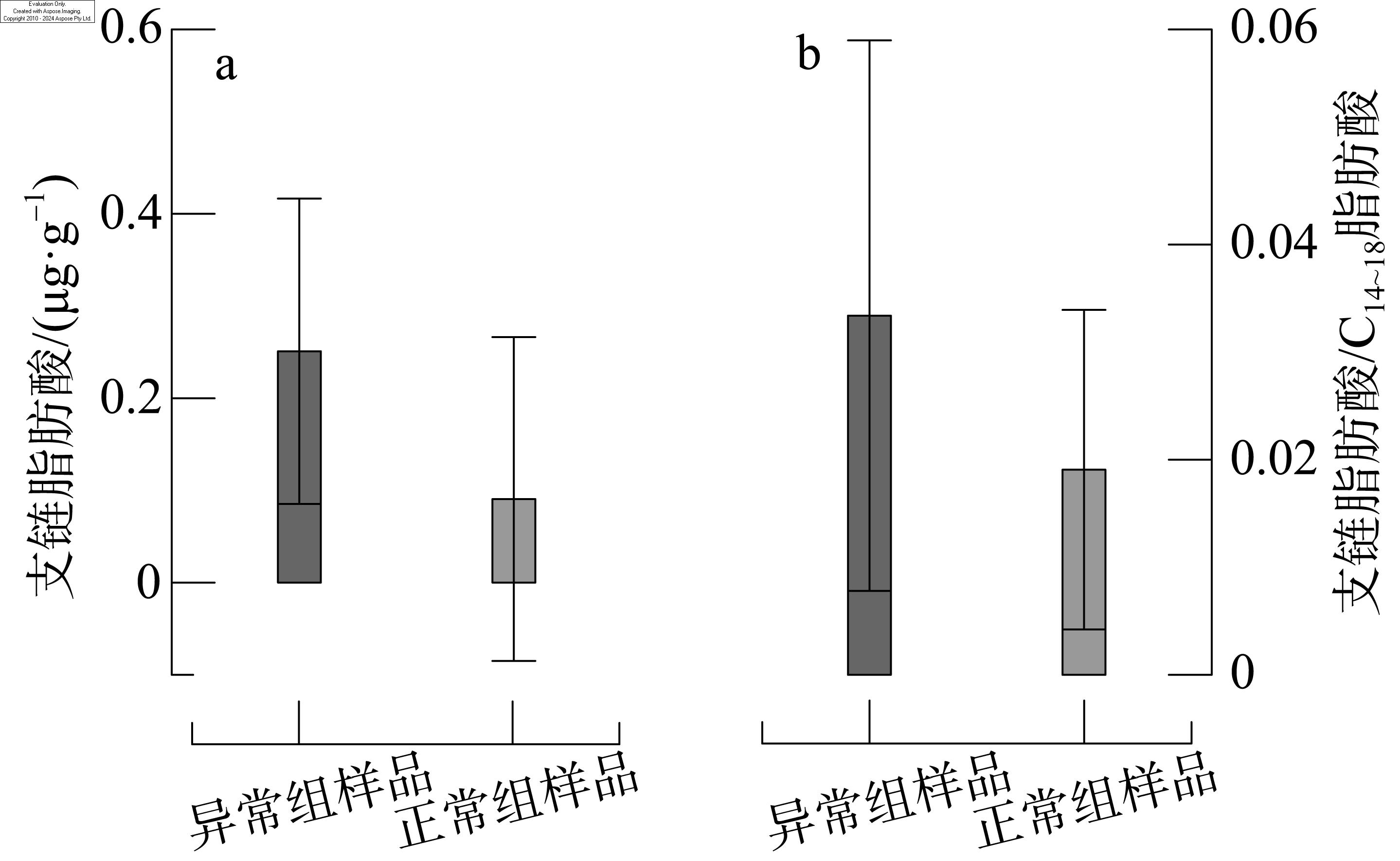
Fig. 9
| [1] |
陈史坚, 1982. 南沙群岛珊瑚礁地貌与沉积特征[J]. 海洋通报, 1(2): 41-52.
|
|
|
|
| [2] |
高婧茹, 朱小畏, 颜文, 2025. 脂类生物标志物在珊瑚研究中的应用[J]. 华东地质, 46(3): 339-355.
|
|
|
|
| [3] |
巩恩普, 李骁, 王立芙, 等, 2026. 黔南早二叠世窝托珊瑚礁的微相类型、发展演化及控制因素[J]. 沉积学报, 44(4): 1495-1506.
|
|
|
|
| [4] |
贾云霞, 王钊, 庞红丽, 2025. 南科1井的地球化学特征及其与陆源输入的关系[J]. 海洋地质前沿, 41(8): 13-23.
|
|
|
|
| [5] |
罗云, 黎刚, 徐维海, 等, 2022. 南科1井第四系暴露面特征及其与海平面变化的关系[J]. 热带海洋学报, 41(1): 143-157.
doi: 10.11978/2021013 |
|
doi: 10.11978/2021013 |
|
| [6] |
吕俏凤, 2012. 生物礁油气藏近源成藏模式及其对勘探的启示[J]. 海相油气地质, 17(1): 41-48.
|
|
|
|
| [7] |
王力, 王鑫, 蔡凯旋, 等, 2021. 生物礁油气分布特征及勘探前景[J]. 内蒙古石油化工, 47(7): 117-121.
|
|
|
|
| [8] |
吴时国, 朱伟林, 马永生, 2018. 南海半封闭边缘海碳酸盐台地兴衰史[J]. 海洋地质与第四纪地质, 38(6): 1-17.
|
|
|
|
| [9] |
臧明思, 王佳宝, 宋宜, 等, 2025. 珊瑚脂类生物标志物组成及对环境的响应: 研究进展与问题[J]. 地球环境学报, 16(4): 416-427.
|
|
|
|
| [10] |
张田升, 吴自银, 赵荻能, 等, 2019. 南海礼乐盆地海底麻坑地貌及成因分析[J]. 海洋学报, 41(3): 106-120.
|
|
|
|
| [11] |
朱照宇, 谢久兵, 郑王琼, 等, 2006. 南海北缘早-中更新世之交新构造活动及其区域对比[J]. 第四纪研究, 26(1): 70-76.
|
|
|
|
| [12] |
doi: 10.1016/j.marpetgeo.2017.02.031 |
| [13] |
doi: 10.1016/j.marpolbul.2012.08.029 pmid: 23014479 |
| [14] |
doi: 10.1190/1.1599690 |
| [15] |
doi: 10.1016/j.orggeochem.2006.05.003 |
| [16] |
doi: 10.1016/j.palaeo.2018.10.007 |
| [17] |
doi: 10.3354/meps296291 |
| [18] |
|
| [19] |
doi: 10.1146/earth.2022.50.issue-1 |
| [20] |
pmid: 14601414 |
| [21] |
doi: 10.1016/j.tecto.2012.09.026 |
| [22] |
doi: 10.1126/science.abm5940 pmid: 35709269 |
| [23] |
doi: 10.3389/feart.2021.643864 |
| [24] |
doi: 10.1016/j.sedgeo.2013.04.003 |
| [25] |
|
| [26] |
doi: 10.1016/j.sedgeo.2005.01.009 |
| [27] |
doi: 10.1016/0146-6380(90)90116-H |
| [28] |
doi: 10.1016/j.marchem.2003.08.005 |
| [29] |
|
| [30] |
doi: 10.1038/344648a0 |
| [31] |
doi: 10.1016/0016-7037(87)90322-X |
| [32] |
doi: 10.1038/nature04565 |
| [33] |
doi: 10.1016/j.scitotenv.2018.07.159 |
| [34] |
doi: 10.1016/j.margeo.2021.106513 |
| [35] |
doi: 10.1007/s12526-020-01057-9 |
| [36] |
doi: 10.1016/j.jhazmat.2019.121299 |
| [37] |
doi: 10.1016/j.orggeochem.2011.01.010 |
| [38] |
|
| [39] |
doi: 10.2110/palo.2010.p10-032r |
| [40] |
doi: 10.1016/j.orggeochem.2014.08.006 |
| [41] |
doi: 10.1016/S0016-7037(02)00864-5 |
| [42] |
doi: 10.1016/j.epsl.2004.05.012 |
| [43] |
doi: 10.1029/94TC02452 |
| [44] |
doi: 10.1126/science.aan8048 pmid: 29302011 |
| [45] |
doi: 10.1007/s00338-011-0817-4 |
| [46] |
doi: 10.1016/S0016-7037(03)00079-6 |
| [47] |
doi: 10.1016/0146-6380(90)90079-F |
| [48] |
doi: 10.1016/j.orggeochem.2019.103906 |
| [49] |
doi: 10.1016/j.rgg.2015.06.011 |
| [50] |
doi: 10.1130/B36365.1 |
| [51] |
doi: 10.1016/j.quascirev.2008.02.007 |
| [52] |
doi: 10.1016/S0743-9547(97)00049-4 |
| [53] |
doi: 10.1016/j.palaeo.2022.110957 |
| [54] |
doi: 10.1007/s13146-019-00515-1 |
| [55] |
doi: 10.1016/j.marpetgeo.2013.01.004 |
| [56] |
doi: 10.1016/j.sedgeo.2021.105933 |
| [57] |
doi: 10.1016/j.earscirev.2018.05.003 |
| [58] |
doi: 10.1016/S0304-4203(97)00010-8 |
| [59] |
doi: 10.5194/bg-11-123-2014 |
| [60] |
National Research Council, 2003. Oil in the sea Ⅲ: inputs, fates, and effects[M]. Washington, DC: The National Academies Press.
|
| [61] |
|
| [62] |
doi: 10.1016/j.scitotenv.2020.137486 |
| [63] |
doi: 10.1016/j.orggeochem.2012.03.002 |
| [64] |
doi: 10.1038/s41586-025-09439-4 |
| [65] |
doi: 10.1016/0025-326X(81)90106-5 |
| [66] |
|
| [67] |
|
| [68] |
doi: 10.1016/j.margeo.2016.04.009 |
| [69] |
doi: 10.1016/j.geomorph.2014.03.004 |
| [70] |
doi: 10.1371/journal.pone.0222327 |
| [71] |
doi: 10.1016/0079-1946(79)90107-1 |
| [72] |
doi: 10.1016/0146-6380(84)90085-8 |
| [73] |
doi: 10.1016/j.palaeo.2017.07.006 |
| [74] |
doi: 10.1016/j.margeo.2017.01.009 |
| [75] |
doi: 10.1016/j.palaeo.2024.112093 |
| [76] |
doi: 10.1016/j.quascirev.2025.109654 |
| [77] |
doi: 10.1016/j.marpetgeo.2015.05.030 |
| [78] |
doi: S0025-326X(17)30357-0 pmid: 28502453 |
| [79] |
doi: 10.1016/j.margeo.2010.10.007 |
| [80] |
|
| [81] |
|
| [82] |
|
| [83] |
doi: 10.1016/j.apgeochem.2010.07.002 |
| [84] |
doi: 10.1016/j.marpetgeo.2018.02.016 |
| [85] |
|
| [86] |
|
| [87] |
doi: 10.1016/j.palaeo.2018.10.013 |
| [88] |
doi: 10.1016/j.palaeo.2023.111912 |
| [89] |
|
| [90] |
doi: 10.1016/j.scib.2020.08.014 pmid: 36654321 |
| [91] |
doi: 10.1007/s11430-014-5044-8 |
| [92] |
|
| [93] |
doi: 10.1007/s10661-013-3107-5 pmid: 23355025 |
| [94] |
doi: 10.1002/ece3.7247 pmid: 33841770 |
| [95] |
doi: 10.1016/j.margeo.2018.12.006 |
| [96] |
doi: 10.3389/feart.2021.759317 |
| [97] |
doi: 10.1016/j.palaeo.2022.110898 |
| [98] |
doi: 10.1016/j.jseaes.2018.11.009 |
| [99] |
doi: 10.1016/j.jseaes.2013.12.011 |
| [1] | LI Gang, XU Weihai, LUO Yun, LIU Jianguo, ZHAO Jianxin, FENG Yuexing, CHENG Jun, SUN Zhen, XIANG Rong, XU Min, YAN Wen. The Cenozoic tectonic evolution of the southern South China Sea: stratigraphic evidence from a deep borehole in Meiji Atoll [J]. Journal of Tropical Oceanography, 2026, 45(5): 16-34. |
| [2] | HUANG Kangjun, ZHANG Pan, FENG Dong, YAN Wen. Controlling factors and implications of magnesium isotopic compositions of marine carbonates* [J]. Journal of Tropical Oceanography, 2026, 45(5): 146-161. |
| [3] | LUO Yun, LI Gang, ZHANG Xiyang, XU Weihai, ZHU Xiaowei, ZHOU Wanqiu, HUANG Huiwen, ZHONG Fuchang, YAN Wen. Differential dolomitization process of coral reefs in the South China Sea: a case study based on a deep borehole in Meiji Atoll [J]. Journal of Tropical Oceanography, 2026, 45(5): 108-127. |
| [4] | LI Ruoan, LI Xuqing, CHEN Tianran. Graded responses of coral skeletal δ18O and Sr/Ca to ENSO in the southern South China Sea [J]. Journal of Tropical Oceanography, 2025, 44(4): 45-55. |
| [5] | Xiuli LIAO, Ming DAI, Xiuyu GONG, Huaxue LIU, Honghui HUANG. Subsurface chlorophyll a maximum and its possible causes in the southern South China Sea* [J]. Journal of Tropical Oceanography, 2018, 37(1): 45-56. |
| [6] | YI Rong, KE Zhi-xin, SONG Xing-yu, SHEN Ping-ping, WANG Sheng-fu, FAN Yan-zhi, HUANG Liang-min, TAN Ye-hui, LI Gang. Comparisons of surface Chl a and primary productivity along three transects of the southern South China Sea, northern Java Sea and eastern Indian Ocean in April 2011* [J]. Journal of Tropical Oceanography, 2014, 33(6): 61-67. |
| [7] | ZHOU Peng,LI Dong-mei,LIU Guang-shan,MEN Wu,JI Li-hong. Biogenic silica in surface sediments of the northeastern and southern South China Sea [J]. Journal of Tropical Oceanography, 2010, 29(4): 40-47. |
| [8] |
, . null [J]. Journal of Tropical Oceanography, 2009, 28(3): 45-53. |
| [9] | XIANG Rong,CHEN Mu-hong,CHENG Xin-rong, ZHANG Lan-lan, LU Jun,Liu Jian-guo,CHEN Zhong. [J]. Journal of Tropical Oceanography, 2009, 28(3): 59-66. |
|
||