

Journal of Tropical Oceanography ›› 2026, Vol. 45 ›› Issue (5): 35-52.doi: 10.11978/2026024CSTR: 32234.14.2026024
Previous Articles Next Articles
Mesozoic magmatism in the Nansha Block: implications for the tectonic affinity of southern continental margin of the South China Sea and the opening mechanism of the Proto-South China Sea*
MIAO Xiuquan1,2( ), ZHANG Yunying1,2(), YAN Wen1,2,3
- 1
State Key Laboratory of Tropical Oceanography ,South China Sea Institute of Oceanology, Chinese Academy of Sciences
2Laboratory of Marginal Sea and Ocean Geology ,South China Sea Institute of Oceanography, Chinese Academy of Sciences
3University of Chinese Academy of Sciences
-
Received:2026-01-30Revised:2026-03-14Online:2026-09-10Published:2026-10-13 -
Contact:ZHANG Yunying. email:zhangyunying@scsio.ac.cn -
Supported by:National Key Research and Development Program of China(2021YFC3100600); National Key Research and Development Program of China(2024YFF0808200); National Natural Science Foundation of China(42541603); National Natural Science Foundation of China(42506052); National Natural Science Foundation of China(42372080)

CLC Number:
- P736.121
Cite this article
MIAO Xiuquan, ZHANG Yunying, YAN Wen. Mesozoic magmatism in the Nansha Block: implications for the tectonic affinity of southern continental margin of the South China Sea and the opening mechanism of the Proto-South China Sea*[J].Journal of Tropical Oceanography, 2026, 45(5): 35-52.
share this article
Add to citation manager EndNote|Reference Manager|ProCite|BibTeX|RefWorks
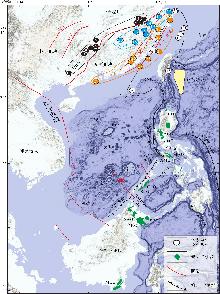
Fig. 1
Distribution of Mesozoic magmatic rocks in the South China Block and simplified tectonic outline of the South China Sea (modified after Miao, 2021). QHB (Qinhang Belt; 185—169 Ma), ZDB (Zhenghe-Dapu Belt; 254—215 Ma), CB (Coastal Belt; 141—116 Ma), DYB (Dongsha-Talun-Yandong Belt; 200—177 Ma); Anhua-Luocheng Fault (ALF), Cili-Baojing Fault (CBF). Ophiolitic complexes include Central Palawan Ophiolite (CPO; Gibaga et al, 2020), Southern Palawan Ophiolite (SPO), Antique Ophiolite (ANO), Darvel Bay Ophiolite (DBO), Amnay Ophiolite (AMO), Ilocos Ophiolite (ILO), Mangyan Ophiolite (MAO), Acoje Ophiolite (ACO), Coto Ophiolite (COO), Segama Ophiolite (SEO), Meratus Ophiolite (MEO), and Sabah Ophiolite (SAO). Geochronological data for the Mesozoic magmatic rocks (circles) and ophiolitic complexes (green areas) are from Miao (2021) and references therein"
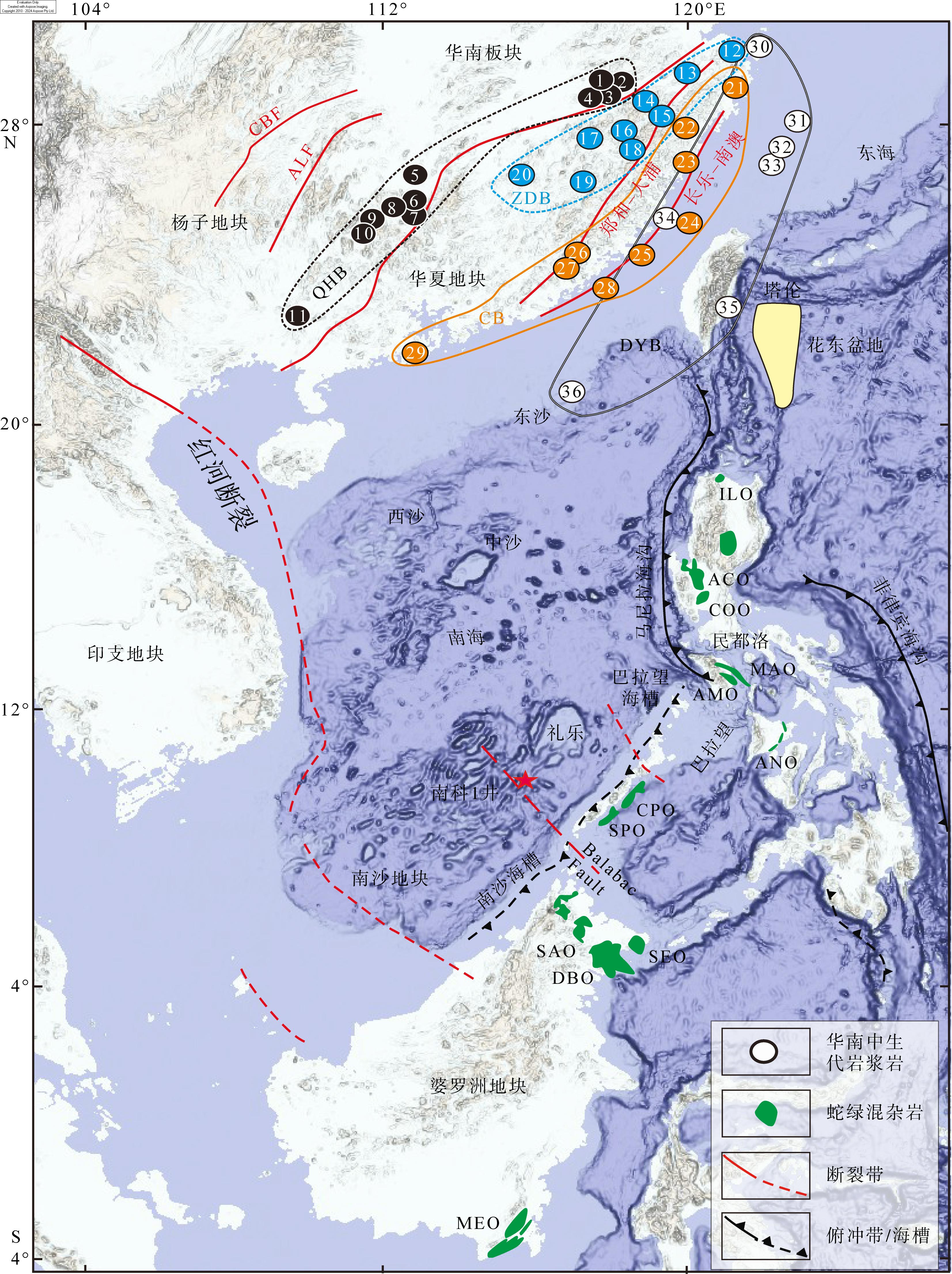
Fig. 1
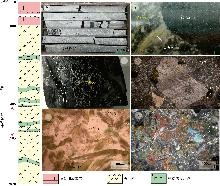
Fig. 2
Lithological column and representative core photographs of Well Nanke-1. (a) Lithological sequence penetrated by Well Nanke-1; (b) representative photographs of the drilled cores; (c) dacites intruded by quartz vein, which was subsequently cut by a later mafic dyke; (d) dacites intruded by later mafic dyke; (e) photomicrograph of dacite; (f) photomicrograph of gabbro-diorite; (g) photomicrograph of diabase. The white solid line in (d) represents a mafic vein"

Fig. 2
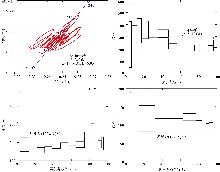
Fig. 3
Geochronological results for the igneous rocks from Well Nanke-1. (a) Zircon U-Pb concordia diagram for dacite; (b) 40Ar/39Ar plateau age spectra for dacite; (c) 40Ar/39Ar plateau age spectra for diorite; (d) 40Ar/39Ar plateau age spectra for diabase. In (a), n represents the number of zircon analysis spots, MSWD represents mean square of weighted deviates, and the red curve represents the age determination result for an individual zircon"
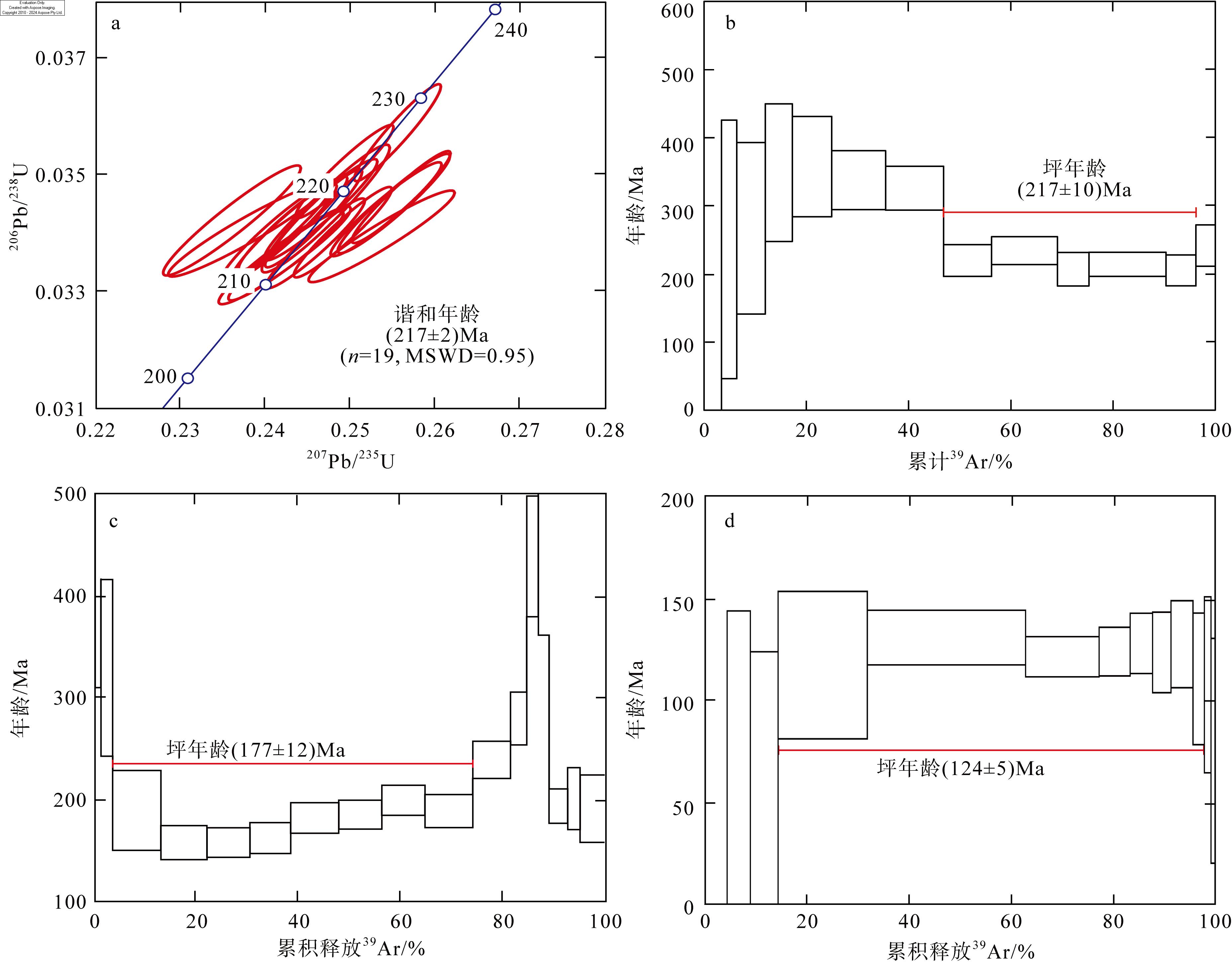
Fig. 3
Fig. 4
Geochemical characteristics of major and trace elements of the igneous rocks from Well Nanke-1. (a) Total Alkali-Silica (TAS) classification diagram (modified after Le Maitre, 1989); (b) SiO2 vs. K2O magmatic series classification diagram; (c-f) diagrams of chondrite-normalized REE patterns, and PM or N-MORB normalized trace-element variations for dacite, diorite, and diabase samples from Well Nanke-1. Data for ophiolites and mafic intrusions, regarded as remnants of oceanic crust of the PSCS in (a), are from Omang et al (1996), Tamayo et al (2001), Hickey-Vargas et al (2008), and Gibaga et al (2020). The solid black lines in (b) distinguish the tholeiitic, calc-alkaline, and high-K calc-alkaline series of magmas. Normalization values in (c-f) were taken from Sun et al (1989). In (c) and (d), upper continental crust (UCC) and lower continental crust (LCC) data are from Rudnick et al (2003), continental arc basalt (CAB) data are for Mexico and Cascades (Schmidt et al, 2017), and BABB data for Okinawa Trough and Japan basalts are from Hoang et al (2006), Hirahara et al (2015) and Miao et al (2021b)"
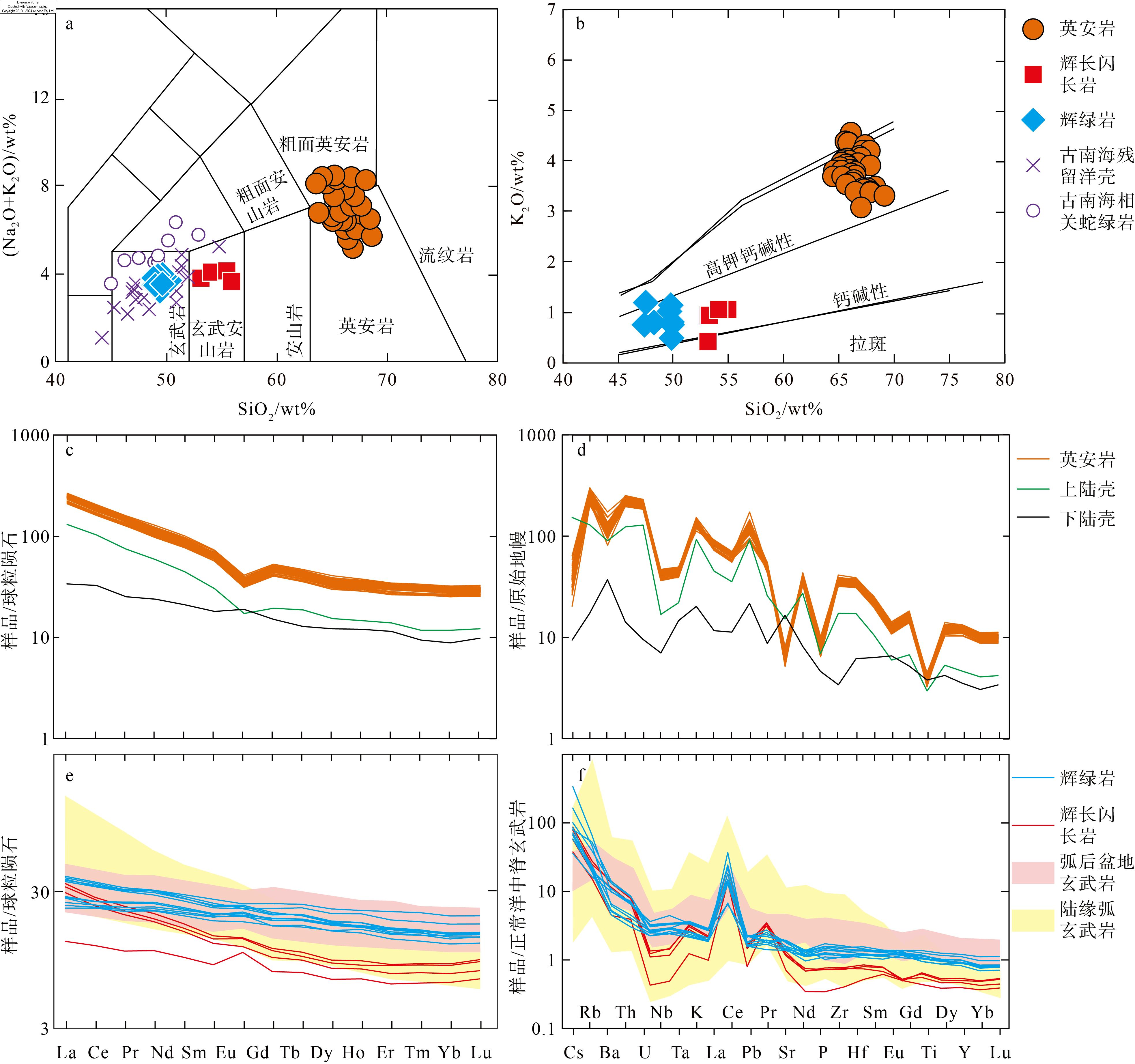
Fig. 4
Fig. 5
Diagrams of Sr-Nd-Hf isotopic compositions for igneous rocks from Well Nanke-1. (a) Sr-Nd isotopic diagram for dacites; (b) Nd-Hf isotopic diagram for dacites; (c) Sr-Nd isotopic diagram for diorites and diabases; (d) Nd-Hf isotopic diagram for diorites and diabases. Data for Triassic A-type granites in the SCB are from Wang et al (2005), Sun et al (2011), and Zhao et al (2013). In (a), (c), and (d), the Sr-Nd-Hf isotopic data of depleted mantle (DM), altered oceanic crust (AOC), global subducting sediments (GLOSS), pelagic sediments, and continental margin sediments are from Miao et al (2021a, 2021b). In (c), gray, orange, and green circles represent DM (depleted mantle), AOC (altered oceanic crust), and GLOSS (global subducting sediments), respectively. BABB denotes back-arc basin basalt. QHB represents the Qin-Hang Belt (185-169 Ma; black dashed line), ZDB represents the Zhenghe-Dapu Belt (254-215 Ma; gray dashed line), and DYB represents the Dongsha-Talun-Yandang Belt (200-177 Ma; purple dashed line). In (c) and (d), the green solid line, green crosses, black solid line, black dots, orange curve, and orange short lines, together with the internal numerical values, represent Sr-Nd and Nd-Hf isotopic mixing model results among the AOC, GLOSS, and DM end-members"

Fig. 5
Fig. 6
Geochemical discrimination diagrams for dacites from Well Nanke-1. (a) (FeOT/MgO) vs (Zr + Nb + Ce + Y) (modified after Whalen et al, 1987); (b) Nb vs 10000 × Ga/Al (modified after Whalen et al, 1987); (c) Zircon saturation temperatures (TZr) for dacites from Well Nanke-1 and Triassic-Jurassic A- and I-type granites in the SCB (modified after Miao, 2021); (d) Ce/Nb vs Y/Nb (modified after Eby, 1992)"
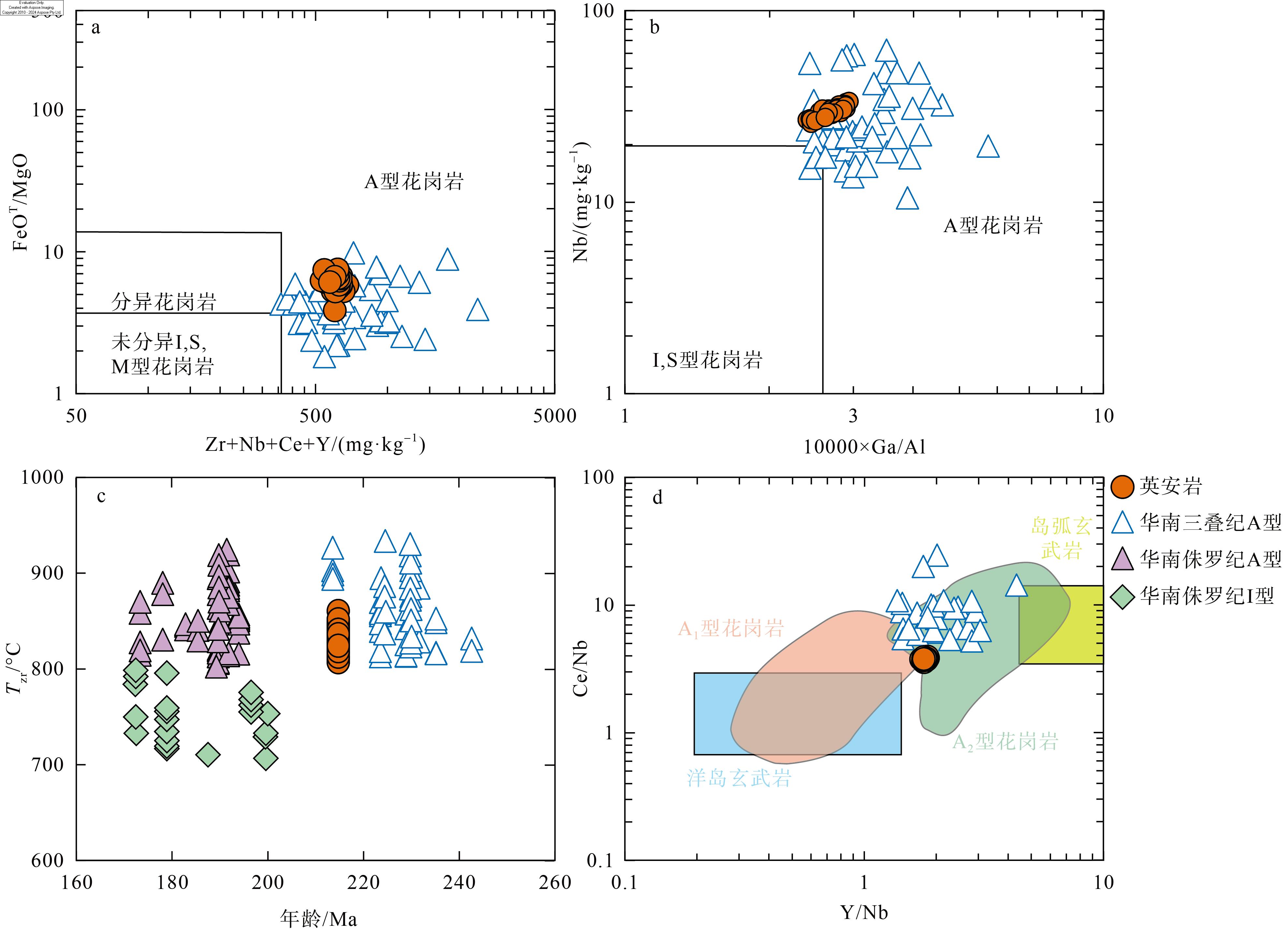
Fig. 6
Fig.7
Geochemical plots of diorite and diabase samples from Well Nanke-1. (a) εNd(t) vs Th/Nb; (b) εNd(t) vs Nd/Hf; (c)εNd(t) vs Sr/Nd; (d) La/Nb vs Y; (e) TiO2 vs FeOT/MgO (modified after Shuto et al, 2006); (f) Th/Yb vs Ta/Yb (modified after Pearce et al, 2005). The dashed arrows in (b) and (c) indicate the metasomatic trends induced by subducted sediment-derived melts and fluids, respectively. In (f), deviations from the MORB array are shown for different contributions (30%, 75%, and 90%) of subduction-mobile elements to the mantle source (Pearce et al, 2005). Arc-related mafic rocks are Mexico and Cascades continental arc basalts (Schmidt et al, 2017). Mafic rocks associated with the rifting and spreading stages of a back-arc basin are represented by the Caribbean and Mariana BABBs (Pearce et al, 2005; Escuder Viruete et al, 2008). Data for Okinawa and Mariana basalts, as indicated by the arrows in (c), are from Gribble et al (1996, 1998), Shinjo et al (1999), and Schmidt et al (2017)"

Fig.7
Fig. 8
Triassic-Cretaceous paleogeographic reconstructions of Southeast Asia and tectonic model of the southern continental margin of South China Sea. (a) Triassic configuration showing the Nansha Block situated along the margin of the South China Block (SCB), with westward slab-subduction of the Paleo-Pacific plate; (b) schematic cross-section illustrating the tectonic setting along A-A′ in (a); (c) Jurassic paleogeography in which the Nansha Block remained attached to the SCB and was still influenced by the subduction of the Paleo-Pacific plate; (d) schematic cross-section corresponding to line B-B′ in (c); (e) Early Cretaceous configuration, showing the PSCS as a back-arc basin related to the rollback of the subducting Paleo-Pacific plate, with the Palawan Block drifting with the opening of the Proto-South China Sea; (f) schematic model of cross-section C-C' in (e). In (a), (c), and (e), the pentagrams represent the three phases of Mesozoic magmatic rocks from Well Nanke-1. The dashed yellow areas in (b), (d), and (f) represent an unknown block. Abbreviations in (a), (c), and (e): Mindoro Block (MB); Nansha Block (NS); Palawan Block (PB); Reed Bank (R); Zhenghe-Dabu Fault (ZDF); Chenzhou-Linwu Fault (CLF)"
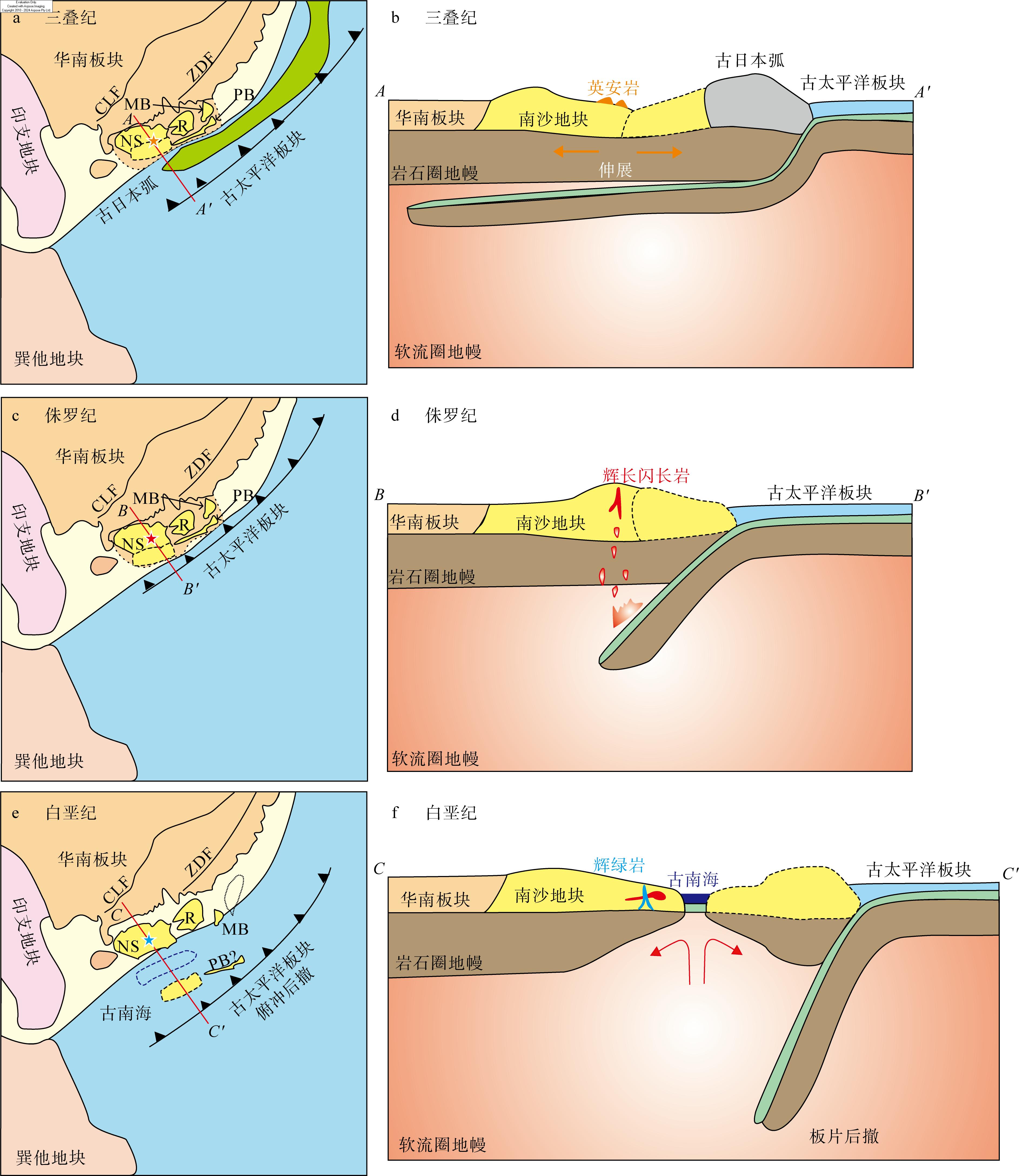
Fig. 8
| [1] |
刘海龄, 2002. 南沙地块断裂构造系统与岩石圈动力学研究[M]. 北京: 科学出版社.
|
|
|
|
| [2] |
苗秀全, 2021. 南沙“南科1井”岩浆岩成因机制与南海南部陆缘中生代构造演化[D]. 广州: 中国科学院大学(中国科学院广州地球化学研究所).
|
|
|
|
| [3] |
孙卫东, 林秋婷, 张丽鹏, 等, 2018. 跳出南海看南海: 新特提斯洋闭合与南海的形成演化[J]. 岩石学报, 34(12): 3467-3478.
|
|
|
|
| [4] |
孙珍, 赵中贤, 李家彪, 等, 2011. 南沙地块内破裂不整合与碰撞不整合的构造分析[J]. 地球物理学报, 54(12): 3196-3209.
|
|
|
|
| [5] |
鄢全树, 石学法, 王昆山, 等, 2008. 南沙微地块花岗质岩石LA-ICP-MS锆石U-Pb定年及其地质意义[J]. 地质学报, 82(8): 1057-1067.
|
|
|
|
| [6] |
姚伯初, 曾维军, 陈艺中, 等, 1994. 南海北部陆缘东部的地壳结构[J]. 地球物理学报, 37(1): 27-35.
|
|
|
|
| [7] |
周蒂, 陈汉宗, 孙珍, 等, 2005. 南海中生代三期海盆及其与特提斯和古太平洋的关系[J]. 热带海洋学报, 24(2): 16-25.
|
|
|
|
| [8] |
朱奕先, 2019. 基于南海重磁震剖面的地质-地球物理研究[D]. 长春: 吉林大学.
|
|
|
|
| [9] |
doi: 10.1016/S1367-9120(99)00050-4 |
| [10] |
|
| [11] |
doi: 10.1016/S0012-821X(01)00379-X |
| [12] |
|
| [13] |
doi: 10.1016/S0012-821X(00)00136-9 |
| [14] |
doi: 10.1130/0091-7613(1992)020<0641:CSOTAT>2.3.CO;2 |
| [15] |
|
| [16] |
doi: 10.1016/j.gr.2020.10.006 |
| [17] |
|
| [18] |
doi: 10.1029/TC008i005p00963 |
| [19] |
|
| [20] |
doi: 10.1016/j.jseaes.2008.10.003 |
| [21] |
doi: 10.1016/j.earscirev.2017.07.016 |
| [22] |
doi: 10.1016/j.earscirev.2018.06.016 |
| [23] |
doi: 10.1016/j.jaesx.2020.100038 |
| [24] |
doi: 10.1016/0016-7037(96)00078-6 |
| [25] |
doi: 10.1093/petroj/39.1.125 |
| [26] |
doi: 10.1016/S1367-9120(01)00069-4 |
| [27] |
doi: 10.1016/j.tecto.2011.12.004 |
| [28] |
doi: 10.1093/petrology/egm013 |
| [29] |
doi: 10.1016/j.epsl.2005.06.017 |
| [30] |
doi: 10.1016/j.epsl.2008.01.003 |
| [31] |
doi: 10.1002/ggge.v16.5 |
| [32] |
doi: 10.1016/j.epsl.2006.07.021 |
| [33] |
doi: 10.1306/03B5A7A5-16D1-11D7-8645000102C1865D |
| [34] |
|
| [35] |
doi: 10.1093/petroj/38.3.371 |
| [36] |
doi: 10.1111/iar.2017.26.issue-1 |
| [37] |
|
| [38] |
doi: 10.1002/ggge.v15.12 |
| [39] |
doi: 10.1029/2017JB014861 |
| [40] |
doi: 10.1016/j.earscirev.2021.103647 |
| [41] |
doi: 10.1086/501222 |
| [42] |
doi: 10.1130/G23193A.1 |
| [43] |
doi: 10.1016/j.gr.2017.11.002 |
| [44] |
doi: 10.1016/0009-2541(94)00140-4 |
| [45] |
|
| [46] |
|
| [47] |
|
| [48] |
doi: 10.1016/S0040-1951(02)00061-6 |
| [49] |
doi: 10.1144/GSL.SP.1996.106.01.17 |
| [50] |
|
| [51] |
doi: 10.1016/S0009-2541(97)00150-2 |
| [52] |
doi: 10.1016/S0012-821X(97)00107-6 |
| [53] |
|
| [54] |
doi: 10.1002/ggge.v18.8 |
| [55] |
doi: 10.1016/j.margeo.2017.08.002 |
| [56] |
|
| [57] |
doi: 10.1007/BF03183537 |
| [58] |
|
| [59] |
doi: 10.1016/j.lithos.2005.06.001 |
| [60] |
doi: 10.1016/0012-821X(77)90060-7 |
| [61] |
doi: 10.1144/GSL.SP.1989.042.01.19 |
| [62] |
doi: 10.1016/j.jseaes.2012.11.020 |
| [63] |
doi: 10.1016/j.jseaes.2011.06.007 |
| [64] |
doi: 10.1093/nsr/nwz116 |
| [65] |
|
| [66] |
doi: 10.1111/rge.2001.51.issue-2 |
| [67] |
|
| [68] |
|
| [69] |
doi: 10.1130/G21639.1 |
| [70] |
doi: 10.1016/j.lithos.2008.01.003 |
| [71] |
doi: 10.1002/jgrb.v122.4 |
| [72] |
doi: 10.1016/j.epsl.2004.11.023 |
| [73] |
doi: 10.1007/BF00402202 |
| [74] |
doi: 10.1016/S0012-821X(01)00453-8 |
| [75] |
doi: 10.1007/s12583-017-0813-x |
| [76] |
doi: 10.1002/2016TC004446 |
| [77] |
doi: 10.1016/j.jseaes.2014.02.005 |
| [78] |
doi: 10.1016/j.earscirev.2018.09.013 |
| [79] |
doi: 10.1080/00206814.2016.1261259 |
| [80] |
doi: 10.1016/j.jaesx.2020.100031 |
| [81] |
doi: 10.5194/se-5-227-2014 |
| [82] |
doi: 10.5575/geosoc.107.316 |
| [83] |
|
| [84] |
doi: 10.1111/iar.2008.17.issue-2 |
| [85] |
|
| [86] |
doi: 10.1016/S0040-1951(00)00120-7 |
| [87] |
|
| [1] | WANG Chan, LIU Hao, XU Weihai. Triassic subduction of the Paleo-Pacific: magmatic records from the southern continental margin of the South China Sea* [J]. Journal of Tropical Oceanography, 2026, 45(5): 53-79. |
| [2] | ZHAO Peng, SHI Xiaobin, LIU Lu, SHEN Yongqiang, REN Ziqiang. Erosion characteristics of the Paleogene top strata in the Nanxiong Basin, southern margin of the South China Block and its tectonic significance [J]. Journal of Tropical Oceanography, 2025, 44(5): 125-139. |
| [3] | LUO Yun, LI Gang, XU Weihai, CHENG Jun, LIU Jianguo, YAN Wen. Characteristics of Quaternary exposure surfaces in Well Nanke-1 and their relationship with sea-level changes [J]. Journal of Tropical Oceanography, 2022, 41(1): 143-157. |
|
||