

Journal of Tropical Oceanography ›› 2026, Vol. 45 ›› Issue (5): 128-145.doi: 10.11978/2026040CSTR: 32234.14.2026040
Previous Articles Next Articles
The formation of atolls: new insights from numerical simulations
LIU Jinlong1,2( ), Jody Webster3, Tristan Salles3, WANG Shuhong1,2, MA Yikai4, XU Weihai1,2, LI Gang1,2, YAN Wen1,2,5()
- 1
State Key Laboratory of Tropical Oceanography ,South China Sea Institute of Oceanology, Chinese Academy of Sciences
2Laboratory of Ocean and Marginal Sea Geology ,South China Sea Institute of Oceanology, Chinese Academy of Sciences
3School of Geosciences ,the University of Sydney
4South China Sea Standards and Metrology Center ,State Oceanic Administration
5University of Chinese Academy of Sciences
-
Received:2026-03-02Revised:2026-03-23Online:2026-09-10Published:2026-10-13 -
Contact:YAN Wen. email:wyan@scsio.ac.cn -
Supported by:National Key Research and Development Program of China(2021-06); Special Funds of the National Natural Science Foundation of China(L2424234); Key Program of National Defense Science and Technology Innovation of the Chinese Academy of Sciences(KGFZD-145-26-36)

CLC Number:
- P737.11
Cite this article
LIU Jinlong, Jody Webster, Tristan Salles, WANG Shuhong, MA Yikai, XU Weihai, LI Gang, YAN Wen. The formation of atolls: new insights from numerical simulations[J].Journal of Tropical Oceanography, 2026, 45(5): 128-145.
share this article
Add to citation manager EndNote|Reference Manager|ProCite|BibTeX|RefWorks
Fig. 1
(a) Image of the natural Meiji Atoll, modified from Zhao (1996) and the corresponding Google Earth satellite image. The black circles indicate the locations, and black numbers indicate the water depths measured during the scientific expedition on Nansha Islands (1987-1989) by the Chinese Academy of Sciences (Zhao, 1996). Please note that the widths of reef flats are not on a precise scale, and the locations and boundaries of lagoonal patch reefs are approximate. Section 0 (the purple line) is a section that was investigated during the scientific expedition on the Nansha Islands (1987-1989). Section 1 (the blue line) is a section that passes through the location of the NK-1 well and extends in the windward and leeward directions. The modeled results along section 1 are the focus and presented in this work; (b) Water depths along section 0; (c) The Pleistocene/Holocene unconformity (the red curve) in a west-east cross section of Meiji Atoll, modified from Liu et al (2019). The numbers on the left side of the boreholes (i.e., the vertical blue lines) indicate the depths (m) below sea level, and the numbers on the right side of the boreholes indicate the depths (m) below seafloor. Please note that the distance was not labelled under uniform scaling"
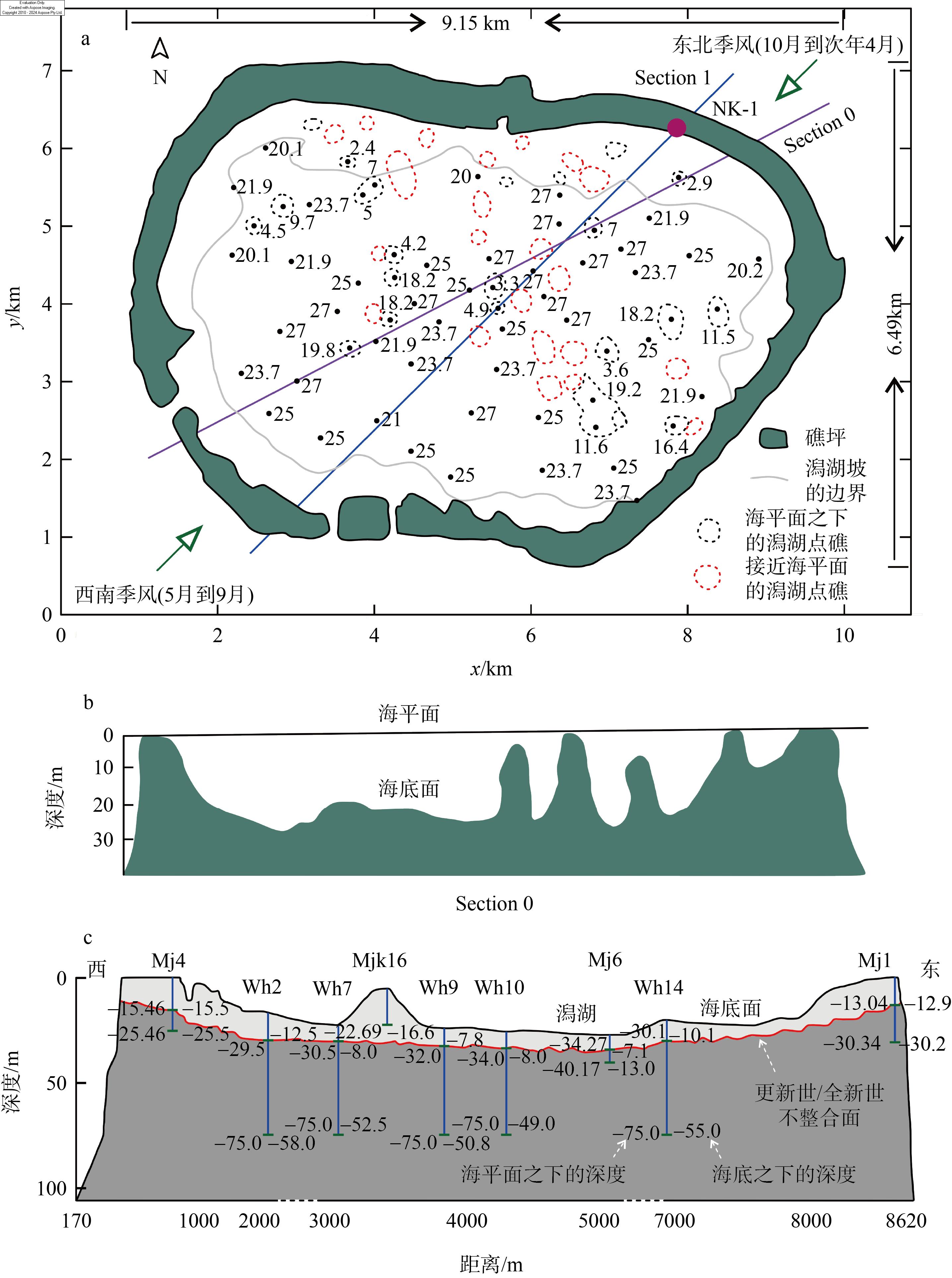
Fig. 1
Fig. 2
Environmental threshold functions for shallow (top row), moderate-deep (middle row) and deep (bottom row) assemblages (Salles et al, 2018b, 2018c)"
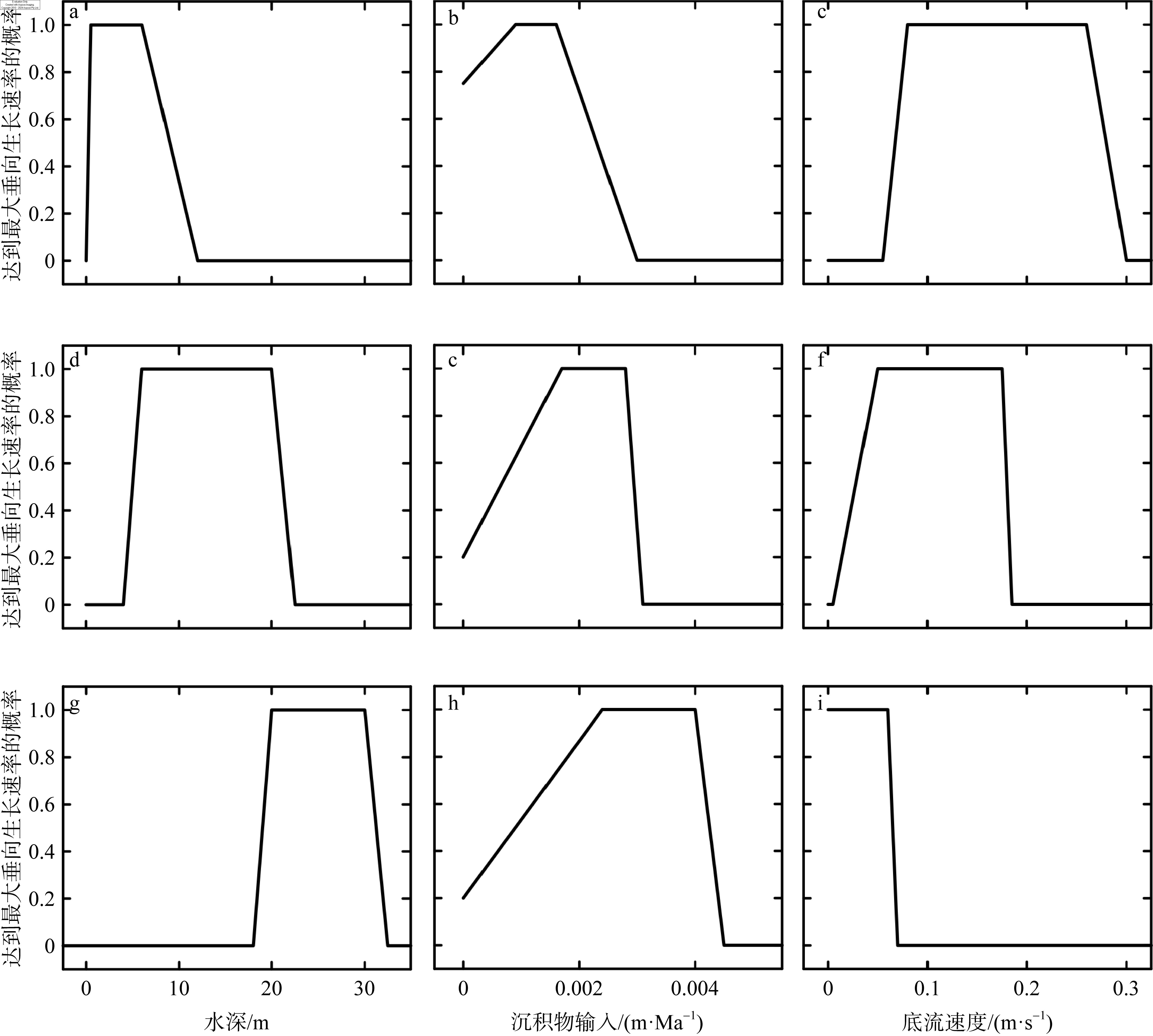
Fig. 2
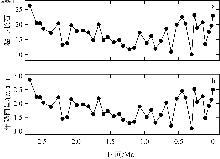
Fig. 3
The annual precipitation data used in the simulations (b) indicated by the ratio of clay/feldspar (a) recorded from ODP Site 1143. The clay/feldspar ratio is from Wan et al (2006)"
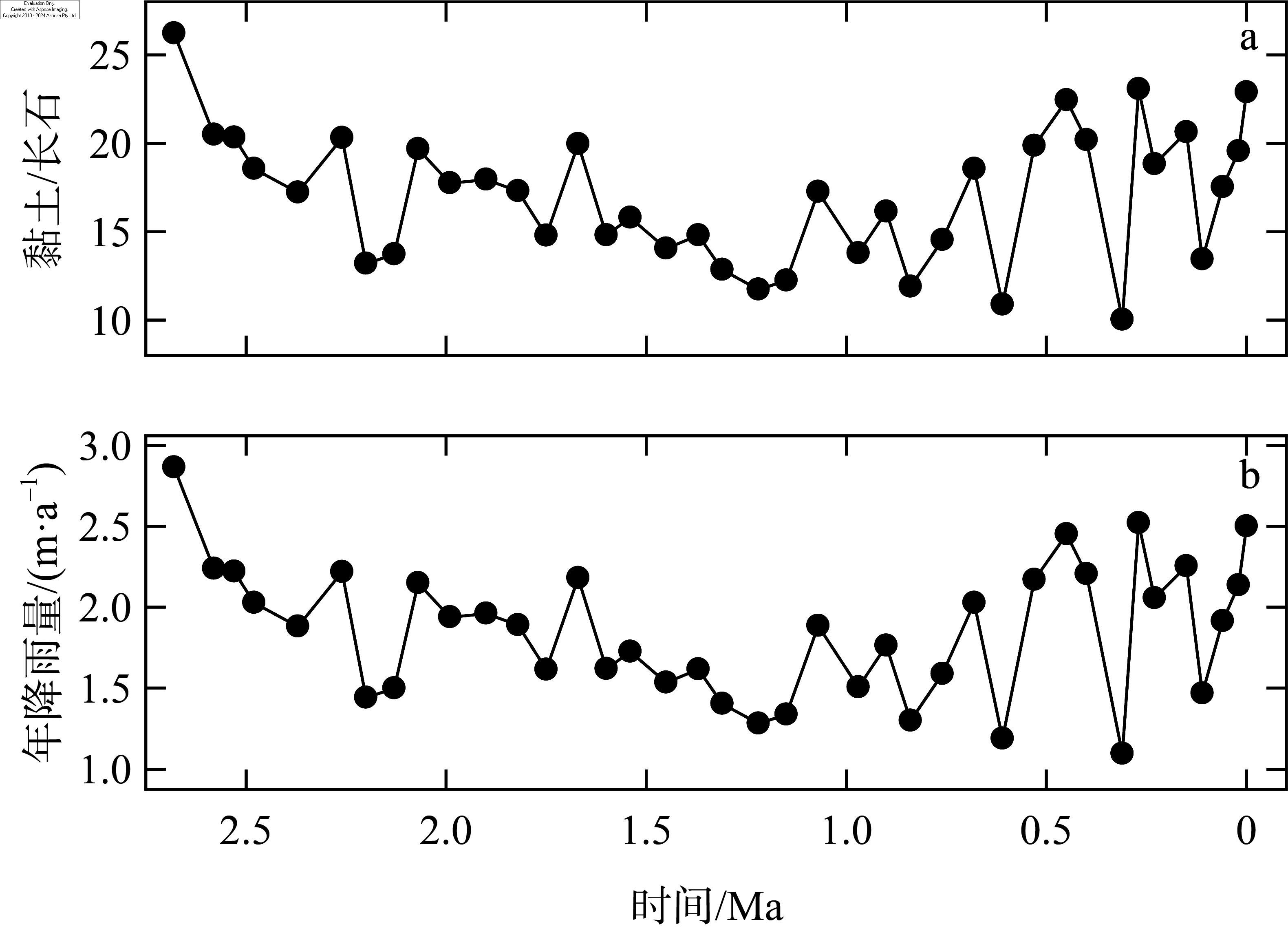
Fig. 3
Tab. 1
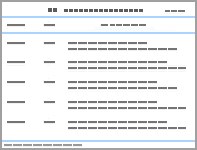
Model parameters used in the simulations"
| 参数 | 数值 | 参考文献 |
|---|---|---|
| 模拟开始的时刻 | 2.65Ma | |
| 模拟结束的时刻 | 0.0Ma | |
| 模型在x或y轴上的长度 | 18km | |
| 最大的波浪侵蚀速率 | 0.002m·a-1 | Thran等( |
| 波浪能影响到的最大深度 | 32.5m | Thran等( |
| 主要的波浪方向 | 东北向和西南向(各 占每年50%的时间) | 赵焕庭( |
| 浅水珊瑚群落碳酸盐岩的最大垂向生长速率 | 0.012m·a-1 | Montaggioni ( |
| 中深水珊瑚群落碳酸盐岩的最大垂向生长速率 | 0.010m·a-1 | Montaggioni ( |
| 深水珊瑚群落碳酸盐岩的最大垂向生长速率 | 0.009m·a-1 | Montaggioni ( |
Tab. 1
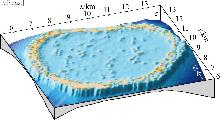
Fig. 4
Three-dimensional view of the modeled Meiji Atoll since 2.65 Ma. The light orange areas indicate the reef rims or flats that reach mean sea level, and the light orange spots in the lagoon are the modeled lagoonal patch reefs that reach mean sea level. The bluer areas have greater water depths. Detailed water depths are presented for a cross section (i.e., section 1) in Fig. 6"
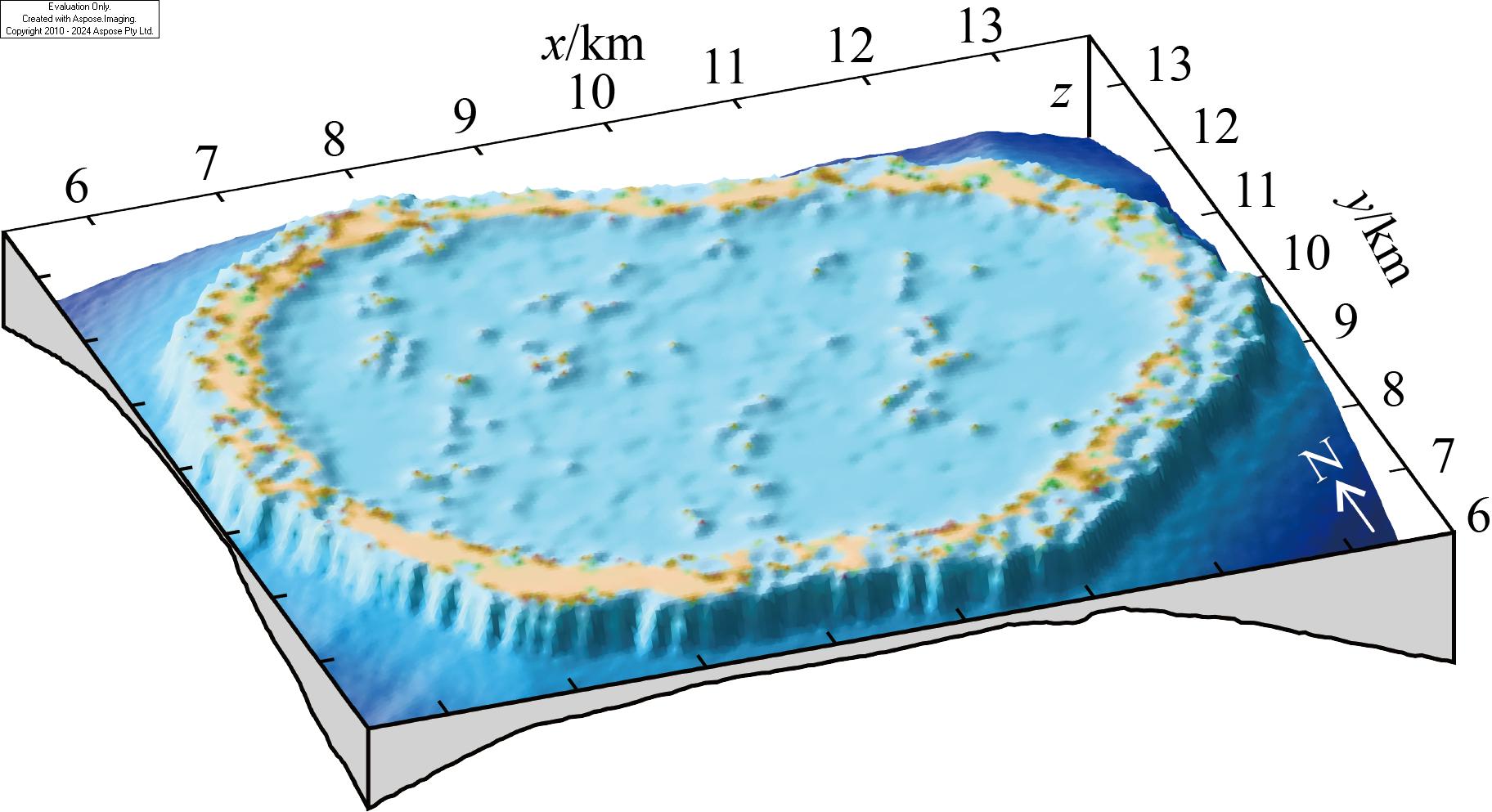
Fig. 4
Fig. 5
(a) Modeled age/depth (thin blue x symbols and solid blue line) compared with the measured age/depth (black circles, red triangles, green diamonds and dark red stars) from the NK-1 well; (b) Modeled and measured age/depth with the sea-level changes (dark green x symbols and dark green solid line) (Bates et al, 2014) used for the area of the Meiji Atoll. In Fig. 5a and 5b, the black circles, red triangles, green diamonds and dark red stars indicate the mean strontium isotope age, U-Th age, C-14 age and paleomagnetic age (2.6 Ma at 166 m and 0.78 Ma at 52 m beneath the reef rim surface), respectively. In Fig. 5a, the horizontal black lines and red lines through black circles and red triangles, respectively, indicate the ranges of measured ages. Several black circles and red triangles have indistinguishable horizontal lines because the ranges of these measured ages are too narrow to discern. (1), (2), (3) and (4) correspond to the four phases of reef accretion as described in section 2"
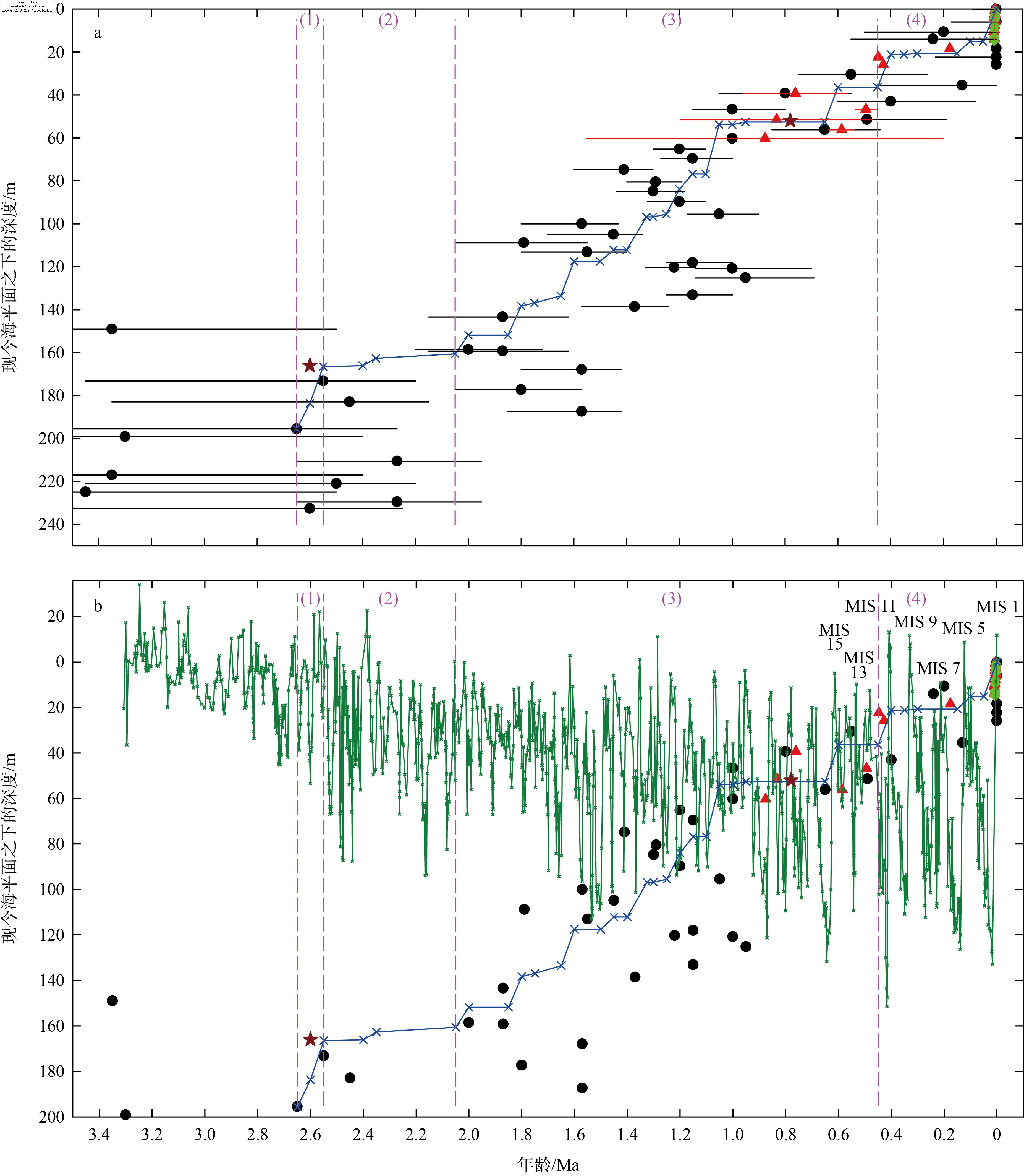
Fig. 5
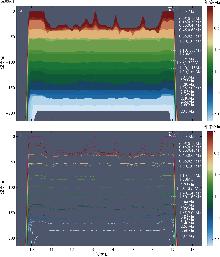
Fig. 6
Modeled age/depth for section 1. (a) Modeled age/depth for the strata on section 1; (b) modeled age/depth for the stratum interfaces on section 1. The white numbers indicate the ages of modeled strata"
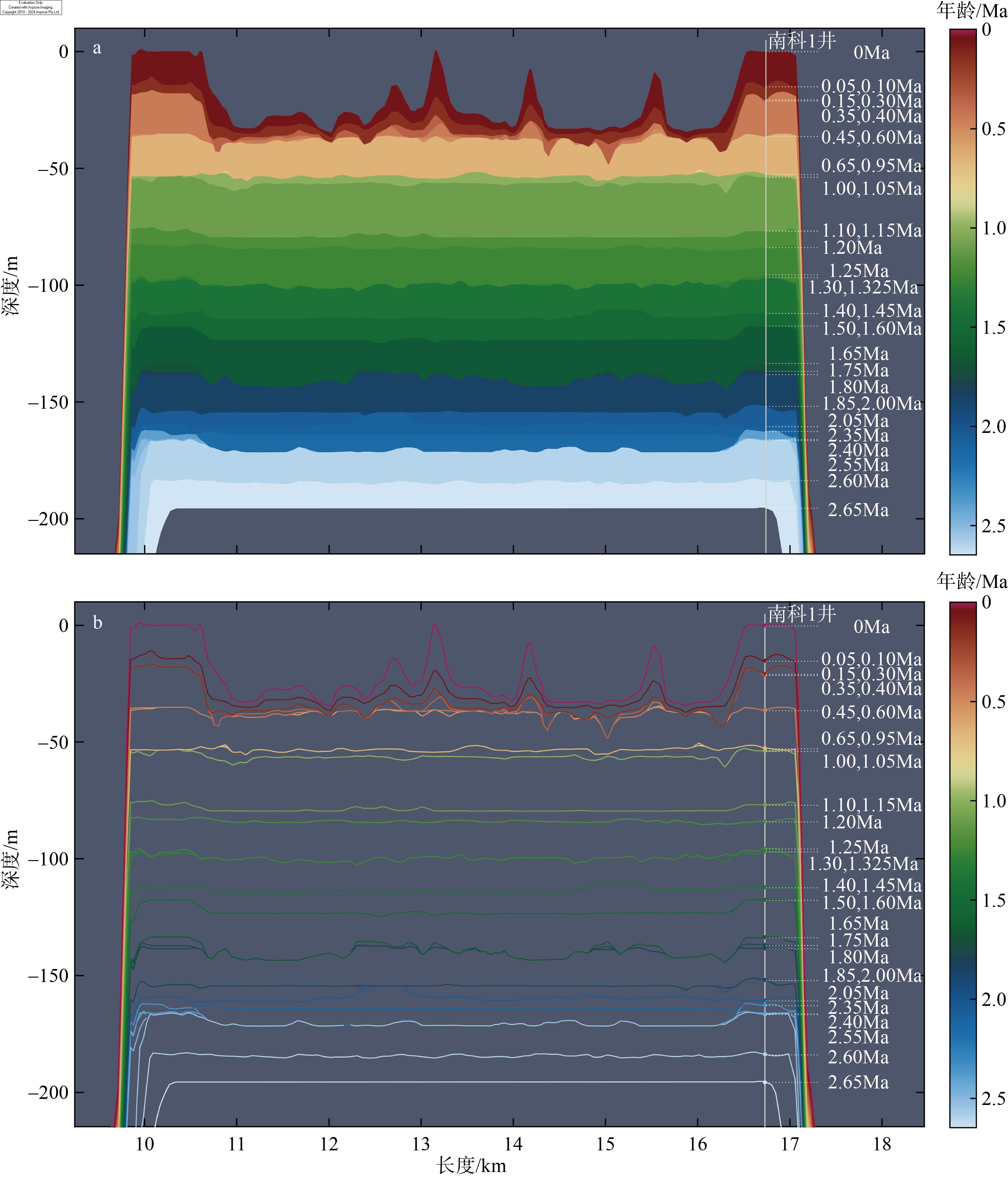
Fig. 6
Fig. 7
Modeled reef morphology at 0.45 Ma (a) and 0.40 Ma (b) on section 1"
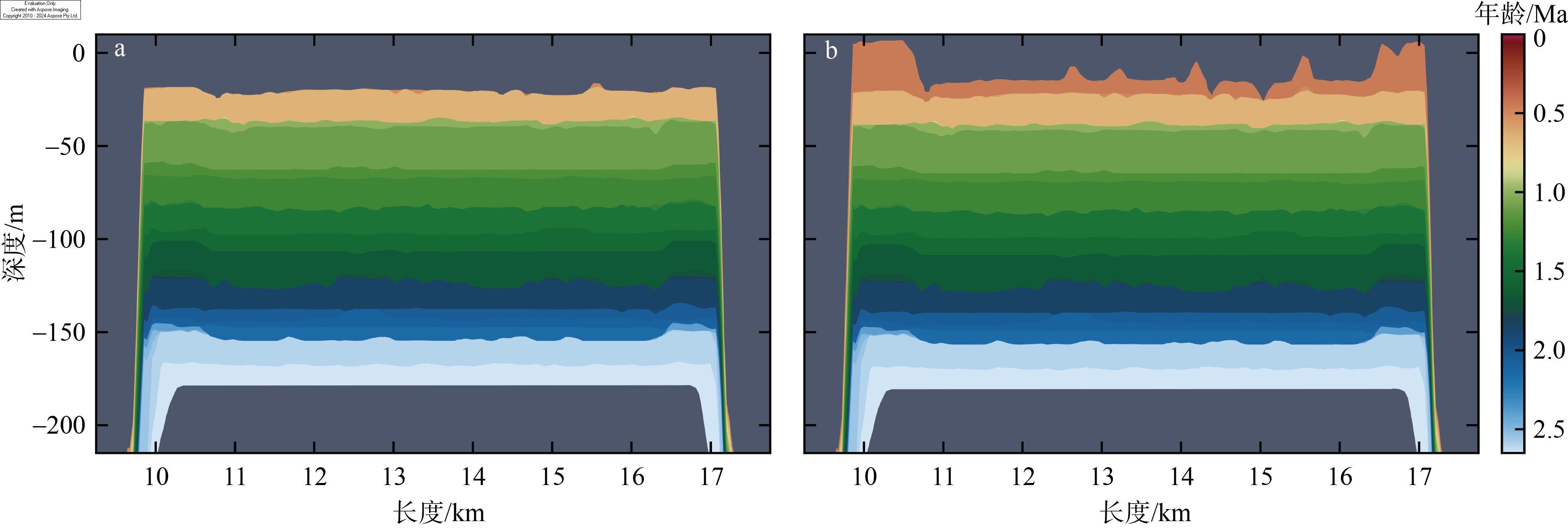
Fig. 7
Fig. 8
Modeled water depths of the top surface of the reef. (a) Map highlighting the modeled top surface of the reef that is less than 5 m deep; (b) map highlighting the modeled top surface of the reef that is less than 50 m deep"
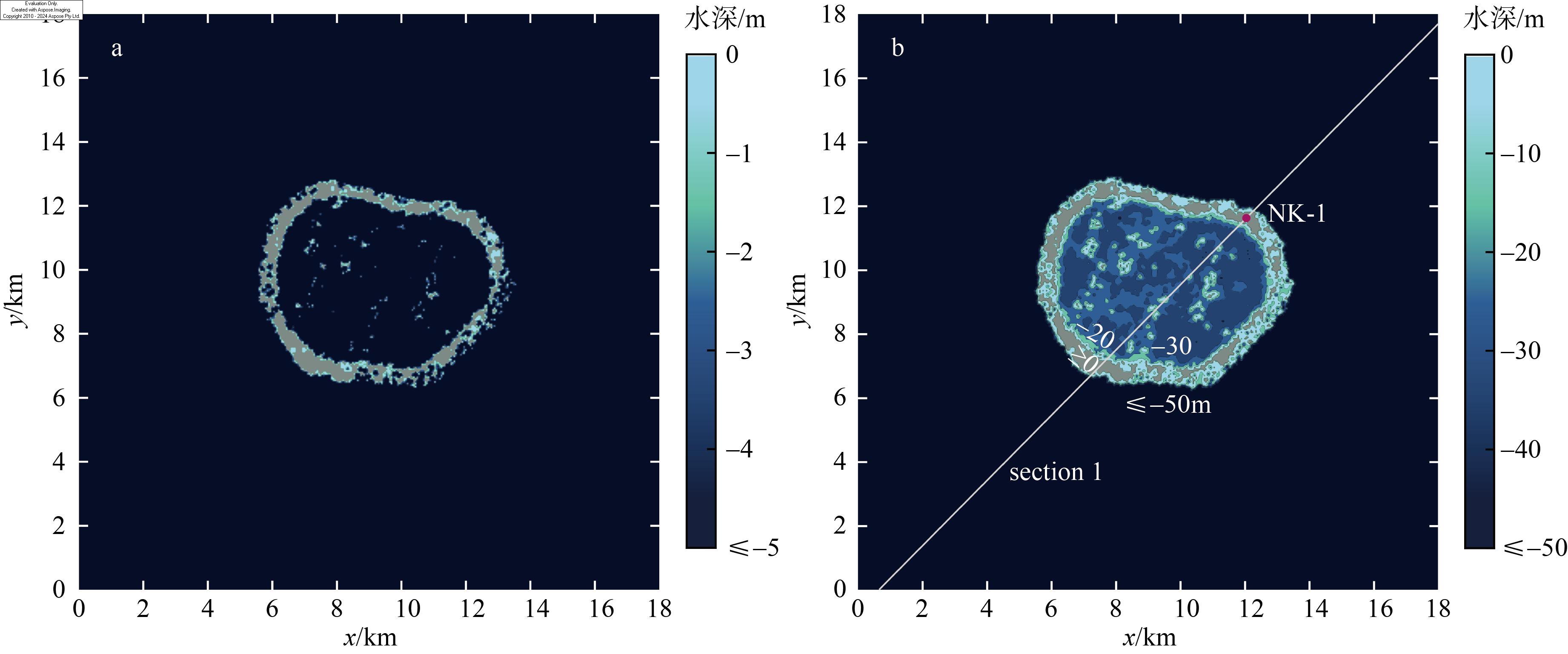
Fig. 8
Tab. 2
Deviation analysis between simulated results and measured data"
| 偏差分析的内容 | 数值 |
|---|---|
| 在模拟的年龄-深度和实测的年龄-深度之间, 其中相同年龄或相近年龄对应的深度的均方根误差 | 5.28m |
| 在模拟的年龄-深度和实测年龄-深度之间, 其中相同年龄或相近年龄对应的深度的平均绝对误差 | 4.67m |
| 在模拟的沉积间断期和实测的沉积间断期之间, 对应间断期的中位时间的最大偏差 | 0.115Ma [模拟的沉积间断期(2.55—2.40Ma) 和实测的沉积间断期(2.45—2.27Ma)之间] |
| 在模拟的沉积间断期和实测的沉积间断期之间, 对应间断期的中位时间的最小偏差 | 0.0048Ma [模拟的沉积间断期(0.10—0.05Ma) 和实测的沉积间断期(0.1300—0.0104Ma)之间] |
| 在模拟的沉积间断期和实测的沉积间断期之间, 对应间断期的中位时间的均方根误差 | 0.05576Ma |
| 在模拟的沉积间断期和实测的沉积间断期之间, 对应间断期的中位时间的平均绝对误差 | 0.04578Ma |
| 模拟的现今潟湖的最大水深和实测的潟湖最大水深之间的最大偏差 | 5m |
| 模拟的礁坪宽度和实际的礁坪宽度之间的偏差(南科1井所在的东北缘礁坪宽度) | 约100m |
Tab. 2
Tab. 3
Summary of the simulation tests in this study"
| 4.1岩溶的参数敏感性分析 | |||||
|---|---|---|---|---|---|
| 4.1.1降雨量相关的参数敏感性分析 | |||||
| 参数 | 主模拟情况 | 礁体周缘区域和中部区域之间无差别岩溶的情况 | |||
| 与降雨量相关的礁体周缘区域岩溶系数(Fdr) | 3.75×10⁻⁵ | 3.75×10⁻⁵ | |||
| 与降雨量相关的礁体中部区域岩溶系数(Fdl) | 6.75×10⁻⁵ | 3.75×10⁻⁵ | |||
| 对模拟结果的影响 | 没有出现中央潟湖或中部凹陷地形 | ||||
| 4.1.2雨水流动相关的参数敏感性分析 | |||||
| 参数 | 主模拟情况 | 不考虑与雨水流动相关的岩溶时 | 与雨水流动相关的岩溶作用更强时 | ||
| 与雨水流动相关的岩溶系数(Ff) | 5.0×10⁻⁵ | 0 | 2.5×10⁻⁴ | ||
| 对模拟结果的影响 | 没有明显的影响 | 形成的中央潟湖的水深更深(更深的程度≤10m), 形成的地层界面更凹凸不平 | |||
| 4.2平顶型台地周缘区域上相对较快的礁体生长相关的参数敏感性分析 | |||||
| 参数 | 主模拟情况 | 考虑碳酸盐岩产率自礁体边缘区域向礁体中部区域降低的情况 | |||
| 描述碳酸盐岩产率自礁体边缘区域 向礁体中部区域降低的函数(U0) | 无U0 | 存在U0 | |||
| 与降雨量相关的礁体周缘区域岩溶系数(Fdr) | 3.75×10⁻⁵ | 3.75×10⁻⁵ | |||
| 与降雨量相关的礁体中部区域岩溶系数(Fdl) | 6.75×10⁻⁵ | 3.75×10⁻⁵ | |||
| 对模拟结果的影响 | 在礁体发育过程中中央潟湖和环礁形态的形成频率更高, 在潟湖中未形成与礁坪高度接近的点礁 | ||||
| 4.3基底沉降相关的参数敏感性分析 | |||||
| 参数 | 主模拟情况 | 无沉降的情况 | |||
| 年平均沉降速率/(m·Ma-1) | 68 | 0 | |||
| 对模拟结果的影响 | 模拟的礁体地层厚度减少约167m, 但中央潟湖和环礁形态 的形成情况几乎与平均沉降速率68m·Ma-1时的结果相同 | ||||
| 4.4 初始基底形态相关的参数敏感性分析 | |||||
| 参数 | 主模拟情况 | 初始基底顶面存在一个中央凹陷的情况 | |||
| 初始基底的形态 | 初始基底顶面是水平的 | 初始基底顶面的中央存在一个比边缘区域深40m的凹陷 (即初始基底的顶面不是水平的) | |||
| 对模拟结果的影响 | 主要影响2.4Ma之前的模拟结果, 使2.4Ma之前已形成中央 潟湖和环礁地貌; 未对2.4Ma之后的模拟结果产生明显影响 | ||||
Tab. 3
Fig. 9
Modeling results for section 1 from two simulation tests. (a) using a uniform dissolution factor of Fdr = Fdl =3.75×10⁻⁵ for both the margin and interior zones; and (b) using a rainfall-runoff-related dissolution factor of Ff = 2.5×10⁻⁴"
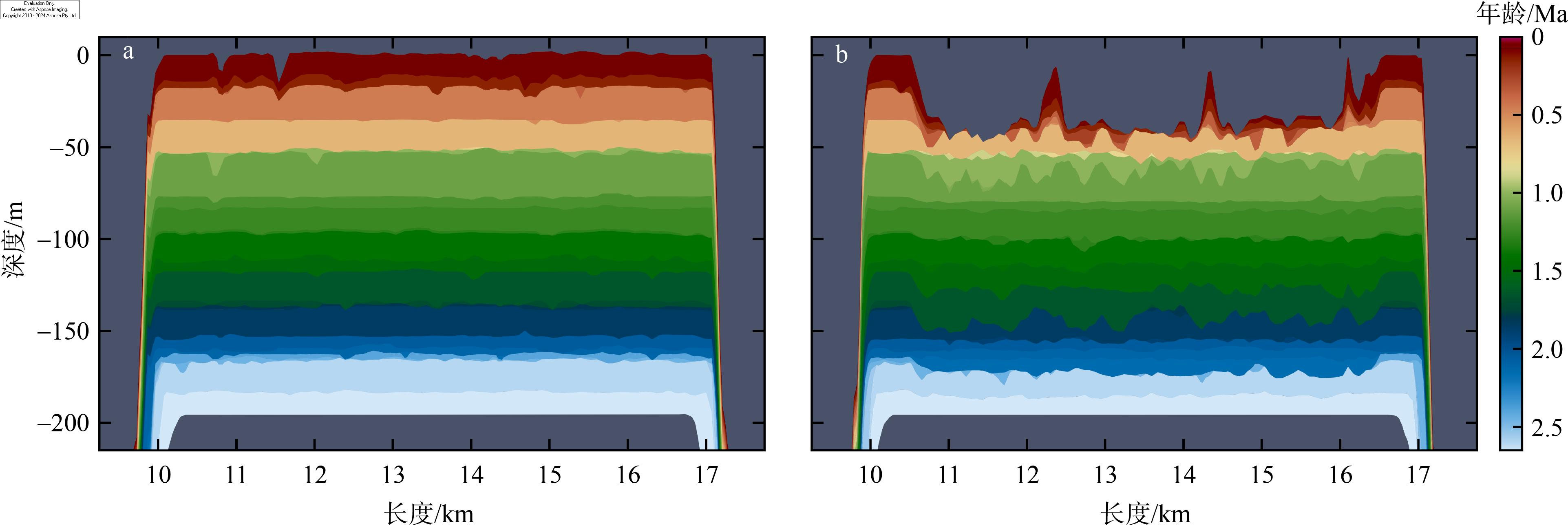
Fig. 9
Fig. 10
Simulation tests using the depth-dependent production function (D0), the horizontal reduction function (U0) and the sediment input controlling function from Warrlich et al (2002). A spatially nondifferential dissolution rate, related to annual rainfall amount (i.e., Fdr = Fdl =3.75×10⁻⁵) was used for both the margin and interior zones. (a) The function describing the depth dependency of carbonate production (D0); (b) the function describing the reduction in carbonate production rate due to deviation from fully marine waters (U0); (c to e) the modeling results for section 1 with U0 included, using maximum vertical accretion rates of 0.01, 0.0075 and 0.005 m·a-1, respectively; (f) modeling results for section 1 without U0, using a maximum vertical accretion rate of 0.01 m·a-1. h is the water depth (m). hb is the bottom depth of maximum carbonate production rate in the function D0 (m). σD is the scale depth for carbonate production in the function D0 (m). dp_m is the distance from a given location to its nearest margin on the platform top (m)"
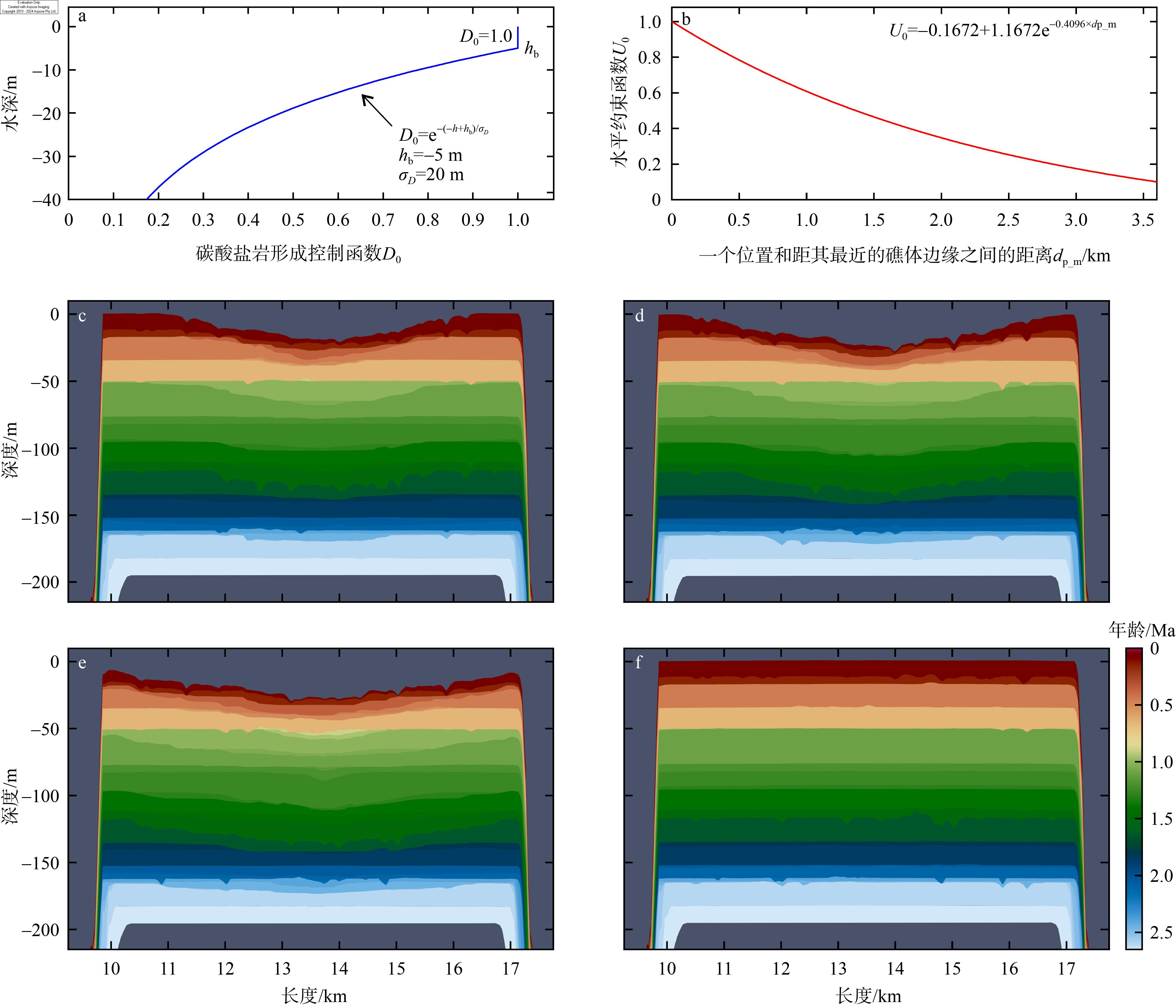
Fig. 10
Fig. 11
Modeling results on section 1 under different assumptions. (a) 0.45 Ma, (b) 0.40 Ma, and (c) 0 Ma, assuming no subsidence; and (d) 0 Ma, assuming a nonflat-topped initial basement"
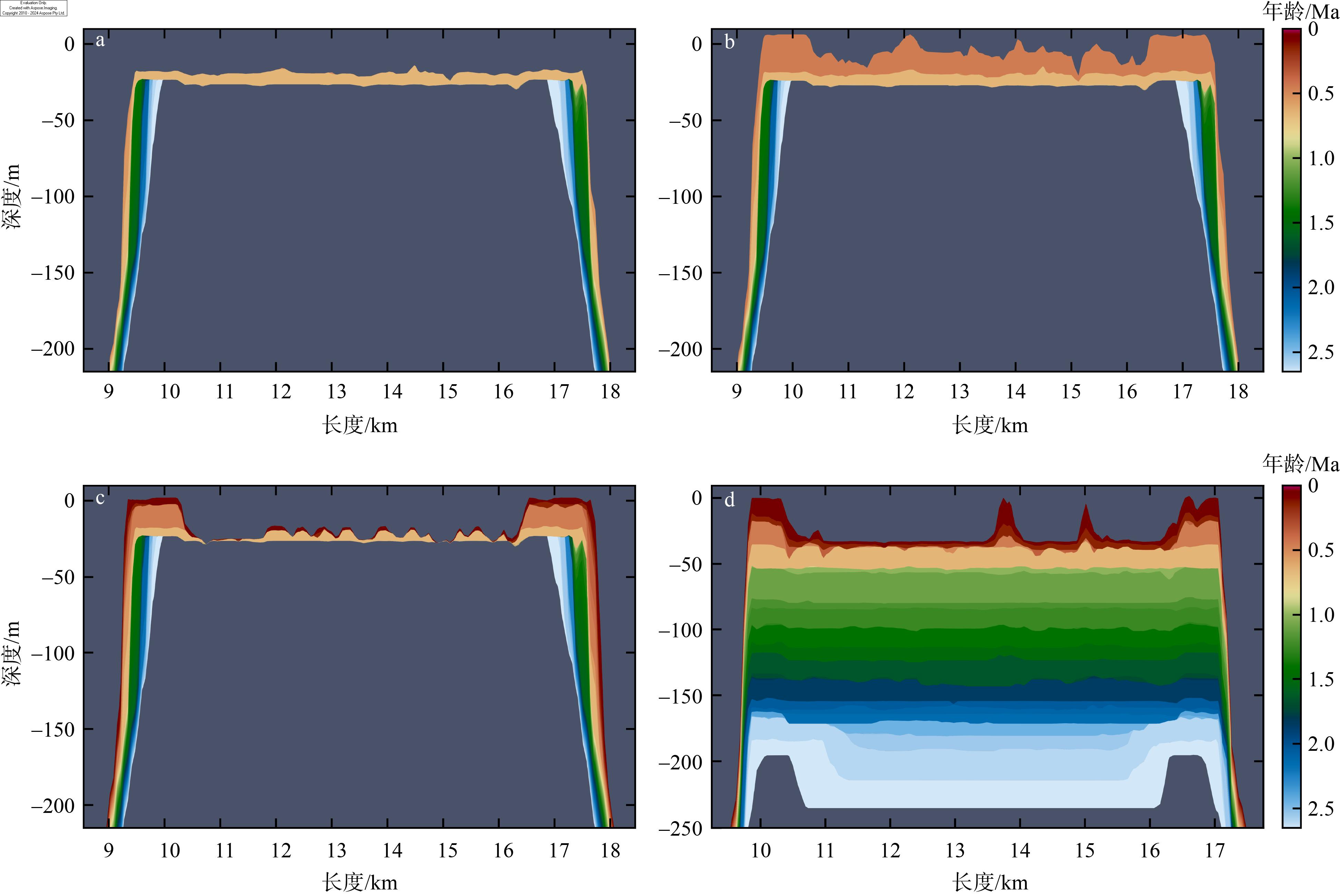
Fig. 11
Tab. 4
Comparison of the drowning periods of the reef body in Core NK-1 from Meiji Atoll with the interglacial or deglacial drowning periods identified by Droxler et al (2021)"
| Droxler等( | 美济礁NK-1井岩芯样品记录或测到的年龄 |
|---|---|
| 2.4Ma | 2.45Ma (2.15—3.35Ma) (Sr) |
| 2.0Ma | 2.00Ma (1.72—2.20Ma) (Sr) |
| 1.5Ma | ① 1.57Ma (1.43—1.80Ma)、(1.42—1.80Ma)、(1.42—1.85Ma) (Sr) ② 1.45Ma (1.34—1.70Ma) (Sr) |
| 1.0Ma | 1.00Ma (0.70—1.14Ma)、(0.75—1.15Ma)、(0.80—1.15Ma) (Sr) |
| MIS 11 (约0.424—0.374Ma) | ① (0.446551 ± 0.016608)Ma (U-Th) ② (0.428226 ± 0.013521)Ma (U-Th) ③ 0.40Ma (0.08—0.60Ma) (Sr) |
| MIS 9 (约0.337—0.300Ma) | 无 |
| MIS 7 (约0.243—0.191Ma) | ① 0.24Ma (0—0.55Ma) (Sr) ② 0.20Ma (0—0.50Ma) (Sr) |
| MIS 5 (约0.130—0.080Ma) | 0.13Ma (0—0.44Ma) (Sr) |
| MIS 1 (约0.014—0Ma) | ① (0.010446 ± 0.000295)Ma (U-Th) ② 0.00820—0.00476Ma (U-Th和14C) |
Tab. 4
| [1] |
刘景儒, 王建平, 郭东, 等, 2019. 西南沙珊瑚礁三维形态和地层结构特征研究[J]. 地球科学前沿, 9(2): 61-68.
|
|
doi: 10.12677/AG.2019.92008 |
|
| [2] |
罗云, 黎刚, 徐维海, 等, 2022. 南科1井第四系暴露面特征及其与海平面变化的关系[J]. 热带海洋学报, 41(1): 143-157.
doi: 10.11978/2021013 |
|
doi: 10.11978/2021013 |
|
| [3] |
赵焕庭, 1996. 南沙群岛自然地理[M]. 北京: 科学出版社: 58-59.
|
|
|
|
| [4] |
赵中贤, 孙珍, 陈广浩, 等, 2011. 南沙海域新生代构造特征和沉降演化[J]. 地球科学, 36(5): 815-822.
|
|
|
|
| [5] |
|
| [6] |
doi: 10.1016/j.margeo.2017.07.007 |
| [7] |
doi: 10.1016/j.quascirev.2014.01.020 |
| [8] |
doi: 10.1038/srep04997 pmid: 24845540 |
| [9] |
doi: 10.1016/j.geomorph.2012.10.008 |
| [10] |
|
| [11] |
doi: 10.2307/20025572 |
| [12] |
|
| [13] |
doi: 10.1146/annurev-marine-121211-172234 pmid: 22809185 |
| [14] |
doi: 10.1146/marine.2021.13.issue-1 |
| [15] |
doi: 10.1086/625235 |
| [16] |
doi: 10.1130/0016-7606(1945)56[809:SEOELT]2.0.CO;2 |
| [17] |
doi: 10.1007/s00531-014-1068-8 |
| [18] |
doi: 10.1016/0146-6313(54)90049-0 |
| [19] |
doi: 10.1007/BF03174302 |
| [20] |
doi: 10.2475/ajs.252.7.402 |
| [21] |
doi: 10.1007/BF00286536 |
| [22] |
doi: 10.1126/sciadv.aaz1346 |
| [23] |
doi: 10.1016/j.earscirev.2005.01.002 |
| [24] |
doi: 10.1111/sed.2015.62.issue-2 |
| [25] |
doi: 10.1016/j.sedgeo.2005.01.007 |
| [26] |
doi: 10.1130/0016-7606(2001)113<0837:OOAL>2.0.CO;2 |
| [27] |
doi: 10.1007/s00531-005-0511-2 |
| [28] |
|
| [29] |
doi: 10.1130/0091-7613(1990)018<0942:PMDAEH>2.3.CO;2 |
| [30] |
doi: 10.1016/j.softx.2016.08.005 |
| [31] |
doi: 10.1371/journal.pone.0195557 |
| [32] |
doi: 10.1038/s41598-018-23519-8 |
| [33] |
doi: 10.5194/gmd-11-2093-2018 |
| [34] |
doi: 10.1007/s00531-013-0913-5 |
| [35] |
doi: 10.1016/j.quascirev.2009.05.011 |
| [36] |
|
| [37] |
doi: 10.1016/j.palaeo.2016.03.018 |
| [38] |
doi: 10.1130/G34109.1 |
| [39] |
|
| [40] |
doi: 10.1016/j.palaeo.2006.06.013 |
| [41] |
doi: 10.1046/j.1365-2117.2002.00181.x |
| [1] | ZHANG Ze, QU Ke, WANG Aoyu, LI Wei, WANG Chao. Three-dimensional numerical investigation of hydrodynamic characteristics over complex coral reefs with tsunami-like waves [J]. Journal of Tropical Oceanography, 2026, 45(3): 39-49. |
| [2] | QIU Jiafu, LIU Jiaxin, DUAN Xiaowei, CHEN Shengli. A study on the migration paths of floating debris in the sea area of Dapeng Bay [J]. Journal of Tropical Oceanography, 2026, 45(2): 160-172. |
| [3] | QIAO Guangquan, XU Rungang. Multi-peak characteristics and cause analysis of tidal levels in Guanghai Bay [J]. Journal of Tropical Oceanography, 2025, 44(6): 12-20. |
| [4] | LIU Wenming, LIU Yuqiao. Three-dimensional numerical simulation of the effect of residual chlorine in cold drainage of liquefied natural gas terminal on ecological environment in coastal waters [J]. Journal of Tropical Oceanography, 2025, 44(3): 217-223. |
| [5] | WANG Xu, QU Ke, WANG Zijun, YANG Yuanping, WANG Chao, ZHANG Liangbin. Numerical simulation study on the effect of wind on the hydrodynamic characteristics of undular tidal bores seawall [J]. Journal of Tropical Oceanography, 2024, 43(5): 116-130. |
| [6] | WU Hongbo, LUO Feng, CHEN Zhipeng, ZHU Fei, ZENG Jingwei, ZHANG Chi, LI Ruijie. A novel pattern for predicting the effects of mangrove ecological reconstruction [J]. Journal of Tropical Oceanography, 2024, 43(4): 86-97. |
| [7] | ZHANG Zheran, HU Junyang, ZHOU Kai, ZHANG Penghui, XING Jiuxing, CHEN Shengli. Storm surge simulations of the coastal area of Shenzhen using different types of typhoon meteorological fields—a case study of Typhoon Mangkhut* [J]. Journal of Tropical Oceanography, 2023, 42(6): 1-14. |
| [8] | ZHANG Min, WU Hangxing, LU Yibin, LU Diwen, MI Jie, ZHU Donglin, CHEN Bo. Impact of the coastal reclamations on topography evolution in the Qinzhou Bay, Guangxi [J]. Journal of Tropical Oceanography, 2023, 42(2): 124-131. |
| [9] | GU Jinghua, ZHU Jianrong, JIN Zhi. Numerical simulation of oil film drift and diffusion after oil spill accident at the Baosteel wharf in the Changjiang Estuary [J]. Journal of Tropical Oceanography, 2022, 41(6): 159-170. |
| [10] | WANG Renzheng, SHAN Zhengduo, MENG Siyu, GONG Xiang. Interannual variation of subsurface chlorophyll maximum in the northern South China Sea [J]. Journal of Tropical Oceanography, 2021, 40(6): 63-75. |
| [11] | ZHANG Hua, WEN Xixi, PENG Shiqiu. Numerical simulation of barotropic tides in Mozambique Strait and its adjacent coastal area and energy budget analysis* [J]. Journal of Tropical Oceanography, 2021, 40(2): 7-16. |
| [12] | Juan Li, Junliang Liu, Shuqun Cai. Numerical simulation of oceanic near-inertial energy induced by Typhoon Conson [J]. Journal of Tropical Oceanography, 2020, 39(2): 35-43. |
| [13] | Yan XU, Xiangquan LIU, Rengang SONG, Xianrong CEN, Shuangxi GUO, Shengqi ZHOU. Numerical simulation of diffusive convection staircase [J]. Journal of Tropical Oceanography, 2019, 38(1): 11-18. |
| [14] | Wen WU, Yuhan YAN, Dehai SONG. Study on the tidal dynamics in Daya Bay, China — Part I. Observation and numerical simulation of tidal dynamic system [J]. Journal of Tropical Oceanography, 2017, 36(3): 34-45. |
| [15] | Yuhan YAN, Wen WU, Dehai SONG, Xianwen BAO. Study on the tidal dynamics in Daya Bay, China — Part Ⅱ. The generation of double high waters and double-peak flood-current flows [J]. Journal of Tropical Oceanography, 2017, 36(3): 46-54. |
|
||