

Journal of Tropical Oceanography ›› 2026, Vol. 45 ›› Issue (1): 105-116.doi: 10.11978/2025017CSTR: 32234.14.2025017
Previous Articles Next Articles
A study on the differential impacts of ENSO and IOD on the interannual air temperature variability over Sri Lanka*
LIN Liru1( ), ZHUANG Wei2()
- 1School of Marine Biology, Applied Technology Engineering Center of Fujian Provincial Higher Education for Marine Resource Protection and Ecological Governance, Xiamen Key Laboratory of Intelligent Fishery, Xiamen Ocean Vocational College, Xiamen 361100, China
2College of Ocean and Earth Sciences, Xiamen University, Xiamen 361102, China
-
Received:2025-02-27Revised:2025-03-23Online:2026-01-10Published:2026-01-30 -
Contact:ZHUANG Wei. email:wzhuang@xmu.edu.cn -
Supported by:International Partnership Program of Chinese Academy of Sciences(133244KYSB20200024); International Partnership Program of Chinese Academy of Sciences(059GJHZ2023104MI); Natural Science Foundation of Fujian Province of China(2023J01021); Fujian Provincial Key Science and Technology Program of China(2024YZ040025); National Natural Science Foundation of China(42006177)

CLC Number:
- P732.6
Cite this article
LIN Liru, ZHUANG Wei. A study on the differential impacts of ENSO and IOD on the interannual air temperature variability over Sri Lanka*[J].Journal of Tropical Oceanography, 2026, 45(1): 105-116.
share this article
Add to citation manager EndNote|Reference Manager|ProCite|BibTeX|RefWorks
Fig. 1
Topographic elevations of Sri Lanka Island and bathymetric depths of the surrounding ocean"
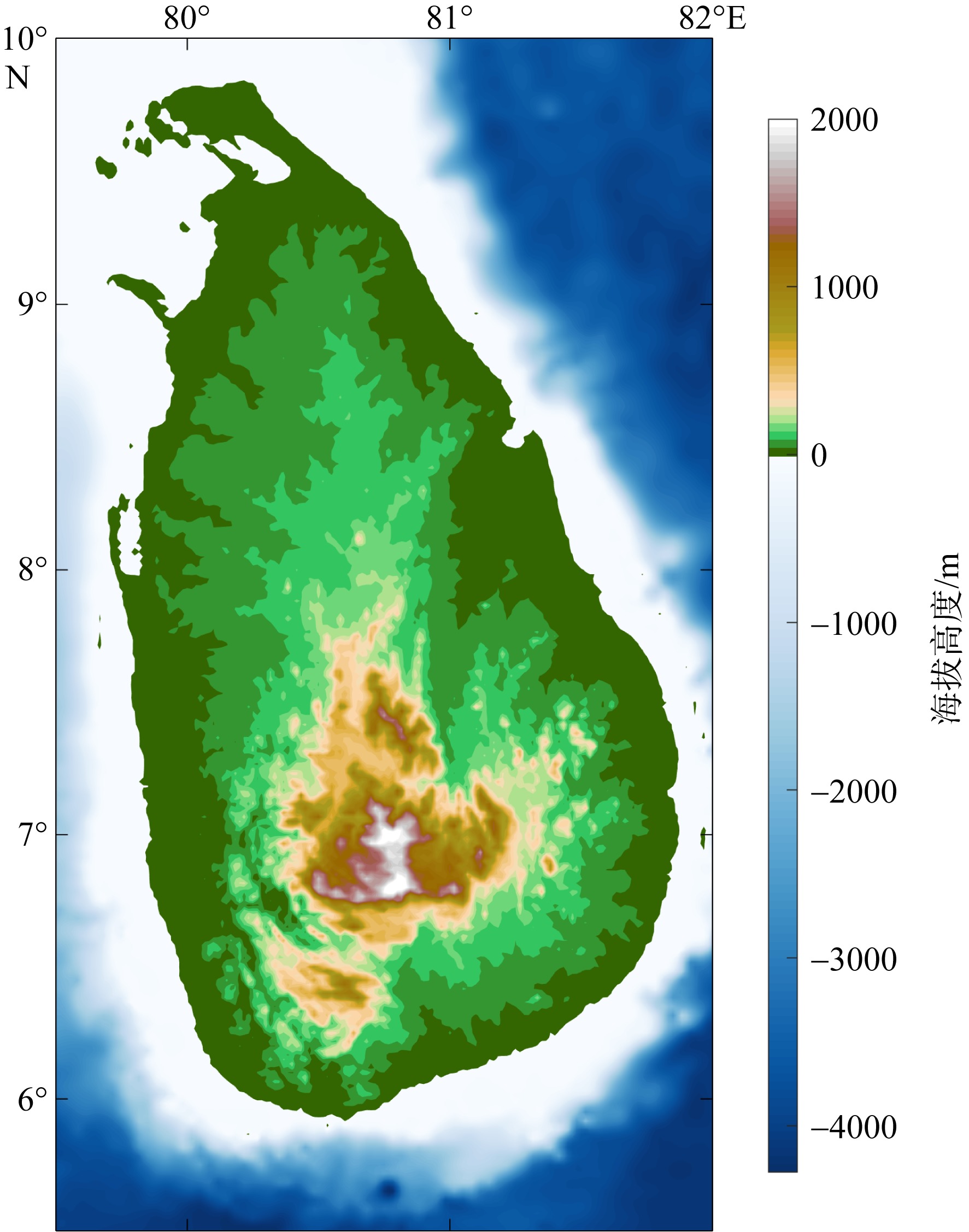
Fig. 1
Fig. 2
Distribution of climatological seasonal mean air temperature (shaded, units: ℃) and wind field (vectors, units: m·s-1) over Sri Lanka. (a) First inter-monsoon season; (b) southwest monsoon prevailing season; (c) second inter-monsoon season; (d) northeast monsoon prevailing season"
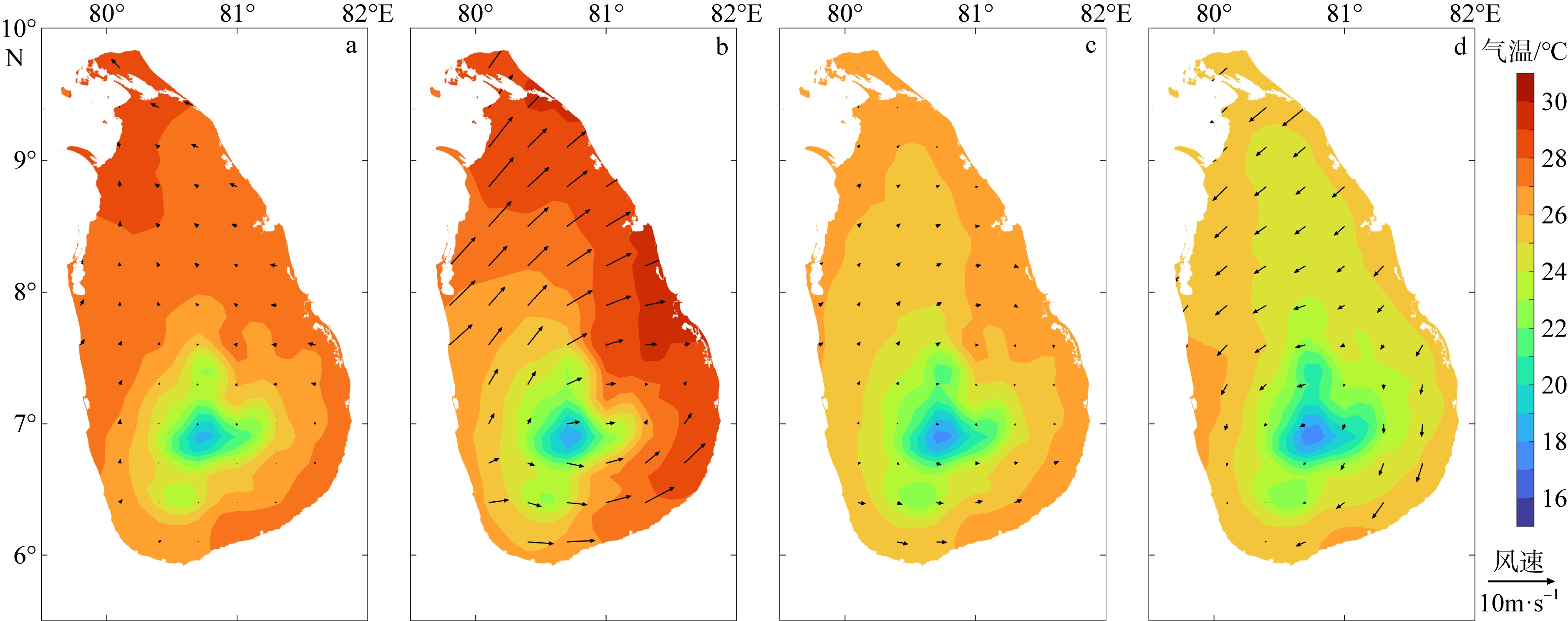
Fig. 2
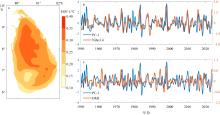
Fig. 3
The first empirical orthogonal function (EOF) mode of interannual air temperature signal over Sri Lanka. (a) Spatial pattern of the first EOF mode (EOF-1, units: ℃); (b) comparison of time series of the corresponding principal component (PC-1) and the Niño3.4 index; (c) comparison of time series of the corresponding PC-1 and the DMI index"
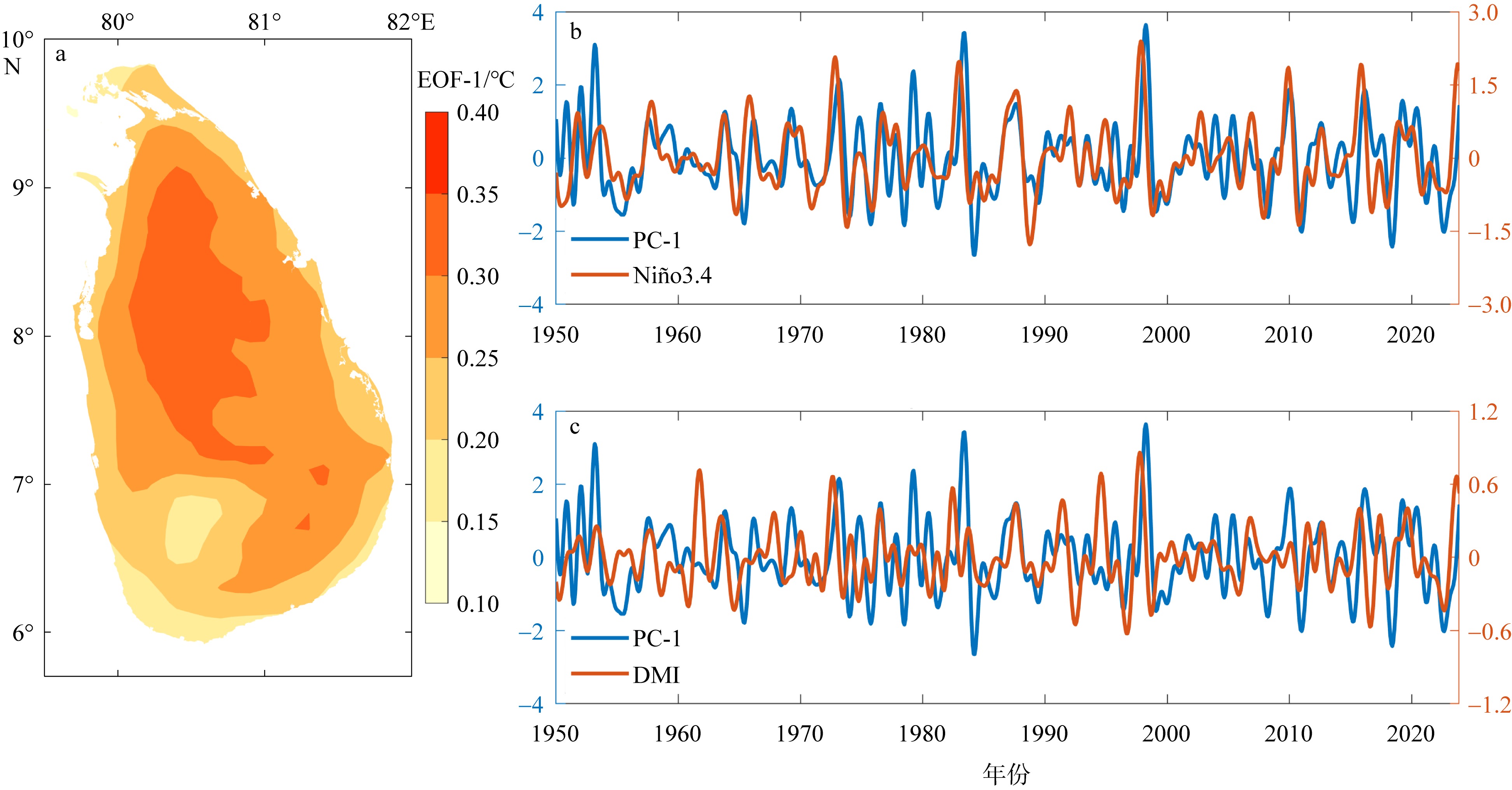
Fig. 3
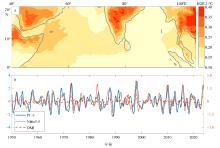
Fig. 4
The first EOF mode of the interannual air temperature signal over the North Indian Ocean. (a) Spatial pattern of EOF-1 (units: ℃) based on ERA5 data; (b) comparison of time series of the corresponding PC-1 with the Niño3.4 and DMI indices"
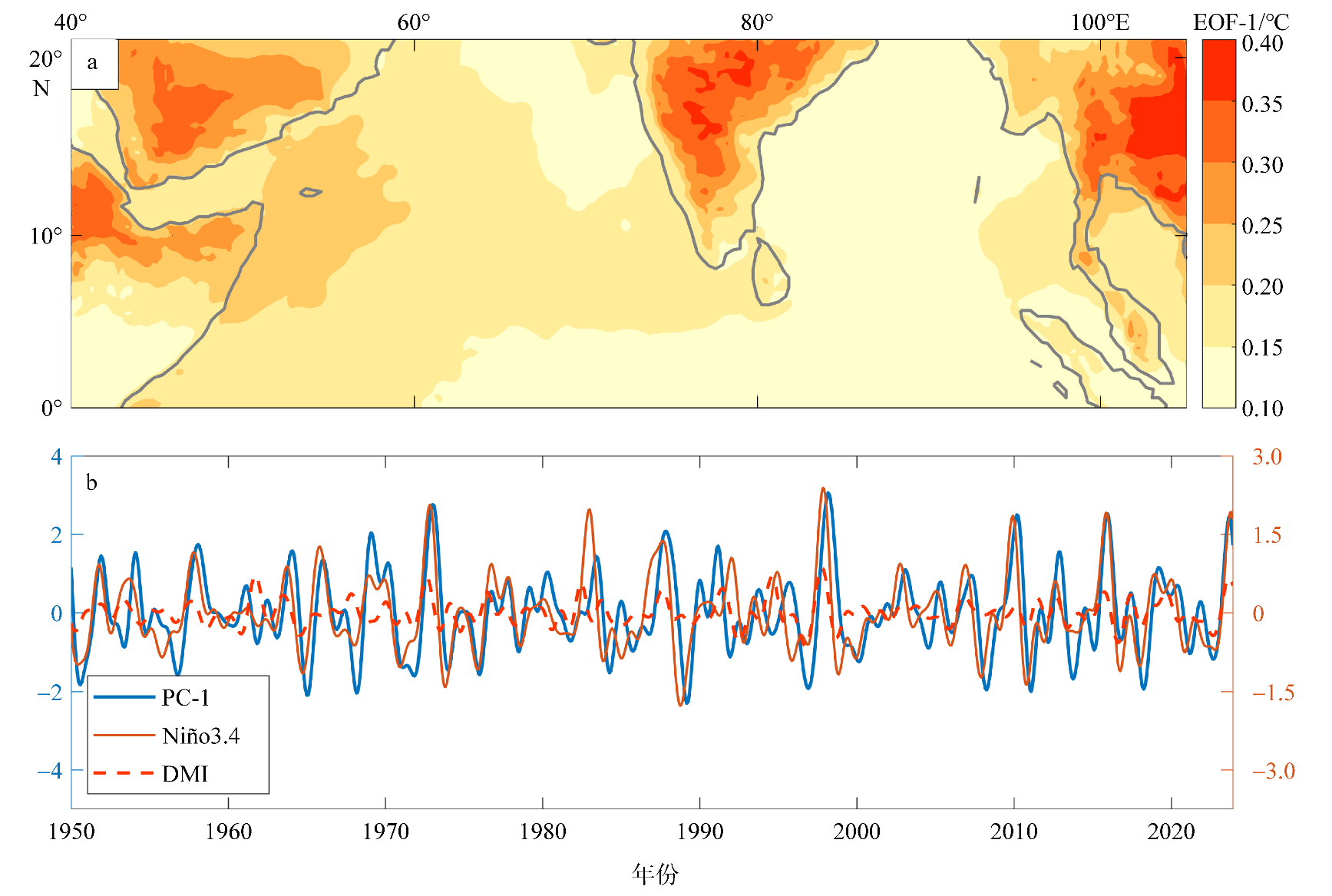
Fig. 4
Fig. 5
Point-by-point correlation coefficients between the interannual air-temperature variability over Sri Lanka and the Niño3.4 and DMI indices. (a) Ordinary correlation coefficients with the interannual temperature signals lagging the Niño3.4 index by 3 months; (b) partial correlation coefficients after removing the influence of DMI; (c) ordinary correlation coefficients with the interannual temperature signals lagging the DMI index by 4 months; (d) partial correlation coefficients after removing the influence of ENSO; black dots indicate results that reached the 95% confidence level in the t-test"
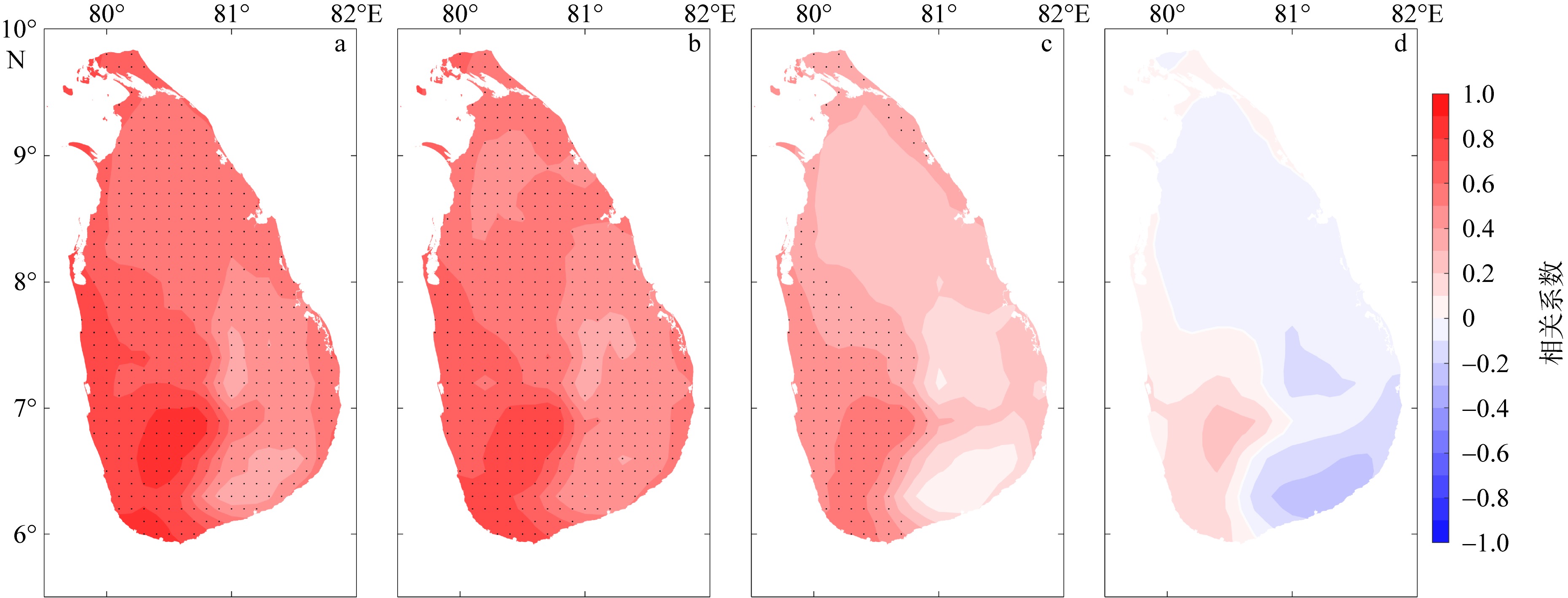
Fig. 5
Fig. 6
Distribution of partial regression coefficients of interannual anomalies for air temperature (shaded), sea level pressure (contours, units: Pa·℃-1) and wind field (vectors, units: m·s-1·℃-1) over the tropical Indian Ocean and surrounding regions relative to the Niño3.4 index. (a) Contemporaneous regression; (b) Niño3.4 index leading by 3 months; (c) Niño3.4 index leading by 6 months; (d) Niño3.4 index leading by 9 months; the impact of the DMI index was removed in the partial regression analysis; regions with black dots indicate that the air temperature and wind field (represented by green arrows) passed the t-test at the 95% confidence level; the purple triangle marks the location of Colombo, Sir Lanka"
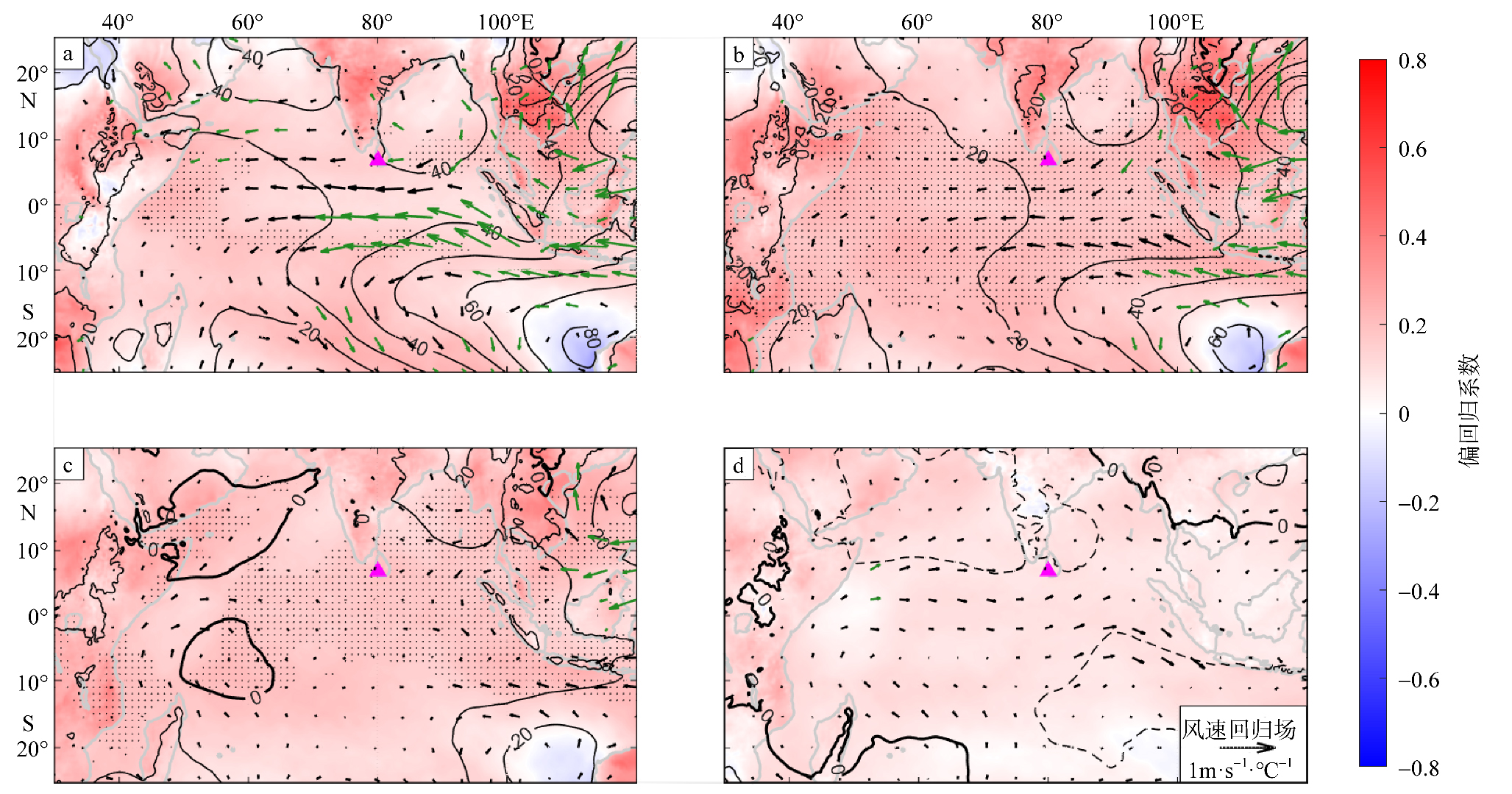
Fig. 6
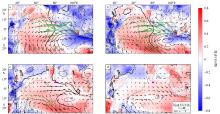
Fig. 7
Distribution of partial regression coefficients of interannual anomalies of air temperature (shaded), sea level pressure (contours, units: Pa·℃-1) and wind field (vectors, units: m·s-1·℃-1) in the tropical Indian Ocean and surrounding regions relative to the DMI index. (a) Contemporaneous regression; (b) DMI index leading by 3 months; (c) DMI index leading by 6 months; (d) DMI index leading by 9 months; the impact of Niño3.4 index was removed in the partial regression analysis; regions with black dots indicate that the air temperature and wind field (represented by green arrows) passed the t-test at the 95% confidence level; the purple triangle marks the location of Colombo, Sir Lanka"

Fig. 7
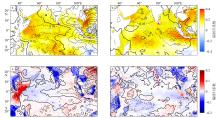
Fig. 8
Distribution of partial regression coefficients of interannual anomalies of SST, shortwave radiation flux, sensible heat flux, and latent heat flux in the tropical Indian Ocean and surrounding regions relative to the Niño3.4 index. (a) Contemporaneous partial regression coefficients of SST (shaded) and shortwave radiation flux (contours, units: W·m-2·℃-1); (b) partial regression coefficients of SST (shaded) and shortwave radiation flux (contours, units: W·m-2·℃-1) lagging by 6 months; (c) contemporaneous partial regression coefficients of sensible heat flux (shaded) and latent heat flux (contours, units: W·m-2·℃-1); (d) partial regression coefficients of sensible heat flux (shaded) and latent heat flux (contours, units: W·m-2·℃-1) lagging by 6 months; the impact of the DMI index was removed in the partial regression analysis; black dots indicate regions where the partial regression coefficients of SST and sensible heat flux passed the t-test at the 95% confidence level; the purple triangle marks the location of Colombo, Sir Lanka"

Fig. 8
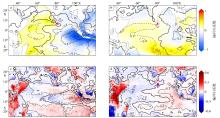
Fig. 9
Distributions of partial regression coefficients of interannual anomalies of SST, shortwave radiation flux, sensible heat flux and latent heat flux in the tropical Indian Ocean and surrounding regions relative to the DMI index. (a) Contemporaneous partial regression coefficients of SST (shaded) and shortwave radiation flux (contours, units: W·m-2·℃-1); (b) partial regression coefficients of SST (shaded) and shortwave radiation flux (contours, units: W·m-2·℃-1) with a 6-month lag; (c) contemporaneous partial regression coefficients of sensible heat flux (shaded, units: W·m-2·℃-1) and latent heat flux (contours, units: W·m-2·℃-1); (d) partial regression coefficients of sensible heat flux (shaded, units: W·m-2·℃-1) and latent heat flux (contours, units: W·m-2·℃-1) with a 6-month lag; the impact of the Niño3.4 index was removed in the partial regression analysis; black dots indicate regions where the partial regression coefficients of SST and sensible heat flux exceed the 95% confidence level on the t-test; the purple triangle marks the location of Colombo, Sir Lanka"
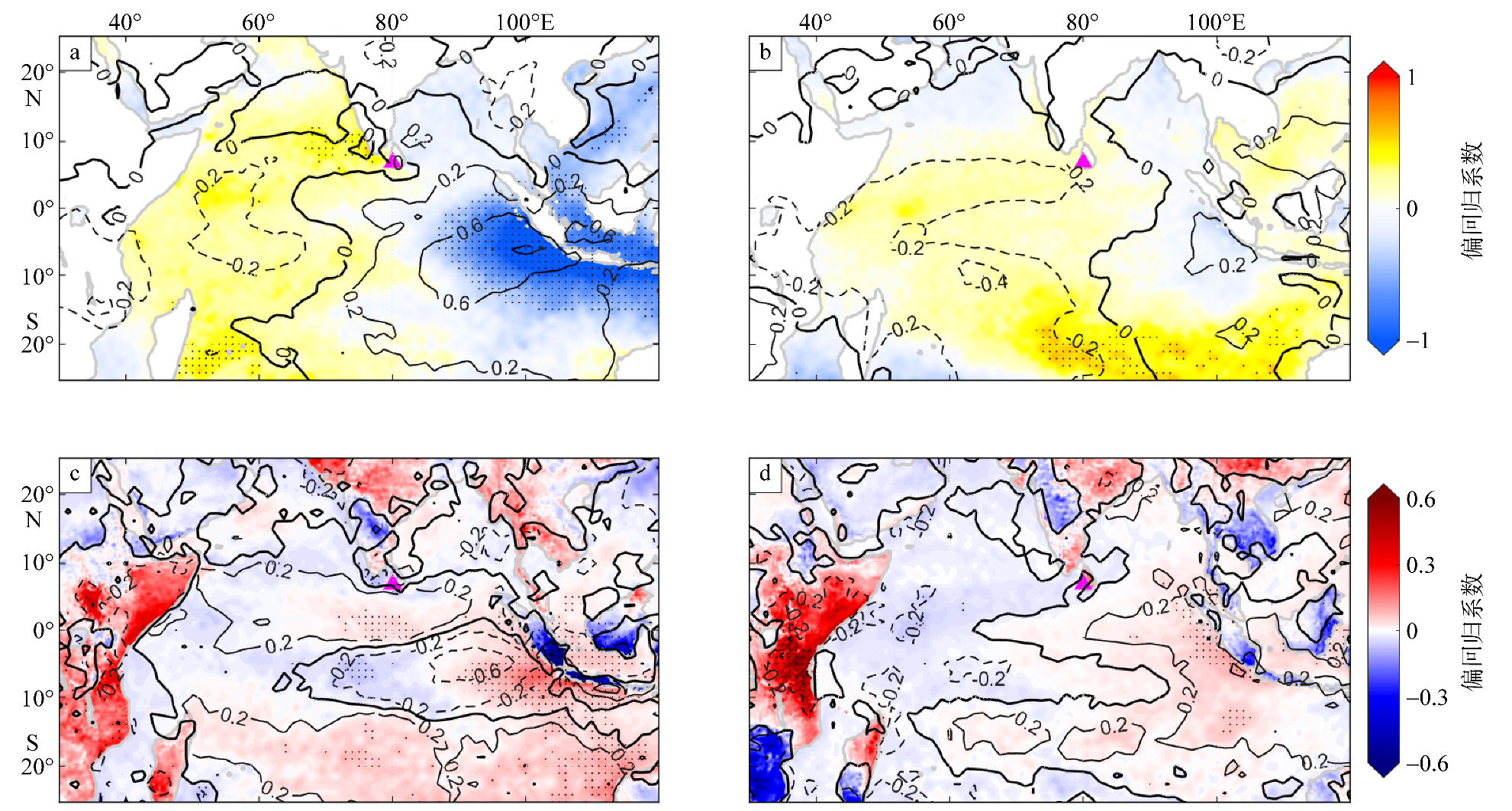
Fig. 9
| [1] |
中国-上海合作组织环境保护合作中心, 2016. 上海合作组织区域和国别环境保护研究(2015)[M]. 北京: 社会科学文献出版社.
|
|
CHINA-SHANGHAI COOPERATION ORGANIZATION ENVIRONMENTAL PROTECTION COOPERATION CENTER, 2016. Studies on regional and country environmental protection of the SCO (2015)[M]. Beijing: Social Sciences Academic Press.
|
|
| [2] |
doi: 10.4038/ta.v167i1.65 |
| [3] |
doi: 10.4038/tar.v32i3.8492 |
| [4] |
doi: 10.1175/2008JCLI2590.1 |
| [5] |
doi: 10.1007/s00382-016-3339-5 |
| [6] |
|
| [7] |
doi: 10.4038/jnsfsr.v43i1.7917 |
| [8] |
doi: 10.1073/pnas.1215582110 pmid: 23610388 |
| [9] |
doi: 10.1007/s00382-016-3328-8 |
| [10] |
doi: 10.1002/joc.v23:10 |
| [11] |
|
| [12] |
doi: 10.1175/JCLI4152.1 |
| [13] |
doi: 10.5194/essd-13-4349-2021 |
| [14] |
|
| [15] |
|
| [16] |
doi: 10.3389/fclim.2024.1361322 |
| [17] |
doi: 10.1175/1520-0493(1983)111<0517:TRBEEP>2.0.CO;2 |
| [18] |
doi: 10.1080/00036846.2019.1597253 |
| [19] |
doi: 10.1175/2009MWR2861.1 |
| [20] |
doi: 10.1016/j.dynatmoce.2004.10.015 |
| [21] |
doi: 10.54302/mausam.v73i3 |
| [22] |
doi: 10.1016/j.jastp.2021.105810 |
| [23] |
doi: 10.1007/s00484-022-02328-9 pmid: 35852659 |
| [24] |
doi: 10.1002/(ISSN)1097-0088 |
| [25] |
doi: 10.1007/s00382-011-1133-y |
| [26] |
|
| [27] |
doi: 10.1175/1520-0442(2002)015<0864:SAMOSI>2.0.CO;2 |
| [28] |
doi: 10.1175/2008JCLI2544.1 |
| [29] |
|
| [30] |
|
| [31] |
|
| [32] |
doi: 10.1002/joc.v28:1 |
| [1] | ZHAO Minghui, SENANAYAKA Dasun, CHENG Jinhui, ZHOU Yong, CAO Lingmin, ZHAO Lei, LUO Yao, ZHANG Zhenqiu, PAN Gang, THALDENA Nilmini, ZHANG Jiazheng, ZHANG Yayun, XU Min. Construction and research prospect of an integrated geological hazards monitoring platform in southern coastal cities of Sri Lanka* [J]. Journal of Tropical Oceanography, 2025, 44(5): 12-21. |
| [2] | HAN Dingyan, LI Min, HU Rui, XIE Lingling. Variation and mechanisms of autumn tropical cyclones landed in Guangdong [J]. Journal of Tropical Oceanography, 2024, 43(1): 64-78. |
| [3] | MA Yu, WANG Weiqiang, YOU Qinglong, XIN Hongyu. The evolution and energy characteristics of the Sri Lanka Dome* [J]. Journal of Tropical Oceanography, 2023, 42(5): 1-16. |
| [4] | WANG Hao, WANG Jing, ZHENG Jiayu. Climatic characteristics and interannual variability of tropical cyclone rapid intensification in the South Indian Ocean [J]. Journal of Tropical Oceanography, 2022, 41(1): 94-105. |
| [5] | Zhou LE, Ke HUANG, Subrahmanyam Mantravadi Venkata. Energy characteristics of eddy-mean flow interaction in the estuary of Bay of Bengal in summer and autumn during 2000-2015 [J]. Journal of Tropical Oceanography, 2020, 39(2): 11-14. |
| [6] | Chuang XU,Yongji XU,Jiatang HU,Shiyu LI,Jintao LIU. Study on the seasonal and interannual variability of river plume in the Pearl River Estuary based on a high-resolution ocean dynamic model [J]. Journal of Tropical Oceanography, 2019, 38(3): 43-52. |
| [7] | JIN Xiao-lin, LI Zhong-xian, ZHENG Zhi-hai, WANG Da-jun. Interannual variability of the TIWs and its relationship with the ENSO [J]. Journal of Tropical Oceanography, 2015, 34(3): 30-35. |
| [8] | WANG Jian, DU Yan, ZHENG Shao-jun, LIU Kai. Interannual variability of Indonesian throughflow in the Makassar Strait during 2004~2011 [J]. Journal of Tropical Oceanography, 2014, 33(6): 9-16. |
| [9] | WU Yan-ling,DU Yan,HUANG Zhuo,. Interannual variability of sea surface temperature in the north Indian Ocean associated with ENSO [J]. Journal of Tropical Oceanography, 2012, 31(5): 116-123. |
| [10] | WANG Yin-xia,SHI Ping,ZENG Li-li,XIE Qiang,WANG Dong-xiao. Interannual variation of vegetation and precipitation in Pearl River Basin during 1982−1999 [J]. Journal of Tropical Oceanography, 2011, 30(4): 44-50. |
| [11] | YAN Hong,SUN Li-guang,LIU Xiao-dong,QIU Shi-can. Relationship between ENSO events and regional climate anomalies around the Xisha Islands during the last 50 years [J]. Journal of Tropical Oceanography, 2010, 29(5): 29-35. |
| [12] | O Hui-er,YU Yong-qiang,Liu Hai-long,Lin Peng-fei. Preliminary results from a high resolution Pacific-Indian basin-wide ocean general circulation model [J]. Journal of Tropical Oceanography, 2009, 28(5): 56-65. |
| [13] | HUANG Zhuo,XU Hai-ming,DU Yan,XIE Qiang. Two sea-surface warming events in the South China Sea during and after El Nino [J]. Journal of Tropical Oceanography, 2009, 28(5): 49-55. |
|
||