Journal of Tropical Oceanography >
Experimental study on the propagation and evolution characteristics of cnoidal waves over typical coral reefs
Editor: YIN Bo
Received date: 2025-05-07
Revised date: 2025-06-17
Online published: 2025-07-04
Supported by
National Key Research and Development Program of China(2022YFC3103601)
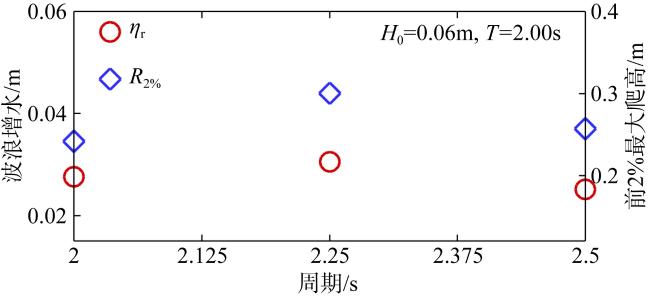
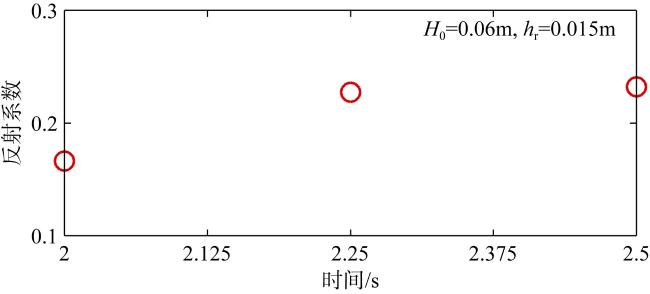
Cnoidal waves can effectively characterize wave motion in shallow water regions, holding significant practical value for the precise description of nearshore hydrodynamic processes. To investigate the propagation and evolution patterns of cnoidal waves over typical reef-lagoon systems, this study conducted physical model experiments in a wave flume, with particular focus on the effects of incident wave height, reef flat submergence, and wave period on wave nonlinear characteristics, energy dissipation, and hydrodynamic parameters. The results demonstrate that reef topography substantially enhances wave nonlinearity, with conspicuous waveform steepening in the fore-reef slope zone and sawtooth-shaped wave profiles accompanied by phase lags over the reef flat. Increased incident wave height induces stronger nonlinear effects, promoting higher harmonic growth and significantly enhancing wave setup and run-up, while reducing reflection coefficients due to enhanced transmission. However, greater reef flat submergence weakens nonlinear wave effects and causes a monotonic decrease in reflection coefficients. Under deeper water conditions, vertical momentum flux intensifies, and run-up exhibits nonlinear growth. The influence of wave period manifests complex patterns: the maximum wave energy concentration and the most pronounced higher harmonics occur at T = 2.25s. Short-period waves (T < 2.25s) experience intensified shoaling deformation that aggravates waveform distortion, whereas long-period waves (T > 2.25s) exhibit characteristic attenuation through energy dissipation. This research provides critical experimental evidence for coral reef ecosystem conservation and coastal engineering design.
ZHANG Ze , QU Ke , LI Wei , WANG Chao . Experimental study on the propagation and evolution characteristics of cnoidal waves over typical coral reefs[J]. Journal of Tropical Oceanography, 2026 , 45(2) : 30 -41 . DOI: 10.11978/2025060
表1 试验工况表Tab. 1 Test conditions |
| 工况编号 | 入射波高/m | 礁坪水深/m | 波浪周期/s | 工况编号 | 入射波高/m | 礁坪水深/m | 波浪周期/s |
|---|---|---|---|---|---|---|---|
| A1 | 0.04 | 0.015 | 2.00 | B3 | 0.06 | 0.030 | 2.00 |
| A2 | 0.06 | 0.015 | 2.00 | B4 | 0.06 | 0.045 | 2.00 |
| A3 | 0.08 | 0.015 | 2.00 | C1 | 0.06 | 0.015 | 2.00 |
| A4 | 0.10 | 0.015 | 2.00 | C2 | 0.06 | 0.015 | 2.25 |
| B1 | 0.06 | 0 | 2.00 | C3 | 0.06 | 0.015 | 2.50 |
| B2 | 0.06 | 0.015 | 2.00 |
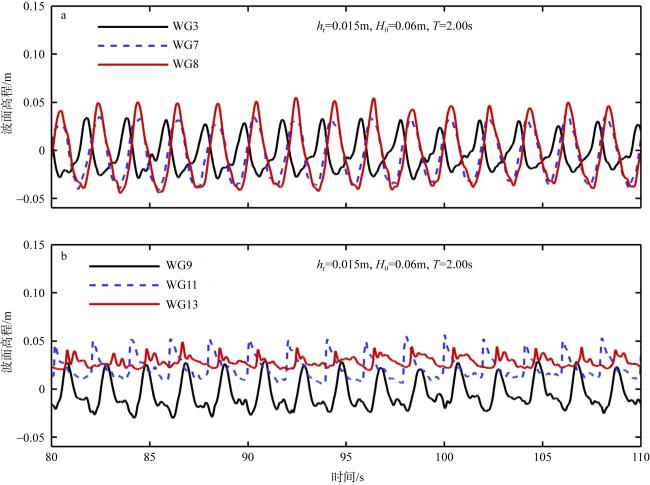
图2 特征测点处波浪自由水面时间序列对比图a. 第3、7、8组浪高仪波面时程曲线; b. 第9、11、13组浪高仪波面时程曲线。hr为礁坪水深; H0为入射波高; T为波浪周期 Fig. 2 Time series comparison of free water surface at characteristic measurement points. (a) Time series of wave surface of wave gauges in groups 3, 7 and 8; (b) Time series of wave surface of wave gauges in groups 9, 11 and 13. hr represents the water depth of the reef flat; H0 represents the incident wave height; T represents the wave period |
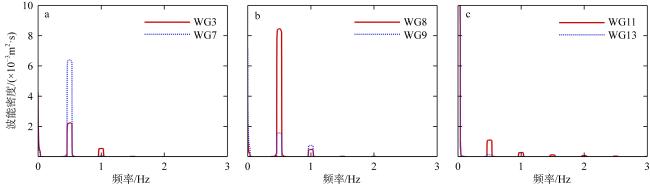
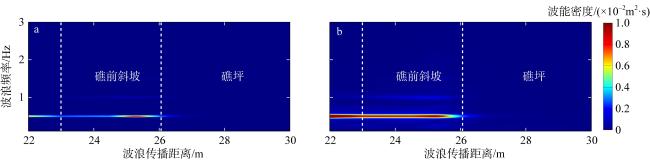
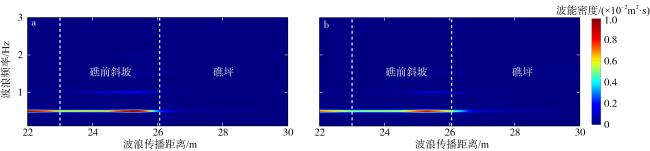
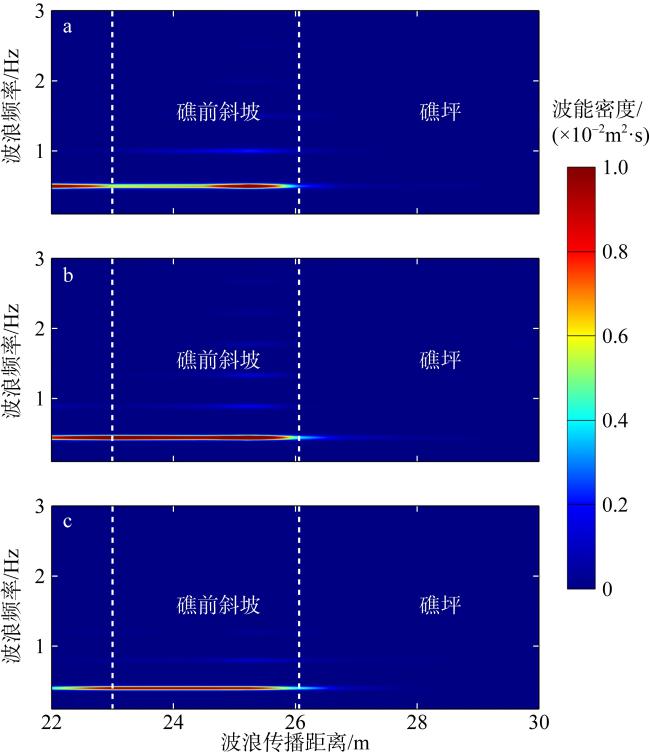
图3 特征测点处波浪能量谱a.第3、7组浪高仪波浪能量谱; b. 第8、9组浪高仪波浪能量谱; c. 第11、13组浪高仪波浪能量谱 Fig. 3 Wave energy spectrum at characteristic measurement points. (a) Wave energy spectra of the 3rd and 7th wave gauges; (b) Wave energy spectra of the 8th and 9th wave gauges; (c) Wave energy spectra of the 11th and 13th wave gauges |
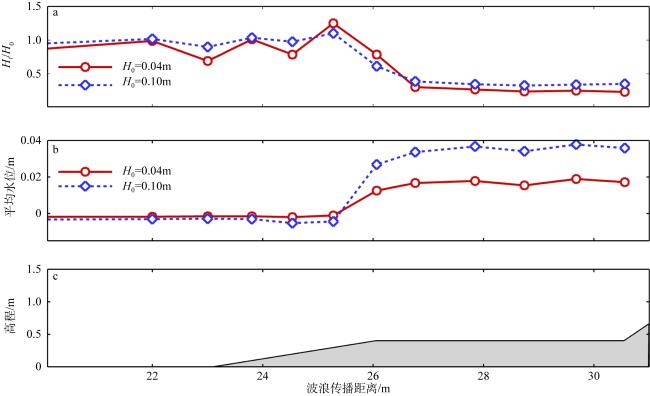
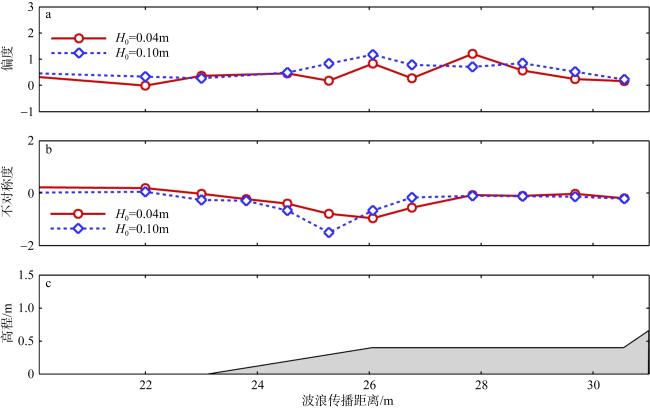
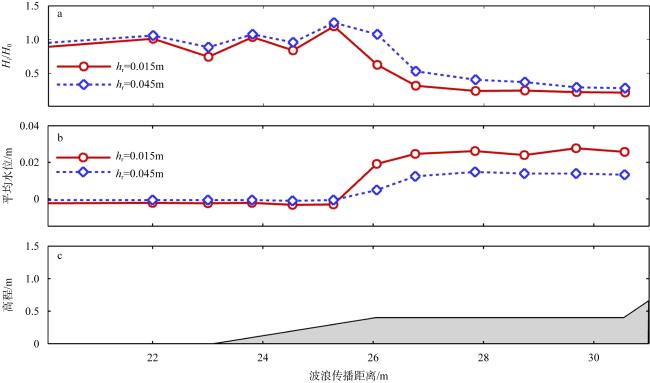
图4 不同入射波高条件下局部波高和平均水位的沿程变化a. 局部波高; b. 平均水位; c. 岛礁地形。H0为入射波高; Hi为当地平均波高 Fig. 4 Along-course variations of local wave height and mean water level under different incident wave height conditions. (a) Local wave height; (b) mean water level; (c) reef topography. Hi represents the average local wave height |
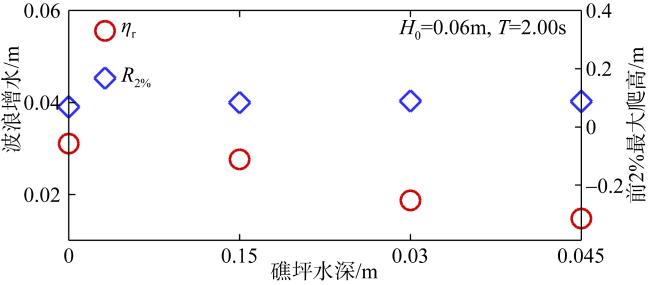
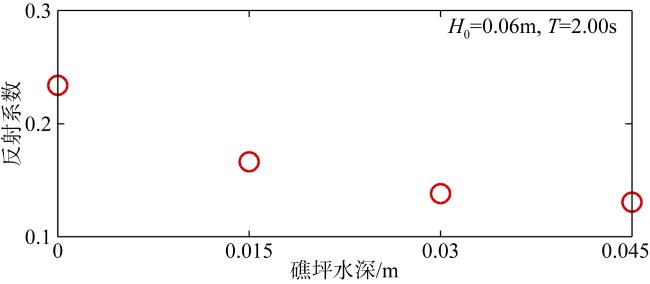
图9 不同礁坪水深(hr)条件下局部波高和平均水位的沿程变化a. 局部波高; b. 平均水位; c. 岛礁地形。H0为入射波高; Hi为当地平均波高 Fig. 9 Along-course variations of local wave height and mean water level under different submergence water depths. (a) local wave height; (b) mean water level; (c) reef topography. H0 represents the height of the incident wave; Hi represents the local average wave height |
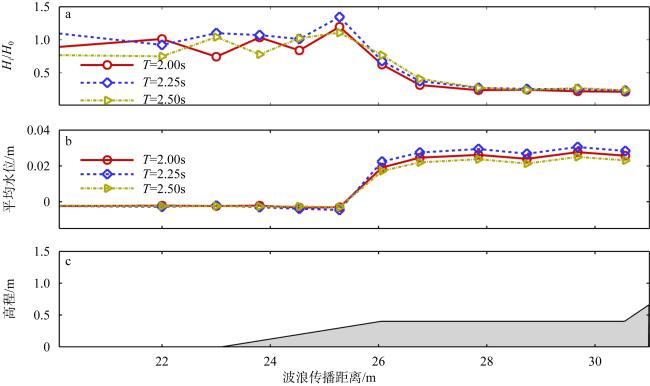
图14 不同波浪周期(T)条件下局部波高和平均水位的沿程变化a. 局部波高; b. 平均水位; c. 岛礁地形。H0为入射波高; Hi为当地平均波高 Fig. 14 Along-course variations of local wave height and mean water level under different wave period conditions. (a) Local wave height; (b) mean water level; (c) reef topography. T represents the wave period; H0 represents the height of the incident wave; Hi represents the local average wave height |
| [1] |
顾家龙, 沈先荣, 1989. 椭圆余弦波的数值计算及其特性研究[J]. 海洋工程, 7(1): 30-40.
|
| [2] |
李玮, 屈科, 王超, 等, 2025. 潜堤对岛礁次重力波波浪特性影响的试验研究[J]. 热带海洋学报, 44(4): 177-186.
|
| [3] |
刘维杰, 宁越, 2023. 基于精确色散Boussinesq方程的珊瑚礁波浪传播模拟[J]. 长沙理工大学学报(自然科学版), 20(4): 47-54.
|
| [4] |
邱大洪, 1981. 椭园余弦波及其应用[J]. 港口工程, 1(1): 2-6.
|
| [5] |
任冰, 唐洁, 王国玉, 等, 2018. 规则波在岛礁地形上传播变化特性的试验[J]. 科学通报, 63(S1): 590-600.
|
| [6] |
孙书敏, 1989. 波浪浅水变形的数值计算[J]. 黄渤海海洋, 7(4): 11-17.
|
| [7] |
王超, 屈科, 王旭, 等, 2024. 类海啸波在非平整岛礁上传播与演变的试验研究[J]. 热带地理, 44(10): 1838-1846.
|
| [8] |
肖波, 邱大洪, 俞聿修, 1991. 实验室中椭圆余弦波的产生[J]. 海洋学报, 13(1): 137-144.
|
| [9] |
姚宇, 2019. 珊瑚礁海岸水动力学问题研究综述[J]. 水科学进展, 30(1): 139-152.
|
| [10] |
姚宇, 唐政江, 杜睿超, 等, 2017. 珊瑚礁破碎带附近波浪演化和波生流实验研究[J]. 海洋科学, 41(2): 12-19.
|
| [11] |
|
| [12] |
|
| [13] |
|
| [14] |
|
| [15] |
|
| [16] |
|
| [17] |
|
| [18] |
|
| [19] |
|
| [20] |
|
| [21] |
|
/
| 〈 |
|
〉 |