

热带海洋学报 ›› 2026, Vol. 45 ›› Issue (5): 16-34.doi: 10.11978/YG2025012CSTR: 32234.14.YG2025012
基于南沙美济礁深钻的南海南部新生代构造演化研究
黎刚1( ), 徐维海1, 罗云1, 刘建国1, 赵建新2, 俸月星2, 程俊1, 孙珍1, 向荣1, 徐敏1, 颜文1,3()
- 1
中国科学院南海海洋研究所 ,热带海洋环境与岛礁生态全国重点实验室, 边缘海与大洋地质实验室
2昆士兰大学地球与环境科学学院放射性同位素实验室
3中国科学院大学
-
收稿日期:2025-11-29修回日期:2026-02-05出版日期:2026-09-10发布日期:2026-10-13 -
通讯作者:颜文 -
作者简介:黎刚(1981—), 四川省仁寿市人, 研究员, 从事珊瑚礁沉积成岩过程研究。email: gangli@scsio.ac.cn
-
基金资助:国家重点研发计划项目(2021-06); 国家自然科学基金项目(42176079); 国家自然科学基金项目(42376079); 国家自然科学基金项目(42406063); 广东省基础与应用基础研究基金项目(2025A1515012022); 广东省基础与应用基础研究基金项目(2025A1515010958); 中国科学院南海海洋研究所基础前沿与创新发展项目(SCSIO2023QY05)
The Cenozoic tectonic evolution of the southern South China Sea: stratigraphic evidence from a deep borehole in Meiji Atoll
LI Gang1(), XU Weihai1, LUO Yun1, LIU Jianguo1, ZHAO Jianxin2, FENG Yuexing2, CHENG Jun1, SUN Zhen1, XIANG Rong1, XU Min1, YAN Wen1,3()
- 1
South China Sea Institute of Oceanology ,Chinese Academy of Sciences, State Key Laboratory of Tropical Oceanography, Laboratory of Ocean and Marginal Sea Geology
2Radiogenic Isotope Facility ,School of Earth Sciences, The University of Queensland
3University of Chinese Academy of Sciences
-
Received:2025-11-29Revised:2026-02-05Online:2026-09-10Published:2026-10-13 -
Contact:YAN Wen -
Supported by:National Key Research and Development Program of China(2021-06); National Natural Science Foundation of China(42176079); National Natural Science Foundation of China(42376079); National Natural Science Foundation of China(42406063); Guangdong Basic and Applied Basic Research Foundation(2025A1515012022); Guangdong Basic and Applied Basic Research Foundation(2025A1515010958); Special Fund of South China Sea Institute of Oceanology of the Chinese Academy of Sciences(SCSIO2023QY05)

摘要:
南海的新生代构造演化与东南亚岛弧的俯冲-碰撞过程密切相关。尽管通过多次大洋钻探计划(ocean drilling program, ODP)与国际大洋发现计划(international ocean discovery program, IODP)钻探, 已经基本明晰了南海海盆张裂与扩张历史, 但其扩张结束后的构造演化过程仍缺乏准确的年代学约束, 特别是对于南沙地块与沙巴—巴拉望岛碰撞结束的时代存在诸多争议。2017年实施的南科1井深钻, 揭示了南沙群岛美济礁新生界碳酸盐岩地层的完整剖面。基于南科1井997m碳酸盐岩岩芯, 文章综合高分辨率锶同位素与激光原位U-Pb年龄, 建立了美济礁碳酸盐岩年代地层格架, 为厘定南海南部新生代构造演化历史提供了新的年代学约束。在美济礁南科1井中部538.6m处发现了中中新世沉积间断面以及间断面之下数百米厚的风化杂色沉积层。锶同位素年代和激光U-Pb年代结果显示了该风化剥蚀面上下地层年代相差约9Ma。基于区域地层对比推测南科1井中中新世沉积间断是由南沙地块南缘的构造抬升引起的。在中中新世期间, 南沙地块南缘的挠曲伴随着其向巴拉望南缘的俯冲以及北婆罗洲的造山运动。南科1井中中新世沉积间断面的形成与南海南部中中新世活跃的挤压碰撞有关。美济礁在中中新世沉积间断之上的碳酸盐沉积代表了此次碰撞事件在南海南部的终结, 其结束时代约在11Ma, 晚于南海海盆停止扩张的时代(约15Ma)。
中图分类号:
- P736.1
引用本文
黎刚, 徐维海, 罗云, 刘建国, 赵建新, 俸月星, 程俊, 孙珍, 向荣, 徐敏, 颜文. 基于南沙美济礁深钻的南海南部新生代构造演化研究[J]. 热带海洋学报, 2026, 45(5): 16-34.
LI Gang, XU Weihai, LUO Yun, LIU Jianguo, ZHAO Jianxin, FENG Yuexing, CHENG Jun, SUN Zhen, XIANG Rong, XU Min, YAN Wen. The Cenozoic tectonic evolution of the southern South China Sea: stratigraphic evidence from a deep borehole in Meiji Atoll[J]. Journal of Tropical Oceanography, 2026, 45(5): 16-34.
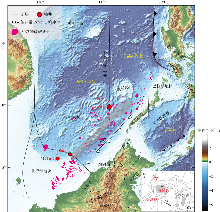
图1
南海南部水下地形及中新统碳酸盐岩分布图以及南科1井位置 该图基于自然资源部标准地图服务网站下载的审图号为琼S(2024)044号的标准地图绘制, 底图无修改。中南—礼乐断裂带南部走向仅依据推测, 用虚线段表示, 婆罗洲上的虚线代表了主要构造区域的分带界线。右下角标注了美济礁岛坡地震剖面位置(M1), 图中灰色曲线表示等深线。中新统碳酸盐岩分布依据Schlüter等(1996), Li等(2014), Steuer等(2014), Wang等(2016)"

图1
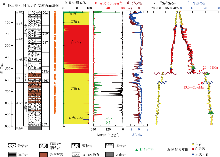
图2
南科1井的岩性地层图及主要矿物、地球化学特征 a. 岩性与珊瑚分布; b. 矿物组成; c. Al、Fe和Mn含量; d. δ18O和δ13C同位素组成; e. 剔除23个杂色样品数据后, 87Sr/86Sr比值总体呈单调递增趋势; f. 数值Sr同位素年龄。南湾组、美济组、礼乐组中4个激光U-Pb年代结果与87Sr/86Sr年龄基本吻合, 显示出两个沉积间断面(红色波浪线和蓝色波浪线位置)"
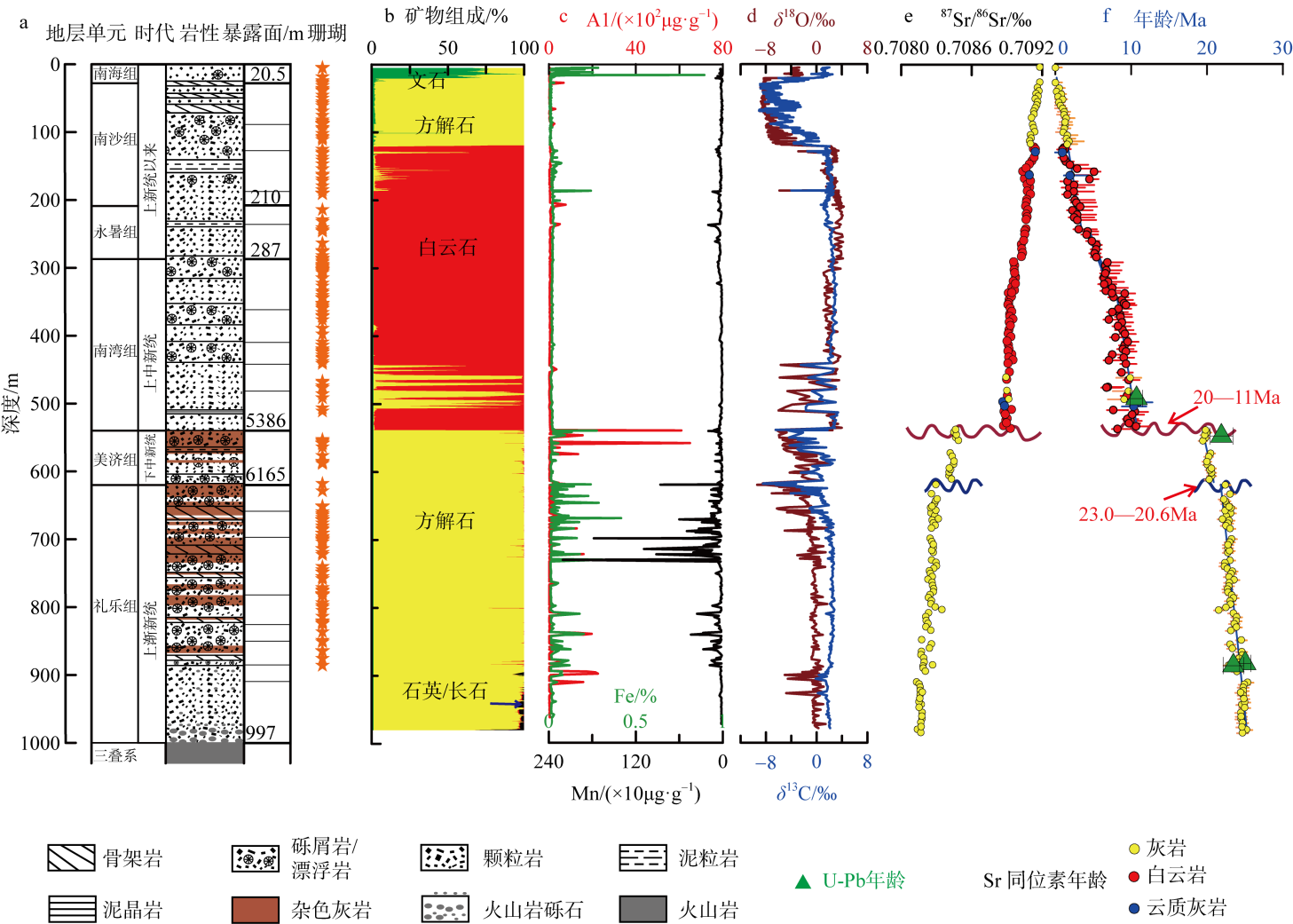
图2
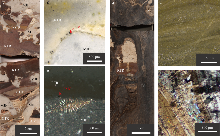
图3
岩芯切片和薄片照片, 显示了美济组和礼乐组中与地表暴露和风化作用相关的岩石学特征 a. 美济组上部(541.0m处)孔隙中充填的红色泥岩; b、c. 大部分充填物为钙质泥岩, 含少量生物壳体。细小的铁锰结核沿红色泥岩与生物碎屑灰岩的边界富集; d. 礼乐组上部(619.7m处)的暗棕色流石, 由保存完好的亮晶方解石组成, 具有清晰的毫米级层状结构; e、f. 图3d中的流石薄片照片。图中MJF表示美济组; OTR表示橄榄色泥岩; RTR表示红色泥岩; CM表示钙质泥岩; FMC表示铁锰结核; LYF表示礼乐组; FS表示流石"
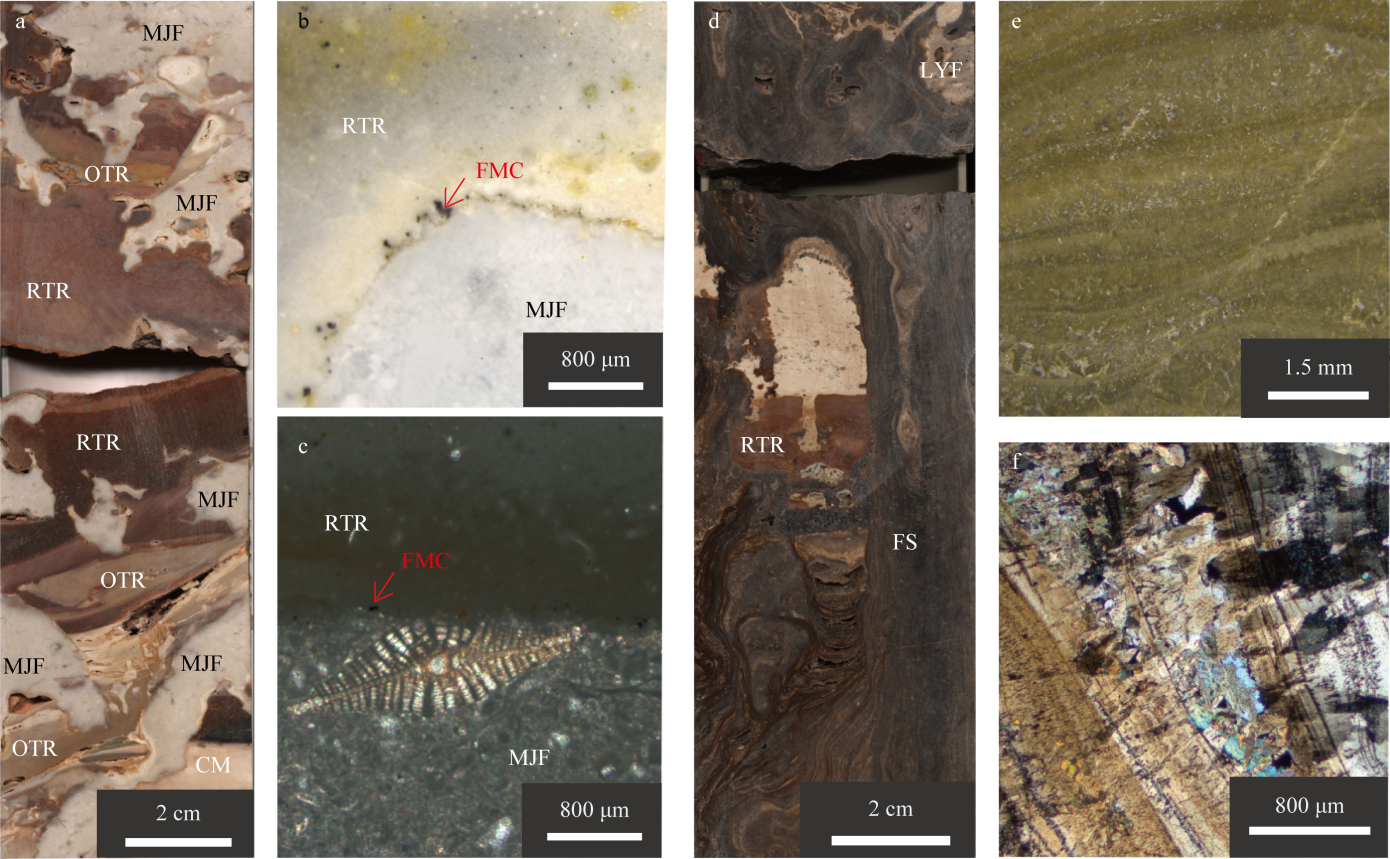
图3
图4
南科1井中生物碳酸盐岩稀土元素含量平均值和部分杂色灰岩的PAAS标准化稀土元素配分模式 稀土元素的参考数据包括南海南部表层海水(Alibo et al, 1999)、细粒陆源沉积物(Wan et al, 2017)以及巴布亚新几内亚Tutum Bay喷口流体的文石(Pichler et al, 2004)"
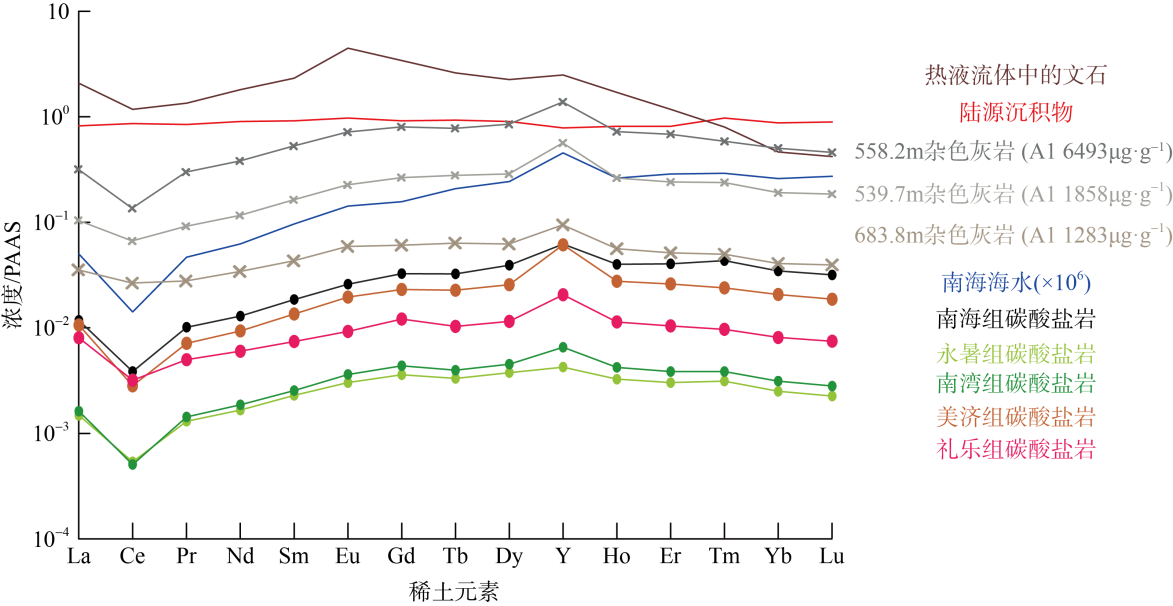
图4
图5
正交偏光下南科1井中典型成岩相的薄片显微照片 a. 结构保留白云岩, 白云石胶结物分布在双壳类和底栖有孔虫的铸模孔周围; b. 结构保留生物碎屑白云岩, 可见底栖有孔虫、自形和半自形白云石晶体充填粒间孔隙; c. 白云石化红藻碎片; d. 大气渗流带的强烈溶蚀灰岩, 孔隙部分被微亮晶方解石胶结物充填; e. 粒间孔隙中的两期胶结作用, 放射状-刃状方解石晶体覆盖在等厚纤维状胶结物之上; f. 骨骼孔隙中的两期胶结作用, 等厚纤维状胶结物蚀变为刃状方解石晶体。各图右上角数字表示取样深度"
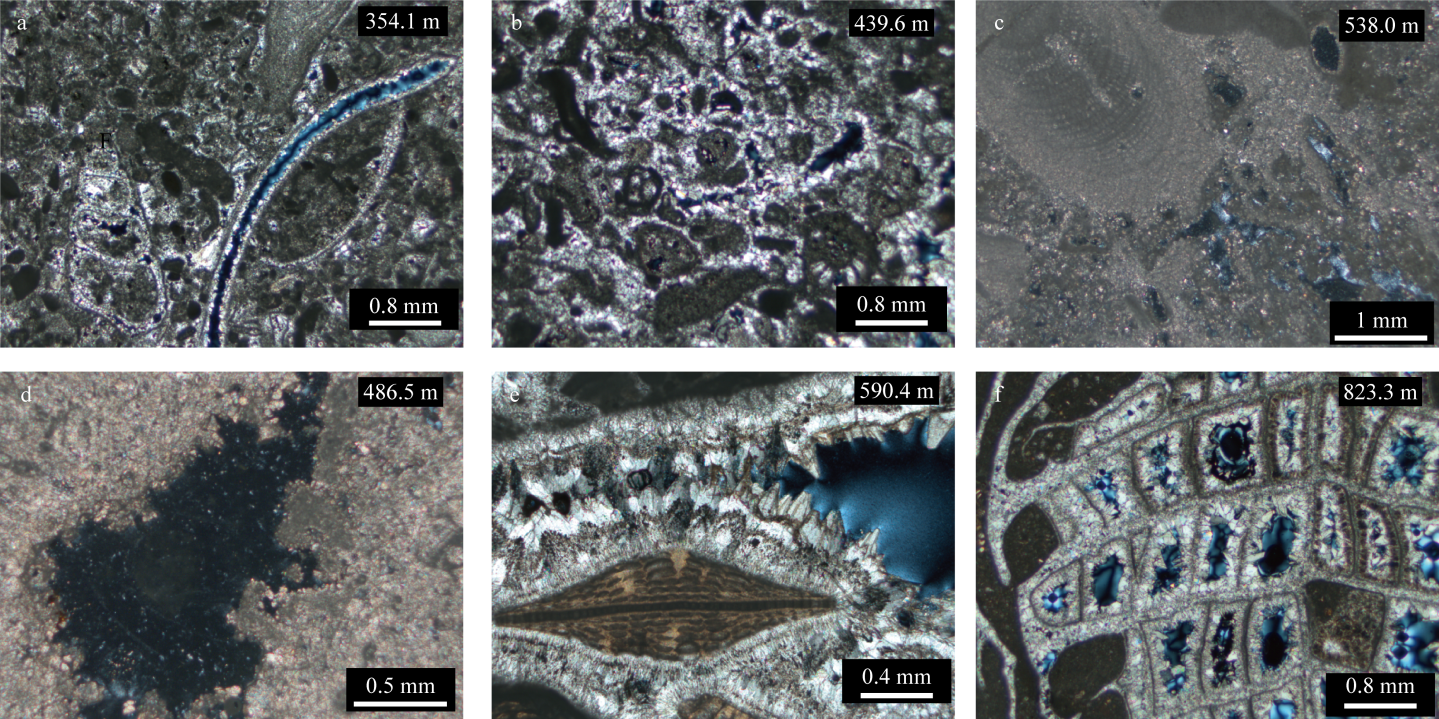
图5
图6
南科1井4个样品的U-Pb数据的Tera-Wasserburg谐和图和年龄 a. 样品4, 年龄为(10.7±0.8)Ma, 取样深度493.03m; b. 样品3, 年龄为(21.9±1.5)Ma, 取样深度548.33m; c. 样品1, 年龄为(25.0±0.7)Ma, 取样深度883.75m; d. 样品7, 年龄为(23.5±1.4)Ma, 取样深度887.05m。褐色曲线表示谐和曲线; 曲线上的数字为封闭条件下矿物沉淀结晶理论年龄; 黑色直线表示不谐和线; 直线上的红色为测量点误差椭圆"
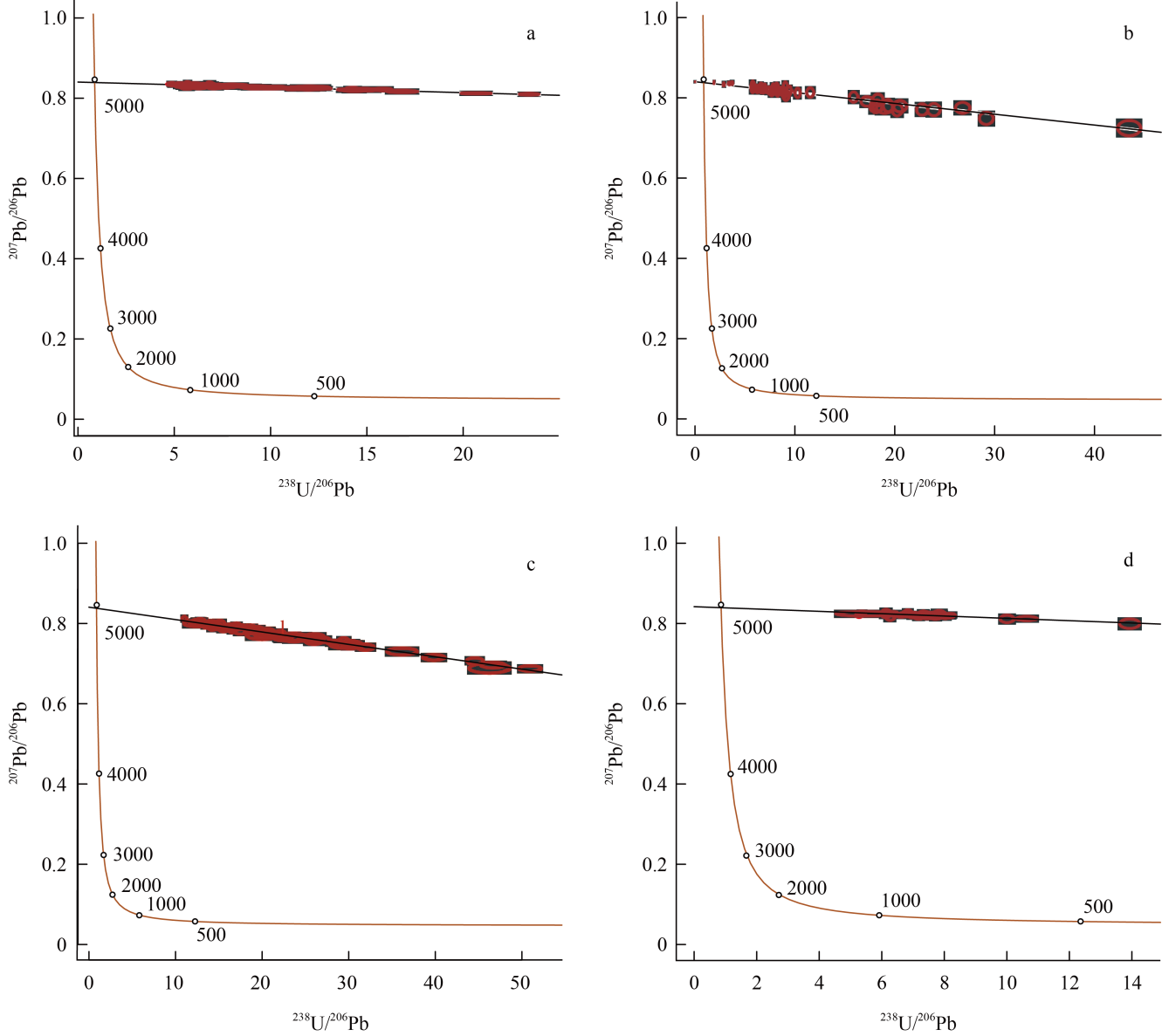
图6
图7
美济环礁东北坡北西西向地震剖面M1 原图(a)和解释图(b)以及南科1井简化的岩芯地层序列(c) 根据Hinz等(1985), 区域地震反射界面被命名为R (Red, 红线)、B (Blue, 浅蓝线, 和红线重合)、B* (Blue*, 深蓝线)和V (Violet, 紫线) 4个不整合面。黑色竖柱表示南科1井, 黑色线段表示断层位置, 箭头指示为半深海沉积, 白色位置表示生物礁沉积。图c图例中的数字为年龄, 按照图中星号位置从上往下顺序对应。图c中黄色和蓝色仅为了突出显示"

图7
图8
南科1井500~800m井段的87Sr/86Sr比值与碳酸盐岩相中Al含量 红色空心圆表示不溶残渣的87Sr/86Sr比值, 黑色圆点代表杂色样品, 褐色圆点表示87Sr/86Sr比值。黄色条带为Al含量较高的样品, 陆源Sr的污染用红色箭头标出。R/B (红色波浪线)、B* (深蓝波浪线)为不整合面"
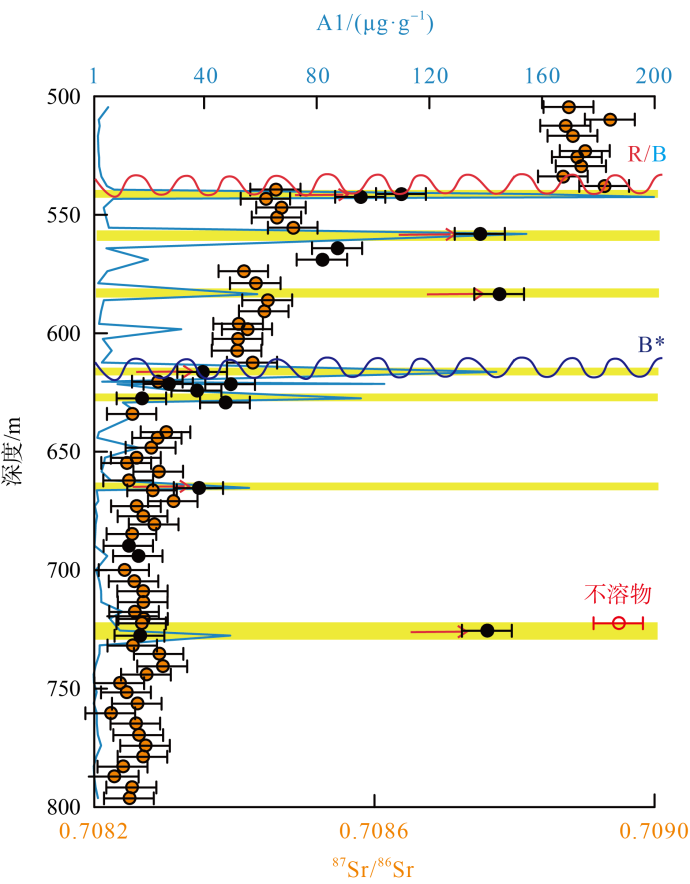
图8
图9
不同成岩带内灰岩和白云岩的87Sr/86Sr年龄 a. 120.5m处灰岩向白云岩的过渡带; b. 南湾组下部, 在大气环境中形成的灰岩与白云岩层互层; c. 美济组和礼乐组上部的灰岩"
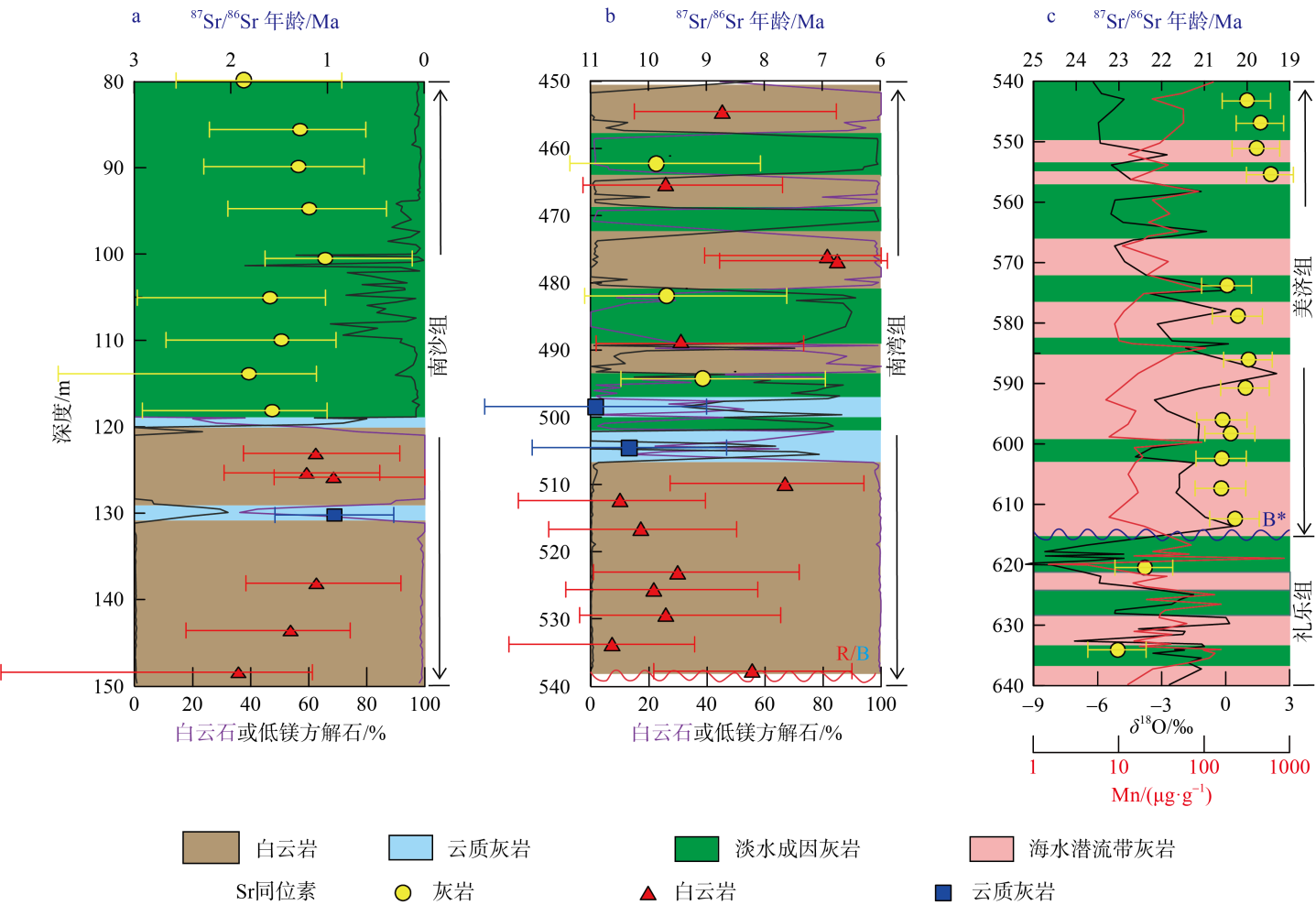
图9
图10
婆罗洲—巴拉望岛及南海南部的新生代地层对比 修订的米里带和北沙巴的地层年表据Breitfeld等(2020)、Burley等(2021)、Hennig-Breitfeld等(2019)和van Hattum等(2013)及其中引用的资料。曾母盆地区和南巴拉望陆架的地层划分基于Krebs (2011)、Madon等(2013)和Steuer等(2013)。全球海平面曲线据Miller等(2020), 并标出了中新世的主要构造事件。前人文献中命名的主要不整合面包括: 浅区域不整合面(shallow regional unconformity, SRU)、中中新世不整合面(middle Miocene unconformity, MMU)、Red和Blue不整合面(Red、Blue)、克罗克组顶不整合面(top Crocker unconformity, TCU)、尼亚劳不整合面(Nyalau unconformity, NU)、Blue*和Violet不整合面(Blue*、Violet)以及基底中新世不整合面(base Miocene unconformity, BMU)。图中白色段表示地层缺失; 波浪线表示为不整合面; 交叉条纹表示为碳酸盐岩沉积, 其他为碎屑岩沉积; 曾母盆地中钻井(Mulu-1、Bako-1)位置见图1"
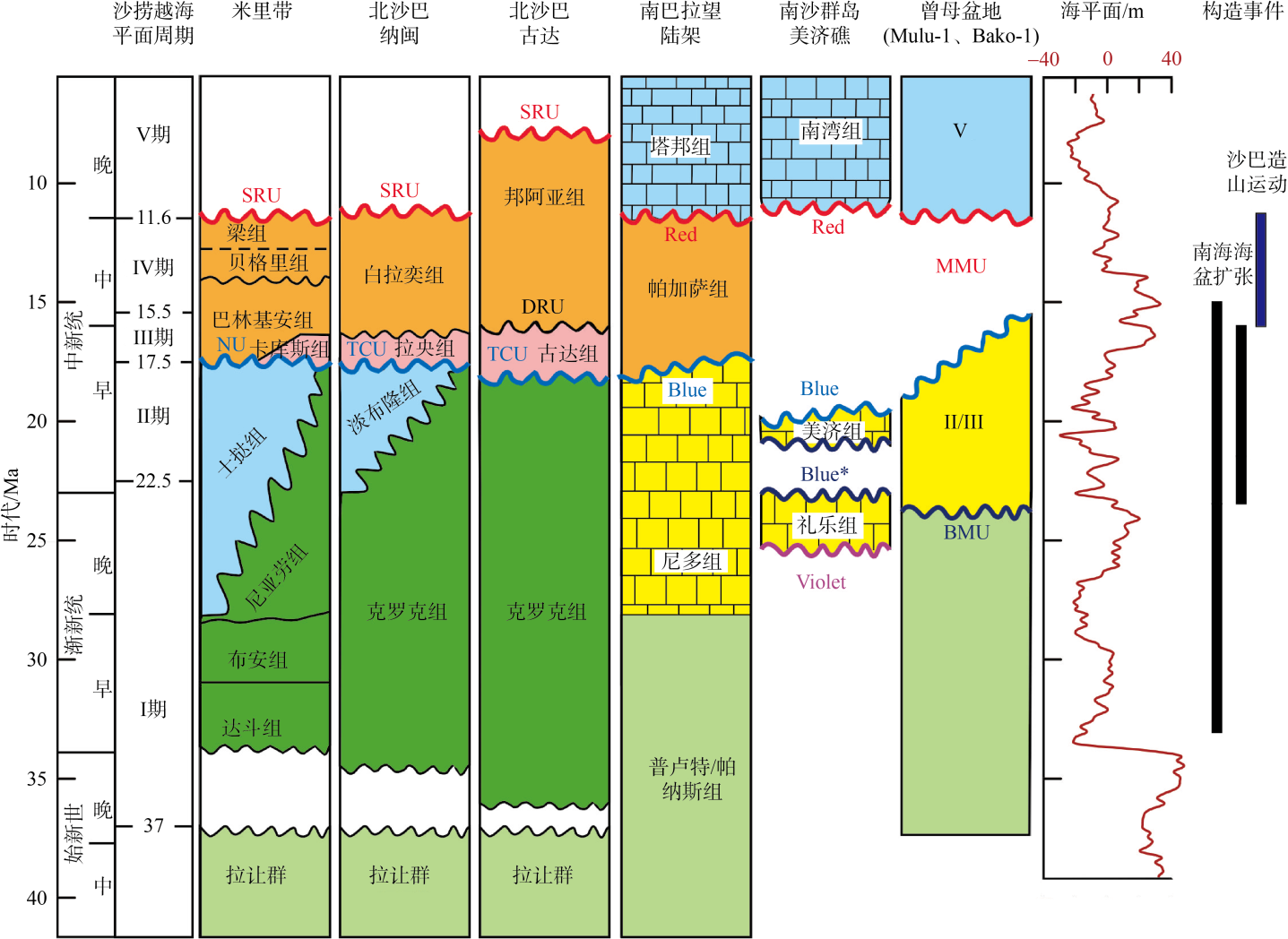
图10
图11
中中新世以来南海南部边缘构造演化图 a. 在南海扩张期间(18—15Ma), 南沙地体的俯冲启动了北婆罗洲的中新世碰撞造山带、南沙地块南缘挠曲以及一些构造地垒(如美济礁)的抬升; b. 南海扩张停止后(15—11Ma), 由于与菲律宾活动带的碰撞以及婆罗洲在中中新世晚期逆时针旋转, 南沙地块南部边缘仍保持挤压构造环境; c. 中中新世南海南缘广泛抬升后(11Ma之后), 由于吕宋岛的北向运动, 南海南部边缘的挤压构造趋于结束。构造演化图据Hall (2013)、Lai等(2021)、Madon等(2013)和Tsikouras等(2021)。图中红色实线和白色箭头表示海盆扩张脊和海盆扩张方向, 黑色实线表示南海次海盆之间的断层; 紫色箭头示意板块运动方向。小图中的黄色部分表示生物礁沉积层, 褐色部分表示基底岩石, 箭头表示基底构造运动"
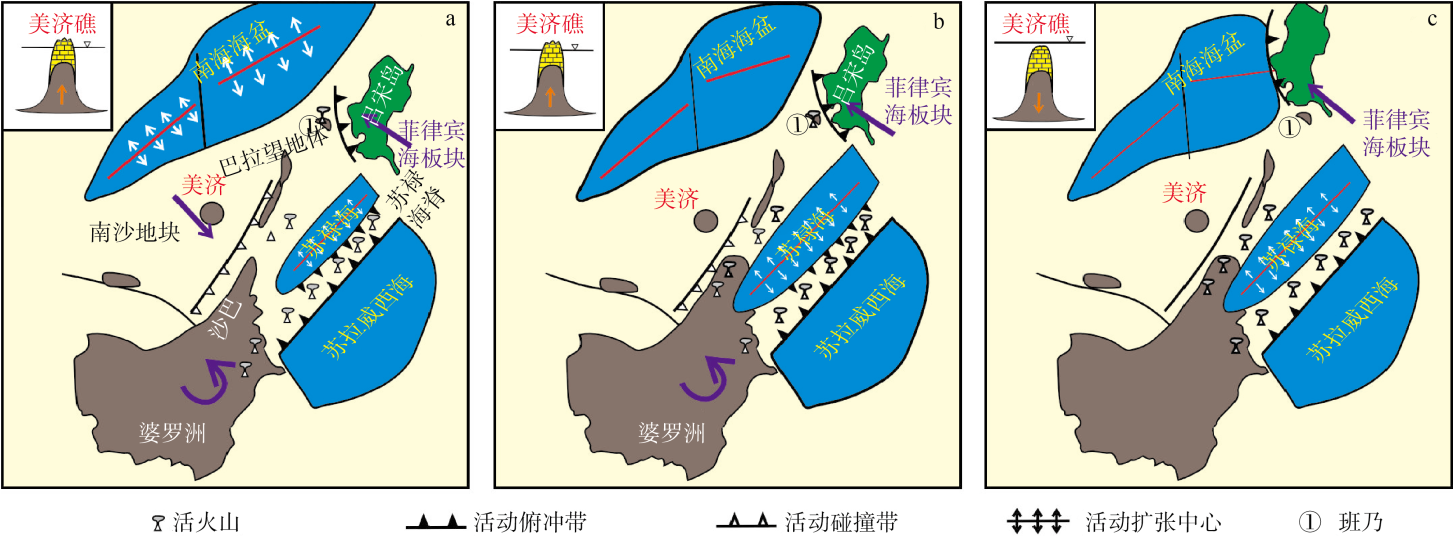
图11
| [1] |
关成尧, 漆家福, 张厚和, 等, 2022. 南沙海域盆地群早中新世“挤压隆升幕”及其构造意义[J]. 地质科学, (1): 139-155.
|
|
|
|
| [2] |
孙珍, 赵中贤, 李家彪, 等, 2011. 南沙地块内破裂不整合与碰撞不整合的构造分析[J]. 地球物理学报, 54(12): 3196-3209.
|
|
|
|
| [3] |
王利杰, 姚永坚, 李学杰, 等, 2019. 南沙东部海域裂陷结束不整合面时空迁移规律及构造意义[J]. 地球物理学报, 62(12): 4766-4781.
|
|
|
|
| [4] |
吴时国, 朱伟林, 马永生, 2018. 南海半封闭边缘海碳酸盐台地兴衰史[J]. 海洋地质与第四纪地质, 38(6): 1-17.
|
|
|
|
| [5] |
姚永坚, 杨楚鹏, 李学杰, 等, 2013. 南海南部海域中中新世(T3界面)构造变革界面地震反射特征及构造含义[J]. 地球物理学报, 56(4): 1274-1286
|
|
|
|
| [6] |
赵帅, 李学杰, 姚永坚, 等, 2019. 南海南部造山运动及其与古南海俯冲的成因联系[J]. 海洋地质与第四纪地质, 39(5): 147-162.
|
|
|
|
| [7] |
周建辉, 白金峰, 2009. 熔融玻璃片制样-X射线荧光光谱测定页岩中主量元素[J]. 岩矿测试, 28(2): 179-181.
|
|
|
|
| [8] |
|
| [9] |
|
| [10] |
|
| [11] |
|
| [12] |
|
| [13] |
|
| [14] |
|
| [15] |
|
| [16] |
|
| [17] |
|
| [18] |
|
| [19] |
|
| [20] |
|
| [21] |
|
| [22] |
|
| [23] |
|
| [24] |
|
| [25] |
|
| [26] |
|
| [27] |
|
| [28] |
|
| [29] |
|
| [30] |
|
| [31] |
|
| [32] |
|
| [33] |
|
| [34] |
|
| [35] |
|
| [36] |
|
| [37] |
|
| [38] |
|
| [39] |
|
| [40] |
|
| [41] |
|
| [42] |
|
| [43] |
|
| [44] |
|
| [45] |
|
| [46] |
|
| [47] |
|
| [48] |
|
| [49] |
|
| [50] |
|
| [51] |
|
| [52] |
|
| [53] |
|
| [54] |
|
| [55] |
|
| [56] |
|
| [57] |
|
| [58] |
|
| [59] |
|
| [60] |
|
| [61] |
|
| [62] |
|
| [63] |
|
| [64] |
|
| [65] |
|
| [66] |
|
| [67] |
|
| [68] |
|
| [69] |
|
| [70] |
|
| [71] |
|
| [72] |
|
| [73] |
|
| [74] |
|
| [75] |
|
| [76] |
|
| [77] |
|
| [78] |
|
| [79] |
|
| [80] |
|
| [81] |
|
| [82] |
|
| [83] |
|
| [84] |
|
| [85] |
|
| [86] |
|
| [87] |
|
| [88] |
|
| [89] |
|
| [90] |
|
| [91] |
|
| [92] |
|
| [93] |
|
| [94] |
|
| [95] |
|
| [96] |
|
| [97] |
|
| [98] |
|
| [99] |
|
| [100] |
|
| [101] |
|
| [102] |
|
| [103] |
|
| [104] |
|
| [105] |
|
| [106] |
|
| [1] | 罗云, 黎刚, 张喜洋, 徐维海, 朱小畏, 周婉秋, 黄慧文, 钟福昌, 颜文. 基于美济礁深钻的南海岛礁差异白云石化过程研究[J]. 热带海洋学报, 2026, 45(5): 108-127. |
| [2] | 王婵, 刘皓, 徐维海. 三叠纪古太平洋俯冲: 南海南部陆缘的岩浆记录*[J]. 热带海洋学报, 2026, 45(5): 53-79. |
| [3] | 黄康俊, 张攀, 冯东, 颜文. 海相碳酸盐岩体系镁同位素组成控制因素及其指示意义*[J]. 热带海洋学报, 2026, 45(5): 146-161. |
| [4] | 苏翔, 向荣, 易亮, 张强, 张亚南, 秦国权, 万随, 颜文. 南沙群岛新近纪碳酸盐台地中的微体化石及其意义*[J]. 热带海洋学报, 2026, 45(5): 80-93. |
| [5] | 朱小畏, 莫梓谊, 茅晟懿, 田雨杭, 罗云, 苗莉, 徐维海, 黎刚, 颜文. 南沙美济礁南科1井生物标志物组成分布特征及其环境指示*[J]. 热带海洋学报, 2026, 45(5): 162-177. |
| [6] | 刘建国, 黄云, 徐维海, 黎刚, 向荣, 苏翔, 罗云, 赵中贤, 颜文. 南海美济珊瑚礁的形成与演化*[J]. 热带海洋学报, 2026, 45(5): 94-107. |
| [7] | 苗秀全, 张运迎, 颜文. 海扩张机制的制约*[J]. 热带海洋学报, 2026, 45(5): 35-52. |
| [8] | 邸鹏飞, 李牛, 宫尚桂, Jörn Peckmann, 王淑红, 陈多福, 颜文. 碳酸盐结合硫酸盐记录海水硫酸盐的δ34S和δ18O: 来自南海南部礁相碳酸盐岩的启示*[J]. 热带海洋学报, 2026, 45(5): 178-198. |
| [9] | 李东平, 石豪磊, 罗中原, 曹建涛, 贾国东. 南海表层水悬浮颗粒物脂肪酸组成特征及其生态指示意义*[J]. 热带海洋学报, 2026, 45(3): 61-73. |
| [10] | 张云帆, 唐丹玲, 孙珍, 邱宁. 南海U形海疆线的地质构造特征研究[J]. 热带海洋学报, 2026, 45(3): 10-24. |
| [11] | 李开枝, 黄良民, 尹健强, 连喜平, 柳原, 谭烨辉. 我国南海浮游动物生态学研究回顾与展望[J]. 热带海洋学报, 2026, 45(2): 1-15. |
| [12] | 梁顺, 黄桂槟, 何国梅, 张永垂, 周毅, 汪洋, 洪梅. 南海土台风时空变化特征分析[J]. 热带海洋学报, 2026, 45(2): 59-70. |
| [13] | 刘泽宇, 张国成, 王媛媛. 珠江三角洲河口湾现代生物遗迹的组成和分布特征[J]. 热带海洋学报, 2025, 44(6): 39-50. |
| [14] | 赵明辉, SENANAYAKA Dasun, 程锦辉, 周勇, 曹令敏, 赵磊, 罗耀, 张镇秋, 潘刚, THALDENA Nilmini, 张佳政, 张亚运, 徐敏. 斯里兰卡沿海城市综合地质灾害监测平台建设与研究展望*[J]. 热带海洋学报, 2025, 44(5): 12-21. |
| [15] | 陈钰宸, 付东洋, 陶邦一, 李姬喆, 祝依娴, 刘贝, 林烨, 柴霞. 南海典型岛礁浅海地形遥感监测及时序变化研究*[J]. 热带海洋学报, 2025, 44(5): 140-153. |
|
||