

热带海洋学报 ›› 2026, Vol. 45 ›› Issue (2): 81-95.doi: 10.11978/2025074CSTR: 32234.14.2025074
基于GDCSM_Argo的西北太平洋中上层海洋热含量与台风的调控与响应关系初探
束波1( ), 张春玲1,2,3(), 苏涵1, 胡松1,2,3
- 1
上海海洋大学海洋科学与生态环境学院
2上海海洋大学海洋科学与技术实验教学示范中心
3自然资源部海洋生态监测与修复技术重点实验室
-
收稿日期:2025-06-05修回日期:2025-07-29出版日期:2026-03-10发布日期:2026-03-26 -
通讯作者:张春玲, 博士, 副教授, 主要从事生态动力学研究。email: clzhang@shou.edu.cn -
作者简介:束波(2000—), 男, 江苏省苏州市人, 硕士研究生, 从事海洋动力学方面研究。email: m230200639@st.shou.edu.cn
-
基金资助:浮标专项外协项目(D-8006-21-0082)
A preliminary study on the regulatory and responsive relationship between upper and middle ocean heat content and typhoons in the northwestern Pacific based on GDCSM_Argo
SHU Bo1(), ZHANG Chunling1,2,3(), SU Han1, HU Song1,2,3
- 1
College of Oceanography and Ecological Science ,Shanghai Ocean University
2Demonstration Center for Experimental Teaching of Marine Science and Technology ,Shanghai Ocean University
3Key Laboratory of Marine Ecological Monitoring and Restoration Technologies ,Ministry of Natural Resources
-
Received:2025-06-05Revised:2025-07-29Online:2026-03-10Published:2026-03-26 -
Contact:ZHANG Chunling. email: clzhang@shou.edu.cn -
Supported by:Float Special Outsourcing Project(D-8006-21-0082)

摘要:
作为全球气候变化的关键指标, 海洋热含量能够准确反映地球系统的净能量收支, 其时空变化对台风的产生和发展具有重要影响。文章基于一套长时间序列、多参数的全球温盐再分析数据集(gradient dependent correlation scale method Argo, GDCSM_Argo), 通过滞后回归、相关分析等方法, 初步探讨了中上层海洋热含量对台风的调控与响应作用。结果表明, 近表层海洋热含量直接影响台风发生频率, 而中、下层热含量通过垂直混合为台风提供持续能量, 且各水层热含量对台风的响应均存在1~6个月的时间滞后。台风搅拌引发的“冷尾流”效应显著降低了台风路径上的海洋层结稳定性, 尤其在台风增强海域(10°—25°N, 120°—145°E), 混合层以下的理查森数低值区与台风最大风速位置高度吻合。热含量和台风的响应关系受异常气候条件影响明显: 厄尔尼诺期间, 台风东移作用于温跃层较深的区域, 风搅拌更易穿透至次表层, 将热量向下输送, 暂时削弱层结; 拉尼娜期间, 台风数相对增加, 路径西移, 台风在高热含量的西太平洋活动。
中图分类号:
- P732.31
引用本文
束波, 张春玲, 苏涵, 胡松. 基于GDCSM_Argo的西北太平洋中上层海洋热含量与台风的调控与响应关系初探[J]. 热带海洋学报, 2026, 45(2): 81-95.
SHU Bo, ZHANG Chunling, SU Han, HU Song. A preliminary study on the regulatory and responsive relationship between upper and middle ocean heat content and typhoons in the northwestern Pacific based on GDCSM_Argo[J]. Journal of Tropical Oceanography, 2026, 45(2): 81-95.
图1
2004—2023年间西北太平洋0~2000m深度内平均海洋热含量异常与台风移动路径(灰色实线)、台风生成位置(蓝色三角)、台风最大风速位置(绿色三角)以及台风消亡位置(红色三角)的对应分布 该图底图基于自然资源部标准地图服务网站下载的审图号为GS(2016)1611号的标准地图制作, 底图无修改"
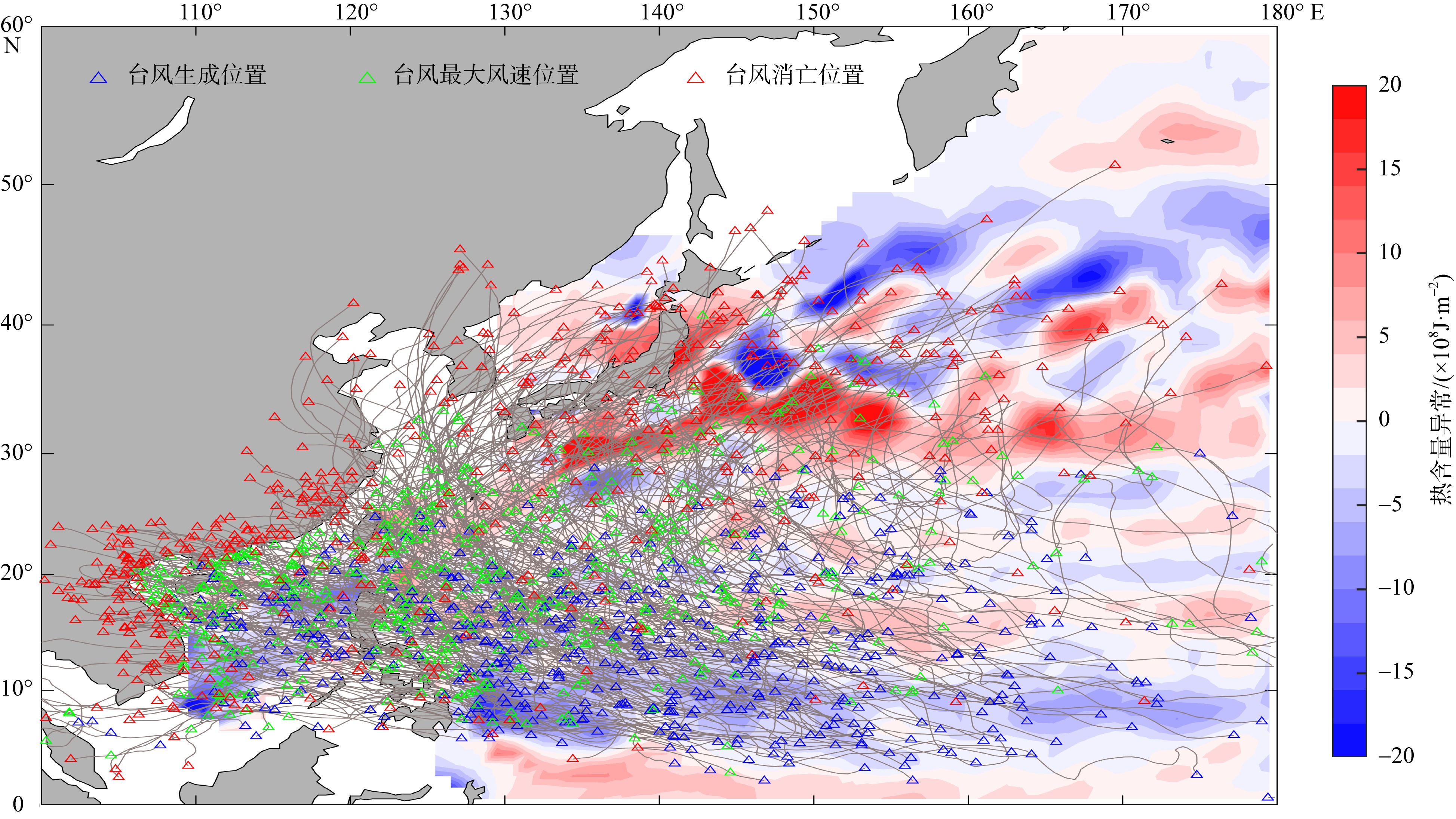
图1
图2
2004—2023年间西北太平洋台风发生频率(a)与中上层海洋热含量异常(OHCA)的时间序列(b) 红色、绿色、蓝色框分别对应2005—2012年、2014—2016年、2016—2020年时间段。图a中台风频数指每月统计总数(20a)的比例; 图b中等值线表示热含量异常值"
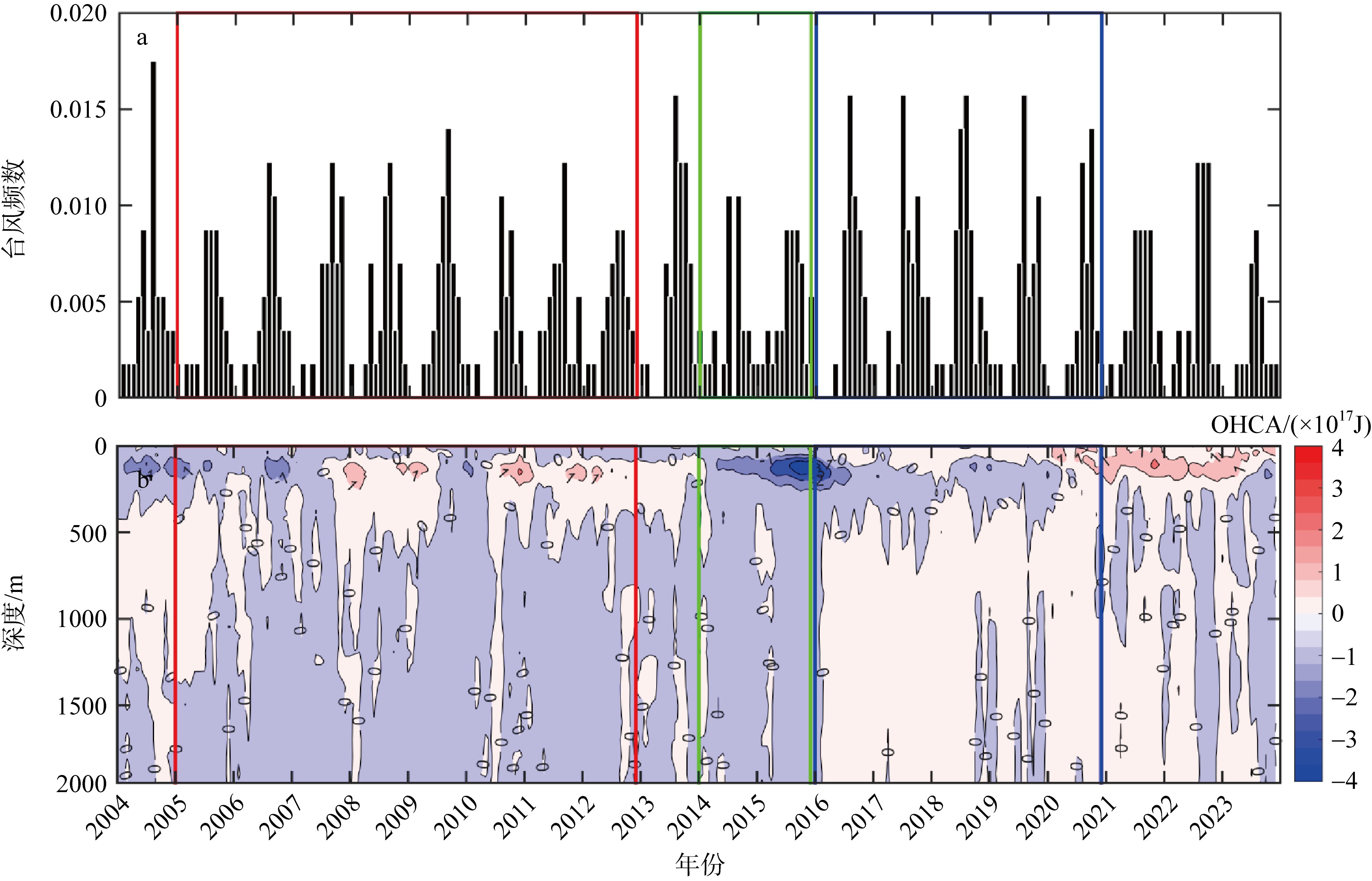
图2
图3
不同深度内海洋热含量异常(OHCA)随时间的变化序列(a—c)和对应的月平均台风生成数量(TGN)(d)、台风平均最大风速(MMWS)(e)、台风耗散指数(PDI)(f) 3个参数时间序列的对应分布 红色、绿色、蓝色框分别对应2005—2012年、2014—2016年、2016—2020年时间段, 红色星标和数字为每年年内OHCA极小值与台风参数极大值出现的月份。图d—f中黑色实线为对应参数平均值, 黑色虚线为每年的极值平均"
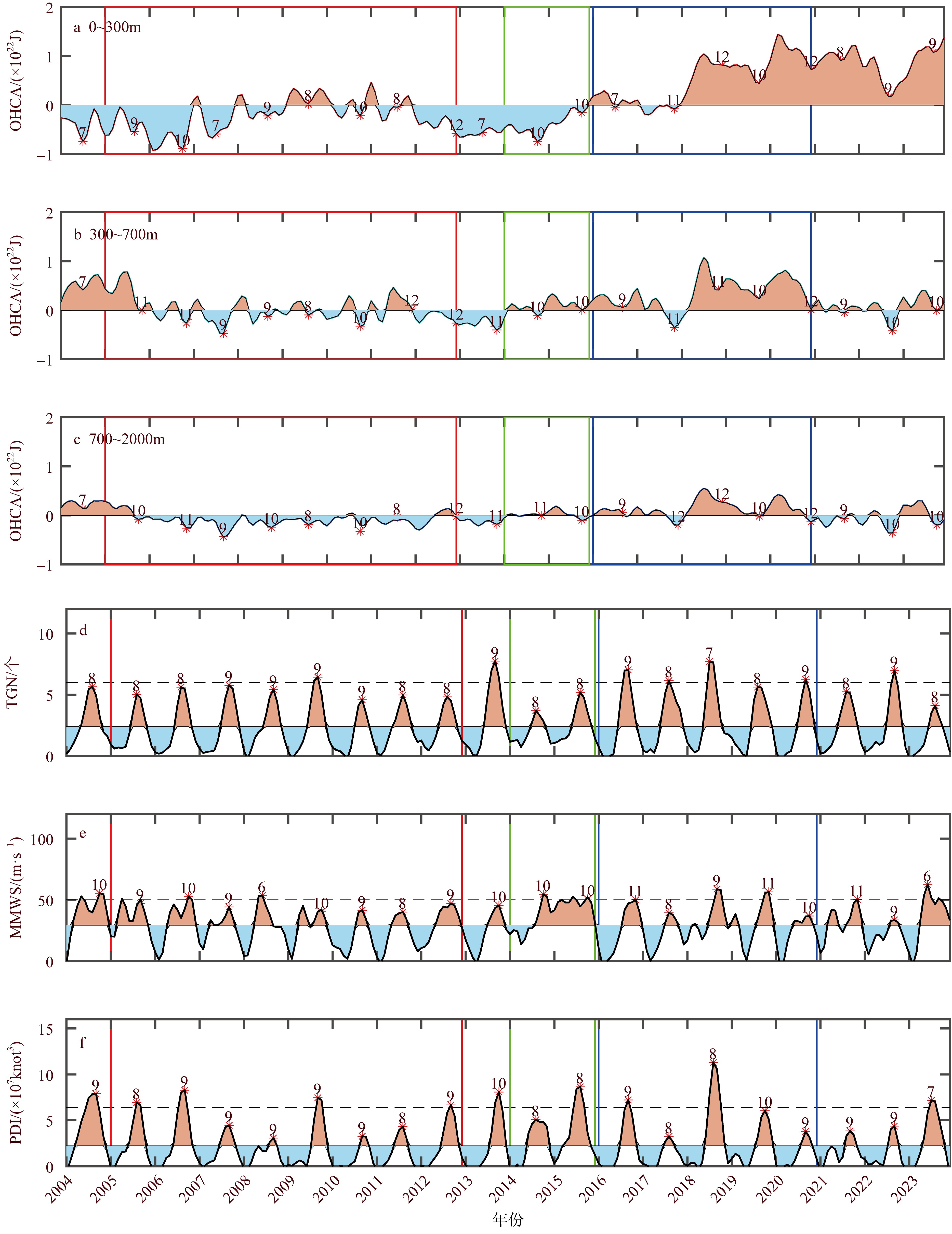
图3
图4
不同深度内海洋热含量收支异常(OHUA)与对应台风参数的滞后空间分布 a1、b1、c1分别为0~300m的OHUA与对应的月平均台风生成数量(TGN)(单位: 个)、台风平均最大风速(MMWS)(单位: m·s-1)、台风耗散指数(PDI)(单位: ×105knot3)滞后1个月的相对分布; a2、b2、c2分别为300~700m的OHUA与TGN、MMWS、PDI滞后3个月的相对分布; a3、b3、c3分别为700~2000m的热OHUA与TGN、MMWS、PDI滞后6个月的相对分布。该图底图基于自然资源部标准地图服务网站下载的审图号为GS(2016)1611号的标准地图制作, 底图无修改"
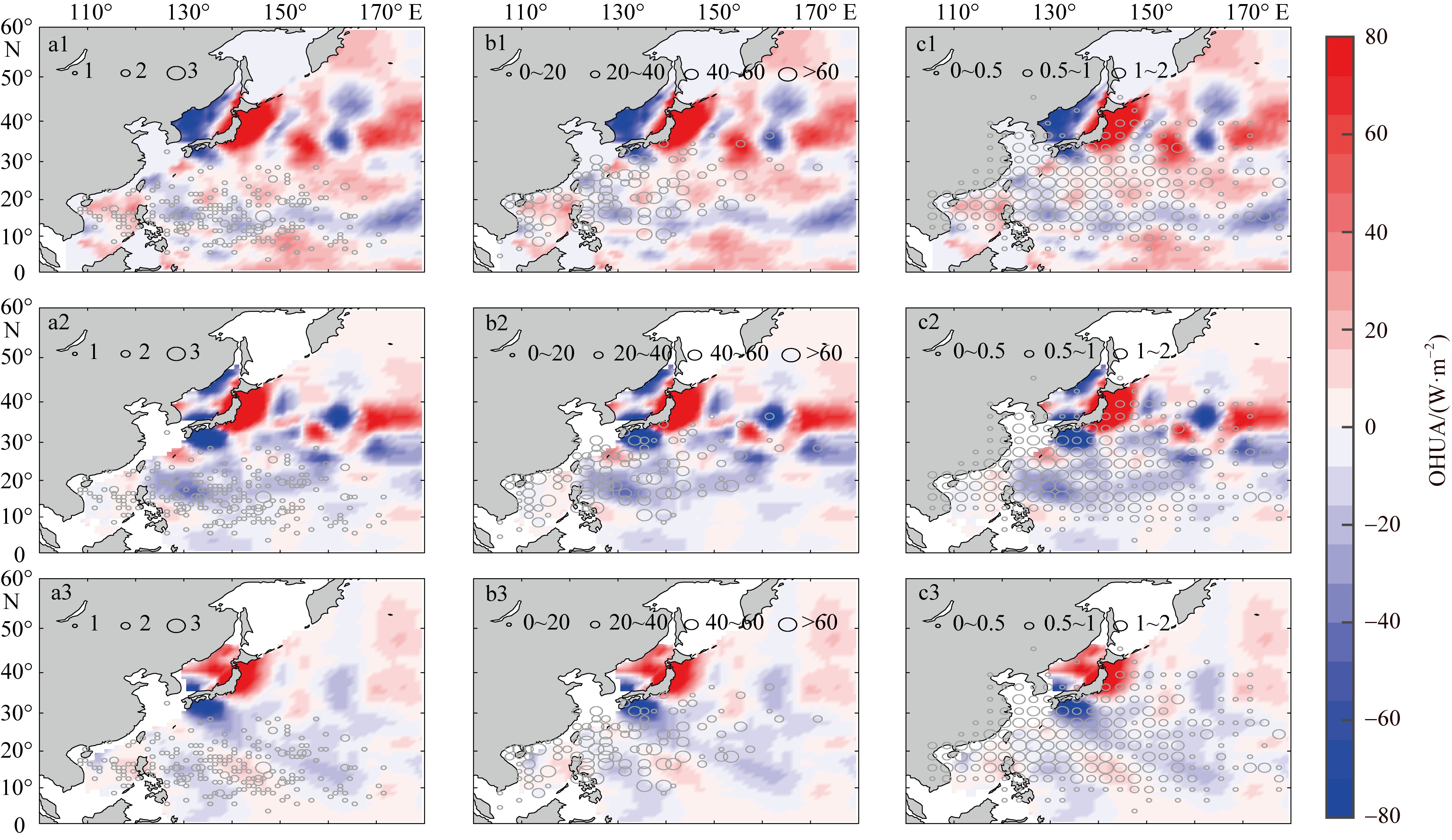
图4
图5
台风参数与不同深度海洋热含量收支异常(OHUA)的滞后相关系数分布 a1、b1、c1为0至混合层内, 台风参数滞后OHUA 1个月; a2、b2、c2为混合层至300m, 台风参数滞后OHUA 2个月; a3、b3、c3为水深300~700m, 台风参数滞后OHUA 3个月; a4、b4、c4为水深700~2000m, 台风参数滞后OHUA 6个月。第一列为对应的月平均台风生成数量(TGN)(单位: 个); 第二列为台风平均最大风速(MMWS)(单位: m·s-1); 第三列为台风耗散指数(PDI)(单位: ×105knot3)。该图底图基于自然资源部标准地图服务网站下载的审图号为GS(2016)1611号的标准地图制作, 底图无修改"
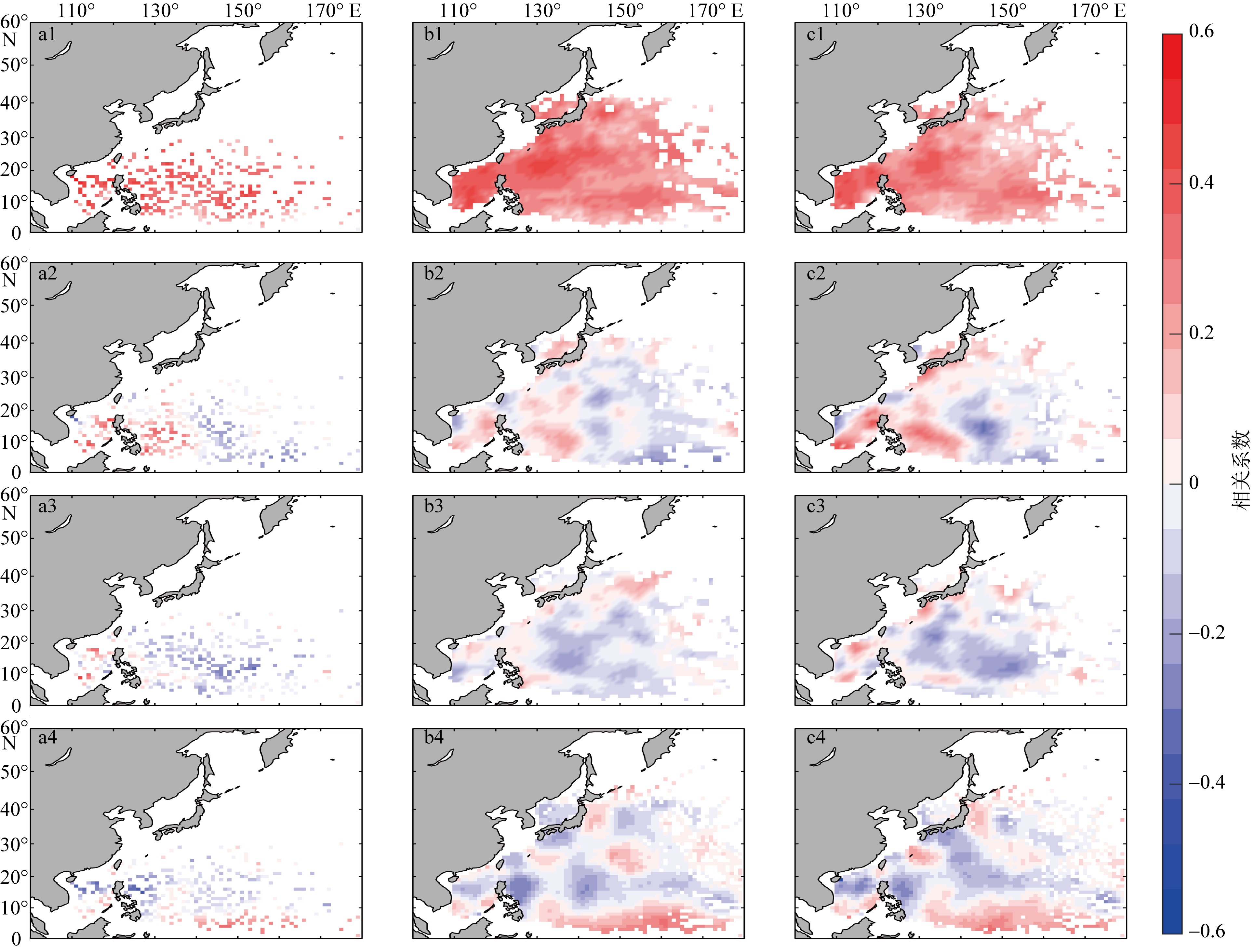
图5
图6
台风高发月对应的不同深度内多年月平均的理查森数(RI)空间分布 a1—a4分别为8月混合层以内、混合层至300m、300~700m、700~2000m的RI; b1—b4分别为9月混合层以内、混合层至300m、300~700m、700~2000m的RI。该图底图基于自然资源部标准地图服务网站下载的审图号为GS(2016)1611号的标准地图制作, 底图无修改"
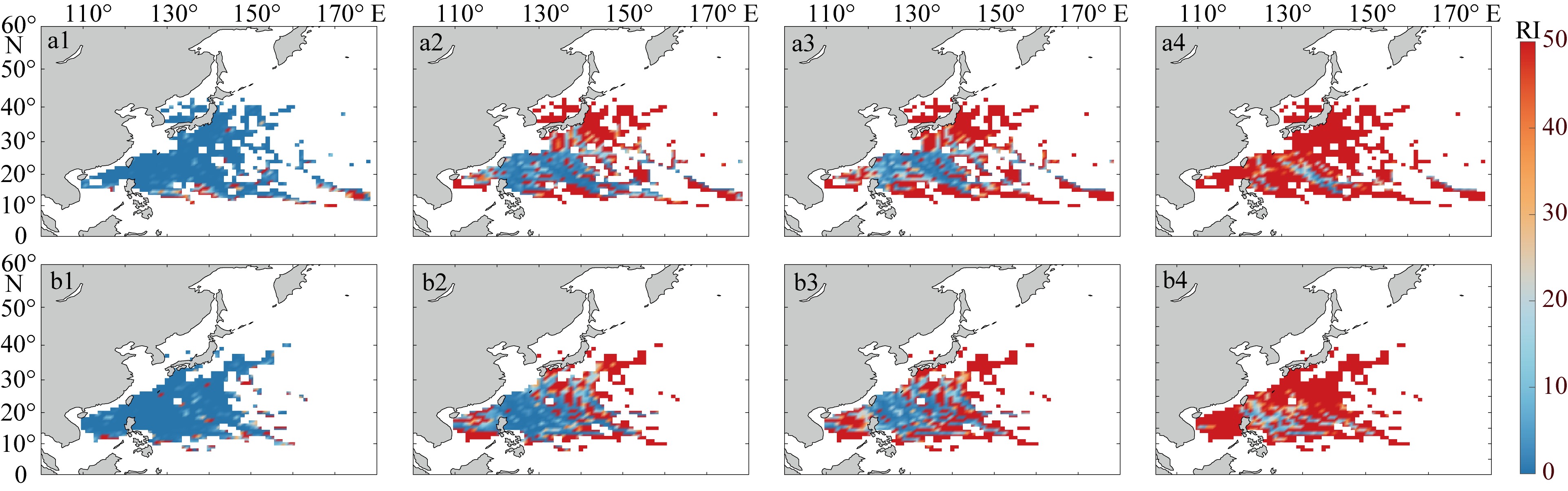
图6
图7
8—9月份台风路径上对应的不同深度内海洋热含量收支异常(OHUA) a1—a3、b1—b3、c1—c3分别为混合层以内、混合层至300m、300~700m分别滞后0、1、2个月的OHUA。该图底图基于自然资源部标准地图服务网站下载的审图号为GS(2016)1611号的标准地图制作, 底图无修改"
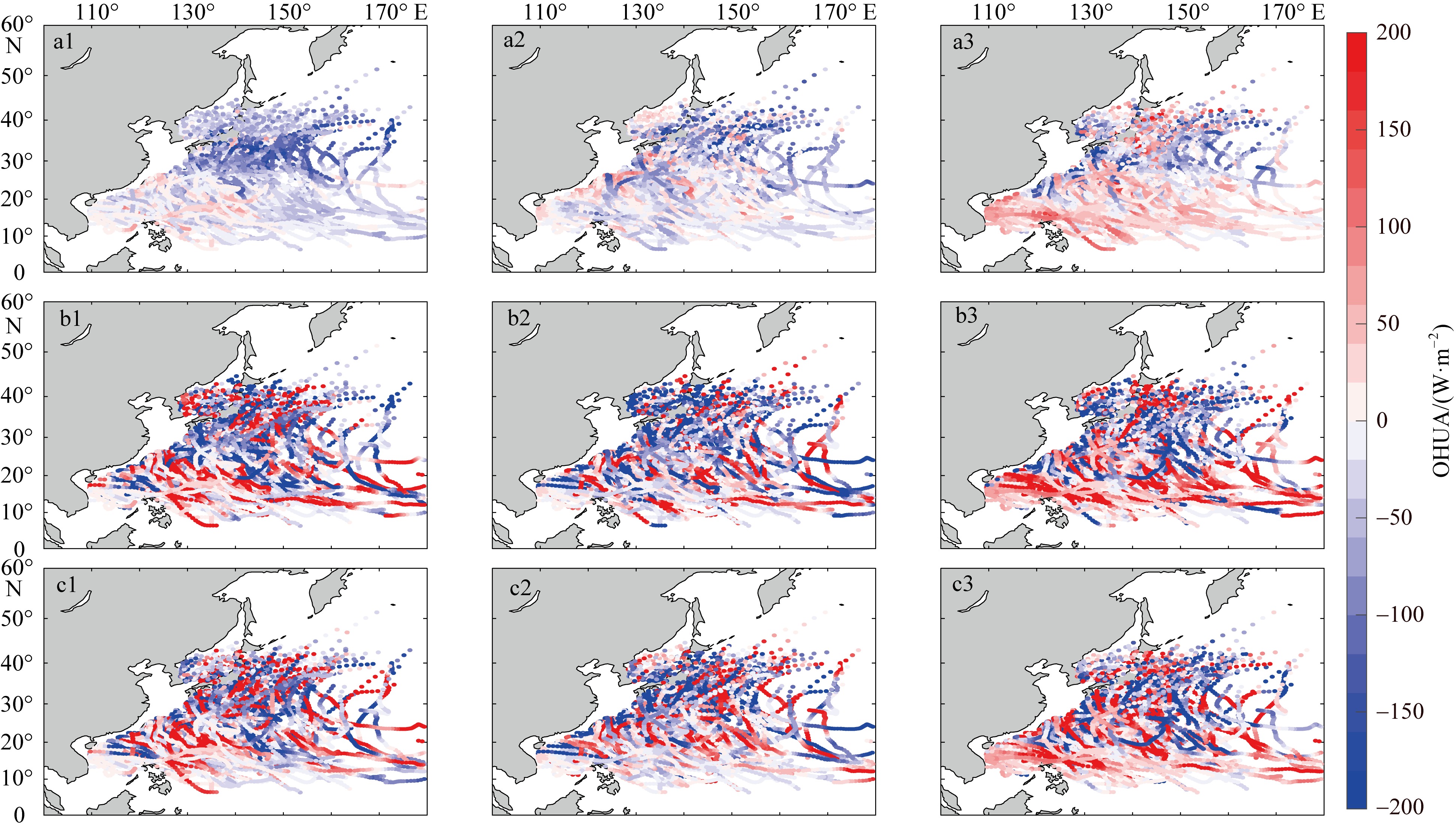
图7
图8
台风季节(7—10月)不同深度内的海洋热含量收支异常(OHUA)与台风参数的相对散点概率密度分布 a1—a4分别为混合层以内、混合层至300m、300~700m、700~2000m的OHUA与台风生成数量的相对分布; b1—b4分别为混合层以内、混合层至300m、300~700m、700~2000m的OHUA与台风最大风速的相对分布; c1—c4分别为混合层以内、混合层至300m、300~700m、700~2000m的OHUA与台风能量耗散指数的相对分布。图中填色为统计概率密度; 黑色圆圈内部为高概率密度分布范围(高于均值); 紫色虚线为OHUA的零刻度线。TGN为月平均台风生成数量, MMWS为台风平均最大风速, PDI为台风耗散指数。该图底图基于自然资源部标准地图服务网站下载的审图号为GS(2016)1611号的标准地图制作, 底图无修改"
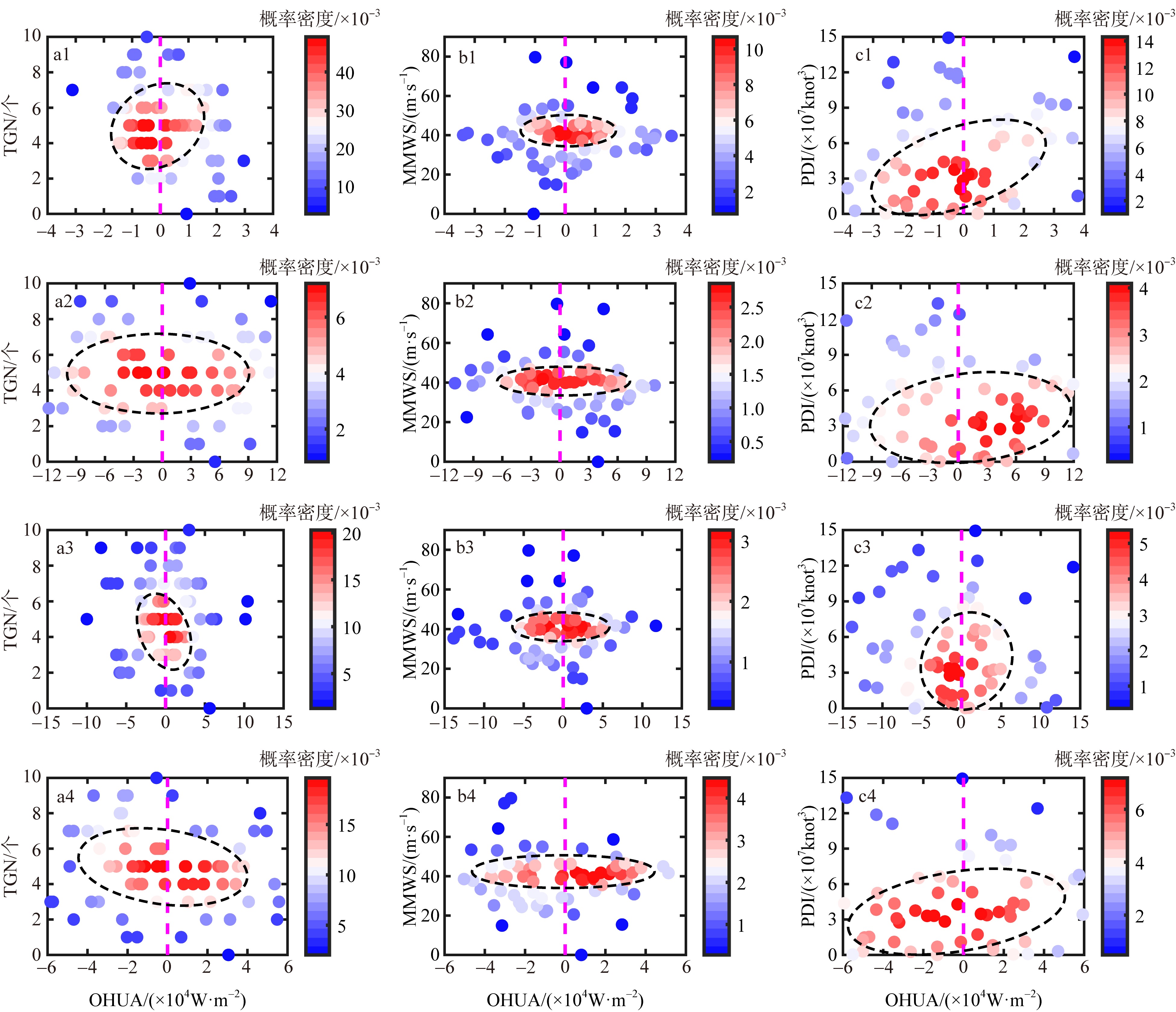
图8
表1
不同深度海洋热含量收支异常(OHUA)与台风参数的滞后相关系数"
| 深度 | 台风参数 | 滞后月份 | ||||||||||||
|---|---|---|---|---|---|---|---|---|---|---|---|---|---|---|
| -6 | -5 | -4 | -3 | -2 | -1 | 0 | 1 | 2 | 3 | 4 | 5 | 6 | ||
| 混合层 以内 | TGN | -0.23 | -0.44 | -0.62 | -0.67 | -0.52 | -0.20 | 0.02 | 0.37 | 0.64 | 0.75 | 0.63 | 0.28 | -0.18 |
| MMWS | -0.24 | -0.38 | -0.36 | -0.30 | -0.22 | -0.12 | 0.02 | 0.32 | 0.47 | 0.45 | 0.25 | 0.06 | -0.11 | |
| PDI | -0.23 | -0.36 | -0.44 | -0.47 | -0.40 | -0.19 | -0.03 | 0.28 | 0.52 | 0.61 | 0.49 | 0.18 | -0.17 | |
| 混合层’300m | TGN | -0.30 | -0.40 | -0.38 | -0.20 | -0.03 | 0.12 | -0.10 | 0.06 | 0.30 | 0.36 | 0.22 | 0.17 | 0.05 |
| MMWS | -0.22 | -0.30 | -0.28 | -0.21 | -0.12 | 0.17 | -0.08 | 0.03 | 0.00 | 0.20 | 0.28 | 0.15 | 0.04 | |
| PDI | -0.34 | -0.37 | -0.32 | -0.22 | -0.10 | 0.11 | -0.10 | 0.07 | 0.20 | 0.24 | 0.21 | 0.18 | 0.14 | |
| 300~700m | TGN | 0.08 | 0.25 | 0.17 | 0.09 | -0.05 | -0.20 | 0.13 | 0.10 | -0.04 | -0.02 | -0.21 | -0.32 | -0.23 |
| MMWS | 0.00 | 0.06 | 0.03 | 0.01 | -0.03 | -0.06 | 0.21 | 0.13 | -0.14 | -0.10 | -0.09 | -0.14 | -0.16 | |
| PDI | -0.03 | 0.17 | 0.14 | 0.07 | 0.02 | -0.17 | 0.09 | 0.10 | 0.02 | -0.05 | -0.14 | -0.28 | -0.15 | |
| 0~2000m | TGN | -0.26 | -0.41 | -0.54 | -0.52 | -0.38 | -0.14 | 0.03 | 0.34 | 0.54 | 0.65 | 0.45 | 0.15 | -0.17 |
| MMWS | -0.25 | -0.36 | -0.36 | -0.31 | -0.21 | -0.03 | 0.06 | 0.28 | 0.28 | 0.34 | 0.27 | 0.08 | -0.12 | |
| PDI | -0.30 | -0.36 | -0.40 | -0.39 | -0.30 | -0.13 | -0.02 | 0.28 | 0.44 | 0.49 | 0.38 | 0.11 | -0.10 | |
表1
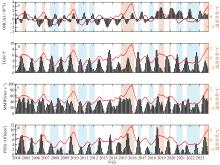
图9
2004—2023年, 西北太平洋不同气候条件下的0~2000m OHCA和台风参数的频率统计 a—d分别为海洋热含量异常(OHCA)、月平均台风生成数量(TGN)、台风平均最大风速(MMWS)、台风耗散指数(PDI)的频率统计。图中红色实线为温度异常值; 红色与蓝色阴影分别代表厄尔尼诺与拉尼娜事件"
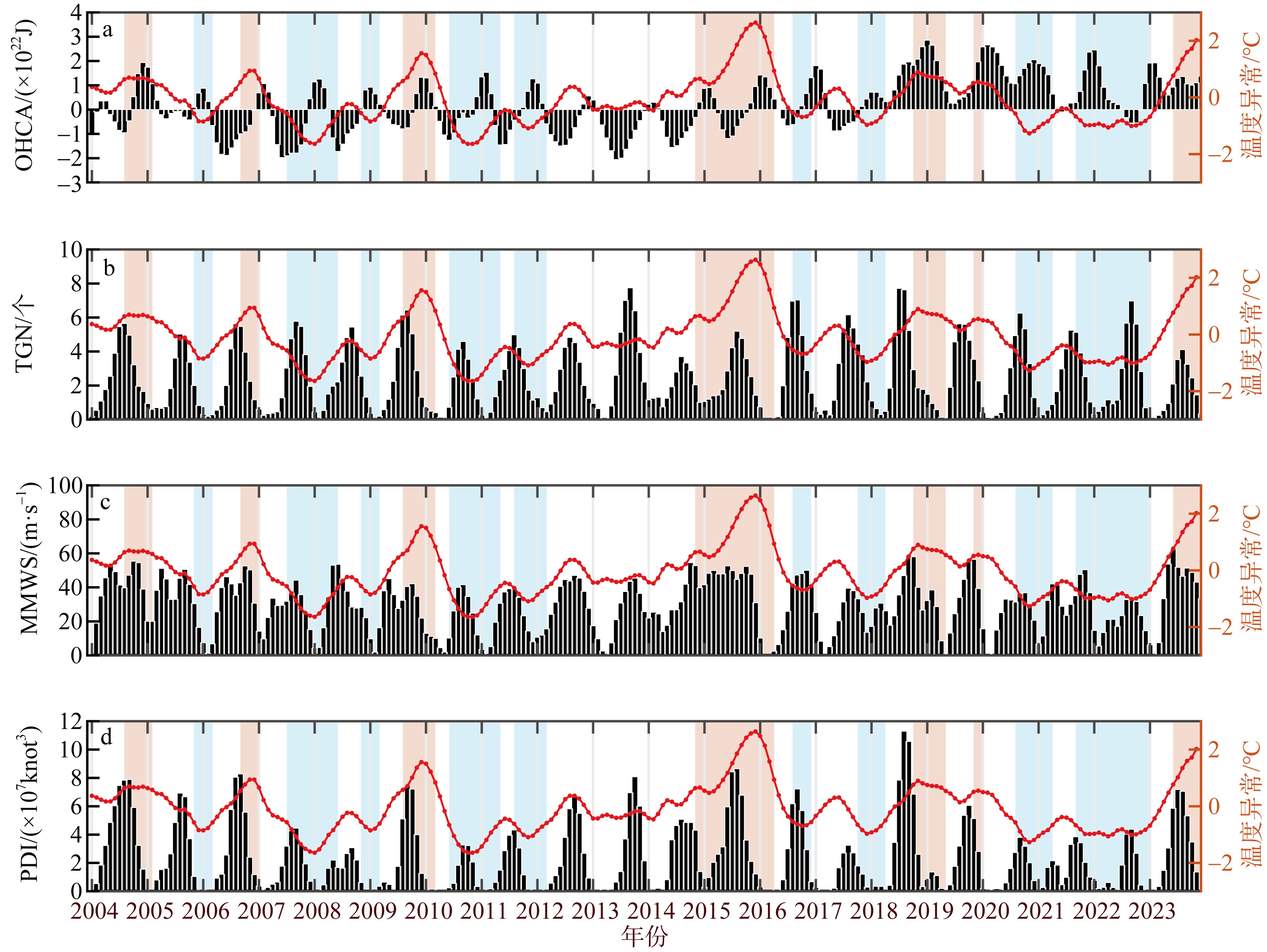
图9
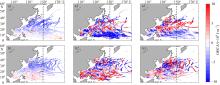
图10
2004—2023年期间西北太平洋不同气候条件下台风路径上各水层海洋热含量异常(OHCA)变化 a1—a3、b1—b3分别代表厄尔尼诺与拉尼娜事件期间, 台风路径上混合层深度以内、混合层至300m、300~700m的OHCA变化。图中黑色虚线为150°E。该图底图基于自然资源部标准地图服务网站下载的审图号为GS(2016)1611号的标准地图制作, 底图无修改"

图10
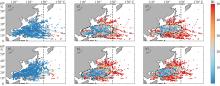
图11
2004—2023年西北太平洋不同气候条件下理查森数(RI)空间分布 a1—a3、b1—b3分别代表厄尔尼诺与拉尼娜事件期间, 混合层深度以内、混合层至300m、300~700m的平均RI分布。图中黑色虚线圈为RI低值分布范围, 黑色虚线为150°E。该图底图基于自然资源部标准地图服务网站下载的审图号为GS(2016)1611号的标准地图制作, 底图无修改"
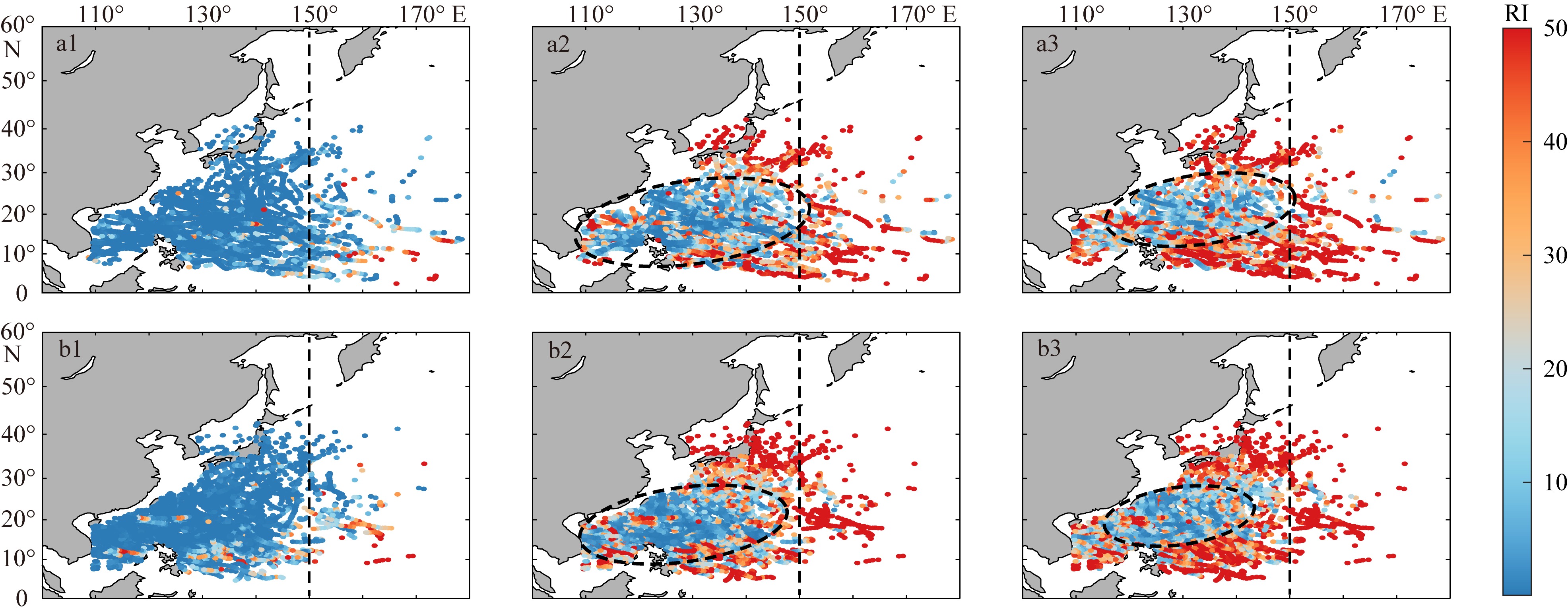
图11
| [18] |
|
| [19] |
doi: 10.1175/JCLI-D-24-0398.1 |
| [20] |
doi: 10.1175/JCLI-D-22-0949.1 |
| [21] |
|
| [22] |
|
| [23] |
doi: 10.1038/ngeo2792 |
| [24] |
doi: 10.5194/os-5-351-2009 |
| [25] |
doi: 10.1175/1520-0485(1981)011<0153:UORTAH>2.0.CO;2 |
| [26] |
doi: 10.1175/1520-0485(1994)024<0233:FSRTAM>2.0.CO;2 |
| [27] |
|
| [28] |
doi: 10.2151/sola.2022-011 |
| [29] |
|
| [30] |
doi: 10.1088/1748-9326/acd2ed |
| [31] |
doi: 10.1073/pnas.1314721110 pmid: 24014590 |
| [32] |
doi: 10.1038/nature05785 |
| [33] |
|
| [34] |
|
| [35] |
doi: 10.1029/2018EF000825 |
| [36] |
doi: 10.1126/science.1116448 pmid: 16166514 |
| [37] |
doi: 10.1007/s00376-024-4076-z |
| [1] |
doi: 10.1088/1748-9326/8/4/044009 |
| [2] |
doi: 10.1002/grl.v42.16 |
| [3] |
|
| [4] |
doi: 10.1126/sciadv.1601545 |
| [5] |
|
| [6] |
doi: 10.1175/JCLI-D-19-0305.1 |
| [7] |
doi: 10.1038/nature03906 |
| [8] |
doi: 10.1029/2000JD900641 |
| [9] |
doi: 10.1175/1520-0469(2004)061<0843:ECOTCI>2.0.CO;2 |
| [10] |
doi: 10.1038/s41467-022-35530-9 pmid: 36517474 |
| [38] |
doi: 10.3389/fmars.2023.1245348 |
| [39] |
doi: 10.1111/fog.v30.1 |
| [40] |
doi: 10.1002/jgrc.v121.9 |
| [41] |
doi: 10.1002/grl.v42.12 |
| [11] |
doi: 10.1175/2008JCLI2131.1 |
| [12] |
doi: 10.1038/s41586-024-08051-2 |
| [13] |
doi: 10.1175/1520-0485(1972)002<0218:HHPOTG>2.0.CO;2 |
| [14] |
doi: 10.1126/science.287.5461.2225 |
| [15] |
|
| [16] |
doi: 10.1002/jgrc.v121.11 |
| [17] |
|
| [1] | 梁顺, 黄桂槟, 何国梅, 张永垂, 周毅, 汪洋, 洪梅. 南海土台风时空变化特征分析[J]. 热带海洋学报, 2026, 45(2): 59-70. |
| [2] | 冯战权, 苏冒亮, 杜媛媛, 钟友凌, 张俊彬. 基于MaxEnt模型分析全球气候变化对中国沿海带鱼潜在分布的影响[J]. 热带海洋学报, 2025, 44(5): 77-85. |
| [3] | 周云霞, 翟丽萍, 覃皓, 黄晴, 祁丽燕. 台风“暹芭”登陆后北折路径成因及诊断分析[J]. 热带海洋学报, 2025, 44(4): 67-76. |
| [4] | 黄兆泳, 许贵林, 莫志明. 广西台风直接经济损失预估模型研究[J]. 热带海洋学报, 2025, 44(4): 56-66. |
| [5] | 肖海婷, 黄荣永, 刘羿, 余克服. 台风影响下西沙灰沙岛的时空变化特征[J]. 热带海洋学报, 2025, 44(2): 157-177. |
| [6] | 刘杰, 闫桐, 经志友. 南海西北部连续台风激发的近惯性内波观测研究[J]. 热带海洋学报, 2025, 44(1): 66-81. |
| [7] | 孙泽铭, 韩树宗, 王明杰, 苏翰祥. 不同路径台风对中国近海海温的影响特征统计分析[J]. 热带海洋学报, 2024, 43(5): 17-31. |
| [8] | 商洁, 吴莹, 邹依珂, 马靖雯. FY-3D卫星MWRI资料反演洋面台风降雨率*[J]. 热带海洋学报, 2024, 43(5): 32-40. |
| [9] | 孙婷婷, 郝雯瑾, 徐鹏臻, 叶丽靖, 董志军. 海水酸化对海月水母螅状体共附生微生物的影响[J]. 热带海洋学报, 2023, 42(6): 111-119. |
| [10] | 张哲然, 胡俊洋, 周凯, 张鹏晖, 邢久星, 陈胜利. 不同类型台风气象场对深圳近海海域风暴潮模拟的比较研究—以台风“山竹”为例*[J]. 热带海洋学报, 2023, 42(6): 1-14. |
| [11] | 李骏旻, 李博, 陈武阳, 刘军亮. 三亚近岸海浪观测特征及其对台风过程的响应[J]. 热带海洋学报, 2023, 42(4): 25-35. |
| [12] | 高娜, 赵明利, 马毅, 徐婉明, 詹海刚, 蔡树群. 台风对珠江口风暴增水的影响分析[J]. 热带海洋学报, 2023, 42(1): 32-42. |
| [13] | 束艾青, 许冬梅, 李泓, 吴海英, 沈菲菲, 邓华, 白亚雯. FY-3D卫星MWHS-2辐射率资料直接同化对台风“米娜”预报的影响*[J]. 热带海洋学报, 2022, 41(5): 17-28. |
| [14] | 郭俊丽, 时连强, 陈沈良, 张敏, 常洋, 张达恒. 台风季节朱家尖岛砂、砾质岬湾海滩的不同沉积地貌动态变化[J]. 热带海洋学报, 2022, 41(4): 82-96. |
| [15] | 喜扬洋, 王日明, 冯炳斌, 陈波. 北海银滩响应台风作用的动力地貌过程[J]. 热带海洋学报, 2022, 41(4): 97-104. |
|
||