

Journal of Tropical Oceanography ›› 2026, Vol. 45 ›› Issue (2): 117-128.doi: 10.11978/2025100CSTR: 32234.14.2025100
Previous Articles Next Articles
Seasonal distribution characteristics and environmental driving factors of bacterial communities in mangrove sediments of Ximen Island, Zhejiang Province
JIANG Shoudian1( ), HU Xin2(), LAN Peixin1, YAO Liqin1, SHUI Bonian1, JI Jianda3, HE Maoqiu1()
- 1
Fisheries College ,Zhejiang Ocean University
2Guangdong Center for Marine Development Research
3Third Institute of Oceanography ,Ministry of Natural Resources
-
Received:2025-06-09Revised:2025-08-13Online:2026-03-10Published:2026-03-26 -
Contact:HE Maoqiu. email: hemaoqiu@zjou.edu.cn -
Supported by:Monitoring Project of the Mangrove Ecosystem at the Estuary of Longgang(21038007721); The Ministry of Natural Resources' 2024 Ministry-Provincial Cooperation Projects(2024ZRBSHZ103); Laoshan Laboratory’s Scientific and Technological Innovation Project(LSKJ202202905)

CLC Number:
- P735.12
Cite this article
JIANG Shoudian, HU Xin, LAN Peixin, YAO Liqin, SHUI Bonian, JI Jianda, HE Maoqiu. Seasonal distribution characteristics and environmental driving factors of bacterial communities in mangrove sediments of Ximen Island, Zhejiang Province[J].Journal of Tropical Oceanography, 2026, 45(2): 117-128.
share this article
Add to citation manager EndNote|Reference Manager|ProCite|BibTeX|RefWorks
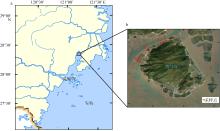
Fig. 1
Location of mangrove sampling sites on Ximen Island"
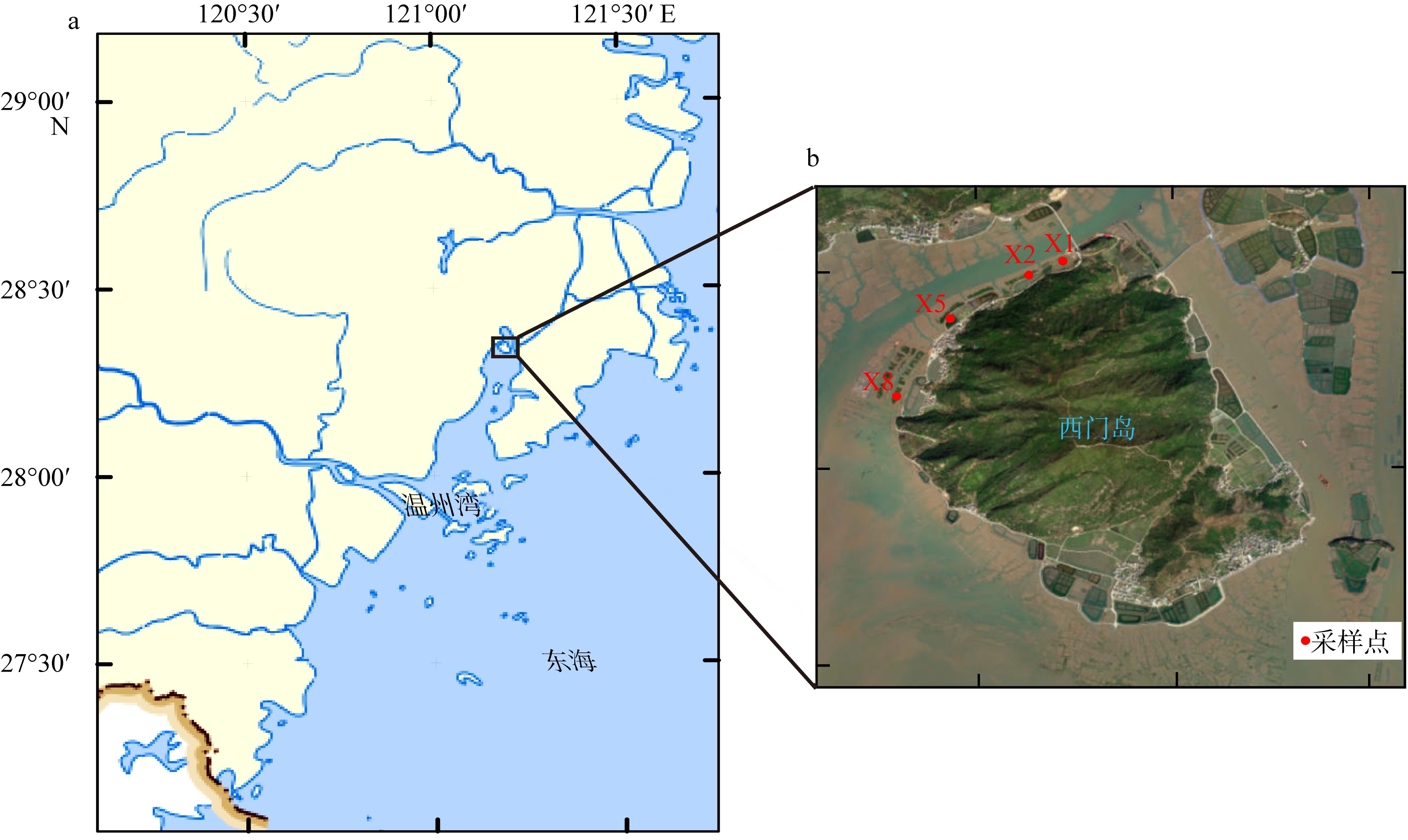
Fig. 1
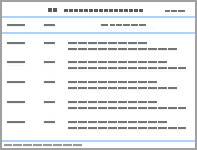
Tab. 1
Environmental parameters of mangrove sediments on Ximen Island"
| 环境参数 | 春季 | 夏季 | 秋季 | 冬季 |
|---|---|---|---|---|
| 温度/℃ | 19.13±0.45b | 31.58±0.71a | 19.30±0.50b | 10.75±1.24c |
| 盐度/‰ | 14.71±1.57c | 27.73±3.35a | 30.00±2.42a | 21.10±3.54b |
| pH | 7.41±0.13a | 7.20±0.30a | 7.29±0.14a | 7.60±0.41a |
| TC/(mg·g-1) | 13.71±0.89a | 13.86±0.55a | 13.68±0.91a | 12.97±1.11a |
| TN/(mg·g-1) | 1.24±0.16a | 1.18±0.12a | 1.23±0.02a | 1.10±0.09a |
| TC/TN | 11.15±0.82a | 11.78±0.79a | 11.11±0.87a | 11.77±0.27a |
| 黏土含量/% | 39.89±1.51a | 39.14±1.16a | 40.52±0.49a | 36.08±1.13b |
| 粉砂含量/% | 59.48±0.87ab | 60.74±1.13a | 59.29±0.18ab | 57.78±2.41b |
| 砂含量/% | 0.54±0.08b | — | 0.76±0.00b | 6.14±3.33a |
Tab. 1
Tab. 2
Bacterial community diversity indices of mangrove sediments on Ximen Island"
| α多样性指数 | 春季 | 夏季 | 秋季 | 冬季 |
|---|---|---|---|---|
| 丰富度指数 | 1588±103c | 1898±161ab | 1708±89bc | 2136±235a |
| 香农指数 | 6.05±0.15b | 6.22±0.14ab | 6.32±0.12a | 6.41±0.17a |
| 辛普森指数 | 0.99±0.00a | 0.99±0.00a | 0.99±0.00a | 0.99±0.00a |
| 均匀度指数 | 0.57±0.01b | 0.57±0.00ab | 0.59±0.01a | 0.58±0.01ab |
Tab. 2
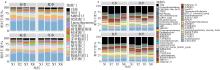
Fig. 2
Relative abundances of dominant bacterial phyla (a) and families (b) in sediment samples across different seasons"
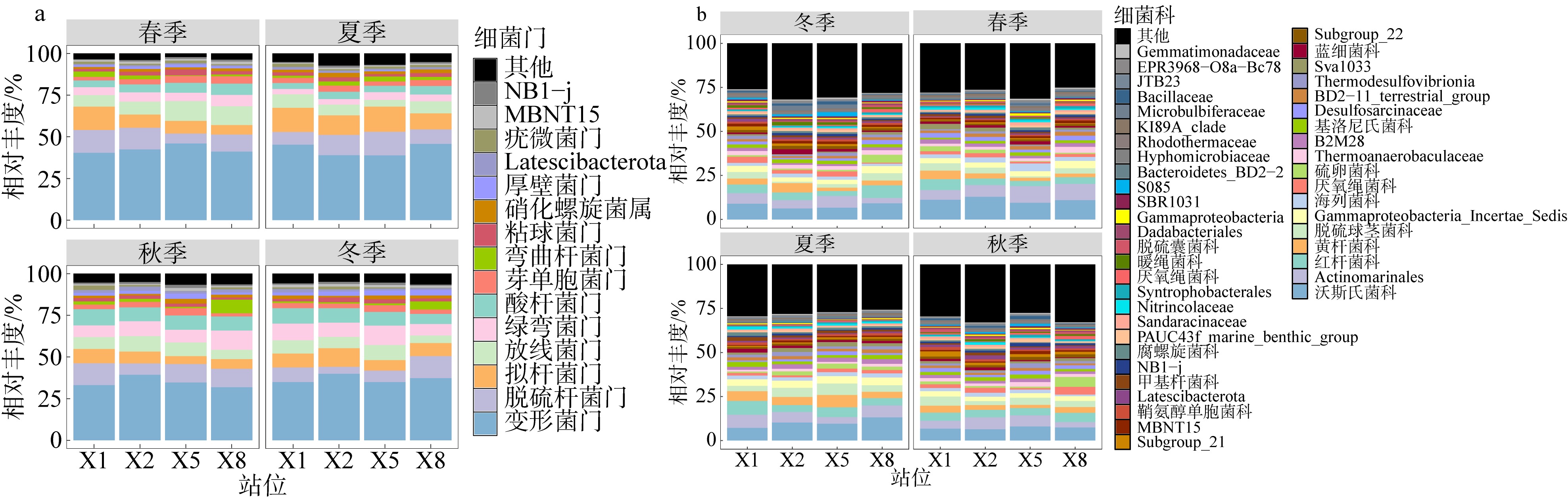
Fig. 2
Fig. 3
PCA (a), ANOSIM (b), and Venn diagram (c) of bacterial community compositions from different seasonal samples"
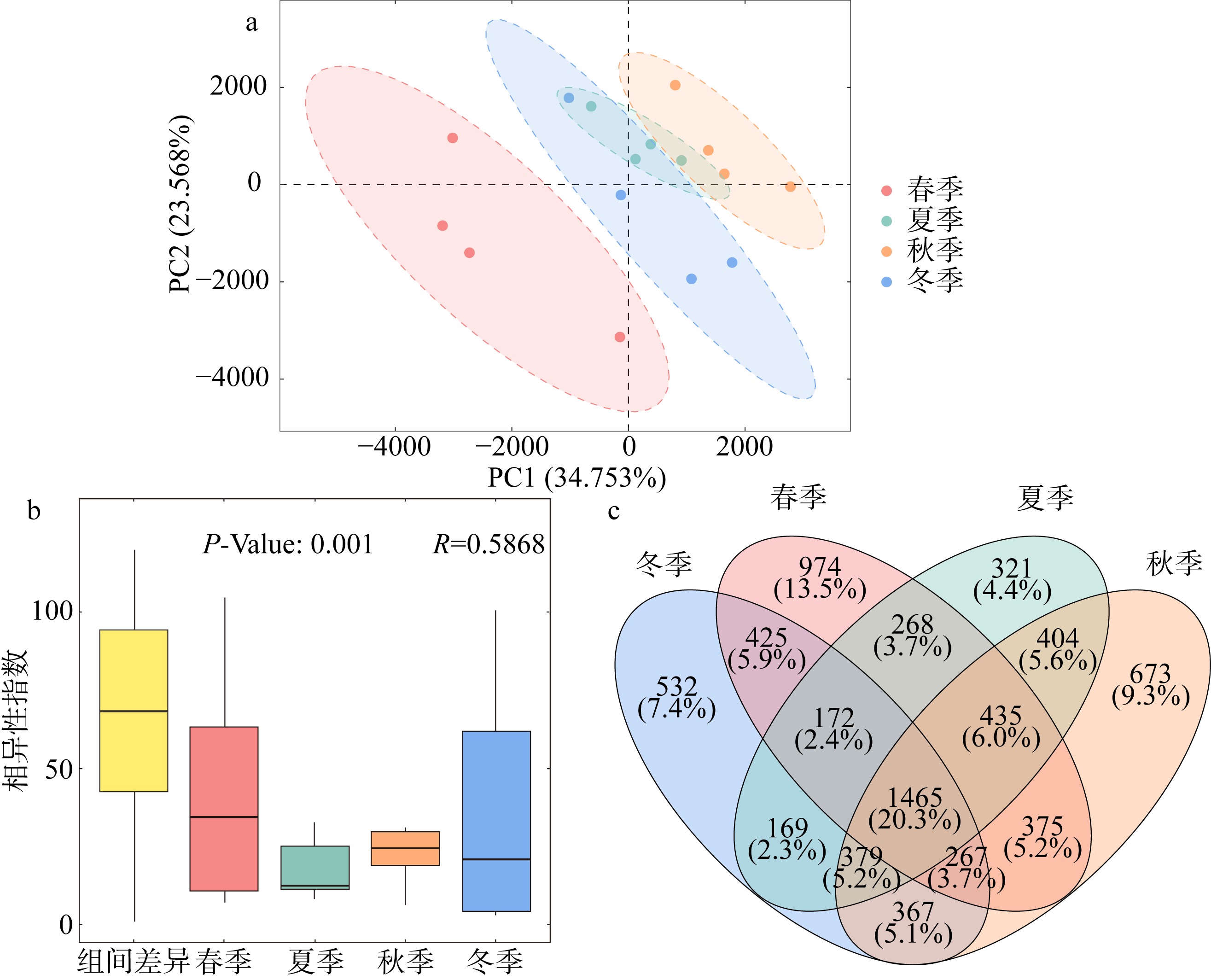
Fig. 3
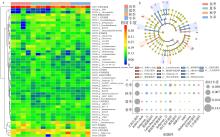
Fig. 4
Heatmap showing the distribution of the top 50 OTUs in different seasonal samples (a), LEfSe analysis revealing the significant difference of bacterial families among different seasons (b), and bubble plot reflecting the relative abundance of bacteria families with significant differences (c)"
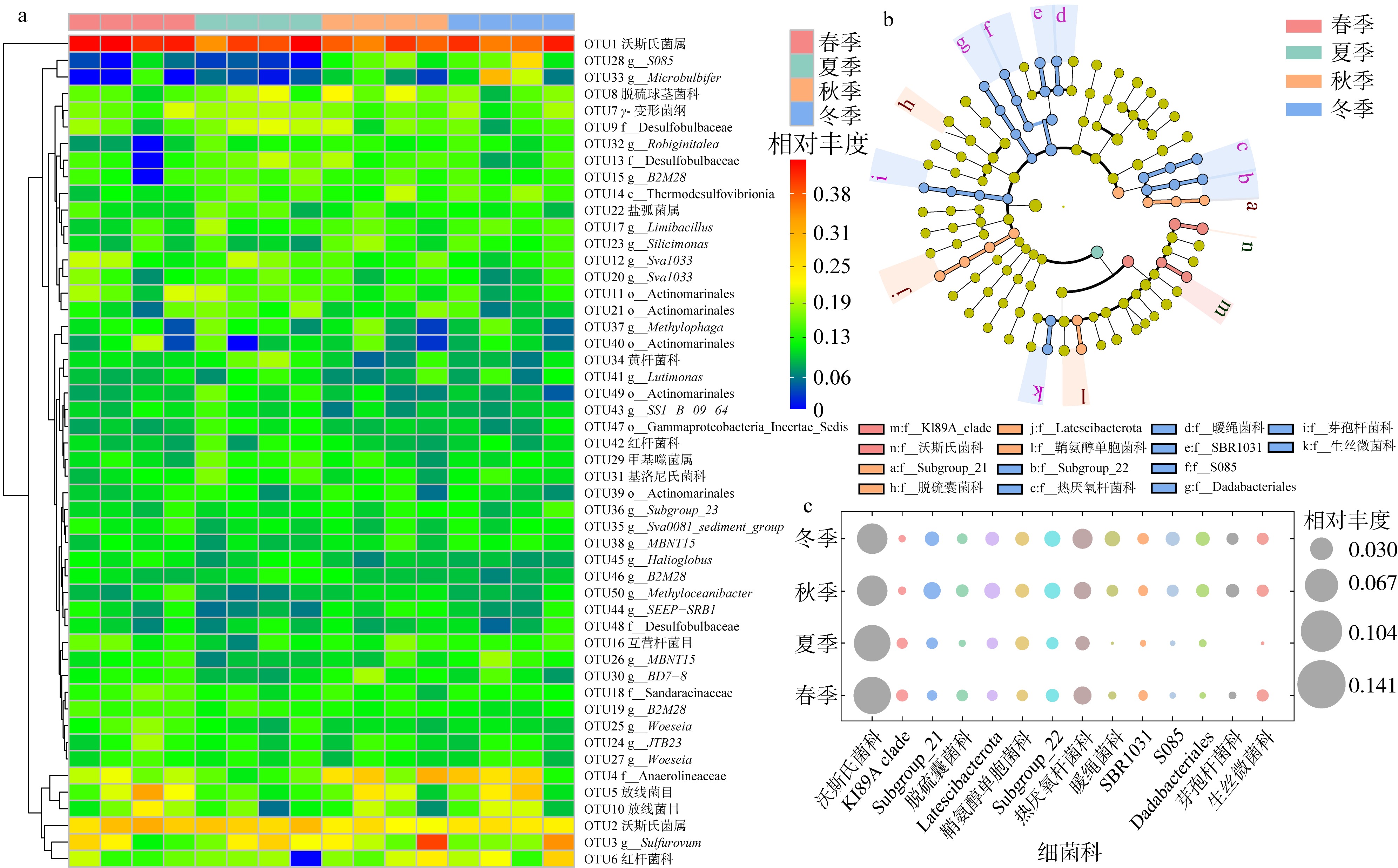
Fig. 4
Fig. 5
Redundancy analysis (RDA) of bacterial communities from different seasonal samples (a), and correlations between the relative abundances of bacterial phyla (b) and families (c) and environmental factors"
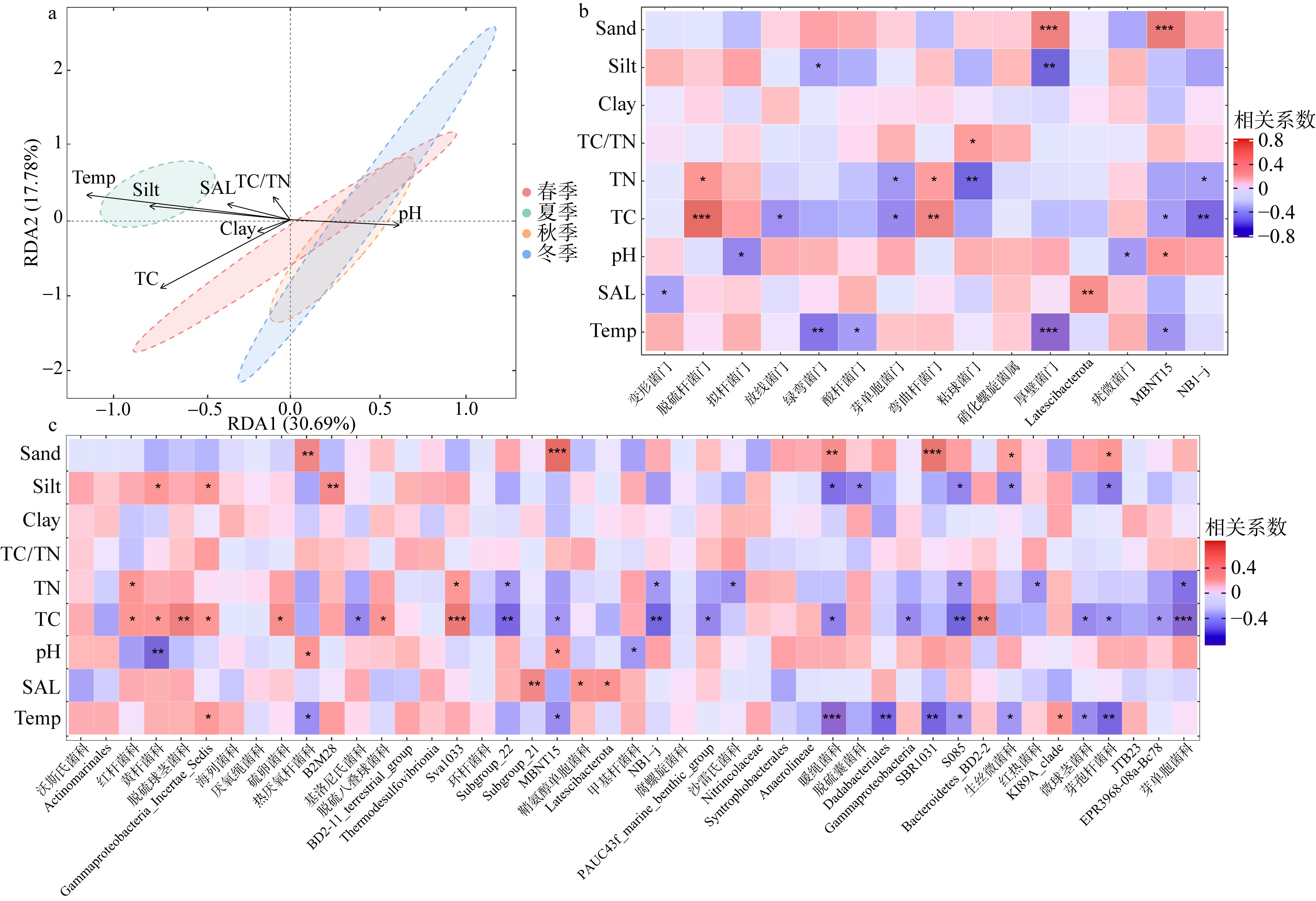
Fig. 5
| [1] |
曹启民, 郑康振, 陈耿, 等, 2008. 红树林生态系统微生物学研究进展[J]. 生态环境, (2): 839-845.
|
|
|
|
| [2] |
曹阳, 裘娟萍, 余志良, 2018. 西门岛红树林细菌种群及群体感应细菌的分析[J]. 科技通报, 34(10): 93-100.
|
|
|
|
| [3] |
陈雅慧, 张树刚, 张钊, 2023. 乐清湾盐沼湿地有机碳密度及碳储量估算[J]. 海洋环境科学, 42(1): 38-45.
|
|
|
|
| [4] |
梁文雅, 王冼民, 刘琦, 2024. 廉江高桥红树林沉积物微生物群落结构特征及其与营养因子相关性[J]. 广东海洋大学学报, 44(4): 80-87.
|
|
|
|
| [5] |
刘孟兰, 祁政宇, 朱明栋, 等, 2025. 中国红树林北缘引种区和天然分布区秋茄种群结构与动态特征研究[J/OL]. 生态与农村环境学报, (2025-06-30). https://link.cnki.net/doi/10.19741/j.issn.1673-4831.2025.0298.
|
|
LIU MENGLAN, QI ZHENGYU, ZHU MINGDONG, et al, 2025. Study on the population structure and dynamic characteristics of Kandelia obovata in the north marginal introduction and natural distribution region of mangroves in China[J/OL]. Journal of Ecology and Rural Environment, (2025-06-30). https://link.cnki.net/doi/10.19741/j.issn.1673-4831.2025.0298 (in Chinese with English abstract).
|
|
| [6] |
骆耐香, 陈森洲, 袁桂峰, 等, 2010. 广西沿海地区红树林根系土壤中放线菌的分离与鉴定[J]. 基因组学与应用生物学, 29(2): 310-313.
|
|
|
|
| [7] |
王友绍, 2021. 全球气候变化对红树林生态系统的影响、挑战与机遇[J]. 热带海洋学报, 40(3): 1-14.
doi: 10.11978/YG2020006 |
|
doi: 10.11978/YG2020006 |
|
| [8] |
吴伟志, 赵志霞, 杨升, 等, 2022. 浙江省红树林分布和造林成效分析[J]. 热带海洋学报, 41(6): 67-74.
doi: 10.11978/2021158 |
|
doi: 10.11978/2021158 |
|
| [9] |
朱慧兰, 郭玉清, 吴成业, 等, 2020. 浙江西门岛红树林湿地小型底栖动物的研究[J]. 集美大学学报(自然科学版), 25(4): 241-247.
|
|
|
|
| [10] |
|
| [11] |
doi: 10.1186/s40168-015-0077-6 |
| [12] |
pmid: 23894211 |
| [13] |
doi: 10.1111/gcb.v29.2 |
| [14] |
doi: 10.1126/science.1155121 pmid: 18556546 |
| [15] |
doi: 10.1111/j.1461-0248.2008.01251.x pmid: 19046360 |
| [16] |
doi: 10.1016/j.envpol.2022.119280 |
| [17] |
doi: 10.1016/j.envpol.2025.126326 |
| [18] |
|
| [19] |
doi: 10.1371/journal.pone.0016943 |
| [20] |
doi: 10.1016/j.jaridenv.2015.02.005 |
| [21] |
doi: 10.1111/ele.12206 pmid: 24261594 |
| [22] |
doi: 10.1146/marine.2010.2.issue-1 |
| [23] |
doi: 10.1016/j.ecss.2022.107791 |
| [24] |
doi: 10.1007/s10661-010-1375-x |
| [25] |
doi: 10.1146/energy.2019.44.issue-1 |
| [26] |
doi: 10.1590/S1517-83822012000400002 pmid: 24031949 |
| [27] |
doi: 10.1038/s41598-019-45804-w pmid: 31253826 |
| [28] |
doi: 10.3389/fmicb.2025.1526730 |
| [29] |
doi: 10.4014/jmb.2311.11050 pmid: 38321644 |
| [30] |
doi: 10.1038/s41396-020-0588-4 |
| [31] |
doi: 10.1007/s003740000319 |
| [32] |
doi: 10.1038/nature14238 |
| [33] |
doi: 10.1016/j.envpol.2021.116704 |
| [34] |
doi: 10.1016/j.soilbio.2007.09.013 |
| [35] |
doi: 10.1111/geb.2014.23.issue-7 |
| [36] |
doi: 10.1016/j.marpolbul.2024.117421 |
| [37] |
doi: 10.1016/j.scitotenv.2020.141555 |
| [38] |
doi: 10.1016/j.marpolbul.2022.114482 |
| [39] |
|
| [40] |
doi: 10.1016/S0038-0717(99)00068-1 |
| [41] |
doi: 10.1016/j.soilbio.2020.107918 |
| [42] |
doi: 10.1007/s11368-014-1045-7 |
| [43] |
doi: 10.3390/app10175850 |
| [44] |
doi: 10.3389/fmicb.2021.764974 |
| [45] |
doi: 10.3390/microorganisms10112191 |
| [46] |
doi: 10.1016/j.scitotenv.2025.179766 |
| [47] |
doi: 10.1890/15-2110.1 |
| [48] |
|
| [49] |
doi: 10.1016/j.soilbio.2023.109019 |
| [50] |
doi: 10.3389/fmicb.2011.00093 pmid: 21747801 |
| [51] |
doi: 10.1038/nature24621 |
| [52] |
doi: 10.1016/j.envpol.2025.125915 |
| [53] |
doi: 10.1016/j.marpolbul.2013.04.005 pmid: 23660440 |
| [54] |
doi: 10.1007/s00253-015-7257-y pmid: 26728019 |
| [55] |
doi: 10.3390/microorganisms13040859 |
| [56] |
doi: 10.1016/j.scitotenv.2024.174770 |
| [57] |
doi: 10.1017/S0021859615001008 |
| [58] |
|
| [59] |
doi: 10.1016/j.scitotenv.2018.03.158 |
| [1] | FANG Yang, TANG Junyi, LUO Yuchi, YE Kuangmin, DENG Weihua. Impacts of exotic mangrove introduction on ecosystem health and service functions: A case study of three representative regions in Guangdong Province [J]. Journal of Tropical Oceanography, 2026, 45(2): 173-190. |
| [2] | ZHONG Fuchang, XIANG Rong, YANG Yiping, MAO Huabin. Distribution characteristics and influencing factors of benthic foraminifera in surface sediments of the northeast Indian Ocean Ridge region* [J]. Journal of Tropical Oceanography, 2026, 45(1): 81-90. |
| [3] | DU Shuhuan, XIANG Rong, SU Xiang, ZHANG Lanlan, PAN Zirui, XIE Jinwo, LUO Chuanxiu, WAN Sui. Calcium carbonate composition of surface sediments and influencing factors in the 90°E Ridge of the northeastern Indian Ocean* [J]. Journal of Tropical Oceanography, 2026, 45(1): 73-80. |
| [4] | ZHANG Lanlan, LI Tong, CHENG Xiawen, PERERA Batagoda Gamage Dumudu Ojitham, XIANG Rong. Depth gradient changes in dead polycystine radiolarians in the tropical southeastern Indian Ocean during spring* [J]. Journal of Tropical Oceanography, 2026, 45(1): 60-72. |
| [5] | LIN Mingzhi, QIN Maogang, CHEN Yang, CHEN Bo, WANG Xuemu, LIU Yanrui, SONG Jiawei, SUN Longfei. Research on the assignment mapping method of seabed sediment types based on Folk classification [J]. Journal of Tropical Oceanography, 2026, 45(1): 178-187. |
| [6] | SU Chunqing, GAO Yuhui, LUO Xinwu, HAN Mengmeng, GONG Yanzhang, ZHENG Weiguo. Forest biomass and carbon storage of different mangrove communities in Shenzhen, China [J]. Journal of Tropical Oceanography, 2025, 44(6): 155-164. |
| [7] | LIU Zeyu, ZHANG Guocheng, WANG Yuanyuan. Composition and distribution characteristics of modern biological relics in the estuary of Pearl River Delta [J]. Journal of Tropical Oceanography, 2025, 44(6): 39-50. |
| [8] | LIN Mingzhi, CHEN Bo, CHEN Yang. Discussion on classification methods of clastic sediment suitable for marine sand exploration [J]. Journal of Tropical Oceanography, 2025, 44(6): 165-175. |
| [9] | WANG Riming, SU Jinheng, DAI Zhijun, WU Tianliang, XIE Xiaowen, HUANG Chunmei, LI Xingrong, ZHANG Shangyu. Dynamic changes in mangrove wetland of the Maolingjiang Estuary, Qinzhou Gulf [J]. Journal of Tropical Oceanography, 2025, 44(6): 143-154. |
| [10] | XIE Xiaokui, LI Xingrong, WANG Riming, DAI Zhijun, GONG Shouji, PANG Wenhong, ZHANG Shangyu. Spatiotemporal succession of the exotic mangrove Sonneratia apetala in the Maowei Sea tidal flats, Beibu Gulf [J]. Journal of Tropical Oceanography, 2025, 44(6): 132-142. |
| [11] | HU Xin, XIONG Lanlan, CHEN Shunyang, ZHANG Huangchen, ZOU Yiyang, ZHANG Jichao, LIU Dongxi, HE Jialu, WU Yuqi, ZHU Zhenjie. Study on biomass models of juvenile mangroves and carbon storage in young mangrove ecosystems* [J]. Journal of Tropical Oceanography, 2025, 44(4): 187-199. |
| [12] | CHEN Jianyong. Spatial distribution and control strategies of organic matter, nitrogen, and phosphorus pollution in sediments of Xinglin Bay, Xiamen [J]. Journal of Tropical Oceanography, 2025, 44(4): 200-209. |
| [13] | TIAN Mi, ZHONG Cairong, LYU Xiaobo, FANG Zanshan, HUANG Danmin. Comparison of mangrove community characteristics in different pond-to-mangrove models in Dongzhaigang [J]. Journal of Tropical Oceanography, 2025, 44(3): 58-65. |
| [14] | YUAN Yujie, ZHONG Shiquan, JIANG Weiguo, CHU Aiping, LING Ziyan. Study on mangrove pests and diseases monitoring for Tieshan Port in 2023 based on HJ-2A/B satellites [J]. Journal of Tropical Oceanography, 2025, 44(3): 188-196. |
| [15] | LIU Sini, BAI Meng, ZHU Yiguang, LUO Xiaowei, GAO Chenghai, LIU Yonghong, XU Xinya, JIANG Xiaodong. 2-Hydroxyphenyl thiazoline derivatives and their biosynthetic gene clusters from the mangroves-derived Strepomyces ardesiacus [J]. Journal of Tropical Oceanography, 2025, 44(2): 64-72. |
|
||