

Journal of Tropical Oceanography ›› 2026, Vol. 45 ›› Issue (3): 143-152.doi: 10.11978/2025105CSTR: 32234.14.2025105
Previous Articles Next Articles
Fractionation of carbon and nitrogen stable isotopes in Sipunculus nudus: insights from aquaculture experiments and intertidal surveys
MENG Yaowen1( ), JIANG Yan2, LIU Xujia2, CAI Dejian2, ZHONG Shengping1, PENG Yinhui3, CAI Xiaohui3, LU Jie4, HUANG Guoqiang1()
- 1
University Engineering Research Center of High-efficient Utilization of Marine Traditional Chinese Medicine Resources ,Guangxi; Guangxi Key Laboratory of Marine Drug; Institute of Marine Drug, Guangxi University of Chinese Medicine
2Guangxi Academy of Marine Sciences (Guangxi Mangrove Research Center)
3Guangxi Key Laboratory of Marine Biodiversity Conservation ,College of Marine Science, Beibu Gulf University
4Guangxi Marine Environment Monitoring Center Station
-
Received:2025-07-14Revised:2025-09-30Online:2026-05-10Published:2026-05-28 -
Contact:HUANG Guoqiang. email: hugh7531@163.com -
Supported by:National Natural Science Foundation of China(31160532); Guangxi Key Laboratory of Beibu Gulf Marine Biodiversity Conservation (Beibu Gulf University)(2023KA01)

CLC Number:
- S963.214
Cite this article
MENG Yaowen, JIANG Yan, LIU Xujia, CAI Dejian, ZHONG Shengping, PENG Yinhui, CAI Xiaohui, LU Jie, HUANG Guoqiang. Fractionation of carbon and nitrogen stable isotopes in Sipunculus nudus: insights from aquaculture experiments and intertidal surveys[J].Journal of Tropical Oceanography, 2026, 45(3): 143-152.
share this article
Add to citation manager EndNote|Reference Manager|ProCite|BibTeX|RefWorks
Fig. 1
Schematic diagram of sampling sites for Sipunculus nudus and surface sediments in the tidal flat"
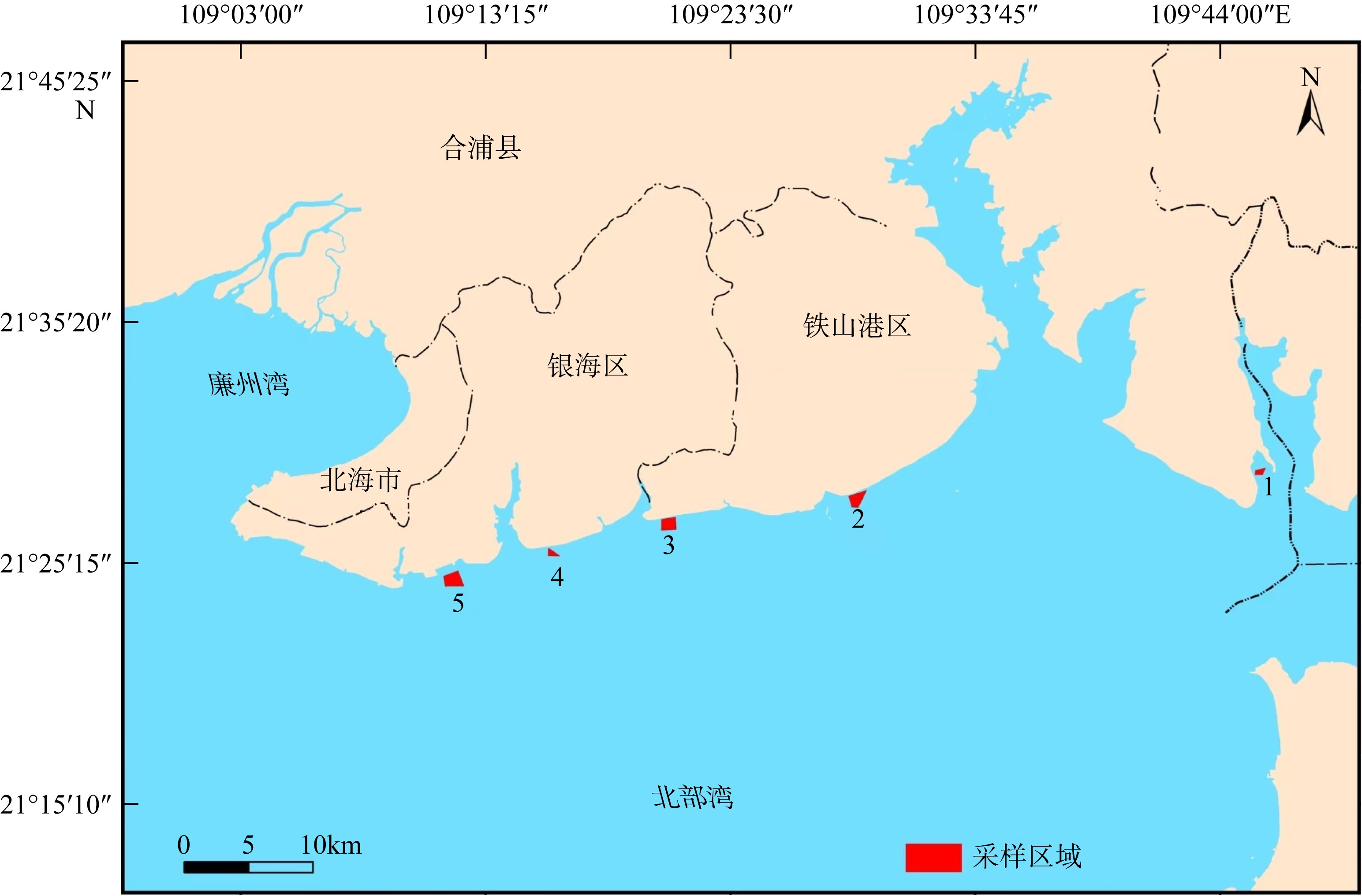
Fig. 1
Tab. 1
Contents of C and N, δ13C, δ15N, and C/N in initial S. nudus and 4 diets"
| 饵料种类 | δ13C / ‰ | C / % | δ15N / ‰ | N / % | C/N |
|---|---|---|---|---|---|
| 红树叶 | -28.36±0.33a | 46.91±1.63c | 8.99±0.26b | 1.04 ± 0.11a | 45.11 ± 1.39c |
| 互花米草 | -13.89±0.19c | 41.31±1.81c | 9.38±0.23b | 0.99 ± 0.09a | 41.73 ± 1.71c |
| 条浒苔 | -15.62±0.21c | 29.28±0.95b | 10.84 ± 0.41b | 3.54 ± 0.17b | 8.27 ± 0.77b |
| 对虾饲料 | -24.29±0.41b | 42.97±1.52c | 5.30 ± 0.18a | 7.20 ± 1.26c | 5.97 ± 0.46b |
| 初始方格星虫 | -14.25±0.25c | 25.63±0.58a | 6.12±0.21a | 4.84±0.19bc | 5.30 ± 0.28a |
Tab. 1
Tab. 2
Contents of C and N, δ13C, and δ15N in final S. nudus fed with 4 diets"
| 饵料种类 | δ13C / ‰ | C / % | δ15N / ‰ | N / % |
|---|---|---|---|---|
| 红树叶 | -16.13±0.48a | 24.40±0.65a | 8.95±0.44b | 7.26±0.20a |
| 互花米草 | -13.53±0.18b | 25.61±0.89a | 8.80±0.26b | 7.73±0.26a |
| 条浒苔 | -14.07±0.24b | 23.30±1.43a | 12.03±0.27c | 7.12±0.44a |
| 对虾饲料 | -14.09±0.09b | 32.66±1.72b | 6.78±0.70a | 10.26±0.57b |
Tab. 2
Tab. 3
Fractionation factors and related differences of 13C and 15N in S. nudus for 4 diets"
| 饵料 | Δδ13C | Δδ15N | δ13Cf - δ13Ci | δ13Ci - δ13Cd | δ15Nf - δ15Ni | δ15Ni - δ15Nd |
|---|---|---|---|---|---|---|
| 红树叶 | 12.22±0.49d | -0.04±0.44a | 1.88±1.07b | 14.11±1.36c | 2.83±0.96b | -2.87±0.23b |
| 互花米草 | 0.36±0.18a | -0.58±0.26ab | 0.71±0.40ab | -0.36±0.17a | 2.67±0.58b | -3.26±0.15b |
| 条浒苔 | 1.55±0.24b | 1.19±0.27b | 0.18±0.54a | 1.37±0.28b | 5.91±0.61c | -4.72±0.24c |
| 对虾饲料 | 10.20±0.09c | 1.48±0.70b | 0.25±0.30a | 10.04±2.13c | 0.72±1.41a | 0.82±0.11a |
Tab. 3
Tab. 4
Results of Pearson correlation analysis between the fractionation factors of stable isotopes in S. nudus and potential influencing factors"
| δ13C/‰ | C/% | δ15N/‰ | N/% | C/N | δ13Cf - δ13Ci | δ13Ci - δ13Cd | δ15Nf - δ15Ni | δ15Ni - δ15Nd | ||
|---|---|---|---|---|---|---|---|---|---|---|
| Δδ13C | R | -0.994** | 0.700 | -0.609 | 0.272 | 0.067 | 0.544 | 0.994** | -0.563 | 0.609 |
| P | -0.006 | 0.300 | 0.391 | 0.728 | 0.933 | 0.456 | 0.006 | 0.437 | 0.391 | |
| Δδ15N | R | -0.159 | -0.431 | -0.395 | 0.894 | -0.955* | -0.626 | 0.159 | 0.035 | 0.395 |
| P | 0.841 | 0.569 | 0.605 | 0.106 | 0.045 | 0.374 | 0.841 | 0.965 | 0.605 |
Tab. 4
Tab. 5
Contents of organic C and N, δ13C, and δ15N of S. nudus in the intertidal zone"
| 地点 | δ13C/‰ | C含量/% | δ15N/‰ | N含量/% |
|---|---|---|---|---|
| 山口镇英罗村 | -10.70±0.14a | 45.01±0.66a | 12.50±0.15c | 13.30±0.31a |
| 兴港镇北暮盐场 | -11.68±0.12b | 45.15±0.30a | 12.28±0.12c | 13.42±0.17a |
| 营盘镇青山头村 | -10.83±0.15a | 45.54±0.28a | 9.36±0.38a | 13.02±0.31a |
| 福成镇竹林盐场 | -10.69±0.13a | 42.89±2.64a | 10.40±0.17b | 13.54±0.21a |
| 银滩镇大冠沙 | -11.09±0.11a | 45.10±0.25a | 10.53±0.29b | 12.93±0.24a |
Tab. 5
Tab. 6
Contents of organic C and N, δ13C, and δ15N of sediments in the intertidal zone"
| 地点 | δ13C/‰ | C含量/% | δ15N/‰ | N含量/% | C/N |
|---|---|---|---|---|---|
| 山口镇英罗村 | -16.23±0.24a | 0.117±0.008a | 3.88±0.26a | 0.035±0.002a | 3.34±0.36ab |
| 兴港镇北暮盐场 | -15.98±0.29a | 0.110±0.006a | 3.31±0.24a | 0.043±0.003a | 2.56±0.29a |
| 营盘镇青山头村 | -15.11±0.43a | 0.149±0.008a | 3.15±0.18a | 0.040±0.003a | 3.73±0.43b |
| 福成镇竹林盐场 | -15.19±0.44a | 0.170±0.024a | 3.62±0.24a | 0.047±0.005a | 3.62±0.27b |
| 银滩镇大冠沙 | -15.42±0.17a | 0.129±0.020a | 3.37±0.32a | 0.036±0.004a | 3.58±0.24ab |
Tab. 6
Tab. 7
Fractionation factors and related differences of 13C and 15N in intertidal zone S. nudus for sediments"
| 地点 | Δδ13C | Δδ15N | δ13Cf - δ13Ci | δ13Ci - δ13Cs | δ15Nf - δ15Ni | δ15Ni - δ15Ns |
|---|---|---|---|---|---|---|
| 山口镇英罗村 | 5.54±0.34a | 8.62±0.32b | 3.55±0.22b | 1.98±0.09b | 6.38±0.41c | 2.24±0.15a |
| 兴港镇北暮盐场 | 4.30±0.31a | 8.97±0.24b | 2.57±0.19a | 1.73±0.11b | 6.16±0.32c | 2.81±0.19a |
| 营盘镇青山头村 | 4.36±0.49a | 6.13±0.35a | 3.42±0.21b | 0.86±0.08a | 3.24±0.36a | 2.97±0.23a |
| 福成镇竹林盐场 | 4.65±0.23a | 7.04±0.33a | 3.56±0.34b | 0.94±0.07a | 4.28±0.18b | 2.50±0.14a |
| 银滩镇大冠沙 | 4.11±0.43a | 6.90±0.27a | 3.16±0.16ab | 1.17±0.09a | 4.41±0.23b | 2.75±0.17a |
Tab. 7
Tab. 8
Results of Pearson correlation analysis between the fractionation factors of stable isotopes in S. nudus for sediments and potential influencing factors"
| δ13C/‰ | C含量/% | δ15N/‰ | N含量/% | C/N | δ13Cf - δ13Ci | δ13Ci - δ13Cs | δ15Nf - δ15Ni | δ15Ni - δ15Ns | ||
|---|---|---|---|---|---|---|---|---|---|---|
| Δδ13C | R | -0.593 | -0.146 | 0.876 | -0.293 | 0.035 | 0.540 | 0.593 | 0.537 | -0.876 |
| P | 0.292 | 0.815 | 0.051 | 0.633 | 0.955 | 0.347 | 0.292 | 0.351 | 0.051 | |
| Δδ15N | R | -0.932* | -0.746 | 0.471 | -0.085 | -0.856 | -0.492 | 0.932* | 0.983** | -0.471 |
| P | 0.021 | 0.148 | 0.423 | 0.892 | 0.064 | 0.400 | 0.021 | 0.003 | 0.423 |
Tab. 8
| [1] |
郭承秧, 杨志, 陈建芳, 等, 2018. 基于碳、氮稳定同位素的雅浦海沟底栖生物食物来源和营养级初探[J]. 海洋学报, 40(10): 51-60.
|
|
|
|
| [2] |
黄国强, 曹素会, 刘旭佳, 等, 2021. 拟穴青蟹对饵料中稳定同位素富集效应的初步研究[J]. 南方水产科学, 17(3): 19-26.
|
|
|
|
| [3] |
黄国强, 刘旭佳, 董兰芳, 等, 2023. 一种测定沉积食性小型底栖动物摄食量的方法: CN112730168B[P]. 2023-07-25.
|
| [4] |
黄国强, 刘旭佳, 彭银辉, 等, 2020. 广西北海市南岸滩涂主要大型植物及表层沉积物的稳定性碳和氮同位素丰度[J]. 广西科学, 27(5): 570-577.
|
|
|
|
| [5] |
江睿, 吴云超, 陈丕茂, 2021. 珠江口淇澳岛红树林湿地沉积物碳、氮分布研究[J]. 南方水产科学, 17(1): 1-9.
|
|
|
|
| [6] |
蒋艳, 刘旭佳, 蔡德建, 等, 2025. 4种饵料对方格星虫能量代谢与分配的影响[J]. 南方水产科学, 21(5): 83-91.
|
|
|
|
| [7] |
李凤鲁, 周红, 王玮, 1992. 中国沿海星虫动物门名录[J]. 青岛海洋大学学报, (2): 72-88.
|
|
|
|
| [8] |
李金铎, 2024. 杭州湾表层沉积物有机碳分布、来源及近20年来的变化[J]. 海洋通报, 43(2): 210-219.
|
|
|
|
| [9] |
李俊伟, 朱长波, 郭永坚, 等, 2015. 光裸方格星虫(Sipunculus nudus)生物扰动对混养系统沉积物及间隙水中营养物质的影响[J]. 渔业科学进展, 36(1): 103-110.
|
|
|
|
| [10] |
李俊伟, 胡瑞萍, 郭永坚, 等, 2019. 光裸方格星虫生物扰动对沉积物氮磷物质释放的影响[J]. 生态科学, 38(5): 8-14.
|
|
|
|
| [11] |
林光辉, 2013. 稳定同位素生态学[M]. 北京: 高等教育出版社.
|
|
|
|
| [12] |
刘旭佳, 黄国强, 陆洁, 等, 2023. 方格星虫滩涂养殖对沉积物TOC和TN垂直分布的影响[J]. 广西科学, 30(4): 653-662.
|
|
|
|
| [13] |
聂梦晨, 黄翠玲, 隋琪, 等, 2022. 桑沟湾沉积物有机质的碳氮稳定同位素分析及其来源解析[J]. 渔业科学进展, 43(5): 84-97.
|
|
|
|
| [14] |
万祎, 胡建英, 安立会, 等, 2005. 利用稳定氮和碳同位素分析渤海湾食物网主要生物种的营养层次[J]. 科学通报, 50(7): 708-712 (in Chinese).
|
| [15] |
谢斌, 李云凯, 张虎, 等, 2017. 基于稳定同位素技术的海州湾海洋牧场食物网基础及营养结构的季节性变化[J]. 应用生态学报, 28(7): 2292-2298.
doi: 10.13287/j.1001-9332.201707.019 |
|
doi: 10.13287/j.1001-9332.201707.019 |
|
| [16] |
张硕, 谢斌, 符小明, 等, 2016. 应用稳定同位素技术对海州湾拖网渔获物营养级的研究[J]. 海洋环境科学, 35(4): 507-511.
|
|
|
|
| [17] |
钟声平, 蔡小辉, 宋建达, 等, 2025. 拟穴青蟹对不同饵料稳定同位素的周转和分馏[J]. 渔业科学进展, 46(1): 30-45.
|
|
|
|
| [18] |
doi: 10.1093/plankt/7.4.553 |
| [19] |
doi: 10.1016/0016-7037(53)90001-5 |
| [20] |
doi: 10.1016/j.dsr2.2015.11.009 |
| [21] |
doi: 10.1016/0016-7037(78)90199-0 |
| [22] |
doi: 10.1016/0016-7037(81)90244-1 |
| [23] |
doi: 10.1016/0016-7037(81)90018-1 |
| [24] |
doi: 10.1071/MF02035 |
| [25] |
doi: 10.1007/BF00378393 |
| [26] |
doi: 10.4319/lo.1988.33.5.1182 |
| [27] |
doi: 10.1139/f93-230 |
| [28] |
doi: 10.3354/meps10421 |
| [29] |
doi: 10.3354/meps299067 |
| [30] |
doi: 10.1016/j.ecss.2010.12.027 |
| [31] |
doi: 10.1016/j.scitotenv.2020.144068 |
| [32] |
doi: 10.1007/s11802-017-3310-z |
| [33] |
doi: 10.1016/j.aquaculture.2014.12.002 |
| [34] |
doi: 10.1139/z05-038 |
| [35] |
doi: 10.1007/s13157-010-0021-2 |
| [36] |
doi: 10.1016/0016-7037(84)90204-7 |
| [37] |
doi: 10.1016/S0031-0182(98)00094-7 |
| [38] |
doi: 10.1146/ecolsys.1987.18.issue-1 |
| [39] |
doi: 10.1890/0012-9658(2002)083[0703:USITET]2.0.CO;2 |
| [40] |
doi: 10.1016/j.jembe.2016.10.031 |
| [41] |
doi: 10.1016/0016-7037(84)90091-7 |
| [42] |
doi: 10.1017/S002185960004853X |
| [43] |
doi: 10.1007/BF00379558 |
| [44] |
doi: 10.1006/ecss.1994.1015 |
| [45] |
doi: 10.3354/meps296115 |
| [1] | ZHANG Qiang, ZHAO Zhongwei, SU Xiang, ZHAO Xuan, LI Wei. A comparison of two non-instrumental methodologies for determining carbonate content in marine sediments* [J]. Journal of Tropical Oceanography, 2026, 45(3): 25-38. |
| [2] | HUANG Chunmei, WANG Riming, XIE Xiaowen, DAI Zhijun, XIE Xiaokui, LI Xingrong. Spatial heterogeneity of carbon content in sediments from mangrove tidal flats at the Nanliu River estuary [J]. Journal of Tropical Oceanography, 2026, 45(3): 174-187. |
| [3] | ZHOU Qiang, YANG Cuihua, CHEN Xueweijie, QI Jiguang, WANG Youkun, WANG Yunzhong. Effects of live bait types and feeding methods on the asexual reproductive ability of polyps of Chrysaora quinquecirrha [J]. Journal of Tropical Oceanography, 2026, 45(3): 164-173. |
| [4] | TAN Qingbi, GUO Hongying, SUN Siqi, ZHONG Yuhang, NIE Hui, NIU Lixia. Analysis of nitrogen sources and influencing factors in mangrove sediments of the Qingjiang River estuary (Zhejiang) using stable isotopes [J]. Journal of Tropical Oceanography, 2026, 45(3): 202-211. |
| [5] | JIANG Shoudian, HU Xin, LAN Peixin, YAO Liqin, SHUI Bonian, JI Jianda, HE Maoqiu. Seasonal distribution characteristics and environmental driving factors of bacterial communities in mangrove sediments of Ximen Island, Zhejiang Province [J]. Journal of Tropical Oceanography, 2026, 45(2): 117-128. |
| [6] | ZHONG Fuchang, XIANG Rong, YANG Yiping, MAO Huabin. Distribution characteristics and influencing factors of benthic foraminifera in surface sediments of the northeast Indian Ocean Ridge region* [J]. Journal of Tropical Oceanography, 2026, 45(1): 81-90. |
| [7] | DU Shuhuan, XIANG Rong, SU Xiang, ZHANG Lanlan, PAN Zirui, XIE Jinwo, LUO Chuanxiu, WAN Sui. Calcium carbonate composition of surface sediments and influencing factors in the 90°E Ridge of the northeastern Indian Ocean* [J]. Journal of Tropical Oceanography, 2026, 45(1): 73-80. |
| [8] | ZHANG Lanlan, LI Tong, CHENG Xiawen, PERERA Batagoda Gamage Dumudu Ojitham, XIANG Rong. Depth gradient changes in dead polycystine radiolarians in the tropical southeastern Indian Ocean during spring* [J]. Journal of Tropical Oceanography, 2026, 45(1): 60-72. |
| [9] | LIN Mingzhi, QIN Maogang, CHEN Yang, CHEN Bo, WANG Xuemu, LIU Yanrui, SONG Jiawei, SUN Longfei. Research on the assignment mapping method of seabed sediment types based on Folk classification [J]. Journal of Tropical Oceanography, 2026, 45(1): 178-187. |
| [10] | LIU Zeyu, ZHANG Guocheng, WANG Yuanyuan. Composition and distribution characteristics of modern biological relics in the estuary of Pearl River Delta [J]. Journal of Tropical Oceanography, 2025, 44(6): 39-50. |
| [11] | LIN Mingzhi, CHEN Bo, CHEN Yang. Discussion on classification methods of clastic sediment suitable for marine sand exploration [J]. Journal of Tropical Oceanography, 2025, 44(6): 165-175. |
| [12] | CHEN Jianyong. Spatial distribution and control strategies of organic matter, nitrogen, and phosphorus pollution in sediments of Xinglin Bay, Xiamen [J]. Journal of Tropical Oceanography, 2025, 44(4): 200-209. |
| [13] | CHEN Tianshu, XIAO Hongwei, GUAN Wenkai, XIAO Huayun. Tracing the sources and formation mechanisms of marine atmospheric nitrate using stable isotopes [J]. Journal of Tropical Oceanography, 2025, 44(3): 167-178. |
| [14] | QIU Xingyu, LIU Qingxia, CHEN Zuozhi, CAI Yancong, HUANG Honghui. Characteristics of carbon and nitrogen stable isotopes of major fish species in coral reefs of the Nansha Islands in spring 2023 [J]. Journal of Tropical Oceanography, 2024, 43(6): 104-113. |
| [15] | LI Rongmao. Study on topographic and geomorphological features and natural disaster capacity of sandy coast in Shenhu Bay, Fujian [J]. Journal of Tropical Oceanography, 2024, 43(6): 72-79. |
|
||