

Journal of Tropical Oceanography ›› 2026, Vol. 45 ›› Issue (1): 60-72.doi: 10.11978/YG2025004CSTR: 32234.14.YG2025004
Previous Articles Next Articles
Depth gradient changes in dead polycystine radiolarians in the tropical southeastern Indian Ocean during spring*
ZHANG Lanlan1( ), LI Tong1,2, CHENG Xiawen1,2, PERERA Batagoda Gamage Dumudu Ojitham1,2, XIANG Rong1
- 1State Key Laboratory of Tropical Oceanography, South China Sea Institute of Oceanology, Chinese Academy of Sciences, Guangzhou 511458, China
2University of Chinese Academy of Sciences, Beijing 100049, China
-
Received:2025-07-07Revised:2025-07-10Online:2026-01-10Published:2026-01-30 -
Contact:ZHANG Lanlan. email:llzhang@scsio.ac.cn -
Supported by:National Natural Science Foundation of China(42176080); National Natural Science Foundation of China(42476067); National Key Research and Development Program of China(2022-24); Development Fund of South China Sea Institute of Oceanology of Chinese Academy of Sciences(SCSIO202201); Shiptime Sharing Project of National Natural Science Foundation of China (NSFC)(41649910)

CLC Number:
- Q913
Cite this article
ZHANG Lanlan, LI Tong, CHENG Xiawen, PERERA Batagoda Gamage Dumudu Ojitham, XIANG Rong. Depth gradient changes in dead polycystine radiolarians in the tropical southeastern Indian Ocean during spring*[J].Journal of Tropical Oceanography, 2026, 45(1): 60-72.
share this article
Add to citation manager EndNote|Reference Manager|ProCite|BibTeX|RefWorks
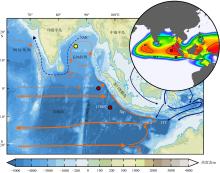
Fig. 1
Geological location of the study area. The red circles represent the equatorial station 17I415 and the southern station 17I507 in this study, while the yellow circles represent the central Bay of Bengal station 19E87-32 (Zhang et al, 2023). Bathymetric data are derived from GEBCO global gridded bathymetric dataset (https://www.gebco.net/). The upper right picture shows the location of the Indo-Pacific warm pool where the annual average sea surface temperature is higher than 28℃. Temperature data come from the World Ocean Atlas WOA 2023 (https://www.ncei.noaa.gov/products/world-ocean-atlas). Dashed lines in the figure represent northeast monsoon current (NMC; winter surface current), southwest monsoon current (SMC; summer surface current), and Wyrtki Jets (seasonal jets that occur during the monsoon transitions, WJs). Solid lines denote Indonesian Throughflow (ITF), south equatorial countercurrent (SECC), south equatorial current (SEC), eastern gyral current (EGC), and south Java current (SJC)"

Fig. 1
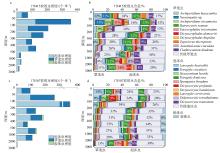
Fig. 2
Changes in radiolarian remains abundance with water depth at the equatorial station (17I415) and the southern station (17I507). (a) Radiolarian remnant population density at 17I415; (b) radiolarian remnant population content at 17I415; (c) radiolarian remnant population density at 17I507; (d) radiolarian remnant population content at 17I507"

Fig. 2
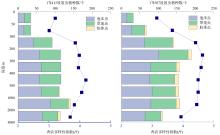
Fig. 3
Changes in species richness and diversity indices of radiolarian remains at the equatorial station (17I415) and the southern station (17I507) in the water"
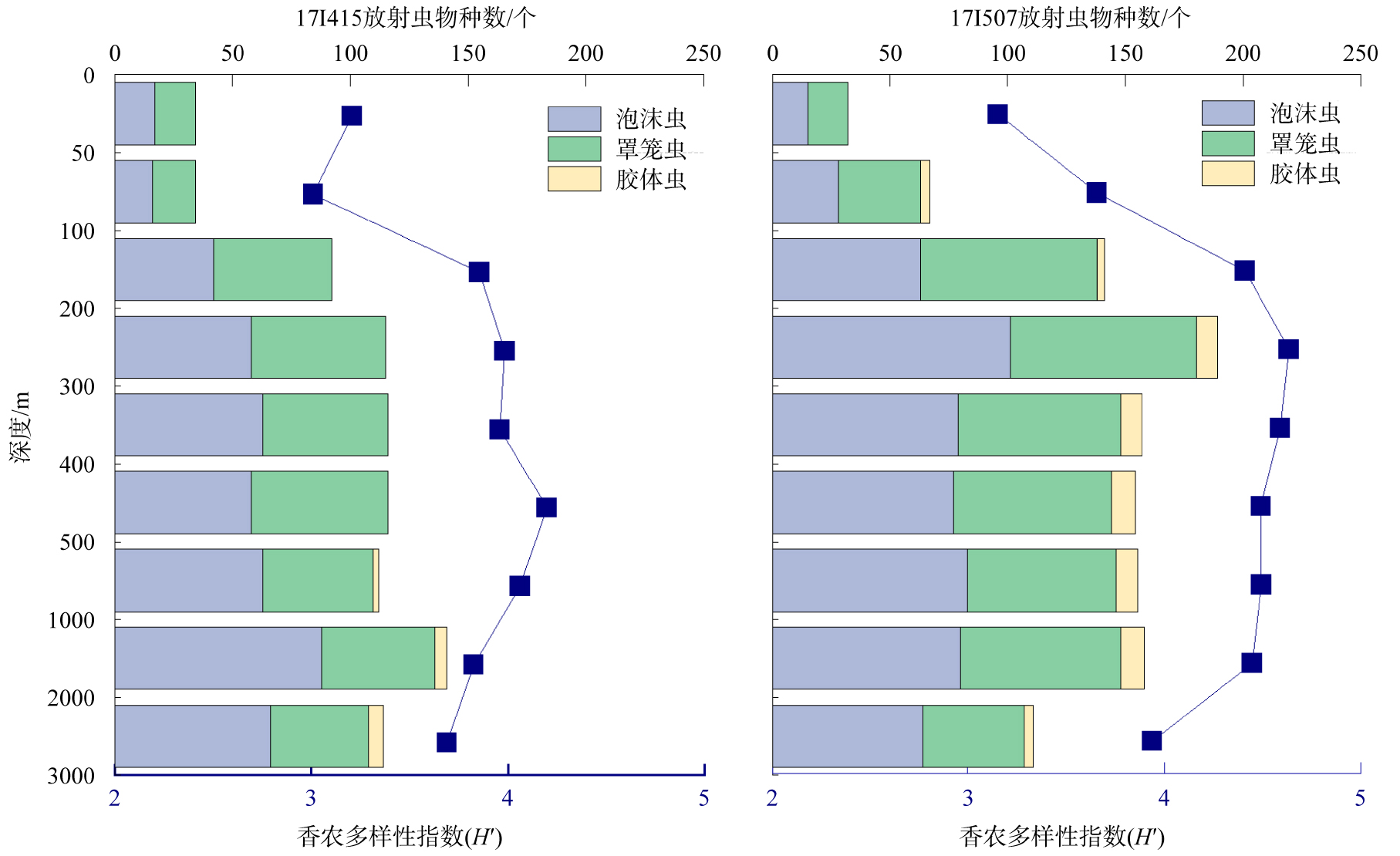
Fig. 3
Fig. 4
Changes in the species turnover rate of radiolarian remains with water depth at the equatorial station (17I415) and the southern station (17I507) in the water"
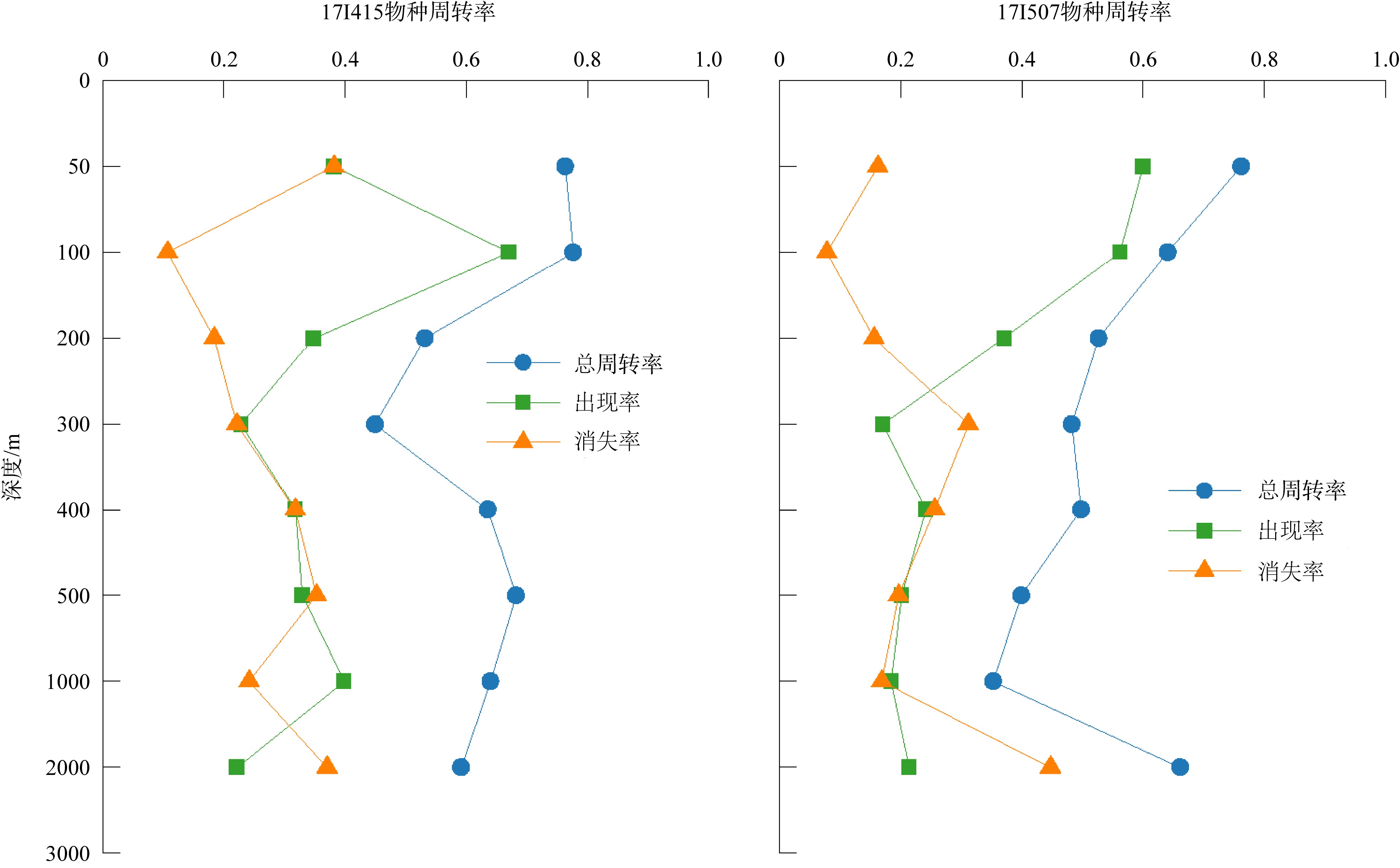
Fig. 4
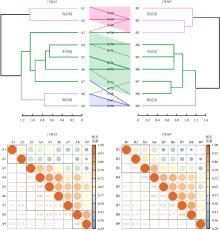
Fig. 5
Cluster analysis and Pearson correlation analysis between different depth layers. The equatorial station (17I415) and southern station (17I507) are labeled as A and B in the figure, respectively. Numbers 1-9 represent the depth layers 0-50 m, 50-100 m, 100-200 m, 200-300 m, 300-400 m, 400-500 m, 500-1000 m, 1000-2000 m, and 2000-3000 m, respectively. The connecting line in the middle indicates the Pearson correlation coefficient between the genus and species composition of the two stations"

Fig. 5
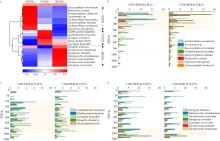
Fig. 6
Cluster analysis and content changes of main genus and species. (a) Clustering analysis results of main species; (b) percent content changes of dominant species in the shallow layer; (c) percent content changes of dominant species in the middle layer; (d) percent content changes of dominant species in the deep layer"

Fig. 6
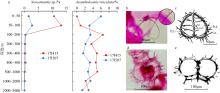
Fig. 7
Changes in genus and species content with depth and their morphological characteristics. (a) Variation in contents of radiolarians Neosemantis sp. and Acantholesmia vinculata with water depth; (b) microscopic photograph of Neosemantis sp.; (c) typical morphology of Neosemantis distephanus (Tan et al, 2003); (d) microscopic photograph of Acantholesmia vinculata; (e) typical morphology of Acantholesmia vinculata (Benson, 1966)"
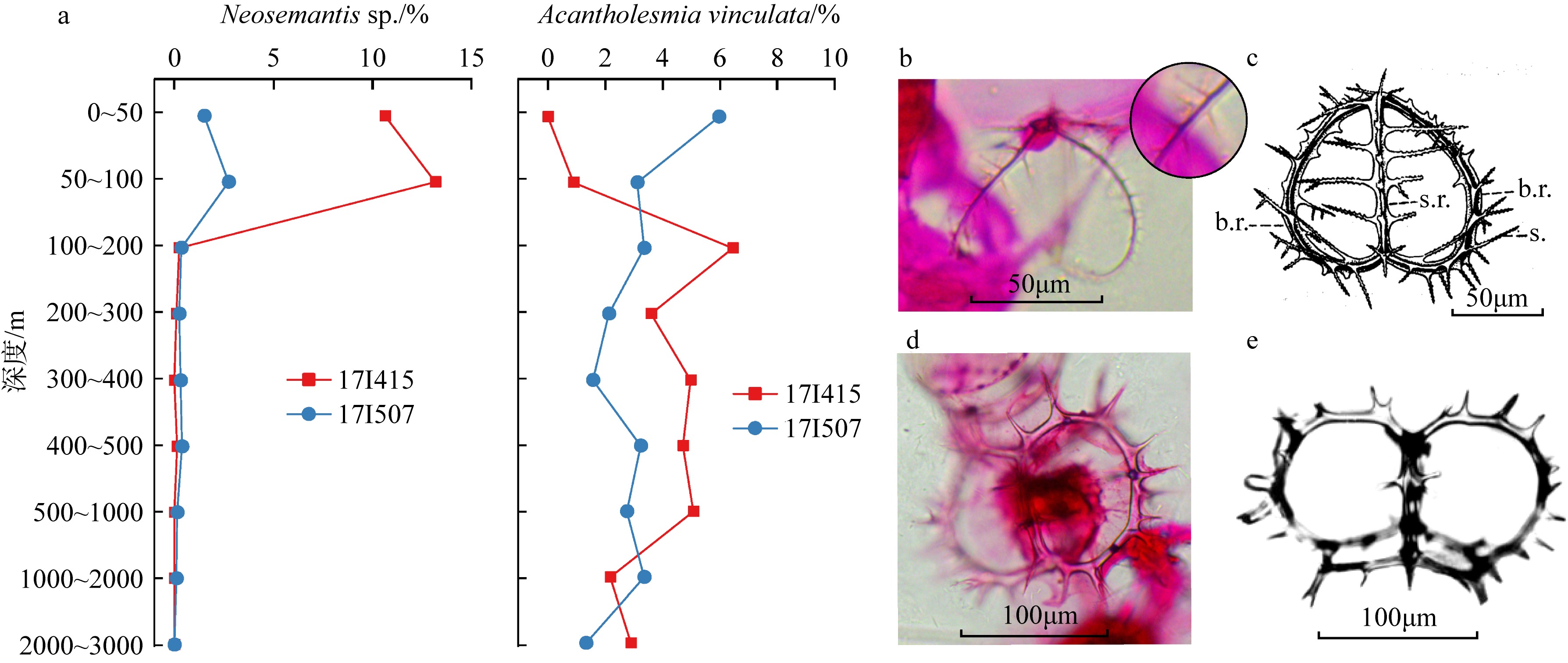
Fig. 7
| [1] |
程夏雯, 张兰兰, 邱卓雅, 等, 2023. 北印度洋-南海表层水体中浮游动物胶体虫(放射虫)的物种多样性、生物地理及其季节变化[J]. 热带海洋学报, 42(2): 97-112.
|
|
|
|
| [2] |
胡维芬, 张兰兰, 陈木宏, 等, 2014. 南海断面春季放射虫残骸的空间分布及其与表层沉积记录对比[J]. 微体古生物学报, 31(3): 213-227.
|
|
|
|
| [3] |
胡维芬, 张兰兰, 陈木宏, 等, 2015. 南海断面春季活体放射虫生态分布及其对环境的响应[J]. 中国科学: 地球科学, 45(1): 83-98.
|
|
doi: 10.1007/s11430-014-4950-0 |
|
| [4] |
孙萍, 李艳, 潘玉龙, 等, 2020. 热带东印度洋春季浮游植物群落结构空间特征分析[J]. 海洋学报, 42(8): 76-88.
|
|
|
|
| [5] |
谭智源, 宿星慧, 2003. 中国动物志无脊椎动物第三十二卷放射虫门[M]. 北京: 科学出版社, 85-86 (in Chinese).
|
| [6] |
薛冰, 孙军, 丁昌玲, 等, 2016. 2014年春季季风间期东印度洋赤道及其邻近海域硅藻群落[J]. 海洋学报, 38(2): 112-120.
|
|
|
|
| [7] |
张杰, 张兰兰, 陈木宏, 等, 2020. 现代放射虫的高阶分类现状及其生态学意义[J]. 微体古生物学报, 37(1): 82-98.
|
|
|
|
| [8] |
张兰兰, 程夏雯, 向荣, 等, 2023. 2019年春季孟加拉湾中部放射虫群落结构垂向变化[J]. 热带海洋学报, 42(4): 166-175.
|
|
|
|
| [9] |
doi: 10.1016/0967-0637(96)00003-9 |
| [10] |
doi: 10.1016/j.quascirev.2020.106302 |
| [11] |
|
| [12] |
doi: 10.1016/j.pocean.2016.09.006 |
| [13] |
doi: 10.1016/0924-7963(95)00038-0 |
| [14] |
doi: 10.1093/plankt/24.8.797 |
| [15] |
doi: 10.1016/j.earscirev.2023.104313 |
| [16] |
doi: 10.1016/j.jmarsys.2012.12.001 |
| [17] |
doi: 10.1016/S0031-0182(03)00388-2 |
| [18] |
|
| [19] |
doi: 10.1111/mee3.2016.7.issue-10 |
| [20] |
doi: 10.1016/j.marmicro.2007.06.002 |
| [21] |
doi: 10.1016/S0377-8398(02)00119-6 |
| [22] |
|
| [23] |
doi: 10.1038/s41612-022-00315-w |
| [24] |
doi: 10.1016/j.rsma.2020.101106 |
| [25] |
|
| [26] |
doi: 10.1038/s41598-019-43841-z pmid: 31089167 |
| [27] |
|
| [28] |
|
| [29] |
|
| [30] |
|
| [31] |
|
| [32] |
doi: 10.1016/j.dsr.2021.103625 |
| [33] |
doi: 10.1016/j.gloplacha.2024.104477 |
| [34] |
doi: 10.1016/j.quascirev.2011.01.006 |
| [35] |
doi: 10.1029/95RG00879 |
| [36] |
doi: 10.1002/bltj.1948.27.issue-3 |
| [37] |
doi: 10.1016/0377-8398(83)90022-1 |
| [38] |
doi: 10.1016/0198-0149(83)90088-2 |
| [39] |
doi: 10.1038/s41586-022-04687-0 |
| [40] |
doi: 10.1016/j.csr.2020.104245 |
| [41] |
doi: 10.1016/j.marmicro.2017.10.007 |
| [1] | ZHANG Lianyi, ZHANG Yuhong, DU Yan. Quantifying impacts of ENSO and internal variability on the Indian Ocean Dipole* [J]. Journal of Tropical Oceanography, 2026, 45(1): 91-104. |
| [2] | CHU Xiaoqing, PENG Qihua. The role of alongshore wind and ocean wave in generating the northward Somali Current [J]. Journal of Tropical Oceanography, 2023, 42(2): 1-8. |
| [3] | CHEN Yunfan, CHEN Tianran, LONG Shangmin, CHEN Zesheng, DU Yan. Reconstruction of climate variability of the tropical Indian Ocean based on coral δ18O data from four representative sites [J]. Journal of Tropical Oceanography, 2022, 41(1): 82-93. |
| [4] | ZHANG Guo-sheng, ZHANG Biao, DU Yan, WANG Lei. Extraction of Rossby wave speed and deformation radius in the tropical Indian Ocean from multi-satellite altimeter data [J]. Journal of Tropical Oceanography, 2014, 33(5): 22-27. |
| [5] | XUAN Li-li, QIU Yun, XU Jin-dian, ZENG Ming-zhang. Seasonal variation of surface-layer circulation in the eastern tropical Indian Ocean [J]. Journal of Tropical Oceanography, 2014, 33(1): 26-35. |
|
||