

热带海洋学报 ›› 2026, Vol. 45 ›› Issue (3): 61-73.doi: 10.11978/2025114CSTR: 32234.14.2025114
所属专题: 南海专题
南海表层水悬浮颗粒物脂肪酸组成特征及其生态指示意义*
李东平( ), 石豪磊, 罗中原, 曹建涛, 贾国东()
同济大学海洋与地球科学学院 ,海洋地质全国重点实验室
-
收稿日期:2025-07-23修回日期:2025-09-29出版日期:2026-05-10发布日期:2026-05-28 -
通讯作者:贾国东。 email: jiagd@tongji.edu.cn -
作者简介:李东平(1997—), 男, 辽宁省抚顺市人, 硕士研究生, 从事有机地球化学研究。email: friend_3@qq.com
-
基金资助:国家自然科学基金重点项目(42030504); 国家自然科学基金委员会共享航次计划项目(42249906)
Compositional characteristics and ecological significance of fatty acids of the surface suspended particulate matter in the South China Sea*
LI Dongping(), SHI Haolei, LUO Zhongyuan, CAO Jiantao, JIA Guodong()
State Key Laboratory of Marine Geology ,School of Ocean and Earth Sciences, Tongji University
-
Received:2025-07-23Revised:2025-09-29Online:2026-05-10Published:2026-05-28 -
Contact:JIA Guodong. email: jiagd@tongji.edu.cn -
Supported by:National Natural Science Foundation of China(42030504); National Natural Science Foundation of China Shared Cruise Project(42249906)

摘要:
脂肪酸是生物细胞膜的一类重要脂质成分, 具有较强的生物指示意义。但是, 海洋颗粒物中脂肪酸的组成如何有效反映颗粒有机质的来源及海洋浮游生物的群落结构特征等方面的研究并不多, 在南海尤其缺乏相关资料。本文对南海夏季表层悬浮颗粒物中的脂肪酸组成进行了详细分析, 共检出30种脂肪酸化合物。通过聚类分析把这些脂肪酸划分为新鲜浮游植物、浮游植物碎屑、细菌、浮游动物和陆源高等植物等五种不同来源。其中, 新鲜浮游植物脂肪酸主要为不饱和脂肪酸, 特别是多不饱和脂肪酸, 从中可分辨出硅藻、甲藻和蓝细菌等不同来源。对这些脂肪酸在南海的空间分布进行了系统分析, 结果表明, 南海西南及西部的夏季上升流影响区域以新鲜浮游植物, 特别是硅藻贡献的脂肪酸为主, 而处于东北部的高温高盐区域则以浮游植物碎屑贡献的短链饱和脂肪酸为主。浮游动物脂肪酸则分别对应于新鲜浮游植物脂肪酸和浮游植物碎屑脂肪酸而呈现出相应的高值。细菌脂肪酸与浮游植物不饱和脂肪酸大致呈反向分布格局, 反映出生态系统的初级生产与呼吸降解之间的相对变化: 在西南—西的方向上以初级生产为主导, 而在中部和东南方向上微生物的呼吸作用增强。陆源的长链饱和脂肪酸占比很低, 其分布呈现夏季海流驱动的模式, 自西南向东北方向减少。本研究表明, 脂肪酸作为分子生物标志物可有效指示南海表层水体颗粒物中不同生物源的输入情况, 对于揭示海洋浮游植物的群落结构特征具有潜在的应用价值。
中图分类号:
- Q178
引用本文
李东平, 石豪磊, 罗中原, 曹建涛, 贾国东. 南海表层水悬浮颗粒物脂肪酸组成特征及其生态指示意义*[J]. 热带海洋学报, 2026, 45(3): 61-73.
LI Dongping, SHI Haolei, LUO Zhongyuan, CAO Jiantao, JIA Guodong. Compositional characteristics and ecological significance of fatty acids of the surface suspended particulate matter in the South China Sea*[J]. Journal of Tropical Oceanography, 2026, 45(3): 61-73.
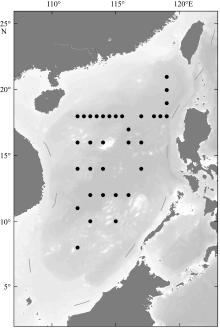
图1
本研究中的南海表层水体颗粒物站位分布 该图基于自然资源部标准地图服务网站下载的审图号为GS(2022) 4318号的标准地图制作, 底图无修改"
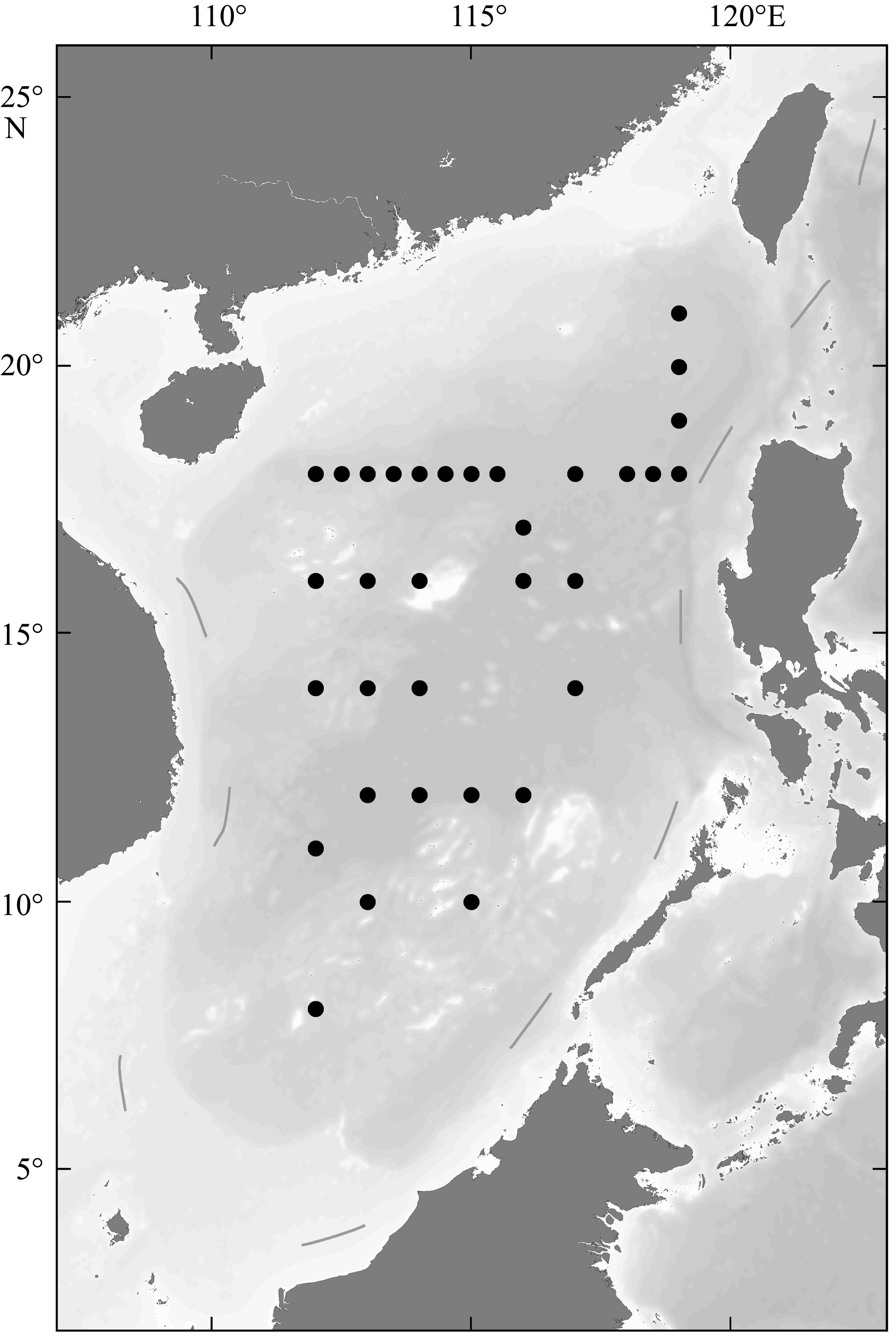
图1
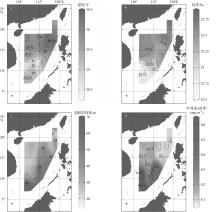
图2
采样期间的南海表层水体环境特征 a. 温度; b. 盐度; c. 温跃层深度; d. 叶绿素a浓度; 该图基于自然资源部标准地图服务网站下载的审图号为GS(2022)4318号的标准地图制作"
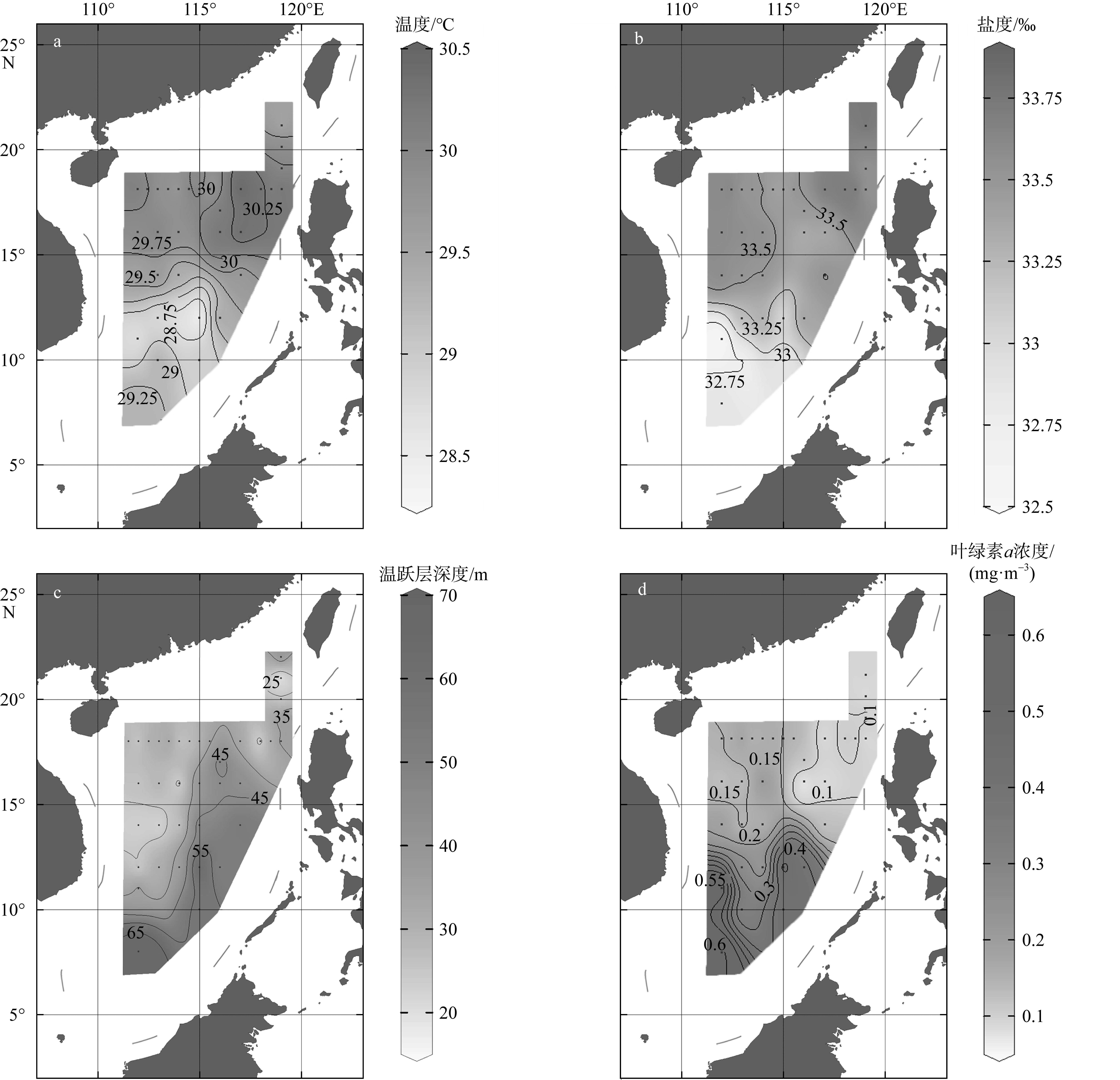
图2
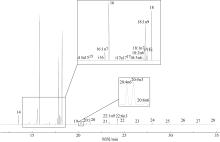
图3
本研究脂肪酸成分的典型气相色谱图 图中字母和数字的含义请参考正文中介绍的脂肪酸命名方法"
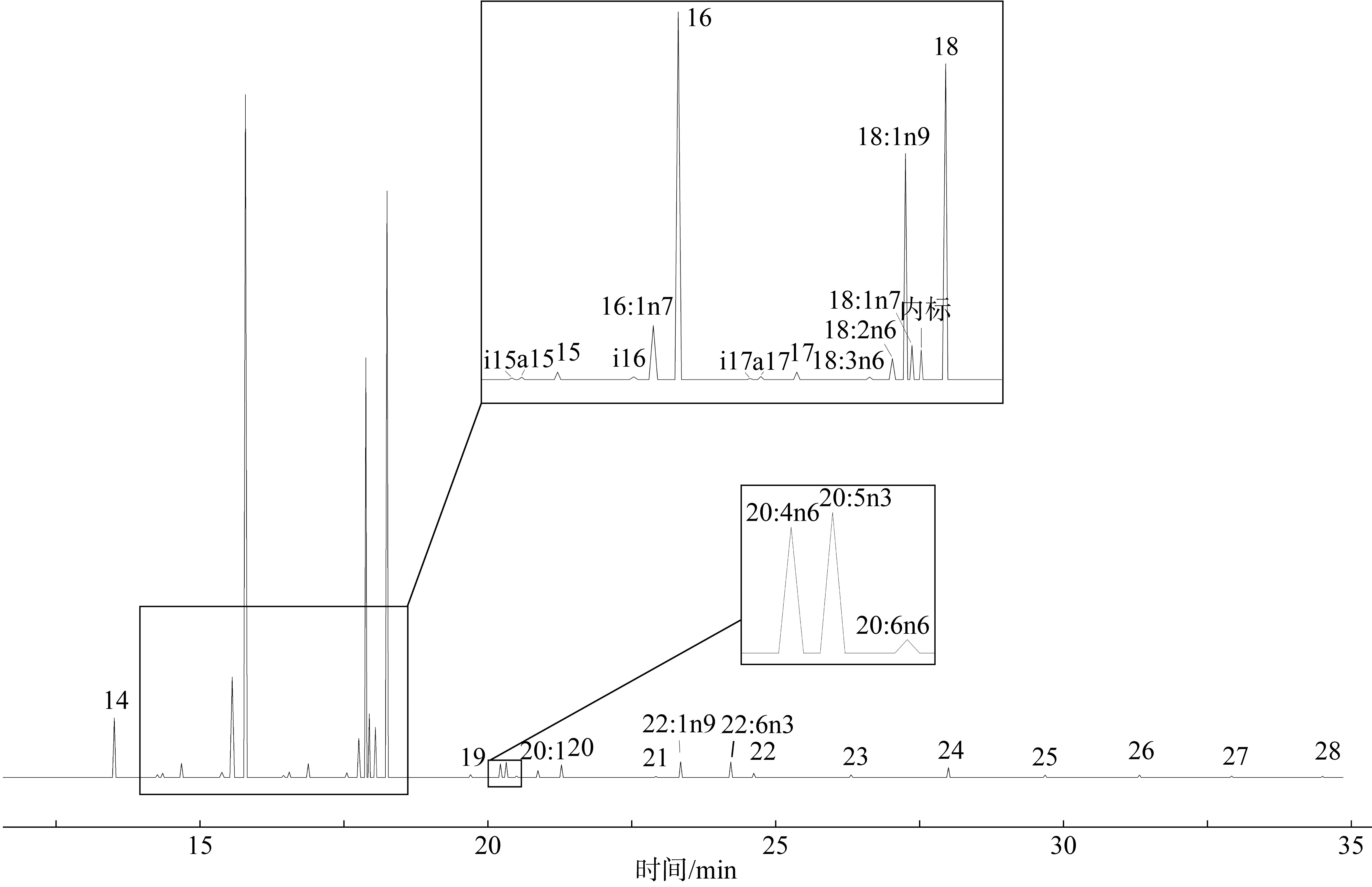
图3
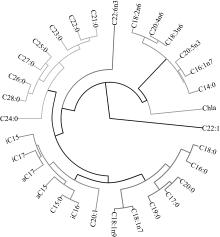
图4
本文检测到的30种脂肪酸成分的聚类分析图"
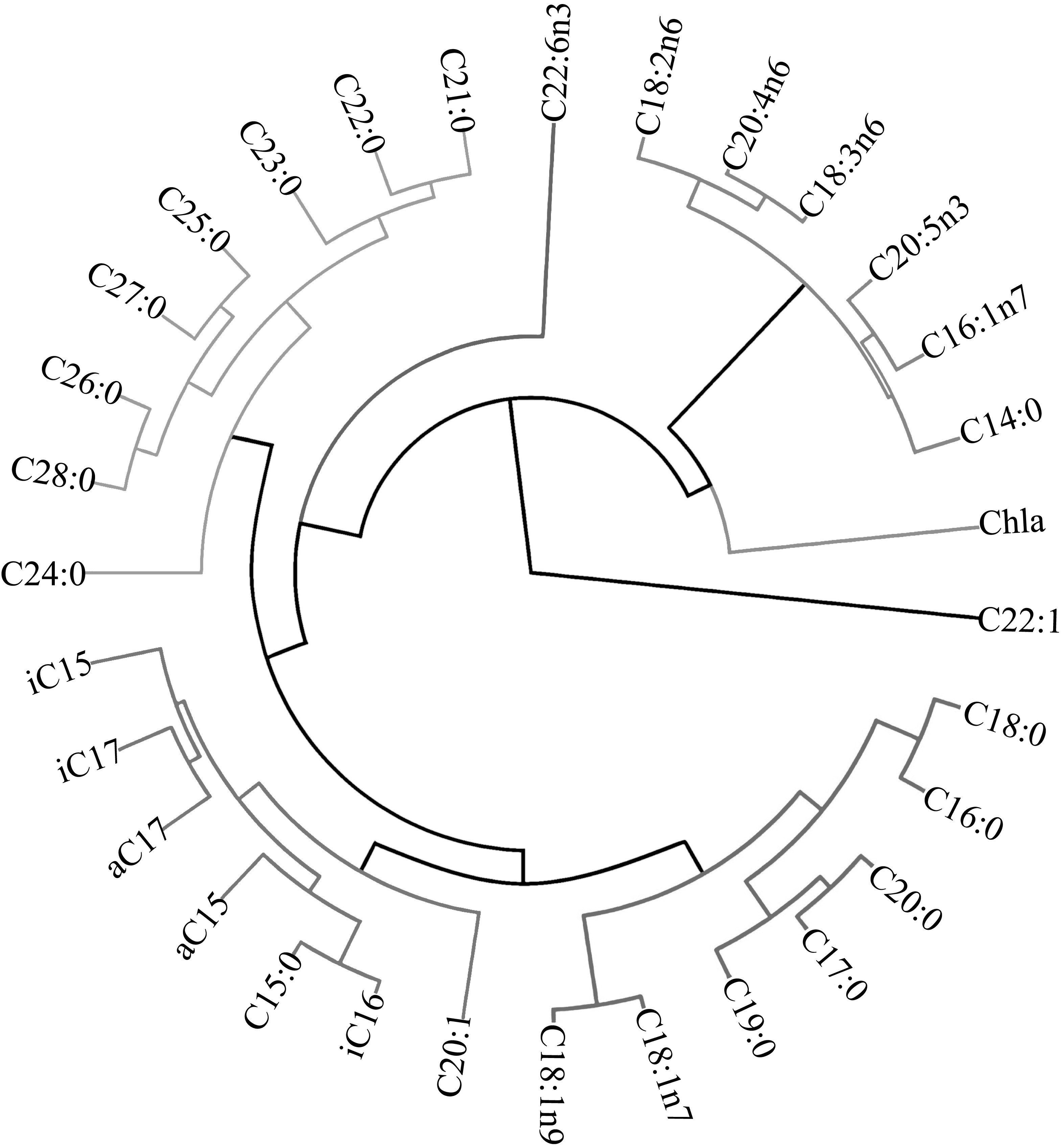
图4
图5
脂肪酸绝对含量在南海的分布 a. 新鲜浮游植物脂肪酸; b. 细菌脂肪酸; c. 陆源脂肪酸; d. 浮游动物脂肪酸; e. 浮游植物碎屑脂肪酸。该图基于自然资源部标准地图服务网站下载的审图号为GS(2022)4318号的标准地图制作"
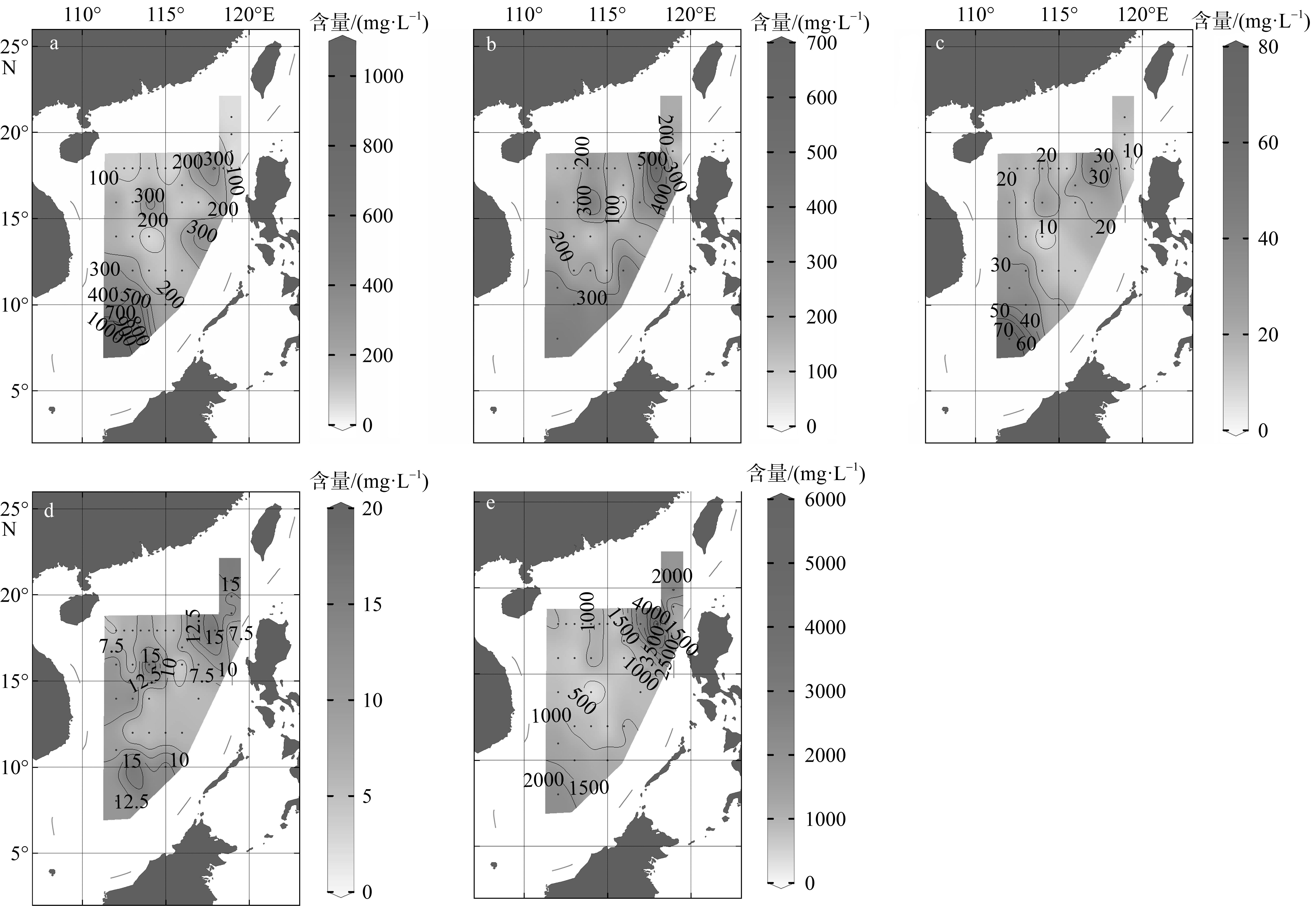
图5
图6
脂肪酸相对含量在南海的分布。 a. 新鲜浮游植物脂肪酸; b. 细菌脂肪酸; c. 陆源脂肪酸; d. 浮游动物脂肪酸; e. 浮游植物碎屑脂肪酸。该图基于自然资源部标准地图服务网站下载的审图号为GS(2022)4318号的标准地图制作"
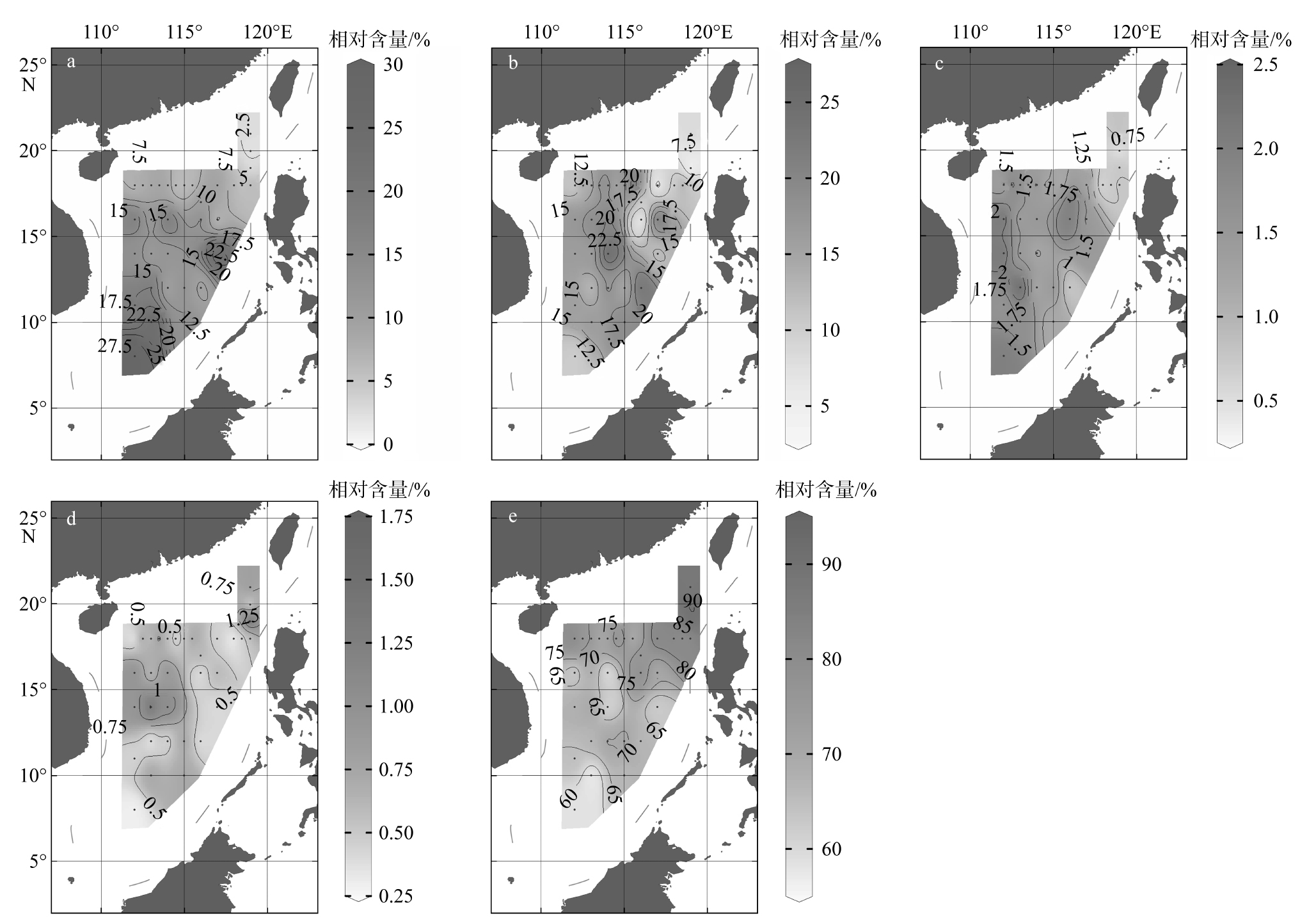
图6
图7
南海不同来源浮游植物不饱和脂肪酸在新鲜浮游植物脂肪酸中占比的分布 a. 硅藻源脂肪酸占比; b. 甲藻源脂肪酸占比; c. 蓝细菌脂肪酸占比; d. EPA/DHA比值(EPA: 二十碳五烯酸; DHA: 二十二碳六烯酸)。该图基于自然资源部标准地图服务网站下载的审图号为GS(2022)4318号的标准地图制作"
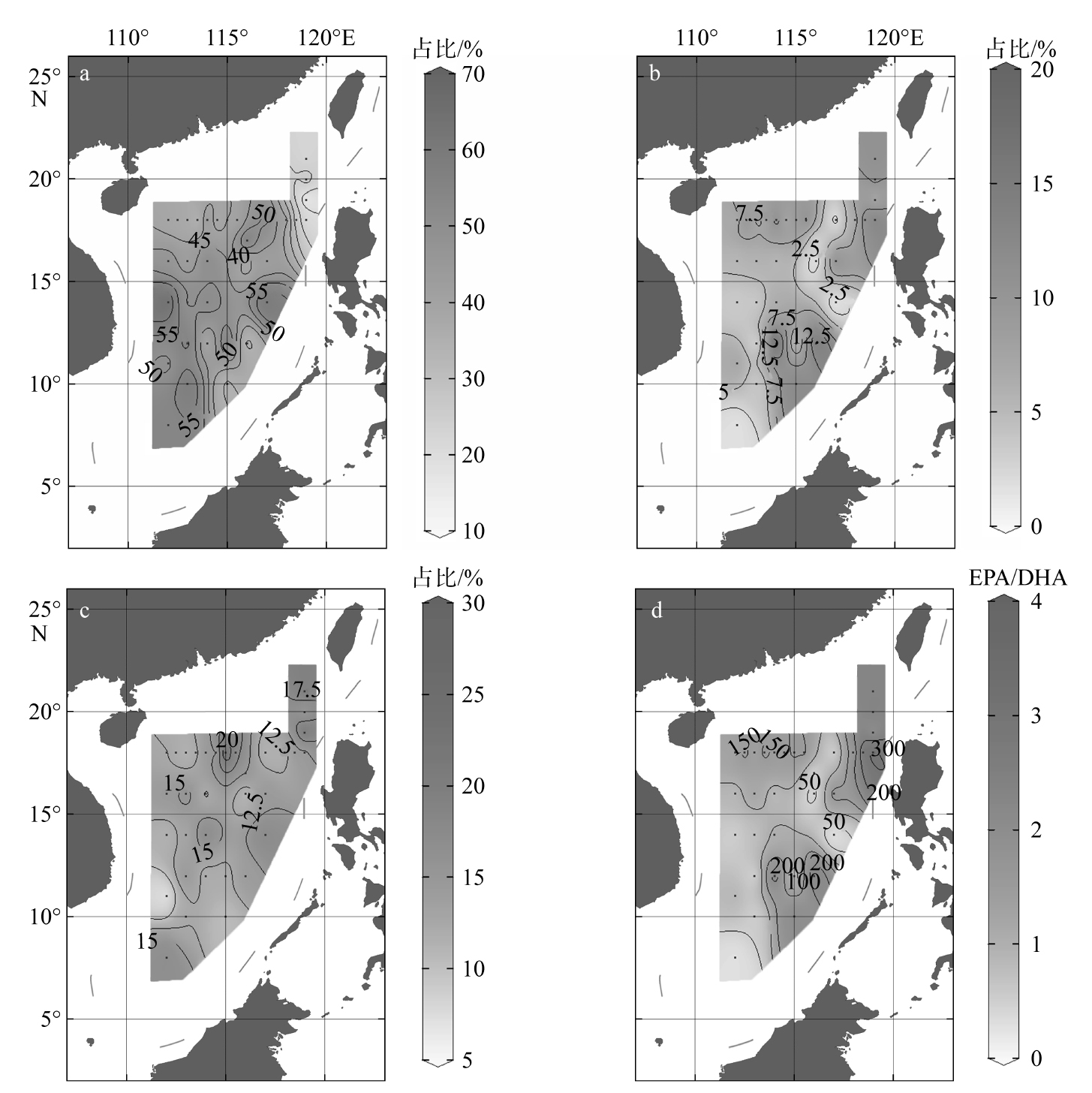
图7
| [1] |
白志鹏, 韩君, 姚小海, 2020. 南海温跃层时空分布及其对水下通信的影响[J]. 舰船科学技术, 42(11): 163-167.
|
|
|
|
| [2] |
陈作志, 邱永松, 2010. 南海北部生态系统食物网结构、能量流动及系统特征[J]. 生态学报, 30(18): 4855-4865.
|
|
|
|
| [3] |
段毅, 崔明中, 罗斌杰, 等, 1997. 我国海洋沉降颗粒物质的有机地球化学研究——I. 有机质通量及烃类化合物和脂肪酸分布特征[J]. 中国科学: 地球科学, 27(5): 442-446 (in Chinese).
|
| [4] |
段毅, 罗斌杰, 钱吉盛, 等, 1996. 南沙海洋沉积物中脂肪酸地球化学研究[J]. 海洋地质与第四纪地质, 16(2): 23-31.
|
|
|
|
| [5] |
高淑敏, 韩树宗, 倪煜淮, 等, 2023. 西北太平洋黑潮水入侵南海的路径、成因及影响[J]. 海洋湖沼通报, 45(5): 163-172.
doi: 10.13984/j.cnki.cn37-1141.2023.05.021 |
|
doi: 10.13984/j.cnki.cn37-1141.2023.05.021 |
|
| [6] |
柯志新, 黄良民, 谭烨辉, 等, 2011. 2007年夏季南海北部浮游植物的物种组成及丰度分布[J]. 热带海洋学报, 30(1): 131-143.
|
|
doi: 10.11978/j.issn.1009-5470.2011.01.131 |
|
| [7] |
乐凤凤, 孙军, 宁修仁, 等, 2006. 2004年夏季中国南海北部的浮游植物[J]. 海洋与湖沼, 37(3): 238-248.
|
|
|
|
| [8] |
刘华雪, 柯常亮, 李纯厚, 等, 2014. 南海南部悬浮颗粒物脂肪酸组成[J]. 生态学报, 34(10): 2599-2607.
|
|
|
|
| [9] |
孙成学, 刘秦玉, 贾英来, 2007. 南海混合层深度的季节变化及年际变化特征[J]. 中国海洋大学学报(自然科学版), 37(2): 197-203.
|
|
|
|
| [10] |
徐豪然, 于华明, 葛晶晶, 等, 2024. 南海海表盐度变化特征及机制研究[J]. 中国海洋大学学报(自然科学版), 54(2): 1-11.
|
|
|
|
| [11] |
杨义, 郝宇昕, 阮小燕, 等, 2018. 南海不同水深表层沉积物脂肪酸分布特征及其生物源的空间变化[J]. 地球科学, 43(11): 4027-4035.
|
|
|
|
| [12] |
中华人民共和国国家质量监督检验检疫总局, 中国国家标准化管理委员会, 2007. 海洋调查规范第7部分: 海洋调查资料交换: GB/T12763. 7—2007[S]. 北京: 中国标准出版社 (in Chinese)
|
| [13] |
|
| [14] |
|
| [15] |
doi: 10.1016/S0146-6380(98)00160-0 |
| [16] |
doi: 10.1016/j.dsr.2013.11.006 |
| [17] |
doi: 10.1016/j.marchem.2004.04.004 |
| [18] |
doi: 10.1016/j.epsl.2008.07.012 |
| [19] |
doi: 10.1007/BF00297065 |
| [20] |
doi: 10.1371/journal.pone.0130053 |
| [21] |
doi: 10.3389/fmars.2024.1384334 |
| [22] |
doi: 10.1016/j.jpap.2021.100083 |
| [23] |
doi: 10.1016/j.jembe.2004.11.016 |
| [24] |
|
| [25] |
doi: 10.1016/j.plipres.2006.01.001 pmid: 16492482 |
| [26] |
doi: 10.1007/s00343-018-7110-0 |
| [27] |
doi: 10.1016/j.orggeochem.2006.10.005 |
| [28] |
doi: 10.1029/2019JC015413 |
| [29] |
|
| [30] |
doi: 10.3390/md17030151 |
| [31] |
doi: 10.1186/1471-2229-11-124 |
| [32] |
doi: 10.1016/j.ecss.2010.12.027 |
| [33] |
doi: 10.3354/meps307273 |
| [34] |
|
| [35] |
doi: 10.1016/j.marpolbul.2021.113189 |
| [36] |
doi: 10.1016/j.rsma.2020.101106 |
| [37] |
doi: 10.1007/s00227-014-2476-9 |
| [38] |
doi: 10.1016/j.asr.2018.07.005 |
| [39] |
doi: 10.1016/S0146-6380(98)00049-7 |
| [40] |
doi: 10.1016/j.pocean.2014.05.012 |
| [41] |
|
| [42] |
|
| [43] |
doi: 10.1007/s00227-006-0290-8 |
| [44] |
doi: 10.1016/0304-4203(93)90248-M |
| [45] |
doi: 10.1016/S0167-7012(01)00319-0 |
| [46] |
doi: 10.1016/j.phytochem.2013.02.001 pmid: 23453131 |
| [47] |
doi: 10.1016/j.jembe.2003.11.008 |
| [48] |
|
| [49] |
doi: 10.1016/S0146-6380(00)00051-6 |
| [50] |
doi: 10.1016/S0146-6380(98)00062-X |
| [51] |
doi: 10.1016/0022-0981(89)90029-4 |
| [52] |
doi: 10.1016/j.epsl.2021.116934 |
| [53] |
doi: 10.1099/ijs.0.02365-0 |
| [54] |
doi: 10.1006/ecss.2001.0815 |
| [1] | 张云帆, 唐丹玲, 孙珍, 邱宁. 南海U形海疆线的地质构造特征研究[J]. 热带海洋学报, 2026, 45(3): 10-24. |
| [2] | 李开枝, 黄良民, 尹健强, 连喜平, 柳原, 谭烨辉. 我国南海浮游动物生态学研究回顾与展望[J]. 热带海洋学报, 2026, 45(2): 1-15. |
| [3] | 梁顺, 黄桂槟, 何国梅, 张永垂, 周毅, 汪洋, 洪梅. 南海土台风时空变化特征分析[J]. 热带海洋学报, 2026, 45(2): 59-70. |
| [4] | 陈钰宸, 付东洋, 陶邦一, 李姬喆, 祝依娴, 刘贝, 林烨, 柴霞. 南海典型岛礁浅海地形遥感监测及时序变化研究*[J]. 热带海洋学报, 2025, 44(5): 140-153. |
| [5] | 朱小宇, 杨华, 毛蓓蓓, 郑雨轩. 南海东北部深层次的细结构观测与湍流混合研究*[J]. 热带海洋学报, 2025, 44(5): 22-30. |
| [6] | 李春山, 张建东, 龙超, 龙丽娟, 黄思军. 三亚湾夏季原核生物的微型浮游动物摄食率与病毒裂解率*[J]. 热带海洋学报, 2025, 44(5): 97-107. |
| [7] | 李若安, 李旭清, 陈天然. 南海南部珊瑚骨骼δ18O和Sr/Ca对ENSO的分级响应[J]. 热带海洋学报, 2025, 44(4): 45-55. |
| [8] | 周志乾, 连喜平, 谭烨辉. 南海磷虾科长螯磷虾属Stylocheiron——新纪录种的形态特征*[J]. 热带海洋学报, 2025, 44(3): 66-71. |
| [9] | 熊鑫, 冯英辞, 杨仁辉, 孙杰, 李健, 詹文欢, 吕开云. 基于声学背散射数据的南海北部东沙海域内孤立波特征研究*[J]. 热带海洋学报, 2025, 44(3): 14-23. |
| [10] | 郑媛宁, 李彩, 周雯, 许占堂, 施震, 张现清, 刘聪, 赵金成. 基于水文气象参数的南海西部叶绿素a估算*[J]. 热带海洋学报, 2025, 44(2): 18-29. |
| [11] | 刘慧, 张辉贤, 刘馨蔓, 林强, 沈萍萍. 南海小叶海蛞蝓(Phyllidiella nanhaiensis sp. nov.)线粒体基因组特征与系统进化[J]. 热带海洋学报, 2025, 44(1): 1-8. |
| [12] | 刘杰, 闫桐, 经志友. 南海西北部连续台风激发的近惯性内波观测研究[J]. 热带海洋学报, 2025, 44(1): 66-81. |
| [13] | 徐超, 龙丽娟, 李莎, 袁丽, 徐晓璐. 南海及其附属岛礁海洋科学考察历史资料系统整编3. 数据共享服务及应用[J]. 热带海洋学报, 2024, 43(5): 158-165. |
| [14] | 徐超, 龙丽娟, 李莎, 何云开, 袁丽, 徐晓璐. 南海及其附属岛礁海洋科学考察历史资料系统整编1. 资料整编技术及应用[J]. 热带海洋学报, 2024, 43(5): 143-149. |
| [15] | 徐超, 龙丽娟, 李莎, 徐晓璐, 袁丽. 南海及其附属岛礁海洋科学考察历史资料系统整编2. 数据治理技术与应用[J]. 热带海洋学报, 2024, 43(5): 150-157. |
|
||