

Journal of Tropical Oceanography ›› 2026, Vol. 45 ›› Issue (5): 16-34.doi: 10.11978/YG2025012CSTR: 32234.14.YG2025012
Previous Articles Next Articles
The Cenozoic tectonic evolution of the southern South China Sea: stratigraphic evidence from a deep borehole in Meiji Atoll
LI Gang1( ), XU Weihai1, LUO Yun1, LIU Jianguo1, ZHAO Jianxin2, FENG Yuexing2, CHENG Jun1, SUN Zhen1, XIANG Rong1, XU Min1, YAN Wen1,3()
- 1
South China Sea Institute of Oceanology ,Chinese Academy of Sciences, State Key Laboratory of Tropical Oceanography, Laboratory of Ocean and Marginal Sea Geology
2Radiogenic Isotope Facility ,School of Earth Sciences, The University of Queensland
3University of Chinese Academy of Sciences
-
Received:2025-11-29Revised:2026-02-05Online:2026-09-10Published:2026-10-13 -
Contact:YAN Wen. email:wyan@scsio.ac.cn -
Supported by:National Key Research and Development Program of China(2021-06); National Natural Science Foundation of China(42176079); National Natural Science Foundation of China(42376079); National Natural Science Foundation of China(42406063); Guangdong Basic and Applied Basic Research Foundation(2025A1515012022); Guangdong Basic and Applied Basic Research Foundation(2025A1515010958); Special Fund of South China Sea Institute of Oceanology of the Chinese Academy of Sciences(SCSIO2023QY05)

CLC Number:
- P736.1
Cite this article
LI Gang, XU Weihai, LUO Yun, LIU Jianguo, ZHAO Jianxin, FENG Yuexing, CHENG Jun, SUN Zhen, XIANG Rong, XU Min, YAN Wen. The Cenozoic tectonic evolution of the southern South China Sea: stratigraphic evidence from a deep borehole in Meiji Atoll[J].Journal of Tropical Oceanography, 2026, 45(5): 16-34.
share this article
Add to citation manager EndNote|Reference Manager|ProCite|BibTeX|RefWorks
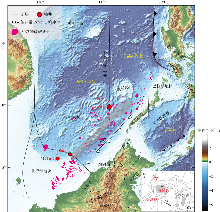
Fig. 1
Bathymetric map of southern South China Sea showing the distribution of carbonates during the Miocene and the location of Well Nanke-1. The distribution of Miocene carbonates is compiled from Schlüter et al (1996), Li et al (2014), Steuer et al (2014), and Wang et al (2016)"

Fig. 1
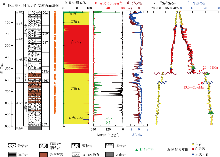
Fig. 2
Lithographic logs of Well Nanke-1 and its main mineralogical and geochemical characteristics. (a) Lithology and corals identified using core photos and thin sections; (b) mineral compositions; (c) Al, Fe and Mn concentrations; (d) δ18O and δ13C isotopes; (e) 87Sr/86Sr ratios (excluding 23 variegated samples) showing a monotonic increasing trend; (f) numerical Sr isotope ages were derived using the LOWESS 6 curve of McArthur et al (2020), with total uncertainties combining analytical errors (NBS987 and samples) and calibration errors of the curve. Four laser ablation U-Pb carbonate ages from the Nanwan, Meiji and Liyue formations are generally consistent with 87Sr/86Sr isotope ages, showing two hiatuses (indicated by red and blue wavy lines)"
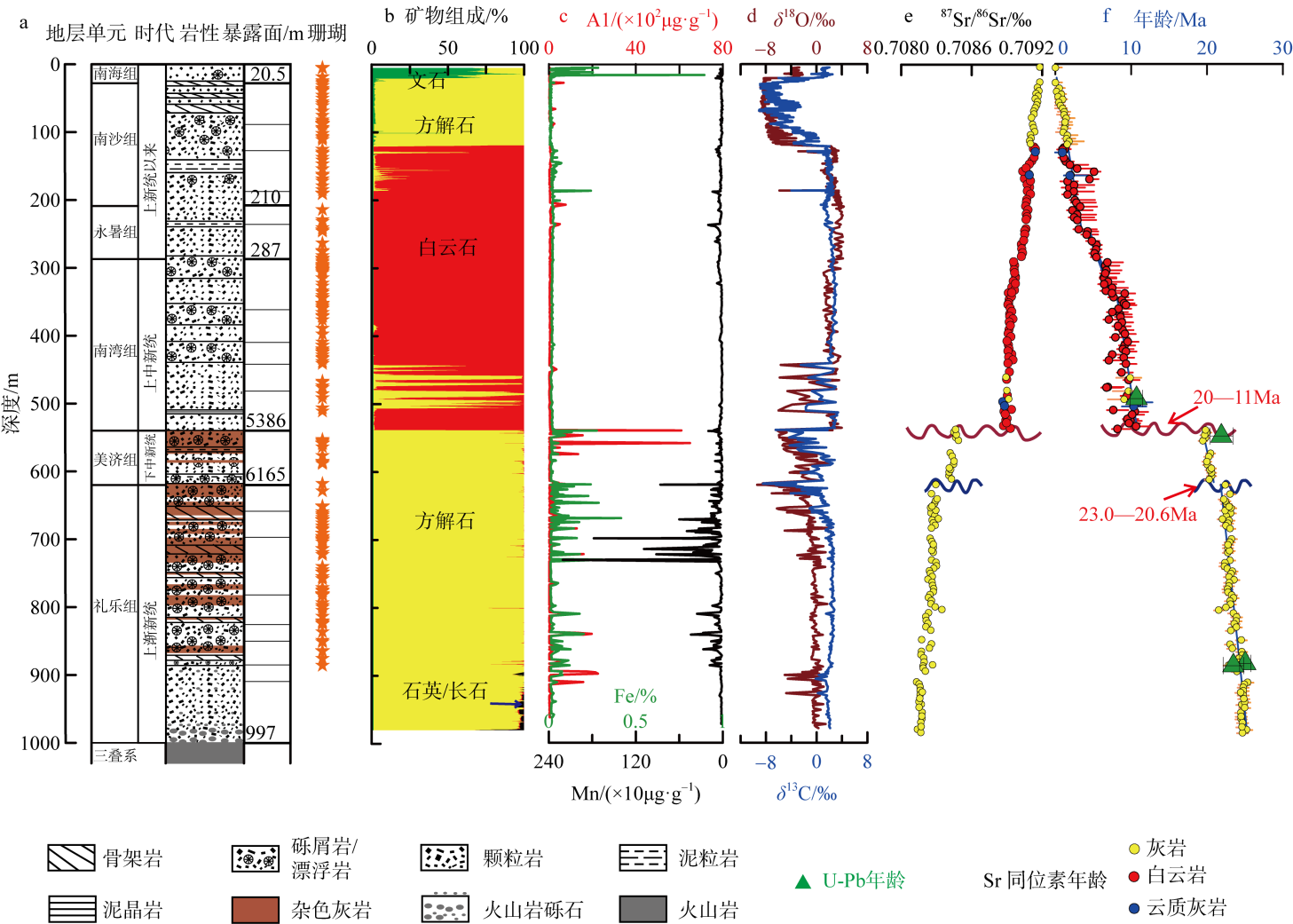
Fig. 2
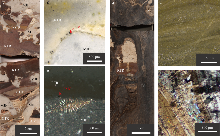
Fig. 3
Photos of core slabs and thin sections showing petrographic features associated with subaerial exposure and weathering in the Meiji and Liyue formations. (a) Pores filled with terra rossa mudstones in the upper Meiji Formation (at 541.0 m); (b, c) most infillings are calcareous mudstones with scarce bio-shells, and tiny ferromanganese concretions concentrate along the boundary between red terra rossa and bioclastic limestones; (d) dark brown flowstones in the upper Liyue Formation consist of well-preserved sparry calcites with clear mm-scale layering structures (at 619.7 m); (e, f) thin-section photographs of flowstones in (d). Abbreviations: MJF = Meiji Formation; LYF = Liyue Formation; RTR = red terra rossa; OTR = olive terra rossa; CM = calcareous mudstone; FMC = ferromanganese concretions; FS = flowstone"
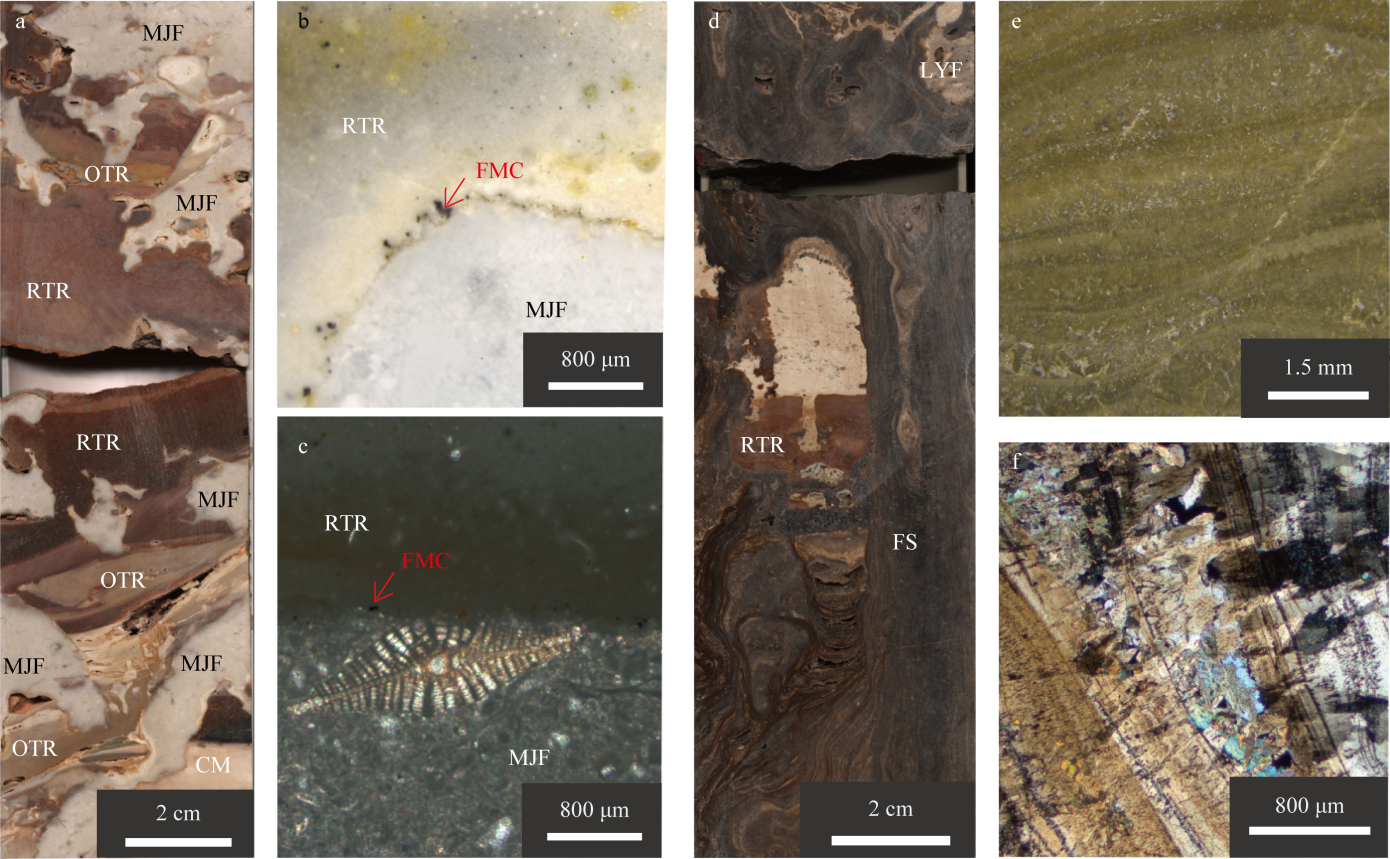
Fig. 3
Fig. 4
PAAS-normalized REY distribution patterns of bio-carbonates (average values) and selected variegated samples in Well Nanke-1. Reference REY data include surface seawater from the southern SCS, fine-grained terrestrial sediments (Wan et al, 2017) and aragonites in Tutum Bay vent waters in Papua New Guinea (Pichler and Veizer, 2004)"
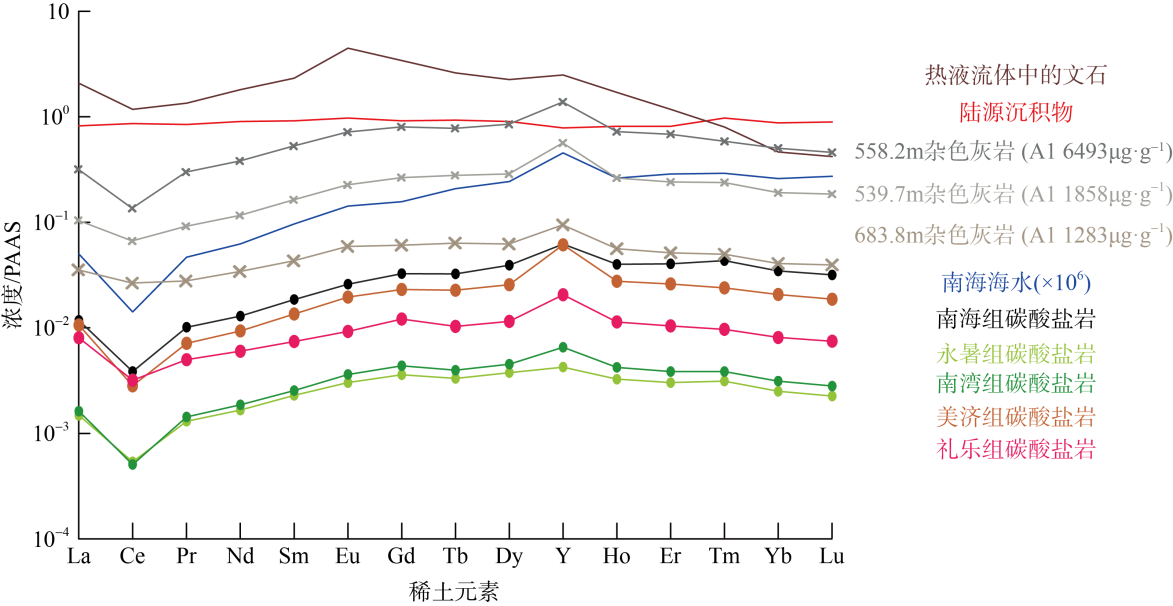
Fig. 4
Fig. 5
Thin-section photomicrographs illustrating diagenetic features from Well Nanke-1 under cross-polarized light. (a) Fabric-retentive dolostone, with limpid dolomite cement lining the molds of bivalves and benthic foraminifera; (b) fabric-retentive bioclastic dolostone, with benthic foraminifera and euhedral to subhedral dolomite crystals filling intergranular pores; (c) dolomitized red algae fragment; (d) heavily dissolved limestone possibly from meteoric vadose zones, with pores partly filled with microspar calcite cement; (e) two-stage cementation in intergranular pores, with radial bladed-shaped calcite overgrowths on isopachous fibrous cement; (f) two-stage cementation in skeletal pores, with isopachous fibrous cement altered to bladed-shaped calcite crystals"
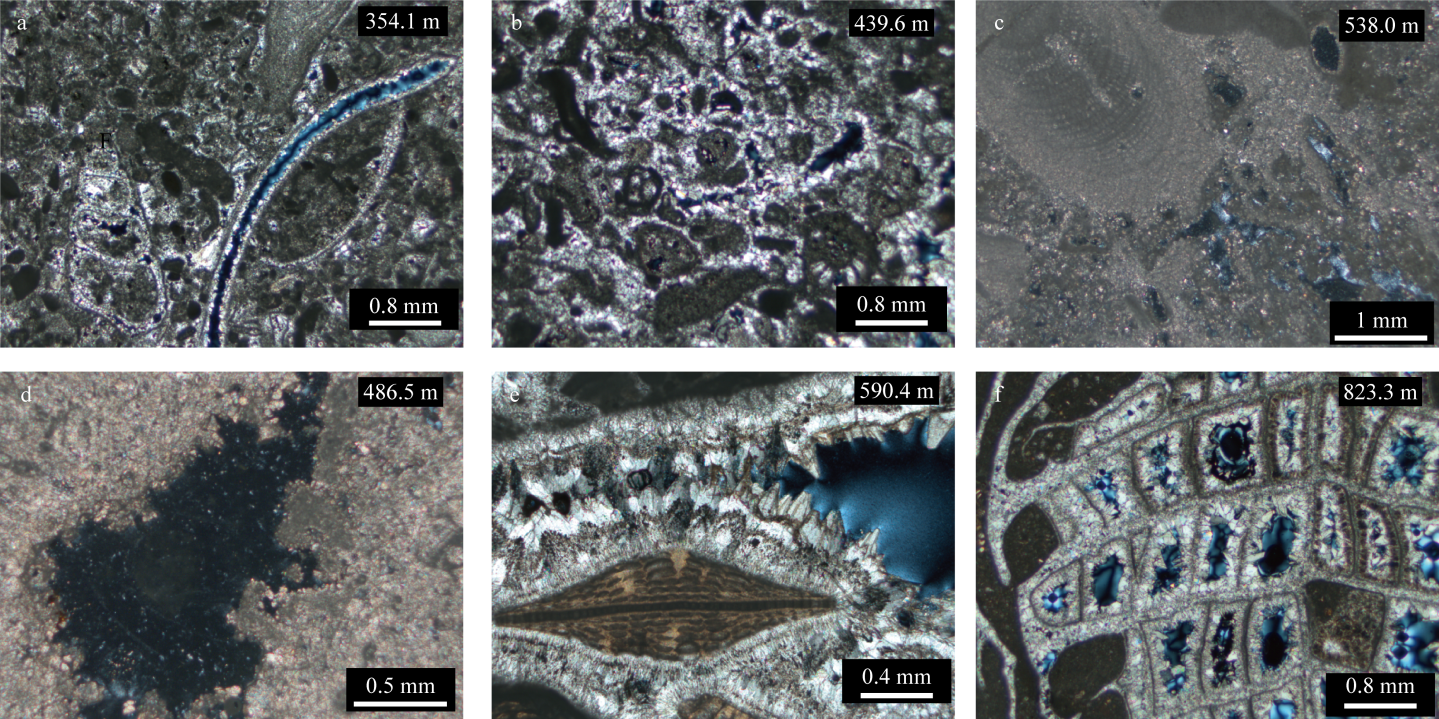
Fig. 5
Fig. 6
Tera-Wasserburg concordia diagrams of U-Pb ages for four samples from Well Nanke-1"
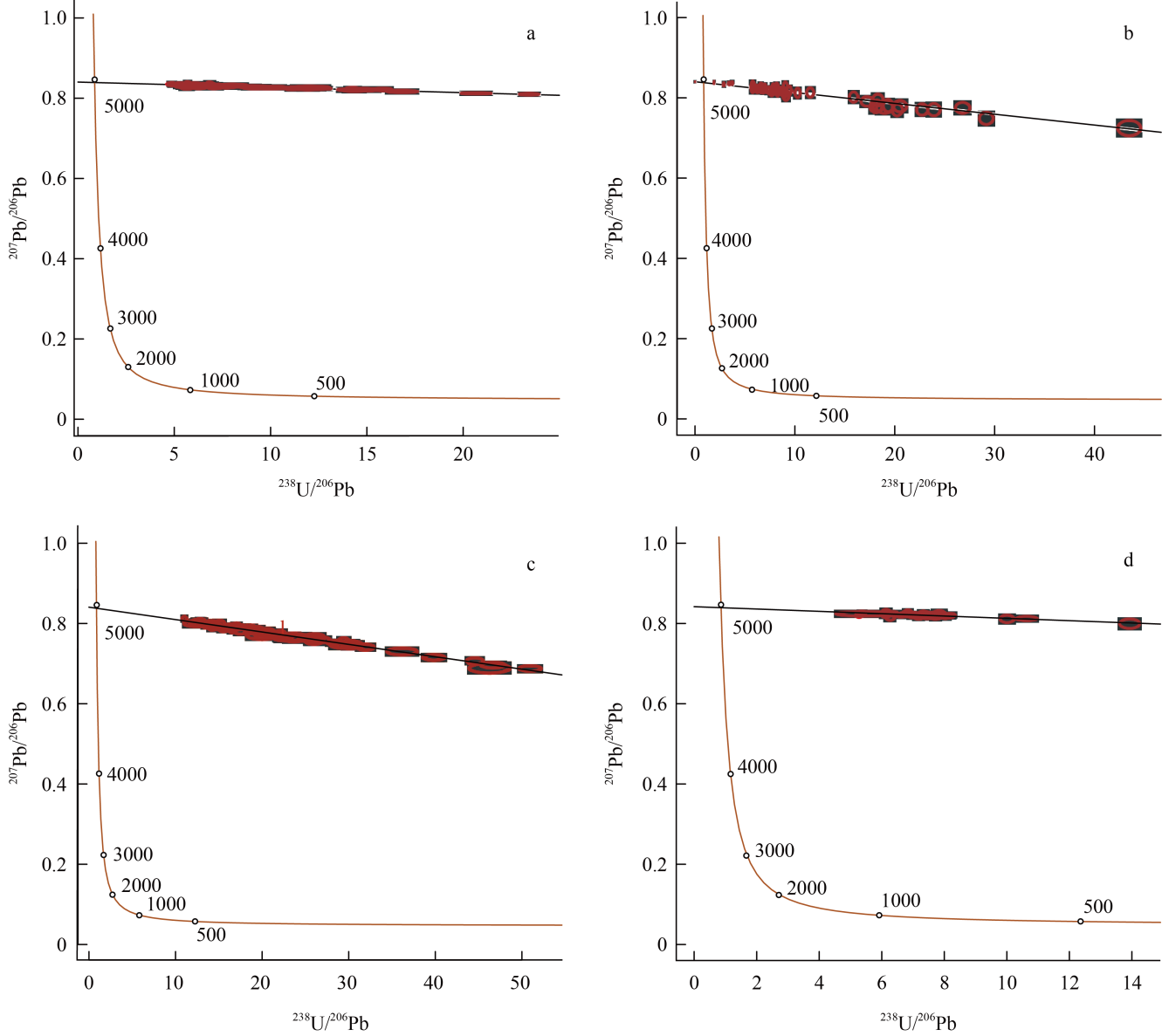
Fig. 6
Fig. 7
(a) Original and (b) NWW-trending seismic profile M1 across the northeastern slope of Meiji Atoll, and (c) simplified core log of Well Nanke-1. The inset shows the locations of profile M1 and Well NK1. Seismic facies associations are separated by four unconformities designated as R (Red), B (Blue, coincident with the Red line in this profile), B* (Blue*), and V (Violet), following Hinz and Schlüter (1985)"

Fig. 7
Fig. 8
87Sr/86Sr ratios and Al concentrations in carbonate phases between 500 m and 800 m in Well Nanke-1. The red open circle represents the 87Sr/86Sr ratio of insoluble residue measured at 721.85 m. Black dots represent variegated samples. Yellow bands highlight samples with elevated Al concentrations in carbonate phases. Contamination by terrigenous Sr is marked by red arrows. The red wavy line (R/B) and dark blue wavy line (B*) denote unconformities. Measurement errors of NBS987 and analyzed samples are included"
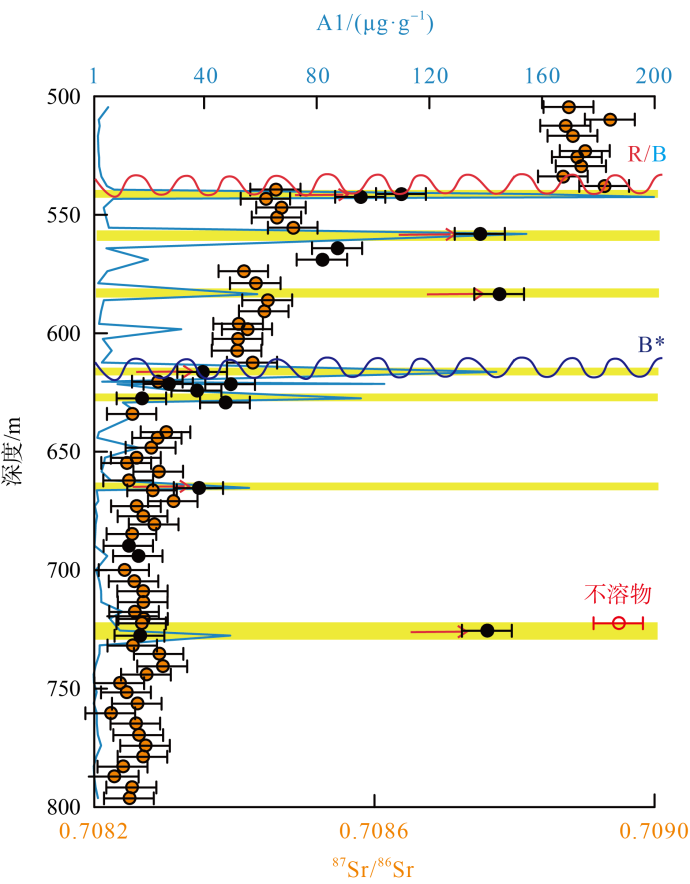
Fig. 8
Fig. 9
87Sr/86Sr ages of diagenetically altered limestones and dolostones. (a) The transition zone from limestone to dolostone at 120.5 m; (b) lower part of Nanwan Formation, where limestones formed in meteoric environments are interlayered with dolostone beds; (c) limestones in the Meiji and upper Liyue formations. Mineral compositions and carbon/oxygen isotopes are plotted to highlight meteoric and marine phreatic environments of limestones"
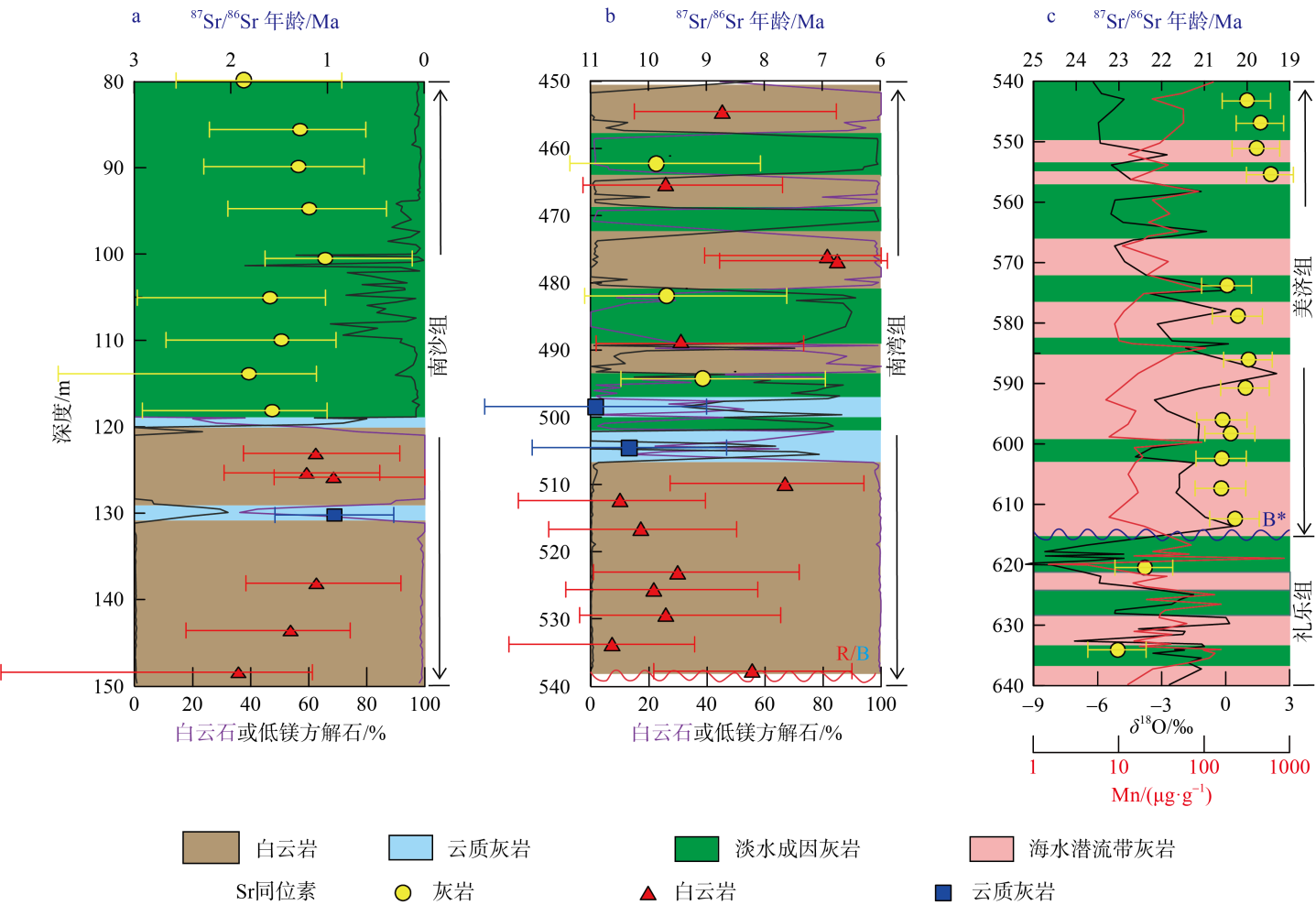
Fig. 9
Fig. 10
Cenozoic stratigraphic correlations on the Borneo-Palawan Islands and the southern SCS. Revised stratigraphy in Miri zone and in the north Sabah is from Breitfeld et al (2020), Burley et al (2021), Hennig-Breitfeld et al (2019), and van Hattum et al (2013) and sources therein. Stratigraphical divisions in deep-water Sarawak and on the South Palawan Shelf are based on Krebs (2011), Madon et al (2013), and Steuer et al (2013). The global sea-level curve is from Miller et al (2020) and main tectonic events during the miocene are also marked. Principal unconformities named in previous studies include shallow regional unconformity (SRU), middle miocene unconformity (MMU), unconformity red and blue (Red and Blue), top crocker unconformity (TCU), nyalau unconformity (NU), unconformity blue* and violet (blue* and violet), and the base miocene unconformity (BMU)"
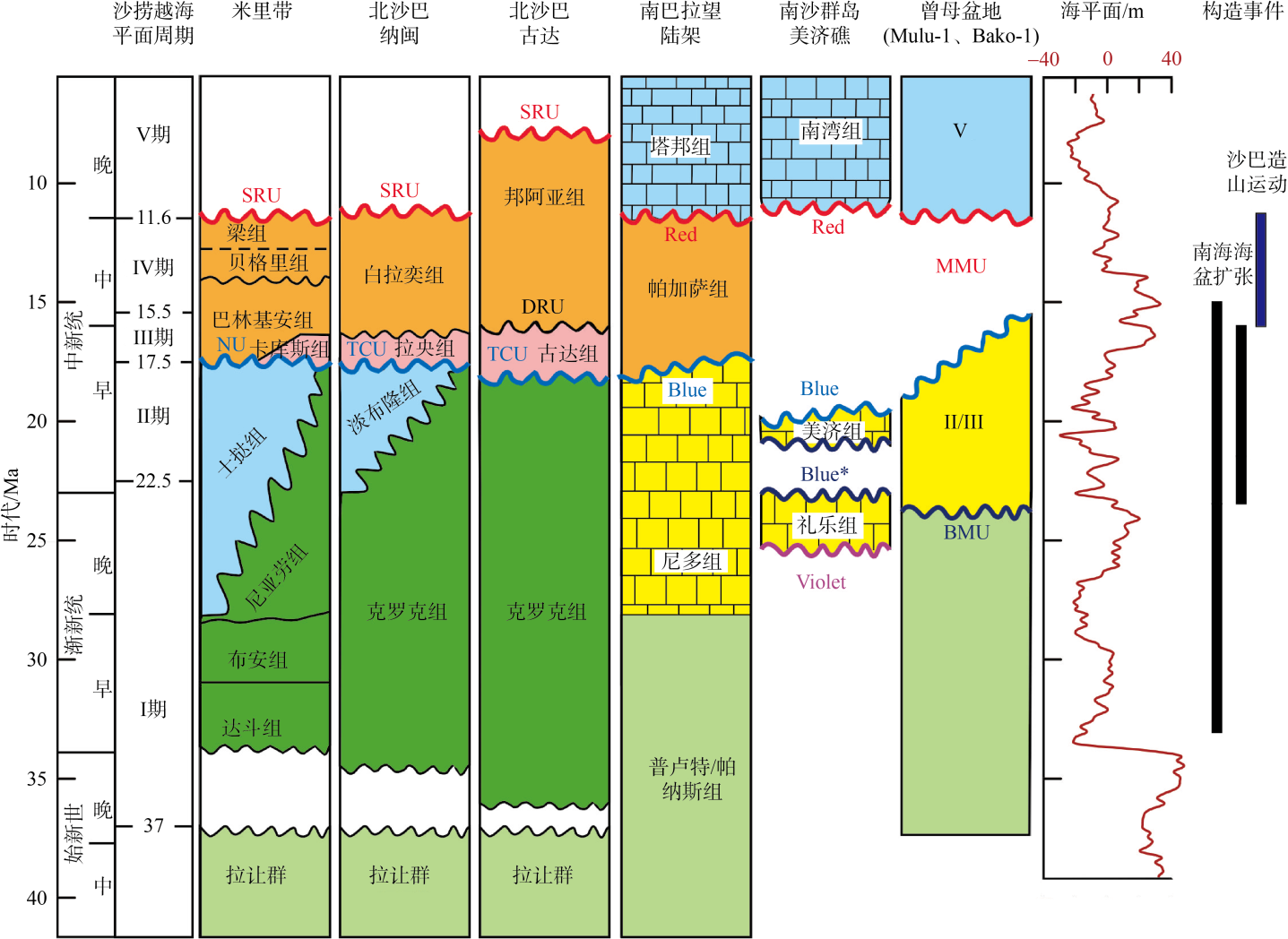
Fig. 10
Fig. 11
Schematic diagrams showing the tectonic evolution of the southern SCS margin since the middle Miocene, modified from Hall (2013), Lai et al (2021), Madon et al (2013) and Tsikouras et al (2021). (a) During the spreading of the SCS, the underthrusting of the Dangerous Grounds terrane initiated the Miocene collisional mountain belt in northern Borneo, the flexural bending of attenuated continental lithosphere and the uplifting of some tectonic highs such as Meji Atoll; (b) after the cessation of the SCS spreading, a compressional regime remained at its southern margin due to the collision with the Philippine mobile belt and the rotation of Borneo during the late middle miocene; (c) after widespread uplift in the dangerous grounds during the middle miocene, the compressional regime ended at the southern margin of SCS due to the northward movement of Luzon Island"
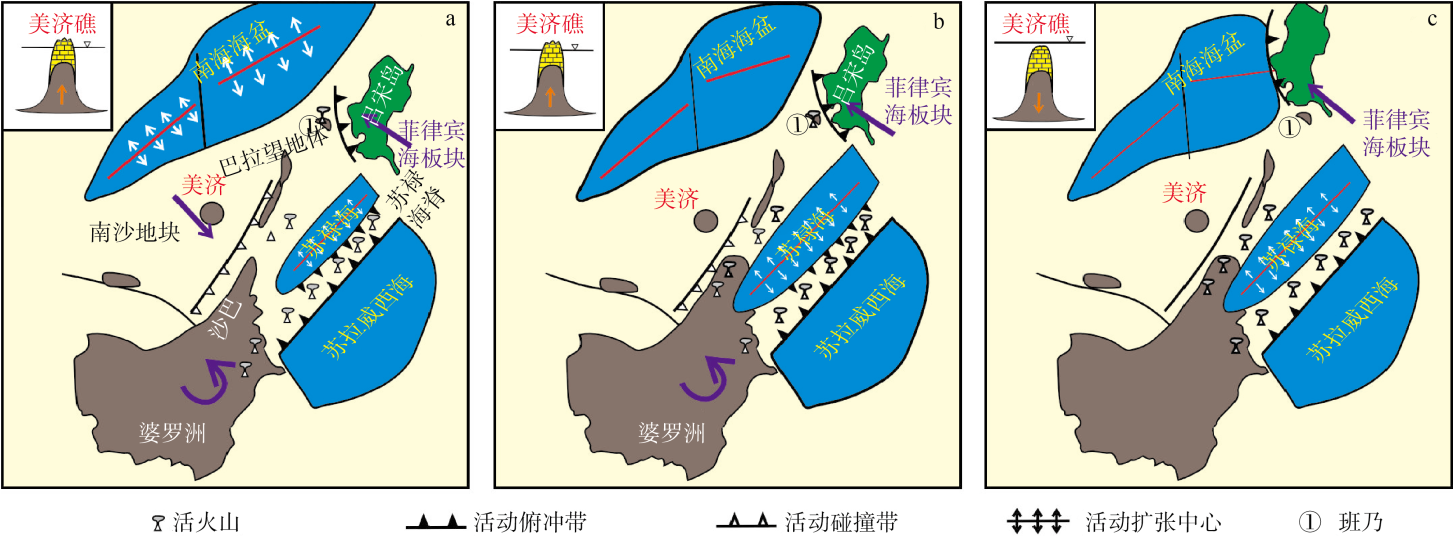
Fig. 11
| [1] |
关成尧, 漆家福, 张厚和, 等, 2022. 南沙海域盆地群早中新世“挤压隆升幕”及其构造意义[J]. 地质科学, (1): 139-155.
|
|
|
|
| [2] |
孙珍, 赵中贤, 李家彪, 等, 2011. 南沙地块内破裂不整合与碰撞不整合的构造分析[J]. 地球物理学报, 54(12): 3196-3209.
|
|
|
|
| [3] |
王利杰, 姚永坚, 李学杰, 等, 2019. 南沙东部海域裂陷结束不整合面时空迁移规律及构造意义[J]. 地球物理学报, 62(12): 4766-4781.
doi: 10.6038/cjg2019M0349 |
|
|
|
| [4] |
吴时国, 朱伟林, 马永生, 2018. 南海半封闭边缘海碳酸盐台地兴衰史[J]. 海洋地质与第四纪地质, 38(6): 1-17.
|
|
|
|
| [5] |
姚永坚, 杨楚鹏, 李学杰, 等, 2013. 南海南部海域中中新世(T3界面)构造变革界面地震反射特征及构造含义[J]. 地球物理学报, 56(4): 1274-1286
|
|
|
|
| [6] |
赵帅, 李学杰, 姚永坚, 等, 2019. 南海南部造山运动及其与古南海俯冲的成因联系[J]. 海洋地质与第四纪地质, 39(5): 147-162.
|
|
|
|
| [7] |
周建辉, 白金峰, 2009. 熔融玻璃片制样-X射线荧光光谱测定页岩中主量元素[J]. 岩矿测试, 28(2): 179-181.
|
|
|
|
| [8] |
doi: 10.1016/S0016-7037(98)00279-8 |
| [9] |
doi: 10.1016/j.marpetgeo.2013.12.002 |
| [10] |
doi: 10.1016/j.jseaes.2020.104331 |
| [11] |
|
| [12] |
doi: 10.1016/S0012-8252(96)00051-7 |
| [13] |
doi: 10.1002/dep2.v7.1 |
| [14] |
|
| [15] |
doi: 10.1144/jgs2011-130 |
| [16] |
doi: 10.1144/1354-079309-828 |
| [17] |
doi: 10.1016/S0003-2670(00)01185-5 |
| [18] |
doi: 10.1007/s11001-014-9237-5 |
| [19] |
doi: 10.1016/0360-5442(81)90029-3 |
| [20] |
doi: 10.1093/oxfordjournals.petrology.a037262 |
| [21] |
doi: 10.1130/B35088.1 |
| [22] |
doi: 10.1016/S0743-9547(98)00057-9 |
| [23] |
doi: 10.1016/j.gr.2017.07.016 |
| [24] |
doi: 10.1016/j.margeo.2021.106513 |
| [25] |
|
| [26] |
doi: 10.1144/SP355.5 |
| [27] |
doi: 10.1016/j.jseaes.2013.04.010 |
| [28] |
doi: 10.1016/j.tecto.2007.11.058 |
| [29] |
doi: 10.1016/j.jas.2015.02.032 |
| [30] |
doi: 10.1016/j.earscirev.2018.12.006 |
| [31] |
|
| [32] |
doi: 10.1007/BF01829317 |
| [33] |
doi: 10.1016/0360-5442(85)90048-9 |
| [34] |
|
| [35] |
doi: 10.1144/GSL.SP.1996.106.01.16 |
| [36] |
doi: 10.1016/j.marpetgeo.2004.07.002 |
| [37] |
doi: 10.1144/jgs.157.4.783 |
| [38] |
doi: 10.1016/j.jseaes.2017.12.017 |
| [39] |
doi: 10.1093/nsr/nwz084 |
| [40] |
doi: 10.1016/j.sedgeo.2016.05.001 |
| [41] |
doi: 10.1016/j.sedgeo.2019.03.016 |
| [42] |
doi: 10.1306/122001720559 |
| [43] |
doi: 10.1016/0012-821X(93)90254-7 |
| [44] |
|
| [45] |
doi: 10.1016/j.marpetgeo.2009.07.008 |
| [46] |
doi: 10.7186/bgsm57201106 |
| [47] |
doi: 10.1016/0264-8172(86)90053-X |
| [48] |
|
| [49] |
doi: 10.1038/s41561-018-0198-1 |
| [50] |
doi: 10.1002/jgrb.v120.3 |
| [51] |
doi: 10.1002/ggge.v15.12 |
| [52] |
|
| [53] |
|
| [54] |
doi: 10.1016/j.marpetgeo.2014.06.005 |
| [55] |
doi: 10.1306/2F918A63-16CE-11D7-8645000102C1865D |
| [56] |
|
| [57] |
doi: 10.1130/0091-7613(1988)016<0173:SISOEA>2.3.CO;2 |
| [58] |
doi: 10.1016/j.jseaes.2019.03.009 |
| [59] |
doi: 10.1016/j.sedgeo.2021.105933 |
| [60] |
doi: 10.1016/j.jseaes.2013.04.040 |
| [61] |
doi: 10.1002/gj.3942 |
| [62] |
doi: 10.1038/s41598-020-64119-9 pmid: 32346046 |
| [63] |
|
| [64] |
|
| [65] |
doi: 10.1016/j.palaeo.2011.02.009 |
| [66] |
|
| [67] |
doi: 10.1126/sciadv.aaz1346 |
| [68] |
doi: 10.1016/j.epsl.2015.01.036 |
| [69] |
doi: 10.1016/j.jseaes.2016.01.013 |
| [70] |
doi: 10.1016/0012-821X(92)90125-F |
| [71] |
doi: 10.1098/rspa.2002.0978 |
| [72] |
doi: 10.1039/c1ja10172b |
| [73] |
doi: 10.1016/j.chemgeo.2004.02.002 |
| [74] |
|
| [75] |
doi: 10.1016/j.palaeo.2017.10.022 |
| [76] |
doi: 10.1016/0040-1951(90)90423-6 |
| [77] |
|
| [78] |
doi: 10.1111/sed.2018.65.issue-6 |
| [79] |
doi: 10.1130/0016-7606(1990)102<0381:ETEMGO>2.3.CO;2 |
| [80] |
doi: 10.1016/0025-3227(95)00137-9 |
| [81] |
doi: 10.1016/j.epsl.2017.08.019 |
| [82] |
doi: 10.1016/j.palaeo.2017.07.006 |
| [83] |
doi: 10.1016/S0743-9547(98)00062-2 |
| [84] |
doi: 10.1016/j.jseaes.2013.01.007 |
| [85] |
doi: 10.1016/j.marpetgeo.2013.12.010 |
| [86] |
doi: 10.1016/j.precamres.2020.105897 |
| [87] |
doi: 10.1093/nsr/nwz116 |
| [88] |
doi: 10.1016/j.jseaes.2008.09.002 |
| [89] |
|
| [90] |
doi: 10.1130/0091-7613(1982)10<611:PETIAN>2.0.CO;2 |
| [91] |
|
| [92] |
doi: 10.1130/G48126.1 |
| [93] |
|
| [94] |
doi: 10.1029/GL015i004p00385 |
| [95] |
doi: 10.1306/D4267825-2B26-11D7-8648000102C1865D |
| [96] |
doi: 10.1016/j.jseaes.2013.02.033 |
| [97] |
doi: 10.1016/j.tecto.2012.10.002 |
| [98] |
doi: 10.1016/j.gca.2016.12.010 |
| [99] |
doi: 10.1002/gj.v51.S1 |
| [100] |
doi: 10.1016/j.sedgeo.2019.07.002 |
| [101] |
doi: 10.1016/j.quageo.2012.02.028 |
| [102] |
doi: 10.1016/j.margeo.2013.12.016 |
| [103] |
doi: 10.1016/j.jseaes.2003.12.005 |
| [104] |
doi: 10.1111/acgs.v95.1 |
| [105] |
doi: 10.1016/j.jseaes.2008.10.002 |
| [106] |
doi: 10.5194/se-5-227-2014 |
| [1] | LUO Yun, LI Gang, ZHANG Xiyang, XU Weihai, ZHU Xiaowei, ZHOU Wanqiu, HUANG Huiwen, ZHONG Fuchang, YAN Wen. Differential dolomitization process of coral reefs in the South China Sea: a case study based on a deep borehole in Meiji Atoll [J]. Journal of Tropical Oceanography, 2026, 45(5): 108-127. |
| [2] | HUANG Kangjun, ZHANG Pan, FENG Dong, YAN Wen. Controlling factors and implications of magnesium isotopic compositions of marine carbonates* [J]. Journal of Tropical Oceanography, 2026, 45(5): 146-161. |
| [3] | SU Xiang, XIANG Rong, YI Liang, ZHANG Qiang, ZHANG Yanan, QIN Guoquan, WAN Sui, YAN Wen. Microfossils in the Neogene carbonate platform of Nansha Islands and their significance* [J]. Journal of Tropical Oceanography, 2026, 45(5): 80-93. |
| [4] | ZHU Xiaowei, MO Ziyi, MAO Shengyi, TIAN Yuhang, LUO Yun, MIAO Li, XU Weihai, LI Gang, YAN Wen. Distribution characteristics of biomarker components and their environmental indications at Well NK-1 on Meiji Atoll, Nansha Islands* [J]. Journal of Tropical Oceanography, 2026, 45(5): 162-177. |
| [5] | MIAO Xiuquan, ZHANG Yunying, YAN Wen. Mesozoic magmatism in the Nansha Block: implications for the tectonic affinity of southern continental margin of the South China Sea and the opening mechanism of the Proto-South China Sea* [J]. Journal of Tropical Oceanography, 2026, 45(5): 35-52. |
| [6] | DI Pengfei, LI Niu, GONG Shanggui, Jörn Peckmann, WANG Shuhong, CHEN Duofu, YAN Wen. Carbonate-associated sulfate records seawater sulfate δ34S and δ18O: insights from reef carbonate rocks in the southern South China Sea* [J]. Journal of Tropical Oceanography, 2026, 45(5): 178-198. |
| [7] | LI Dongping, SHI Haolei, LUO Zhongyuan, CAO Jiantao, JIA Guodong. Compositional characteristics and ecological significance of fatty acids of the surface suspended particulate matter in the South China Sea* [J]. Journal of Tropical Oceanography, 2026, 45(3): 61-73. |
| [8] | ZHANG Yunfan, TANG Danling, SUN Zhen, QIU Ning. Study on the geological structural characteristics of the U-shaped boundary in the South China Sea [J]. Journal of Tropical Oceanography, 2026, 45(3): 10-24. |
| [9] | LI Kaizhi, HUANG Liangmin, YIN Jianqiang, LIAN Xiping, LIU Yuan, TAN Yehui. Review and prospects of zooplankton ecology in the South China Sea [J]. Journal of Tropical Oceanography, 2026, 45(2): 1-15. |
| [10] | LIANG Shun, HUANG Guibin, HE Guomei, ZHANG Yongchui, ZHOU Yi, WANG Yang, HONG Mei. Analysis of spatiotemporal variation characteristics of local typhoons in the South China Sea [J]. Journal of Tropical Oceanography, 2026, 45(2): 59-70. |
| [11] | ZHAO Minghui, SENANAYAKA Dasun, CHENG Jinhui, ZHOU Yong, CAO Lingmin, ZHAO Lei, LUO Yao, ZHANG Zhenqiu, PAN Gang, THALDENA Nilmini, ZHANG Jiazheng, ZHANG Yayun, XU Min. Construction and research prospect of an integrated geological hazards monitoring platform in southern coastal cities of Sri Lanka* [J]. Journal of Tropical Oceanography, 2025, 44(5): 12-21. |
| [12] | CHEN Yuchen, FU Dongyang, TAO Bangyi, LI Jizhe, ZHU Yixian, LIU Bei, LIN Ye, CHAI Xia. Study on remote sensing monitoring and time series change of shallow sea topography of typical islands and reefs in the South China Sea* [J]. Journal of Tropical Oceanography, 2025, 44(5): 140-153. |
| [13] | ZHU Xiaoyu, YANG Hua, MAO Beibei, ZHENG Yuxuan. Observations of fine-scale structure and study of turbulent mixing in the deep northeastern South China Sea* [J]. Journal of Tropical Oceanography, 2025, 44(5): 22-30. |
| [14] | LI Ruoan, LI Xuqing, CHEN Tianran. Graded responses of coral skeletal δ18O and Sr/Ca to ENSO in the southern South China Sea [J]. Journal of Tropical Oceanography, 2025, 44(4): 45-55. |
| [15] | ZHOU Zhiqian, LIAN Xiping, TAN Yehui. Morphological characteristics of a newly recorded species of the genus Stylocheiron (Euphausiidae) from the South China Sea* [J]. Journal of Tropical Oceanography, 2025, 44(3): 66-71. |
|
||