

Journal of Tropical Oceanography ›› 2026, Vol. 45 ›› Issue (1): 91-104.doi: 10.11978/2024238CSTR: 32234.14.2024238
Previous Articles Next Articles
Quantifying impacts of ENSO and internal variability on the Indian Ocean Dipole*
ZHANG Lianyi1( ), ZHANG Yuhong1,2, DU Yan1,2()
- 1State Key Laboratory of Tropical Oceanography/Guangdong Key Lab of Ocean Remote Sensing and Big Data (LORS), South China Sea Institute of Oceanology, Chinese Academy of Sciences, Guangzhou 510301, China
2College of Marine Sciences, University of Chinese Academy of Sciences, Qingdao 266000, China
-
Received:2024-12-23Revised:2025-01-15Online:2026-01-10Published:2026-01-30 -
Contact:DU Yan. email:duyan@scsio.ac.cn -
Supported by:National Natural Science Foundation of China(U21A6001); National Natural Science Foundation of China(42106021); Chinese Academy of Sciences(183311KYSB20200015); South China Sea Institute of Oceanology(SCSIO202201); South China Sea Institute of Oceanology(SCSIO2023HC07); Science and Technology Projects in Guangzhou(2023A04J0186); Southern Marine Science and Engineering Guangdong Laboratory (Guangzhou)(2019BT02H594); Guangdong Natural Science Funds for Distinguished Young Scholar(2024B1515020037); Guangdong Basic and Applied Basic Research Foundation(2023A1515012691)

CLC Number:
- P732.6
Cite this article
ZHANG Lianyi, ZHANG Yuhong, DU Yan. Quantifying impacts of ENSO and internal variability on the Indian Ocean Dipole*[J].Journal of Tropical Oceanography, 2026, 45(1): 91-104.
share this article
Add to citation manager EndNote|Reference Manager|ProCite|BibTeX|RefWorks
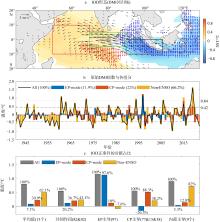
Fig. 1
Basic configuration and quantitative measures of the Indian Ocean Dipole (IOD). (a) Spatial distribution of sea surface temperature (shading), 10-meter wind field (vectors), and thermocline depth (stippling; red and blue dots indicate thermocline deepening or shoaling by more than 4 meters, respectively) during the peak phase of IOD (Northern Hemisphere autumn, September-November); these results are based on regression onto Dipole Mode Index (DMI) in September-November (SON); only significant results exceeding the 95% confidence level are shown; red and black boxes indicate the western pole and eastern pole of IOD; green box shows the location of equatorial zonal wind index (Ueq); (b) quantification of the dipole mode index (DMI) during the peak phase of IOD from 1941 to 2022; black line, blue bar, red bar, and yellow bar represent the contribution of original (All), EP ENSO (EP-mode), CP ENSO (CP-mode) and independent part (Non-ENSO) to the DMI; variance explanations are noted in the legend box; dashed/dotted line exhibits the one/twice standard deviation (STD, 0.42/0.84°C); (c) average and typical categorical contribution ratios of IOD events, selected based on exceeding one standard deviation in (b)"
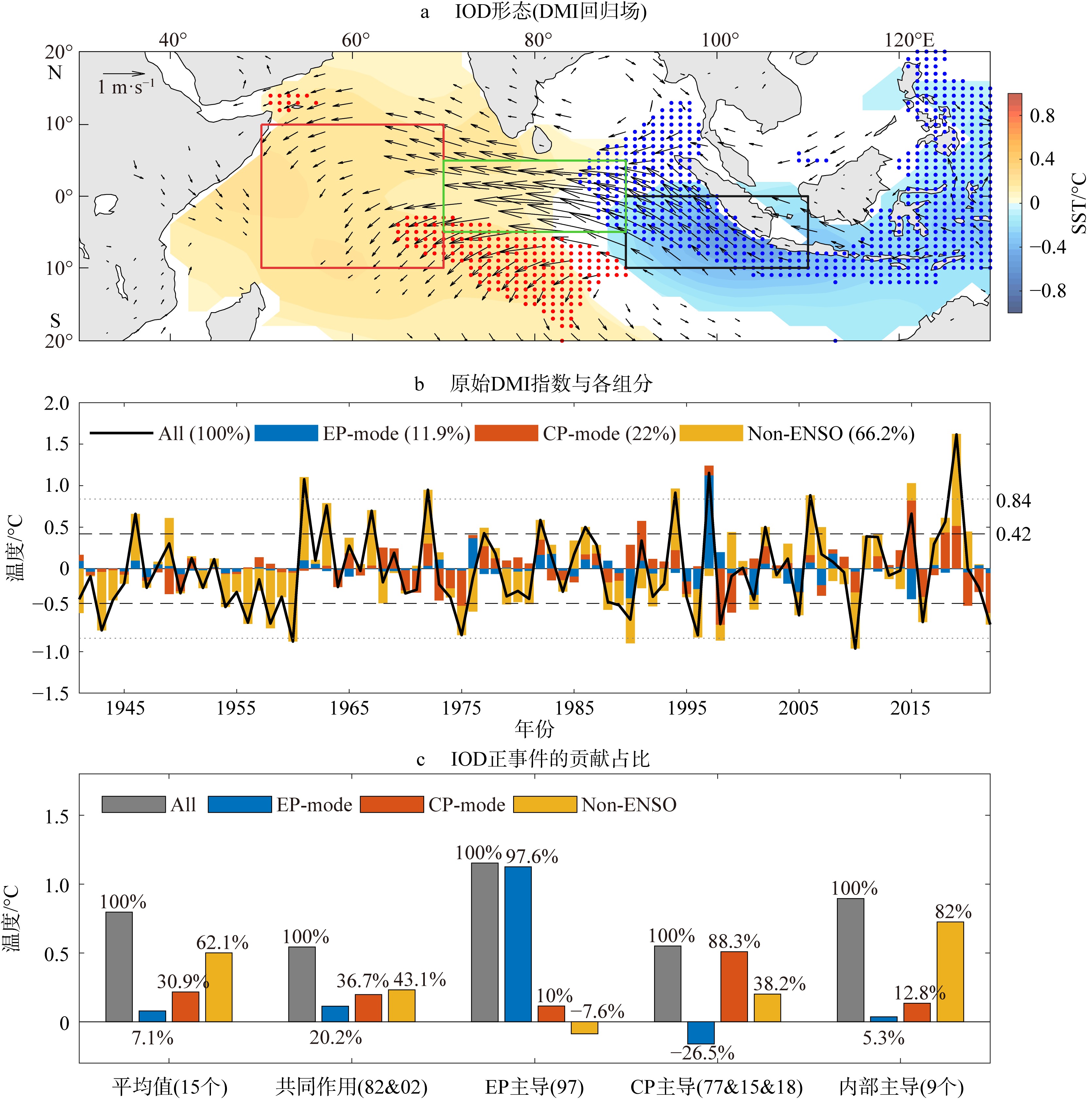
Fig. 1
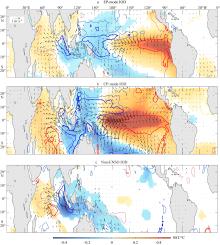
Fig. 2
Mature phase patterns of the IOD in different components. (a) Anomalous fields of sea surface temperature (shading), 10-meter wind field (vectors), and thermocline (contours) regressed onto the DMI during the mature phase of the IOD in the EP-mode component; (b, c) similar to (a) but for the regression fields of the DMI in the CP-mode component and the internal variability component, respectively; only significant results exceeding the 95% confidence level are shaded, bold, and contoured light/dark red (blue) color indicates the thermocline deepening (shallowing) by 2/4 meters"
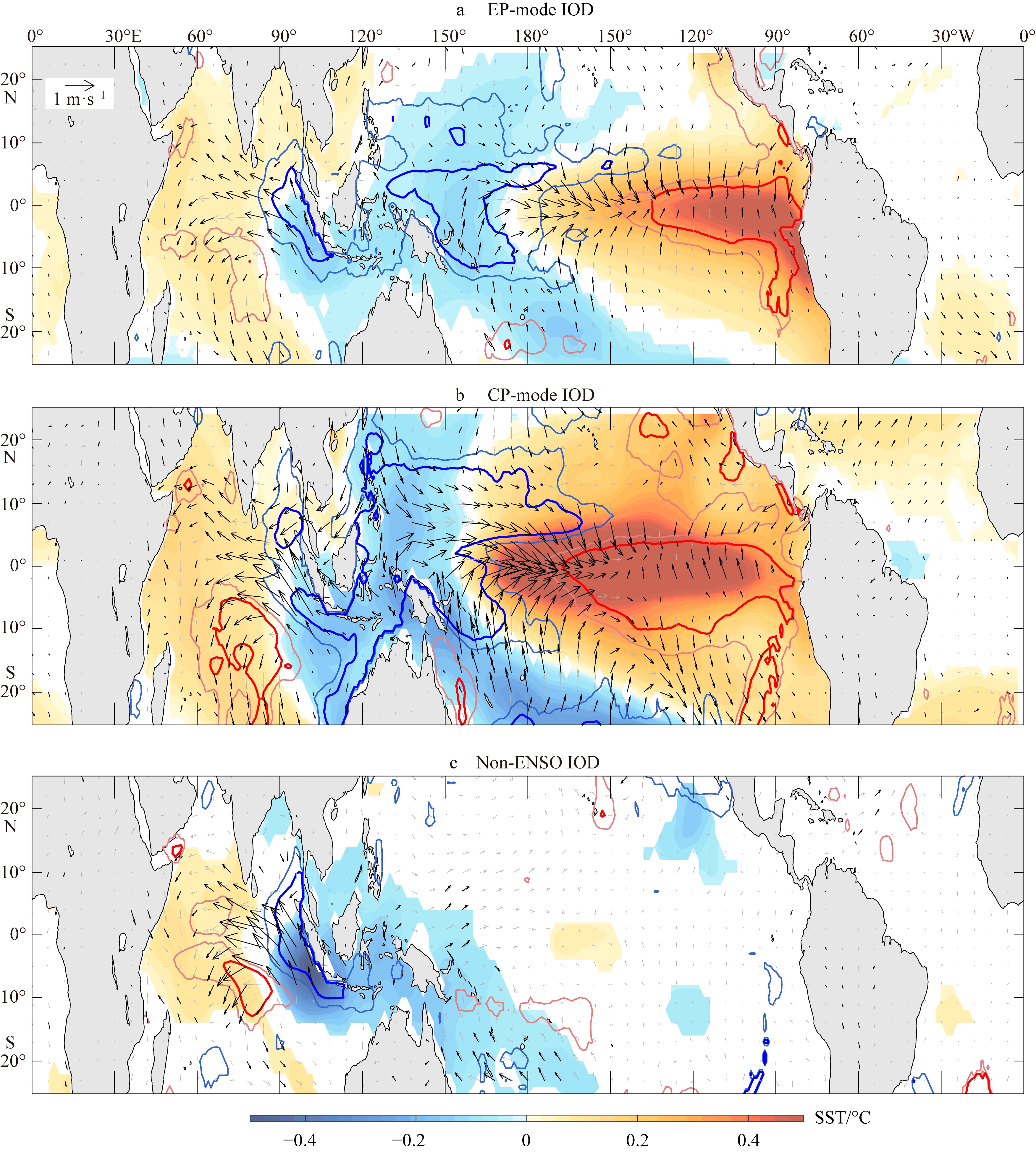
Fig. 2
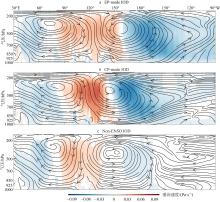
Fig. 3
Walker circulation patterns corresponding to IOD in different components. (a) Regression of equatorial Indo-Pacific atmospheric circulation fields onto the DMI during the peak phase of the EP-mode component, showing anomalous vertical velocity and zonal velocity; (b, c) similar to (a) but for the CP-mode component and the internal variability component, respectively"

Fig. 3
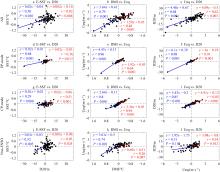
Fig. 4
Performance of the thermocline-SST-wind positive feedback coupling efficiency in the tropical Indian Ocean across different components. (a) Scatter plot of SST at the eastern pole of the Indian Ocean Dipole (IOD) and thermocline depth (D20) from the original variations, illustrating the thermocline-SST feedback; blue/red line denotes the relationship between thermocline-shoaling and SST-cooling/thermocline-deepening and SST-warming; (b) scatter plot of the dipole mode index (DMI) and equatorial Indian Ocean zonal wind (Ueq), illustrating the temperature gradient-zonal wind feedback; (c) scatter plot of Ueq and D20, illustrating the zonal wind-thermocline feedback; considering the asymmetry of IOD, regressions are made for positive (blue) and negative (red) phases; (d-f), (g-i), (j-l) similar to (a-c), but for the EP-mode component, CP-mode component, and Non-ENSO component, respectively, showing the feedback efficiency in each component"

Fig. 4
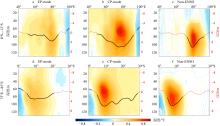
Fig. 5
Subsurface temperature variations in the South Indian Ocean during the peak phase of the Indian Ocean Dipole (IOD). (a) Anomalies in subsurface temperature (contours and shading) and thermocline depth (red and black lines) in the EP-mode component, based on the regression of the dipole mode index (DMI) during the peak IOD phase onto the southern tropical Indian Ocean (zonal section 8°S-12°S); (b, c) similar to (a), but for the CP-mode component and the internal variability component, respectively; (d-f) similar to (a-c), but showing the influence of each component on the meridional section (75°E-85°E)"

Fig. 5
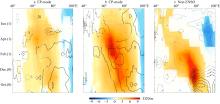
Fig. 6
Rossby wave propagation in the South Indian Ocean induced by IOD. (a) Lag regression of the thermocline depth anomaly (color contours and shading) and wind stress curl anomaly (black contours and stippling) in the South Tropical Indian Ocean (10°S section) on the DMI during the peak phase of the EP-mode component; (b, c) similar to (a), showing the DMI regression fields for the CP-mode component and the internal variability component, respectively; significant results exceeding the 95% confidence level are shaded and bold"
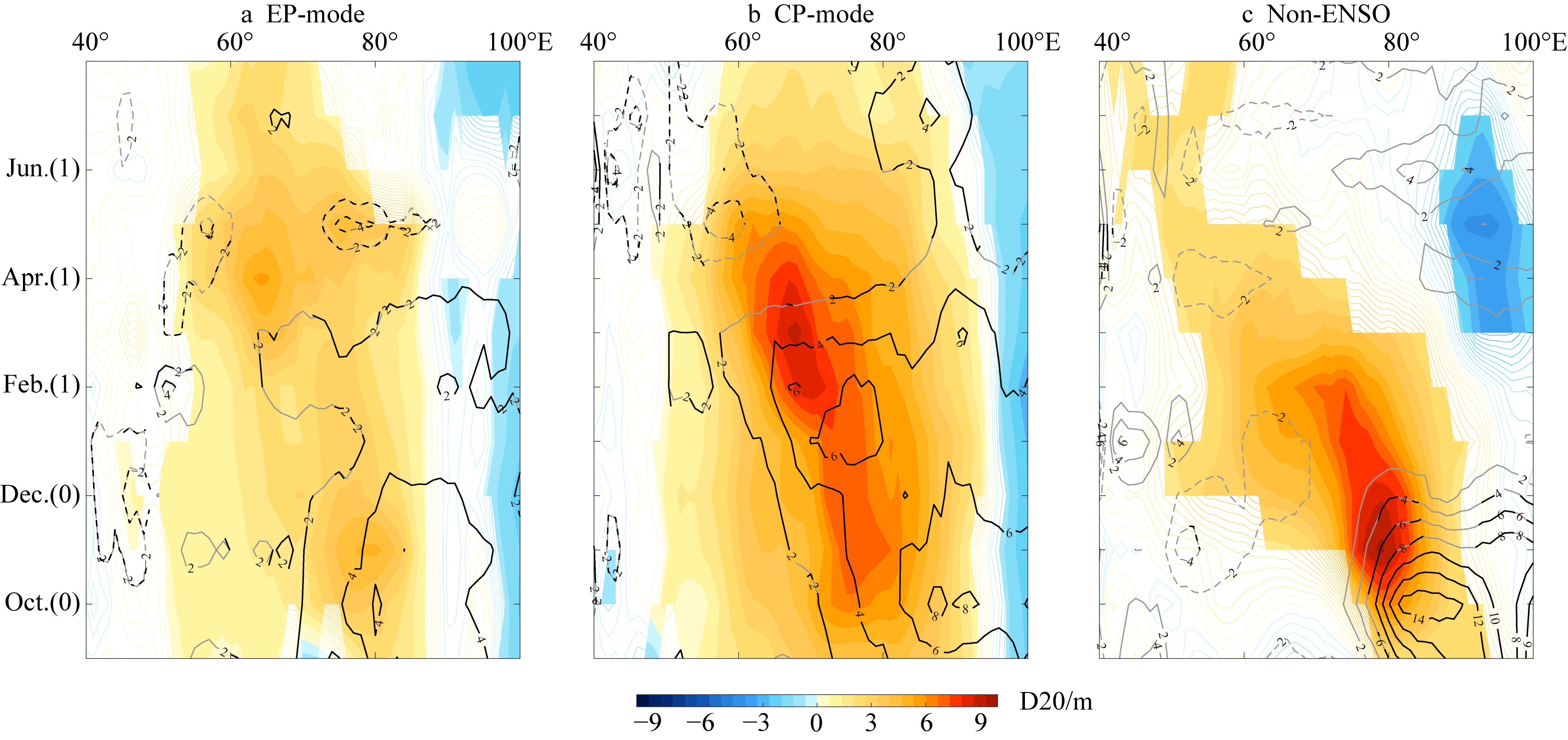
Fig. 6
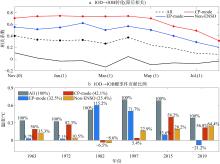
Fig. 7
Estimation of the transition from IOD to the following year's Indian Ocean basin-wide mode (IOB). (a) Monthly lagged regression of the IOB index based on the dipole mode index (DMI) during the peak phase of IOD; (b) contributions of various components in the six cases where positive IOD events (as shown in Fig. 1b) transitioned into IOB warming out of 15 events"
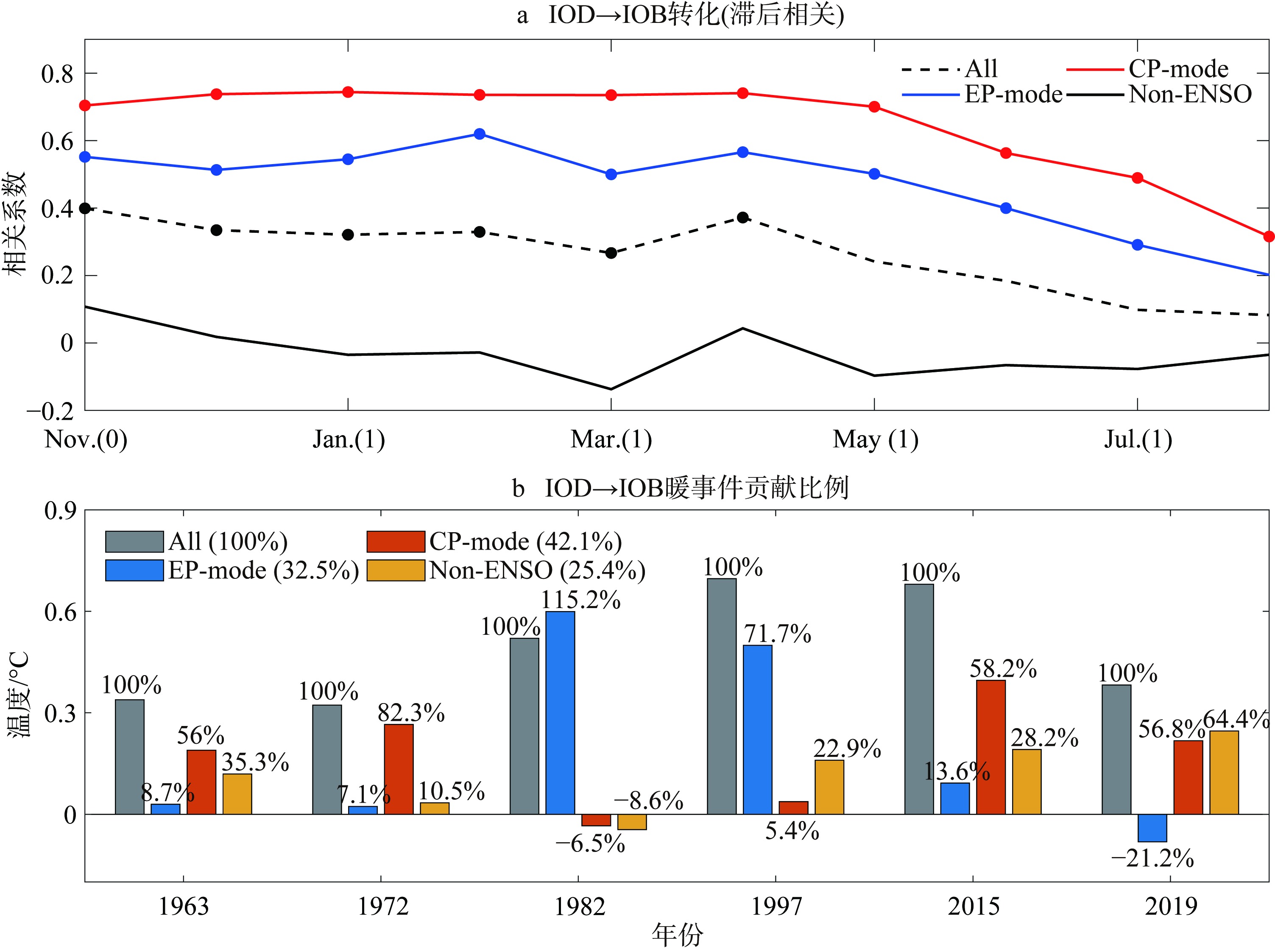
Fig. 7
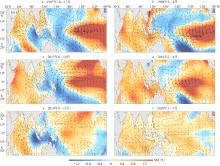
Fig. 8
Three typical positive IOD events and their transitions to Indian Ocean basin-wide warming in the following year. (a, b) The 1997 positive IOD event and the subsequent 1998 IOB warming event; (c, d), (e, f) similar to (a, b), showing the cases for 2015-2016 and 2019-2020, respectively. These three events represent IOD and IOB events dominated by EP-mode, CP-mode, and internal variability, respectively"

Fig. 8
| [19] |
doi: 10.1007/s00382-015-2773-0 |
| [20] |
doi: 10.1175/JCLI3478.1 |
| [21] |
doi: 10.1007/s10236-009-0236-z |
| [22] |
doi: 10.1002/jgrc.v118.12 |
| [23] |
doi: 10.1175/JCLI-D-14-00507.1 |
| [24] |
|
| [25] |
doi: 10.1175/2008JCLI2222.1 |
| [26] |
doi: 10.1175/JCLI-D-16-0836.1 |
| [27] |
doi: 10.1175/2008JCLI2309.1 |
| [28] |
doi: 10.1175/1520-0442(1999)012<0917:RSSTVD>2.0.CO;2 |
| [29] |
doi: 10.1175/2008JCLI2624.1 |
| [30] |
|
| [31] |
doi: 10.1038/s41598-020-68268-9 pmid: 32661240 |
| [32] |
doi: 10.1175/JCLI-D-15-0508.1 |
| [33] |
|
| [34] |
doi: 10.1038/s41598-018-31842-3 pmid: 30202078 |
| [35] |
doi: 10.1175/JCLI-D-11-00615.1 |
| [36] |
doi: 10.1038/srep04943 |
| [37] |
|
| [38] |
doi: 10.1002/rog.v55.4 |
| [39] |
|
| [40] |
|
| [41] |
doi: 10.1175/JCLI-D-14-00580.1 |
| [42] |
|
| [43] |
doi: 10.1038/s41586-018-0252-6 |
| [44] |
doi: 10.1175/1520-0477(1997)078<2771:TDOENO>2.0.CO;2 |
| [45] |
doi: 10.1175/1520-0442(2001)014<1697:LIOENO>2.0.CO;2 |
| [1] |
李崇银, 穆明权, 2001. 赤道印度洋海温偶极子型振荡及其气候影响[J]. 大气科学, 25(4): 433-443.
|
|
|
|
| [2] |
晏红明, 肖子牛, 2000. 印度洋海温异常对亚洲季风区天气气候影响的数值模拟研究[J]. 热带气象学报, 16(1): 18-27.
|
|
|
|
| [3] |
doi: 10.1175/1520-0442(2002)015<2205:TABTIO>2.0.CO;2 |
| [4] |
|
| [5] |
doi: 10.1175/JCLI3494.1 |
| [6] |
doi: 10.1175/1520-0493(1969)097<0163:ATFTEP>2.3.CO;2 |
| [7] |
doi: 10.1038/s41586-018-0776-9 |
| [8] |
doi: 10.1038/s41558-020-00943-1 |
| [46] |
doi: 10.1002/2014GL059997 |
| [47] |
|
| [48] |
|
| [49] |
doi: 10.1175/JCLI-D-20-0710.1 |
| [50] |
doi: 10.1038/43848 |
| [51] |
doi: 10.1002/grl.v41.24 |
| [52] |
|
| [53] |
doi: 10.1175/1520-0442(2002)015<0864:SAMOSI>2.0.CO;2 |
| [54] |
doi: 10.1175/2008JCLI2544.1 |
| [9] |
|
| [10] |
doi: 10.1002/grl.v43.12 |
| [11] |
doi: 10.1175/JCLI-D-18-0704.1 |
| [12] |
doi: 10.1175/2009JCLI2735.1 |
| [13] |
doi: 10.1007/s00382-017-3956-7 |
| [14] |
|
| [15] |
doi: 10.1175/JCLI-D-12-00047.1 |
| [16] |
doi: 10.1016/j.earscirev.2023.104313 |
| [17] |
doi: 10.1175/2008JCLI2590.1 |
| [18] |
|
| [55] |
doi: 10.1007/s00376-015-5192-6 |
| [56] |
doi: 10.3402/tellusa.v46i4.15484 |
| [57] |
doi: 10.1002/joc.4475 |
| [58] |
|
| [59] |
doi: 10.1175/JCLI-D-15-0078.1 |
| [60] |
doi: 10.1002/joc.v28:14 |
| [61] |
doi: 10.1002/grl.v45.2 |
| [62] |
|
| [63] |
doi: 10.1007/s13131-021-1733-2 |
| [64] |
doi: 10.1175/JCLI-D-21-0426.1 |
| [65] |
doi: 10.1175/JCLI-D-14-00047.1 |
| [66] |
doi: 10.1175/JCLI-D-12-00638.1 |
| [1] | ZHANG Lanlan, LI Tong, CHENG Xiawen, PERERA Batagoda Gamage Dumudu Ojitham, XIANG Rong. Depth gradient changes in dead polycystine radiolarians in the tropical southeastern Indian Ocean during spring* [J]. Journal of Tropical Oceanography, 2026, 45(1): 60-72. |
| [2] | CHU Xiaoqing, PENG Qihua. The role of alongshore wind and ocean wave in generating the northward Somali Current [J]. Journal of Tropical Oceanography, 2023, 42(2): 1-8. |
| [3] | TANG Jiaoyu, WANG Weiqiang, XU Kang, ZHANG Zhenqiu. Interannual variability of subsurface high salinity water in eastern equatorial Indian Ocean* [J]. Journal of Tropical Oceanography, 2023, 42(1): 10-21. |
| [4] | CHEN Yunfan, CHEN Tianran, LONG Shangmin, CHEN Zesheng, DU Yan. Reconstruction of climate variability of the tropical Indian Ocean based on coral δ18O data from four representative sites [J]. Journal of Tropical Oceanography, 2022, 41(1): 82-93. |
| [5] | Zhou LE, Ke HUANG, Subrahmanyam Mantravadi Venkata. Energy characteristics of eddy-mean flow interaction in the estuary of Bay of Bengal in summer and autumn during 2000-2015 [J]. Journal of Tropical Oceanography, 2020, 39(2): 11-14. |
| [6] | ZHANG Ying, DU Yan, ZHANG Yu-hong, YANG Ya-li. Asymmetric influences of positive and negative IOD events on salinity transport by the fall Wyrtki Jet along the equatorial Indian Ocean [J]. Journal of Tropical Oceanography, 2015, 34(5): 1-10. |
| [7] | TAN Jing, WANG Zhang-gui, HUANG Rong-hui, CHEN Xing-rong, CAI Yi, HUANG Yong-yong. Analysis of tropical sea surface temperature and atmospheric circulation anomalies and their relationship with abnormal precipitation in Yunnan during rainy season [J]. Journal of Tropical Oceanography, 2015, 34(2): 15-23. |
| [8] | ZHANG Guo-sheng, ZHANG Biao, DU Yan, WANG Lei. Extraction of Rossby wave speed and deformation radius in the tropical Indian Ocean from multi-satellite altimeter data [J]. Journal of Tropical Oceanography, 2014, 33(5): 22-27. |
| [9] | LI Yan, WANG Qing-yuan, LI Huan, ZHANG Zengjian, SONG Jun, LI Xiang. Impacts of long lasting SST anomaly events in the tropical Pacific and Indian oceans on anomalous Philippine Sea anticyclone [J]. Journal of Tropical Oceanography, 2014, 33(1): 36-43. |
| [10] | XUAN Li-li, QIU Yun, XU Jin-dian, ZENG Ming-zhang. Seasonal variation of surface-layer circulation in the eastern tropical Indian Ocean [J]. Journal of Tropical Oceanography, 2014, 33(1): 26-35. |
| [11] | XU Hai-ming, ZHANG Lan, DU Yan. Research progress of southern Indian Ocean Dipole and its influence [J]. Journal of Tropical Oceanography, 2013, 32(1): 1-7. |
|
||