

Journal of Tropical Oceanography ›› 2025, Vol. 44 ›› Issue (6): 39-50.doi: 10.11978/2025004CSTR: 32234.14.2025004
Previous Articles Next Articles
Composition and distribution characteristics of modern biological relics in the estuary of Pearl River Delta
LIU Zeyu1( ), ZHANG Guocheng1,2, WANG Yuanyuan1,2()
- 1
Institute of Resource and Environment ,Henan Polytechnic University
2Henan Key Laboratory of Biogenie Traces & Sedimentary Minerals of Henan Province
-
Received:2025-01-04Revised:2025-04-17Online:2025-11-10Published:2025-12-03 -
Contact:WANG Yuanyuan. email: yyw@hpu.edu.cn -
Supported by:National Natural Science Foundation of China(42172130); Yong Backbone Teachers Training Program of Henan Province(2023GGJS055)

CLC Number:
- P512.2
Cite this article
LIU Zeyu, ZHANG Guocheng, WANG Yuanyuan. Composition and distribution characteristics of modern biological relics in the estuary of Pearl River Delta[J].Journal of Tropical Oceanography, 2025, 44(6): 39-50.
share this article
Add to citation manager EndNote|Reference Manager|ProCite|BibTeX|RefWorks
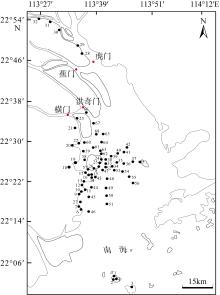
Fig. 1
Location map of the study area"

Fig. 1
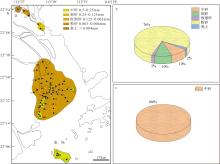
Fig. 2
Grain size characteristics of sediments in Pearl River Delta estuary. (a) Grain size distribution of sediments at sampling sites in Pearl River Delta estuary; (b) percentage distribution of sediment grain size points in the estuary and offshore shallow sea; (c) percentage distribution of sandy sediment grain size sampling points in inland waters outside the estuary"

Fig. 2
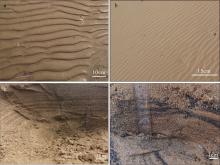
Fig. 3
Physical sedimentary structures of sandy deposits in the estuary. (a) Curved ridge ripple marks; (b) bifurcated ripple marks; (c) sandy rhythmic bedding; (d) cross-bedding. (a) and (b) are cited from Wang et al (2024)"

Fig. 3
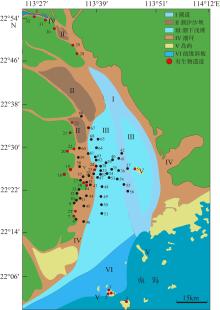
Fig. 4
Microenvironment classification and distribution of biological relics in Pearl River Delta estuary"

Fig. 4
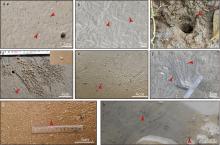
Fig. 5
Tidal flat biological remains in Pearl River Delta estuary. (a) Footprint tracks near crab burrows; (b) epichnial concave crawling traces of crabs; (c) domicile burrows of crabs; (d) excavation traces of crabs (trace-maker shown in upper right corner); (e) U-shaped banded crawling traces of mudskippers; (f) domicile burrows and foraging traces near burrows of mudskippers, cited from Wang et al (2024); (g) elongated straight crawling traces of Perinereis aibuhitensis; (h) linear decal strings and domicile traces of Perinereis aibuhitensis. Red arrows indicate the described traces"

Fig. 5
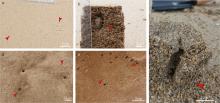
Fig. 6
Biological relics of estuary islands in the Pearl River Delta. (a) Avian footprints on sandy surfaces; (b) domicile burrows of Corbicula fluminea; (c) cross-section of Corbicula fluminea burrows; (d) crab domicile burrows and footprint tracks; (e) epichnial curved dragging traces of a hermit crab. Red arrows indicate the described traces"

Fig. 6
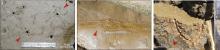
Fig. 7
Biological relics in tidal sandbars in Pearl River Delta estuary. (a) Radially arranged digging pellets of crabs; (b) dragging traces of mudskippers; (c) cross-sectional domicile traces of Perinereis aibuhitensis. Red arrows indicate the described traces"

Fig. 7
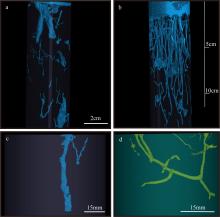
Fig. 8
Three-dimensional morphology of trace-maker burrows. (a) Y-, U-, and I-shaped burrow morphologies of crabs; (b) Y-, U-, and I-shaped burrows of Perinereis aibuhitensis and their symbiotic burrow morphologies with crabs; (c) Y-shaped Perinereis aibuhitensis burrows and I-shaped crab burrows; (d) Y- and L-shaped burrow morphologies of Perinereis aibuhitensis"

Fig. 8
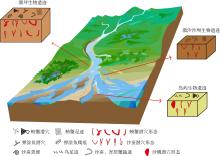
Fig. 9
Distribution of biological relics in Pearl River Delta estuary"

Fig. 9
| [1] |
陈伟, 1993. 河口湾动力响应特征[J]. 水动力学研究与进展(A辑), 8(S1): 552-559.
|
|
|
|
| [2] |
陈耀泰, 1995. 珠江口沉积分区[J]. 中山大学学报(自然科学版), 34(3): 109-114.
|
|
|
|
| [3] |
方神光, 喻丰华, 2023. 洪季伶仃洋水域径潮动力作用机制及演变探讨[J]. 海岸工程, 42(4): 301-316.
|
|
|
|
| [4] |
宫清华, 周晴, 李平日, 等, 2019. 珠江口伶仃洋地貌特征演变与纳潮能力变化研究[J]. 海洋学报, 41(1): 98-107.
|
|
|
|
| [5] |
何用, 吴尧, 卢陈, 2022. 珠江河口演变与治理保护探讨[J]. 泥沙研究, 47(6): 1-8.
|
|
|
|
| [6] |
胡斌, 王冠忠, 齐永安, 1997. 痕迹学理论与应用[M]. 徐州: 中国矿业大学出版社: 30-50 (in Chinese).
|
| [7] |
黄畅, 王永红, 杨清书, 等, 2022. 珠江三角洲河网流量的时空变化及影响因素[J]. 中国海洋大学学报(自然科学版), 52(5): 97-106.
|
|
|
|
| [8] |
金长茂, 眭良仁, 1989. 试论河口湾[J]. 海洋学报, 11(3): 378-384 (in Chinese).
|
| [9] |
马道修, 徐明广, 周青伟, 等, 1988. 珠江三角洲沉积相序[J]. 海洋地质与第四纪地质, 8(1): 43-53.
|
|
|
|
| [10] |
|
|
|
|
| [11] |
齐永安, 1999. 河口湾相模式研究[J]. 地质科技情报, 18(1): 45-49.
|
|
|
|
| [12] |
宋慧波, 于会新, 王海邻, 等, 2014. 杭州湾庵东浅滩现代沉积物中的生物遗迹[J]. 古地理学报, 16(5): 703-714.
doi: 10.7605/gdlxb.2014.05.56 |
|
doi: 10.7605/gdlxb.2014.05.56 |
|
| [13] |
王翠, 王媛媛, 胡斌, 2023. 黄河三角洲潮坪环境现代生物遗迹与物化条件的响应关系[J]. 沉积学报, 41(3): 748-762.
|
|
|
|
| [14] |
王海邻, 王长征, 宋慧波, 等, 2017. 杭州湾庵东滨岸潮间带现代沉积物中的生物遗迹特征[J]. 沉积学报, 35(4): 714-729.
|
|
|
|
| [15] |
王润怀, 齐永安, 潘结南, 2000. 河口湾沉积学及层序地层学研究[J]. 焦作工学院学报(自然科学版), 19(3): 188-191.
|
|
|
|
| [16] |
王文介, 1985. 珠江口的沉积作用和沉积相[J]. 沉积学报, 3(2): 129-140.
|
|
|
|
| [17] |
王英国, 王珍如, 1999. 河口湾区生物扰动强度及扰动作用特征研究: 以山海关大石河河口湾为例[J]. 青岛海洋大学学报(自然科学版), 29(4): 709-714.
|
|
|
|
| [18] |
王英国, 2000. 渤海湾西岸大石河河口湾遗迹生态学研究[J]. 古地理学报, 2(1): 54-63.
|
|
|
|
| [19] |
王媛媛, 勾松林, 张国成, 2024. 现代珠江三角洲前缘生物遗迹组成与分布特征[J]. 沉积学报, 42(5): 1512-1529.
|
|
|
|
| [20] |
吴贤涛, 张国成, 吴渤, 等, 2014. 东濮凹陷古近系沙河街组三段河口湾沉积亚相之沉积学与痕迹学识别与油气储层[J]. 沉积学报, 32(4): 744-753.
|
|
|
|
| [21] |
肖志建, 李团结, 廖世智, 2011. 伶仃洋表层沉积物特征及其泥沙运移趋势[J]. 热带海洋学报, 30(4): 58-65.
|
|
doi: 10.11978/j.issn.1009-5470.2011.04.058 |
|
| [22] |
赵焕庭, 1982. 珠江三角洲的形成和发展[J]. 海洋学报, 4(5): 595-607 (in Chinese).
|
| [23] |
赵焕庭, 1984. 珠江河口演变的基本过程[J]. 热带海洋, 3(4): 1-9+92.
|
|
|
|
| [24] |
赵焕庭, 1989. 珠江河口的水文和泥沙特征[J]. 热带地理, 9(3): 201-212.
|
|
|
|
| [25] |
张光威, 1988. 珠江口现代沉积环境的沉积物特征[J]. 海洋地质动态, 4(2): 4-6 (in Chinese).
|
| [26] |
张光威, 马道修, 徐明广, 等, 1988. 珠江口现代沉积物构造特征及其沉积环境[J]. 海洋地质与第四纪地质, 8(3): 71-83.
|
|
|
|
| [27] |
郑建禄, 何锦文, 朱克勤, 1984. 珠江口海域重金属的河口化学研究: Ⅴ. 表层沉积物中粘土矿物的分布[J]. 海洋学报, 6(2): 197-205 (in Chinese).
|
| [28] |
doi: 10.1144/GSL.SP.2004.228.01.10 |
| [29] |
|
| [30] |
|
| [31] |
doi: 10.2110/palo.2004.p04-32 |
| [32] |
doi: 10.1016/j.earscirev.2017.10.006 |
| [33] |
|
| [34] |
|
| [35] |
|
| [36] |
doi: 10.3354/ab00055 |
| [37] |
doi: 10.2307/3515462 |
| [38] |
doi: 10.1175/1520-0485(1989)019<1060:TIVOTD>2.0.CO;2 |
| [39] |
doi: 10.1111/sed.2016.63.issue-3 |
| [40] |
doi: 10.1016/j.sedgeo.2012.03.024 |
| [41] |
doi: 10.2110/jsr.2015.47 |
| [42] |
|
| [43] |
doi: 10.1016/j.sedgeo.2006.05.008 |
| [44] |
doi: 10.1016/j.sedgeo.2016.07.005 |
| [45] |
doi: 10.1016/j.pocean.2013.05.018 |
| [46] |
doi: 10.1111/sed.1981.28.issue-2 |
| [47] |
doi: 10.1306/D4267F50-2B26-11D7-8648000102C1865D |
| [48] |
doi: 10.1016/j.ecss.2012.09.005 |
| [1] | WANG Riming, SU Jinheng, DAI Zhijun, WU Tianliang, XIE Xiaowen, HUANG Chunmei, LI Xingrong, ZHANG Shangyu. Dynamic changes in mangrove wetland of the Maolingjiang Estuary, Qinzhou Gulf [J]. Journal of Tropical Oceanography, 2025, 44(6): 143-154. |
| [2] | GUO Shaojing, ZHANG Xiaobo, CHANG Jinglong, ZHANG Shouwen, JI Xuanliang, MIAO Runqiao, LI Jiandong, ZHU Xueming. Summer hydrological variations during 2021-2023 in the Pearl River Estuary and its adjacent areas [J]. Journal of Tropical Oceanography, 2025, 44(1): 108-121. |
| [3] | SONG Xingyu, LIN Yajun, ZHANG Liangkui, XIANG Chenhui, HUANG Yadong, ZHENG Chuanyang. Distribution characteristics and influencing factors of meso- and micro-zooplankton communities in the offshore waters of the Guangdong-Hong Kong-Macao Greater Bay Area* [J]. Journal of Tropical Oceanography, 2023, 42(3): 136-148. |
| [4] | YAN Jing, WEI Xing. Geomorphological changes and dynamic responses of the Huangmaohai Estuary in the Pearl River Delta [J]. Journal of Tropical Oceanography, 2023, 42(2): 9-20. |
| [5] | GAO Na, ZHAO Mingli, MA Yi, XU Wanming, ZHAN Haigang, CAI Shuqun. Effect of typhoon on storm surge in the Pearl River Estuary [J]. Journal of Tropical Oceanography, 2023, 42(1): 32-42. |
| [6] | TANG Ling, NIE Yuhua, WANG Ping, TANG Chaolian. Trend analysis of marine heatwaves variability in the outer Pearl River estuary from 1974 to 2020 [J]. Journal of Tropical Oceanography, 2022, 41(6): 143-150. |
| [7] | SHANG Bowen, WU Yunchao, JIANG Zhijian, LIU Songlin, HUANG Xiaoping. Characteristics and sources of organic matter in sediments of the Pearl River Estuary: Carbon storage implications [J]. Journal of Tropical Oceanography, 2022, 41(3): 16-28. |
| [8] | YIN Tianqi, WANG Qing, YANG Yufeng, CEN Jingyi. Comparative study on zooplankton community structure in Pearl River Estuary based on morphological and DNA identification [J]. Journal of Tropical Oceanography, 2022, 41(3): 172-185. |
| [9] | ZENG Dianting, LI Junyi, XIE Lingling, YE Xiaomin, ZHOU Da. Analysis of temporal characteristics of chlorophyll a in Lingding Bay during summer [J]. Journal of Tropical Oceanography, 2022, 41(2): 16-25. |
| [10] | SHUAI Yiping, CHEN Yinchao, LIU Zijia, GE Zaiming, MA Mengzhen, ZHANG Yuanfang, LI Qian. Distribution of Pearl-River diluted water and its ecological characteristics during spring monsoon transitional period in 2016* [J]. Journal of Tropical Oceanography, 2021, 40(5): 63-71. |
| [11] | LAN Xuan, LI Feng, ZHANG Chao, DONG Hanying, YANG Qingshu, YU Minghui, WEN Rubing, YANG Yujie. Ecological risk assessment of thallium in Pearl River Estuary and network based on the SOM model [J]. Journal of Tropical Oceanography, 2021, 40(3): 132-142. |
| [12] | CAI Jiannan, LIU Hailong, JIANG Bo, CHEN Yinhui, LI Jiehong, WU Sixiao, LIANG Jianxia, HUANG Hua, XING Qianguo. Retrieval of non-optically active water quality parameters by hyperspectra for river network waters in the Pearl River estuary [J]. Journal of Tropical Oceanography, 2021, 40(1): 58-64. |
| [13] | JIANG Chenjuan, ZHOU Jianan, YANG Qingshu. Effects of human intervention on tidal dynamics in the Modaomen Estuary, Pearl River [J]. Journal of Tropical Oceanography, 2020, 39(6): 66-76. |
| [14] | SU Xinying, ZHONG Yu, LI Yao, TAN Meiting, HUANG Yadong, LIU Shan, XU Xiangrong, SONG Xingyu. Distribution characteristics and influencing factors of phytoplankton in waters around typical islands in the Pearl River Estuary* [J]. Journal of Tropical Oceanography, 2020, 39(5): 30-42. |
| [15] | Di DONG, Jisheng ZENG, Zheng WEI, Jinhui YAN. Integrating spaceborne optical and SAR imagery for monitoring mangroves and Spartina alterniflora in Zhangjiang Estuary [J]. Journal of Tropical Oceanography, 2020, 39(2): 107-117. |
|
||