

Journal of Tropical Oceanography ›› 2026, Vol. 45 ›› Issue (4): 116-125.doi: 10.11978/2025153CSTR: 32234.14.2025153
• Marine Environmental Science • Previous Articles Next Articles
Spatiotemporal variation and source analysis of per- and polyfluoroalkyl substances (PFAS) in the surface seawater of Qinzhou Bay, China
TIAN Mi1,2( ), ZHANG Jian2, LIAO Riquan3, DONG Fengfeng4, TANG Jianhui2,3()
- 1
School of Geography and Environment ,Liaocheng University
2Shandong Key Laboratory of Coastal Environmental Processes and Ecological Security ,Yantai Institute of Coastal Zone Research, Chinese Academy of Sciences
3Guangxi Key Laboratory of Marine Environmental Disaster Processes and Ecological Protection Technology ,Pinglu Canal and Beibu Gulf Coastal Ecosystem Observation and Research Station of Guangxi, Beibu Gulf University
4School of Environmental Science and Engineering ,Shanghai Jiao Tong University
-
Received:2025-08-31Revised:2025-09-21Online:2026-07-10Published:2026-07-31 -
Contact:TANG Jianhui. email: jhtang@yic.ac.cn -
Supported by:Joint Fund for Regional Innovation and Development of the National Natural Science Foundation of China (Shandong)(U22A20607); Scientific Research and Technology Development Project of Qinzhou(202116623)

CLC Number:
- P76
Cite this article
TIAN Mi, ZHANG Jian, LIAO Riquan, DONG Fengfeng, TANG Jianhui. Spatiotemporal variation and source analysis of per- and polyfluoroalkyl substances (PFAS) in the surface seawater of Qinzhou Bay, China[J].Journal of Tropical Oceanography, 2026, 45(4): 116-125.
share this article
Add to citation manager EndNote|Reference Manager|ProCite|BibTeX|RefWorks
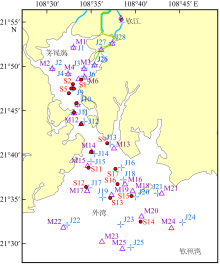
Fig. 1
Schematic diagram of the study area and sampling sites"
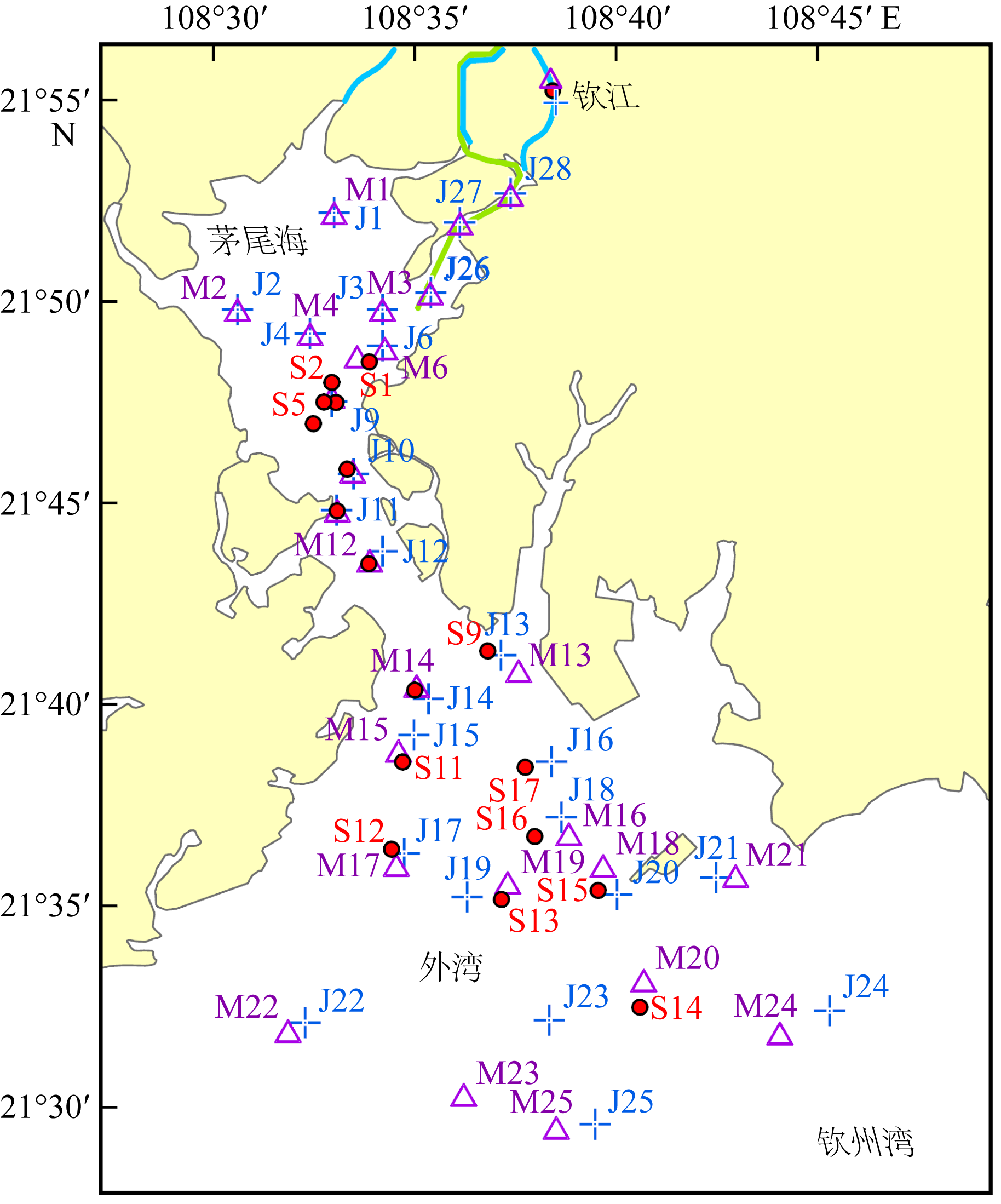
Fig. 1
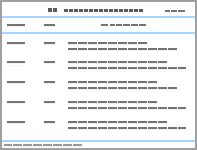
Tab. 1
Target PFAS and their internal standards"
| 类型 | 传统PFAS | 中文名 | 内标 |
|---|---|---|---|
| 全氟烷基羧酸类(PFCAs) | PFBA | 全氟丁酸 | 13C4-PFBA |
| PFPeA | 全氟戊酸 | 13C5-PFPeA | |
| PFHxA | 全氟己酸 | 13C5-PFHxA | |
| PFHpA | 全氟庚酸 | 13C4-PFHpA | |
| PFOA | 全氟辛酸 | 13C8-PFOA | |
| PFNA | 全氟壬酸 | 13C9-PFNA | |
| PFDA | 全氟癸酸 | 13C6-PFDA | |
| PFUnDA | 全氟十一酸 | 13C7-PFUnDA | |
| PFDoDA | 全氟十二酸 | 13C2-PFDoDA | |
| 全氟烷基磺酸类(perfluoroalkyl sulfonate acids, PFSAs) | PFBS | 全氟丁烷磺酸 | 13C3-PFBS |
| PFPeS | 全氟戊烷磺酸 | 13C3-PFHxS | |
| PFHxS | 全氟己烷磺酸 | 13C3-PFHxS | |
| PFHpS | 全氟庚烷磺酸 | 13C3-PFHxS | |
| PFOS | 全氟辛烷磺酸 | 13C8-PFOS | |
| 4∶2FTSA | 全氟丁基乙基磺酸钠 | 13C2-4∶2 FTSA | |
| 6∶2FTSA | 全氟己基乙基磺酸 | 13C2-6∶2 FTSA | |
| 8∶2FTSA | 1H, 1H, 2H, 2H-全氟癸磺酸 | 13C2-8∶2 FTSA | |
| 全氟聚醚磺酸类 (PFESAs) | 4∶2Cl-PFESA | 4∶2氯代多氟醚磺酸 | 13C8-PFOS |
| 6∶2H-PFESA | 6∶2多氟醚磺酸 | 13C8-PFOS | |
| 6∶2Cl-PFESA | 6∶2氯代多氟醚磺酸 | 13C8-PFOS | |
| 8∶2Cl-PFESA | 8∶2氯代多氟醚磺酸 | 13C8-PFOS | |
| H-PFMO2OSA | 全氟二氧辛烷磺酸 | 13C8-PFOS | |
| 全氟聚醚羧酸类(PFECAs) | HFPO-DA | 六氟环氧丙烷二聚体羧酸 | 13C3-HFPO-DA |
| HFPO-TA(C7) | 六氟环氧丙烷三聚体羧酸(C7) | 13C3-HFPO-DA | |
| HFPO-TA(C8) | 六氟环氧丙烷三聚体羧酸(C8) | 13C8-PFOA | |
| HFPO-TA (C9) | 六氟环氧丙烷三聚体羧酸(C9) | 13C9-PFNA | |
| PFMOAA | 全氟2-甲氧基乙酸 | 13C4-PFBA | |
| PFO2HxA | 全氟(3, 5-二氧六)酸 | 13C5-PFPeA | |
| PFO3OA | 全氟(3, 5, 7-三氧杂)辛酸 | 13C5-PFHxA | |
| PFO4DA | 全氟(3, 5, 7, 9-四氧十二烷)酸 | 13C4-PFHpA | |
| PFO5DoDA | 全氟(3, 5, 7, 9, 11-五氧十二烷)酸 | 13C8-PFOA | |
| PF4OPeA | 全氟-4-氧戊酸 | 13C4-PFBA | |
| PF5OHxA | 全氟-4-甲氧基丁酸 | 13C5-PFPeA | |
| 3,6-OPFHpA | 全氟-3,6-二噁庚酸 | 13C5-PFHxA | |
| PFO2OA | 全氟环氧丙烷二聚酸 | 13C4-PFHpA | |
| PMPA | 全氟-3-甲氧基丙酸 | 13C4-PFBA |
Tab. 1
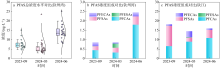
Fig. 2
Comparison of PFAS concentrations and composition in different months"
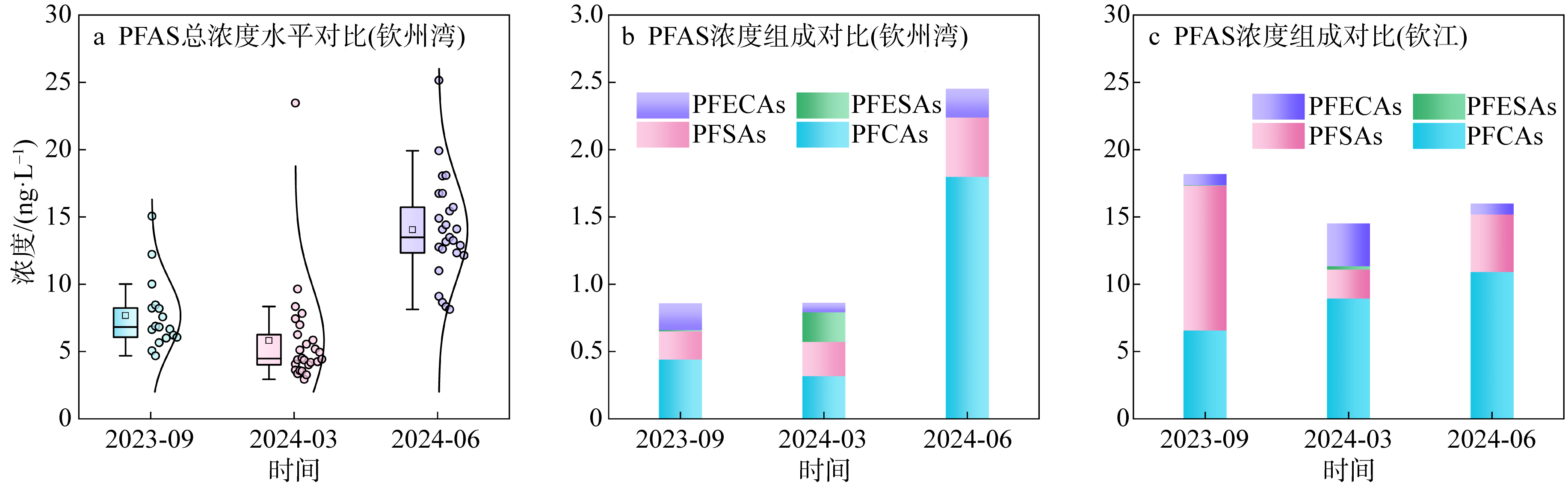
Fig. 2
Tab. 2
Mean concentrations ± SEM (standard error of mean) of the same PFAS in seawater during different months"
| PFAS | 2023-09 | 2024-03 | 2024-06 |
|---|---|---|---|
| 浓度平均值/(ng·L−1) | 浓度平均值/(ng·L−1) | 浓度平均值/(ng·L−1) | |
| PFBA(C4) | 1.26±0.10 | 1.06±0.08 | 6.67±0.52 |
| PFHxA(C6) | 0.32±0.02 | 0.18±0.03 | 0.61±0.09 |
| PFHpA(C7) | 0.37±0.04 | 0.28±0.03 | 0.60±0.11 |
| PFOA(C8) | 1.61±0.18 | 0.65±0.04 | 1.54±0.27 |
| PFNA(C9) | 0.16±0.01 | 0.17±0.03 | 0.64±0.18 |
| PFBS(C4) | 0.31±0.02 | 0.37±0.04 | 1.18±0.17 |
| PFHxS(C6) | 0.05±0.004 | 0.02±0.01 | 0.18±0.13 |
| PFHpS(C7) | 0.19±0.09 | 0.01±0.003 | 0.13±0.09 |
| PFOS(C8) | 0.80±0.08 | 0.28±0.09 | 0.37±0.22 |
| HFPO-TA(C7) | 0.15±0.01 | 0.07±0.01 | 0.02±0.01 |
| HFPO-TA(C8) | 0.10±0.01 | 0.12±0.02 | 0.26±0.10 |
| PFMOAA(C3) | 0.76±0.51 | 0.12±0.01 | 0.25±0.10 |
| PFO2HxA(C4) | 0.26±0.02 | 0.10±0.01 | 0.15±0.03 |
| PFO3OA(C5) | 0.08±0.01 | 0.05±0.004 | 0.04±0.02 |
| PMPA(C4) | 0.21±0.01 | 0.18±0.03 | 0.74±0.03 |
Tab. 2
Fig. 3
Spatial distribution of $\sum{\text{PFAS}}$and major PFAS concentrations in seawater"
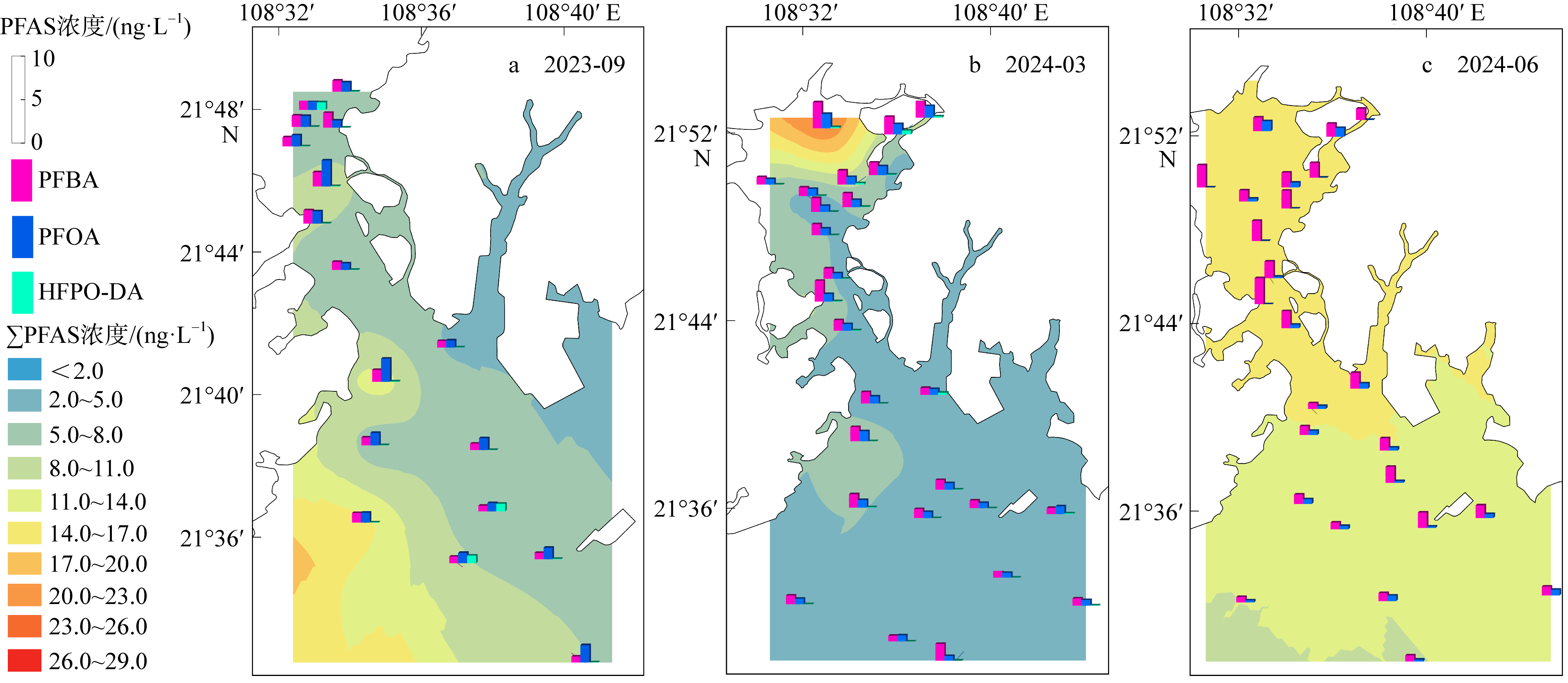
Fig. 3
Tab. 3
Statistical results of principal components analysis of PFAS in seawater"
| PFAS | 2023-09 | 2024-03 | 2024-06 | |||
|---|---|---|---|---|---|---|
| PC1载荷(78.0%) | PC2载荷(7.1%) | PC1载荷(80.0%) | PC2载荷(11.4%) | PC1载荷(87.3%) | PC2载荷(5.0%) | |
| PFBA | 8.53 | -1.72 | 15.52 | -1.05 | 17.52 | 1.06 |
| PFPeA | -1.30 | -0.34 | -0.51 | -0.25 | -0.29 | 0.16 |
| PFHxA | 0.02 | -0.34 | -0.80 | -0.03 | -0.47 | -0.72 |
| PFHpA | 0.14 | -0.34 | 1.23 | -0.19 | -0.52 | 0.12 |
| PFOA | 11.05 | 1.74 | 8.69 | -1.26 | 2.96 | -4.06 |
| PFNA | -1.40 | -0.57 | -0.78 | -0.39 | -0.52 | 0.78 |
| PFUnDA | -2.57 | -0.40 | -3.20 | -0.16 | - | - |
| PFDoDA | -2.80 | -0.38 | -3.57 | -0.15 | - | - |
| PFBS | -0.10 | -0.30 | 2.85 | -0.40 | 1.23 | 0.17 |
| PFHxS | -2.43 | -0.43 | -3.32 | -0.22 | -2.31 | 0.79 |
| PFHpS | -1.46 | 1.55 | -3.41 | -0.15 | -2.24 | 0.12 |
| PFOS | 4.63 | -1.42 | -0.37 | 0.81 | -1.83 | 0.63 |
| 4∶2 FTSA | -2.71 | -0.38 | -3.51 | -0.14 | - | - |
| 6∶2 FTSA | -2.55 | -0.39 | 2.73 | 7.30 | - | - |
| HFPO-DA | -0.88 | 0.47 | -2.75 | -0.49 | -2.60 | 0.34 |
| HFPO-TA(C7) | -1.48 | -0.20 | -2.20 | -0.28 | -2.60 | 0.40 |
| HFPO-TA(C8) | -1.99 | -0.01 | -1.05 | -0.95 | -1.55 | -0.56 |
| HFPO-TA(C9) | -0.79 | 0.95 | -2.24 | -0.56 | -2.66 | 0.42 |
| PFMOAA | -0.51 | 3.28 | -1.26 | -0.36 | -2.05 | 0.46 |
| PFO2HxA | -0.48 | -0.34 | -1.57 | -0.52 | -2.04 | 0.11 |
| PMPA | -0.92 | -0.42 | -0.46 | -0.56 | -0.03 | -0.23 |
Tab. 3
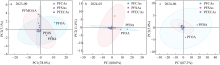
Fig. 4
Comparison of PFAS sources in seawater during different months"
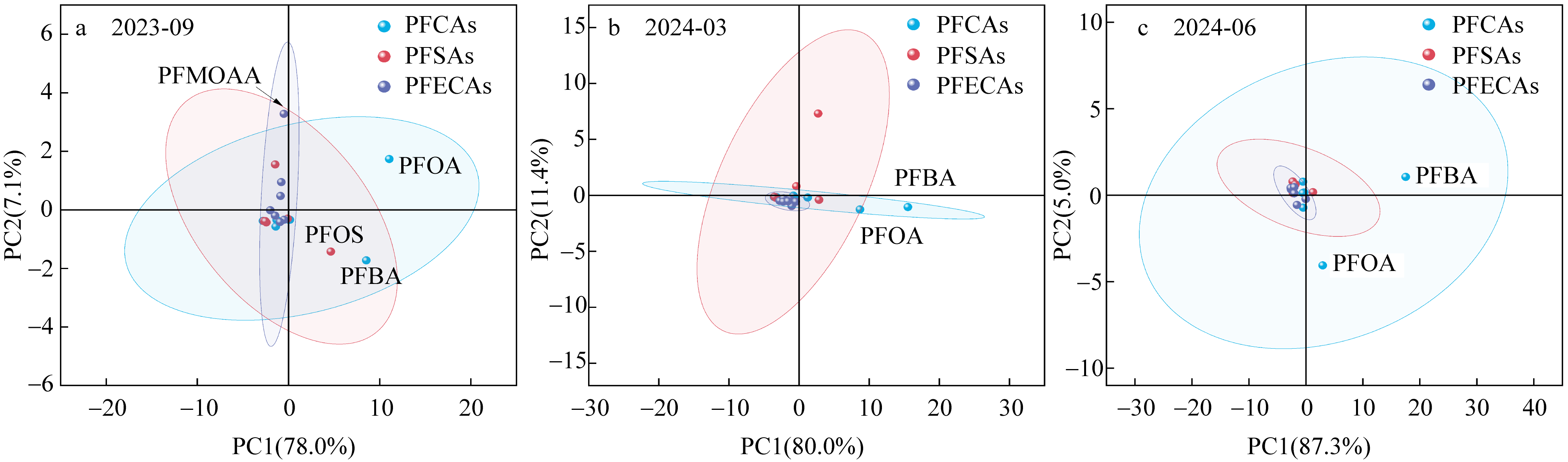
Fig. 4
| [1] |
曹超, 吴承强, 蔡锋, 等, 2020. 钦州湾外湾水下地形地貌特征及沉积物来源[J]. 应用海洋学学报, 39(3): 378-388.
|
|
|
|
| [2] |
丁达, 宋昕, 刘朝阳, 等, 2021. 某化工园区周边土壤中传统和新兴全氟化合物的赋存特征及潜在来源[J]. 土壤, 53(4): 779-787.
|
|
|
|
| [3] |
范博伦, 步秀芹, 郭诗琪, 等, 2024. 广西北部湾经济区重点海湾水污染物特征分析[J]. 四川环境, 43(3): 36-42.
|
|
|
|
| [4] |
郝丽丽, 张磊, 宁钧宇, 等, 2022. PFOS与PFOA的毒性效应及其在我国普通人群中的内暴露研究进展[J]. 中国食品卫生杂志, 34(5): 1112-1121.
|
|
|
|
| [5] |
来冠铮, 戴家银, 盛南, 2024. 新型全氟及多氟聚醚羧酸识别、分布特征及毒理效应研究进展[J]. 科学通报, 69(6): 774-786.
|
|
|
|
| [6] |
李亚楠, 2022. 典型卤代物在河口-近海的生物累积及营养级传递研究[D]. 烟台: 中国科学院大学(中国科学院烟台海岸带研究所).
|
|
|
|
| [7] |
刘承友, 刘金林, 郭婧, 等, 2022. 大伙房水库多介质中全氟化合物赋存特征、源解析及健康风险评估[J]. 环境监控与预警, 14(5): 133-142.
|
|
|
|
| [8] |
欧芳兰, 邓建明, 卢远, 等, 2020. 钦江流域历史径流泥沙演变规律分析[J]. 大众科技, 22(10): 15-17+28.
|
|
|
|
| [9] |
盛南, 潘奕陶, 戴家银, 2018. 新型全氟及多氟烷基化合物生态毒理研究进展[J]. 安徽大学学报(自然科学版), 42(6): 3-13.
|
|
|
|
| [10] |
吴李杏子, 韩欣乐, 时延锋, 等, 2024. PFOA和PFOS替代品的环境污染及毒性研究进展[J]. 生态毒理学报, 19(5): 112-134.
|
|
|
|
| [11] |
武倩倩, 吴强, 宋帅, 等, 2021. 天津市主要河流和土壤中全氟化合物空间分布、来源及风险评价[J]. 环境科学, 42(8): 3682-3694.
|
|
|
|
| [12] |
张苗苗, 田芹, 安子怡, 等, 2025. 环境中全氟和多氟烷基化合物来源、分析方法及分布特征研究进展[J]. 环境科学研究, 38(3): 677-687.
|
|
|
|
| [13] |
|
| [14] |
doi: 10.1016/j.chemosphere.2023.141106 |
| [15] |
doi: 10.1016/j.scitotenv.2023.162687 |
| [16] |
doi: 10.1016/j.jenvman.2021.113879 |
| [17] |
doi: 10.1021/acs.est.7b02488 |
| [18] |
doi: 10.1016/j.envpol.2020.115011 |
| [19] |
doi: 10.1021/acs.est.5b01648 |
| [20] |
doi: 10.1021/acs.est.0c04587 |
| [21] |
doi: 10.1021/acs.est.4c03985 |
| [22] |
doi: 10.1016/j.jhazmat.2023.131353 |
| [23] |
doi: 10.1016/j.chemosphere.2022.134378 |
| [24] |
doi: 10.1016/j.chemosphere.2021.132812 |
| [25] |
doi: 10.1016/j.envres.2024.118214 |
| [26] |
doi: 10.1016/j.ntt.2023.107174 |
| [27] |
doi: 10.1021/acs.est.7b02259 |
| [28] |
doi: 10.1021/acs.est.5b01010 |
| [29] |
|
| [30] |
U. S. EPA (United States Environmental Protection Agency), 2022. IRIS toxicological review of perfluorobutanoic acid (PFBA) and related salts (final report, 2022)[R]. Washington, D.C.: U. S. Environmental Protection Agency.
|
| [31] |
doi: 10.1016/j.chemosphere.2019.124578 |
| [32] |
doi: 10.1016/j.chemosphere.2021.132513 |
| [33] |
doi: 10.1016/j.jhazmat.2023.132937 |
| [34] |
doi: 10.1016/j.envpol.2022.118957 |
| [35] |
doi: 10.1016/j.scitotenv.2023.168116 |
| [36] |
doi: 10.1016/j.watres.2024.122606 |
| [1] | SUN Kangwei, LIAO Riquan, LI Han, WENG Peiyao, TANG Jianhui. Monthly variability of nutrient concentrations and influencing factors in surface seawater of Qinzhou Bay* [J]. Journal of Tropical Oceanography, 2026, 45(4): 162-178. |
| [2] | XIE Yajun, DAI Zhijun, CHEN Jianqing, ZHONG Mingtao, HUANG Qiang, WANG Riming. Analysis of changes in macrobenthic community in the Shajing Island intertidal zone of the Pinglu Canal estuary in response to near-natural restoration [J]. Journal of Tropical Oceanography, 2026, 45(4): 29-40. |
| [3] | LIANG Xixing, DAI Zhijun, LI Yan, LI Shushi, LI Weihua, WANG Riming, WU Erjiang. Spatiotemporal dynamics of mangroves at the Pinglu Canal estuary based on Sentinel-2 [J]. Journal of Tropical Oceanography, 2026, 45(4): 77-88. |
| [4] | JIANG Shihao, LIAO Riquan, NIU Donglei, QIAO Zhen, LU Dongliang, TANG Jianhui. The distribution characteristics, compositions and sources of dissolved organic matter (DOM) in Qinzhou Bay [J]. Journal of Tropical Oceanography, 2026, 45(4): 190-202. |
| [5] | WANG Mengzhu, XU Shanshan, LI Shushi, LI Jianming, YANG Xialing, HUANG Sheng. Variations of suspended sediment concentration in the Qinjiang River in the past 60 years under the influence of human activities and climate change [J]. Journal of Tropical Oceanography, 2026, 45(4): 126-139. |
| [6] | GUO Shaojing, ZHANG Xiaobo, CHANG Jinglong, ZHANG Shouwen, JI Xuanliang, MIAO Runqiao, LI Jiandong, ZHU Xueming. Summer hydrological variations during 2021-2023 in the Pearl River Estuary and its adjacent areas [J]. Journal of Tropical Oceanography, 2025, 44(1): 108-121. |
| [7] | DONG Hanying, SU Juan, ZHOU Shengzhen, LIANG Shaoxia, CHEN Guanyu, WANG Fan. Investigating the contents and sources of heavy metals in winter season in the Xisha waters of South China Sea* [J]. Journal of Tropical Oceanography, 2023, 42(2): 169-177. |
|
||