

热带海洋学报 ›› 2026, Vol. 45 ›› Issue (3): 202-211.doi: 10.11978/2025124CSTR: 32234.14.2025124
稳定同位素示踪浙江清江口红树林沉积物氮源及其影响因子分析
谭清碧1( ), 郭泓瀛1, 孙思旗1, 钟宇航1, 聂会2, 牛丽霞1,3,4()
- 1
中山大学 ,海洋工程与技术学院/南方海洋科学与工程广东省实验室
2浙江水利水电学院水利工程学院
3河口海岸研究所/广东省海岸与岛礁工程技术研究中心
4广东省深水信息技术重点实验室
-
收稿日期:2025-08-06修回日期:2025-10-06出版日期:2026-05-10发布日期:2026-05-28 -
通讯作者:牛丽霞(1985—), 女, 副教授。email: niulixia@mail.sysu.edu.cn -
作者简介:谭清碧(2002—), 女。email: tanqb@mail2.sysu.edu.cn
-
基金资助:浙江省自然科学基金项目(LGEY25E090012); 浙江省水利厅科技计划项目(RC2436); 国家自然科学基金(51709289)
Analysis of nitrogen sources and influencing factors in mangrove sediments of the Qingjiang River estuary (Zhejiang) using stable isotopes
TAN Qingbi1(), GUO Hongying1, SUN Siqi1, ZHONG Yuhang1, NIE Hui2, NIU Lixia1,3,4()
- 1
School of Ocean Engineering and Technology ,Sun Yat-sen University (Guangzhou)/Southern Laboratory of Ocean Science and Engineering
2Water Conservancy and Hydropower College ,Zhejiang University of Water Resources and Electric Power School of Hydraulic Engineering
3Institute of Estuarine and Coastal Research ,Guangdong Provincial Engineering Research Center of Coasts, Islands and Reefs
4Guangdong Provincial Key Laboratory of Information Technology for Deep Water Acoustics
-
Received:2025-08-06Revised:2025-10-06Online:2026-05-10Published:2026-05-28 -
Contact:NIU Lixia. email: niulixia@mail.sysu.edu.cn -
Supported by:Zhejiang Provincial Natural Science Foundation Project(LGEY25E090012); Science and Technology Program of Zhejiang Provincial Department of Water Resources(RC2436); National Natural Science Foundation of China(51709289)

摘要:
浙江乐清湾清江河口位于我国红树林分布的最北端, 处于温带与亚热带交会的生态过渡地带, 开展红树林区域沉积物氮源研究, 具有重要的生态参考价值。本文选取清江口红树林(2019—2020年种植)、互花米草、混合区等典型植被区域为研究对象, 通过分析沉积物中总氮(total nitrogen, TN)、总有机氮(total organic nitrogen, TON)、总有机碳(total organic carbon, TOC)及总有机质(total organic matter, TOM)等指标, 并结合δ13C、δ15N稳定同位素特征及多源混合模型(mixing stable isotope analysis in R, MixSIAR), 识别氮和有机质的主要来源。结果表明, 清江河口沉积物氮、碳含量整体呈现由西向东递减趋势, 反映出陆源输入强度的空间梯度差异; 不同植被类型区域的氮形态及含量差异显著, 互花米草区由于植物根系活性较弱、生产力较低、有机质分解速率较快, 对外源有机质与氮素的截留能力有限, 红树林生态系统在调节氮循环方面的功能强于互花米草。氮源分析显示, 该区域主要以其他陆源输入为主, 占33.65%, 红树林(C3植物)贡献率达到25.28%, 海洋来源贡献为23.78%, 互花米草(C4植物)的影响相对较小, 为17.33%。本研究揭示了清江河口植被类型与氮的空间分布之间的关系, 探讨了红树林在区域氮循环过程中的关键生态功能, 为不同气候带红树林生态系统的保护修复与河口氮污染防控提供了理论依据和实践指导。
中图分类号:
- P597.2
引用本文
谭清碧, 郭泓瀛, 孙思旗, 钟宇航, 聂会, 牛丽霞. 稳定同位素示踪浙江清江口红树林沉积物氮源及其影响因子分析[J]. 热带海洋学报, 2026, 45(3): 202-211.
TAN Qingbi, GUO Hongying, SUN Siqi, ZHONG Yuhang, NIE Hui, NIU Lixia. Analysis of nitrogen sources and influencing factors in mangrove sediments of the Qingjiang River estuary (Zhejiang) using stable isotopes[J]. Journal of Tropical Oceanography, 2026, 45(3): 202-211.
图1
浙江省清江河口及研究区及采样点位 该图基于浙江省标准地图服务网站下载的审图号为浙S(2024)38号的标准地图制作, 底图无修改"
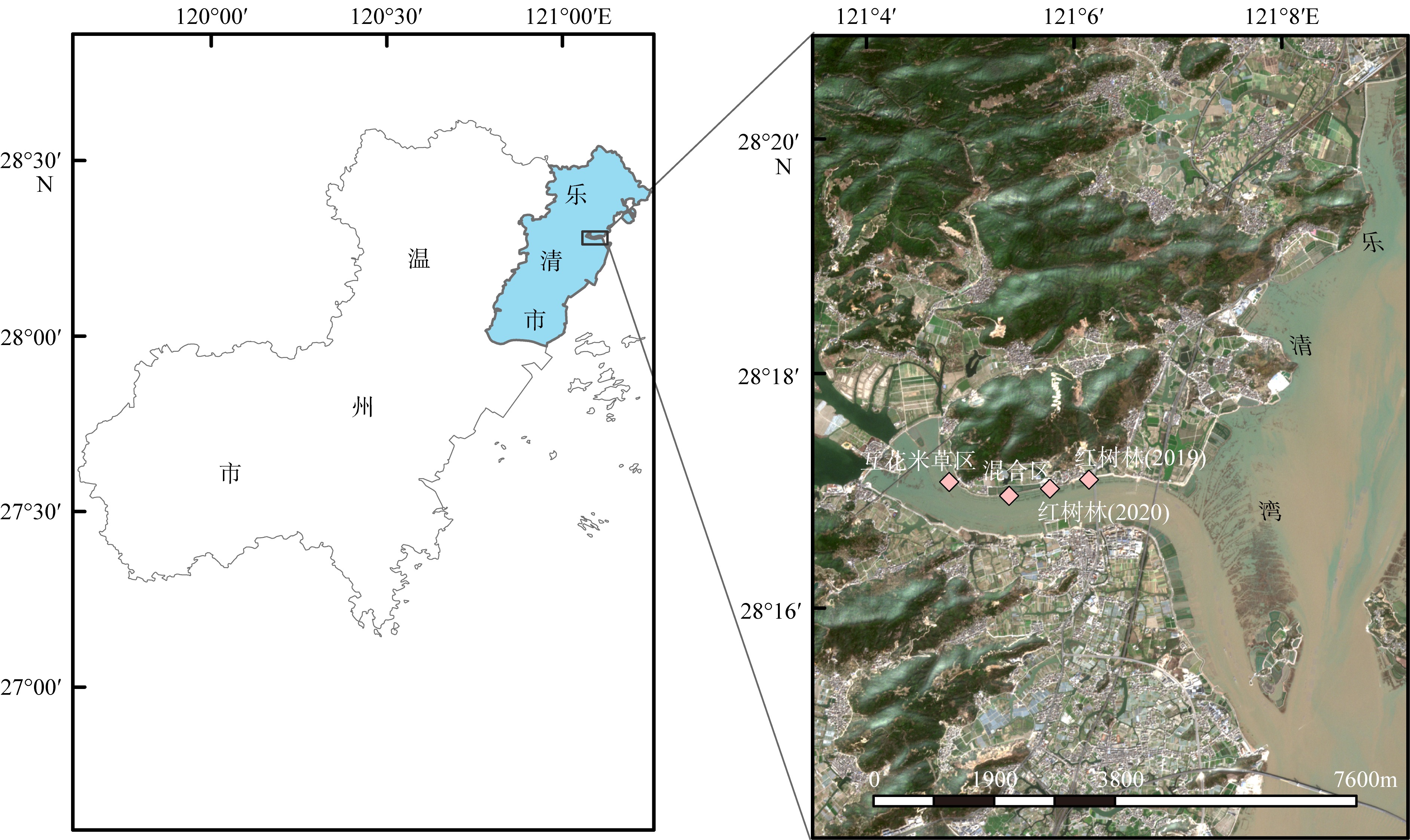
图1
图2
不同采样区域 TOC、TN浓度的箱线图"
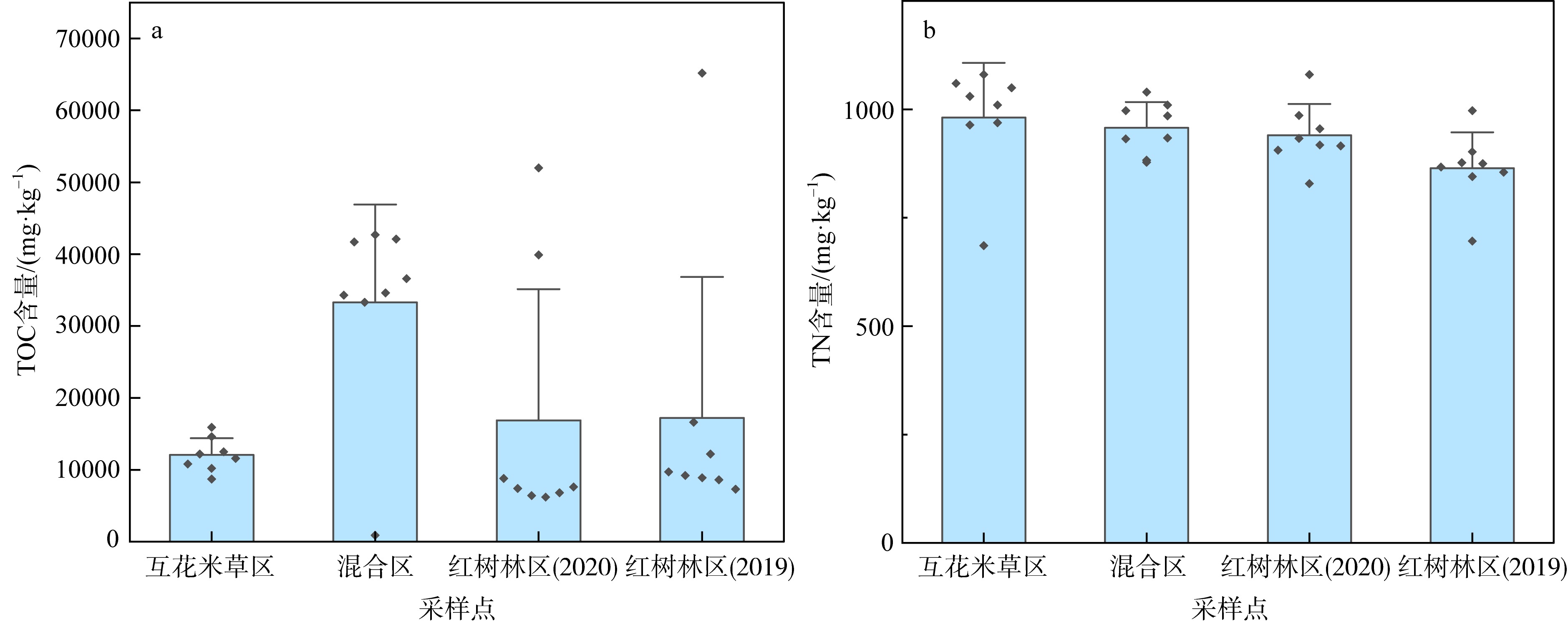
图2
表1
清江口不同植被区域的C/N值"
| 点位 | C/N值 | |||
|---|---|---|---|---|
| 互花米草区 | 混合区 | 红树林区(2020) | 红树林区(2019) | |
| 1 | 11.02 | 50.57 | 66.08 | 10.41 |
| 2 | 14.09 | 48.16 | 8.72 | 11.90 |
| 3 | 10.47 | - | 7.82 | - |
| 4 | 15.13 | 38.81 | 8.50 | 11.44 |
| 5 | 11.89 | 49.26 | 9.42 | 16.84 |
| 6 | 12.89 | 41.68 | 8.21 | 22.65 |
| 7 | 18.01 | 48.35 | 10.41 | 13.05 |
| 8 | 24.83 | 45.57 | 51.37 | 12.24 |
| 平均值 | 14.79 | 40.44 | 21.32 | 23.18 |
表1
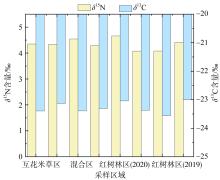
图3
清江口不同植被区δ13C和δ15N特征"
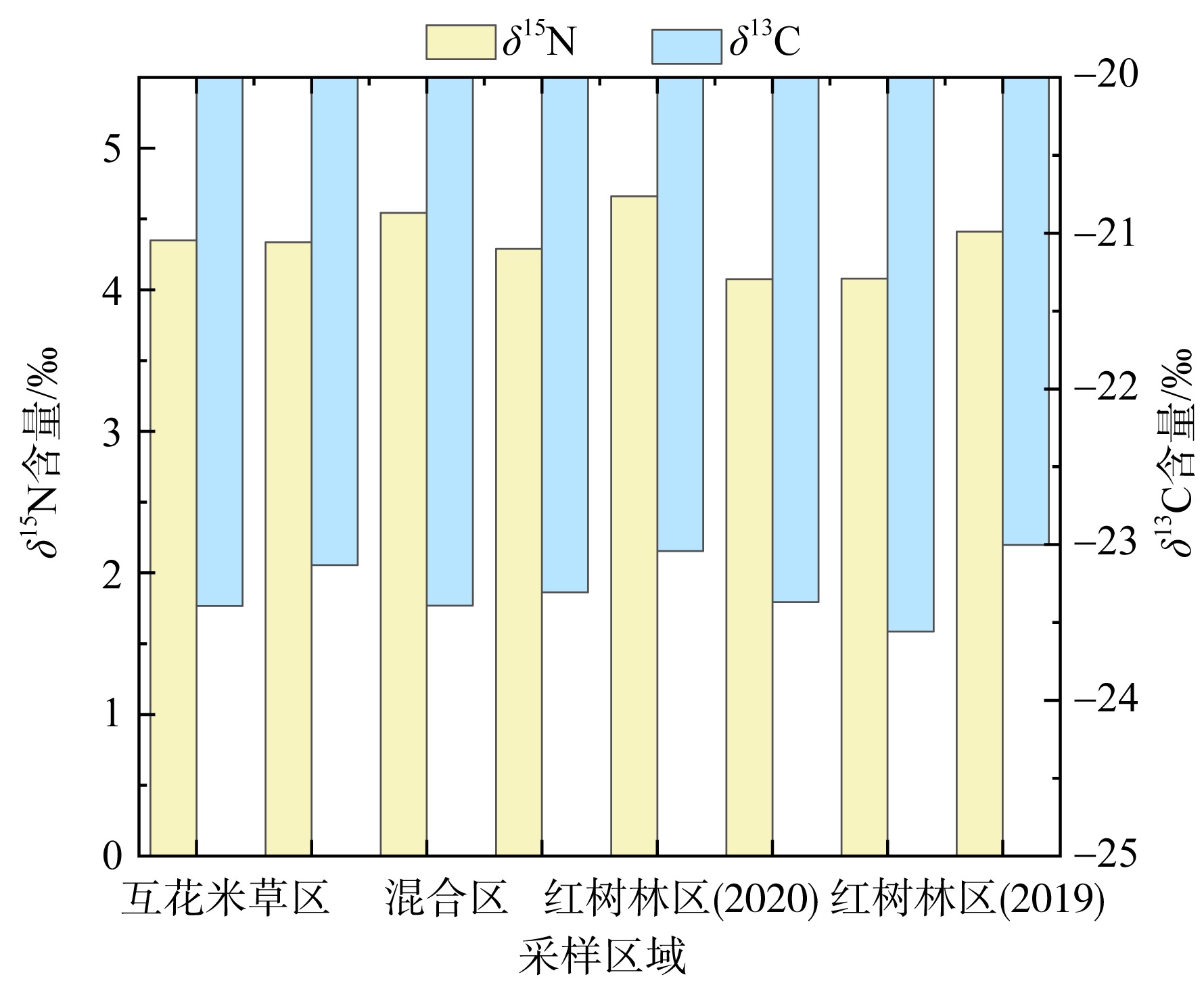
图3
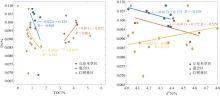
图4
清江河口TN与TOC、δ15N之间的相关性分析"
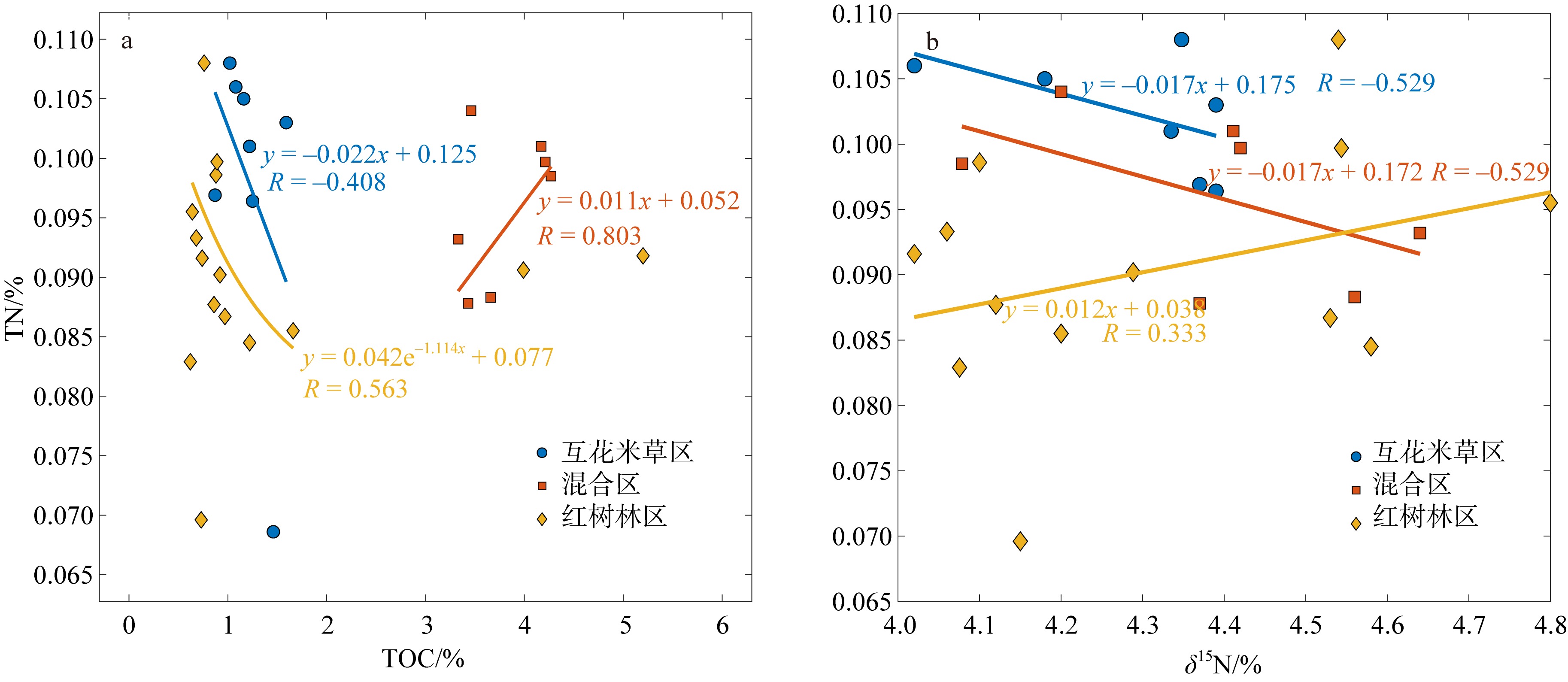
图4
表2
清江河口有机质来源的同位素及碳氮比范围"
| 有机质来源 | δ13C /‰ | δ15N /‰ | C/N | 数据来源 |
|---|---|---|---|---|
| 红树林(C3植物) | -32~-24 | 3.11~3.93 | >20 | 吴雪 等, |
| 互花米草(C4植物) | -17~-9 | 2.52~4.85 | 15~25 | 吴雪 等, |
| 海洋输入 | -23.40~-20.60 | 4~9 | 6~8 | 权伟 等, |
| 其他陆源输入 | -27~-25 | 3~8 | 30~50 | Li et al, |
表2
表3
清江河口沉积物中有机质来源及其贡献率"
| 有机质来源 | δ13C/‰ | δ15N/‰ | 贡献率范围/% |
|---|---|---|---|
| 红树林(C3植物) | -28.00 | 4.50 | 23.50~27.80 |
| 互花米草(C4植物) | -13.00 | 3.46 | 17.10~18.20 |
| 海洋来源 | -22.00 | 6.00 | 22.20~25.20 |
| 其他陆源输入 | -26.00 | 3.00 | 31.80~35.70 |
表3
图5
清江河口沉积物有机质4种潜在来源的贡献率分布"
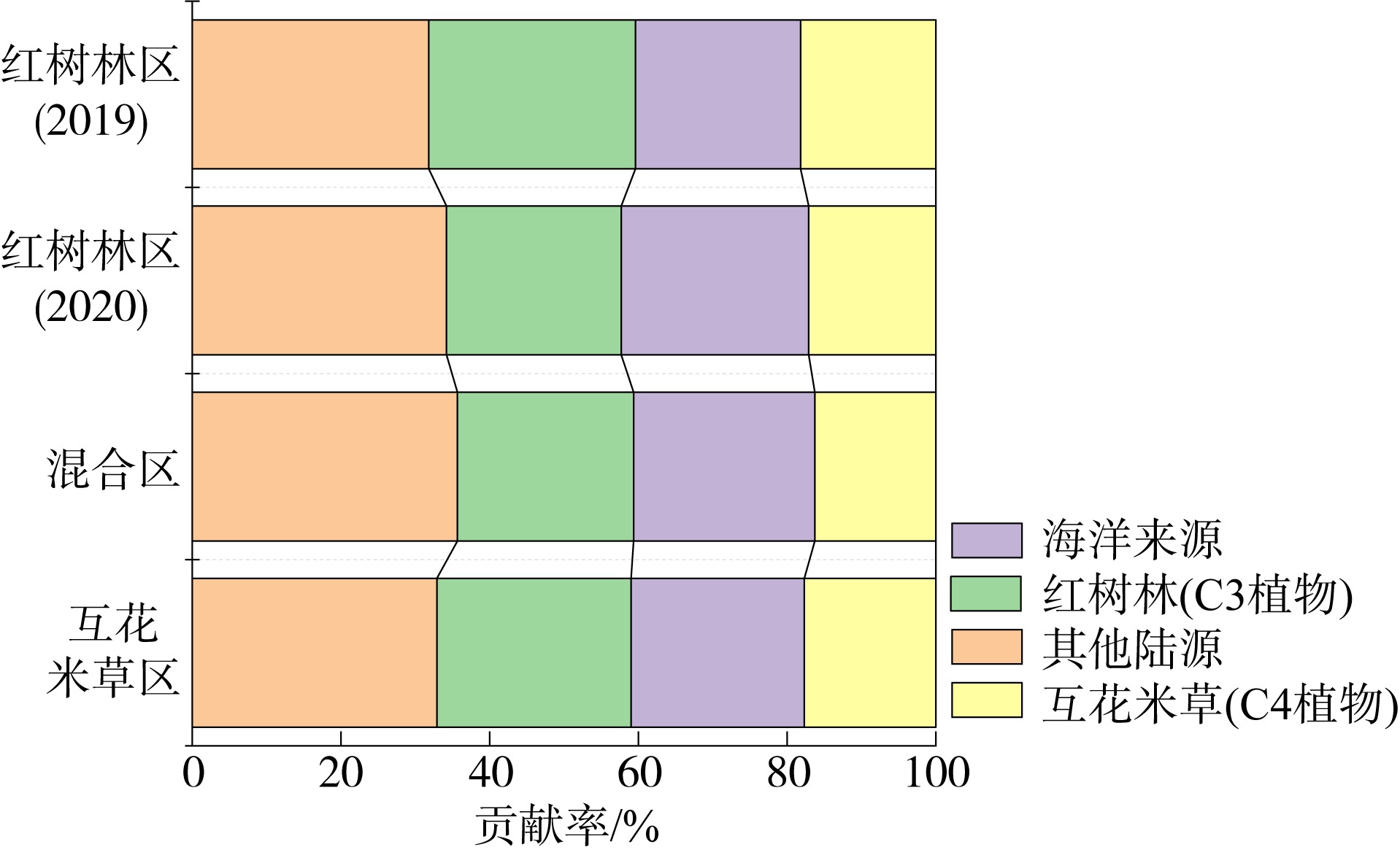
图5
| [1] |
鲍士旦, 2000. 土壤农化分析[M]. 第3版. 北京: 中国农业出版社 (in Chinese).
|
| [2] |
戴志军, 周晓妍, 王杰, 等, 2021. 红树林潮滩沉积动力研究进展与展望[J]. 热带海洋学报, 40(3): 69-75.
doi: 10.11978/YG2020007 |
|
doi: 10.11978/YG2020007 |
|
| [3] |
丁悌平, 2002. 稳定同位素测试技术与参考物质研究现状及发展趋势[J]. 岩矿测试, 21(4): 291-300.
|
|
|
|
| [4] |
付涛, 牛丽霞, 党浩铭, 等, 2023. 珠江河口氮、磷营养盐的季节分布特征及影响因子研究[J]. 海洋环境科学, 42(1): 122-130.
|
|
|
|
| [5] |
韩永强, 夏嘉, 谭靖千, 等, 2020. 环雷州半岛近海表层沉积物有机碳分布及其控制因素分析[J]. 海洋科学, 44(3): 93-103.
|
|
|
|
| [6] |
梁坤, 樊玉清,
|
|
|
|
| [7] |
潘进疆, 黄俊华, 张蕊, 等, 2021. 鄂西大九湖晚更新世以来沉积物的碳氮比值、有机碳氮同位素特征与气候环境演变[J]. 第四纪研究, 41(4): 916-930.
|
|
|
|
| [8] |
权伟, 应苗苗, 周庆澔, 等, 2018. 基于稳定碳同位素技术的养殖贝类碳源分析[J]. 上海海洋大学学报, 27(2): 175-180.
|
|
|
|
| [9] |
申铠君, 2019. 珠江河流及河口浅层沉积物中有机碳、氮及同位素分布和来源浅析[J]. 广东化工, 46(3): 57-60.
|
|
|
|
| [10] |
谭皓月, 曹慧群, 卢士强, 等, 2025. 长江口2022年水动力及营养盐时空分布规律模拟研究[J]. 环境科学研究, 38(2): 272-281.
|
|
|
|
| [11] |
田芳妍, 何贤强, 朱伯仲, 等, 2023. 考虑潮位校正的乐清湾潮滩面积近30年变化遥感研究[J]. 海洋学研究, 41(1): 68-81.
doi: 10.3969-j.issn.1001-909X.2023.01.006 |
|
doi: 10.3969-j.issn.1001-909X.2023.01.006 |
|
| [12] |
童朝锋, 安福伟, 章家保, 等, 2020. 乐清湾内外潮波变形及不对称性分析[J]. 海洋工程, 38(3): 113-123.
|
|
|
|
| [13] |
王毛兰, 熊鑫, 何昶, 等, 2021. 鄱阳湖网箱养殖区沉积物有机质来源分析[J]. 湖泊科学, 33(1): 158-167.
|
|
doi: 10.18307/2021.0108 |
|
| [14] |
王雯雯, 王书航, 姜霞, 等, 2021. 多方法研究呼伦湖表层沉积物有机质的赋存特征及来源[J]. 环境科学研究, 34(2): 305-318.
|
|
|
|
| [15] |
王玉莲, 韩忠, 李浩, 等, 2024. 威海市东部滨海新城海域海砂资源分布及特征[J]. 海洋地质前沿, 40(5): 19-26.
|
|
|
|
| [16] |
吴雪, 赵鑫, 辜伟芳, 等, 2025. 浙南海岸带人工秋茄(Kandelia obovata)红树林与互花米草(Spartina alterniflora)盐沼土壤碳汇对比研究[J]. 热带海洋学报, 44(1): 172-181.
|
|
|
|
| [17] |
严维兵, 饶文波, 栗天宁, 等, 2024. 江苏沿海沉积物有机磷含量、总有机碳、总氮与同位素特征及有机质来源解析[J]. 地球科学与环境学报, 46(1): 67-80.
|
|
|
|
| [18] |
章叶飞, 李滔, 张露, 等, 2025. 模拟夏季陆源输入对长湖浮游植物群落的影响[J]. 水生态学杂志, 46(4): 164-173.
|
|
|
|
| [19] |
doi: 10.3390/nitrogen1020014 |
| [20] |
doi: 10.1126/science.aan3242 pmid: 28522494 |
| [21] |
doi: 10.1016/j.scitotenv.2019.02.212 |
| [22] |
doi: 10.1016/j.jenvman.2024.121569 |
| [23] |
doi: 10.1016/j.ecss.2016.08.006 |
| [24] |
doi: 10.1016/j.catena.2022.106474 |
| [25] |
doi: 10.3897/natureconservation.34.30099 |
| [26] |
doi: 10.1016/j.catena.2025.109317 |
| [27] |
doi: 10.3390/land13101557 |
| [28] |
doi: 10.1016/j.ecss.2020.107003 |
| [29] |
doi: 10.1016/j.jenvman.2024.123341 |
| [30] |
doi: 10.1007/s11104-024-07130-7 |
| [31] |
doi: 10.3389/fmars.2024.1400381 |
| [32] |
doi: 10.1016/j.aquabot.2007.12.005 |
| [33] |
doi: 10.1016/j.marpolbul.2022.114010 |
| [34] |
doi: S0043-1354(18)30450-0 pmid: 29890473 |
| [35] |
doi: 10.1007/s12665-016-5245-x |
| [36] |
|
| [37] |
|
| [38] |
doi: 10.1139/cjz-2014-0127 |
| [39] |
doi: 10.1016/j.rsma.2016.05.006 |
| [40] |
doi: 10.1016/j.catena.2023.107151 |
| [41] |
|
| [42] |
doi: 10.1016/j.geoderma.2024.116811 |
| [43] |
doi: 10.1016/j.envpol.2020.115445 |
| [44] |
doi: 10.1016/j.scitotenv.2021.150281 |
| [45] |
doi: 10.1016/j.marpolbul.2015.12.046 |
| [46] |
doi: 10.3389/fmars.2023.1234116 |
| [47] |
doi: 10.1016/j.scitotenv.2024.175824 |
| [48] |
doi: 10.1016/j.ecoleng.2020.105758 |
| [49] |
doi: 10.1016/j.ecoleng.2015.11.010 |
| [50] |
doi: 10.3390/w16060866 |
| [51] |
doi: S0025-326X(17)30344-2 pmid: 28457556 |
| [52] |
doi: 10.1016/j.scitotenv.2023.163995 |
| [53] |
doi: 10.1016/j.watres.2025.123330 |
| [54] |
doi: 10.1016/j.envpol.2022.120438 |
| [1] | 张强, 赵中伟, 苏翔, 赵璇, 李伟. 两种测定海洋沉积物中碳酸盐含量的非器测方法对比分析*[J]. 热带海洋学报, 2026, 45(3): 25-38. |
| [2] | 黄春梅, 王日明, 谢晓雯, 戴志军, 谢小魁, 李兴荣. 南流江河口红树林潮滩沉积物碳含量的空间分异特征[J]. 热带海洋学报, 2026, 45(3): 174-187. |
| [3] | 齐峰, 邓晓杰, 关永鹏, 周盛垚, 何庆, RAJAPAKSHALAGE Thashikala Nethmini, 李楠, 姜宫凌侠, 陈清香, 雷欣悦, 侯庆华, 黄来珍, 李小蕾, 韦巧艳. 红树植物秋茄根系固氮微生物群落的稳定性和复杂性及其关键影响因子研究[J]. 热带海洋学报, 2026, 45(3): 153-163. |
| [4] | 孟耀文, 蒋艳, 刘旭佳, 蔡德建, 钟声平, 彭银辉, 蔡小辉, 陆洁, 黄国强. 方格星虫对碳和氮稳定同位素的分馏: 养殖试验与滩涂调查[J]. 热带海洋学报, 2026, 45(3): 143-152. |
| [5] | 方扬, 唐俊逸, 罗育池, 叶匡旻, 邓炜华. 外来红树引入对生态系统健康与服务功能的影响——以广东省3个典型区域为例[J]. 热带海洋学报, 2026, 45(2): 173-190. |
| [6] | 蒋守殿, 胡鑫, 蓝珮心, 姚李勤, 水柏年, 纪建达, 何茂求. 浙江西门岛红树林细菌群落季节性特征及环境驱动因素[J]. 热带海洋学报, 2026, 45(2): 117-128. |
| [7] | 钟福昌, 向荣, 杨艺萍, 毛华斌. 东北印度洋海岭区表层沉积物底栖有孔虫分布特征及其影响因素初探*[J]. 热带海洋学报, 2026, 45(1): 81-90. |
| [8] | 杜恕环, 向荣, 苏翔, 张兰兰, 潘子锐, 谢金沃, 罗传秀, 万随. 东北印度洋90°E海岭表层沉积物碳酸钙组成与影响因子*[J]. 热带海洋学报, 2026, 45(1): 73-80. |
| [9] | 林明智, 覃茂刚, 陈旸, 陈波, 王雪木, 刘艳锐, 宋家伟, 孙龙飞. Folk分类的海底沉积物类型赋值制图方法研究[J]. 热带海洋学报, 2026, 45(1): 178-187. |
| [10] | 粟春青, 高育慧, 罗炘武, 韩梦梦, 宫彦章, 郑卫国. 深圳不同红树林群落生物量和碳储量[J]. 热带海洋学报, 2025, 44(6): 155-164. |
| [11] | 林明智, 陈波, 陈旸. 适用于海砂勘查的碎屑沉积物分类方法探讨[J]. 热带海洋学报, 2025, 44(6): 165-175. |
| [12] | 王日明, 苏金恒, 戴志军, 吴天亮, 谢晓雯, 黄春梅, 李兴荣, 张尚宇. 钦州湾茅岭江河口红树林湿地动态变化过程[J]. 热带海洋学报, 2025, 44(6): 143-154. |
| [13] | 谢小魁, 李兴荣, 王日明, 戴志军, 龚受基, 庞文鸿, 张尚宇. 北部湾茅尾海潮滩外来红树无瓣海桑时空演替[J]. 热带海洋学报, 2025, 44(6): 132-142. |
| [14] | 胡鑫, 熊兰兰, 陈顺洋, 张黄琛, 邹易阳, 张吉超, 刘东熙, 何佳潞, 吴于琪, 朱振杰. 幼龄红树生物量模型及幼林红树林碳储量研究*[J]. 热带海洋学报, 2025, 44(4): 187-199. |
| [15] | 陈建勇. 厦门杏林湾沉积物有机质、氮、磷污染空间分布及治理对策[J]. 热带海洋学报, 2025, 44(4): 200-209. |
|
||