

Journal of Tropical Oceanography ›› 2026, Vol. 45 ›› Issue (4): 2-14.doi: 10.11978/2025171CSTR: 32234.14.2025171
• Marine Ecology • Previous Articles Next Articles
Characteristics of bacterioplankton communities and their environmental driving factors in coastal areas of the Pinglu Canal*
JI Jinjie1,2( ), WANG Ting1, WEI Dongqun1,3, LI Jialin1,4(), QIN Song1,2
- 1
State Key Laboratory of Coastal Biology and Biological Resource Utilization ,Yantai Institute of Coastal Zone Research, Chinese Academy of Sciences
2University of Chinese Academy of Sciences
3School of Pharmacy ,Binzhou Medical University
4College of Marine Sciences ,Beibu Gulf University
-
Received:2025-09-22Revised:2025-10-14Online:2026-07-10Published:2026-07-31 -
Contact:LI Jialin. email: jlli@yic.ac.cn -
Supported by:National Key Research and Development Program of China(2024YFF0808802); National Natural Science Foundation of China(42576259); National Natural Science Foundation of China(42176131)

CLC Number:
- P735
Cite this article
JI Jinjie, WANG Ting, WEI Dongqun, LI Jialin, QIN Song. Characteristics of bacterioplankton communities and their environmental driving factors in coastal areas of the Pinglu Canal*[J].Journal of Tropical Oceanography, 2026, 45(4): 2-14.
share this article
Add to citation manager EndNote|Reference Manager|ProCite|BibTeX|RefWorks
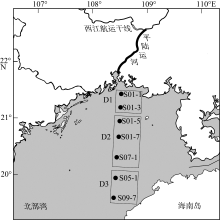
Fig. 1
Map of sampling stations in the Beibu Gulf. The black markers are the sampling stations, with D1, D2, and D3 representing the estuarine zone, transitional zone, and offshore zone, respectively"
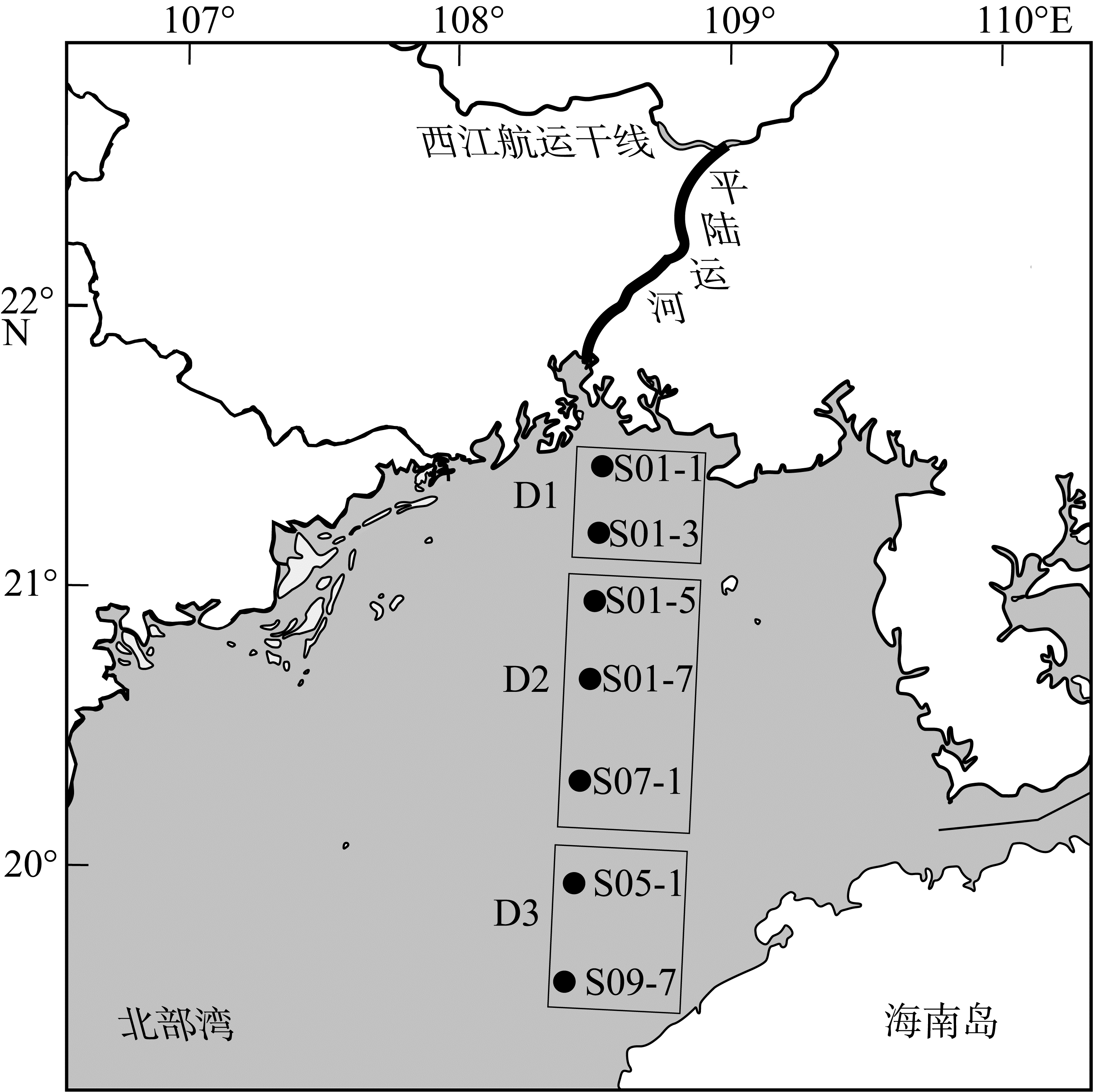
Fig. 1
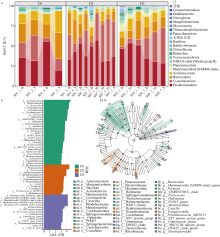
Fig. 2
Relative abundance distribution of major bacterial phyla (a) and LEfSe analysis (b) in different regions"
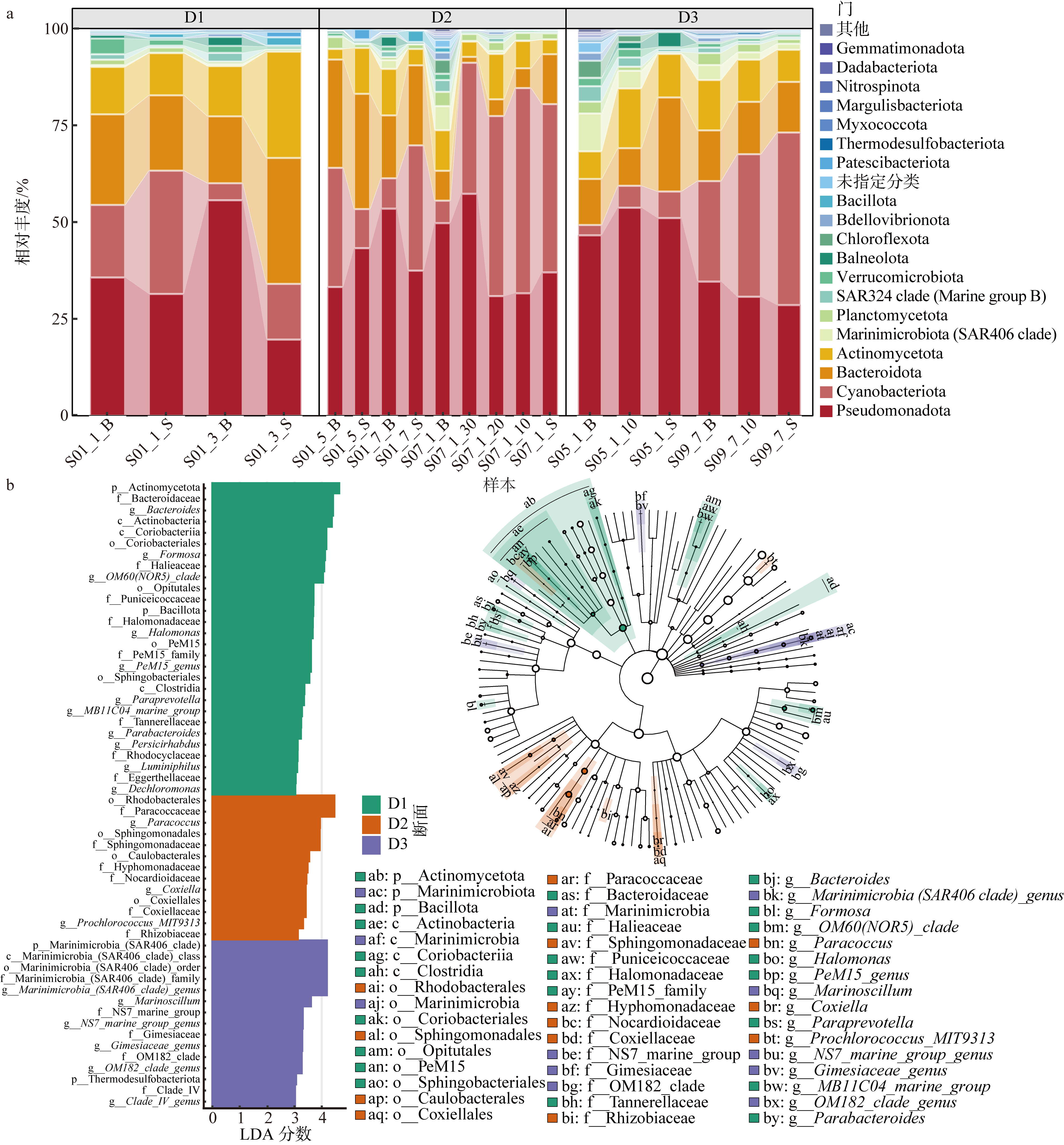
Fig. 2
Fig. 3
Characteristics of spatial variation of α-diversity (a) and β-diversity (b) in different regions"
Fig. 3
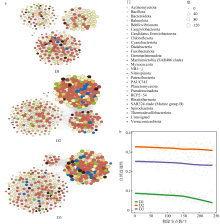
Fig. 4
Bacterioplankton co-occurrence network (a) and community stability (b) in different regions"

Fig. 4
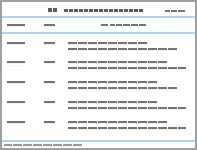
Tab. 1
Topological parameters of bacterioplankton co-occurrence networks in different regions"
| 区域 | 节点数 | 边数 | 平均度 | 平均路径长度 | 平均聚类系数 | 模块化 | 正向相关性/% | 负向相关性/% |
|---|---|---|---|---|---|---|---|---|
| D1 | 291 | 5808 | 39.9 | 3.8 | 0.8 | 0.8 | 85.6 | 14.4 |
| D2 | 362 | 14223 | 78.6 | 2.3 | 0.8 | 0.4 | 97.9 | 2.2 |
| D3 | 336 | 10233 | 60.9 | 2.6 | 0.8 | 0.5 | 93.7 | 6.3 |
Tab. 1
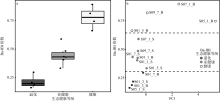
Fig. 5
Ecological health classifications (a) and distributions (b) based on the bacteria-based index of biotic integrity (Ba-IBI)"
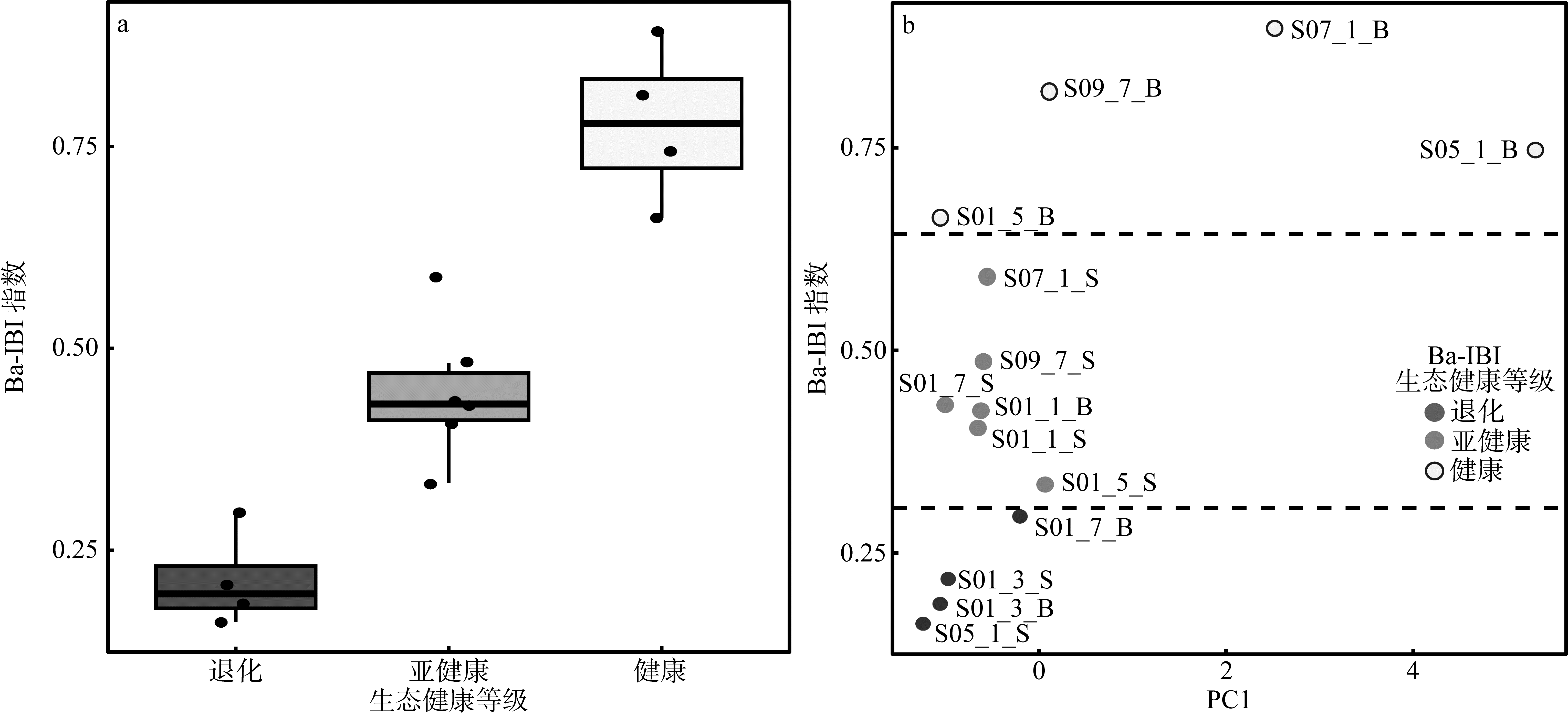
Fig. 5
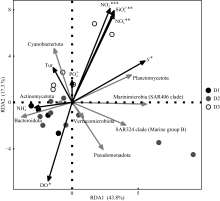
Fig. 6
Correlation analysis between bacterial community composition and environmental factors"
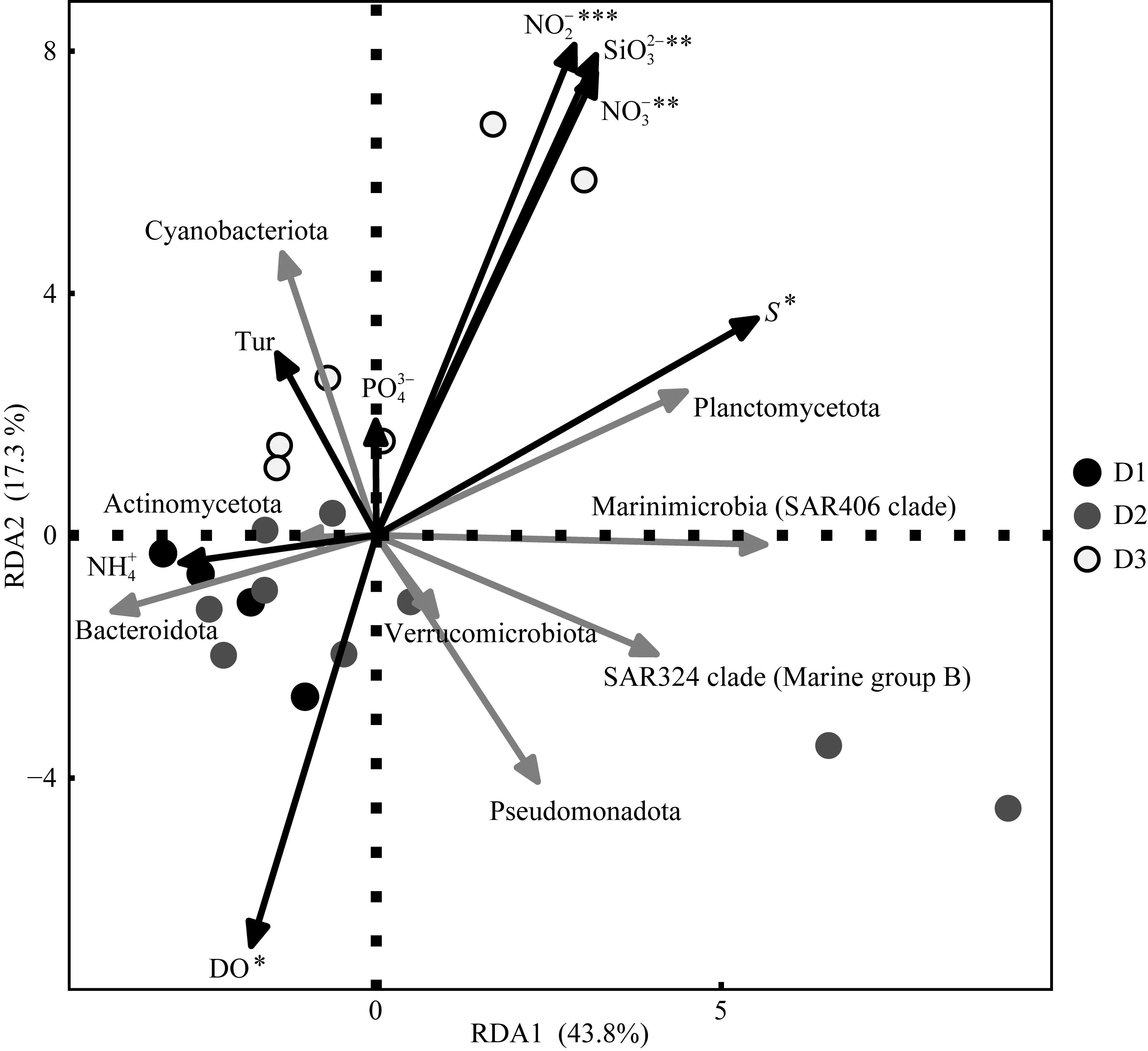
Fig. 6
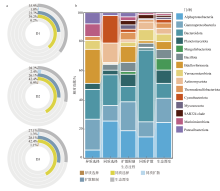
Fig. 7
Analysis of bacterial community assembly processes across different regions (a) and relative contributions of major bacterial phyla to assembly processes (b)"

Fig. 7
| [1] |
邓嘉辉, 王权明, 谢成磊, 2024. 陆海统筹的总氮污染治理研究进展及对策建议[J]. 海洋环境科学, 43(5): 664-671.
|
|
|
|
| [2] |
董俊德, 黄小芳, 龙爱民, 等, 2023. 红树林固氮微生物及其生态功能研究进展[J]. 热带海洋学报, 42(4): 1-11.
|
|
|
|
| [3] |
黄邦钦, 邱勇, 陈纪新, 2019. 海洋生物泵研究的若干新进展与展望[J]. 应用海洋学学报, 38(4): 474-483.
|
|
|
|
| [4] |
廖能健, 赵华显, 杨恕, 等, 2023. 广西北部湾茅尾海夏冬季浮游细菌群落结构及其影响因子[J]. 生态学报, 43(19): 8109-8121.
|
|
|
|
| [5] |
刘可, 王劼耘, 2025. 平陆运河多类型支流汇入口航道治理研究[J]. 水利水运工程学报, 4: 184-192.
|
|
|
|
| [6] |
孙军, 2011. 海洋浮游植物与生物碳汇[J]. 生态学报, 31(18): 5372-5378.
|
|
|
|
| [7] |
王符菁, 林元烧, 曹文清, 等, 2015. 北部湾北部浮游植物群落结构及其与营养盐的关系[J]. 热带海洋学报, 34(6): 73-85.
doi: 10.11978/2014134 |
|
doi: 10.11978/2014134 |
|
| [8] |
姚焕玫, 龚祝清, 钟炜萍, 等, 2021. 广西北部湾海域初级生产力与环境因子相关关系研究[J]. 海洋环境科学, 40(2): 242-249.
|
|
|
|
| [9] |
曾德斌, 彭光煜, 杨斌, 等, 2025. 南海北部钦州湾茅尾海溶解碳水化合物的分布特征及影响因素[J]. 热带海洋学报, 44(3): 197-205.
|
|
|
|
| [10] |
张金尚, 邹定辉, 马玉, 等, 2023. 南海北部水团及中尺度现象对营养盐时空分布的影响[J]. 热带海洋学报, 42(1): 168-181.
doi: 10.11978/2022043 |
|
doi: 10.11978/2022043 |
|
| [11] |
|
| [12] |
pmid: 11077159 |
| [13] |
doi: 10.1038/nmeth.3869 pmid: 27214047 |
| [14] |
|
| [15] |
doi: 10.1146/marine.2024.16.issue-1 |
| [16] |
doi: 10.1038/s41586-023-05760-y |
| [17] |
doi: 10.1126/science.1185198 pmid: 20558706 |
| [18] |
doi: 10.1038/s41586-020-2146-7 |
| [19] |
|
| [20] |
doi: 10.1016/j.tree.2025.06.008 |
| [21] |
doi: 10.1016/j.scitotenv.2023.168659 |
| [22] |
doi: 10.1016/j.marpolbul.2024.116596 |
| [23] |
|
| [24] |
doi: 10.1016/j.scitotenv.2024.172005 |
| [25] |
doi: 10.1038/s41396-020-0723-2 |
| [26] |
doi: 10.1577/1548-8446(1981)006<0021:AOBIUF>2.0.CO;2 |
| [27] |
doi: 10.1038/nrmicro.2018.9 pmid: 29398704 |
| [28] |
doi: 10.3389/fenvs.2022.900508 |
| [29] |
doi: 10.1016/j.envres.2025.122565 |
| [30] |
doi: 10.1016/j.marpolbul.2020.111742 |
| [31] |
doi: 10.5194/bg-11-481-2014 |
| [32] |
doi: 10.1016/j.jenvman.2020.111382 |
| [33] |
doi: 10.1016/j.scitotenv.2018.05.291 |
| [34] |
doi: 10.1016/j.marpolbul.2020.111064 |
| [35] |
doi: 10.1016/j.jhazmat.2023.132544 |
| [36] |
doi: 10.1016/j.scitotenv.2023.167499 |
| [37] |
doi: 10.1016/j.eiar.2024.107766 |
| [38] |
doi: S1001-0742(20)30085-1 pmid: 32446462 |
| [39] |
doi: 10.1093/femsec/fiaa255 |
| [40] |
doi: 10.1016/j.ese.2024.100451 |
| [41] |
doi: 10.1016/j.marenvres.2023.106311 |
| [42] |
doi: 10.1038/s41467-025-57054-8 |
| [43] |
doi: 10.1016/j.scitotenv.2022.160650 |
| [44] |
doi: 10.1038/s41467-020-18560-z pmid: 32948774 |
| [45] |
doi: 10.1126/sciadv.abc6434 |
| [46] |
doi: 10.1038/s41586-018-0627-8 |
| [47] |
doi: 10.1016/j.jag.2019.101902 |
| [48] |
doi: 10.1016/j.marenvres.2024.106560 |
| [49] |
doi: 10.3389/fmicb.2018.02881 pmid: 30564204 |
| [50] |
|
| [51] |
doi: 10.3389/fmicb.2020.01730 pmid: 33071990 |
| [52] |
doi: 10.1186/s40793-023-00546-1 pmid: 38178261 |
| [53] |
doi: 10.1016/j.marpolbul.2022.114380 |
| [54] |
doi: 10.1002/imt2.32 pmid: 38868720 |
| [55] |
doi: 10.1186/s40168-024-01817-w pmid: 38918820 |
| [56] |
doi: 10.1007/s11430-022-1080-8 |
| [57] |
doi: 10.1186/s40168-024-01816-x pmid: 38797849 |
| [58] |
doi: 10.1016/j.ecolind.2025.113915 |
| [59] |
|
| [60] |
doi: S0025-326X(19)30594-6 pmid: 31426242 |
| [61] |
|
| [62] |
doi: 10.1016/j.ecss.2021.107501 |
| [63] |
doi: 10.1016/j.envres.2021.110934 |
| [1] | LI Xinzheng, DU Xiaoli, XU Yong, ZHANG Yue, WANG Jinbao, SUI Jixing, CHEN Dan. Study on the community characteristics of macrozoobenthos and environmental influencing factors in Maowei Sea, Qinzhou Bay during summer and winter* [J]. Journal of Tropical Oceanography, 2026, 45(4): 15-28. |
| [2] | LI Kaizhi, HUANG Liangmin, YIN Jianqiang, LIAN Xiping, LIU Yuan, TAN Yehui. Review and prospects of zooplankton ecology in the South China Sea [J]. Journal of Tropical Oceanography, 2026, 45(2): 1-15. |
| [3] | JIANG Shoudian, HU Xin, LAN Peixin, YAO Liqin, SHUI Bonian, JI Jianda, HE Maoqiu. Seasonal distribution characteristics and environmental driving factors of bacterial communities in mangrove sediments of Ximen Island, Zhejiang Province [J]. Journal of Tropical Oceanography, 2026, 45(2): 117-128. |
| [4] | LI Nenghui, LYU Zhengwen, CAI Hongyan, LI Hang, ZENG Jun, HE Haiping, ZHU Yuzhen, WU Kefeng, ZHAO Wei, TAN Huaqiang, LUO Hui. Morphological and molecular identification of five Gracilaria species (Gracilariaceae, Rhodophyta) from the Zhanjiang coastal area [J]. Journal of Tropical Oceanography, 2025, 44(6): 74-90. |
| [5] | HE Chen, WANG Jianing, ZHOU Linbin, KE Zhixin, LIU Weiwei, LIU Jiaxing, WANG Junxing, TAN Yehui, CHEN Zhiyun. Comparison of macrobenthic community structure between seagrass beds in Xincungang and Li’angang, Hainan [J]. Journal of Tropical Oceanography, 2025, 44(4): 106-118. |
| [6] | WU Guiqing, LI Ruihua, XIAO Yihao, CHEN Yanlin, LUO Xuan, LIU Xiangquan, ZHU Jiajie, WU Xueping. Analysis of genetic diversity in 9 populations of Sinonovacula constricta using microsatellite markers [J]. Journal of Tropical Oceanography, 2025, 44(2): 124-136. |
| [7] | HUANG Hongwei, ZHANG Zhixin, ZHONG Jia, LIN Qiang, GUO Baoying, YAN Xiaojun. The genetic structure and connectivity of eight fish species in the Indo-Pacific Convergence Region [J]. Journal of Tropical Oceanography, 2025, 44(1): 9-23. |
| [8] | HUANG Qinyu, LYU Lina, LI Jie, JU Huimin, SU Hongfei. Microbial diversity of potential EHMC-degrading bacteria from coral [J]. Journal of Tropical Oceanography, 2025, 44(1): 133-145. |
| [9] | HUANG Wen, FENG Yi, LI Ming, WU Qian, LUO Yanqiu, CHEN Yinmin, WANG Lirong, YU Kefu. A review on the population genetics of scleractinian corals [J]. Journal of Tropical Oceanography, 2024, 43(6): 13-26. |
| [10] | JIANG Rouyun, JIAN Lili, SHI Songbiao, TIAN Xinpeng. Diversity of culturable bacteria in the sedimentary sands of the Meiji Reef [J]. Journal of Tropical Oceanography, 2024, 43(6): 170-180. |
| [11] | XIE Hongyu, LIU Yong, LI Chunhou, ZHAO Jinfa, SUN Jinhui, SHEN Jianzhong, SHI Juan, WANG Teng. Species composition and evolutionary characteristics of coral reef fish in the Langhua Reef, Xisha Islands [J]. Journal of Tropical Oceanography, 2024, 43(6): 114-128. |
| [12] | WANG Qing, REN Hui, KE Zhixin. Community structure of meso- and micro-zooplankton in the mariculture area in the Nan’ao Island, Guangdong Province [J]. Journal of Tropical Oceanography, 2024, 43(6): 92-103. |
| [13] | ZHANG Jing, LING Juan, SHI Songbiao, WEI Zhangliang, FAN Like. Diversity of culturable bacteria in different water layers in the upwelling area of eastern Guangdong [J]. Journal of Tropical Oceanography, 2024, 43(6): 80-91. |
| [14] | RAO Yiyong, ZHAO Meirong, KUANG Zexing, HUANG Honghui, TAN Erhui. Influence of raft-string oyster culture on the functional structure of macrobenthic communities: a case study in the Dapeng Cove* [J]. Journal of Tropical Oceanography, 2024, 43(5): 69-83. |
| [15] | LIU Weiwei, WEN Shaowei, TAN Yehui. Progress in studies on diversity and ecological role of ciliates in mariculture [J]. Journal of Tropical Oceanography, 2024, 43(4): 1-19. |
|
||