

Journal of Tropical Oceanography ›› 2025, Vol. 44 ›› Issue (6): 108-119.doi: 10.11978/2025031CSTR: 32234.14.2025031
Previous Articles Next Articles
Denitrifying microbial activity and community characteristics in coastal lagoons of South China
RONG Qing1( ), XIAN Hanbiao2, DONG Xuhui2, YE Fei1, WU Jiapeng1, WANG Yu1(), LI Jiahui3, HONG Yiguo1
- 1
Institute of Environmental Research at Greater Bay Area ,Guangzhou University
2School of Geography and Remote Sensing ,Guangzhou University
3PLA Army Academy of Special Operations
-
Received:2025-02-25Revised:2025-04-03Online:2025-11-10Published:2025-12-03 -
Contact:WANG Yu. email: wangyu@gzhu.edu.cn -
Supported by:National Natural Science Foundation of China(42476144); General Program of Guangdong Basic and Applied Basic Research Foundation(2023A1515011747); General Program of Guangdong Basic and Applied Basic Research Foundation(2025A1515010828)

CLC Number:
- P744.2
Cite this article
RONG Qing, XIAN Hanbiao, DONG Xuhui, YE Fei, WU Jiapeng, WANG Yu, LI Jiahui, HONG Yiguo. Denitrifying microbial activity and community characteristics in coastal lagoons of South China[J].Journal of Tropical Oceanography, 2025, 44(6): 108-119.
share this article
Add to citation manager EndNote|Reference Manager|ProCite|BibTeX|RefWorks
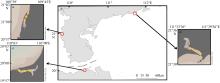
Fig. 1
Distribution of three lagoons and sampling sites. (a) Jianghong (JH); (b) The relative positions of the sampling points; (c) Dongshui (DS); (d) Nanshanhai (NSH)"

Fig. 1
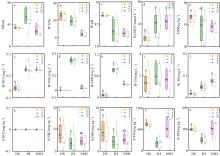
Fig. 2
Physicochemical parameters of the three lagoons. (a) Secchi depth; (b) water salinity; (c) water pH; (d) dissolution of N2O in water; (e) sediment organic matter; (f) nitrate nitrogen concentration in water; (g) ammonia nitrogen concentration in water; (h) inorganic nitrogen concentration in water; (i) total nitrogen concentration in water; (j) total phosphorus concentration in water; (k) nitrate nitrogen concentration in sediments; (l) ammonia nitrogen concentration in sediments; (m) inorganic nitrogen concentration in sediments; (n) total nitrogen concentration in sediments; (o) total phosphorus concentration in sediments"

Fig. 2
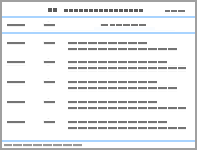
Tab. 1
Spearman correlation analysis between the distance from each lagoon to the estuary and the physical and chemical parameters"
| 潟湖 | 理化参数 | |||||||||||
|---|---|---|---|---|---|---|---|---|---|---|---|---|
| S | SD | T | pH | W-$\text{NO}_{3}^{-}$ | W-$\text{NH}_{4}^{+}$ | W-DIN | W-TN | S-$\text{NH}_{4}^{+}$ | S-$\text{NO}_{2}^{-}$ | S-DIN | S-TP | |
| DS | -1.000** | / | 1.000** | -1.000** | -0.767* | / | 0.843** | -0.949** | 0.369 | 0.847** | 0.369 | -0.525 |
| JH | -0.500 | -1.000** | 1.000** | -1.000** | -0.685* | 0.738* | 0.738* | -0.791* | 0.474 | -0.791* | 0.474 | -0.482 |
| NSH | -1.000** | -1.000** | -0.429 | -1.000** | 0.201 | -0.891* | 0.497 | 0.891* | -0.754* | -0.088 | -0.715* | 0.717* |
| 所有潟湖 | -0.369 | -0.370 | 0.158 | -0.527** | 0.407* | 0.069 | 0.350 | -0.476* | -0.070 | -0.166 | -0.035 | 0.082 |
Tab. 1
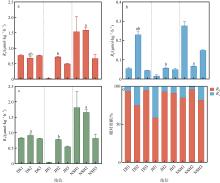
Fig. 3
Comparison of denitrification and anammox nitrogen removal rates in the three lagoons. (a) Denitrification rate; (b) anammox rate; (c) nitrogen removal rate dominated by denitrification and anammox rates; (d) relative contributions of denitrification and anammox rates to denitrification removal rate"

Fig. 3
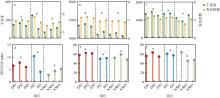
Fig. 4
Alpha diversity indices and gene abundance in the three lagoons. (a) nirK richness and Shannon index at each site; (b) nirS richness and Shannon index at each site; (c) nosZ richness and Shannon index at each site; (d) nirK gene abundance at each site; (e) nirS gene abundance at each site; (f) nosZ gene abundance at each site"

Fig. 4
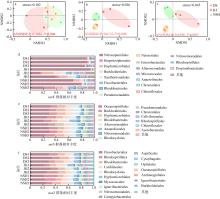
Fig. 5
NMDS analysis based on OTU level and community composition at order level in the three lagoons.(a-c) NMDS analysis of .nirK, nirS and nosZ based on OTU classification level; (d-f) NMDS analysis of.nirK, nirS and nosZ based on order classification level"

Fig. 5
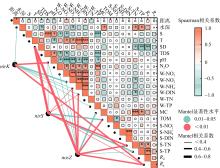
Fig. 6
Mantel test of three functional gene community composition and environmental factors in the three lagoons"

Fig. 6
| [1] |
关凤杰, 洪义国, 吴佳鹏, 等, 2017. 发展一种小体系连续快速测定海洋水体溶解性铵盐的方法[J]. 生态科学, 36(2): 42-48.
|
|
|
|
| [2] |
韩磊, 胡盎, 任明磊, 等, 2023. 湖泊微生物群落及其介导的碳循环过程[J]. 生命科学, 35(12): 1613-1629.
|
|
|
|
| [3] |
洪义国, 张宝善, 吴佳鹏, 等, 2025. 河口近海N2O的分布特征及微生物代谢驱动机制[J]. 热带海洋学报: 1-13.
|
|
|
|
| [4] |
王雅君, 张司一, 欧素英, 等, 2025. 基于短时调和分析的广东惠州双月湾潟湖体系潮汐动力特征分析[J]. 热带海洋学报, 44(1): 93-107.
|
|
|
|
| [5] |
邢容容, 刘修锦, 邱若峰, 2019. 七里海潟湖湿地近期演变分析及生态修复研究[J]. 海洋开发与管理, 36(11): 64-68.
|
|
|
|
| [6] |
杨柳燕, 赵兴青, 肖琳, 等, 2006. 沉积物总氮、总磷联合测定分析方法: CN1869656[P]. 2006-11-29 (in Chinese).
|
| [7] |
杨文焕, 石大钧, 张元, 等, 2020. 高原湖泊沉积物中反硝化微生物的群落特征: 以包头南海湖为例[J]. 中国环境科学, 40(1): 431-438.
|
|
|
|
| [8] |
张奕璞, 于硕, 黄大吉, 等, 2022. 海南新村潟湖潮汐、潮流特征及其对营养盐的影响[J]. 海洋学研究, 40(2): 69-82.
|
|
|
|
| [9] |
赵锋, 许海, 詹旭, 等, 2021. 太湖春夏两季反硝化与厌氧氨氧化速率的空间差异及其影响因素[J]. 环境科学, 42(5): 2296-2302.
|
|
|
|
| [10] |
周茜, 彭秋萧, 张才巧, 等, 2021. 贵州草海沉积物中养分的空间分布与评价[J]. 西南大学学报(自然科学版), 43(11): 33-39.
|
|
|
|
| [11] |
doi: 10.1007/s00284-024-04032-w |
| [12] |
doi: 10.1016/j.margeo.2014.06.005 |
| [13] |
doi: 10.1038/s41396-018-0190-1 |
| [14] |
doi: 10.1016/j.scitotenv.2024.177057 |
| [15] |
doi: 10.1016/j.scitotenv.2022.157516 |
| [16] |
doi: 10.1186/s12864-020-06971-7 pmid: 32819293 |
| [17] |
doi: 10.1016/j.tim.2017.07.003 |
| [18] |
doi: 10.1016/j.marpolbul.2024.116181 |
| [19] |
doi: 10.1002/advs.v12.8 |
| [20] |
doi: 10.1016/j.ocemod.2024.102388 |
| [21] |
doi: S0304-3894(19)30278-X pmid: 30856440 |
| [22] |
doi: 10.1016/j.watres.2024.121565 |
| [23] |
|
| [24] |
doi: 10.1038/ncomms15416 pmid: 28561030 |
| [25] |
doi: 10.1016/j.soilbio.2024.109553 |
| [26] |
doi: 10.1016/j.scitotenv.2023.167732 |
| [27] |
|
| [28] |
doi: 10.1016/j.ecss.2008.01.003 |
| [29] |
doi: 10.1016/j.scitotenv.2024.176694 |
| [30] |
|
| [31] |
doi: 10.1021/es071173s |
| [32] |
doi: 10.1016/j.biortech.2024.132013 |
| [33] |
|
| [34] |
doi: 10.1016/j.pocean.2015.04.020 |
| [35] |
doi: 10.1007/s00792-023-01310-6 pmid: 37668803 |
| [36] |
doi: S0269-7491(18)34216-7 pmid: 31284208 |
| [37] |
doi: 10.1016/j.marpolbul.2024.117498 |
| [38] |
doi: 10.1038/s41467-020-16236-2 pmid: 32424260 |
| [39] |
doi: 10.1016/j.apsoil.2021.104001 |
| [1] | TIAN Mi, ZHONG Cairong, LYU Xiaobo, FANG Zanshan, HUANG Danmin. Comparison of mangrove community characteristics in different pond-to-mangrove models in Dongzhaigang [J]. Journal of Tropical Oceanography, 2025, 44(3): 58-65. |
| [2] | MO Danyang, NING Zhiming, YANG Bin, XIA Ronglin, LIU Zhijin. Response of dissimilatory nitrate reduction processes in coral reef sediments of the Weizhou island to temperature changes [J]. Journal of Tropical Oceanography, 2024, 43(4): 137-143. |
| [3] | ZHAO Jinfa, LIU Yong, LI Chunhou, WANG Teng, SHI Juan, XIAO Yayuan, WU Peng, SONG Xiaoyu. Study on species composition and distribution of fish eggs in Yongle Atoll and Dongdao Island by high-throughput sequencing technology [J]. Journal of Tropical Oceanography, 2023, 42(6): 127-136. |
| [4] | YANG Hongqiang, TAN Fei, XU Huilong, ZHANG Xiyang, SHI Qi, TAO Shichen. Reconstruction of the tropical cyclones activity in the Nansha Islands since the Little Ice Age from the atoll lagoon sediments [J]. Journal of Tropical Oceanography, 2022, 41(6): 171-182. |
| [5] | CONG Xin, KUANG Cuiping, WU Yunlong, XIA Zilong. Study of the erosion and deposition in a sandbar-lagoon system influenced by submerged vegetation under erosion wave conditions [J]. Journal of Tropical Oceanography, 2022, 41(4): 31-37. |
| [6] | LIU Wei, GUO Haipeng, DONG Pengsheng, YAN Mengchen, ZHANG Demin. Draft genome sequence and comparative genome analysis of Alliroseovarius sp. Z3 [J]. Journal of Tropical Oceanography, 2022, 41(1): 52-61. |
| [7] | ZHENG Jinhai, SHI Jian, CHEN Songgui. Recent research advances on multi-scale coastal wave and current characteristics of coral reefs and islands [J]. Journal of Tropical Oceanography, 2021, 40(3): 44-56. |
| [8] | HAN Yu,ZHANG Gui-ling,ZHAO Yu-chuan. Distribution and fluxes of methane in tropical rivers and lagoons of eastern Hainan [J]. Journal of Tropical Oceanography, 2012, 31(2): 87-95. |
|
||