

Journal of Tropical Oceanography ›› 2026, Vol. 45 ›› Issue (4): 217-229.doi: 10.11978/2025067CSTR: 32234.14.2025067
The role of multi-hormone synergistic regulation in the resistance of Kandelia obovata to transplant stress
GONG Shouji1( ), XIE Xiaokui2,3, WANG Riming2,3(), LI Xiujian3, LING Longyan1, ZHENG Jian1
- 1
College of Food Engineering ,Beibu Gulf University
2Guangxi Key Laboratory of Marine Environmental Disaster Processes and Ecological Protection Technology ,Beibu Gulf University
3College of Resources and Environment ,Beibu Gulf University
-
Received:2025-05-20Revised:2025-06-24Online:2026-07-10Published:2026-07-31 -
Contact:WANG Riming. email: wangriming@bbgu.edu.cn -
Supported by:National Natural Science Foundation of China(42366009); Municipal-level Financial Science and Technology Development Projects of Qinzhou City(20223623); Municipal-level Financial Science and Technology Development Projects of Qinzhou City(20233204)

CLC Number:
- P735
Cite this article
GONG Shouji, XIE Xiaokui, WANG Riming, LI Xiujian, LING Longyan, ZHENG Jian. The role of multi-hormone synergistic regulation in the resistance of Kandelia obovata to transplant stress[J].Journal of Tropical Oceanography, 2026, 45(4): 217-229.
share this article
Add to citation manager EndNote|Reference Manager|ProCite|BibTeX|RefWorks
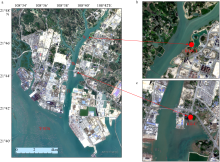
Fig. 1
Map of sampling locations"

Fig. 1
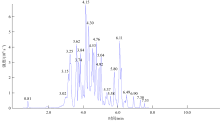
Fig. 2
Total ion chromatogram (TIC) of hormones by LC-MS/MS"
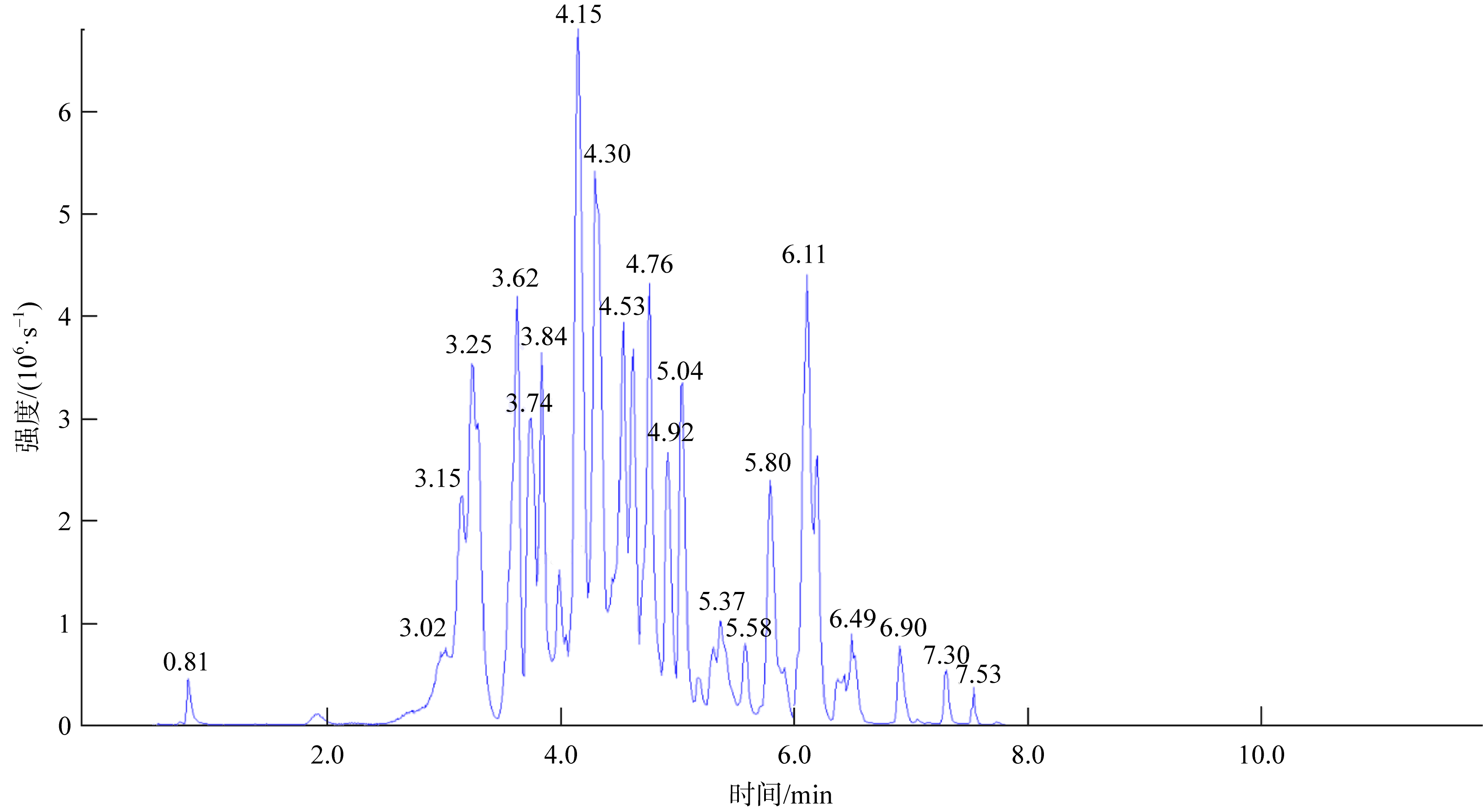
Fig. 2
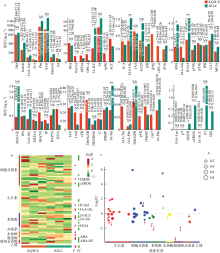
Fig. 3
Dynamic changes of hormones in the roots of Kandelia obovata between two groups. (a) Hormone concentration bar chart (NS: no significant difference, * P<0.05, ** P<0.01); (b) sample-hormone content heatmap (red rectangles on the right indicate P< 0.05, green rectangles indicate |log2FC|≥1); (c) hormone fold change scatter plot (arrows indicate significantly different hormones)"
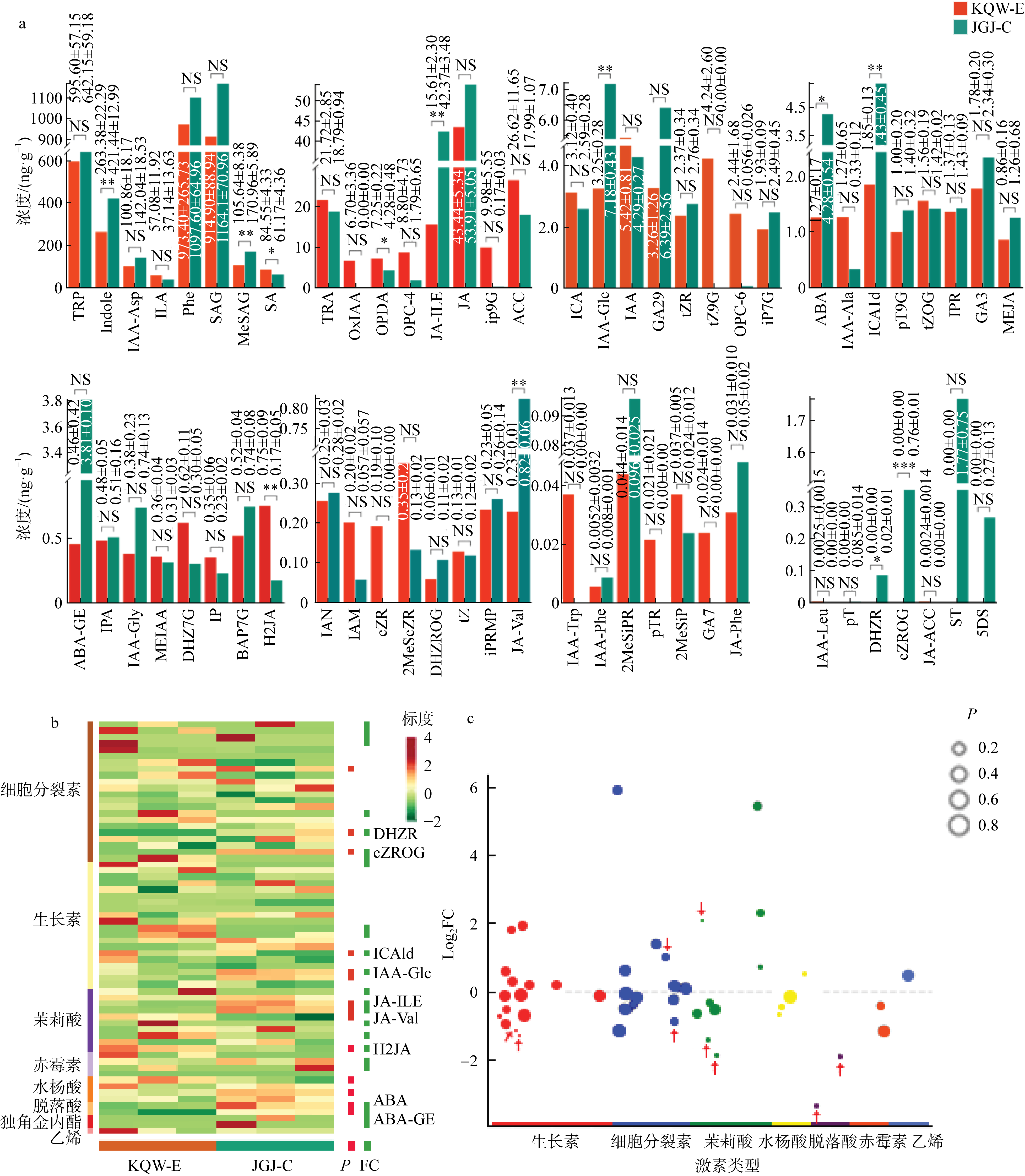
Fig. 3

Tab. 1
Results of differential hormone screening"
| 指标 | 化合物 | 激素类别 | P-value | FC | 类型 |
|---|---|---|---|---|---|
| ABA | 脱落酸(abscisic acid) | ABA | 0.030 | 0.32 | 下调 |
| ABA-GE | ABA-glucosyl ester 脱落酸葡萄糖酯 | ABA | 0.014 | 0.11 | 下调 |
| IAA-Glc | 1-O-indol-3-ylacetylglucose 1-O-吲哚-3-基乙酰基葡萄糖 | auxin | 0.007 | 0.45 | 下调 |
| ICAld | indole-3-carboxaldehyde 吲哚-3-甲醛 | auxin | 0.007 | 0.41 | 下调 |
| IAA-Trp | indole-3-acetyl-L-tryptophan 吲哚乙酸-色氨酸 | auxin | 0.105 | Inf | 上调 |
| OxIAA | 2-oxindole-3-acetic acid 氧化吲哚乙酸 | auxin | 0.184 | Inf | 上调 |
| DHZR | dihydrozeatin ribonucleoside 双氢玉米素核苷 | CK | 0.030 | 0 | 下调 |
| cZROG | cis-zeatin-O-glucoside riboside 顺式玉米核苷-O-糖苷 | CK | 1.2e-4 | 0 | 下调 |
| iP9G | N6-isopentenyl-adenine-9-glucoside 异戊烯腺嘌呤-9-葡糖苷 | CK | 0.219 | 59.32 | 上调 |
| cZR | cis-zeatin riboside 顺式-玉米素-D-核糖甙 | CK | 0.210 | Inf | 上调 |
| tZ9G | trans-zeatin-9-glucoside 反式玉米素-9-糖苷 | CK | 0.244 | Inf | 上调 |
| H2JA | dihydrojasmonic acid 二氢茉莉酸 | JA | 0.009 | 4.35 | 上调 |
| OPC-6 | 3-oxo-2-(2-(Z)-pentenyl)cyclopentane-1-hexanoic acid 氧化戊烯基环戊烷己酸 | JA | 0.293 | 43.18 | 上调 |
| JA-ILE | jasmonoyl-L-isoleucine 茉莉酸-异亮氨酸 | JA | 0.004 | 0.36 | 下调 |
| JA-Val | N-[(-)-jasmonoyl]-(L)-valine 茉莉酸-缬氨酸 | JA | 0.008 | 0.27 | 下调 |
Tab. 1
Tab. 2
Analysis of KEGG annotation of significantly different metabolites"
| 代谢名称 | Ko 编号 | KEGG注释差异显著代谢物个数 | 通路中检测到代谢物个数 | KEGG 通路名称 |
|---|---|---|---|---|
| 氨基酸代谢 | ko00260 | 0 | 1 | glycine, serine and threonine metabolism 甘氨酸、丝氨酸和苏氨酸代谢 |
| ko00360 | 0 | 1 | phenylalanine metabolism 苯丙氨酸代谢 | |
| ko00380 | 2 | 5 | tryptophan metabolism 色氨酸代谢 | |
| 玉米素代谢 | ko00908 | 0 | 5 | zeatin biosynthesis 玉米素生物合成 |
| 萜类及类二烯代谢 | ko00904 | 1 | 2 | diterpenoid biosynthesis 双萜生物合成 |
| ko00906 | 2 | 2 | carotenoid biosynthesis 类胡萝卜素生物合成 | |
| 次级代谢物综合路径 | ko01110 | 2 | 7 | biosynthesis of secondary metabolites 次级代谢产物的生物合成 |
| 植物激素转导 | ko04075 | 2 | 3 | plant hormone signal transduction 植物激素信号转导 |
Tab. 2
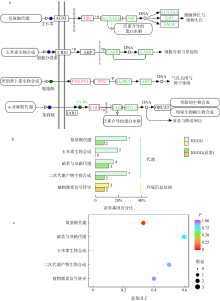
Fig. 4
KEGG signaling pathway diagram of metabolites. (a) Schematic diagram of metabolic pathways; (b) hierarchical bar chart of metabolic pathway enrichment; (c) KEGG enrichment bubble plot. In Fig. 4a, blue dots represent metabolites that may be up-regulated or down-regulated, green dots indicate significantly down-regulated metabolites in the experimental group; hormones in red font indicate inhibitory effects, while hormones in green font indicate promoting effects; in Fig. 4b, the y-axis represents the names of KEGG metabolic pathways, and the numbers indicate the count of metabolites"

Fig. 4
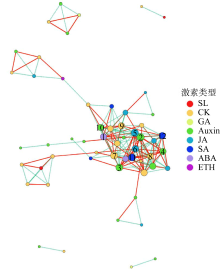
Fig. 5
Schematic diagram of metabolite spatial interactions. Node size represents the connectivity of the substance (i.e., the number of other metabolites significantly correlated with it); larger nodes denote higher connectivity. Solid red lines represent positive correlations, while dashed green lines represent negative correlations. Numbers in the figure represent the corresponding hormones: 1. ABA-GE; 2. IAA-Glc; 3. indole; 4. ICAld; 5.JA-ILE; 6. JA-Val; 7. DHZ7G; 8. DHZR; 9. iP9G; 10. OxIAA; 11. MeSAG; 12. SA"
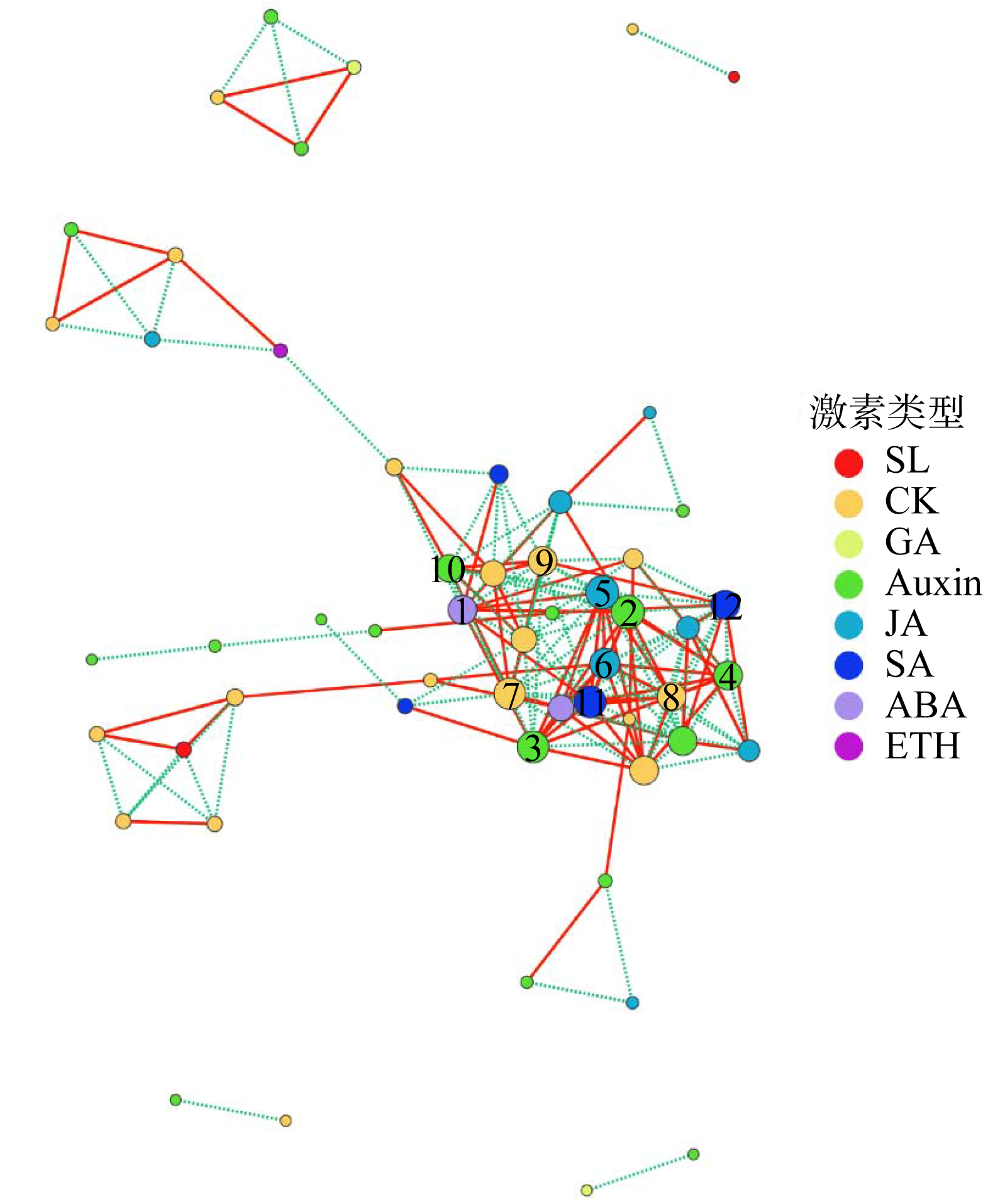
Fig. 5
| [1] |
岳丹斐, 张慧玉, 刘伟成, 等, 2024. 低温胁迫下褪黑素对秋茄幼苗光合效率、碳同化以及激素的调控作用[J]. 生态学杂志, 43(8): 2395-2402.
|
|
|
|
| [2] |
张慧玉, 岳丹斐, 潘晓娇, 等, 2023. 5-羟色胺在红树植物秋茄幼苗抗寒中的作用[J]. 应用生态学报, 34(5): 1263-1271.
doi: 10.13287/j.1001-9332.202305.013 |
|
|
|
| [3] |
赵昊阳, 2024. 自然低温下木榄苗光合和激素对模拟潮汐的动态响应[D]. 南宁: 广西大学.
|
|
|
|
| [4] |
doi: 10.1111/tpj.15124 pmid: 33617121 |
| [5] |
doi: 10.1016/j.molp.2020.09.023 pmid: 32992028 |
| [6] |
doi: 10.3390/ijms241310863 |
| [7] |
|
| [8] |
doi: 10.1093/jxb/erac384 |
| [9] |
doi: 10.1111/nph.18887 pmid: 36941219 |
| [10] |
doi: 10.1371/journal.pone.0177381 |
| [11] |
|
| [12] |
doi: 10.3390/atmos14081195 |
| [13] |
doi: 10.1890/02-655 |
| [14] |
doi: 10.1016/j.molp.2022.06.005 pmid: 35689389 |
| [15] |
doi: 10.1111/tpj.2014.78.issue-2 |
| [16] |
doi: 10.1073/pnas.95.12.7197 pmid: 9618562 |
| [17] |
doi: 10.1111/pce.v45.6 |
| [18] |
doi: 10.1016/j.plantsci.2016.03.014 pmid: 27095406 |
| [19] |
doi: 10.1016/j.ijbiomac.2023.126472 |
| [20] |
doi: 10.3390/ijms242417312 |
| [21] |
doi: 10.1186/s12870-024-05204-3 pmid: 38822275 |
| [22] |
doi: 10.1093/nar/gkaa970 |
| [23] |
doi: 10.1007/s00299-013-1460-z pmid: 23715739 |
| [24] |
doi: 10.1016/j.biortech.2021.125118 |
| [25] |
doi: 10.1104/pp.77.3.635 pmid: 16664112 |
| [26] |
doi: 10.3390/ijms21082705 |
| [27] |
doi: 10.1111/nph.17477 pmid: 34009665 |
| [28] |
doi: S1674-2052(17)30335-0 pmid: 29162416 |
| [29] |
doi: 10.1016/j.scitotenv.2024.173336 |
| [30] |
doi: 10.1016/j.foodchem.2023.136155 |
| [31] |
doi: 10.1016/j.marpolbul.2023.115598 |
| [32] |
doi: 10.1186/s12870-022-03990-2 pmid: 36529723 |
| [33] |
doi: 10.3390/ijms21010118 |
| [34] |
doi: 10.2488/jwrs.54.68 |
| [35] |
doi: 10.1126/sciadv.abd4113 |
| [36] |
doi: 10.1111/plb.13252 pmid: 33710751 |
| [37] |
doi: 10.1111/pbi.14276 pmid: 38193234 |
| [38] |
doi: S0960-9822(18)31004-2 pmid: 30270188 |
| [39] |
doi: 10.1038/s41467-023-39885-5 pmid: 37429856 |
| [40] |
doi: 10.1016/j.envpol.2019.113272 |
| [41] |
doi: 10.1126/science.aaw1720 pmid: 31371615 |
| [42] |
doi: 10.1111/cobi.v38.4 |
| [43] |
doi: 10.1104/pp.18.00293 pmid: 29703867 |
| [44] |
doi: 10.1038/nrm2020 pmid: 16990790 |
| [45] |
doi: 10.1146/annurev-marine-040422-092951 pmid: 35850492 |
| [46] |
doi: 10.3389/fpls.2022.847202 |
| [47] |
doi: 10.3389/fmars.2023.1113278 |
| [48] |
doi: 10.1111/pce.v45.3 |
| [49] |
doi: 10.3389/fpls.2017.00161 pmid: 28265276 |
| [50] |
doi: 10.1111/tpj.17010 pmid: 39222478 |
| [51] |
doi: 10.1038/s41580-022-00479-6 pmid: 35513717 |
| [52] |
doi: 10.1007/s11104-021-05271-7 |
| [53] |
doi: 10.1038/nrg2558 pmid: 19360022 |
| [54] |
|
| [55] |
doi: S0003-2670(18)30675-5 pmid: 30119729 |
| [56] |
doi: 10.1016/j.aquatox.2012.10.011 pmid: 23202134 |
| [57] |
doi: 10.1016/j.scitotenv.2022.160189 |
| [58] |
doi: 10.1126/science.ado0376 pmid: 38452065 |
| [59] |
doi: S1369-5266(14)00106-X pmid: 25104049 |
| [60] |
doi: 10.1105/tpc.18.00766 pmid: 30606780 |
| [61] |
|
| [62] |
doi: 10.1016/j.molp.2022.10.001 |
| [63] |
doi: 10.1111/j.1365-313X.2010.04367.x pmid: 21105924 |
| [64] |
doi: 10.1021/acs.jafc.4c01680 pmid: 38739902 |
| [65] |
doi: 10.1016/j.plaphy.2023.107799 |
| [66] |
doi: S0092-8674(16)31080-7 pmid: 27716505 |
| [1] | LIU Shuai, LIU Xuerui, ZHANG Rui, GUO Xiangrui, YU Zhen, SUN Hao, ZHANG Yanying. Intracellular and extracellular metabolites analysis and key metabolite screening on the Bacillus paranthracis SG49 [J]. Journal of Tropical Oceanography, 2025, 44(1): 122-132. |
| [2] | SUN Wenjie, LI Jiamin, WANG Hualong, MI Tiezhu, ZHEN Yu. Transcriptomic analysis of fatty acid metabolism in the Thalassiosira pseudonana under low salinity stress [J]. Journal of Tropical Oceanography, 2023, 42(5): 92-103. |
| [3] | SU Boyu, ZHANG Weishi, WANG Youshao. Response of antioxidant enzyme systems in root tissues of three mangrove species to waterlogging stress [J]. Journal of Tropical Oceanography, 2022, 41(6): 35-43. |
| [4] | LIU Shuangshuang, YANG Sheng, LIU Xing, CHEN Qiuxia, WANG Jinwang, GUO Jinmin, WANG Jiayu, WANG Wenqing, WU Weizhi, LIANG Licheng, ZHANG Xiaowei. Morphological characteristics of hypocotyls with different fresh weights of Kandelia obovata and their effects on the seedling growth [J]. Journal of Tropical Oceanography, 2022, 41(6): 56-66. |
| [5] | WU Weizhi, ZHAO Zhixia, YANG Sheng, LIANG Licheng, Chen Qiuxia, LU Xiang, LIU Xing, ZHANG Xiaowei. The mangrove forest distribution and analysis of afforestation effect in Zhejiang Province [J]. Journal of Tropical Oceanography, 2022, 41(6): 67-74. |
| [6] | HAO Lulu, KE Mingsi, ZHU Yixiu, XU Yanmin, ZHANG Ying, ZHENG Chunfang. Expression of DEAD-box RNA helicase enzyme genes in Lumnitzera littorea under low temperature stress [J]. Journal of Tropical Oceanography, 2022, 41(6): 44-55. |
| [7] | XIE Yong, WANG Youshao. Physiological response characteristics of four mangrove plants seedlings to heavy metal stress [J]. Journal of Tropical Oceanography, 2022, 41(6): 28-34. |
| [8] | XIN Hongyu, XIE Qiang, WANG Weiqiang. Seasonal variation of East India Coastal Current and its transports of heat and salt [J]. Journal of Tropical Oceanography, 2022, 41(2): 38-51. |
| [9] | LIU Lijie, LIN Lidong. The effect of high temperature on stress physiology of Sargassum fusiforme [J]. Journal of Tropical Oceanography, 2021, 40(2): 74-82. |
| [10] | Xiaolan PAN, Huiru LIU, Meng XU, Hanzhi XU, Hua ZHANG, Maoxian HE. Cloning and expression analysis of aquaporin gene AQP4 cDNA from Pinctada fucata martensii [J]. Journal of Tropical Oceanography, 2020, 39(3): 66-75. |
| [11] | Jianbao LIU, Zhen SUN, Zhenfeng WANG, Anmin HUANG, Xiaoyu ZENG. Cenozoic tectonic stress inversion in the northern South China Sea and its dynamic background [J]. Journal of Tropical Oceanography, 2018, 37(2): 63-71. |
| [12] | Fuxuan WANG, Shu XIAO, Zhiming XIANG, Ziniu YU. Molecular cloning and expression analysis of Commd1 under salinity stress in Crassostrea hongkongensis [J]. Journal of Tropical Oceanography, 2017, 36(1): 48-55. |
| [13] | Yongjun SONG, Danling TANG. Mixed layer depth responses to tropical cyclones Kalmaegi and Fung-Wong in the northeastern South China Sea [J]. Journal of Tropical Oceanography, 2017, 36(1): 15-24. |
| [14] | QI Peng, LI Shasha, CAO Lei. Local factors affecting decadal variability of Luzon Strait transport [J]. Journal of Tropical Oceanography, 2016, 35(4): 1-10. |
| [15] | SHEN Cheng, LIU Chuwu, LIU Li. Heat-induced stress genes Hsp70, Hsp90 and chloroplast psaA and psbA gene expressions of Galaxea astreata endosymbiotic zooxanthella revealing the ability of tolerance and recovery [J]. Journal of Tropical Oceanography, 2016, 35(3): 72-78. |
|
||