

Journal of Tropical Oceanography ›› 2025, Vol. 44 ›› Issue (6): 21-30.doi: 10.11978/2025014CSTR: 32234.14.2025014
Special Issue: 台湾海峡专题
Previous Articles Next Articles
Study on boundary layer characteristics of a persistent sea fog process on the west coast of Taiwan Strait in spring 2021*
DUAN Qing1( ), SUN Wei2, BIAN Yishu3, LIN Qiuhan4, LIN Wen5()
- 1
Fujian Meteorological Information Center
2Kunshan Meteorological Bureau
3Fujian Meteorological Service Center
4Putian Meteorological Office of Fujian Province
5Fujian Institute of Meteorological Sciences
-
Received:2025-01-24Revised:2025-04-14Online:2025-11-10Published:2025-12-03 -
Contact:LIN Wen. email: donnakoon@foxmail.com -
Supported by:National Key Research and Development Program of China(2023YFC3007603); Open Research Fund Project of Fujian Meteorological Bureau(2022K03)

CLC Number:
- P732.2
Cite this article
DUAN Qing, SUN Wei, BIAN Yishu, LIN Qiuhan, LIN Wen. Study on boundary layer characteristics of a persistent sea fog process on the west coast of Taiwan Strait in spring 2021*[J].Journal of Tropical Oceanography, 2025, 44(6): 21-30.
share this article
Add to citation manager EndNote|Reference Manager|ProCite|BibTeX|RefWorks

Tab. 1
Parameters of microwave radiometer and wind profile radar"
| 型号 | 数据类型 | 时间分辨率 | 采样高度 | 垂直分辨率 | |
|---|---|---|---|---|---|
| 微波辐射计 | GRAWRPG-HATPRO-G4 | 综合水汽含量 | 1s | / | 30~50m(0~1200m) 50~250m(1200~10000m) |
| 液态水路径 | |||||
| 气象传感器 | 1.5m | ||||
| 液态水廓线 | 0~10000m | ||||
| 湿度廓线 | 1min | ||||
| 对流层温度廓线 | |||||
| 边界层温度廓线 | 20min | ||||
| 风廓线雷达 | CFL-06 | 水平风向 | 6min | 150~10110m | 120m(150~4110m) 240m(4110~10110m) |
| 水平风速 | |||||
| 垂直风速 |
Tab. 1
Tab. 2
Overview of sea fog process from March 29 to April 4, 2021"
| 海雾出现时段 | 最小能见度出现时间 | 最小能见度/m |
|---|---|---|
| 3月29日23时—3月30日10时 | 3月30日07:09 | 113 |
| 3月30日20时—3月31日02时 | 3月30日22:39 | 170 |
| 3月31日20时—4月1日13时 | 4月1日00:34 | 184 |
| 4月1日18时—4月2日11时 | 4月2日04:03 | 70 |
| 4月2日18时—4月3日10时 | 4月3日07:20 | 943 |
Tab. 2
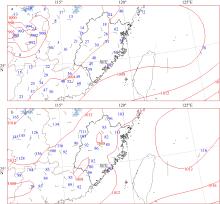
Fig. 1
Sea level pressure field (contour; units: hPa) and surface wind field (wind barb; units: m·s-1) in southeastern China at 20:00 BST on (a) March 29 and (b) April 2, 2021. The red triangle indicates the location of Xiang'an"

Fig. 1
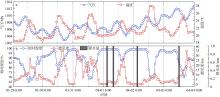
Fig. 2
Time series of (a) pressure and temperature, and (b) relative humidity, visibility, and precipitation at Xiang 'an Station from March 29 to April 3, 2021"

Fig. 2
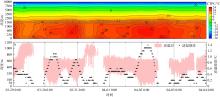
Fig. 3
(a) Vertical composite temperature profiles and (b) inversion layer characteristics (range and intensity) at Xiang'an Station from March 29 to April 3, 2021"

Fig. 3
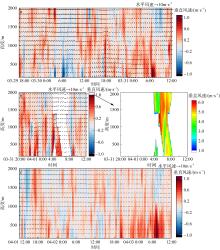
Fig. 4
Wind profiles at Xiang 'an Station during: (a) 18:00 March 29-11:00 March 31; (b) 20:00 March 31-11:00 April 1; (c) 12:00 April 1-11:00 April 3, 2021"

Fig. 4
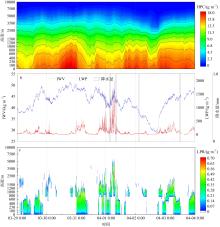
Fig. 5
Time series of (a) vertical profiles of absolute humidity, (b) integrated water vapor content, liquid water path and precipitation, and (c) liquid water profiles at Xiang’an Station from March 29 to April 3, 2021"

Fig. 5
| [1] |
樊旭, 毛文茜, 吴肖燕, 等, 2019. 基于伪逆学习算法的地基微波辐射计反演算法研究[J]. 西南大学学报(自然科学版), 41(1): 114-122.
|
|
|
|
| [2] |
方莎莎, 陆鹏程, 廖可文, 等, 2020. 基于微波辐射计资料对武汉市冬季典型大雾个例的探测分析[J]. 气象与环境科学, 43(4): 81-87.
|
|
|
|
| [3] |
郭丽君, 郭学良, 2016. 北京2009-2013年期间持续性大雾的类型、垂直结构及物理成因[J]. 大气科学, 40(2): 296-310.
|
|
|
|
| [4] |
贺丽媛, 杨柳, 朱瑶, 等, 2025. 四川盆地霾过程边界层逆温的演化特征及其污染效应[J]. 中国环境科学, 45(1): 11-18.
|
|
|
|
| [5] |
胡晨悦, 丘仲锋, 廖廓, 等, 2023. 福建海雾的CALIOP遥感监测及基于Himawari-8的云下雾光谱特征分析[J]. 热带海洋学报, 42(4): 104-112.
|
|
|
|
| [6] |
花丛, 刘超, 张恒德, 2017. 风廓线雷达资料在北京秋季雾霾天气过程分析中的应用[J]. 气象科技, 45(5): 870-875.
|
|
|
|
| [7] |
黄惠镕, 韩美, 潘宁, 等, 2019. 福建一次春季海雾的边界层特征及其成因分析[J]. 海峡科学 (3): 12-15, 25 (in Chinese).
|
| [8] |
黄建平, 朱诗武, 朱彬, 1998. 辐射雾的大气边界层特征[J]. 南京气象学院学报, 21(2): 258-265.
|
|
|
|
| [9] |
李德俊, 周建山, 柳草, 等, 2009. 恩施大雾天气的雷达风廓线特征[J]. 高原山地气象研究, 29(B09): 120-123 (in Chinese).
|
| [10] |
廖碧婷, 黄俊, 邓雪娇, 等, 2018. 基于微波辐射计分析低能见度的液态含水量特征[J]. 中国环境科学, 38(10): 3673-3682.
|
|
|
|
| [11] |
廖晨菲, 冯志明, 高聪晖, 等, 2022. 福建沿海一次持续性海雾过程的边界层特征分析[J]. 海峡科学 (7): 9-13 (in Chinese).
|
| [12] |
林彤, 桑建人, 姚展予, 等, 2021. 基于微波辐射计的宁夏六盘山西侧大气水汽变化特征[J]. 干旱区地理, 44(4): 923-933.
doi: 10.12118/j.issn.1000–6060.2021.04.05 |
|
doi: 10.12118/j.issn.1000–6060.2021.04.05 |
|
| [13] |
刘亚亚, 毛节泰, 刘钧, 等, 2010. 地基微波辐射计遥感大气廓线的BP神经网络反演方法研究[J]. 高原气象, 29(6): 1514-1523.
|
|
|
|
| [14] |
卢春婷, 张庆奎, 张录军, 等, 2014. 阜阳市雾日气候特征及变化趋势分析[J]. 自然灾害学报, 23(3): 144-151.
|
|
|
|
| [15] |
齐少群, 张菲菲, 万鲁河, 等, 2016. 哈尔滨秋季雾霾期秸秆焚烧区域识别提取研究[J]. 自然灾害学报, 25(4): 152-158.
|
|
|
|
| [16] |
任兆鹏, 李昊倩, 鞠霞, 等, 2020. 青岛地区海雾分布及大气边界层条件分析[J]. 海洋科学, 44(5): 96-106.
|
|
|
|
| [17] |
孙舒悦, 黄彬, 刘龙生, 2023. 2020年海上灾害天气特征分析[J]. 海洋预报, 40(3): 56-65.
|
|
|
|
| [18] |
孙颖, 马艳, 高荣珍, 等, 2018. 山东一次持续性平流辐射雾过程特征及成因分析[J]. 海洋气象学报, 38(4): 128-135.
|
|
|
|
| [19] |
孙奕敏, 1994. 灾害性浓雾[M]. 北京: 气象出版社 (in Chinese).
|
| [20] |
宋建洋, 王志, 李蔼恂, 等, 2022. 雾天高速公路交通安全气象风险模型研究[J]. 自然灾害学报, 31(1): 60-68.
|
|
|
|
| [21] |
王彬华, 1983. 海雾[M]. 北京: 海洋出版社 (in Chinese).
|
| [22] |
王春红, 王清平, 谭艳梅, 等, 2020. 微波辐射计资料在乌鲁木齐机场持续浓雾天气中的试验应用[J]. 气象科技进展, 10(4): 22-27.
|
|
|
|
| [23] |
王鑫, 黄菲, 周发琇, 2006. 黄海沿海夏季海雾形成的气候特征[J]. 海洋学报, 28(1): 26-34.
|
|
|
|
| [24] |
余佳, 2021. 风廓线雷达在辐射雾过程中的应用[J]. 河南科技, 40(24): 19-22.
|
|
|
|
| [25] |
张苏平, 刘飞, 孔扬, 2014. 一次春季黄海海雾和东海层云关系的研究[J]. 海洋与湖沼, 45(2): 341-352.
|
|
|
|
| [26] |
张伟, 李菲, 吕巧谊, 等, 2023. 闽南沿海一次海雾过程的多源资料综合分析[J]. 气象, 49(6): 682-696.
|
|
|
|
| [27] |
郑泽华, 张伟, 陈德花, 2021. 2020年5月5日凌晨福建中南沿海海雾过程特征及成因分析[J]. 海峡科学, 2021(03): 3-10 (in Chinese).
|
| [28] |
doi: 10.1175/1520-0469(1971)028<1183:TRBVAL>2.0.CO;2 |
| [29] |
doi: 10.1007/s00376-007-0065-2 |
| [30] |
doi: 10.1007/s00024-007-0211-x |
| [31] |
|
| [32] |
doi: 10.1007/s11430-014-4924-2 |
| [33] |
doi: 10.1016/j.atmosres.2005.05.003 |
| [34] |
doi: 10.1016/j.atmosenv.2021.118647 |
| [1] | LIAO Kuo, LI Kailin, DANG Haofei, LIN Bin, ZHAO Dongzhi, LI Hui. Process and characteristics of occurrence and dissipation of sea fog in the west coast of the Taiwan Strait based on coastal automatic weather station* [J]. Journal of Tropical Oceanography, 2024, 43(1): 79-93. |
| [2] | WANG Yu, HU Chenyue, QIU Zhongfeng, ZHAO Dongzhi, WU Daomao, LIAO Kuo. Research on the multi-source satellite daytime sea fog detection technology based on cloud characteristics* [J]. Journal of Tropical Oceanography, 2023, 42(6): 15-28. |
| [3] | HU Chenyue, QIU Zhongfeng, LIAO Kuo, ZHAO Dongzhi, WU Daomao. CALIOP remote sensing monitoring of the Fujian sea fog and spectral characteristics analysis of subcloud fog based on Himawari-8 [J]. Journal of Tropical Oceanography, 2023, 42(4): 104-112. |
| [4] | YANG Qi, OU Jian-jun, LI Yong-ping. An objective forecast method for sea fog over the Yangshan Sea [J]. Journal of Tropical Oceanography, 2013, 32(5): 59-64. |
| [5] | YIN Xiao-bin1,WANG Zhen-zhan1,LANG Shu-yan2,ZHENG Pei-nan3. A study on retrieval algorithms in oceanic passive microwave remote sensing using 1.4 GHz and 10.7 GHz bands [J]. Journal of Tropical Oceanography, 2009, 28(5): 18-28. |
|
||