

Journal of Tropical Oceanography ›› 2026, Vol. 45 ›› Issue (4): 15-28.doi: 10.11978/YG2025006CSTR: 32234.14.YG2025006
• Marine Ecology • Previous Articles Next Articles
Study on the community characteristics of macrozoobenthos and environmental influencing factors in Maowei Sea, Qinzhou Bay during summer and winter*
LI Xinzheng1,2,3,4,5( ), DU Xiaoli1(), XU Yong2,3(), ZHANG Yue2,3, WANG Jinbao2, SUI Jixing2,3, CHEN Dan1()
- 1
College of Marine Sciences ,Beibu Gulf University
2Laboratory of Marine Organism Taxonomy & Phylogeny ,Shandong Province Key Laboratory of Marine Biodiversity and Bio-resource Sustainable Utilization, Institute of Oceanology, Chinese Academy of Sciences
3University of Chinese Academy of Sciences
4Laboratory for Marine Biology and Biotechnology ,Qingdao Marine Science and Technology Center
5Pinglu Canal and Beibu Gulf Coastal Ecosystem Observation and Research Station of Guangxi ,Guangxi Key Laboratory of Marine Environmental Disaster Processes and Ecological Protection Technology, Beibu Gulf University
-
Received:2025-08-08Revised:2025-09-02Online:2026-07-10Published:2026-07-31 -
Contact:XU Yong, email: xuyong@qdio.ac.cn;CHEN Dan, email: cd@bbgu.edu.cn -
Supported by:National Key Research and Development Program of China(2022YFF0802202); National Natural Science Foundation of China(42176114); National Natural Science Foundation of China(42576137); Innovation Project of Guangxi Graduate Education(YCSW2025623)

CLC Number:
- P76
Cite this article
LI Xinzheng, DU Xiaoli, XU Yong, ZHANG Yue, WANG Jinbao, SUI Jixing, CHEN Dan. Study on the community characteristics of macrozoobenthos and environmental influencing factors in Maowei Sea, Qinzhou Bay during summer and winter*[J].Journal of Tropical Oceanography, 2026, 45(4): 15-28.
share this article
Add to citation manager EndNote|Reference Manager|ProCite|BibTeX|RefWorks
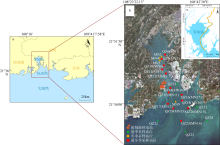
Fig. 1
Study area and sampling stations for macrozoobenthos in Maowei Sea, Qinzhou Bay. (a) Overview of the study area; (b) sampling stations; (c) Pinglu Canal waterway"

Fig. 1
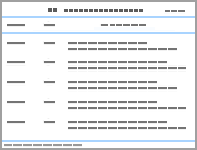
Tab. 1
Species number of different macrozoobenthic groups in the Maowei Sea area"
| 类群 | 冬季 | 夏季 | 夏、冬季 | |||
|---|---|---|---|---|---|---|
| 物种数 | 百分比 | 物种数 | 百分比 | 物种数 | 百分比 | |
| 纽形动物 | 1 | 1.52% | 1 | 0.98% | 1 | 0.75% |
| 多毛类动物 | 36 | 54.55% | 36 | 35.29% | 46 | 34.33% |
| 星虫动物 | 1 | 1.52% | 1 | 0.98% | 2 | 1.49% |
| 软体动物 | 8 | 12.12% | 20 | 19.61% | 27 | 20.15% |
| 甲壳动物 | 14 | 21.21% | 30 | 29.41% | 41 | 30.60% |
| 棘皮动物 | 4 | 6.06% | 5 | 4.90% | 7 | 5.22% |
| 刺胞动物 | — | — | 2 | 1.96% | 2 | 1.49% |
| 鱼类(脊索动物) | 2 | 3.03% | 6 | 5.88% | 7 | 5.22% |
| 其他脊索动物 | — | — | 1 | 0.98% | 1 | 0.75% |
| 合计 | 66 | 102 | 134 | |||
Tab. 1
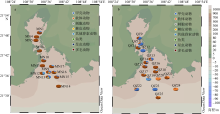
Fig. 2
Proportions and distribution of macrozoobenthic groups in Maowei Sea (a: winter; b: summer)"
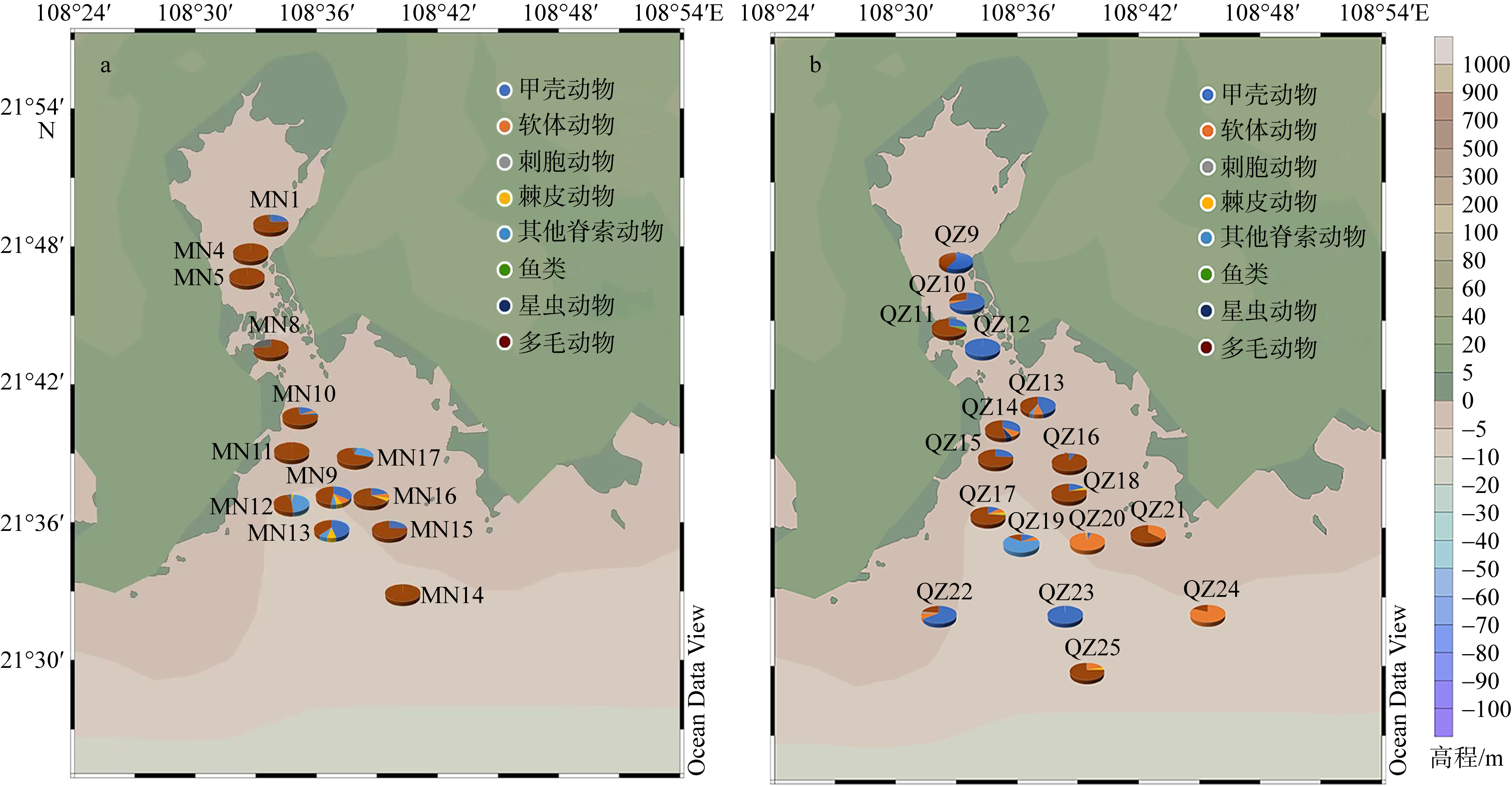
Fig. 2
Tab. 2
Dominant macrozoobenthos and their dominance in Maowei Sea"
| 排名 | 冬季 | 夏季 | ||
|---|---|---|---|---|
| 物种 | 优势度(Y) | 物种 | 优势度(Y) | |
| 1 | 白氏文昌鱼 (Branchiostoma belcheri) | 0.042 | 豆形短眼蟹 (Xenophthalmus pinnotheroides) | 0.045 |
| 2 | 寡鳃微齿吻沙蚕 (Micronephthys oligobranchia) | 0.036 | 寡鳃微齿吻沙蚕 (Micronephthys oligobranchia) | 0.023 |
| 3 | 丝异须虫 (Heteromastus filiformis) | 0.025 | 丝异须虫 (Heteromastus filiformis) | 0.020 |
Tab. 2
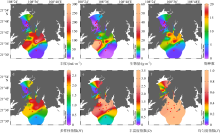
Fig. 3
Distribution of macrozoobenthic community parameters at various stations in Maowei Sea during winter. (a) Abundance (ind.·m−2); (b) biomass (g·m−2); (c) species richness (S); (d) Shannon-Wiener diversity index (H′); (e) Margalef richness index (D); (f) Pielou evenness index (J′)"

Fig. 3
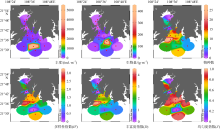
Fig. 4
Distribution of macrozoobenthic community parameters at various stations in Maowei Sea during summer. (a) Abundance (ind.·m−2); (b) biomass (g·m−2); (c) species richness (S); (d) Shannon-Wiener diversity index (H′); (e) Margalef richness index (D); (f) Pielou evenness index (J′)"

Fig. 4
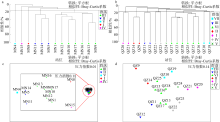
Fig. 5
Clustering (a: winter; b: summer) and non-metric multidimensional scaling (nMDS) (c. winter; d. summer) of the macrozoobenthic community in Maowei Sea"
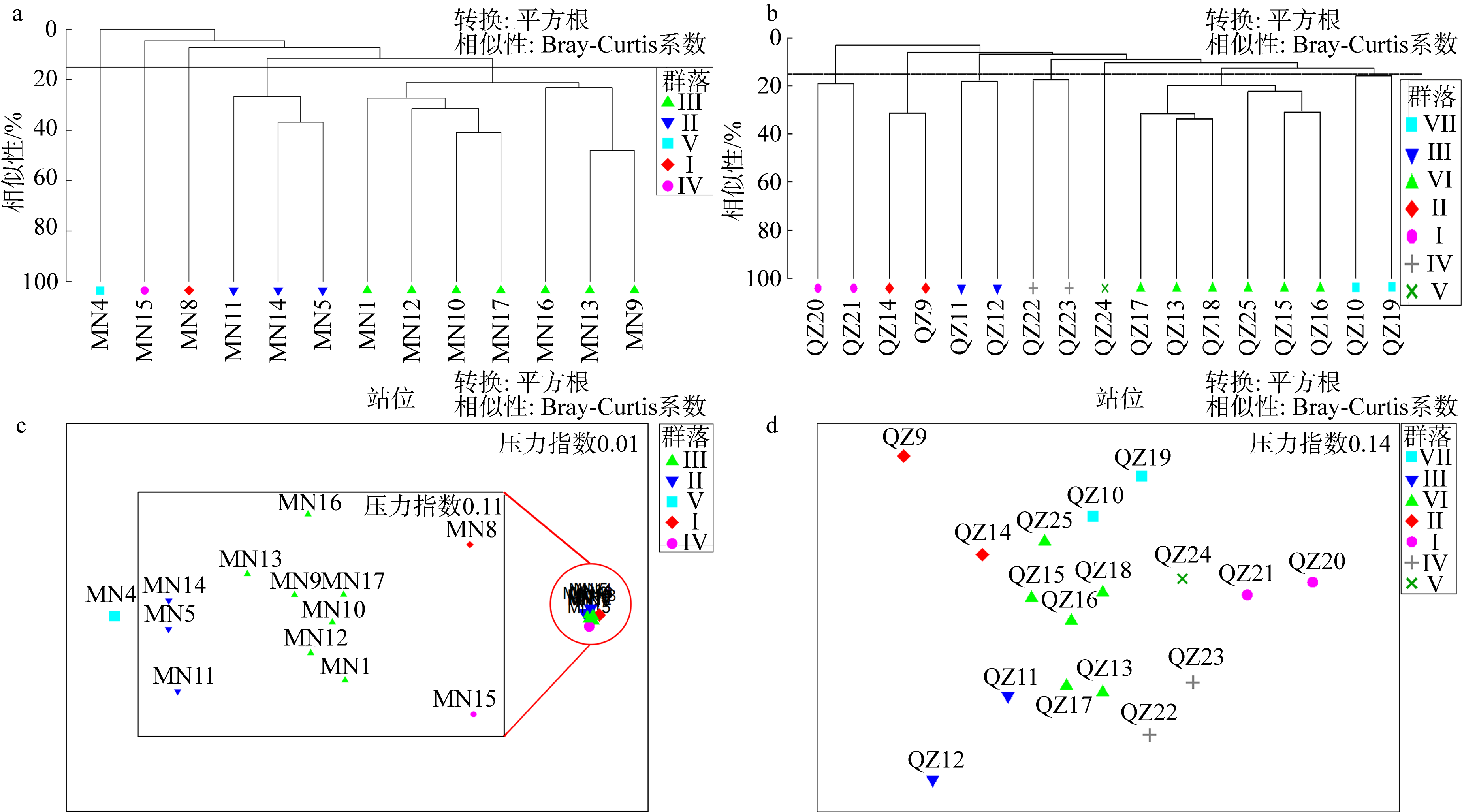
Fig. 5
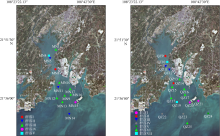
Fig. 6
Distribution of macrozoobenthic communities in Maowei Sea, Qinzhou Bay. (a) Winter; (b) summer"

Fig. 6
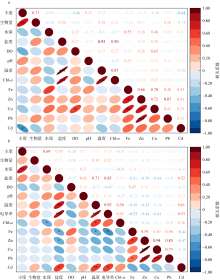
Fig. 7
Pearson correlation between the abundance, biomass of macrozoobenthos and environmental factors in Maowei Sea (a: winter; b: summer)"
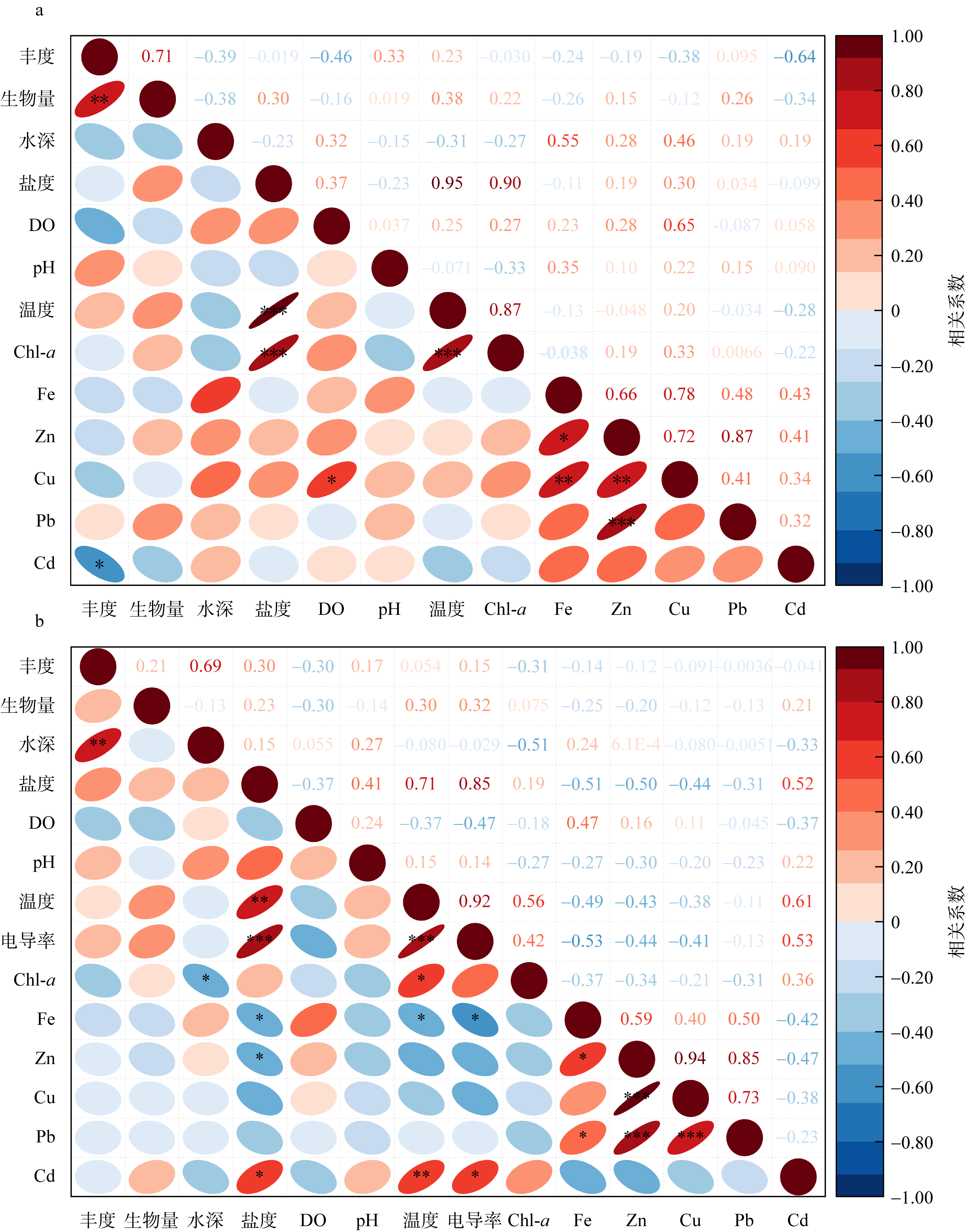
Fig. 7
Tab. 3
Comparison with historical surveys in Qinzhou Bay"
| 调查区域 | 调查年份 | 站位数 | 季节 | 平均丰度/ (ind.·m−2) | 平均生物量/(g·m−2) | 采集方式 | 物种数 | 文献 |
|---|---|---|---|---|---|---|---|---|
| 钦州湾 | 1983—1984 | 7 | 四季 | 310.00 | 619.56 | 拖网采集 | 250余种 | 李树华 等, |
| 钦州湾 | 2008 | 11 | 秋季 | 346.70 | 6.40 | 底泥采集 | 58种 | 王宗兴 等, |
| 钦州湾及附近海域 | 2008—2009 | 12 | 秋季 | 594.00 | 138.88 | 底泥采集 | 94种 | 王迪 等, |
| 冬季 | 858.00 | 192.93 | ||||||
| 春季 | 189.00 | 66.93 | ||||||
| 夏季 | 113.00 | 61.83 | ||||||
| 钦州湾外湾及湾颈处 | 2010 | 12 | 夏季 | 15.09 | 1.76 | 拖网采集 | 148种 | 许铭本 等, |
| 冬季 | 0.10 | 0.41 | ||||||
| 钦州湾外东南近岸 | 2011 | 17 | 夏季 | 50.00 | 105.48 | 拖网采集 | 55种 | 许铭本 等, |
| 钦州湾外东南近岸 | 2011—2012 | 12 | 春季 | 117.92 | 63.93 | 底泥采集 | 31种 | 黄驰 等, |
| 秋季 | 152.50 | 41.20 | 33种 | |||||
| 钦州湾茅尾海 | 2023—2024 | 17 | 冬季 | 97.69 | 11.59 | 底泥采集 | 65种 | 本研究 |
| 18 | 夏季 | 442.06 | 40.57 | 100种 |
Tab. 3
| [1] |
毕洪生, 孙松, 孙道元, 2001. 胶州湾大型底栖生物群落的变化[J]. 海洋与湖沼, 32(2): 132-138.
|
|
|
|
| [2] |
何晨, 王佳宁, 周林滨, 等, 2025. 海南新村港和黎安港海草床大型底栖生物的群落结构比较[J]. 热带海洋学报, 44(4): 106-118.
|
|
|
|
| [3] |
黄驰, 江志坚, 张景平, 等, 2017. 钦州湾春季和秋季大型底栖动物群落结构特征[J]. 渔业研究, 39(4): 272-282.
|
|
|
|
| [4] |
李宝泉, 李新正, 王洪法, 等, 2007. 长江口附近海域大型底栖动物群落特征[J]. 动物学报(1): 76-82.
|
|
|
|
| [5] |
李磊, 2023. 基于典型底栖渔业生物的长江口临近水域(杭州湾)沉积环境综合污染压力研究[D]. 上海: 上海海洋大学.
|
|
|
|
| [6] |
李素霞, 刘海霞, 侯景耀, 等, 2024. 茅尾海悬浮颗粒物中重金属分布特征及其风险评价[J]. 江汉大学学报(自然科学版), 52(4): 88-96.
|
|
|
|
| [7] |
李树华, 黎广钊, 1993. 中国海湾志第十二分册广西海湾[M]. 北京: 海洋出版社 (in Chinese).
|
| [8] |
李新正, 2011. 我国海洋大型底栖生物多样性研究及展望: 以黄海为例[J]. 生物多样性, 19(6): 676-684.
doi: 10.3724/SP.J.1003.2011.09126 |
|
doi: 10.3724/SP.J.1003.2011.09126 |
|
| [9] |
龙颖贤, 檀笑, 韩保新, 等, 2012. 茅尾海营养状况及其来源研究[J]. 生态科学, 31(5): 572-576.
|
|
|
|
| [10] |
彭松耀, 赖子尼, 麦永湛, 2020. 珠江口大型底栖动物群落及沉积物生态毒理效应指示种筛选[J]. 海洋渔业, 42(5): 571-584.
|
|
|
|
| [11] |
沈国英, 黄凌风, 郭丰, 等, 2010. 海洋生态学(第三版)[M]. 北京: 科学出版社 (in Chinese).
|
| [12] |
王迪, 陈丕茂, 马媛, 2011. 钦州湾大型底栖动物生态学研究[J]. 生态学报, 31(16): 4768-4777.
|
|
|
|
| [13] |
王宗兴, 孙丕喜, 姜美洁, 等, 2010. 钦州湾秋季大型底栖动物多样性研究[J]. 广西科学, 17(1): 89-92.
|
|
|
|
| [14] |
许铭本, 姜发军, 赖俊翔, 等, 2014. 钦州湾外湾东北部近岸区域大型底栖动物群落特征[J]. 广西科学, 21(4): 389-395+402.
|
|
|
|
| [15] |
许铭本, 姜发军, 赖俊翔, 等, 2015. 广西钦州湾大型底栖动物生态特征及其与沉积物环境的相关性研究[J]. 海洋技术学报, 34(1): 62-68.
|
|
|
|
| [16] |
徐兆礼, 陈亚瞿, 1989. 东黄海秋季浮游动物优势种聚集强度与鲐鲹渔场的关系[J]. 生态学杂志, 8(4): 13-15+19.
|
|
|
|
| [17] |
杨斌, 冯文慧, 周孝萱, 等, 2025. 茅尾海入海河口区柱状沉积物对磷的吸附行为特征[J]. 渔业科学进展, 46(2): 53-63.
|
|
|
|
| [18] |
曾德斌, 彭光煜, 杨斌, 等, 2025. 南海北部钦州湾茅尾海溶解碳水化合物的分布特征及影响因素[J]. 热带海洋学报, 44(3): 197-205.
|
|
|
|
| [19] |
张悦, 于国旭, 徐勇, 等, 2023. 夏季庙岛群岛大型底栖动物群落特征[J]. 海洋科学, 47(7): 96-110.
|
|
|
|
| [20] |
中华人民共和国国家质量监督检验检疫总局, 中国国家标准化管理委员会, 2007a. GB 17378.4-2007海洋监测规范第4部分: 海水分析[S]. 北京: 中国标准出版社.
|
|
General Administration of Quality Supervision, Inspection and Quarantine of the People's Republic of China, Standardization Administration of the People's Republic of China, The specification for marine monitoring. Part 4: Seawater analysis (GB 17378.4-2007)[S]. Beijing: Standards Press of China (in Chinese).
|
|
| [21] |
中华人民共和国国家质量监督检验检疫总局, 中国国家标准化管理委员会, 2007b. GB 17378.5-2007海洋监测规范第5部分: 沉积物分析[S]. 北京: 中国标准出版社.
|
|
General Administration of Quality Supervision, Inspection and Quarantine of the People's Republic of China, Standardization Administration of the People's Republic of China, 2007b. The specification for marine monitoring-Part 5: Sediment analysis (GB 17378.5- 2007)[S]. Beijing: Standards Press of China (in Chinese).
|
|
| [22] |
中华人民共和国国家质量监督检验检疫总局, 中国国家标准化管理委员会, 2007c. GB/T 12763.6-2007海洋调查规范第 6 部分: 海洋生物调查[S]. 北京: 中国标准出版社.
|
|
General Administration of Quality Supervision, Inspection and Quarantine of the People's Republic of China, Standardization Administration of the People's Republic of China, 2007c. Specifications for oceanographic survey - Part 6: Marine biological survey (GB/T 12763.6-2007)[S]. Beijing: Standards Press of China (in Chinese).
|
|
| [23] |
周红, 张志南, 2003. 大型多元统计软件PRIMER的方法原理及其在底栖群落生态学中的应用[J]. 青岛海洋大学学报(自然科学版), 33(1): 58-64.
|
|
|
|
| [24] |
朱欧娜, 田义超, 2023. 基于Landsat-8 TIRS的防城港核电站温排水分布规律研究[J]. 生态科学, 42(5): 25-30.
|
|
|
|
| [25] |
doi: 10.3389/fmars.2025.1502123 |
| [26] |
|
| [27] |
doi: 10.1016/j.aquatox.2016.06.002 |
| [28] |
doi: 10.1007/s11802-021-4557-y |
| [29] |
doi: 10.1016/j.jhydrol.2022.128576 |
| [30] |
|
| [31] |
doi: 10.3389/fmars.2024.1473104 |
| [32] |
|
| [33] |
pmid: 5964400 |
| [34] |
|
| [35] |
doi: 10.1016/j.ecss.2024.108752 |
| [36] |
doi: 10.1016/j.marpolbul.2025.117908 |
| [37] |
doi: 10.1016/j.scitotenv.2025.179624 |
| [38] |
doi: 10.1016/j.scitotenv.2018.12.192 |
| [1] | LOU Zhifeng, LI Yuchen, YIN Xuehua, SUN Rong, TIAN Chongguo. Distribution characteristics and main sources of nitrate in the waters of Qinzhou Bay* [J]. Journal of Tropical Oceanography, 2026, 45(4): 153-161. |
| [2] | JIA Suxiao, ZHANG Ruirui, WU Xiaoke, QIU Yueshan, LI Qiying, OU Haixu, SUN Guoling, CHANG Taoqi, XU Youhou, CAI Shuanghu. Analysis of bacterial diversity and environmental factors in the Pearl Bay Trachinotus ovatus Linnaeus aquaculture area [J]. Journal of Tropical Oceanography, 2026, 45(4): 63-76. |
| [3] | JIANG Shihao, LIAO Riquan, NIU Donglei, QIAO Zhen, LU Dongliang, TANG Jianhui. The distribution characteristics, compositions and sources of dissolved organic matter (DOM) in Qinzhou Bay [J]. Journal of Tropical Oceanography, 2026, 45(4): 190-202. |
| [4] | JIN Song, ZOU Tao, LIAO Riquan, CHEN Chaohao, MI Huan, TANG Jianhui. Study on the spatial expansion mode of raft aquaculture in Qinzhou Bay since 2000 using remote sensing technology [J]. Journal of Tropical Oceanography, 2026, 45(4): 104-115. |
| [5] | SUN Kangwei, LIAO Riquan, LI Han, WENG Peiyao, TANG Jianhui. Monthly variability of nutrient concentrations and influencing factors in surface seawater of Qinzhou Bay* [J]. Journal of Tropical Oceanography, 2026, 45(4): 162-178. |
| [6] | LI Kaizhi, HUANG Liangmin, YIN Jianqiang, LIAN Xiping, LIU Yuan, TAN Yehui. Review and prospects of zooplankton ecology in the South China Sea [J]. Journal of Tropical Oceanography, 2026, 45(2): 1-15. |
| [7] | FANG Yang, TANG Junyi, LUO Yuchi, YE Kuangmin, DENG Weihua. Impacts of exotic mangrove introduction on ecosystem health and service functions: A case study of three representative regions in Guangdong Province [J]. Journal of Tropical Oceanography, 2026, 45(2): 173-190. |
| [8] | ZHOU Weihua, YAO Yukun, LUO Yong, LI Tao, LONG Aimin, HUANG Hui. Long-term variation of dissolved organic carbon and its influencing factors in Sanya Bay* [J]. Journal of Tropical Oceanography, 2026, 45(2): 106-116. |
| [9] | YU Zhen, GUO Xiangrui, LIU Xuerui, SUN Hao, ZHANG Yanying. Community structure of rhizosphere eukaryotic microorganisms and its influencing factors of three seagrass species along the coast of Shandong Province [J]. Journal of Tropical Oceanography, 2025, 44(5): 86-96. |
| [10] | FENG Zhanquan, SU Maoliang, DU Yuanyuan, ZHONG Youling, ZHANG Junbin. MaxEnt model predicting potential distribution of Trichiurus japonicus in the coastal waters of China under global climate change [J]. Journal of Tropical Oceanography, 2025, 44(5): 77-85. |
| [11] | LI Da, WANG Yunzhong, QI Jiguang, YANG Cuihua. Effects of water quality changes on community structures of Symbiodiniaceae and symbiotic bacteria in soft coral Lobophytum sp. [J]. Journal of Tropical Oceanography, 2025, 44(4): 136-144. |
| [12] | SUN Jianing, WANG Yuqing, ZHANG Shouyu, WANG Kai. Structure of macrobenthic community in the seaweed beds of Lvhua Island waters and its response to environmental factors [J]. Journal of Tropical Oceanography, 2025, 44(4): 119-135. |
| [13] | HE Chen, WANG Jianing, ZHOU Linbin, KE Zhixin, LIU Weiwei, LIU Jiaxing, WANG Junxing, TAN Yehui, CHEN Zhiyun. Comparison of macrobenthic community structure between seagrass beds in Xincungang and Li’angang, Hainan [J]. Journal of Tropical Oceanography, 2025, 44(4): 106-118. |
| [14] | DAI Li, PAN Huakang, LIU Liyang, HE Jian, ZHAO Ke, QI Jianfei, ZHANG Zhen, SU Pei, FENG Danqing. Effects of environmental factors on larval settlement and metamorphosis of the fouling organism Mytilopsis sallei [J]. Journal of Tropical Oceanography, 2025, 44(3): 121-129. |
| [15] | HUANG Hongwei, ZHANG Zhixin, ZHONG Jia, LIN Qiang, GUO Baoying, YAN Xiaojun. The genetic structure and connectivity of eight fish species in the Indo-Pacific Convergence Region [J]. Journal of Tropical Oceanography, 2025, 44(1): 9-23. |
|
||