

热带海洋学报 ›› 2026, Vol. 45 ›› Issue (4): 63-76.doi: 10.11978/2025185CSTR: 32234.14.2025185
珍珠湾卵形鲳鲹养殖区水体细菌多样性及环境因子相关性
贾素晓1( ), 张瑞瑞1, 武晓柯1, 裘悦珊1, 李其赢1, 欧海旭1, 孙国玲1, 昌涛琦1, 许尤厚1(), 蔡双虎2
- 1
北部湾大学 ,海洋学院, 广西海洋环境灾害过程与生态保护技术重点实验室, 北部湾海洋生态环境广西野外科学观测研究站
2广东海洋大学 ,水产学院
-
收稿日期:2025-10-07修回日期:2025-10-25出版日期:2026-07-10发布日期:2026-07-31 -
通讯作者:许尤厚。email: xyh_2016@bbgu.edu.cn -
作者简介:贾素晓(2000—), 女, 河南省郑州市人, 硕士研究生, 从事水产病害研究。email: 15638252691@163.com
-
基金资助:国家自然科学基金(U20A2065)
Analysis of bacterial diversity and environmental factors in the Pearl Bay Trachinotus ovatus Linnaeus aquaculture area
JIA Suxiao1(), ZHANG Ruirui1, WU Xiaoke1, QIU Yueshan1, LI Qiying1, OU Haixu1, SUN Guoling1, CHANG Taoqi1, XU Youhou1(), CAI Shuanghu2
- 1
Guangxi Key Laboratory of Marine Environmental Disaster Processes and Ecological Protection Technology ,Beibu Gulf Marine Ecological Environment Field Observation and Research Station of Guangxi, College of Marine Sciences, Beibu Gulf University
2College of Fisheries ,Guangdong Ocean University
-
Received:2025-10-07Revised:2025-10-25Online:2026-07-10Published:2026-07-31 -
Contact:XU Youhou. email: xyh_2016@bbgu.edu.cn -
Supported by:National Natural Science Foundation of China(U20A2065)

摘要:
本文旨在评估珍珠湾卵形鲳鲹养殖区水体细菌的多样性及其与环境因子的关系, 为优化该区域的养殖环境和提升养殖效益提供科学依据。采集2024年3月—2025年2月海水样本, 测定水体理化参数, 并结合高通量测序技术对不同季节和采样点的水体细菌多样性进行分析, 并探讨细菌群落结构与水体环境条件之间的关系。总体而言, 珍珠湾卵形鲳鲹养殖区各采样点水体的理化性质呈现出显著的时空差异性, 尤其是夏季养殖网箱内(N-sum)的叶绿素a含量显著高于冬季养殖网箱外(W-win)。 细菌群落分属于23个门、47个纲、102个目、187个科、271个属; 变形菌门(Pseudomonadota)为最主要的优势菌门, 相对丰度为48.45%~53.20%; 季节变化对细菌群落的影响较为显著, 菌群alpha多样性指数显示, 春季未养殖海域(C-spr)的Ace指数、Chao1指数、Simpson指数、Shannon指数均显著低于秋季养殖网箱内(N-aut)(P<0.05), 这可能与水温、盐度、溶解氧等季节性变化有关; 通过RDA (redundancy analysis)分析发现, 盐度、温度和硝酸盐为主要显著性影响因子; Mantel测试及相关性分析得出硝酸盐是驱动群落结构的主要环境因子; 通过PICRUSt2(phylogenetic investigation of communities by reconstruction of unobserved states 2)功能预测, 细菌功能主要集中在代谢过程、遗传信息处理以及细胞信息处理等方面。该研究发现珍珠湾卵形鲳鲹养殖区水体中细菌种类繁多, 受到多种环境因子的共同作用, 以硝酸盐的作用最为显著, 为海水养殖业的发展提供了基础性数据支撑, 也为珍珠湾网箱养殖疾病的科学防控与流行规律研究提供了有益参考。
中图分类号:
- P735
引用本文
贾素晓, 张瑞瑞, 武晓柯, 裘悦珊, 李其赢, 欧海旭, 孙国玲, 昌涛琦, 许尤厚, 蔡双虎. 珍珠湾卵形鲳鲹养殖区水体细菌多样性及环境因子相关性[J]. 热带海洋学报, 2026, 45(4): 63-76.
JIA Suxiao, ZHANG Ruirui, WU Xiaoke, QIU Yueshan, LI Qiying, OU Haixu, SUN Guoling, CHANG Taoqi, XU Youhou, CAI Shuanghu. Analysis of bacterial diversity and environmental factors in the Pearl Bay Trachinotus ovatus Linnaeus aquaculture area[J]. Journal of Tropical Oceanography, 2026, 45(4): 63-76.
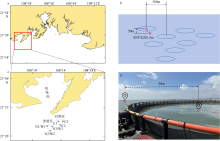
图1
珍珠湾卵形鲳鲹养殖海域采样位置示意图(a)、采样模式图(b)、采样位点示意图(c)和现场采样图(d)"

图1
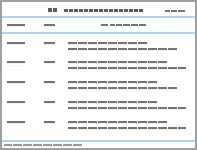
表1
珍珠湾四季卵形鲳鲹养殖区海水主要理化性质指标"
| 组别 | 温度/℃ | 盐度/‰ | pH | 溶解氧/ (mg·L−1) | 叶绿素a/ (mg·m−3) | 硝酸盐/ (mg·L−1) | 亚硝酸/(mg·L−1) | 氨氮/(mg·L−1) | 总磷/ (mg·L−1) | 化学需氧量 /(mg·L−1) |
|---|---|---|---|---|---|---|---|---|---|---|
| W-spr | 26.26±5.20b | 30.42±1.48bc | 7.93±0.35abcd | 7.34±1.03ab | 2.06±2.45a | 0.99±0.09b | 0.0058±0.0055ab | 0.0752±0.0073e | 0.10±0.18bc | 0.72±0.51bc |
| N-spr | 26.27±5.05b | 30.52±1.46bc | 7.79±0.23abc | 7.17±1.00ab | 1.95±2.20a | 0.98±0.11b | 0.0084±0.0058ab | 0.0744±0.0072de | 0.11±0.13c | 0.77±0.37c |
| C-spr | 26.41±4.79b | 30.57±1.60bc | 7.96±0.41abcd | 7.59±0.88bc | 1.99±2.37a | 0.98±0.09b | 0.0058±0.0038ab | 0.0736±0.0077bcde | 0.03±0.01abc | 0.61±0.46abc |
| W-sum | 30.86±0.51c | 24.42±2.39a | 7.63±0.76a | 6.50±0.63a | 11.69±4.24c | 1.06±0.04c | 0.0147±0.0163b | 0.0754±0.0043e | 0.05±0.03abc | 0.50±0.17abc |
| N-sum | 30.86±0.54c | 24.56±2.68a | 7.67±0.77ab | 6.56±0.58a | 11.51±4.16c | 1.06±0.03c | 0.0149±0.0165b | 0.0739±0.0033cde | 0.04±0.01abc | 0.54±0.20abc |
| C-sum | 30.62±0.57c | 24.76±2.28a | 7.72±0.73ab | 6.66±0.56a | 11.09±3.30c | 1.05±0.04c | 0.0152±0.0173b | 0.0728±0.0038abcde | 0.03±0.01abc | 0.68±0.22bc |
| W-aut | 26.39±1.94b | 29.55±0.77b | 8.10±0.12bcd | 6.89±0.51ab | 5.31±1.83b | 0.93±0.05ab | 0.0045±0.0024a | 0.0685±0.0050ab | 0.03±0.02a | 0.50±0.16abc |
| N-aut | 26.38±1.95b | 29.51±0.72b | 8.21±0.02cd | 6.78±0.52ab | 5.04±1.07b | 0.92±0.05ab | 0.0059±0.0046ab | 0.0689±0.0049abc | 0.02±0.00a | 0.50±0.23abc |
| C-aut | 26.52±2.03b | 29.61±0.82b | 8.26±0.04d | 7.08±0.94ab | 4.88±3.00b | 0.94±0.05ab | 0.0035±0.0017a | 0.0677±0.0037a | 0.03±0.02ab | 0.45±0.28ab |
| W-win | 19.36±2.09a | 31.45±0.59c | 8.34±0.14d | 8.27±0.92c | 1.12±0.59a | 0.90±0.03a | 0.0018±0.0005a | 0.0703±0.0026abcde | 0.05±0.07abc | 0.36±0.10a |
| N-win | 19.44±2.09a | 31.45±0.59c | 8.35±0.08d | 8.20±0.66c | 1.37±1.05a | 0.91±0.02a | 0.0016±0.0005a | 0.0696±0.0033abcd | 0.02±0.01a | 0.43±0.15ab |
| C-win | 19.13±2.08a | 31.36±0.70c | 8.34±0.07d | 8.21±1.04c | 1.17±0.52a | 0.91±0.02a | 0.0019±0.0007a | 0.0681±0.0024a | 0.04±0.04abc | 0.46±0.16ab |
表1
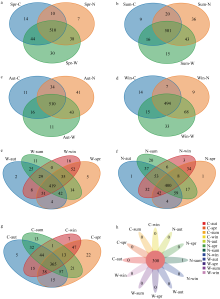
图2
不同季节不同站点海水细菌群落的Venn和花瓣图 a. 春季不同站点的Venn图; b. 夏季不同站点Venn图; c. 秋季不同站点Venn图; d. 冬季不同站点Venn图; e. W站点不同季节Venn图; f. N站点不同季节Venn图; g. C站点不同季节Venn图; h. 不同季节不同站点海水细菌群落的花瓣图, 中心数字300表示所有样品共有的ASV数量, 每个花瓣中的数字为样本独有种类数量"
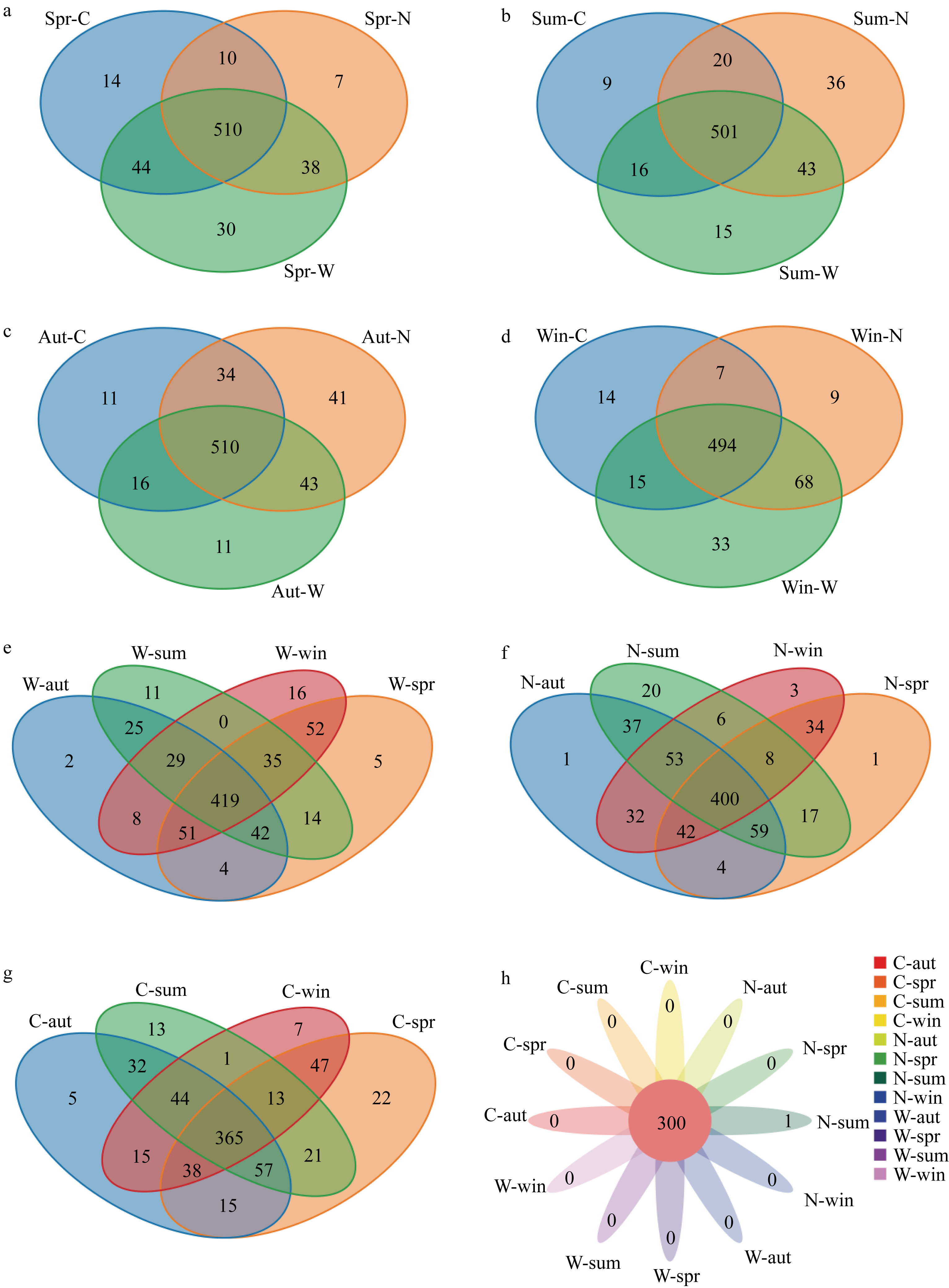
图2
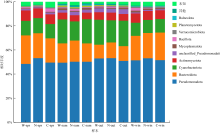
图3
门水平群落结构"
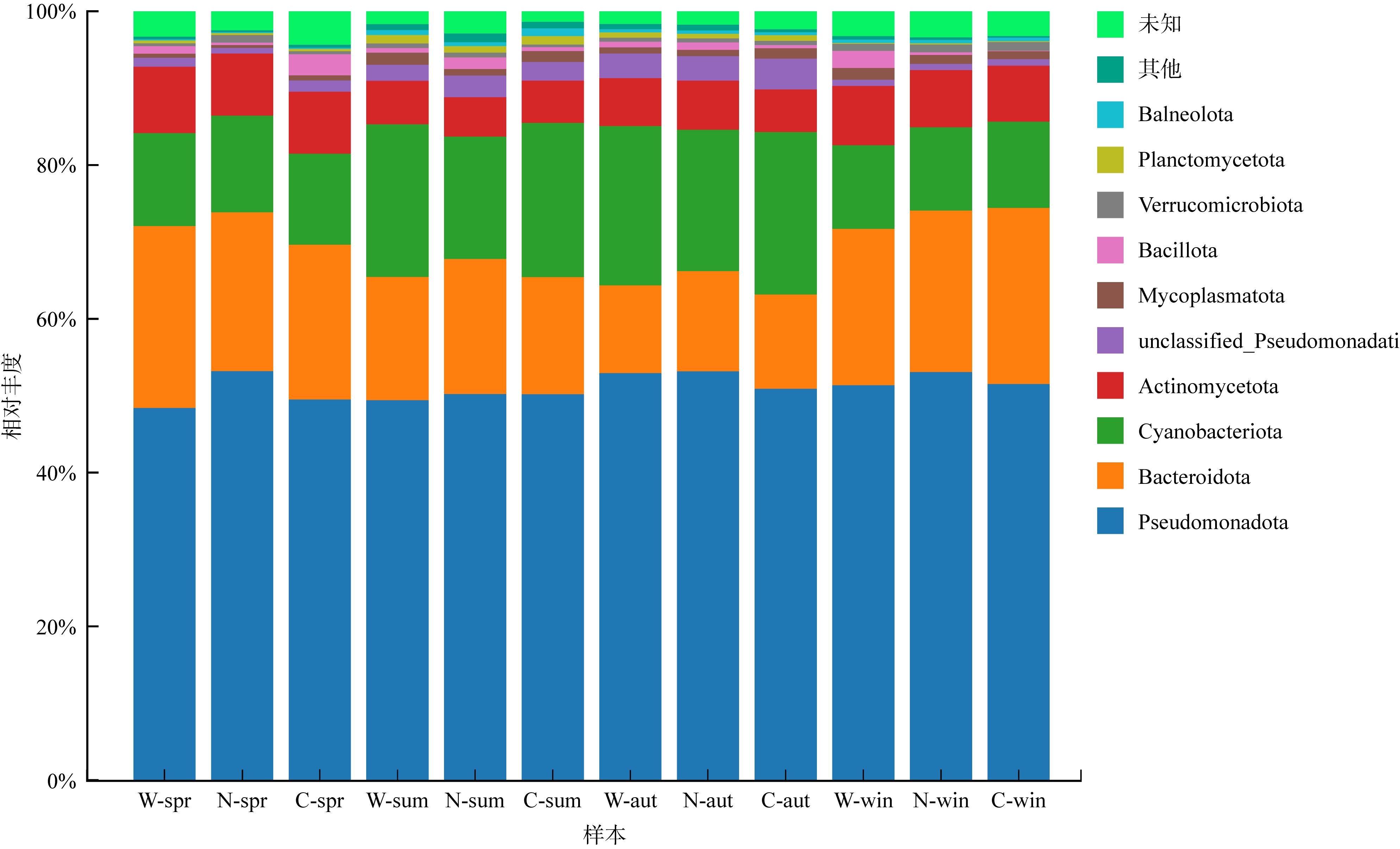
图3
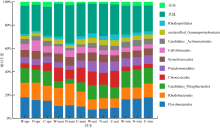
图4
目水平群落结构"
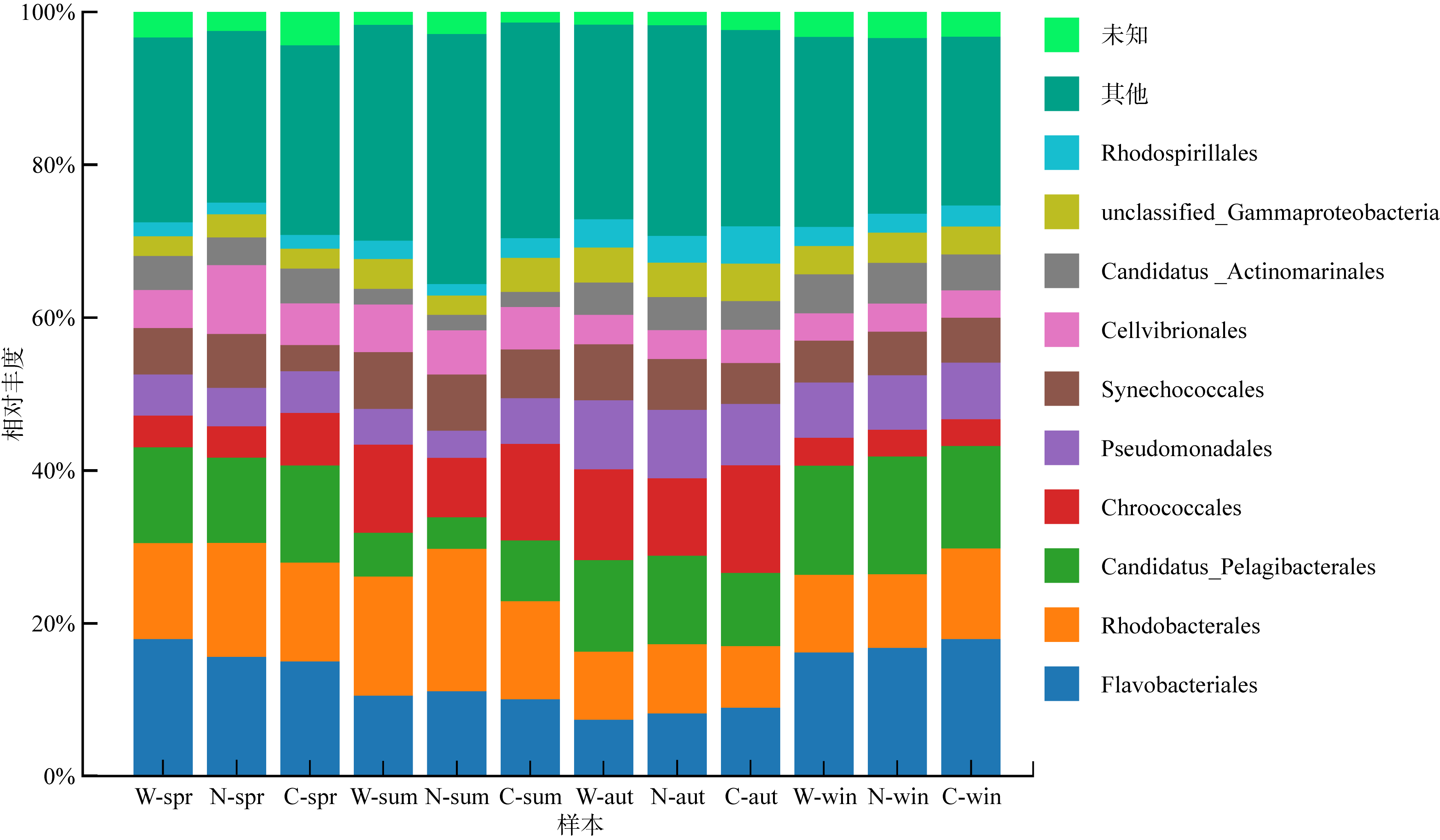
图4
图5
属水平群落结构"
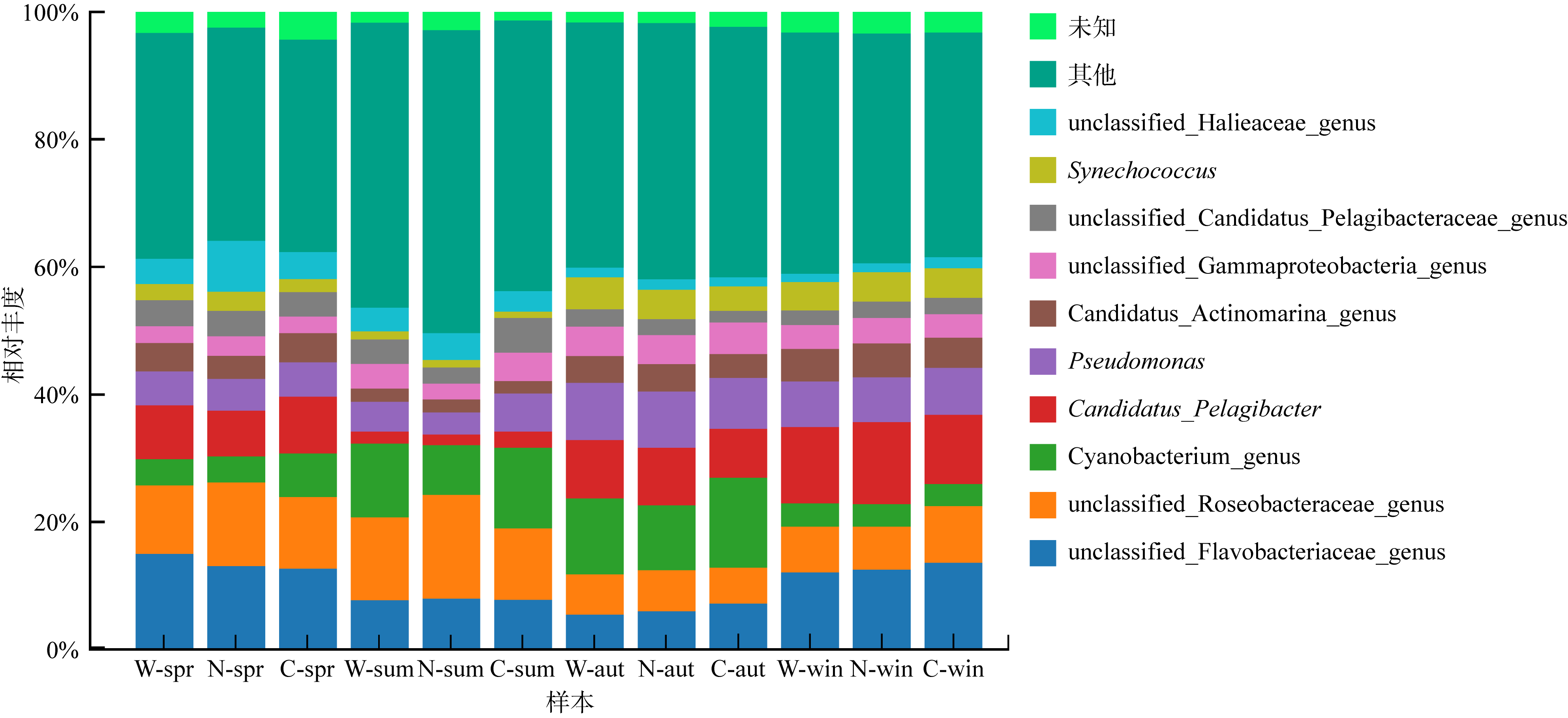
图5
表2
珍珠湾卵形鲳鲹养殖区海水菌群alpha多样性指数"
| 组别 | Ace指数 | Chao1指数 | Simpson指数 | Shannon指数 | Coverage覆盖率 |
|---|---|---|---|---|---|
| W-spr | 284.66±57.61ab | 287.08±57.21bc | 0.962±0.008bc | 5.92±0.26bc | 1.000 |
| N-spr | 276.82±15.09ab | 276.73±14.71ab | 0.952±0.014a | 5.64±0.38a | 1.000 |
| C-spr | 251.49±52.84a | 251.41±53.02a | 0.957±0.014ab | 5.78±0.34ab | 1.000 |
| W-sum | 333.97±23.17cd | 335.24±23.44de | 0.969±0.009cd | 6.22±0.29d | 1.000 |
| N-sum | 334.45±27.75cd | 335.21±27.57de | 0.969±0.006cd | 6.23±0.24d | 1.000 |
| C-sum | 325.79±17.54cd | 326.20±17.98de | 0.969±0.007cd | 6.17±0.18cd | 1.000 |
| W-aut | 348.84±19.38de | 349.16±18.88e | 0.971±0.002cd | 6.18±0.15cd | 1.000 |
| N-aut | 382.22±35.42e | 382.89±34.71f | 0.973±0.003d | 6.32±0.19d | 1.000 |
| C-aut | 336.60±28.12cd | 338.15±29.12e | 0.969±0.009cd | 6.09±0.17cd | 1.000 |
| W-win | 335.16±50.37cd | 337.29±47.56e | 0.969±0.007cd | 6.27±0.37d | 1.000 |
| N-win | 320.57±44.63cd | 320.56±44.20cde | 0.965±0.009cd | 6.14±0.27cd | 1.000 |
| C-win | 298.96±27.94bc | 298.76±27.79bcd | 0.969±0.004cd | 6.11±0.15cd | 1.000 |
表2
图6
不同季节不同站点海水细菌群落的PCoA分析 a. 春季; b. 夏季; c. 秋季; d. 冬季"
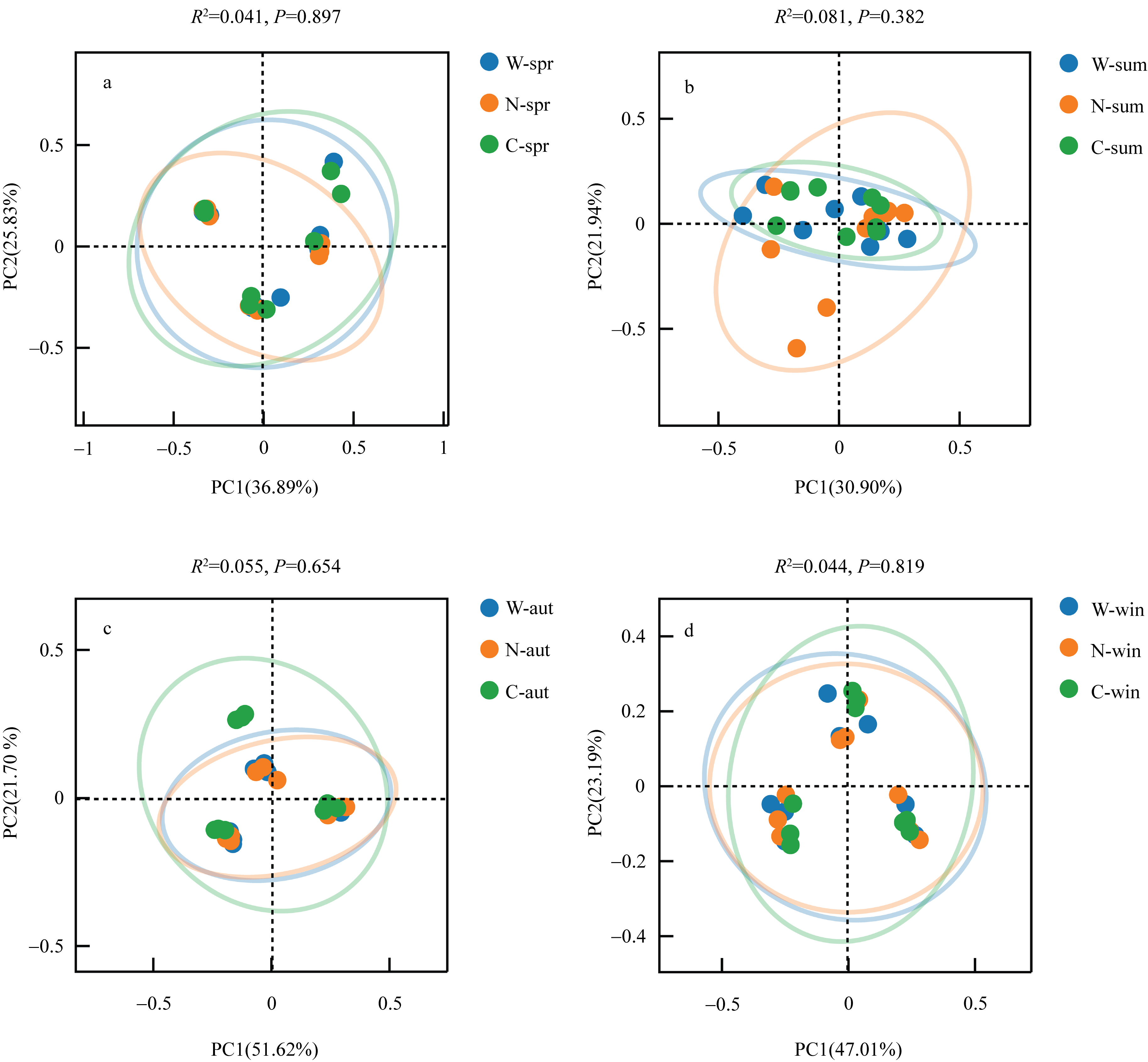
图6
图7
ASV水平上水质因子与菌群相关性的RDA分析"
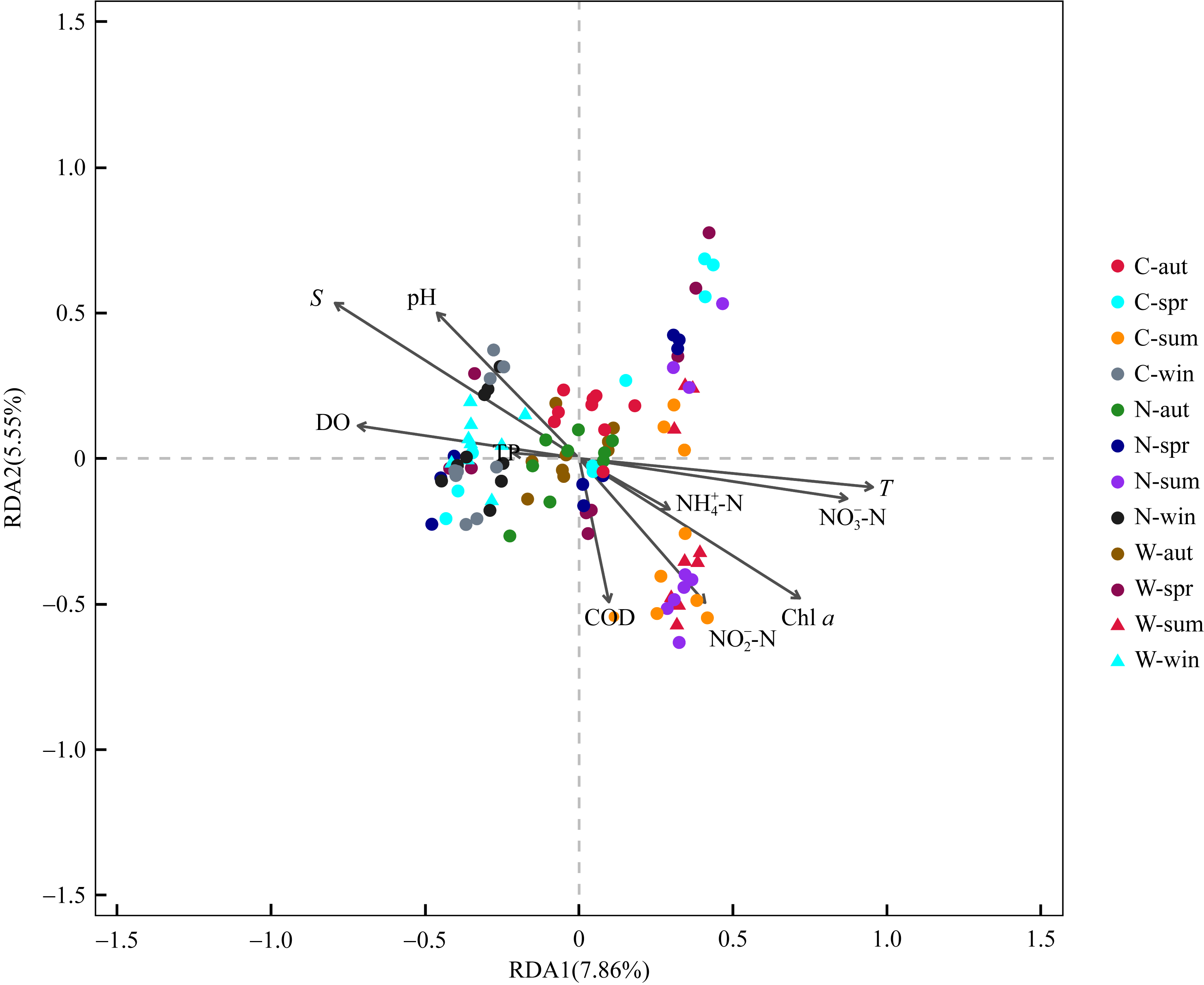
图7
图8
水质因子与菌群(目水平)的关系热图 图中*表示P<0.05, **表示P<0.05, ***表示P<0.001"
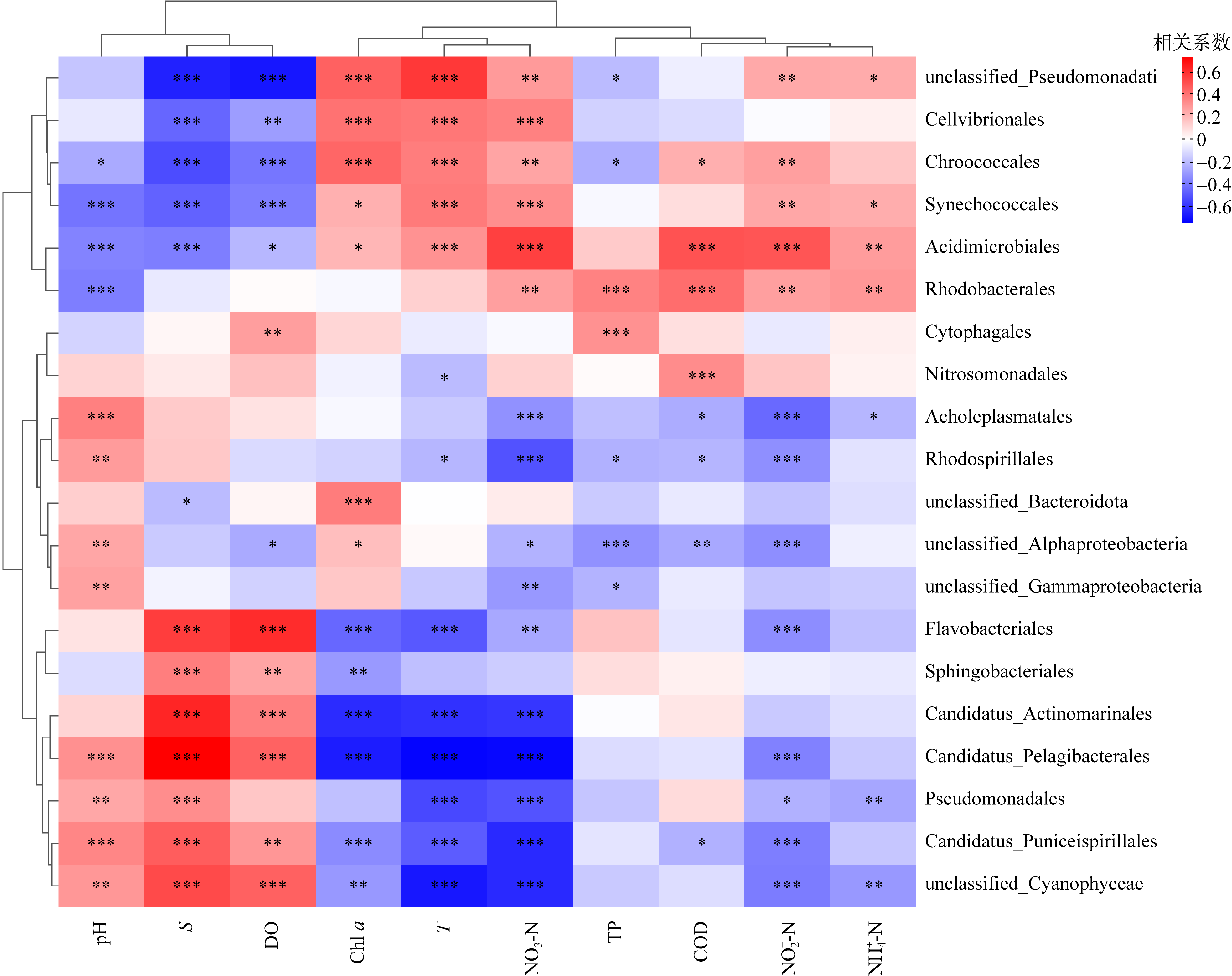
图8
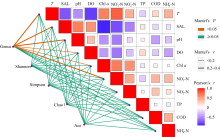
图9
物种与环境因子、alpha多样性指数相关性热图与网络组合图"
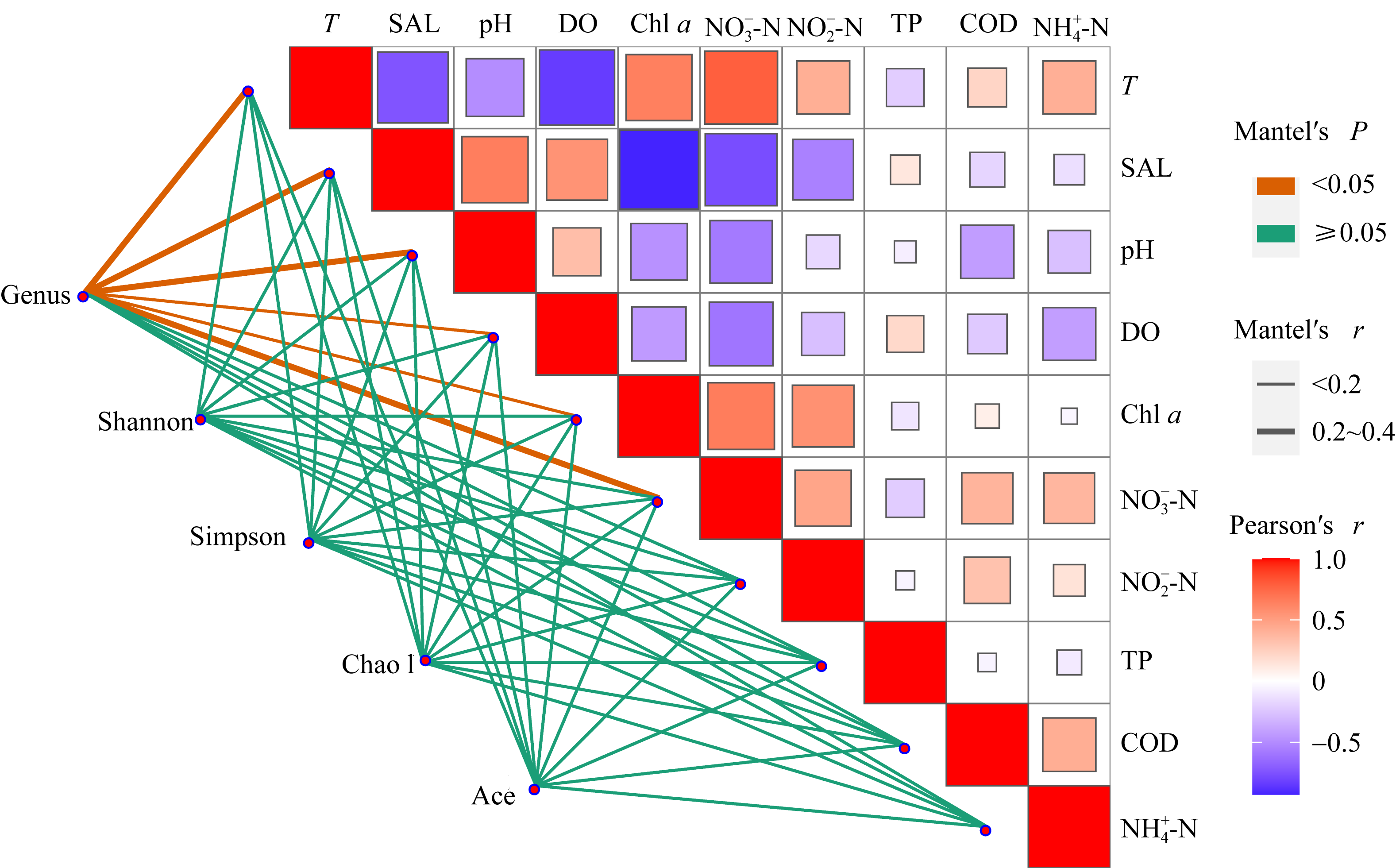
图9
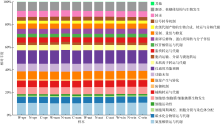
图10
菌群功能预测"
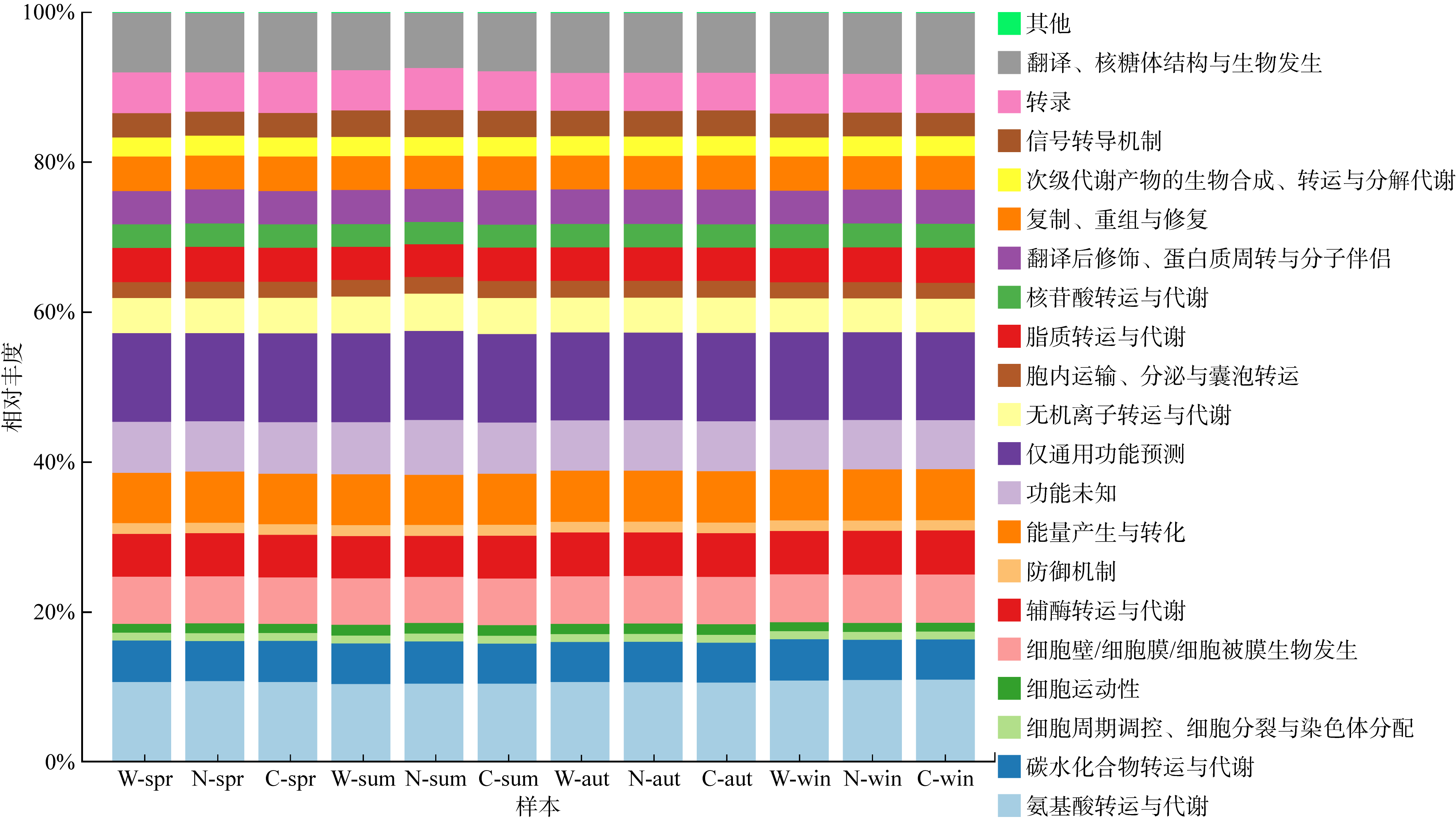
图10
| [1] |
成庆泰, 郑葆珊, 1987. 中国鱼类系统检索[M]. 北京: 科学出版社: 341-342 (in Chinese).
|
| [2] |
房睿, 2024. 环境因子对微生物群落结构的影响分析[J]. 水利科技与经济, 30(9): 84-87.
|
|
|
|
| [3] |
顾颖, 伏光辉, 姚永琪, 等, 2023. 海州湾细菌群落结构多样性及环境因子分析[J]. 生命科学研究, 27(6): 512-520+527.
|
|
|
|
| [4] |
郭越, 韩璐文, 齐志豪, 等, 2022. 细菌DNA损伤修复的诱导、调控及结局的研究进展[J]. 生物化学与生物物理进展, 49(2): 359-369.
|
|
|
|
| [5] |
何银加, 於锋, 许萱, 等, 2025. 密度和饵料日投喂量对科斯塔氏直线脂鲤(Moenkhausia costae)养殖的影响[J]. 海南大学学报(自然科学版中英文), 43(1): 7-14.
|
|
|
|
| [6] |
胡安谊, 李姜维, 杨晓永, 等, 2015. 宁波三江口水域原核生物群落结构分析[J]. 环境科学, 36(7): 2487-2495.
|
|
|
|
| [7] |
黄健旋, 刘悦, 黎学友, 等, 2024. 盐度对弓背青鳉行为及肠道菌群的影响[J]. 农业与技术, 44(13): 114-120 (in Chinese).
|
| [8] |
黄明荣, 2018. 厦门近岸细菌群落的物种多样性研究及其功能预测[D]. 厦门: 厦门大学: 58-59.
|
|
|
|
| [9] |
李雪红, 李述刚, 石钢鹏, 等, 2021. 生长环境对克氏原螯虾细菌群落多样性的影响[J]. 食品工业科技, 42(16): 91-98.
|
|
|
|
| [10] |
李雪妮, 吴一桂, 2025. 珍珠湾海洋牧场“牧出”防城港市首家自治区农业产业化重点龙头企业[EB/OL]. (2025-01-02)[2025-10-25] http://nynct.gxzf.gov.cn/xwdt/gxlb/fcg/t19469382.shtml (in Chinese).
|
| [11] |
廖经球, 杨小立, 庞强, 等, 2014. 卵形鲳鲹繁殖生物学及人工繁育技术研究进展[J]. 红河学院学报, 12(5): 21-25.
|
|
|
|
| [12] |
刘蔓婷, 王良明, 杨长平, 等, 2023. 基于Stella的防城港珍珠湾及其邻近海域渔业生态承载力分析[J]. 安徽农业科学, 51(8): 58-62.
|
|
|
|
| [13] |
刘晓辉, 2017. 长江口及邻近海域海水细菌多样性及时空分布规律研究[D]. 舟山: 浙江海洋大学.
|
|
|
|
| [14] |
马景雪, 张培玉, 王宗兴, 等, 2022. 青岛崂山湾近海扇贝养殖区细菌多样性及环境因子分析[J]. 海洋科学进展, 40(2): 307-319.
|
|
|
|
| [15] |
万年新, 吕媛媛, 慈芳芳, 等, 2024. 四种功能水体的水质现状以及微生物群落结构分析[J]. 现代生物医学进展, 24(22): 4214-4220.
|
|
|
|
| [16] |
吴冬梅, 2018. 长江口和东海海域细菌群落结构及其生态功能预测[D]. 舟山: 浙江海洋大学.
|
|
|
|
| [17] |
夏立群, 黄郁葱, 鲁义善, 2012. 卵形鲳鲹主要病害及其研究进展[J]. 安徽农学通报(上半月刊), 18(23): 140-143+150.
|
|
|
|
| [18] |
张炼辉, 2019. 微生物群体感应系统的研究进展[J]. 华南农业大学学报, 40(5): 50-58.
|
|
|
|
| [19] |
张天文, 包卫洋, 高磊, 等, 2012. 对虾高位池精养和生态养殖模式下沉积物中碳、氮元素变化及对底栖细菌的影响[J]. 中国海洋大学学报(自然科学版), 42(5): 41-46.
|
|
|
|
| [20] |
赵旺, 黄星美, 邓正华, 等, 2022. 夏季美济礁潟湖养殖区海水细菌多样性及其与环境因子的相关性[J]. 中国水产科学, 29(5): 720-731.
|
|
|
|
| [21] |
中华人民共和国国家质量监督检验检疫总局, 中国国家标准化管理委员会, 2007. GB 17378.4-2007海洋监测规范第4 部分: 海水分析[S]. 北京: 中国标准出版社.
|
|
General Administration of Quality Supervision, Inspection and Quarantine of the People's Republic of China, Standardization Administration of the People's Republic of China, 2007. Specifications for marine monitoring-Part 4: seawater analysis (GB 17378.4-2007)[S]. Beijing: Standards Press of China (in Chinese).
|
|
| [22] |
doi: 10.1186/s13568-022-01423-9 pmid: 35737135 |
| [23] |
doi: 10.1038/s41587-019-0209-9 pmid: 31341288 |
| [24] |
doi: 10.1038/nmeth.3869 pmid: 27214047 |
| [25] |
doi: 10.1111/gcb.14163 pmid: 29645398 |
| [26] |
doi: 10.1038/nature08058 |
| [27] |
doi: 10.1146/annurev-marine-010814-015934 pmid: 27687974 |
| [28] |
doi: 10.7717/peerj.10866 |
| [29] |
|
| [30] |
doi: 10.3389/fmars.2024.1266410 |
| [31] |
doi: 10.1111/jam.15702 |
| [32] |
doi: 10.1126/science.aaf4507 pmid: 27634532 |
| [33] |
doi: 10.1038/s41598-018-29214-y pmid: 30022152 |
| [34] |
doi: 10.1016/j.aqrep.2022.101459 |
| [35] |
doi: 10.3354/aei00122 |
| [36] |
doi: 10.3389/fmicb.2022.904815 |
| [37] |
doi: 10.1186/s42523-022-00203-x pmid: 36109797 |
| [38] |
doi: 10.3390/jmse12050787 |
| [39] |
doi: 10.1126/science.1261359 |
| [40] |
doi: 10.1016/j.marenvres.2023.106063 |
| [41] |
doi: 10.1016/j.scitotenv.2021.150498 |
| [42] |
doi: 10.1111/1462-2920.15281 pmid: 33073448 |
| [43] |
doi: 10.3390/w14111769 |
| [44] |
doi: 10.3934/microbiol.2024012 pmid: 38919720 |
| [1] | 李晓婷, 甫佳, 邱梦涵, 吴宗奇, 李皓琛, 刘莹, 彭春艳, 唐建辉, 龚斌. 基于宏条形码技术的北部湾近岸海域无脊椎动物多样性的季节动态和群落构建[J]. 热带海洋学报, 2026, 45(4): 41-62. |
| [2] | 李新正, 杜小丽, 徐勇, 张悦, 王金宝, 隋吉星, 陈丹. 夏、冬季钦州湾茅尾海大型底栖动物群落特征及其环境影响因素探究*[J]. 热带海洋学报, 2026, 45(4): 15-28. |
| [3] | 周伟华, 姚煜坤, 罗勇, 李涛, 龙爱民, 黄晖. 三亚湾溶解有机碳长期变化趋势及影响因素分析*[J]. 热带海洋学报, 2026, 45(2): 106-116. |
| [4] | 杨天炜, 林军, 焦俊鹏, 吴越. 网采镜检与全息粒子成像综合分析贻贝养殖区浮游植物群落特征[J]. 热带海洋学报, 2025, 44(6): 91-107. |
| [5] | 于蓁, 郭祥瑞, 刘雪睿, 孙浩, 张燕英. 山东沿海三种海草根际真核生物群落结构及其影响因素[J]. 热带海洋学报, 2025, 44(5): 86-96. |
| [6] | 冯战权, 苏冒亮, 杜媛媛, 钟友凌, 张俊彬. 基于MaxEnt模型分析全球气候变化对中国沿海带鱼潜在分布的影响[J]. 热带海洋学报, 2025, 44(5): 77-85. |
| [7] | 孙佳宁, 王玉清, 章守宇, 王凯. 绿华岛海域海藻场大型底栖生物群落结构及其对环境因子的响应[J]. 热带海洋学报, 2025, 44(4): 119-135. |
| [8] | 代丽, 潘铧康, 刘励阳, 何健, 赵科, 祁剑飞, 张真, 苏培, 冯丹青. 环境因子对污损生物沙筛贝(Mytilopsis sallei)幼体附着变态的影响研究[J]. 热带海洋学报, 2025, 44(3): 121-129. |
| [9] | 周志希, 唐汇娟, 柯志新, 刘甲星, 周伟华. 基于形态学和高通量测序的春季南澳海域浮游植物群落特征及其与环境因子关系[J]. 热带海洋学报, 2025, 44(1): 53-65. |
| [10] | 贾男, 周天成, 胡思敏, 张琛, 黄晖, 刘胜. 南沙群岛海域珊瑚礁区三种寄居蟹的摄食差异比较[J]. 热带海洋学报, 2024, 43(3): 109-121. |
| [11] | 罗勇, 黄林韬, 杨剑辉, 练健生, 刘骋跃, 江雷, 梁宇娴, 陈伦举, 雷新明, 刘胜, 黄晖. 海南临高红牌—马袅沿岸海域造礁石珊瑚群落结构及其环境影响因子[J]. 热带海洋学报, 2024, 43(3): 72-86. |
| [12] | 林先智, 周岩岩, 林皓晔, 胡思敏, 黄晖, 张黎, 刘胜. 南沙群岛珊瑚礁区黑斑鹦嘴鱼(Scarus globiceps)食性分析[J]. 热带海洋学报, 2024, 43(3): 100-108. |
| [13] | 黄圆, 岑竞仪, 梁芊艳, 吕颂辉, 王建艳. 基于高通量测序技术的深圳湾真核浮游植物群落结构研究[J]. 热带海洋学报, 2024, 43(2): 21-33. |
| [14] | 叶锦成, 陈毅青, 高琳, 周鲜娇, 钟才荣, 张颖, 王芸. 红树植物拟海桑及其亲本的根际细菌群落特征分析[J]. 热带海洋学报, 2022, 41(6): 75-89. |
| [15] | 黄思军, 邱晨, 龙超, 龙丽娟. 三亚湾珊瑚来源虫黄藻不同株系微环境中微生物群落结构的差异比较分析[J]. 热带海洋学报, 2022, 41(6): 90-104. |
|
||