

热带海洋学报 ›› 2026, Vol. 45 ›› Issue (5): 94-107.doi: 10.11978/YG2025010CSTR: 32234.14.YG2025010
南海美济珊瑚礁的形成与演化*
刘建国1,2( ), 黄云1,2, 徐维海1,2, 黎刚1,2, 向荣1,2, 苏翔1,2, 罗云1,2, 赵中贤1,2, 颜文1,2,3()
- 1
热带海洋环境与岛礁生态全国重点实验室(中国科学院南海海洋研究所)
2边缘海与大洋地质实验室(中国科学院南海海洋研究所)
3中国科学院大学
-
收稿日期:2025-11-04修回日期:2025-12-20出版日期:2026-09-10发布日期:2026-10-13 -
通讯作者:颜文 -
作者简介:刘建国(1978—), 男, 江西省萍乡市人, 研究员, 从事海洋沉积与古环境研究。email: jgliu@scsio.ac.cn
*感谢沈建伟、朱小畏、田雨杭、孙杰、张强、邸鹏飞和王旭东在野外采集珊瑚礁样本。
-
基金资助:国家重点研发计划(2021-06)
Formation and development of Meiji coral reefs in the South China Sea*
LIU Jianguo1,2(), HUANG Yun1,2, XU Weihai1,2, LI Gang1,2, XIANG Rong1,2, SU Xiang1,2, LUO Yun1,2, ZHAO Zhongxian1,2, YAN Wen1,2,3()
- 1
State Key Laboratory of Tropical Oceanography ,South China Sea Institute of Oceanology, Chinese Academy of Sciences
2Laboratory of Marginal Sea and Ocean Geology ,South China Sea Institute of Oceanology, Chinese Academy of Sciences
3University of Chinese Academy of Sciences
-
Received:2025-11-04Revised:2025-12-20Online:2026-09-10Published:2026-10-13 -
Contact:YAN Wen -
Supported by:National Key Research and Development Program of China(2021-06)

摘要:
珊瑚礁是一种独特的地质体, 由生物活动在热带和亚热带海洋及沿海地区形成。尽管珊瑚礁的形成时间和演化过程已受到广泛关注, 但其具体细节仍存在诸多争议。文章以南沙群岛美济礁为研究对象, 通过锶、碳和氧同位素分析、矿物学、微体古生物学以及元素分析等方法, 重建了该珊瑚礁的形成和演化历史。研究结果表明, 珊瑚礁的形成演化是一个复杂的地质过程, 受到多种因素的综合影响, 其中区域构造运动和长期气候变化起着关键作用。珊瑚礁形成通常经历8个主要阶段, 第1阶段是火山基底的形成; 其后则是早期珊瑚群落于基底之上的定殖与构建, 并在此基础上逐渐发展壮大。如今, 在火山基底表面可以观察到大量的珊瑚礁, 其厚度可达约1000m, 这些珊瑚礁在形成过程中遭受了显著的侵蚀作用。这种阶段性侵蚀与沉积的现象, 可以通过阶段性侵蚀-沉积模型加以解释, 该模型不仅适用于美济礁, 也适用于研究西沙群岛等地区珊瑚礁的形成与演化。基于以上研究, 我们推测许多热带珊瑚礁可能不会长时间持续繁荣发展, 其生长过程中可能会受到多种环境因素的影响, 导致生长中断或衰退。在珊瑚礁的层状结构中, 通常会伴随沉积间断现象。这些间断记录了珊瑚礁生长过程中的暂停或侵蚀事件。
中图分类号:
- P737.11
引用本文
刘建国, 黄云, 徐维海, 黎刚, 向荣, 苏翔, 罗云, 赵中贤, 颜文. 南海美济珊瑚礁的形成与演化*[J]. 热带海洋学报, 2026, 45(5): 94-107.
LIU Jianguo, HUANG Yun, XU Weihai, LI Gang, XIANG Rong, SU Xiang, LUO Yun, ZHAO Zhongxian, YAN Wen. Formation and development of Meiji coral reefs in the South China Sea*[J]. Journal of Tropical Oceanography, 2026, 45(5): 94-107.
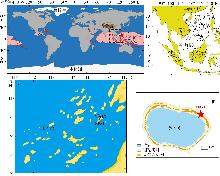
图1
南沙群岛美济礁NK-1井钻探位置及区域背景 a. 当前珊瑚礁分布(红点)(UNEP-WCMC et al, 2008)以及极地冰盖(白色)、青藏高原(褐色)和暖池(粉色)的位置。图a中虚线方框为南海及周边海域, 黑色五角星表示NK-1井, 图中数字表示海表年平均温度(单位: ℃)。b. 南海美济礁NK-1井(黑色五角星)、XK-1井(黄色五角星)(Yi et al, 2018)、琛航岛CK-2井(16°27′N, 111°43′E)(Fan et al, 2020)的位置示意图。c. 南沙群岛周围珊瑚礁(黄色)的具体位置。d. 美济礁中NK-1井的详细位置。该图基于自然资源部标准地图服务网站下载的审图号为琼S(2024)046号的标准地图制作, 底图无修改"
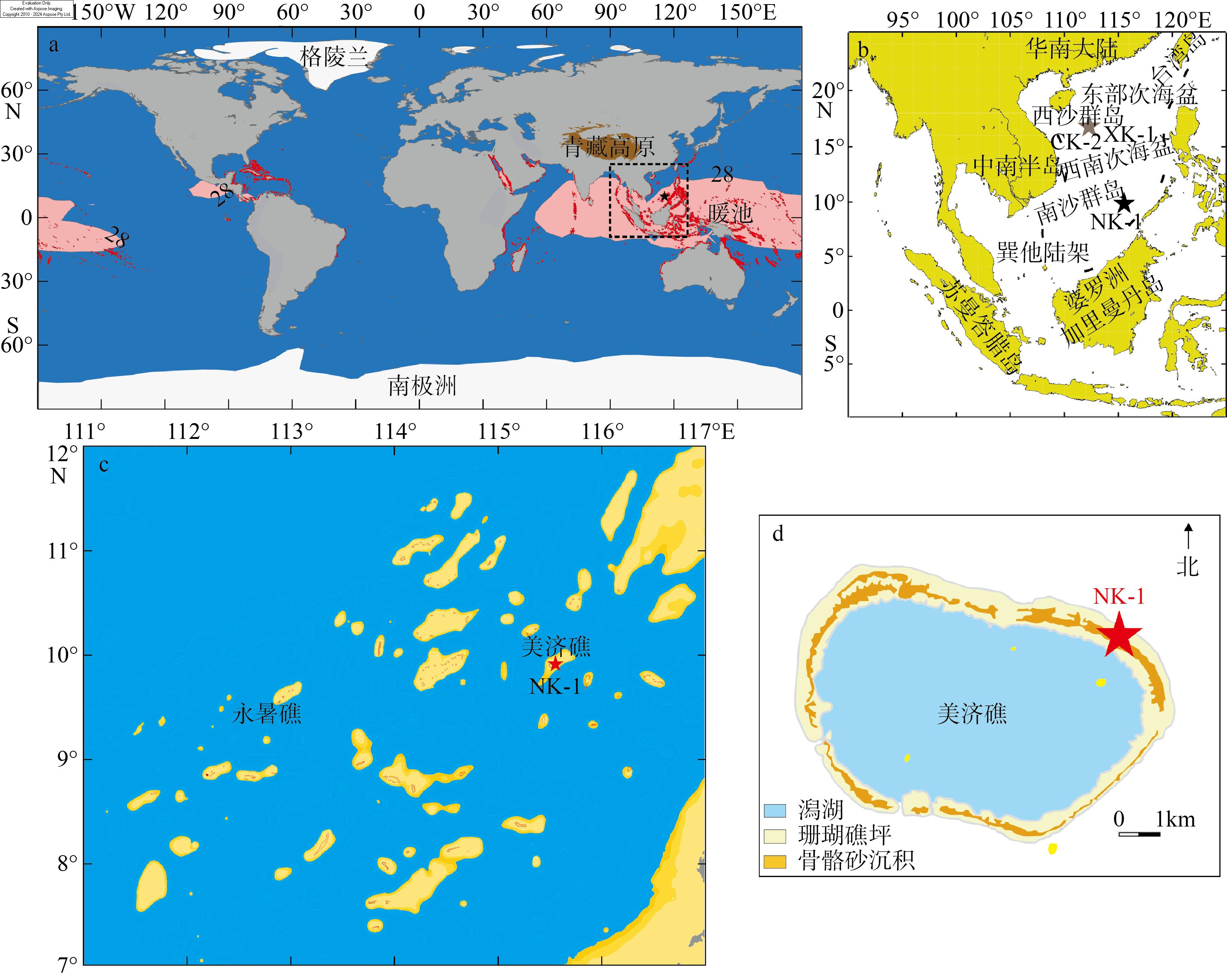
图1
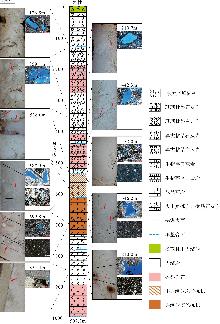
图2
美济礁NK-1井中不同深度珊瑚礁典型暴露面的展示 展示了晚新生代热带地区美济礁NK-1井中不同深度的珊瑚礁典型暴露面, 在手持标本(左)和显微切片(右)下的视图, 其中蓝色部分表示被胶水填满的孔隙。展示了深度为126.5m、210.7m、359.1m、442.3m、538.0m、558.0m、587.9m、646.2m、699.8m、810.0m和854.4m的样本图片。红色箭头表示珊瑚礁的溶解边界"

图2
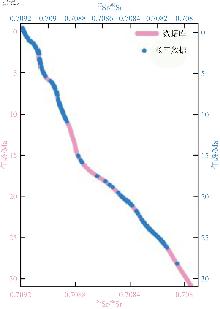
图3
美济礁层序87Sr/86Sr比值-深度及其与全球锶同位素参考曲线(McArthur et al, 2001)的对比 蓝色圆点为实测87Sr/86Sr值; 年龄框架据Liu等(2022)的Sr同位素地层学结果(粉色)"
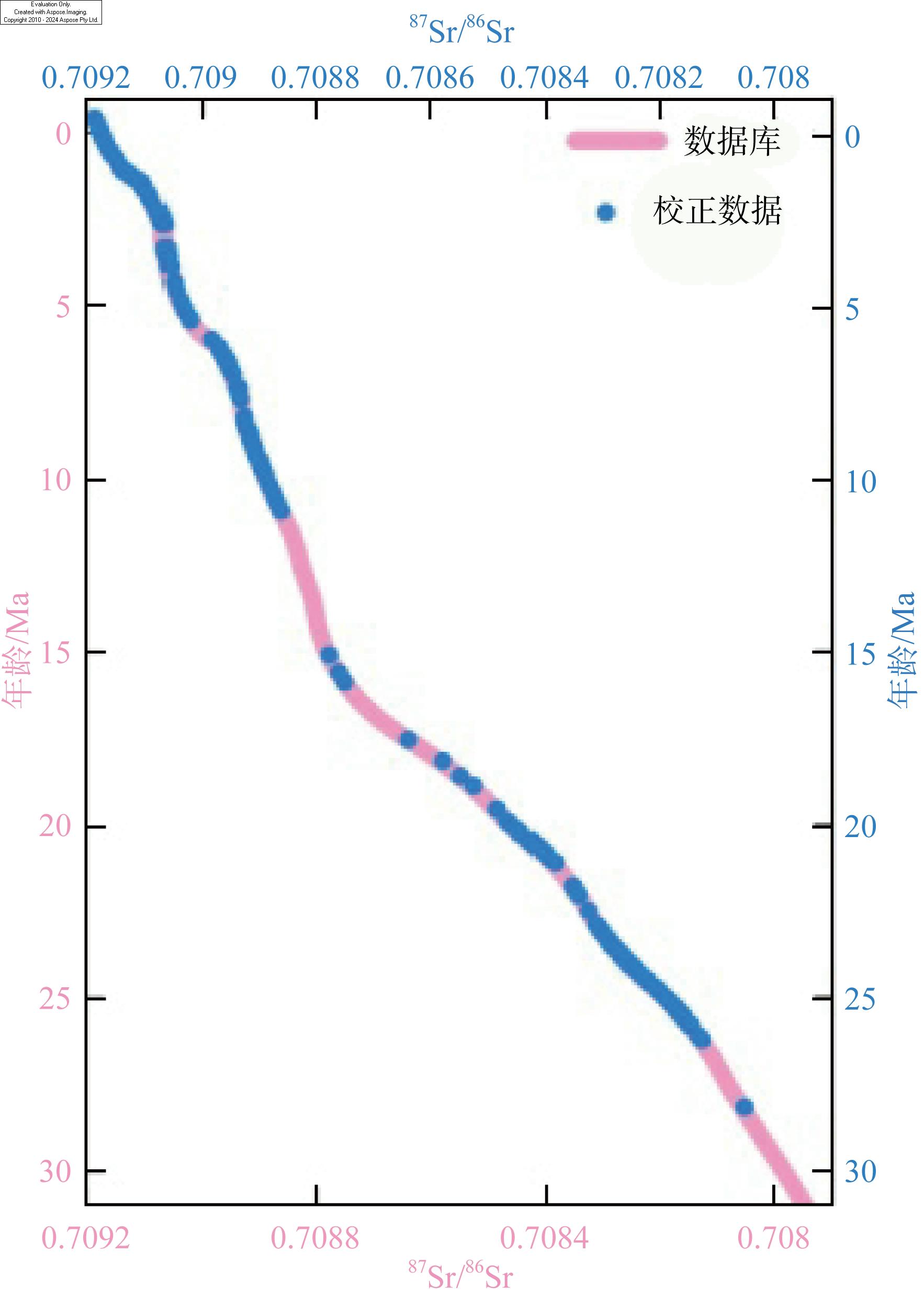
图3
图4
南海美济礁珊瑚礁发育的岩性剖面和阶段划分 展示了美济礁珊瑚礁发育的岩性剖面, 以及根据矿物、同位素和元素变化划分的8个阶段。除了测量主要元素(Al2O3和MgO)浓度用经过去离子水清洗的粉末样品外, 其他参数均用整体粉末样品进行测量。图中还展示了西沙海区的相对海平面数据[来自Shao等(2017)的重绘], 南极洲和格陵兰冰盖的形成时间[分别形成于23Ma前和2.6Ma前(Miller et al, 2005)], 南海的最后扩张时间[大约20—16Ma前(Sun et al, 2019)], 青藏高原的加速抬升时间[21Ma前和3.6Ma前(An et al, 2001)], 以及西太平洋暖池的形成演化时间[最初形成于大约11Ma前, 并在3.2Ma前完全发育成形(Jian et al, 2006)]"

图4
图5
美济礁NK-1井中8个不同阶段的矿物在XRD曲线上的特征图像 左侧的岩性剖面为右侧的矿物分布提供了地质背景。竖图的图例见图2。为了更清晰地展示每个阶段的矿物组成, 从珊瑚礁的每个划分阶段中选取了不同深度的样本曲线。在这些曲线上, 用彩色数字标注了相应的矿物种类: 1代表文石, 2代表高镁方解石, 3代表低镁方解石, 4代表菱铁矿, 5代表白云石, 6代表绿泥石, 7代表伊利石, 8代表角闪石, 9代表石英, 10代表微斜长石, 11代表钠长石"
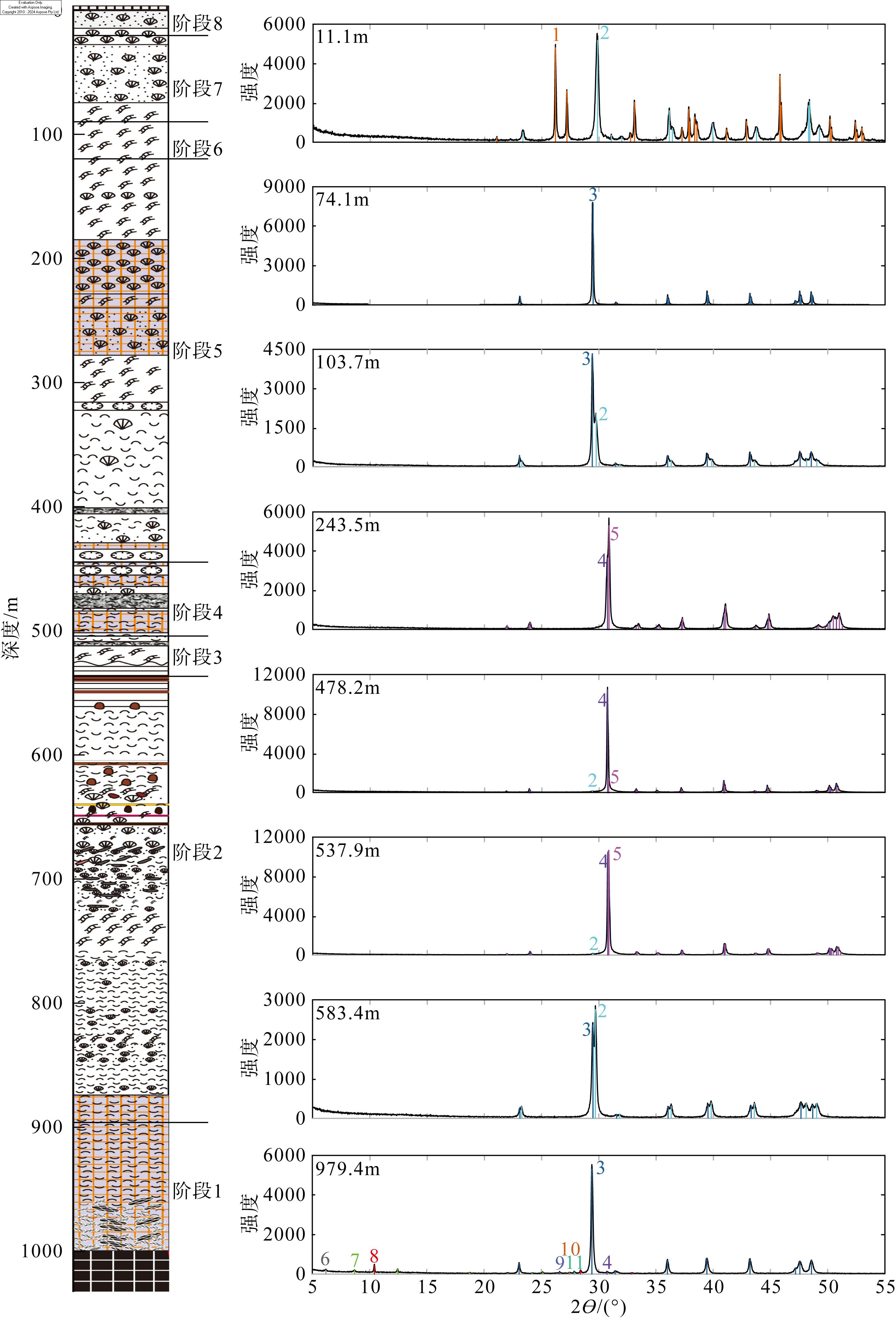
图5
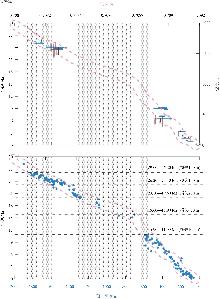
图6
美济礁的标准化深度, 这一深度是根据锶同位素曲线(McArthur et al, 2001)进行调整得出的 a. 美济礁标准化深度。图中蓝线标示了同一年龄对应的不同深度, 棕线标示了同一深度对应的不同年龄; b. 呈现了各种年龄的珊瑚礁的估计深度。值得注意的是, 珊瑚礁曾暴露于大气环境中, 导致了较长的沉积间断, 这些间断在图中以点状阴影和黑色虚线标注出来"

图6
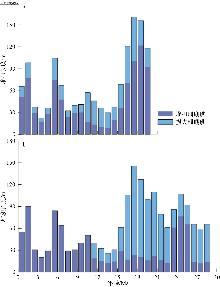
图7
西沙群岛琛航岛CK-2井(a)(Fan et al, 2020)和南沙群岛美济礁NK-1井(b)珊瑚礁的估计积累和损失长度"
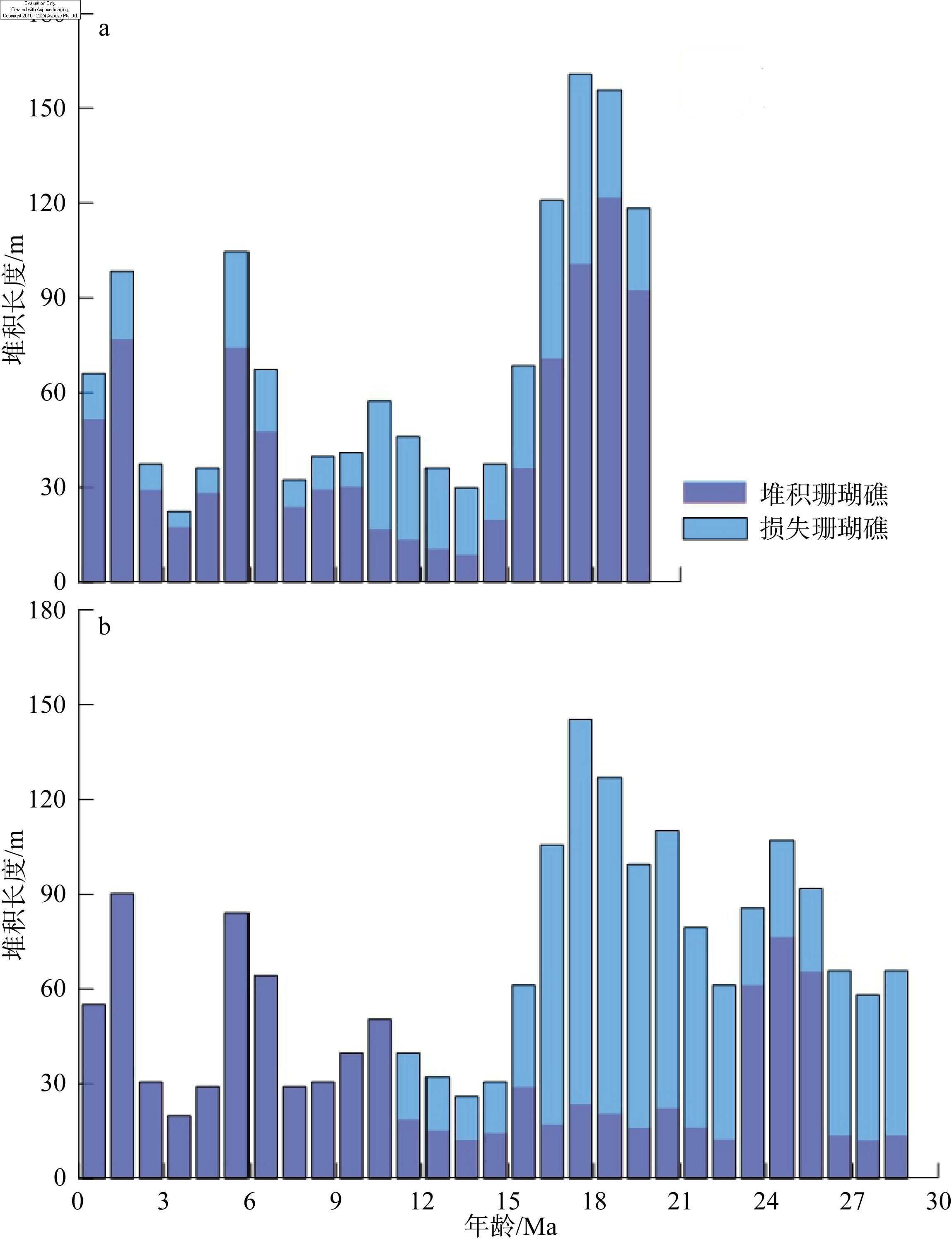
图7
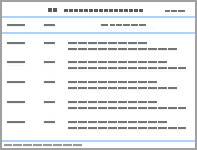
表1
采用分阶段侵蚀-沉积模型对美济礁沉积间断及某些层孤立年龄的存在进行解释, 同时列出了钙质微化石和地磁学证据的实际与可能深度"
| 实际深度/m | 年龄/Ma | 沉积事件 | 可能深度/m |
|---|---|---|---|
| 580.3 | 11.85 | Cyclicargolithus floridanus (末现面)(Martini, | 700~530 |
| 698.3 | 13.53 | Sphenolithus heteromorphus (末现面)(Martini, | 700~530 |
| 600.0 | 14.61 | 地磁层序C5ADn (底部)(Yi et al, | 700~530 |
| 845.6 | <17.71 | Sphenolithus heteromorphus (首现面)(Martini, | 1000~600 |
| 807.0 | 18.06 | 地磁层序C5En (顶部)(Yi et al, | 1000~600 |
| 887.0 | 20.71 | 地磁层序C6An.an (底部)(Yi et al, | 960~690 |
表1
图8
中晚新生代美济礁的阶段性侵蚀-沉积过程典型演化模式示意图 图a和图b分别表示珊瑚礁的水平和垂直剖面演化。图b中的虚线和实线等高线分别代表了受长期大气/水环境暴露和侵蚀影响的珊瑚礁的侵蚀和沉积情况, 这些过程导致了沉积间断以及在逐渐的构造沉降背景下的沉积; 右侧的灰线表示NK-1井的位置。美济礁的珊瑚礁是在火山基底上发展起来的, 并且在其形成过程中, 南海地区经历了5个主要侵蚀期, 因此, 在新生代的5个时期中均有大规模的侵蚀导致了超过50m的珊瑚礁损失"
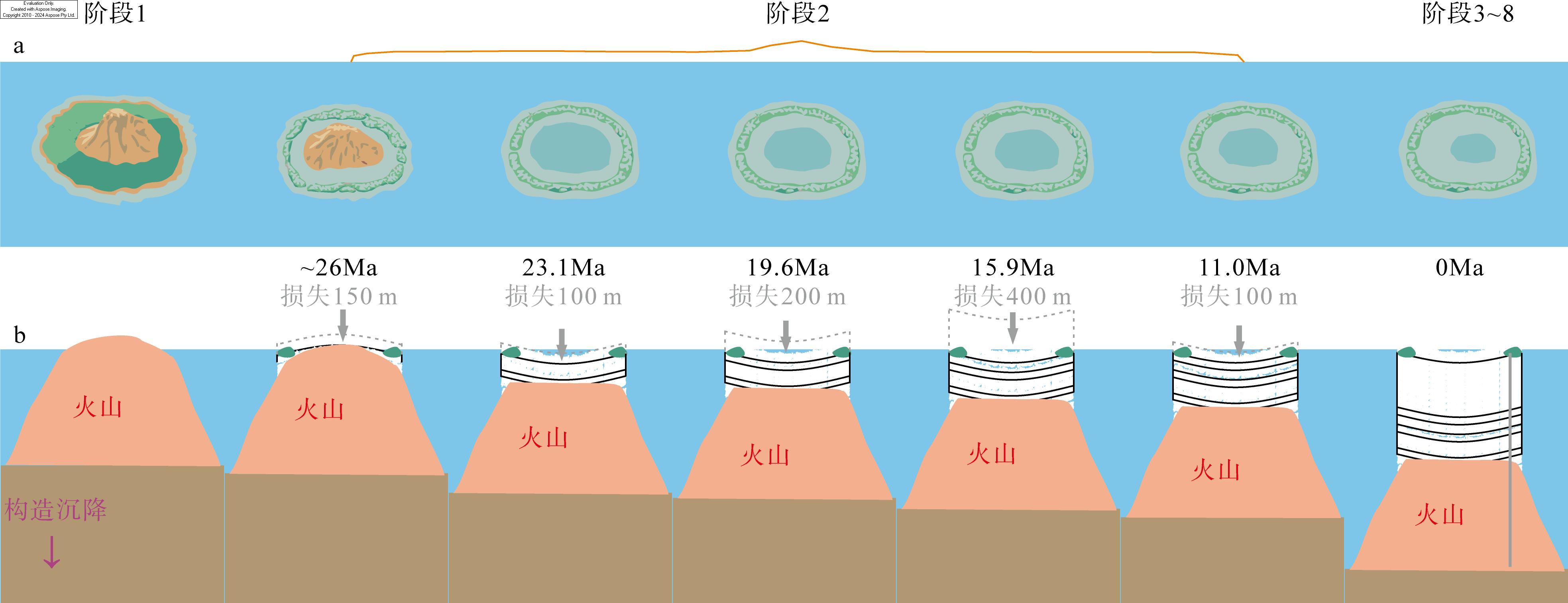
图8
| [1] |
陈北辰, 2020. 南海生物礁滩体系发育演化及其南北陆缘差异[D]. 武汉: 中国地质大学.
|
|
|
|
| [2] |
罗云, 黎刚, 徐维海, 等, 2022. 南科1井第四系暴露面特征及其与海平面变化的关系[J]. 热带海洋学报, 41(1): 143-157.
|
|
|
|
| [3] |
孙珍, 赵中贤, 李家彪, 等, 2011. 南沙地块内破裂不整合与碰撞不整合的构造分析[J]. 地球物理学报, 54(12): 3196-3209.
|
|
|
|
| [4] |
赵中贤, 孙珍, 陈广浩, 等, 2011. 南沙海域新生代构造特征和沉降演化[J]. 地球科学, 36(5): 815-822.
|
|
|
|
| [5] |
朱袁智, 王有强, 赵焕庭, 等, 1994. 南沙群岛永暑礁第四纪珊瑚礁成岩作用与海平面变化关系[J]. 热带海洋, 13(2): 1-8.
|
|
|
|
| [6] |
|
| [7] |
|
| [8] |
|
| [9] |
|
| [10] |
|
| [11] |
|
| [12] |
|
| [13] |
|
| [14] |
|
| [15] |
|
| [16] |
|
| [17] |
|
| [18] |
|
| [19] |
|
| [20] |
|
| [21] |
|
| [22] |
|
| [23] |
|
| [24] |
|
| [25] |
|
| [26] |
|
| [27] |
|
| [28] |
|
| [29] |
|
| [30] |
|
| [31] |
|
| [32] |
|
| [33] |
|
| [34] |
|
| [35] |
|
| [36] |
|
| [37] |
|
| [38] |
|
| [39] |
|
| [40] |
|
| [41] |
|
| [42] |
|
| [43] |
|
| [44] |
|
| [45] |
|
| [46] |
|
| [47] |
|
| [48] |
|
| [49] |
|
| [50] |
UNEP-WCMC,
|
| [51] |
|
| [52] |
|
| [53] |
|
| [54] |
|
| [55] |
|
| [56] |
|
| [57] |
|
| [58] |
|
| [59] |
|
| [60] |
|
| [61] |
|
| [62] |
|
| [63] |
|
| [64] |
|
| [65] |
|
| [66] |
|
| [67] |
|
| [68] |
|
| [69] |
|
| [70] |
|
| [71] |
|
| [72] |
|
| [73] |
|
| [1] | 黄康俊, 张攀, 冯东, 颜文. 海相碳酸盐岩体系镁同位素组成控制因素及其指示意义*[J]. 热带海洋学报, 2026, 45(5): 146-161. |
| [2] | 苏翔, 向荣, 易亮, 张强, 张亚南, 秦国权, 万随, 颜文. 南沙群岛新近纪碳酸盐台地中的微体化石及其意义*[J]. 热带海洋学报, 2026, 45(5): 80-93. |
| [3] | 朱小畏, 莫梓谊, 茅晟懿, 田雨杭, 罗云, 苗莉, 徐维海, 黎刚, 颜文. 南沙美济礁南科1井生物标志物组成分布特征及其环境指示*[J]. 热带海洋学报, 2026, 45(5): 162-177. |
| [4] | 黎刚, 徐维海, 罗云, 刘建国, 赵建新, 俸月星, 程俊, 孙珍, 向荣, 徐敏, 颜文. 基于南沙美济礁深钻的南海南部新生代构造演化研究[J]. 热带海洋学报, 2026, 45(5): 16-34. |
| [5] | 徐东升, 刘洋, 颜文, 金伟强. 珊瑚礁灰岩物理力学特性及数值模型研究进展[J]. 热带海洋学报, 2026, 45(5): 3-15. |
| [6] | 刘金龙, Jody Webster, Tristan Salles, 王淑红, 马一开, 徐维海, 黎刚, 颜文. 基于数值模拟的环礁形成与发育演化研究[J]. 热带海洋学报, 2026, 45(5): 128-145. |
| [7] | 王梦竹, 许珊珊, 黎树式, 李建明, 杨夏玲, 黄升. 人类活动和气候变化影响下钦江近60年悬浮泥沙浓度变化[J]. 热带海洋学报, 2026, 45(4): 126-139. |
| [8] | 袁翔城, 唐硕, 周伟华, 龙爱民. 南海珊瑚礁固碳评估方法研究进展*[J]. 热带海洋学报, 2026, 45(3): 1-9. |
| [9] | 张泽, 屈科, 王傲宇, 李玮, 王超. 类海啸波复杂珊瑚礁水动力特性三维数值模拟研究[J]. 热带海洋学报, 2026, 45(3): 39-49. |
| [10] | 束波, 张春玲, 苏涵, 胡松. 基于GDCSM_Argo的西北太平洋中上层海洋热含量与台风的调控与响应关系初探[J]. 热带海洋学报, 2026, 45(2): 81-95. |
| [11] | 姚宇, 刘小娜, 周宝宝, 周婷. 基于XBeach-NH的大糙率礁面波浪运动数值模拟[J]. 热带海洋学报, 2025, 44(5): 31-38. |
| [12] | 冯战权, 苏冒亮, 杜媛媛, 钟友凌, 张俊彬. 基于MaxEnt模型分析全球气候变化对中国沿海带鱼潜在分布的影响[J]. 热带海洋学报, 2025, 44(5): 77-85. |
| [13] | 赵中伟, 赵璇, 陈天然, 李伟. 西沙群岛珊瑚礁2015—2023年间海岸地貌演化与其区域海洋环境特征的关联性研究[J]. 热带海洋学报, 2025, 44(4): 25-44. |
| [14] | 陈裕月, 姜伟, 杨浩丹, 余克服. 近30年来涠洲岛海域海水磷含量变化及其影响因素——来自高分辨率珊瑚记录的证据[J]. 热带海洋学报, 2025, 44(3): 206-216. |
| [15] | 王超, 屈科, 王旭, 高榕泽, 王傲宇. 人工生态礁体群对非平整岛礁孤立波水动力特性影响的试验研究[J]. 热带海洋学报, 2025, 44(2): 30-38. |
|
||