

Journal of Tropical Oceanography ›› 2025, Vol. 44 ›› Issue (6): 132-142.doi: 10.11978/2025061CSTR: 32234.14.2025061
Previous Articles Next Articles
Spatiotemporal succession of the exotic mangrove Sonneratia apetala in the Maowei Sea tidal flats, Beibu Gulf
XIE Xiaokui1( ), LI Xingrong2, WANG Riming1, DAI Zhijun3(), GONG Shouji4, PANG Wenhong5, ZHANG Shangyu2
- 1
Guangxi Key Laboratory of Marine Environmental Disaster Processes and Ecological Protection Technology /College of Resources and Environment ,Beibu Gulf University
2CCCC-FHDI Engineering Co. ,Ltd.
3State Key Laboratory of Estuarine and Costal Research ,East China Normal University
4College of Food Engineering ,Beibu Gulf University
5Guangxi Key Laboratory of Marine Environmental Disaster Processes and Ecological Protection Technology / College of Marine Sciences ,Beibu Gulf University
-
Received:2025-05-08Revised:2025-05-26Online:2025-11-10Published:2025-12-03 -
Contact:DAI Zhijun. email: zjdai@sklec.ecnu.edu.cn -
Supported by:Key Special Project of Intergovernmental International Scientific and Technological Innovation Cooperation under the National Key R&D Program of China(Mechanisms of Erosion and Retreat in Estuarine Tidal Wetlands Driven by Climatic and Non-Climatic Factors and Restoration Technologies); National Natural Science Foundation Key Program of China(41930537); National Natural Science Foundation of China(42366009); Open Fund Project of the Guangxi Key Laboratory of Marine Environmental Change and Disaster in Beibu Gulf Research(2021KA02); Qinzhou Scientific Research and Technology Development Program(20223623)

CLC Number:
- Q948
Cite this article
XIE Xiaokui, LI Xingrong, WANG Riming, DAI Zhijun, GONG Shouji, PANG Wenhong, ZHANG Shangyu. Spatiotemporal succession of the exotic mangrove Sonneratia apetala in the Maowei Sea tidal flats, Beibu Gulf[J].Journal of Tropical Oceanography, 2025, 44(6): 132-142.
share this article
Add to citation manager EndNote|Reference Manager|ProCite|BibTeX|RefWorks
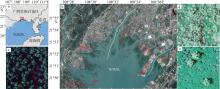
Fig. 1
Overview of the study area. (a) Geographical location of Maowei Sea in the Beibu Gulf; (b) overview of Maowei Sea; (c) mangrove forest on the tidal flats outside Kangxiling, the initial introduction location of S. apetala; (d) mangrove forest on the tidal flats outside Jianshan; (e) mangrove forest on the tidal flats outside Jianxinwei. (c, d, e) are aerial images captured by drones, each covering an area of 60m×60m with a ground resolution of 0.1m"

Fig. 1
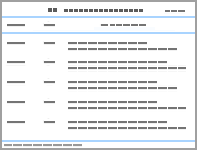
Tab. 1
Interpretation markers for S. apetala and native mangroves"
| 植被类型 | 无人机影像 | Landsat真彩色影像 | Landsat标准假彩色影像 | Sentinel-2真彩色影像 | Sentinel-2标准假彩色影像 |
|---|---|---|---|---|---|
| 无瓣海桑S. apetala | | | | | |
| 本地红树 | | | | | |
Tab. 1
Tab. 2
Spectral indices used for classification and the calculation formulas"
| 指数名称 | 计算公式 | 参考文献 |
|---|---|---|
| NDVI | $\frac{{\rho }_{\text{nir}}-{\rho }_{\text{red}}}{{\rho }_{\text{nir}}+{\rho }_{\text{red}}}$ | Rouse et al, |
| EVI | $\frac{2.5\times ({\rho }_{\text{nir}}-{\rho }_{\text{red}})}{{\rho }_{\text{nir}}+6\times {\rho }_{\text{red}}-7.5\times {\rho }_{\text{blue}}}$ | Huete et al, |
| NDWI | $\frac{{\rho }_{\text{green}}-{\rho }_{\text{red}}}{{\rho }_{\text{green}}+{\rho }_{\text{red}}}$ | Mcfeeters, |
Tab. 2
Tab. 3
Accuracy of image classification"
| 年份 | 总体精度/% | Kappa系数 |
|---|---|---|
| 2001 | 99.99 | 0.99 |
| 2004* | - | - |
| 2007 | 99.84 | 0.96 |
| 2011 | 99.99 | 0.99 |
| 2015 | 99.93 | 0.99 |
| 2019 | 99.91 | 0.99 |
| 2023 | 99.99 | 0.99 |
Tab. 3
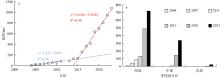
Fig. 2
Annual area changes of S. apetala. (a) Overall area change; (b) area changes by subregion"

Fig. 2
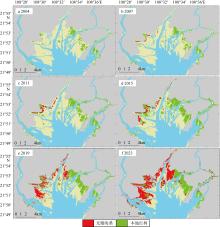
Fig. 3
Spatial distribution of S. apetala in typical years"

Fig. 3
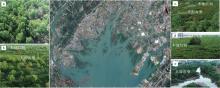
Fig. 4.
Aerial photography of S. apetala landscapes in Maowei Sea. (a) In the western tidal flat, S. apetala has formed nearly pure stands, with only a few native mangrove species visible in local canopy gaps; (b, c) in the central-western tidal flats, S. apetala has formed large patches, coexisting with native mangrove species in a mixed distribution; (d) in the eastern tidal flats, S. apetala is gradually invading in a scattered pattern; (e) S. apetala is expanding along the banks of Qinjiang River and its tributaries, encroaching on herbaceous and shrub vegetation."

Fig. 4.
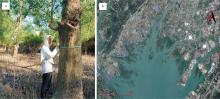
Fig. 5
The diameter at breast height (DBH) Gradient Distribution of S. apetala in Maowei Sea. (a) Field survey; (b) distribution of sampling points, with mean DBH of 0.74 m, 0.64 m, 0.60 m, and 0.44 m at locations Ⅰ, Ⅱ, Ⅲ, and Ⅳ, respectively"

Fig. 5
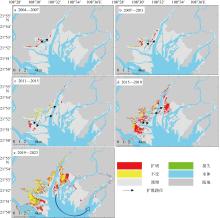
Fig. 6
Gain, loss, and unchanged extent of S. apetala in Maowei Sea during typical years"

Fig. 6
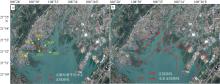
Fig. 7
Expansion patterns of S. apetala. (a) Centroid shift of S. apetala from 2004 to 2023; (b) diffusion pattern of S. apetala"

Fig. 7
| [1] |
常涛, 吴志强, 黄亮亮, 等, 2015. 茅尾海红树林水域仔稚鱼群落结构及与主要环境因子关系[J]. 应用海洋学学报, 34(2): 219-226.
|
|
|
|
| [2] |
范航清, 2018. 红树林[M]. 南宁: 广西科学技术出版社 (in Chinese).
|
| [3] |
黄李丛, 苏宏河, 唐丰利, 2013. 钦州市引种无瓣海桑现状及发展对策分析[J]. 广东科技, 22(14): 188-189 (in Chinese).
|
| [4] |
亢振军, 郭伟, 李杰, 等, 2017. 茅岭江入海口水质状况分析与评价[J]. 海洋科学前沿, 4(1): 7-16.
|
|
doi: 10.12677/AMS.2017.41002 |
|
| [5] |
李云, 郑德璋, 陈焕雄, 等, 1998. 红树植物无瓣海桑引种的初步研究[J]. 林业科学研究, 11(1): 39-44.
|
|
|
|
| [6] |
梁喜幸, 王日明, 戴志军, 等, 2023. 茅尾海钦江河口光滩时空变化过程研究[J]. 海洋地质与第四纪地质, 43(3): 107-118.
|
|
|
|
| [7] |
廖宝文, 郑德璋, 郑松发, 等, 1997. 海桑育苗技术及其幼苗生长规律的研究[J]. 林业科学研究, 10(3): 296-302.
|
|
|
|
| [8] |
廖宝文, 李玫, 郑松发, 等, 2003. 外来种无瓣海桑种内、种间竞争关系研究[J]. 林业科学研究, 16(4): 418-422.
|
|
|
|
| [9] |
蒙良莉, 凌子燕, 蒋卫国, 等, 2020. 基于Sentinel遥感数据的红树林信息提取研究——以广西茅尾海为例[J]. 地理与地理信息科学, 36(4): 41-47.
|
|
|
|
| [10] |
王炳宇, 杨珊, 刘强, 等, 2020. 外来红树植物无瓣海桑和拉关木在海南东寨港的人工种植与自然扩散[J]. 生态学杂志, 39(6): 1778-1786.
|
|
|
|
| [11] |
王日明, 梁喜幸, 周晓妍, 等, 2022. 钦江河口潮滩红树林群落空间分布[J]. 遥感学报, 26(6): 1143-1154.
|
|
doi: 10.11834/jrs.20221540 |
|
| [12] |
王日明, 苏金恒, 戴志军, 等, 2025. 钦州湾茅岭江河口红树林湿地动态变化过程[J]. 热带海洋学报, 44(6):143-154.
|
|
|
|
| [13] |
张坤, 娄安刚, 孟云, 等, 2014. 钦州湾海域纳潮量和水交换能力的数值模拟研究[J]. 海洋环境科学, 33(4): 585-591.
|
|
|
|
| [14] |
doi: 10.1016/j.ecss.2009.10.013 |
| [15] |
doi: 10.1016/j.ecss.2007.08.024 |
| [16] |
doi: 10.1016/j.gecco.2024.e03022 |
| [17] |
|
| [18] |
doi: 10.1111/rec.2013.21.issue-2 |
| [19] |
doi: 10.1177/001316446002000104 |
| [20] |
|
| [21] |
doi: 10.1038/ngeo1123 |
| [22] |
doi: 10.1126/science.317.5834.41b pmid: 17615322 |
| [23] |
doi: 10.1007/s10530-009-9660-8 |
| [24] |
doi: 10.1111/geb.2011.20.issue-1 |
| [25] |
doi: 10.1111/gcb.v26.10 |
| [26] |
doi: 10.1016/j.rse.2017.06.031 |
| [27] |
doi: 10.1038/s41467-022-33962-x pmid: 36289201 |
| [28] |
doi: 10.5343/bms.2012.1069 |
| [29] |
doi: 10.1371/journal.pone.0118880 |
| [30] |
doi: 10.1111/geb.2016.25.issue-6 |
| [31] |
doi: 10.1016/S0034-4257(02)00096-2 |
| [32] |
pmid: 843571 |
| [33] |
doi: 10.1038/nature15538 |
| [34] |
doi: 10.1007/s11273-005-5388-0 |
| [35] |
doi: 10.1080/01431169608948714 |
| [36] |
doi: 10.1073/pnas.1510272113 pmid: 26712025 |
| [37] |
doi: 10.1038/s41467-020-18118-z pmid: 32848150 |
| [38] |
doi: 10.1016/j.ecoleng.2009.05.008 |
| [39] |
|
| [40] |
doi: 10.1016/j.isprsjprs.2020.04.001 |
| [41] |
doi: 10.1016/j.isprsjprs.2022.09.011 |
| [1] | HU Xin, XIONG Lanlan, CHEN Shunyang, ZHANG Huangchen, ZOU Yiyang, ZHANG Jichao, LIU Dongxi, HE Jialu, WU Yuqi, ZHU Zhenjie. Study on biomass models of juvenile mangroves and carbon storage in young mangrove ecosystems* [J]. Journal of Tropical Oceanography, 2025, 44(4): 187-199. |
| [2] | YUAN Yujie, ZHONG Shiquan, JIANG Weiguo, CHU Aiping, LING Ziyan. Study on mangrove pests and diseases monitoring for Tieshan Port in 2023 based on HJ-2A/B satellites [J]. Journal of Tropical Oceanography, 2025, 44(3): 188-196. |
| [3] | LIU Jianyun, XIA Jialang, BAI Meng, LI Yueyao, WEI Jinhua, LIU Kai, GAO Chenghai, YI Xiangxi. The identification of glycosides from the fruit of mangrove Sonneratia apetala and investigation of their anti-aging activity in Caenorhabditis elegans [J]. Journal of Tropical Oceanography, 2025, 44(3): 148-156. |
| [4] | ZENG Debin, PENG Guangyu, YANG Bin, MO Xiaorong, ZHOU Jiaodi, HUANG Haifang, YAN Tingting. Distribution characteristics of dissolved carbohydrates and their influencing factors in the Maowei Sea, Qinzhou Bay, northern South China Sea [J]. Journal of Tropical Oceanography, 2025, 44(3): 197-205. |
| [5] | LIU Sini, BAI Meng, ZHU Yiguang, LUO Xiaowei, GAO Chenghai, LIU Yonghong, XU Xinya, JIANG Xiaodong. 2-Hydroxyphenyl thiazoline derivatives and their biosynthetic gene clusters from the mangroves-derived Strepomyces ardesiacus [J]. Journal of Tropical Oceanography, 2025, 44(2): 64-72. |
| [6] | AN Fan, JIANG Yue, WANG Yu, CAO Guangping, GAO Chenghai, LIU Yonghong, YI Xiangxi, BAI Meng. Studies on secondary metabolites of endophytic fungus Aspergillus terreus GXIMD 03158 isolated from mangroves Acanthus ilicifolius L. [J]. Journal of Tropical Oceanography, 2024, 43(5): 41-48. |
| [7] | WU Hongbo, LUO Feng, CHEN Zhipeng, ZHU Fei, ZENG Jingwei, ZHANG Chi, LI Ruijie. A novel pattern for predicting the effects of mangrove ecological reconstruction [J]. Journal of Tropical Oceanography, 2024, 43(4): 86-97. |
| [8] | LIANG Hanqiao, CHEN Wenfeng, FAN Yikai, ZHU Zidong, MA Guoxu, CHEN Deli, TIAN Jing. Research progress on the secondary metabolites and activities of endophytic fungi of genus Aspergillus and Trichoderma from mangroves [J]. Journal of Tropical Oceanography, 2023, 42(4): 12-24. |
| [9] | ZHANG Min, WU Hangxing, LU Yibin, LU Diwen, MI Jie, ZHU Donglin, CHEN Bo. Impact of the coastal reclamations on topography evolution in the Qinzhou Bay, Guangxi [J]. Journal of Tropical Oceanography, 2023, 42(2): 124-131. |
| [10] | INYANG Aniefiok Ini, ZHOU Yueyue, WANG Youshao. Characteristics of water quality and their eutrophication assessment on the mangrove ecosystems along the Guangdong coast [J]. Journal of Tropical Oceanography, 2022, 41(6): 1-11. |
| [11] | WANG Youshao. Impacts, challenges and opportunities of global climate change on mangrove ecosystems [J]. Journal of Tropical Oceanography, 2021, 40(3): 1-14. |
| [12] | Di DONG, Jisheng ZENG, Zheng WEI, Jinhui YAN. Integrating spaceborne optical and SAR imagery for monitoring mangroves and Spartina alterniflora in Zhangjiang Estuary [J]. Journal of Tropical Oceanography, 2020, 39(2): 107-117. |
|
||