

热带海洋学报 ›› 2026, Vol. 45 ›› Issue (4): 2-14.doi: 10.11978/2025171CSTR: 32234.14.2025171
平陆运河近海水域浮游细菌群落特征及其环境驱动因子*
季金洁1,2( ), 王挺1, 韦冬群1,3, 李佳霖1,4(), 秦松1,2
- 1
海岸带生物学与生物资源利用重点实验室(中国科学院烟台海岸带研究所)
2中国科学院大学
3滨州医学院 ,药学院
4北部湾大学 ,海洋学院
-
收稿日期:2025-09-22修回日期:2025-10-14出版日期:2026-07-10发布日期:2026-07-31 -
通讯作者:李佳霖。email: jlli@yic.ac.cn -
作者简介:季金洁(2001—), 女, 山东省潍坊人, 硕士研究生, 从事海洋微生物研究。email: jijinjie24@mails.ucas.ac.cn
*感谢国家基金委共享航次计划 “2023年度北部湾科学考察实验研究项目” (42349911)资助采集数据与样本, 该航次(编号: NORC2024-11)由 “蓝波1号”科学考察船实施, 在此一并致谢
-
基金资助:国家重点研发计划项目(2024YFF0808802); 国家自然科学基金项目(42576259); 国家自然科学基金项目(42176131)
Characteristics of bacterioplankton communities and their environmental driving factors in coastal areas of the Pinglu Canal*
JI Jinjie1,2(), WANG Ting1, WEI Dongqun1,3, LI Jialin1,4(), QIN Song1,2
- 1
State Key Laboratory of Coastal Biology and Biological Resource Utilization ,Yantai Institute of Coastal Zone Research, Chinese Academy of Sciences
2University of Chinese Academy of Sciences
3School of Pharmacy ,Binzhou Medical University
4College of Marine Sciences ,Beibu Gulf University
-
Received:2025-09-22Revised:2025-10-14Online:2026-07-10Published:2026-07-31 -
Contact:LI Jialin. email: jlli@yic.ac.cn -
Supported by:National Key Research and Development Program of China(2024YFF0808802); National Natural Science Foundation of China(42576259); National Natural Science Foundation of China(42176131)

摘要:
细菌群落作为环境变化的敏感指征因子, 其分布特征对于评估河口生态系统健康状态具有重要意义。2026年通航的平陆运河将承担起实现陆海连通的重要功能, 但其生态影响存在不确定性, 因而建立本底生态数据至关重要。本研究于2024年8月在平陆运河入海口沿河口区、过渡区、远海区设置采样断面, 采用16S rRNA高通量测序技术, 结合多样性与生物完整性指数计算、共现网络分析及零模型模拟方法, 解析了浮游细菌群落的结构组成与分布特征, 探讨了群落异质性与环境因子之间的关联机制。结果表明, 优势类群主要包括变形菌门(Pseudomonadota)、蓝细菌门(Cyanobacteriota)、拟杆菌门(Bacteroidota)和放线菌门(Actinomycetota), 相对丰度分别为40.1%、24.0%、16.0%和10.4%, 稀有类群在过渡区与远海区富集; α多样性表现为过渡区>河口区>远海区; 不同区域间群落结构差异极显著(P<0.01), 亚硝酸盐($\text{NO}_{2}^{-}$)是结构差异的主要环境驱动因子; 基于随机森林模型构建的细菌生物完整性指数显示, 河口区的生物完整性最低, 过渡区与远海区相对较高, 表明河口区域细菌群落结构稳定性及功能完整性相对较弱; 研究区域内细菌群落构建过程以随机过程为主导, 相对贡献率达58.0%, 水动力干扰是构建细菌群落的主要环境驱动力。本研究初步构建了平陆运河近海水域的细菌生物完整性指数, 揭示了平陆运河近海水域浮游细菌群落的分布格局, 为运河生态管理与保护提供基础数据和科学指导。
中图分类号:
- P735
引用本文
季金洁, 王挺, 韦冬群, 李佳霖, 秦松. 平陆运河近海水域浮游细菌群落特征及其环境驱动因子*[J]. 热带海洋学报, 2026, 45(4): 2-14.
JI Jinjie, WANG Ting, WEI Dongqun, LI Jialin, QIN Song. Characteristics of bacterioplankton communities and their environmental driving factors in coastal areas of the Pinglu Canal*[J]. Journal of Tropical Oceanography, 2026, 45(4): 2-14.
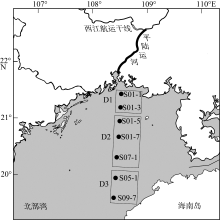
图1
北部湾采样站位图 该图基于自然资源部标准地图服务网站下载的审图号为GS(2022)4318号的标准地图制作。图中黑点为调查站位, D1、D2和D3分别代表河口区、过渡区和远海区"
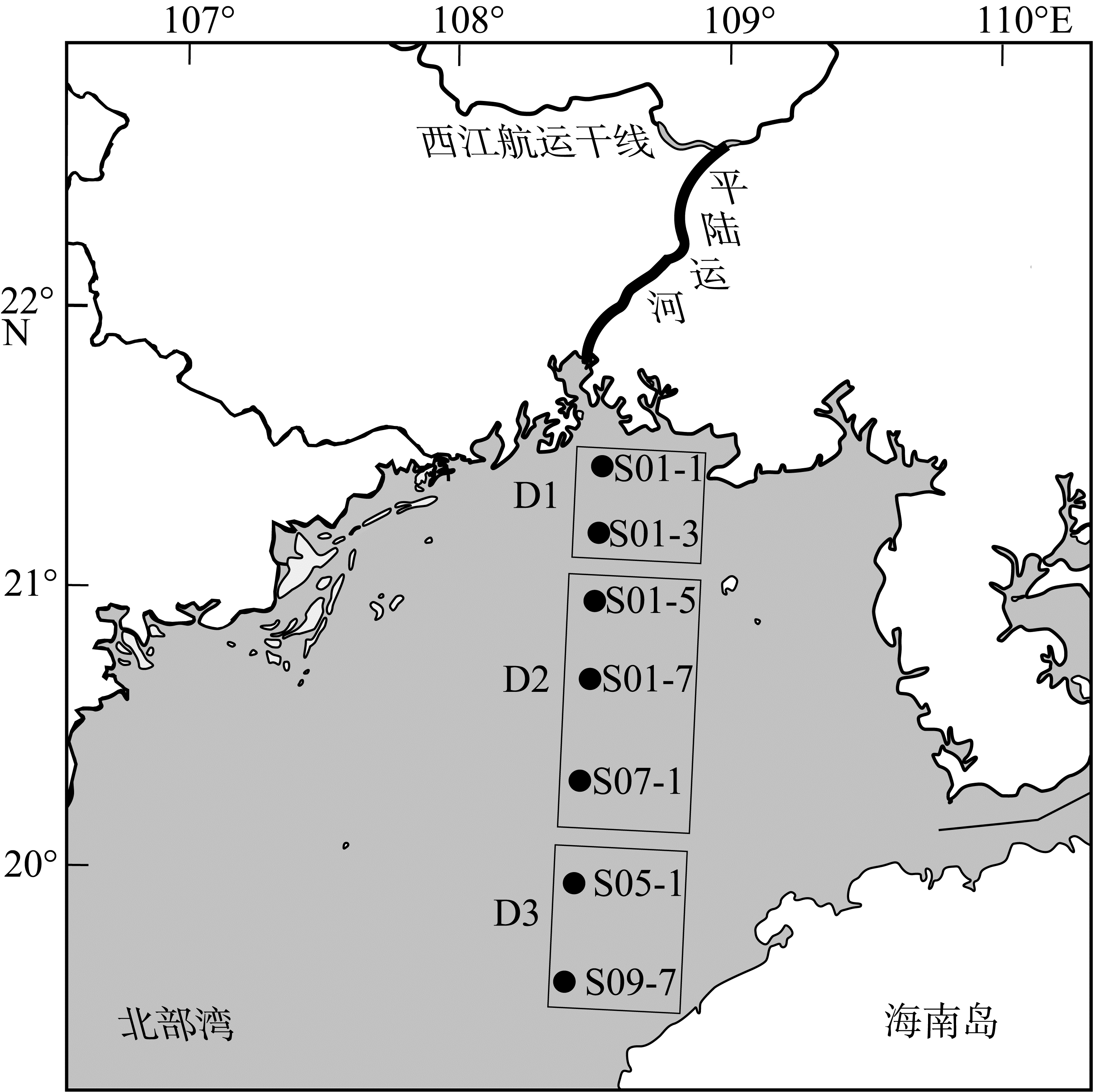
图1
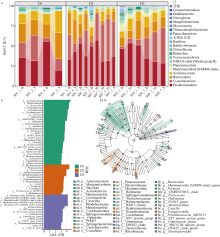
图2
不同区域中主要细菌门类的相对丰度分布(a)与LEfSe分析(b) 图a中样本按水体层次标记, 其中B表示底层水, S表示表层水"
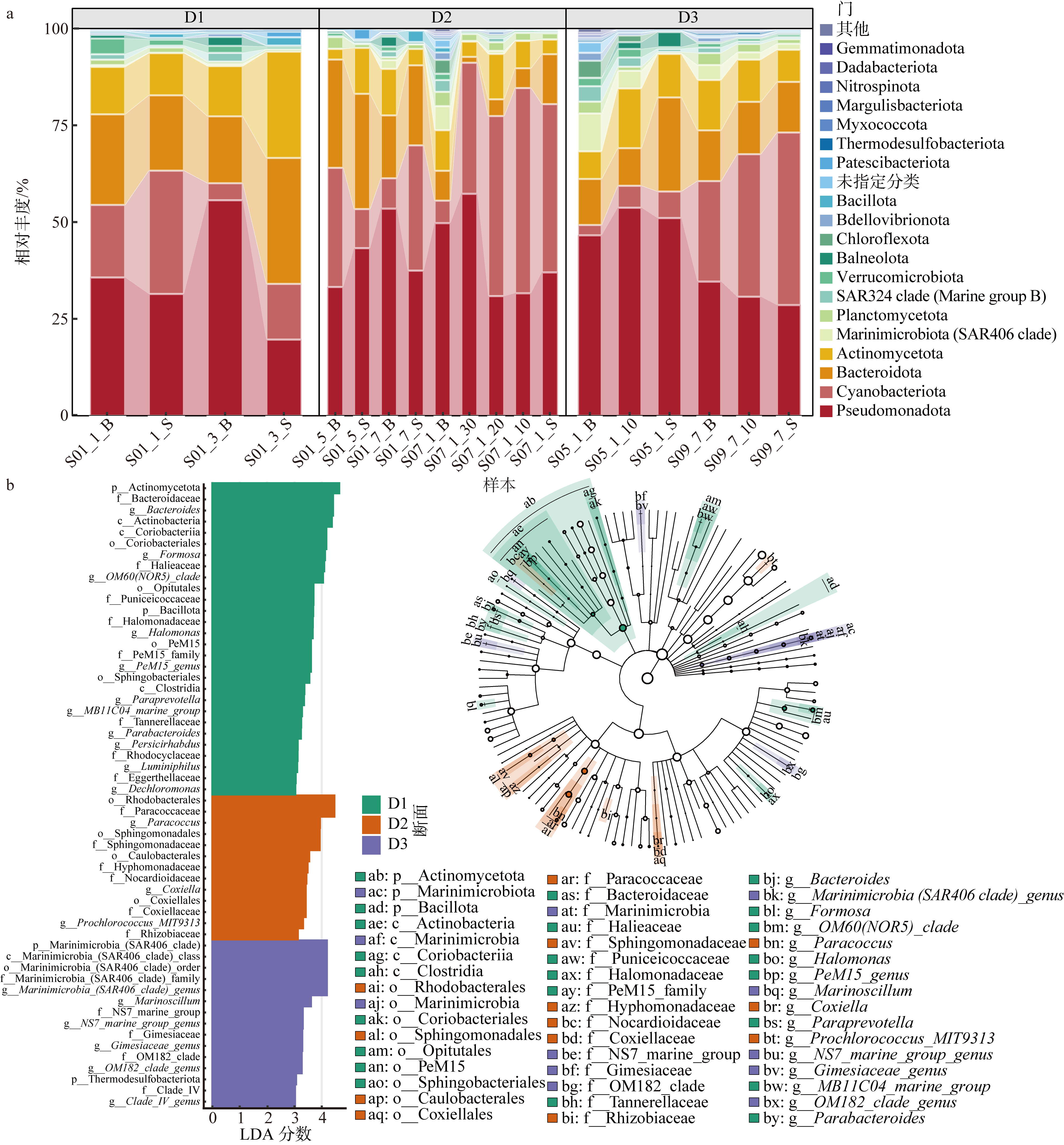
图2
图3
不同区域α多样性(a)与β多样性(b)的空间变化特征 *表示P<0.05; ns: 无显著差异"
图3
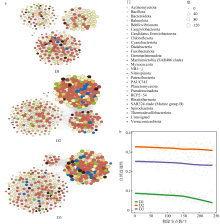
图4
不同区域浮游细菌共现网络(a)与群落稳定性(b) 图a中Unassigned: 未指定分类"

图4
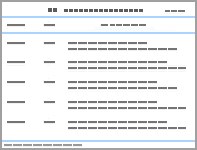
表1
不同区域浮游细菌共现网络拓扑参数"
| 区域 | 节点数 | 边数 | 平均度 | 平均路径长度 | 平均聚类系数 | 模块化 | 正向相关性/% | 负向相关性/% |
|---|---|---|---|---|---|---|---|---|
| D1 | 291 | 5808 | 39.9 | 3.8 | 0.8 | 0.8 | 85.6 | 14.4 |
| D2 | 362 | 14223 | 78.6 | 2.3 | 0.8 | 0.4 | 97.9 | 2.2 |
| D3 | 336 | 10233 | 60.9 | 2.6 | 0.8 | 0.5 | 93.7 | 6.3 |
表1
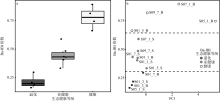
图5
细菌生物完整性指数(Ba-IBI)的生态健康等级划分(a)与分布(b) 图b中样本按水体层次标记, 其中B表示底层水, S表示表层水"
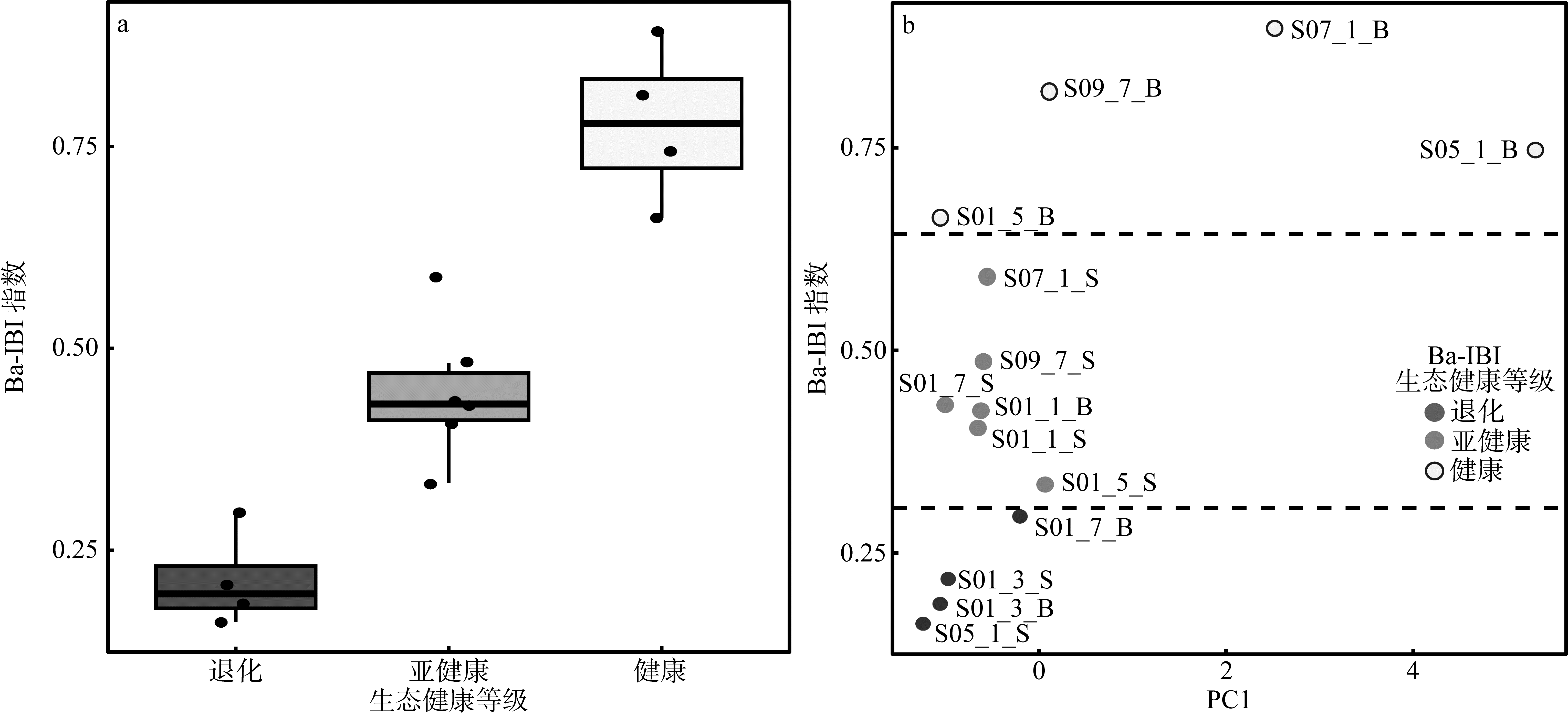
图5
图6
细菌群落组成与环境因子之间的相关性分析 *表示P< 0.05, **表示 P< 0.01, ***表示P< 0.001"
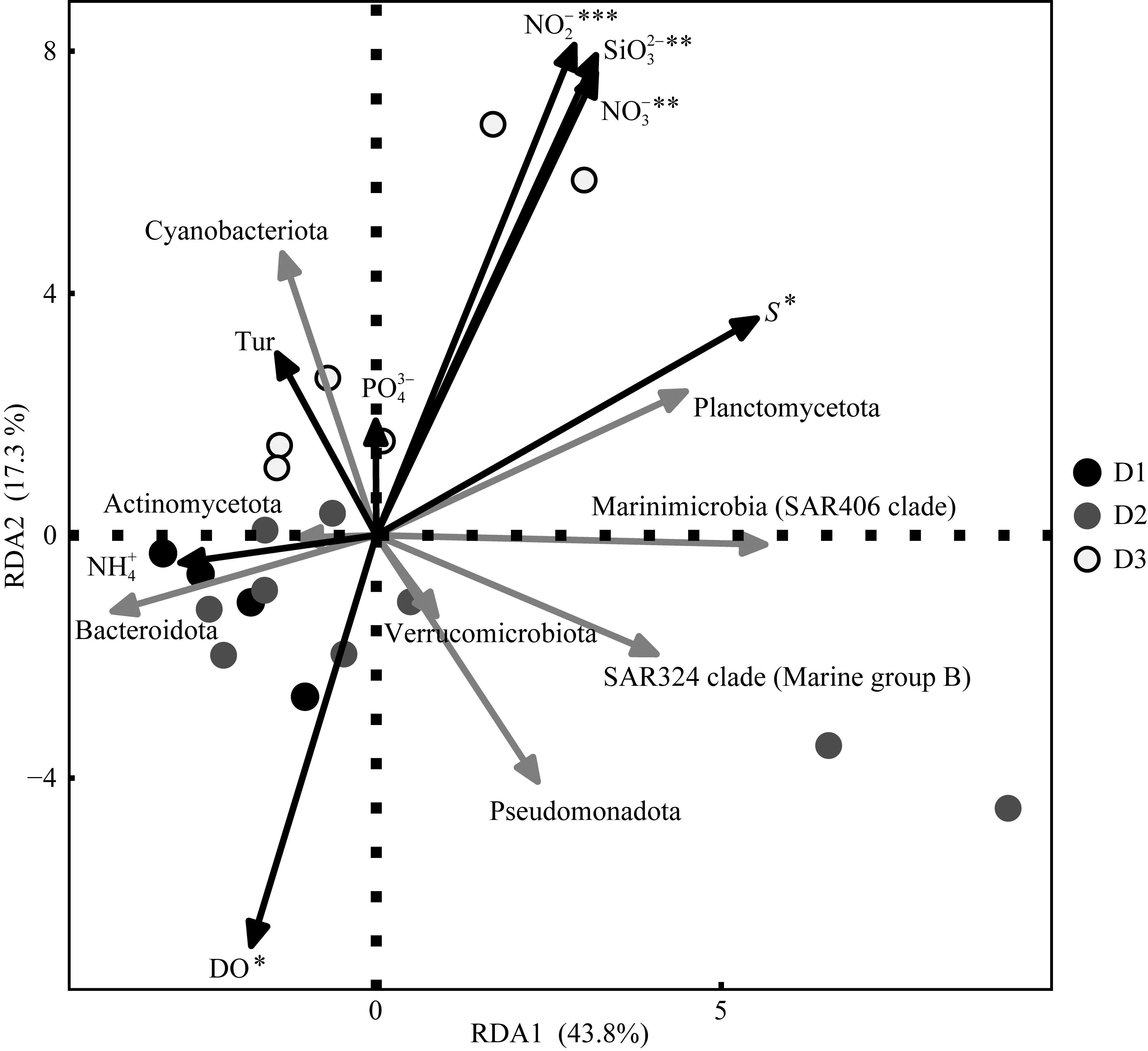
图6
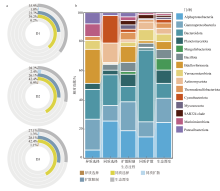
图7
不同区域细菌群落组装过程分析(a)和主要细菌门类对组装过程的相对贡献(b)"

图7
| [1] |
邓嘉辉, 王权明, 谢成磊, 2024. 陆海统筹的总氮污染治理研究进展及对策建议[J]. 海洋环境科学, 43(5): 664-671.
|
|
|
|
| [2] |
董俊德, 黄小芳, 龙爱民, 等, 2023. 红树林固氮微生物及其生态功能研究进展[J]. 热带海洋学报, 42(4): 1-11.
|
|
|
|
| [3] |
黄邦钦, 邱勇, 陈纪新, 2019. 海洋生物泵研究的若干新进展与展望[J]. 应用海洋学学报, 38(4): 474-483.
|
|
|
|
| [4] |
廖能健, 赵华显, 杨恕, 等, 2023. 广西北部湾茅尾海夏冬季浮游细菌群落结构及其影响因子[J]. 生态学报, 43(19): 8109-8121.
|
|
|
|
| [5] |
刘可, 王劼耘, 2025. 平陆运河多类型支流汇入口航道治理研究[J]. 水利水运工程学报, 4: 184-192.
|
|
|
|
| [6] |
孙军, 2011. 海洋浮游植物与生物碳汇[J]. 生态学报, 31(18): 5372-5378.
|
|
|
|
| [7] |
王符菁, 林元烧, 曹文清, 等, 2015. 北部湾北部浮游植物群落结构及其与营养盐的关系[J]. 热带海洋学报, 34(6): 73-85.
doi: 10.11978/2014134 |
|
doi: 10.11978/2014134 |
|
| [8] |
姚焕玫, 龚祝清, 钟炜萍, 等, 2021. 广西北部湾海域初级生产力与环境因子相关关系研究[J]. 海洋环境科学, 40(2): 242-249.
|
|
|
|
| [9] |
曾德斌, 彭光煜, 杨斌, 等, 2025. 南海北部钦州湾茅尾海溶解碳水化合物的分布特征及影响因素[J]. 热带海洋学报, 44(3): 197-205.
|
|
|
|
| [10] |
张金尚, 邹定辉, 马玉, 等, 2023. 南海北部水团及中尺度现象对营养盐时空分布的影响[J]. 热带海洋学报, 42(1): 168-181.
doi: 10.11978/2022043 |
|
doi: 10.11978/2022043 |
|
| [11] |
|
| [12] |
pmid: 11077159 |
| [13] |
doi: 10.1038/nmeth.3869 pmid: 27214047 |
| [14] |
|
| [15] |
doi: 10.1146/marine.2024.16.issue-1 |
| [16] |
doi: 10.1038/s41586-023-05760-y |
| [17] |
doi: 10.1126/science.1185198 pmid: 20558706 |
| [18] |
doi: 10.1038/s41586-020-2146-7 |
| [19] |
|
| [20] |
doi: 10.1016/j.tree.2025.06.008 |
| [21] |
doi: 10.1016/j.scitotenv.2023.168659 |
| [22] |
doi: 10.1016/j.marpolbul.2024.116596 |
| [23] |
|
| [24] |
doi: 10.1016/j.scitotenv.2024.172005 |
| [25] |
doi: 10.1038/s41396-020-0723-2 |
| [26] |
doi: 10.1577/1548-8446(1981)006<0021:AOBIUF>2.0.CO;2 |
| [27] |
doi: 10.1038/nrmicro.2018.9 pmid: 29398704 |
| [28] |
doi: 10.3389/fenvs.2022.900508 |
| [29] |
doi: 10.1016/j.envres.2025.122565 |
| [30] |
doi: 10.1016/j.marpolbul.2020.111742 |
| [31] |
doi: 10.5194/bg-11-481-2014 |
| [32] |
doi: 10.1016/j.jenvman.2020.111382 |
| [33] |
doi: 10.1016/j.scitotenv.2018.05.291 |
| [34] |
doi: 10.1016/j.marpolbul.2020.111064 |
| [35] |
doi: 10.1016/j.jhazmat.2023.132544 |
| [36] |
doi: 10.1016/j.scitotenv.2023.167499 |
| [37] |
doi: 10.1016/j.eiar.2024.107766 |
| [38] |
doi: S1001-0742(20)30085-1 pmid: 32446462 |
| [39] |
doi: 10.1093/femsec/fiaa255 |
| [40] |
doi: 10.1016/j.ese.2024.100451 |
| [41] |
doi: 10.1016/j.marenvres.2023.106311 |
| [42] |
doi: 10.1038/s41467-025-57054-8 |
| [43] |
doi: 10.1016/j.scitotenv.2022.160650 |
| [44] |
doi: 10.1038/s41467-020-18560-z pmid: 32948774 |
| [45] |
doi: 10.1126/sciadv.abc6434 |
| [46] |
doi: 10.1038/s41586-018-0627-8 |
| [47] |
doi: 10.1016/j.jag.2019.101902 |
| [48] |
doi: 10.1016/j.marenvres.2024.106560 |
| [49] |
doi: 10.3389/fmicb.2018.02881 pmid: 30564204 |
| [50] |
|
| [51] |
doi: 10.3389/fmicb.2020.01730 pmid: 33071990 |
| [52] |
doi: 10.1186/s40793-023-00546-1 pmid: 38178261 |
| [53] |
doi: 10.1016/j.marpolbul.2022.114380 |
| [54] |
doi: 10.1002/imt2.32 pmid: 38868720 |
| [55] |
doi: 10.1186/s40168-024-01817-w pmid: 38918820 |
| [56] |
doi: 10.1007/s11430-022-1080-8 |
| [57] |
doi: 10.1186/s40168-024-01816-x pmid: 38797849 |
| [58] |
doi: 10.1016/j.ecolind.2025.113915 |
| [59] |
|
| [60] |
doi: S0025-326X(19)30594-6 pmid: 31426242 |
| [61] |
|
| [62] |
doi: 10.1016/j.ecss.2021.107501 |
| [63] |
doi: 10.1016/j.envres.2021.110934 |
| [1] | 李新正, 杜小丽, 徐勇, 张悦, 王金宝, 隋吉星, 陈丹. 夏、冬季钦州湾茅尾海大型底栖动物群落特征及其环境影响因素探究*[J]. 热带海洋学报, 2026, 45(4): 15-28. |
| [2] | 李开枝, 黄良民, 尹健强, 连喜平, 柳原, 谭烨辉. 我国南海浮游动物生态学研究回顾与展望[J]. 热带海洋学报, 2026, 45(2): 1-15. |
| [3] | 蒋守殿, 胡鑫, 蓝珮心, 姚李勤, 水柏年, 纪建达, 何茂求. 浙江西门岛红树林细菌群落季节性特征及环境驱动因素[J]. 热带海洋学报, 2026, 45(2): 117-128. |
| [4] | 李能辉, 吕正文, 蔡红艳, 李航, 曾俊, 何海萍, 朱宇珍, 吴科锋, 赵卫, 谭华强, 罗辉. 湛江海域5种江蓠属物种(江蓠科, 红藻门)的形态与分子鉴定研究[J]. 热带海洋学报, 2025, 44(6): 74-90. |
| [5] | 何晨, 王佳宁, 周林滨, 柯志新, 刘炜炜, 刘甲星, 王军星, 谭烨辉, 陈志云. 海南新村港和黎安港海草床大型底栖生物的群落结构比较*[J]. 热带海洋学报, 2025, 44(4): 106-118. |
| [6] | 吴贵清, 李瑞华, 肖意豪, 陈彦林, 罗璇, 刘相全, 朱佳杰, 吴雪萍. 基于微卫星标记9个缢蛏群体的遗传多样性分析[J]. 热带海洋学报, 2025, 44(2): 124-136. |
| [7] | 黄红伟, 张志新, 仲嘉, 林强, 郭宝英, 严小军. 印太交汇区八种鱼类群体遗传结构和连通性分析[J]. 热带海洋学报, 2025, 44(1): 9-23. |
| [8] | 黄沁愉, 吕丽娜, 李洁, 琚慧敏, 苏宏飞. 珊瑚来源潜在降解对甲氧基肉桂酸辛酯的细菌物种多样性[J]. 热带海洋学报, 2025, 44(1): 133-145. |
| [9] | 黄雯, 冯逸, 李明, 武茜, 罗燕秋, 陈胤民, 王丽荣, 余克服. 造礁石珊瑚群体遗传学研究进展[J]. 热带海洋学报, 2024, 43(6): 13-26. |
| [10] | 江柔韵, 简丽丽, 石松标, 田新朋. 美济礁沉积砂可培养细菌多样性分析[J]. 热带海洋学报, 2024, 43(6): 170-180. |
| [11] | 谢宏宇, 刘永, 李纯厚, 赵金发, 孙金辉, 沈建忠, 石娟, 王腾. 西沙群岛浪花礁珊瑚礁鱼类种类组成与演替[J]. 热带海洋学报, 2024, 43(6): 114-128. |
| [12] | 王庆, 任辉, 柯志新. 广东南澳海水养殖区中小型浮游动物群落结构特征[J]. 热带海洋学报, 2024, 43(6): 92-103. |
| [13] | 张敬, 凌娟, 石松标, 韦章良, 范利可. 粤东上升流区不同水层可培养细菌多样性[J]. 热带海洋学报, 2024, 43(6): 80-91. |
| [14] | 饶义勇, 赵美榕, 旷泽行, 黄洪辉, 谭萼辉. 浮筏式牡蛎养殖对大型底栖动物群落功能结构的影响——以大鹏澳为例*[J]. 热带海洋学报, 2024, 43(5): 69-83. |
| [15] | 刘炜炜, 温少薇, 谭烨辉. 海水养殖水域纤毛虫多样性及其生态效应研究进展[J]. 热带海洋学报, 2024, 43(4): 1-19. |
|
||