

Journal of Tropical Oceanography ›› 2026, Vol. 45 ›› Issue (5): 94-107.doi: 10.11978/YG2025010CSTR: 32234.14.YG2025010
Previous Articles Next Articles
Formation and development of Meiji coral reefs in the South China Sea*
LIU Jianguo1,2( ), HUANG Yun1,2, XU Weihai1,2, LI Gang1,2, XIANG Rong1,2, SU Xiang1,2, LUO Yun1,2, ZHAO Zhongxian1,2, YAN Wen1,2,3()
- 1
State Key Laboratory of Tropical Oceanography ,South China Sea Institute of Oceanology, Chinese Academy of Sciences
2Laboratory of Marginal Sea and Ocean Geology ,South China Sea Institute of Oceanology, Chinese Academy of Sciences
3University of Chinese Academy of Sciences
-
Received:2025-11-04Revised:2025-12-20Online:2026-09-10Published:2026-10-13 -
Contact:YAN Wen. email:wyan@scsio.ac.cn -
Supported by:National Key Research and Development Program of China(2021-06)

CLC Number:
- P737.11
Cite this article
LIU Jianguo, HUANG Yun, XU Weihai, LI Gang, XIANG Rong, SU Xiang, LUO Yun, ZHAO Zhongxian, YAN Wen. Formation and development of Meiji coral reefs in the South China Sea*[J].Journal of Tropical Oceanography, 2026, 45(5): 94-107.
share this article
Add to citation manager EndNote|Reference Manager|ProCite|BibTeX|RefWorks
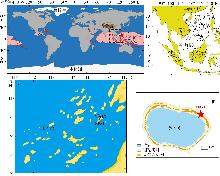
Fig. 1
Location of the NK-1 well drilled on Meiji Reef in the Nansha Islands and its regional geological setting. (a) Current coral reef distribution (red dots) (UNEP-WCMC et al, 2008), as well as the locations of the polar ice caps (white), the Tibetan Plateau (brown), and the warm pool (pink). The dashed box indicates the South China Sea and adjacent waters. The black star indicates the NK-1 well, and the numbers denote annual mean sea surface temperature (℃); (b) schematic diagram of the locations of the NK-1 (black star) and XK-1 (yellow star) wells on Yongxing Island in the South China Sea (Yi et al, 2018), and the CK 2 well (16°27'N, 111°43'E) on Chenhang Island in the northern South China Sea (Fan et al, 2020); (c) specific locations of coral reefs (yellow) around the Nansha Islands. The dashed box marks Meiji Reef; (d) detailed location of the NK-1 well on Meiji Reef"
Fig. 1
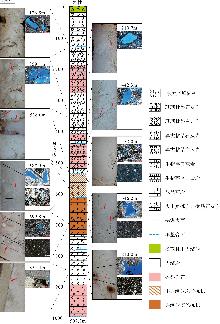
Fig. 2
Display of typical exposure surfaces of coral reefs at various depths in the Meiji Reef NK-1 well. Typical exposure surfaces observed at different depths in the Meiji Reef well in the tropical region during the late Cenozoic are shown in hand specimens (left) and thin sections (right). Sample images at depths of 126.5, 210.7, 359.1, 442.3, 538.0, 558.0, 587.9, 646.2, 699.8, 810.0, and 854.4 m are presented. Red arrows indicate the dissolution boundaries of the coral reefs"

Fig. 2
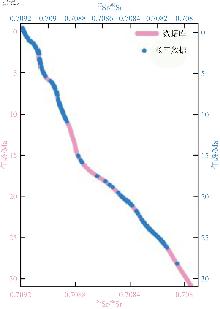
Fig. 3
Comparison of the 87Sr/86Sr ratio versus depth profile from Meiji Reef with the global seawater strontium isotope reference (McArthur et al, 2001; pink line)"
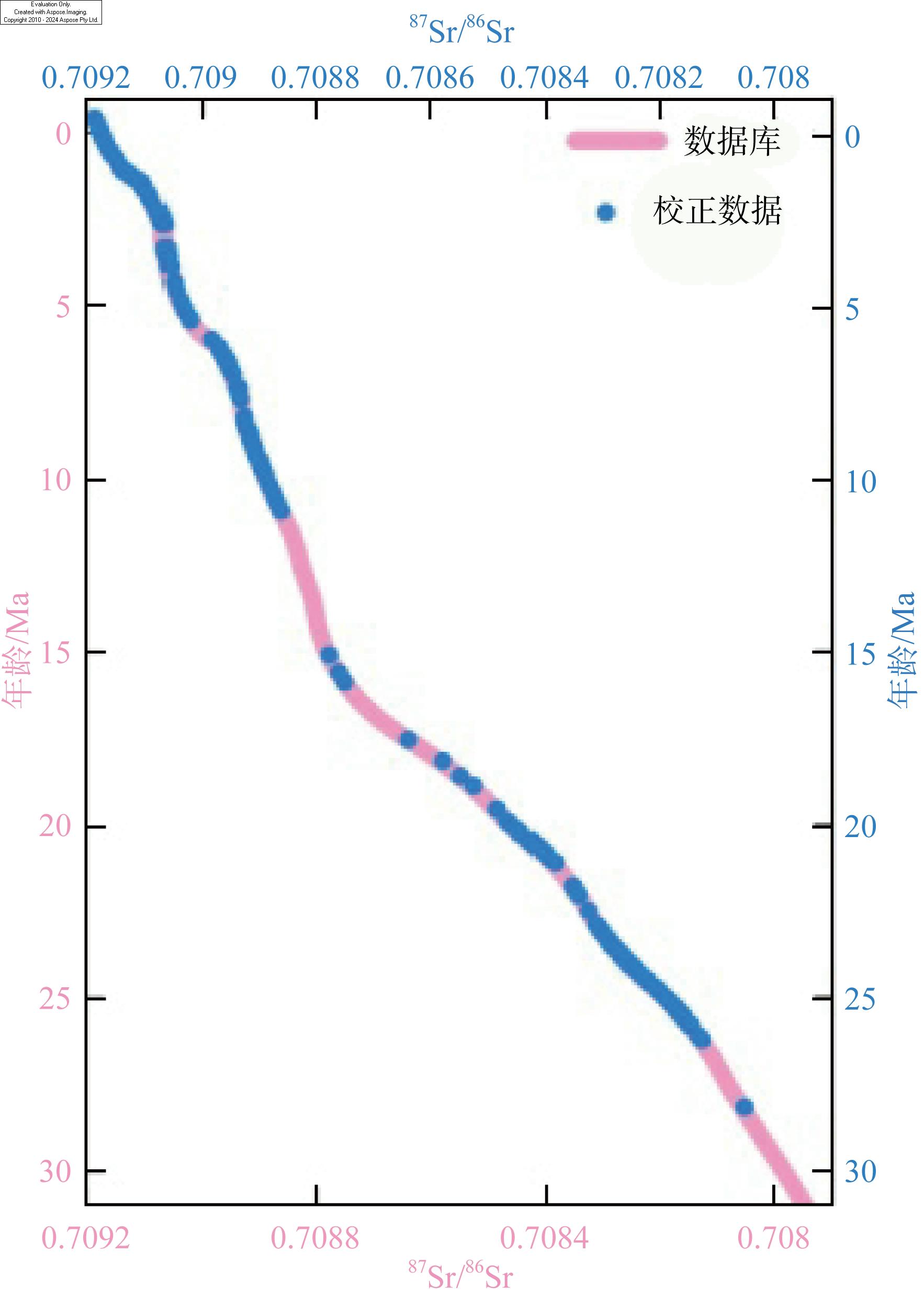
Fig. 3
Fig. 4
Lithologic profile and stage division of coral reef development on Meiji Reef in the South China Sea. The lithologic profile of coral reef development on Meiji Reef is displayed, along with the eight stages defined according to changes in minerals, isotopes, and elements. All measured parameters correspond to bulk powder samples, except for the concentrations of major elements (Al2O3 and MgO), which correspond to powder samples washed with deionized water. The figure also shows the relative sea-level data of the Xisha area (redrawn from Shao et al, 2017), the formation times of the Antarctic and Greenland ice caps (formed 23 and 2.6 Ma ago, respectively; Miller et al, 2005), the latest expansion time of the South China Sea (approximately 20 to 16 Ma ago; Sun et al, 2019), the accelerated uplift times of the Tibetan Plateau (21 and 3.6 Ma ago; An et al, 2001), and the formation and development times of the western Pacific warm pool (initially formed around 11 Ma ago and fully developed around 3.2 Ma ago; Jian et al, 2006)"

Fig. 4
Fig. 5
Characteristic XRD patterns of minerals in the eight different stages of the Meiji Reef NK-1 well. The lithologic profile on the left side of Fig. 2 provides the geological context for the distribution of these minerals. The legend for the vertical figure is shown in Fig. 2. To more clearly display the mineral composition of each stage, sample curves from different depths were selected from each divided stage of the coral reef. Above these curves, colored numbers are used to label the corresponding minerals: 1 for aragonite, 2 for high-Mg calcite, 3 for low-Mg calcite, 4 for siderite, 5 for dolomite, 6 for chlorite, 7 for illite, 8 for amphibole, 9 for quartz, 10 for microcline, and 11 for albite"
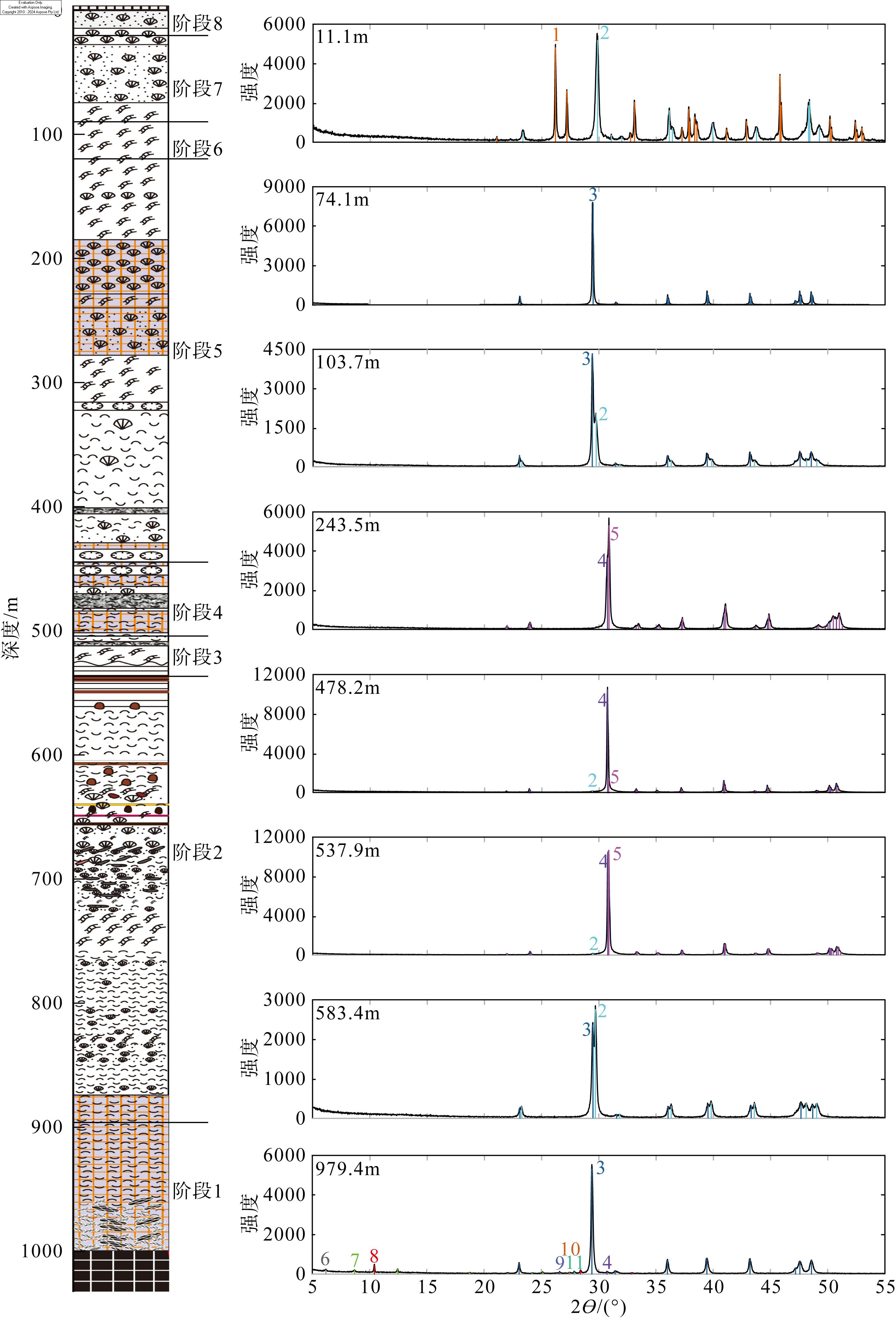
Fig. 5
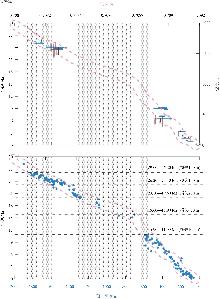
Fig. 6
Normalized depth profile of Meiji Reef, which is adjusted based on the strontium isotope curve (McArthur et al, 2001). (a) normalized depth of Meiji Reef. Blue lines indicate different depths corresponding to the same measured age, whereas brown lines indicate different ages corresponding to the same depth; (b) estimated depths of coral reefs of various ages. In particular, due to the exposure of the coral reef to the atmospheric environment, long-term sedimentary hiatuses occurred, which are marked by black dashed lines and gray shading for intervals exceeding 50 meters"

Fig. 6
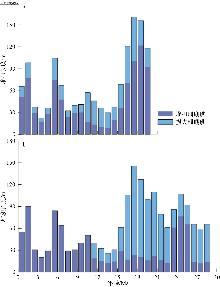
Fig. 7
Estimated accumulation and loss lengths of coral reefs on Meiji Reef from the CK-2 well on Chenhang Island, Xisha Islands (a) (Fan et al 2020) and the NK-1 well on Meiji Reef, Nansha Islands (b)"
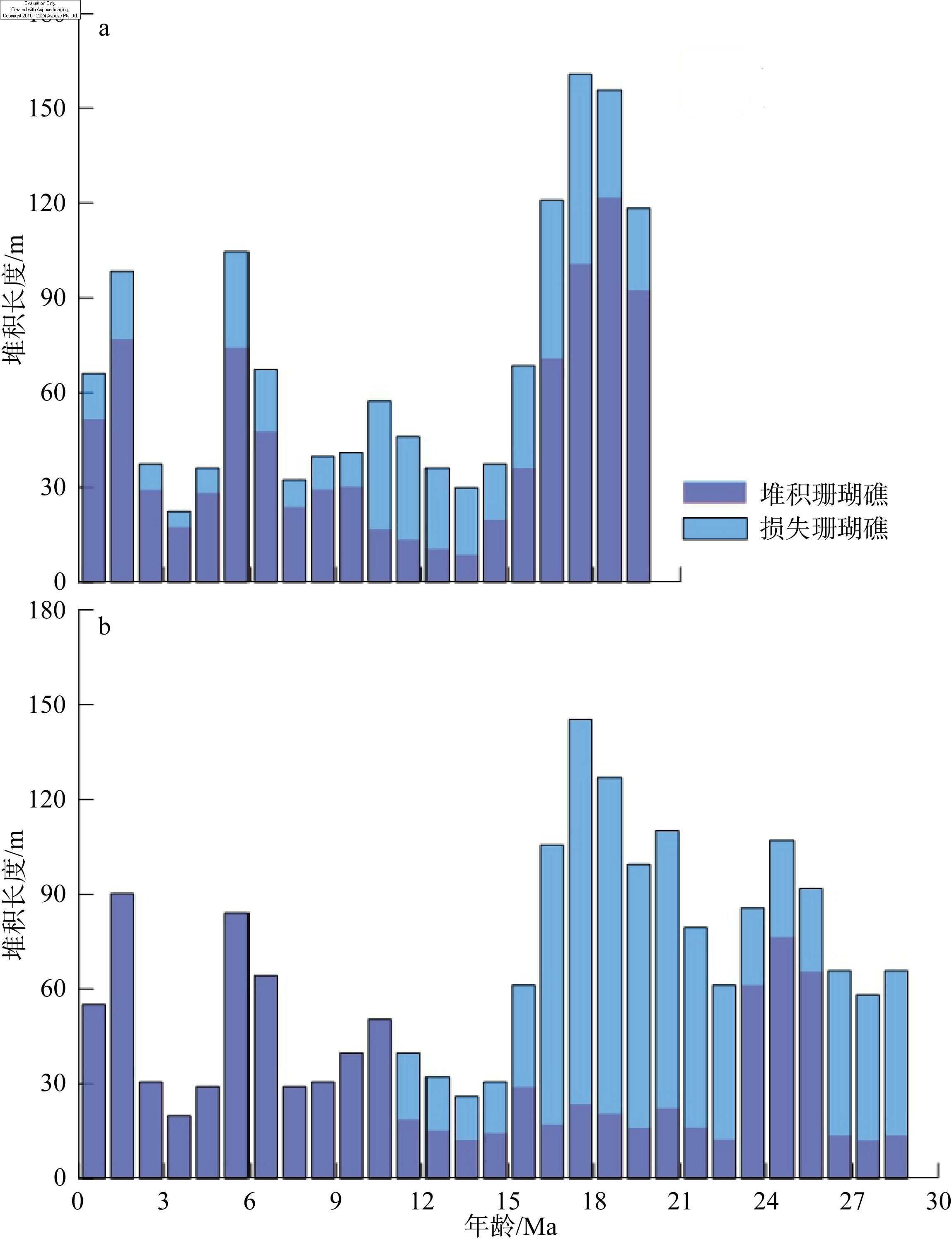
Fig. 7
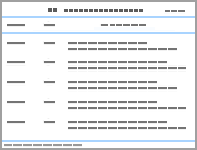
Tab. 1
Interpretation of sedimentary hiatuses and the presence of isolated ages in some layers of Meiji Reef using a staged erosion-deposition model, along with the actual and possible depths of calcareous microfossil and paleomagnetic evidence"
| 实际深度/m | 年龄/Ma | 沉积事件 | 可能深度/m |
|---|---|---|---|
| 580.3 | 11.85 | Cyclicargolithus floridanus (末现面)(Martini, | 700~530 |
| 698.3 | 13.53 | Sphenolithus heteromorphus (末现面)(Martini, | 700~530 |
| 600.0 | 14.61 | 地磁层序C5ADn (底部)(Yi et al, | 700~530 |
| 845.6 | <17.71 | Sphenolithus heteromorphus (首现面)(Martini, | 1000~600 |
| 807.0 | 18.06 | 地磁层序C5En (顶部)(Yi et al, | 1000~600 |
| 887.0 | 20.71 | 地磁层序C6An.an (底部)(Yi et al, | 960~690 |
Tab. 1
Fig. 8
Conceptual model illustrating the staged erosion-deposition process of Meiji Reef during the Middle-Late Cenozoic, presenting its typical developmental patterns. (a, b) horizontal and vertical profile development of the coral reef are shown respectively. The dashed and solid contour lines represent the erosion and deposition of the coral reefs affected by long-term exposure to atmospheric/aqueous environments and erosion, respectively, which led to sedimentary hiatuses and deposition against the backdrop of gradual tectonic subsidence. The gray line on the right indicates the location of the NK-1 well. In (b), purple arrows indicate tectonic subsidence. The coral reef of Meiji Reef developed on a volcanic basement, and during its formation, the South China Sea region experienced five major erosion periods."
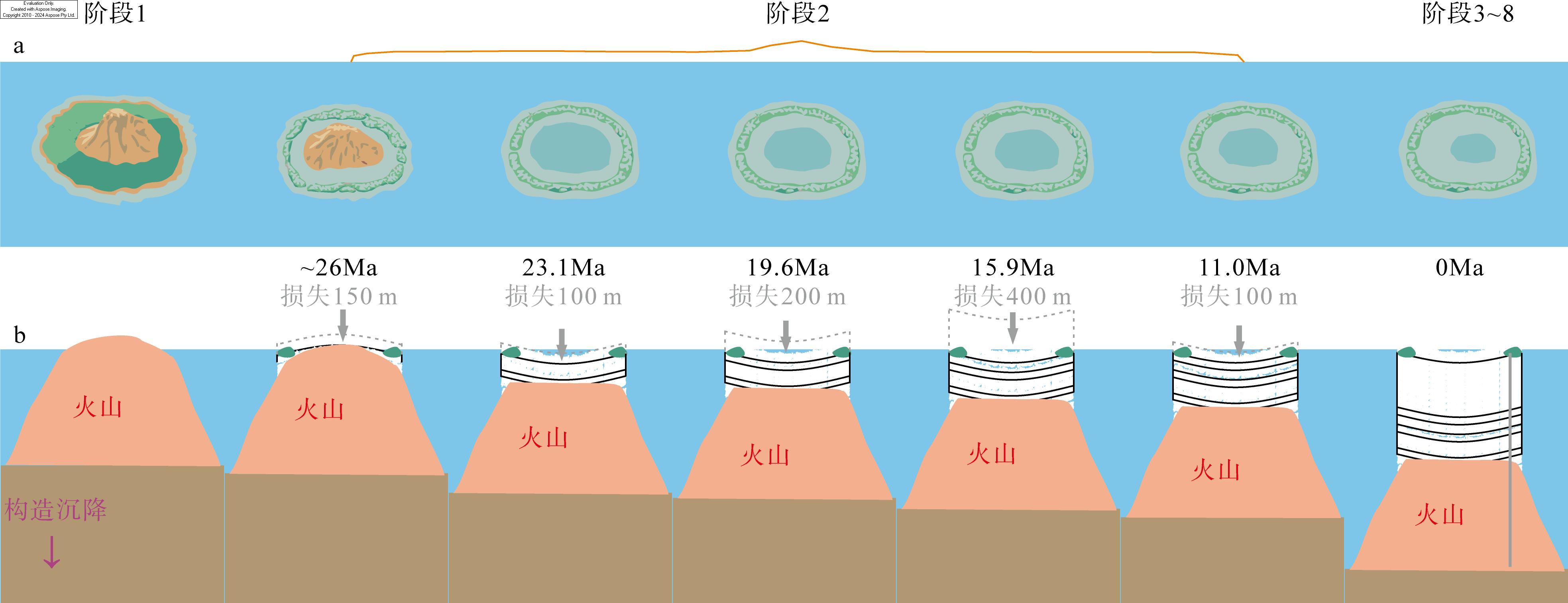
Fig. 8
| [1] |
陈北辰, 2020. 南海生物礁滩体系发育演化及其南北陆缘差异[D]. 武汉: 中国地质大学.
|
|
|
|
| [2] |
罗云, 黎刚, 徐维海, 等, 2022. 南科1井第四系暴露面特征及其与海平面变化的关系[J]. 热带海洋学报, 41(1): 143-157.
doi: 10.11978/2021013 |
|
doi: 10.11978/2021013 |
|
| [3] |
孙珍, 赵中贤, 李家彪, 等, 2011. 南沙地块内破裂不整合与碰撞不整合的构造分析[J]. 地球物理学报, 54(12): 3196-3209.
|
|
|
|
| [4] |
赵中贤, 孙珍, 陈广浩, 等, 2011. 南沙海域新生代构造特征和沉降演化[J]. 地球科学, 36(5): 815-822.
|
|
|
|
| [5] |
朱袁智, 王有强, 赵焕庭, 等, 1994. 南沙群岛永暑礁第四纪珊瑚礁成岩作用与海平面变化关系[J]. 热带海洋, 13(2): 1-8.
|
|
|
|
| [6] |
doi: 10.1016/j.quascirev.2009.07.006 |
| [7] |
pmid: 16239468 |
| [8] |
doi: 10.1038/35075035 |
| [9] |
doi: 10.1016/j.sedgeo.2004.12.030 |
| [10] |
|
| [11] |
doi: 10.1130/0091-7613(1991)019<0200:EHOESL>2.3.CO;2 |
| [12] |
doi: 10.1111/sed.2008.55.issue-2 |
| [13] |
doi: 10.1107/S0021889874010387 |
| [14] |
doi: 10.1126/science.286.5442.1104 |
| [15] |
doi: 10.1351/pac199466020273 |
| [16] |
doi: 10.2307/20025572 |
| [17] |
|
| [18] |
doi: 10.1016/j.epsl.2006.10.014 |
| [19] |
|
| [20] |
doi: 10.1130/B35088.1 |
| [21] |
doi: 10.1016/j.gca.2005.11.014 |
| [22] |
doi: 10.1127/0078-0421/2012/0020 |
| [23] |
doi: 10.1016/S1367-9120(01)00069-4 |
| [24] |
doi: 10.1130/0016-7606(1999)111<0395:CRDRPF>2.3.CO;2 |
| [25] |
doi: 10.1038/s41586-018-0041-2 |
| [26] |
doi: 10.1016/j.palaeo.2005.07.018 |
| [27] |
doi: 10.1306/122001720559 |
| [28] |
doi: 10.1007/s11430-014-4962-9 |
| [29] |
doi: 10.2110/jsr.2007.086 |
| [30] |
doi: 10.1038/ncomms11461 pmid: 27151103 |
| [31] |
doi: 10.1002/ggge.v15.12 |
| [32] |
doi: 10.1016/j.palaeo.2022.110957 |
| [33] |
doi: 10.1130/0091-7613(1988)016<0173:SISOEA>2.3.CO;2 |
| [34] |
doi: 10.1016/S0031-0182(01)00484-9 |
| [35] |
doi: 10.1007/s00338-007-0254-6 |
| [36] |
|
| [37] |
doi: 10.1086/319243 |
| [38] |
doi: 10.1126/sciadv.aaz1346 |
| [39] |
doi: 10.1126/science.1116412 pmid: 16311326 |
| [40] |
doi: 10.1016/0012-821X(92)90125-F |
| [41] |
doi: 10.1007/s10347-009-0197-1 |
| [42] |
doi: 10.1016/j.sedgeo.2016.12.001 |
| [43] |
doi: 10.1007/s00338-019-01830-8 |
| [44] |
doi: 10.1016/j.palaeo.2017.07.006 |
| [45] |
doi: 10.1038/nature01690 |
| [46] |
doi: 10.1046/j.1365-3091.1997.d01-33.x |
| [47] |
doi: 10.1016/j.jseaes.2012.12.038 |
| [48] |
doi: 10.1016/j.palaeo.2024.112093 |
| [49] |
doi: 10.1029/2019JB017584 |
| [50] |
UNEP-WCMC,
|
| [51] |
|
| [52] |
doi: 10.1016/j.margeo.2018.09.006 |
| [53] |
doi: 10.1016/j.marpetgeo.2018.02.016 |
| [54] |
doi: 10.1038/s41561-018-0127-3 |
| [55] |
doi: 10.1016/j.palaeo.2008.05.012 |
| [56] |
doi: 10.1016/j.margeo.2013.12.006 |
| [57] |
doi: 10.1016/j.palaeo.2023.111912 |
| [58] |
doi: 10.1007/s00531-021-02033-9 |
| [59] |
doi: 10.1016/j.margeo.2020.106203 |
| [60] |
doi: 10.1016/j.margeo.2013.12.016 |
| [61] |
doi: 10.1360/02tb9082 |
| [62] |
doi: 10.1016/j.margeo.2022.106758 |
| [63] |
doi: 10.1016/j.scib.2020.08.014 pmid: 36654321 |
| [64] |
doi: 10.1016/j.scib.2018.04.001 pmid: 36658843 |
| [65] |
doi: 10.1016/j.tecto.2009.06.002 |
| [66] |
doi: 10.1007/s11430-012-4449-5 |
| [67] |
doi: 10.1038/ncomms11833 pmid: 27270557 |
| [68] |
doi: 10.1016/j.sedgeo.2011.11.004 |
| [69] |
doi: 10.1016/j.palaeo.2022.111152 |
| [70] |
doi: 10.1002/ggge.v19.3 |
| [71] |
doi: 10.1111/bre.2018.30.issue-S1 |
| [72] |
doi: 10.1016/j.gloplacha.2025.104835 |
| [73] |
doi: 10.1016/j.oceaneng.2014.03.035 |
| [1] | SU Xiang, XIANG Rong, YI Liang, ZHANG Qiang, ZHANG Yanan, QIN Guoquan, WAN Sui, YAN Wen. Microfossils in the Neogene carbonate platform of Nansha Islands and their significance* [J]. Journal of Tropical Oceanography, 2026, 45(5): 80-93. |
| [2] | XU Dongsheng, LIU Yang, YAN Wen, JIN Weiqiang. Advances in the study of physical-mechanical properties and numerical models of coral reef limestone [J]. Journal of Tropical Oceanography, 2026, 45(5): 3-15. |
| [3] | LIU Jinlong, Jody Webster, Tristan Salles, WANG Shuhong, MA Yikai, XU Weihai, LI Gang, YAN Wen. The formation of atolls: new insights from numerical simulations [J]. Journal of Tropical Oceanography, 2026, 45(5): 128-145. |
| [4] | YUAN Xiangcheng, TANG Shuo, ZHOU Weihua, LONG Aimin. Research progress in carbon sequestration assessment methods for coral reefs in the South China Sea * [J]. Journal of Tropical Oceanography, 2026, 45(3): 1-9. |
| [5] | ZHANG Ze, QU Ke, WANG Aoyu, LI Wei, WANG Chao. Three-dimensional numerical investigation of hydrodynamic characteristics over complex coral reefs with tsunami-like waves [J]. Journal of Tropical Oceanography, 2026, 45(3): 39-49. |
| [6] | YAO Yu, LIU Xiaona, ZHOU Baobao, ZHOU Ting. Numerical simulation of wave motion over large roughness reef surfaces based on XBeach-NH [J]. Journal of Tropical Oceanography, 2025, 44(5): 31-38. |
| [7] | ZHAO Zhongwei, ZHAO Xuan, Chen Tianran, LI Wei. A study of the correlation between coastal morphological changes and oceanographic conditions of coral reef islands in the Xisha Islands from 2015 to 2023 [J]. Journal of Tropical Oceanography, 2025, 44(4): 25-44. |
| [8] | LI Wei, QU Ke, WANG Chao, YU Renshi, ZHANG Ze. Experimental study on the influence of submerged breakwater on the wave characteristics of infragravity waves on coral reefs [J]. Journal of Tropical Oceanography, 2025, 44(4): 177-186. |
| [9] | CHEN Yuyue, JIANG Wei, YANG Haodan, YU Kefu. Changes and controlling factors of seawater phosphorus in Weizhou Island over the past 30 years: Insights from high-resolution coral records [J]. Journal of Tropical Oceanography, 2025, 44(3): 206-216. |
| [10] | WANG Chao, QU Ke, WANG Xu, GAO Rongze, WANG Aoyu. Influences of artificial fish reef on wave hydrodynamics of solitary wave on an uneven fringing reef [J]. Journal of Tropical Oceanography, 2025, 44(2): 30-38. |
| [11] | QIU Xingyu, LIU Qingxia, CHEN Zuozhi, CAI Yancong, HUANG Honghui. Characteristics of carbon and nitrogen stable isotopes of major fish species in coral reefs of the Nansha Islands in spring 2023 [J]. Journal of Tropical Oceanography, 2024, 43(6): 104-113. |
| [12] | XIE Hongyu, LIU Yong, LI Chunhou, ZHAO Jinfa, SUN Jinhui, SHEN Jianzhong, SHI Juan, WANG Teng. Species composition and evolutionary characteristics of coral reef fish in the Langhua Reef, Xisha Islands [J]. Journal of Tropical Oceanography, 2024, 43(6): 114-128. |
| [13] | HUANG Liangmin, LIN Qiang, TAN Yehui, HUANG Xiaoping, ZHOU Linbin, HUANG Hui. Thoughts on the restoration, reconstruction and protection of typical tropical marine ecosystems [J]. Journal of Tropical Oceanography, 2024, 43(6): 1-12. |
| [14] | MO Danyang, NING Zhiming, YANG Bin, XIA Ronglin, LIU Zhijin. Response of dissimilatory nitrate reduction processes in coral reef sediments of the Weizhou island to temperature changes [J]. Journal of Tropical Oceanography, 2024, 43(4): 137-143. |
| [15] | JIANG Lyumiao, CHEN Tianran, ZHAO Kuan, ZHANG Ting, XU Lijia. Experimental study on bioerosion of marginal reefs in the Weizhou Island, northern South China Sea [J]. Journal of Tropical Oceanography, 2024, 43(3): 155-165. |
|
||