

Journal of Tropical Oceanography ›› 2026, Vol. 45 ›› Issue (1): 17-26.doi: 10.11978/2025034CSTR: 32234.14.2025034
• Review • Previous Articles Next Articles
Research progress on the characteristics of deep-sea circulation and water masses in the deep Eastern Indian Ocean*
LIANG Zhanlin1,2( ), WANG Weiqiang1,2()
- 1State Key Laboratory of Tropical Oceanography, South China Sea Institute of Oceanology, Chinese Academy of Sciences, Guangzhou 511458, China
2Guangdong Key Lab of Ocean Remote Sensing and Big Data (LORS), South China Sea Institute of Oceanology, Chinese Academy of Sciences, Guangzhou 510301, China
-
Received:2025-01-28Revised:2025-03-03Online:2026-01-10Published:2026-01-30 -
Contact:WANG Weiqiang -
Supported by:Project Deployment for the Overseas Science and Education Cooperation Center of the Chinese Academy of Sciences(133244KYSB20200024); National Key Research and Development Program of China(2022YFE0203500); Science and Technology Planning Project of Guangdong Province, China(2022B1212050003); International Partnership Program of Chinese Academy of Sciences(059GJHZ2023104MI); Development Fund of South China Sea Institute of Oceanology of the Chinese Academy of Sciences(SCSIO202201); Development Fund of South China Sea Institute of Oceanology of the Chinese Academy of Sciences(SCSIO2023HC07); Shiptime Sharing Project of National Natural Science Foundation of China (NSFC)(42249910); Shiptime Sharing Project of National Natural Science Foundation of China (NSFC)(42149910)

CLC Number:
- P731.27
Cite this article
LIANG Zhanlin, WANG Weiqiang. Research progress on the characteristics of deep-sea circulation and water masses in the deep Eastern Indian Ocean*[J].Journal of Tropical Oceanography, 2026, 45(1): 17-26.
share this article
Add to citation manager EndNote|Reference Manager|ProCite|BibTeX|RefWorks
Fig. 1
Bathymetric features of the deep Eastern Indian Ocean (EIO)"
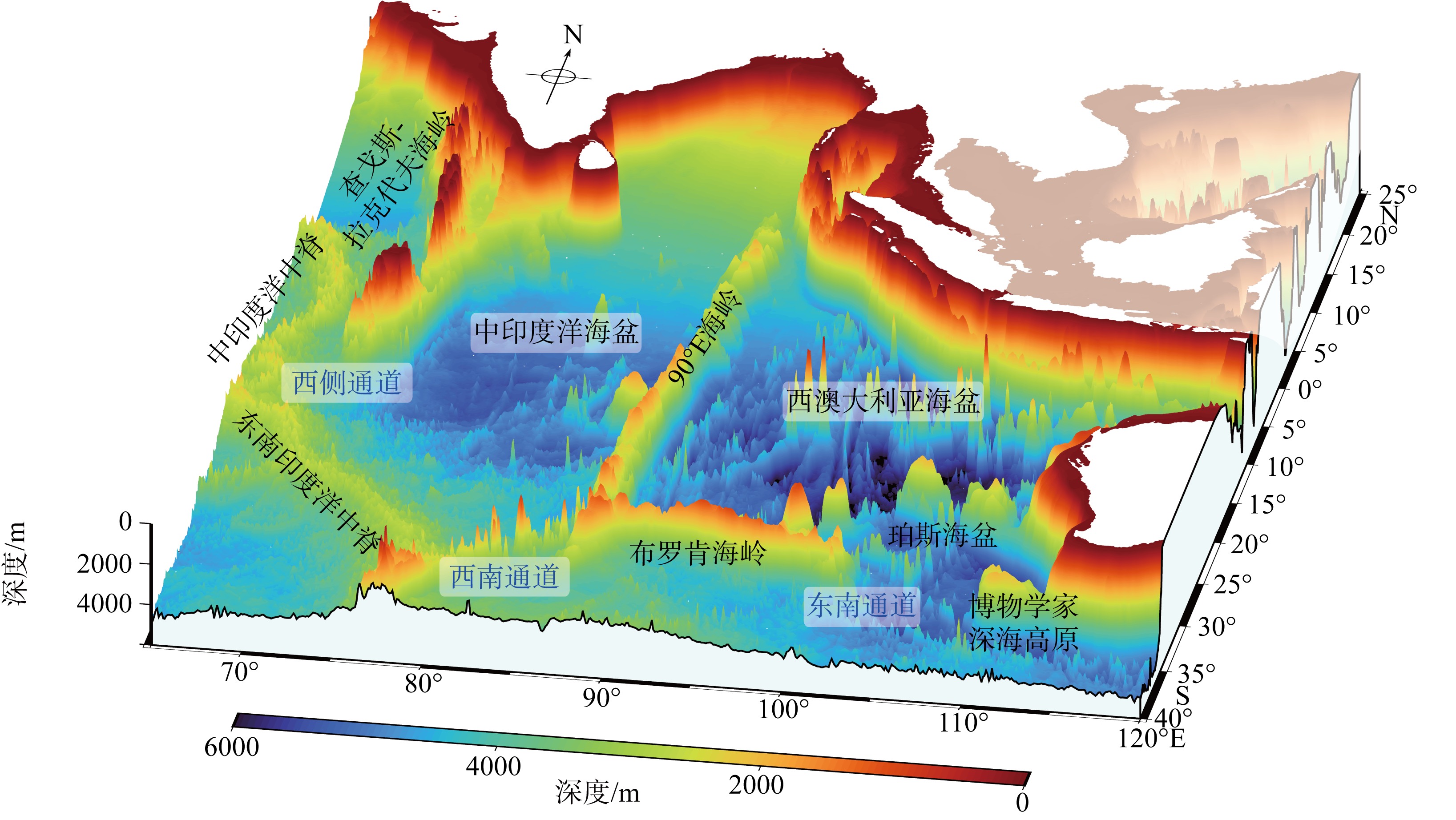
Fig. 1
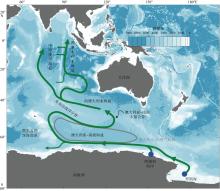
Fig. 2
Schematic diagram of the sources and pathways of bottom water in the EIO"

Fig. 2
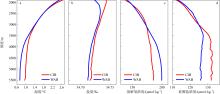
Fig. 3
Vertical variations of basin-averaged WOA23 temperature (a), salinity (b), dissolved oxygen (c), and silicate concentrations (d) over Central Indian Basin (red line) and West Australian Basin (blue line)"
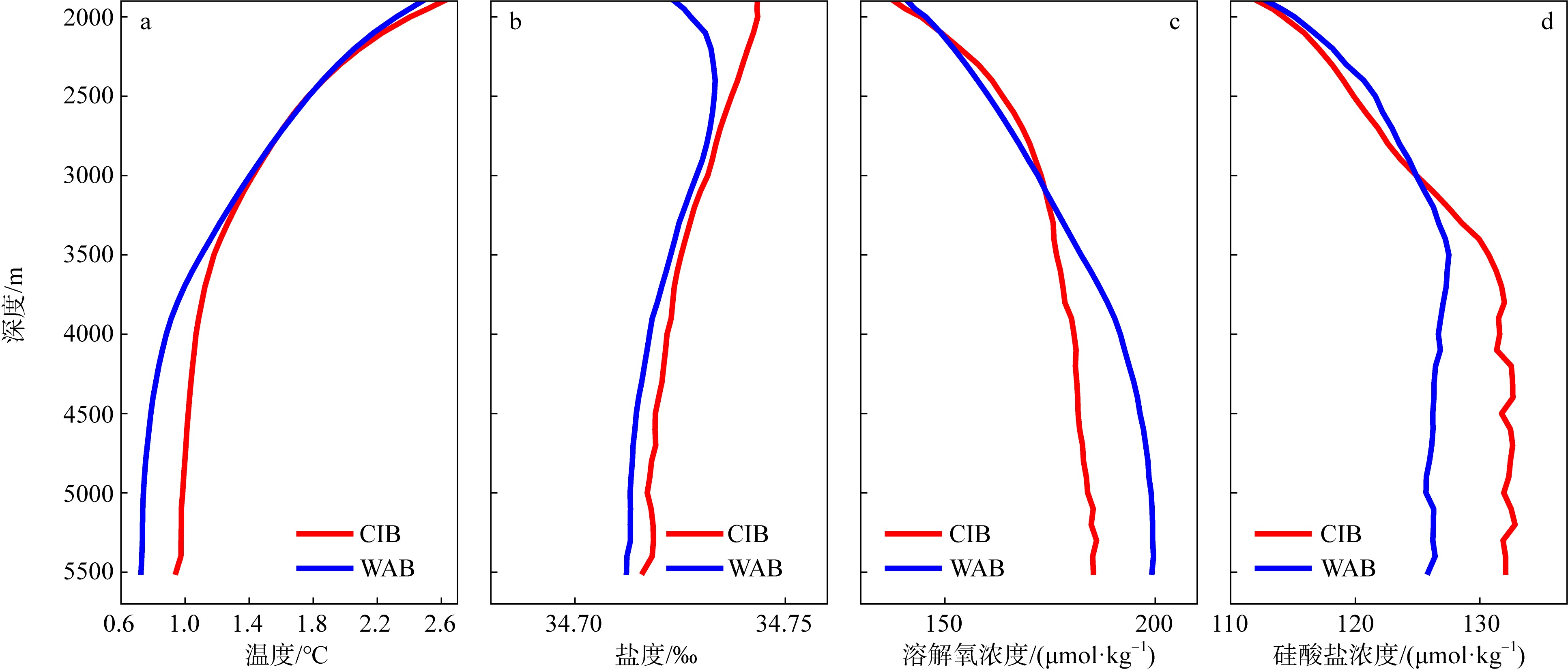
Fig. 3
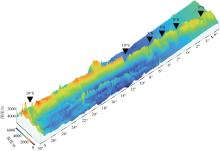
Fig. 4
Bathymetric features of the Ninety East Ridge and its saddles"

Fig. 4
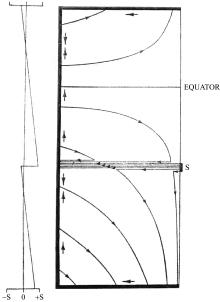
Fig. 5
Schematic pattern of horizontal circulation in a rectangular basin (representing the CIB) driven by upwelling at the top of the layer, as forced by a source S on the eastern boundary (Warren, 1982). Light lines with arrowheads denote streamlines of the interior flow. Heavy lines indicate the northern-, southern-, and western-boundary currents, with adjacent arrows showing flow direction. The bundle of streamlines represents the zonal jet flowing westward from the source. The left side shows the volume transport of the western-boundary current varying with latitude (positive values indicate northward flow), measured in units of source-strength S"
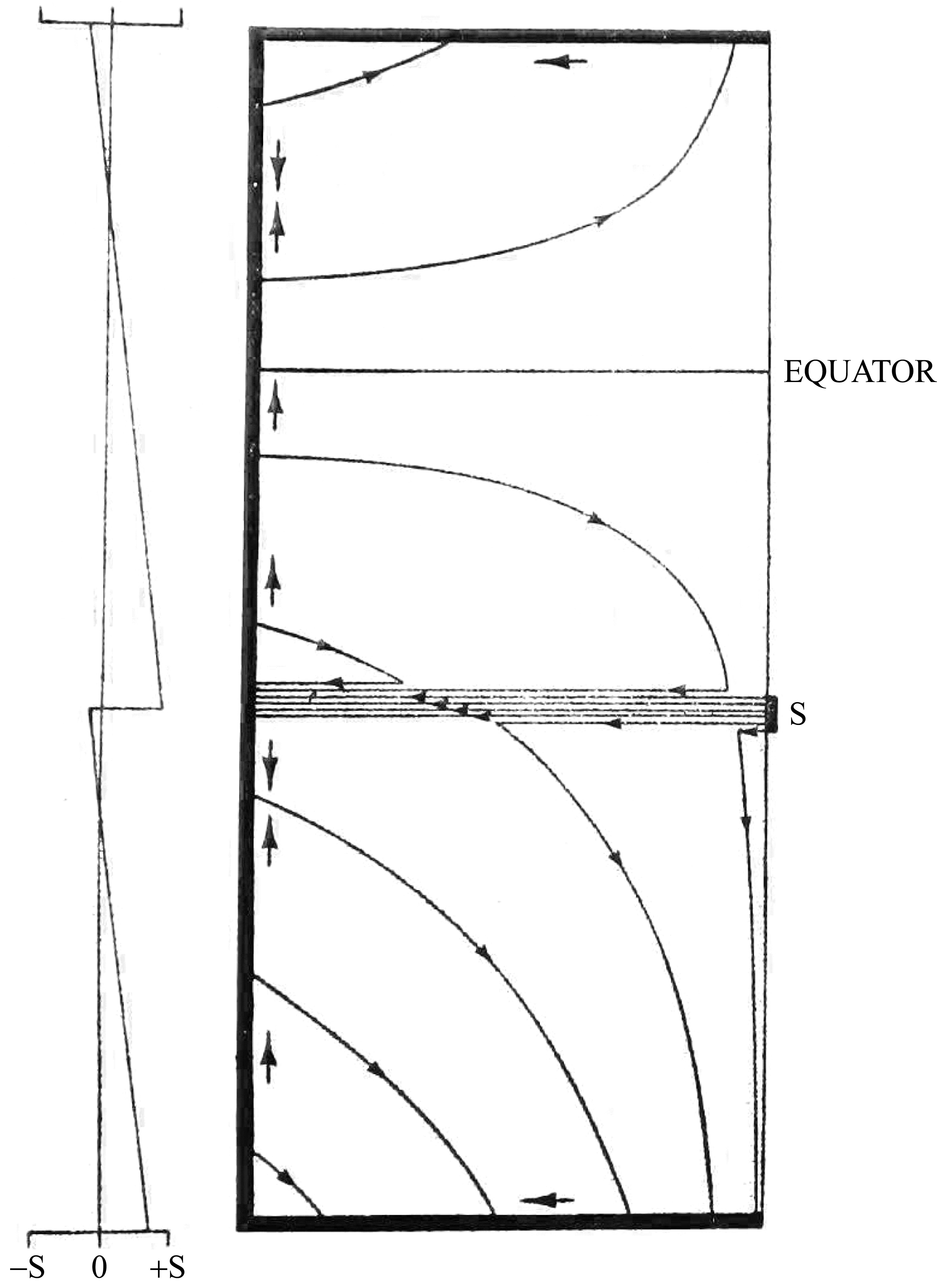
Fig. 5
| [1] |
黄旭媚, 王卫强, 刘海龙, 2016. 基于多套数据的印度洋深层经向翻转环流的动力特征[J]. 热带海洋学报, 35(4): 11-20.
doi: 10.11978/2015126 |
|
doi: 10.11978/2015126 |
|
| [2] |
朱佳豪, 裴彦良, 支鹏遥, 等, 2024. 东印度洋东经90°海岭的地球物理特征和成因探讨[J]. 海洋科学进展, 42(3): 515-531.
|
|
|
|
| [3] |
doi: 10.1002/jgrb.v121.5 |
| [4] |
doi: 10.1016/S0967-0645(00)00038-2 |
| [5] |
doi: 10.1029/JB078i026p06029 |
| [6] |
doi: 10.1029/JB078i005p00846 |
| [7] |
|
| [8] |
doi: 10.1038/136936a0 |
| [9] |
doi: 10.1029/1999GL900099 |
| [10] |
doi: 10.1175/2007JPO3640.1 |
| [11] |
|
| [12] |
doi: 10.1016/j.epsl.2010.12.051 |
| [13] |
doi: 10.1007/s004100050087 |
| [14] |
doi: 10.1038/ngeo842 |
| [15] |
|
| [16] |
doi: 10.1038/s41558-023-01667-8 |
| [17] |
doi: 10.1016/j.pocean.2016.06.005 |
| [18] |
doi: 10.1029/97GL02278 |
| [19] |
|
| [20] |
doi: 10.1016/S0079-6611(02)00021-6 |
| [21] |
|
| [22] |
|
| [23] |
|
| [24] |
doi: 10.1175/1520-0485(1998)028<0923:SCOMOA>2.0.CO;2 |
| [25] |
doi: 10.33175/mtr.2021.248158 |
| [26] |
doi: 10.1134/S0001437014020143 |
| [27] |
doi: 10.1126/science.aad0126 |
| [28] |
|
| [29] |
doi: 10.1175/JPO3130.1 |
| [30] |
doi: 10.1016/S0079-6611(98)00020-2 |
| [31] |
|
| [32] |
doi: 10.1016/j.pocean.2007.02.008 |
| [33] |
doi: 10.1016/j.pocean.2008.07.001 |
| [34] |
|
| [35] |
doi: 10.1016/S0079-6611(99)00004-X |
| [36] |
doi: 10.1016/0967-0637(95)00021-W |
| [37] |
doi: 10.1007/BF01204132 |
| [38] |
doi: 10.1016/S0924-7963(98)00026-8 |
| [39] |
doi: 10.1175/JCLI-D-11-00612.1 |
| [40] |
doi: 10.1016/S0079-6611(02)00141-6 |
| [41] |
doi: 10.1016/S0967-0637(96)00126-4 |
| [42] |
|
| [43] |
doi: 10.1029/95RG00879 |
| [44] |
|
| [45] |
doi: 10.1016/S0079-6611(01)00083-0 |
| [46] |
doi: 10.1093/petrology/egt009 |
| [47] |
doi: 10.3389/fmars.2023.1221701 |
| [48] |
|
| [49] |
doi: 10.1175/1520-0485(2001)031<0143:TSOLOT>2.0.CO;2 |
| [50] |
doi: 10.1126/science.277.5334.1956 |
| [51] |
|
| [52] |
doi: 10.1029/2000GL011748 |
| [53] |
doi: 10.1016/j.dsr.2009.07.001 |
| [54] |
doi: 10.1016/j.epsl.2020.116218 |
| [55] |
doi: 10.1016/j.earscirev.2019.102896 |
| [56] |
doi: 10.1016/S0146-6291(58)80014-4 |
| [57] |
doi: 10.1016/j.dsr.2010.01.005 |
| [58] |
doi: 10.1007/s10236-008-0134-9 |
| [59] |
|
| [60] |
doi: 10.1029/97GL02657 |
| [61] |
doi: 10.1029/2018JC014569 |
| [62] |
doi: 10.1016/0967-0637(95)00012-U |
| [63] |
doi: 10.1016/0967-0637(93)90042-2 |
| [64] |
doi: 10.1175/JPO-D-23-0082.1 |
| [65] |
doi: 10.1016/j.dynatmoce.2012.08.001 |
| [66] |
doi: 10.1175/JCLI-D-13-00472.1 |
| [67] |
pmid: 17733523 |
| [68] |
|
| [69] |
doi: 10.1016/S0967-0645(01)00156-4 |
| [70] |
doi: 10.1029/2019GC008515 |
| [71] |
|
| [72] |
|
| [73] |
|
| [74] |
doi: 10.1002/grl.v42.12 |
| [1] | SU Xiang, XIANG Rong, ZHANG Lanlan, LUO Chuanxiu, LIU Jianguo, WAN Sui, LI Zaigui, NILUFAR Yasmin Liza. Evolution of marine primary productivity on the 90°E Ridge in the northeastern Indian Ocean since the Last Glacial Period: Insights from coccolith records⁎ [J]. Journal of Tropical Oceanography, 2026, 45(1): 131-139. |
| [2] | ZHONG Qingwen, CHEN Gengxin, CHEN Ju, HE Yunkai. Intraseasonal variability and dynamical mechanisms of equatorial deep currents in the Indian Ocean* [J]. Journal of Tropical Oceanography, 2026, 45(1): 140-153. |
| [3] | WANG Xingyue, MAO Huabin, QI Yongfeng, XING Huanlin, YU Linghui, LI Xianpeng. Application and study of the DGS AT1M-11 marine gravimeter in the northeastern Indian Ocean* [J]. Journal of Tropical Oceanography, 2026, 45(1): 168-177. |
| [4] | PANG Yanran, SUN Qiwei, ZHANG Yuhong, ZHANG Ying, CHI Jianwei, DU Yan. Analysis of the mechanisms underlying the low-frequency variability of the low-salinity tongue in the southeastern Indian Ocean* [J]. Journal of Tropical Oceanography, 2026, 45(1): 154-167. |
| [5] | LI Ruofei, KE Zhixin, LI Kaizhi, LIU Jiaxin, TAN Yehui. Vertical distribution of zooplankton in the “Haima” cold seep region based on ZooScan image analysis [J]. Journal of Tropical Oceanography, 2023, 42(2): 87-96. |
| [6] | CONG Mengjing, HU Yiwei, ZHAO Kai, ZHANG Xiaoyong, LIU Yonghong, WANG Junfeng. Study on the polyketides from a cold-seep-derived Talaromyces helicus SCSIO41311 [J]. Journal of Tropical Oceanography, 2022, 41(5): 117-120. |
| [7] | LI Zhuo, LI Weibiao, ZHANG Aoqi. Analysis of diurnal variation characteristics of precipitation over South China before typhoon landfall [J]. Journal of Tropical Oceanography, 2022, 41(2): 26-37. |
| [8] | MENG Zhao, LI Ning, GUAN Yuping, FENG Yang. Exchanges of surface plastic particles in the South China Sea through straits using Lagrangian method [J]. Journal of Tropical Oceanography, 2020, 39(5): 109-116. |
| [9] | YAN Dong, SONG Dehai, BAO Xianwen. Spring-neap tidal variation and mechanism analysis of the maximum turbidity in the Pearl River Estuary during flood season [J]. Journal of Tropical Oceanography, 2020, 39(1): 20-35. |
| [10] | Shuheng LIN,Yuping GUAN,Banglin ZHANG. Deficiency of CMIP5 models in simulating changes of Pacific Walker circulation in recent three decades: the role of Sea Surface Temperature * [J]. Journal of Tropical Oceanography, 2019, 38(5): 52-67. |
| [11] | Na LIU,Guihua WANG,Yuanfa GONG,Lei LIU. An analysis of response characteristics of saline circulation to typhoon precipitation in South China Sea [J]. Journal of Tropical Oceanography, 2019, 38(3): 13-21. |
| [12] | Xiaoqiu YANG, Xiaobin SHI, Junfeng ZHAO, Chuanhai YU, Hongfang GAO, Aihua CHEN, Yuanzheng LU, Xianrong CEN, Weiren LIN, Xin ZENG, Hehua XU, Ziqiang REN, Shengqi ZHOU, Ziying XU, Jinlong SUN, Nana KAMIYA, Jian LIN. Bottom water temperature measurements in the South China Sea, eastern Indian Ocean and western Pacific Ocean* [J]. Journal of Tropical Oceanography, 2018, 37(5): 86-97. |
| [13] | Jiazheng ZHANG, Jianping ZHOU, Minghui ZHAO, Xuelin QIU. Progress and prospect of anisotropic study of hydrothermal field (49º39'E) on the Southwest Indian Ridge [J]. Journal of Tropical Oceanography, 2017, 36(6): 71-81. |
| [14] | Yanping SHI, Yan DU, Zesheng CHEN. Impacts of Northwest Pacific anomalous anticyclone on sea surface height and circulation [J]. Journal of Tropical Oceanography, 2017, 36(4): 10-17. |
| [15] | HUANG Xumei, WANG Weiqiang, LIU Hailong. The dynamic characteristics of deep meridional overturning circulation in the Indian Ocean based on six reanalysis datasets [J]. Journal of Tropical Oceanography, 2016, 35(4): 11-20. |
|
||