

Journal of Tropical Oceanography ›› 2026, Vol. 45 ›› Issue (4): 41-62.doi: 10.11978/2025225CSTR: 32234.14.2025225
• Marine Ecology • Previous Articles Next Articles
Seasonal dynamics and community assembly of invertebrate in the coastal waters of the Beibu Gulf based on metabarcoding technology
LI Xiaoting1( ), FU Jia1, QIU Menghan1, WU Zongqi1, LI Haochen1, LIU Ying1, PENG Chunyan1, TANG Jianhui1,2, GONG Bin1()
- 1
Pinglu Canal and Beibu Gulf Coastal Ecosystem Observation and Research Station of Guangxi ,Guangxi Key Laboratory of Marine Environmental Disaster Processes and Ecological Protection Technology, College of Marine Sciences, Beibu Gulf University
2Laboratory of Coastal Environmental Processes and Ecological Remediation ,Yantai Institute of Coastal Zone Research, Chinese Academy of Sciences
-
Received:2025-09-01Revised:2025-09-25Online:2026-07-10Published:2026-07-31 -
Contact:GONG Bin. email: gongbin@bbgu.edu.cn -
Supported by:Guangxi Key Research and Development Program(GuikeAB24010146); Key Project of Guangxi Natural Science Foundation(2020GXNSFDA238015)

CLC Number:
- P735
Cite this article
LI Xiaoting, FU Jia, QIU Menghan, WU Zongqi, LI Haochen, LIU Ying, PENG Chunyan, TANG Jianhui, GONG Bin. Seasonal dynamics and community assembly of invertebrate in the coastal waters of the Beibu Gulf based on metabarcoding technology[J].Journal of Tropical Oceanography, 2026, 45(4): 41-62.
share this article
Add to citation manager EndNote|Reference Manager|ProCite|BibTeX|RefWorks
Fig. 1
Spatial distribution of sampling sites in Beibu Gulf. Sixteen black dots represent the sixteen sampling sites"
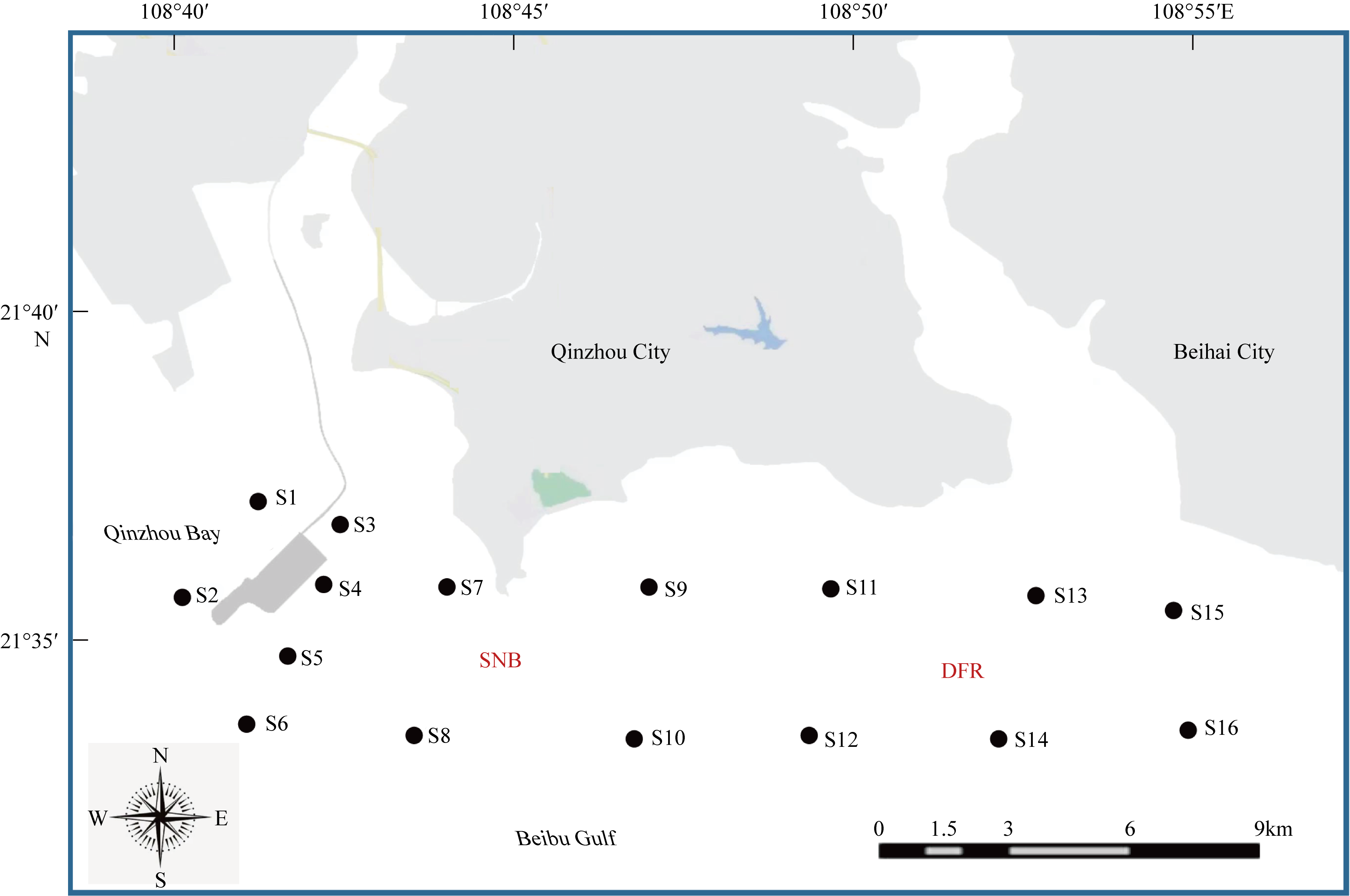
Fig. 1
Fig. 2
Relative abundance of invertebrates in Sanniang Bay and the Dafeng River estuary in March (a), July (b), September (c), and December (d)"
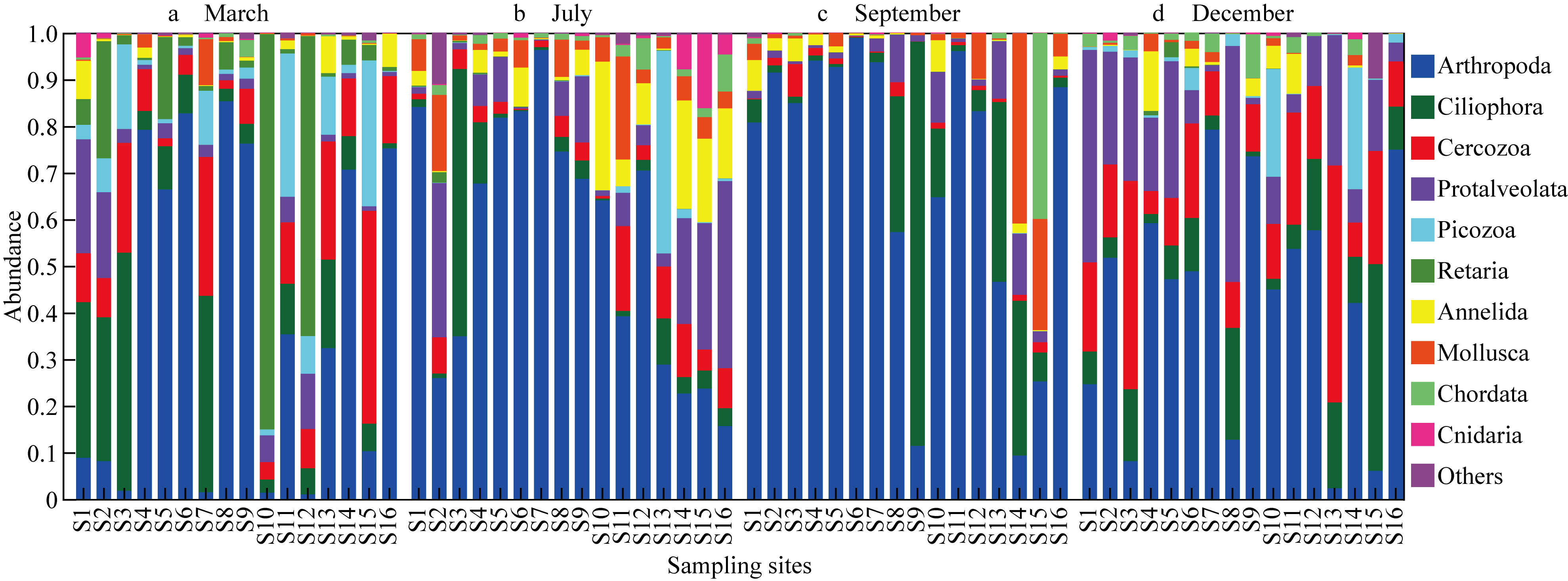
Fig. 2
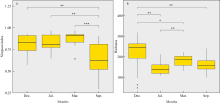
Fig. 3
Seasonal variation in alpha diversity indices: Simpson index (a) and species richness (b). Note: for one-way ANOVA, * denotes P<0.05, ** denotes P <0.01, *** denotes P<0.001"
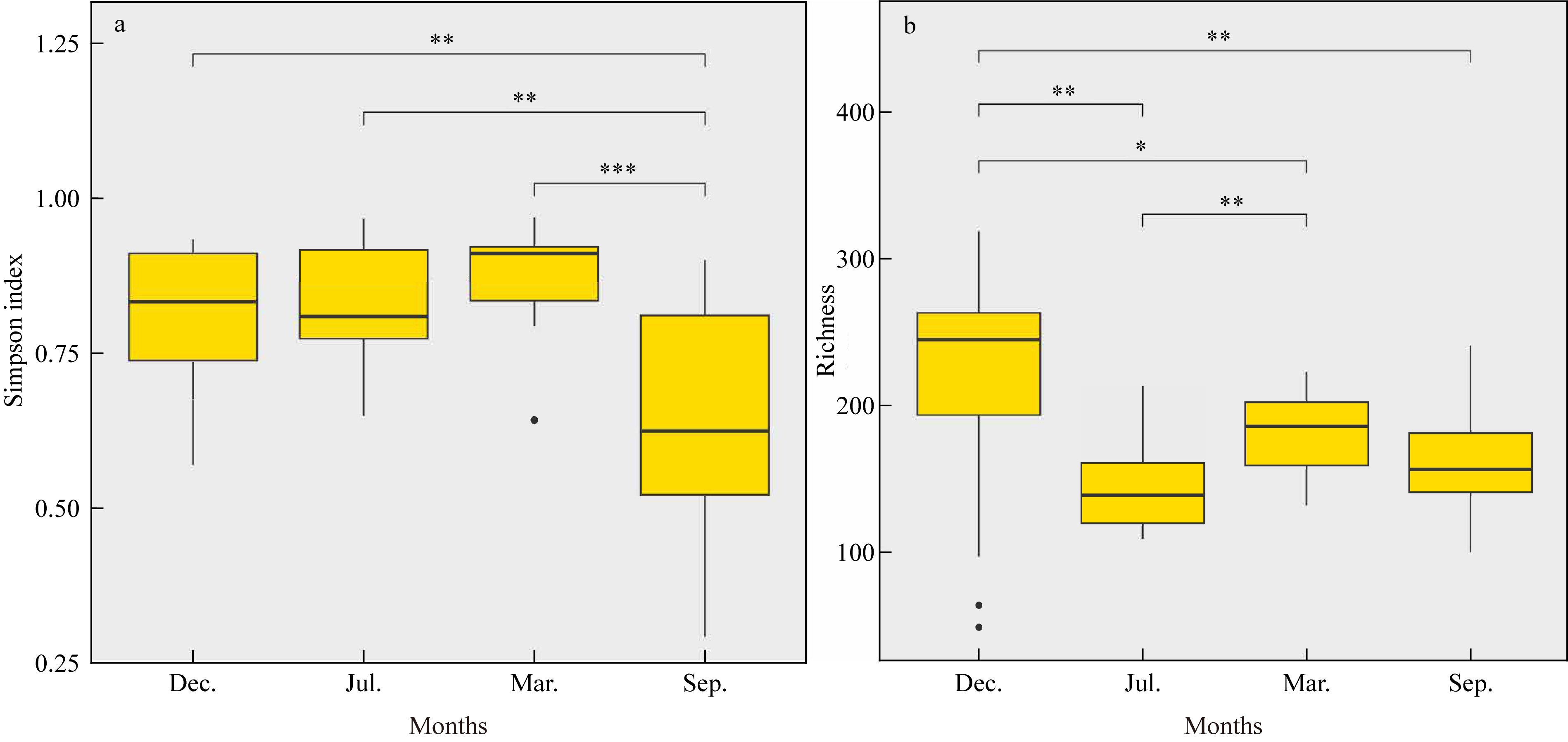
Fig. 3
Tab. 1
Linear regression analysis of alpha diversity indices: Simpson index, Shannon index, and species richness with environmental factors in March, July, September, and December"
| months | alpha-diversity metric | pH | TN | TEMP | $\text{NO}_{3}^{-}$ | Turbidity | DO | Chl-a | TOC |
|---|---|---|---|---|---|---|---|---|---|
| March | Shannon | 0.44** | 0.24 | 0.25* | 0.0025 | 0.006 | 0.001 | 0.015 | 0.005 |
| Simpson | 0.34* | 0.35* | 0.20 | 0.11 | 0.017 | 0.008 | 0.007 | 0.004 | |
| Richness | 0.23 | 0.002 | 0.22 | 0.26* | 0.019 | 0.099 | 0.16 | 0.025 | |
| July | Shannon | 0.11 | 0.28* | 0.24 | 0.27* | 0.50* | 0.18 | 0.32* | 0.23 |
| Simpson | 0.051 | 0.26* | 0.21 | 0.38* | 0.47** | 0.27* | 0.28* | 0.16 | |
| Richness | 0.093 | 0.32* | 0.22 | 0.13 | 0.55*** | 0.041 | 0.26* | 0.25* | |
| September | Shannon | 0.003 | 0.015 | 0.31* | 0.035 | 0.081 | 0.0007 | 0.12 | 0.0009 |
| Simpson | 0.004 | 0.035 | 0.32* | 0.057 | 0.10 | 0.0004 | 0.11 | 0.0056 | |
| December | Shannon | 0.16 | 0.006 | 0.21 | 0.16 | 0.19 | 0.002 | 0.35* | 0.11 |
| Simpson | 0.049 | 0.0011 | 0.094 | 0.091 | 0.21 | 0.001 | 0.40** | 0.13 |
Tab. 1
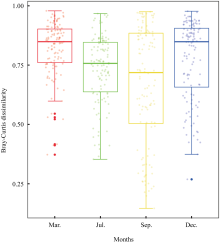
Fig. S1
Bray-Curtis dissimilarity between two sampling sites in different seasons"
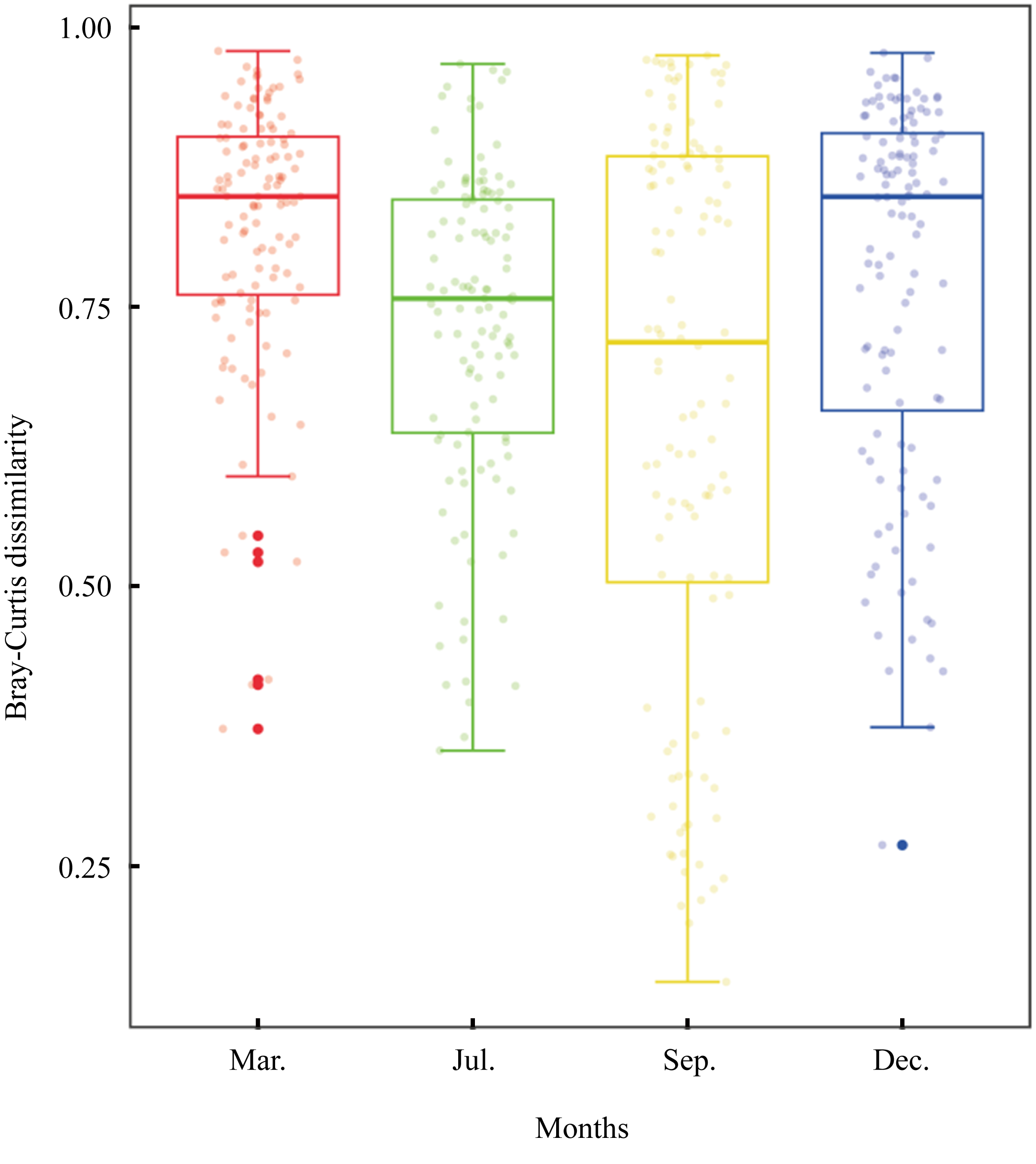
Fig. S1
Fig. S2
Relationships between Bray-Curtis dissimilarity and geographical distance, pH, TN, $\text{NO}_{2}^{-}$, and Chl-a in March. The black line represents the linear regression, r indicates the degree of correlation, and P-values were calculated to indicate significant differences"

Fig. S2
Fig. S3
Relationships between Bray-Curtis dissimilarity and geographical distance, pH, salinity, and TN in July. The black line represents the linear regression, r indicates the degree of correlation, and P-values were calculated to indicate significant differences"
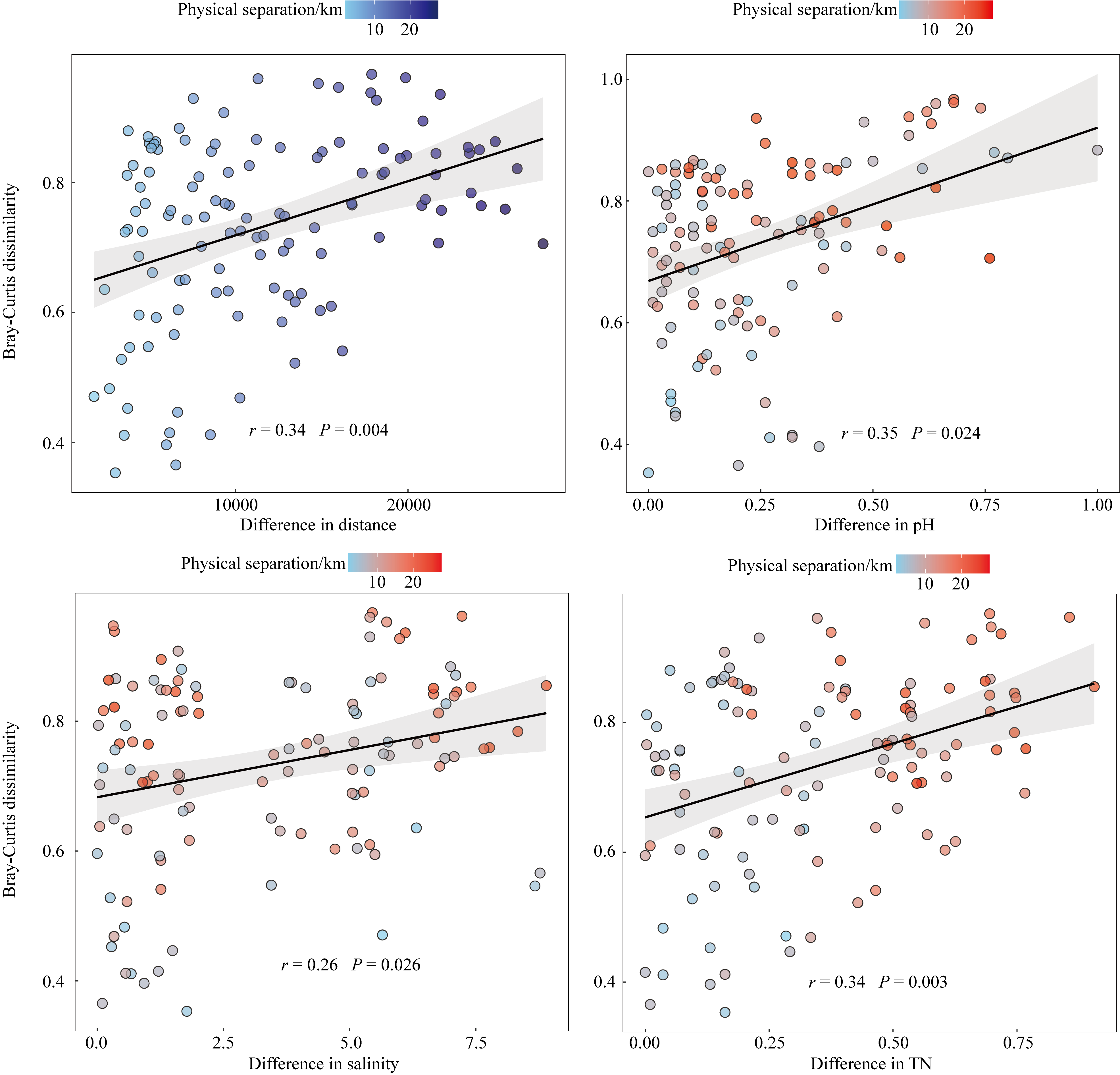
Fig. S3
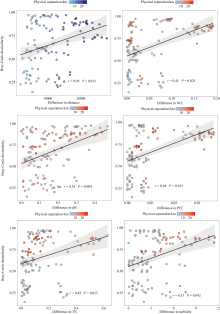
Fig. S4
Relationships between Bray-Curtis dissimilarity and geographical distance, pH, turbidity, $\text{PO}_{4}^{3-}$, $\text{NO}_{3}^{-}$, and TN in September. The black line represents the linear regression, r indicates the degree of correlation, and P-values were calculated to indicate significant differences"

Fig. S4
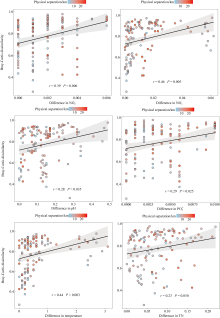
Fig. S5
Relationships between Bray-Curtis dissimilarity and temperature, pH, $\text{PO}_{4}^{3-}$, $\text{NO}_{3}^{-}$, $\text{NO}_{2}^{-}$, and TN in December. The black line represents the linear regression, r indicates the degree of correlation, and P-values were calculated to indicate significant differences"

Fig. S5
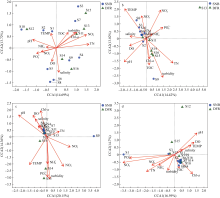
Fig. 4
Seasonal CCA biplots of invertebrate community composition and environmental variables in March (a), July (b), September (c), and December (d)"
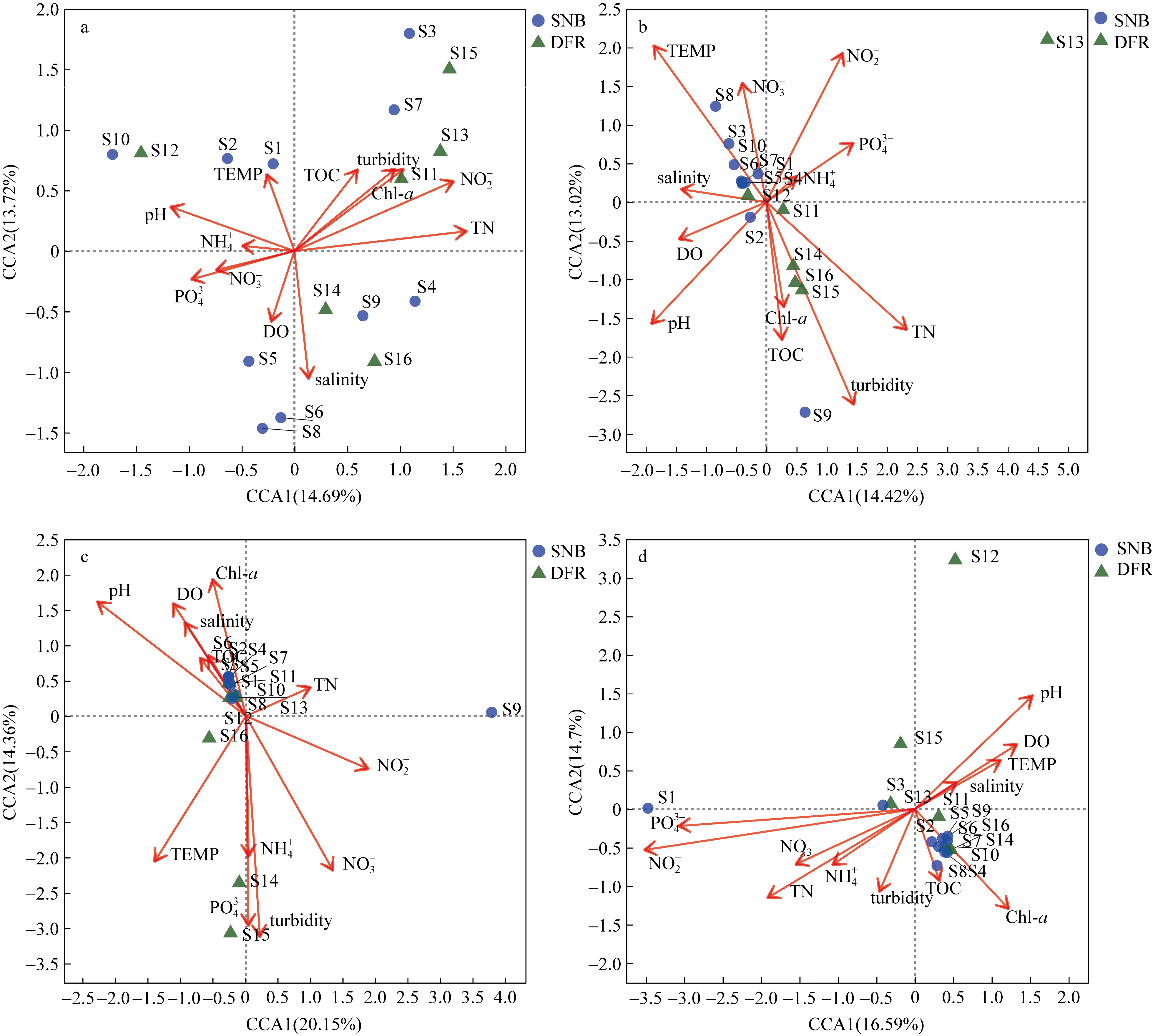
Fig. 4
Fig. 5
PLS-PM analysis of invertebrate communities responses to environmental variables in March (a), July (b), September (c), and December (d). Invertebrate community formation correlates well with seawater properties and nutritional factors, as indicated by strong model fit indices (R2 values between 0.876 and 0.956). Positive and negative interactions are represented by red and blue lines respectively. Solid lines denote significant interactions, while dashed lines indicate non-significant ones"
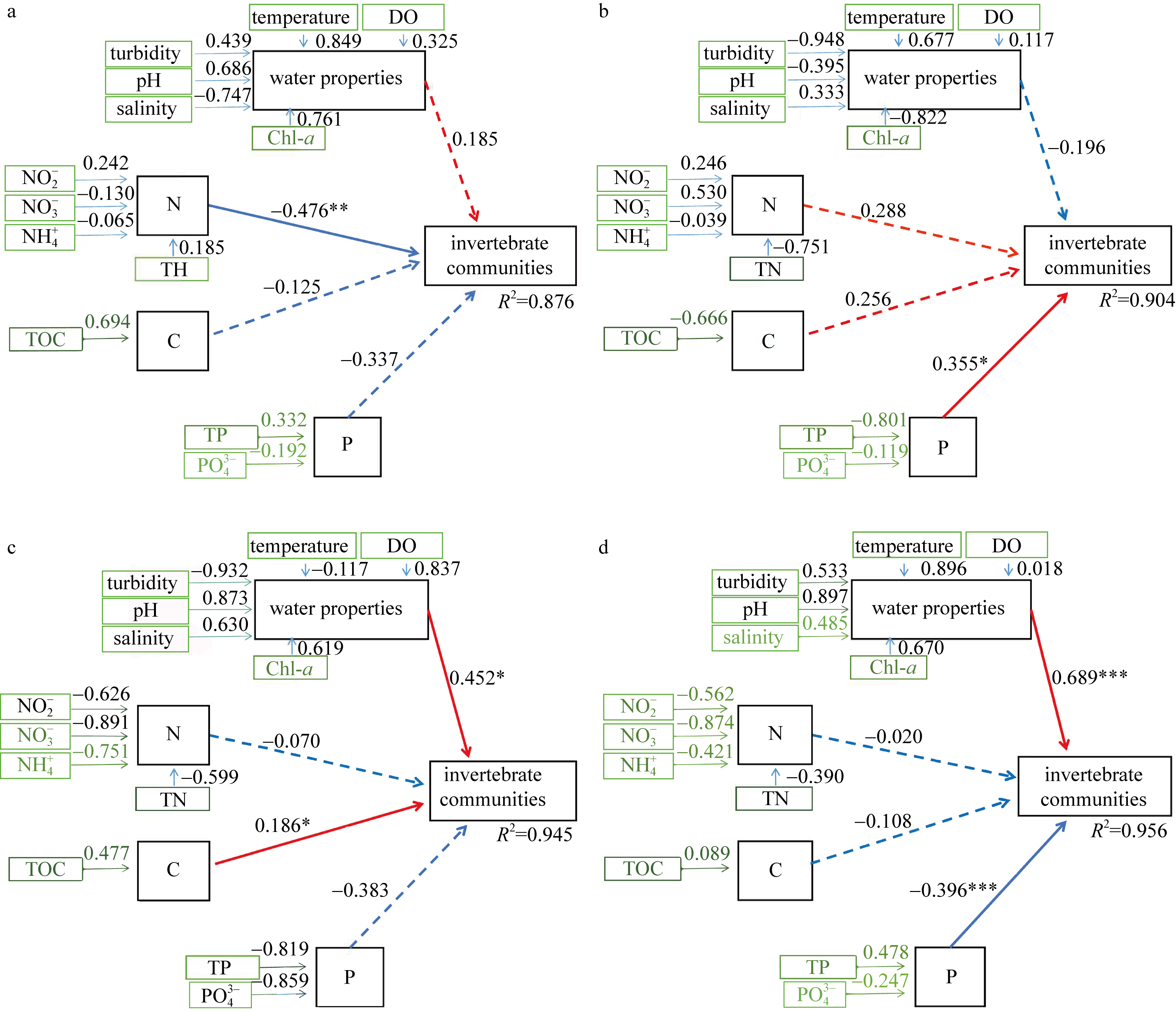
Fig. 5
Fig. S6
Heatmaps showing the relative abundance of top 20 invertebrate communities in March (a), July (b), September (c), and December (d) and Spearman's rank correlation of these communities with environmental factors (*P<0.05, ** P<0.01, *** P<0.001)"
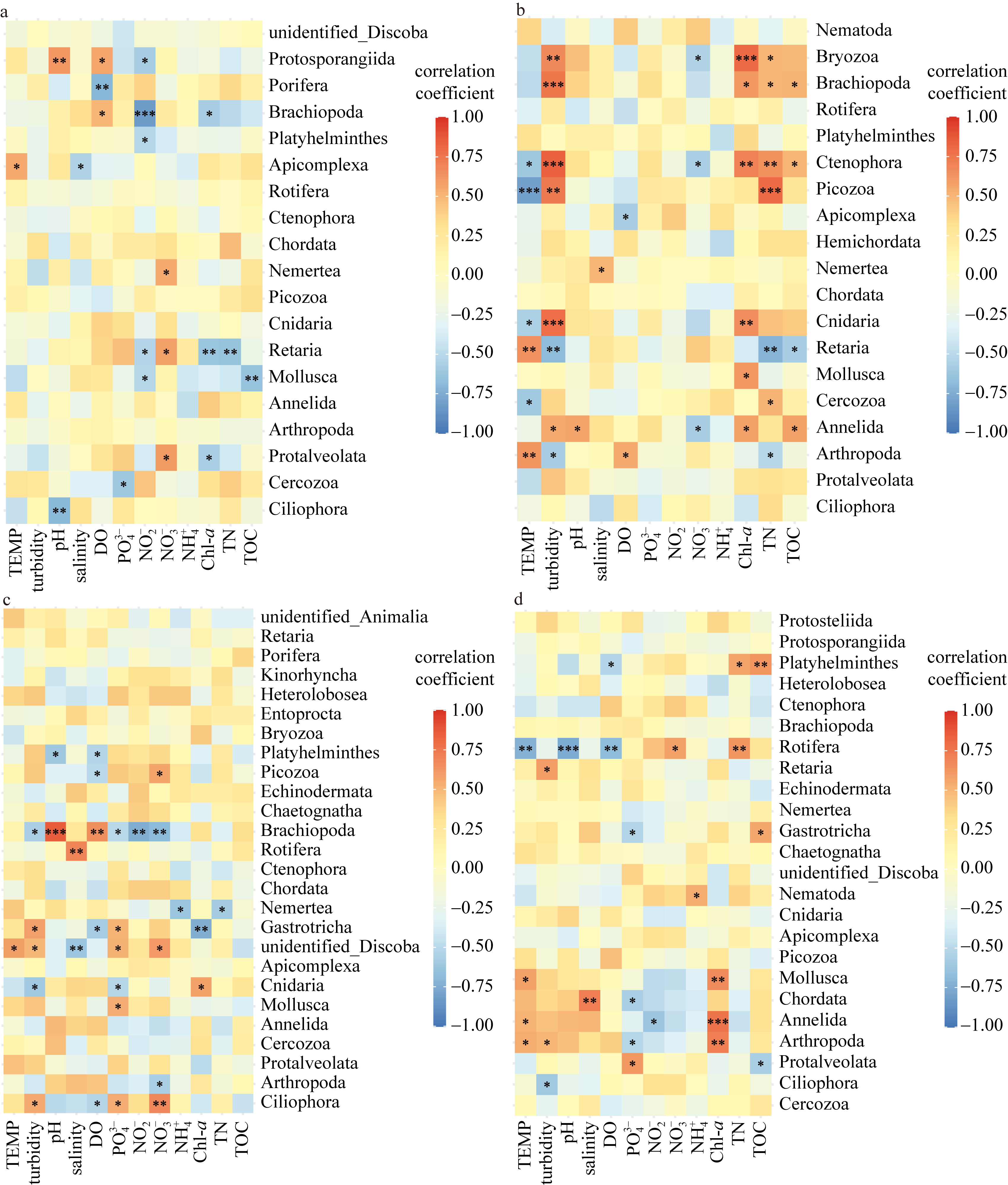
Fig. S6
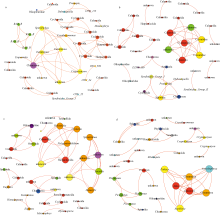
Fig. 6
The co-occurrence networks in invertebrate communities based on OTU analysis in March (a), July (b), September (c), and December (d). Node colors differentiate phyla in the network. Connections indicate strong (Spearman’s |r|>0.80) and statistically significant (FDR-adjusted P<0.05) correlations within the invertebrate community. Node size reflects the eigenvector centrality, representing each node’s influence in the network"

Fig. 6
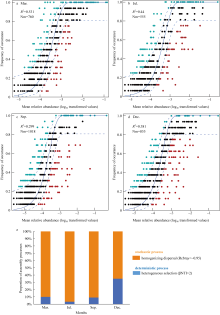
Fig. 7
Proportional influence of deterministic and stochastic processes on invertebrate community assembly. In Fig.a-Fig.d, blue dots: taxa above the neutral model prediction curve (stochastic process-dominated); black dots: taxa fitting the neutral model (neutral process-explained); red dots: taxa deviating from the neutral model (deterministic process-dominated). Nm is the product of metacommunity size (N) and migration rate (m), representing dispersal flux (alternatively, the effective number of migrants) to quantify the overall species dispersal capacity among communities"
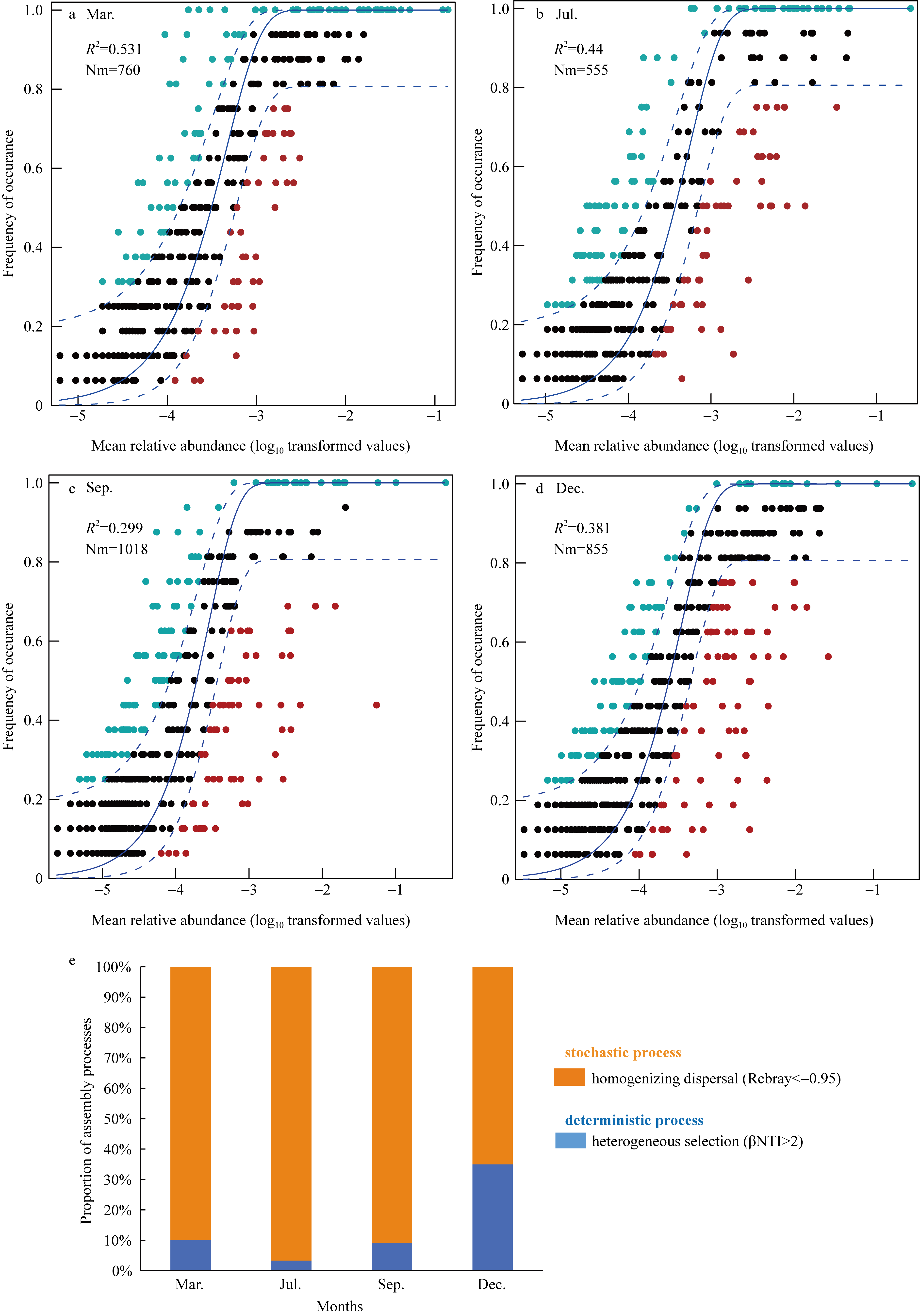
Fig. 7
| [1] |
贺成, 宋书群, 李才文, 2019. 广西北部湾海域球形棕囊藻囊体时空分布及其影响因素[J]. 海洋与湖沼, 50(3): 630-643.
|
|
|
|
| [2] |
蓝文陆, 李天深, 刘勐伶, 等, 2015. 钦州湾丰水期和枯水期浮游动物群落特征[J]. 海洋学报, 37(4): 124-133.
|
|
|
|
| [3] |
李连春, 廖文波, 吕海强, 等, 2010. 一座热带城市型水库浮游动物群落结构的特征[J]. 南方水产科学, 6(6): 32-40.
|
|
|
|
| [4] |
刘悦, 李丽, 翟晓辉, 等, 2022a. 深圳大鹏湾一次球形棕囊藻藻华的发生过程及成因分析[J]. 热带海洋学报, 41(3): 164-171.
|
|
|
|
| [5] |
doi: 10.1007/s10750-018-3593-0 |
| [6] |
doi: 10.1609/icwsm.v3i1.13937 |
| [7] |
doi: 10.1016/j.ecolmodel.2005.09.008 |
| [8] |
doi: 10.1038/s41396-019-0459-z |
| [9] |
doi: 10.1016/j.marpolbul.2022.113327 |
| [10] |
doi: 10.1111/jvs.2003.14.issue-6 |
| [11] |
doi: 10.1002/lom3.10237 pmid: 29937700 |
| [12] |
doi: 10.1038/ismej.2016.96 |
| [13] |
doi: 10.1002/imt2.13 pmid: 38868563 |
| [14] |
doi: 10.1007/s11356-018-3976-9 |
| [15] |
doi: 10.1016/j.soilbio.2022.108604 |
| [16] |
doi: 10.1093/ismeco/ycae007 |
| [17] |
doi: 10.1038/s41558-023-01630-7 |
| [18] |
|
| [19] |
|
| [20] |
|
| [21] |
doi: 10.3389/fmars.2021.806208 |
| [22] |
doi: 10.1016/j.jenvman.2024.121497 |
| [23] |
doi: 10.1093/bioinformatics/btq166 pmid: 20395285 |
| [24] |
doi: 10.1017/S0376892902000061 |
| [25] |
doi: 10.1016/j.ygeno.2011.05.009 pmid: 21651976 |
| [26] |
|
| [27] |
doi: 10.1002/aqc.v28.1 |
| [28] |
doi: 10.1007/s11802-022-5164-2 pmid: 35582547 |
| [29] |
doi: 10.1016/j.scitotenv.2019.135156 |
| [30] |
doi: 10.1016/j.marchem.2018.09.006 |
| [31] |
doi: 10.3389/fmars.2024.1416359 |
| [32] |
doi: 10.1016/j.ecoenv.2021.113009 |
| [33] |
|
| [34] |
|
| [35] |
doi: 10.1016/j.ecolind.2022.108695 |
| [36] |
doi: 10.1007/s11802-019-3630-2 |
| [37] |
|
| [38] |
doi: 10.1016/j.scitotenv.2022.157197 |
| [39] |
doi: 10.1038/s41598-023-30228-4 pmid: 36813945 |
| [40] |
doi: 10.1002/lno.v63.2 |
| [41] |
doi: 10.1016/j.ecolind.2022.108587 |
| [42] |
|
| [43] |
doi: 10.3390/microorganisms13081945 |
| [44] |
doi: 10.3390/ani12080950 |
| [45] |
doi: 10.1093/nar/gks1219 |
| [46] |
doi: 10.1023/A:1016509016852 |
| [47] |
doi: 10.1038/s41467-023-36241-5 pmid: 36732509 |
| [48] |
doi: 10.7717/peerj.2584 |
| [49] |
doi: 10.1186/s13104-016-1900-2 |
| [50] |
doi: 10.4319/lo.2007.52.5.2135 |
| [51] |
doi: 10.1146/annurev-marine-010814-015924 pmid: 27814033 |
| [52] |
doi: 10.1038/ncomms5114 pmid: 24916345 |
| [53] |
doi: 10.3389/fmars.2018.00387 |
| [54] |
doi: 10.1186/s40793-024-00630-0 pmid: 39501349 |
| [55] |
doi: 10.1016/j.chemosphere.2021.132770 |
| [56] |
doi: 10.1016/j.ecolind.2021.108355 |
| [57] |
doi: 10.1016/j.rsma.2017.12.009 |
| [58] |
doi: 10.1016/j.envpol.2019.113225 |
| [59] |
|
| [60] |
doi: 10.1111/geb.2016.25.issue-8 |
| [61] |
doi: 10.1016/j.envpol.2022.120386 |
| [62] |
doi: 10.1016/j.scitotenv.2021.150303 |
| [63] |
doi: 10.3389/fmicb.2023.1132925 |
| [64] |
doi: 10.1038/s41598-017-05312-1 pmid: 28684750 |
| [65] |
doi: 10.1111/1749-4877.12531 pmid: 33725414 |
| [66] |
doi: 10.1007/s10452-020-09816-3 |
| [67] |
doi: 10.1016/j.watres.2022.118057 |
| [68] |
doi: 10.1016/j.scitotenv.2022.154285 |
| [69] |
doi: 10.1016/j.envpol.2021.117256 |
| [70] |
doi: 10.1016/j.apsoil.2017.08.019 |
| [71] |
doi: 10.1080/02705060.2025.2501975 |
| [72] |
|
| [73] |
doi: 10.4319/lo.2009.54.1.0262 |
| [1] | JIA Suxiao, ZHANG Ruirui, WU Xiaoke, QIU Yueshan, LI Qiying, OU Haixu, SUN Guoling, CHANG Taoqi, XU Youhou, CAI Shuanghu. Analysis of bacterial diversity and environmental factors in the Pearl Bay Trachinotus ovatus Linnaeus aquaculture area [J]. Journal of Tropical Oceanography, 2026, 45(4): 63-76. |
| [2] | LIN Liru, ZHUANG Wei. A study on the differential impacts of ENSO and IOD on the interannual air temperature variability over Sri Lanka* [J]. Journal of Tropical Oceanography, 2026, 45(1): 105-116. |
| [3] | NIU Haoran, WANG Xidong, GAO Zhenbo, CHEN Zhiqiang. Domestic satellite sea surface temperature data fusion based on successive corrections* [J]. Journal of Tropical Oceanography, 2025, 44(6): 1-11. |
| [4] | LI Lin, WANG Xidong, HE Zikang, CHEN Zhiqiang, CAO Yuan, LIU Kefeng, CHEN Jian. Three-dimensional eddy structure reconstruction in the Northwest Pacific using variational method and satellite sea surface data [J]. Journal of Tropical Oceanography, 2025, 44(5): 39-49. |
| [5] | OU Jiaming, WANG Shuhan, ZHAO Xu, CHEN Jianqu, SUN Jianing, ZOU Qiao, WANG Kaiyi, ZHANG Shouyu, WANG Kai. Response of photosynthetic activity to temperature rise and light quality of four intertidal macroalgae from Lühua Island, Zhejiang, China [J]. Journal of Tropical Oceanography, 2025, 44(3): 72-84. |
| [6] | ZHOU Xiangrun, WANG Ying, ZHI Hai. Distribution characteristics and mechanism of the Northwest Pacific marine heatwaves in the summer of 2022* [J]. Journal of Tropical Oceanography, 2025, 44(1): 82-92. |
| [7] | ZHOU Zhixi, TANG Huijuan, KE Zhixin, LIU Jiaxing, ZHOU Weihua. Phytoplankton community structure and its relationship with environmental factors in the spring coastal region of Nan’ao based on morphology and high-throughput sequencing [J]. Journal of Tropical Oceanography, 2025, 44(1): 53-65. |
| [8] | JIANG Rouyun, JIAN Lili, SHI Songbiao, TIAN Xinpeng. Diversity of culturable bacteria in the sedimentary sands of the Meiji Reef [J]. Journal of Tropical Oceanography, 2024, 43(6): 170-180. |
| [9] | SUN Zeming, HAN Shuzong, WANG Mingjie, SU Hanxiang. Statistical study on the influence of typhoon with different path on the temperature of coastal waters of China [J]. Journal of Tropical Oceanography, 2024, 43(5): 17-31. |
| [10] | QI Huandong, ZHU Cheng, LI Xuchun, JING Xindi, SONG Derui. Rule set and multilayer perceptron based quality control method for Argo temperature data* [J]. Journal of Tropical Oceanography, 2024, 43(5): 190-202. |
| [11] | LIN Guihuan, YAN Youfang, LIU Ying. Ocean stratification in the Indonesian-Australian basin and its influencing factors [J]. Journal of Tropical Oceanography, 2024, 43(4): 57-67. |
| [12] | MO Danyang, NING Zhiming, YANG Bin, XIA Ronglin, LIU Zhijin. Response of dissimilatory nitrate reduction processes in coral reef sediments of the Weizhou island to temperature changes [J]. Journal of Tropical Oceanography, 2024, 43(4): 137-143. |
| [13] | JIA Nan, ZHOU Tiancheng, HU Simin, ZHANG Chen, HUANG Hui, LIU Sheng. Difference in the feeding contents of three hermit crabs in the coral reefs of the Nansha Islands, South China Sea [J]. Journal of Tropical Oceanography, 2024, 43(3): 109-121. |
| [14] | LIN Xianzhi, ZHOU Yanyan, LIN Haoye, HU Simin, HUANG Hui, ZHANG Li, LIU Sheng. Diet analysis of the parrotfish (Scarus globiceps) in coral reefs of the Nansha Islands [J]. Journal of Tropical Oceanography, 2024, 43(3): 100-108. |
| [15] | HUANG Yuan, CEN Jingyi, LIANG Qianyan, LYU Songhui, WANG Jianyan. Study on the community structure of eukaryotic phytoplankton in the Shenzhen Bay based on high-throughput sequencing technology [J]. Journal of Tropical Oceanography, 2024, 43(2): 21-33. |
|
||